Asymmetry

Polyhedron2

In Manila, Pope Francis returned to a concept that he first introduced in Evangelii Gaudium – that of the polyhedron being the ideal of social interaction instead of the, seemingly more perfect, sphere. There, speaking about “ideological colonization,” he said:

“[W]hen conditions are imposed by […] colonizing empires they seek to make peoples forget their own identity and make them (all) equal. This is the globalization of the sphere – all the points are equidistant from the center. But the true globalization […] is not the sphere. It is important to globalize […] not like the sphere, but like the polyhedron. Namely that every people, every part, conserves its own identity without being ideologically colonized.”

To make more sense of the sphere-polyhedron distinction, let’s go back to Evangelii Gaudium, where it is presented in the context of strategies for contributing to the common good and peace in society. There, Francis gives preference to time over space (§222-225), unity over conflict (§226-230), realities over ideas (§231-233) and finally the whole over the part. However, he is quick to argue that the part is not negated or subsumed in the whole, but that they mutually enrich each other (§235):

“The whole is greater than the part, but it is also greater than the sum of its parts. There is no need, then, to be overly obsessed with limited and particular questions. We constantly have to broaden our horizons and see the greater good which will benefit us all. But this has to be done without evasion or uprooting. We need to sink our roots deeper into the fertile soil and history of our native place, which is a gift of God. We can work on a small scale, in our own neighborhood, but with a larger perspective. Nor do people who wholeheartedly enter into the life of a community need to lose their individualism or hide their identity; instead, they receive new impulses to personal growth. The global need not stifle, nor the particular prove barren.”

And it is in the context of how the whole and its parts can be thought of without the former stifling the latter that the concept of the polyhedron comes into play (§236):

“Here our model is not the sphere, which is no greater than its parts, where every point is equidistant from the centre, and there are no differences between them. Instead, it is the polyhedron, which reflects the convergence of all its parts, each of which preserves its distinctiveness. Pastoral and political activity alike seek to gather in this polyhedron the best of each. There is a place for the poor and their culture, their aspirations and their potential. Even people who can be considered dubious on account of their errors have something to offer which must not be overlooked. It is the convergence of peoples who, within the universal order, maintain their own individuality; it is the sum total of persons within a society which pursues the common good, which truly has a place for everyone.”

Reading the above, I believe, that the image of a polyhedron also points to another fundamental feature, implicit in the distinction between sphere and polyhedron, which is that of asymmetry.

Purely on geometric grounds, an obvious distinction between a sphere and any polyhedron is that the former abounds in symmetry: an infinity of rotation symmetries around the sphere’s center, an infinity of reflection symmetries with respect to any plane containing the sphere’s center and a central point symmetry, also with respect to its center, not to mention a host of other symmetry groups. On the other hand, a polyhedron, in general, has no guaranteed symmetry whatsoever, where each of its vertices may relate to all the others in a unique way and where even subsets of the polyhedron’s vertices may form geometries distinct from those of other vertex subsets. As a result, the polyhedron formed by a set of vertices, edges and faces is both a unique whole and one whose nature depends on where each one of its components is located, potentially without any symmetry at all. In fact, the absence of symmetry can also be though of as an expression of the non-redundancy of the polyhedron’s parts, since any, even partial symmetries or repetitions would allow for a representation of the polyhedron that no longer requires a reliance on all of its parts. The sphere here represents an extreme, where the infinite continuum of points that form its surface can be reduced just to the coordinates of its center and its radius. Incidentally this line of thinking also resonates with Pope Francis’ early insistence on the importance of peripheries, expressed by him saying that “We understand reality better not from the center, but from the peripheries.” To understand a polyhedron requires traversing its vertices, edges and faces that form its perimeter, while a sphere can be “understood” from its center and radius, since its surface can be inferred from them, without ever being traversed.

Asymmetry not only means that each member is necessary for the identity of the resulting whole, but it is also a principle that is deeply embedded in Jesus’ life and teaching. His incarnation itself is vastly asymmetrical, since it is the infinite, unbounded God making Himself spatiotemporally finite, as is His death on the cross, where his one life is given “so that everyone who believes in him might not perish but might have eternal life.” (John 3:16). The all becomes one to save the many.

Jesus’ teaching too is full of asymmetry, starting with the following, emphatic passage:

“But to you who hear I say, love your enemies, do good to those who hate you, bless those who curse you, pray for those who mistreat you. To the person who strikes you on one cheek, offer the other one as well, and from the person who takes your cloak, do not withhold even your tunic. Give to everyone who asks of you, and from the one who takes what is yours do not demand it back.” (Luke 6:27-30)

In St. Matthew’s account of the same speech, we then hear Jesus adding: “If anyone wants to go to law with you over your tunic, hand him your cloak as well. Should anyone press you into service for one mile, go with him for two miles.” (Matthew 5:40-41).

Love-hate, bless-curse, pray-mistreat, strike-offer, take-give, tunic-tunic+cloak.

And the madness doesn’t stop there! The asymmetrical rewards offered in the parable of the workers in the vineyard have those who have worked a full day complain to the owner: “These last ones worked only one hour, and you have made them equal to us, who bore the day’s burden and the heat.” (Matthew 20:12). The pittance offered by a poor widow is valued above the large sums contributed by the rich (cf. Mark 12:41-44) and asymmetry is also at the heart of Jesus’ exhortation to “be shrewd as serpents and simple as doves” (Matthew 10:16).

Not only are action and reaction, action and reward asymmetrical, but asymmetry is at the very heart of God’s own inner life and at the core of love as such. The gratuity of love and the very concept of a gift hinge on asymmetry. I give without expecting anything in return, for if I did, my gift would not be a gift at all, but – at least implicitly – an exchange, a transaction, a symmetrical process. In the Trinity the Father gives all of Himself to the Son, without holding back or without requiring prior guarantees of equal recompense. The Son too gives Himself to the Father unreservedly and totally, making Himself nothing to Himself and all as gift to the Father. The Holy Spirit makes Himself empty unconditionally to allow for the love of the Father and the Son to find space in Him. Each Person of the Trinity is ultimately asymmetrical: a gift of self outside oneself, for the other; nothing and everything. It is only on this asymmetry that Father, Son and Holy Spirit are one – a one that is dynamic (instead of being static), varied (instead of being monotonous) and communion (instead of being regimented).

A consequence of the asymmetry of love is also a difference in what to expect of oneself versus others. For my actions to be gratuitous and an expression of love, their end must remain their being love, gift and a benefit for the other. If they get reciprocated, my neighbor and I share in the life of the Trinity and we become one without either of us being annihilated.

I believe it is for these same reasons that St. John Paul II used to say: “Be strict to yourself and lenient with everyone else.” and that I choose to constrain what I say and do, out of love for my neighbors, without wanting to impose those same constraints on them. For by imposing them, I would preclude them from freely choosing to self-apply them out of love for me.

Jesus the blasphemer

After the Charlie Hebdo attack, I was struck by a tweet from the Protestant theologian and Yale professor, Miroslav Volf:

“Jesus was crucified for “blasphemy.” Blasphemers should not be crucified, or killed, or punished in any way.”

This assertion of Jesus having been a blasphemer stopped me in my tracks, as I have never thought of him in that way. Good Shepherd, Son of God, Paschal Lamb, and Word Made Flesh would ring a bell, but not Blasphemer. Then, I started thinking about all the offense Jesus has caused during his lifetime: fraternizing with tax collectors and prostitutes (cf. Luke 5:27-32), healing the sick on the Sabbath (cf. Mark 3:1-6), having his disciples eat corn without washing their hands (cf. Mark 7:2), making ludicrous claims about rebuilding the temple in Jerusalem in three days (cf. John 2:19), and even his death on a cross was perceived as a scandal (cf. 1 Corinthians 1:23) … And how did his listeners react? Exactly as Pope Francis suggested recently – with threats and violence, to the point of dragging Jesus to the edge of a cliff and wanting to throw him to his death (cf. Luke 4:29), or to making him fear for his life to the point of deciding to hide from the people he scandalized and who were about to stone him (cf. John 8:59).

Suddenly adding blasphemy to the list doesn’t seem like such a stretch, and in fact the Gospel accounts of Jesus’ trial clearly state that this was the charge brought against him.

When questioned by the Sanhedrin during the night at the start of Good Friday, the high priest commanded Jesus: “I order you to tell us under oath before the living God whether you are the Messiah, the Son of God.” (Matthew 26:63), to which Jesus responded: “You have said so. But I tell you: From now on you will see ‘the Son of Man seated at the right hand of the Power’ and ‘coming on the clouds of heaven.’” (Matthew 26:64). Jesus’ words then triggered the following scene:

““Then the high priest tore his robes and said, “He has blasphemed! What further need have we of witnesses? You have now heard the blasphemy; what is your opinion?” They said in reply, “He deserves to die!” (Matthew 26:65-66)

The determination of Jesus’ blasphemer status is then presented to Pilate by his accusers as the grounds for having the secular powers of the Roman Empire put him to death: “We have a law, and according to that law he ought to die, because he made himself the Son of God.” (John 19:7)

The above may seem pretty cut-and-dried, but, like all legal arguments, it too is just that – arguable. Here the New American Bible has the following, interesting note on Jesus’ blasphemy, as a commentary on the passage about his hearing before the Sanhedrin:

Blasphemed: the punishment for blasphemy was death by stoning (see Leviticus 24:10–16). According to the Mishnah, to be guilty of blasphemy one had to pronounce “the Name itself,” i.e., Yahweh […]. Those who judge the gospel accounts of Jesus’ trial by the later Mishnah standards point out that Jesus uses the surrogate “the Power,” and hence no Jewish court would have regarded him as guilty of blasphemy; others hold that the Mishnah’s narrow understanding of blasphemy was a later development.”

The spirit of what Jesus said certainly qualified as blasphemy, while the letter may have been arguable. Nonetheless, this guy, who was going around Galilee and Judea, telling everyone he was the Son of God, was guilty – a blasphemer! – and had to be killed. It’s the law. The Bible say so …

Now, you may ask yourself, where am I going wit all of this? And that brings us to Charlie Hebdo and other brutal murders of those who speak out against oppressors of free speech, whether they be religious or atheist regimes (and, sadly, there are plenty of examples of both, both in the present and the past). In the case of Charlie Hebdo too we have a bunch of blasphemers, depicting what the law decries as insulting and blasphemous, and law-abiding believers doing their bit for the law’s just punishment being meted out.

Is what the Charlie Hebdo murderers have done consistent with how the vast majority of Muslims understand Islam? Is what Charlie Hebdo have been publishing detestable, crude and inciting of hatred?

Regardless of how those questions are answered (and I’d say “no” and “in some cases, yes”), the first order of business has to be a defense of the freedom of speech – and not just the freedom of “good” speech. Is this an argument for all speech being equal? Absolutely not! And neither is it an expression of support for what publications like Charlie Hebdo have been doing. Instead it is an insistence on the absolute value of free speech. And once that is given, arguments against expressions like Charlie Hebdo can be made (and must be made). Arguments to convince their listeners and readers of such offensive expressions being contrary to the common good, risking an angry (albeit wrong!) response, and not being the most efficacious ways of fighting against oppression, corruption or bigotry. But these must be arguments made on the foundation of free speech where its limiting to “good” free speech becomes a choice of the individual and not the imposed dictate of a legislative regime that is enforced at all cost, including the administration of death.

Making freedom of speech about “good” speech turns it into its opposite, as is clear both from fictional (although chillingly prophetic) accounts like George Orwell’s 1984 and the enforced superficial innocuousness of public speech in 20th century communist regimes, where everything was wonderful, according to plan, fraternal and equal. Unless you made fun of it that is … in which case you’d qualify for a “Golden Bars” award (bars that were not golden, but embedded in prison walls instead). And the distortions of political correctness that grip many countries today are a scarily similar phenomenon. Only two days ago did I hear the following here in the US, in response to showing a historical photo of a Native American during a presentation to illustrate that a certain process was native to its context: “Um … You should be careful about saying “native.” It is a very sensitive term here. Saying Red Indian or chief or similar can be offensive. Some sports teams here have already changed their names not to offend.” My colleague then proceeded to tiptoe around such a sensitive topic and ended up using the term “native” as a non-offensive way of referring to this whole faux pas of mine – the exact term that initially triggered the friendly advice.

Freedom of speech is clearly a complex question and it is easy to come up with examples of things that shouldn’t be said (e.g., racist slurs), that shouldn’t be made fun of (e.g., genocide), that should not be promoted (e.g., violence or exploitation). And I would unquestionably agree with that and support very specific, narrow constraints on freedom of speech. However, the easy solution of criminalizing whole categories of verbal expression brings with it great dangers in that those same legal instruments may be abused for very different ends. The extremes here are totalitarian regimes that criminalize any criticism of themselves and that consider any such criticism an offense against the common good that their leaders embody. In our democratic societies too there are dangers, where governments have been prone to overstep their remits and where legislation to prevent terrorism has enabled infringements of privacy and the gagging or undermining of critical voices. A society that cannot handle hearing ideas it disagrees with will eventually descend into fear and caution, rendering speech lukewarm. Speech that becomes barely worthy of being spat out.

I am therefore wholeheartedly with Volf: “Blasphemers should not be crucified, or killed, or punished in any way.” Instead, they should be challenged and engaged with in the same free speech context they employ and, who knows, maybe such engagement (instead of a silencing by law or bullets) could let all discover each other’s brothers and sisters on the other side of the argument.

Peppuccio: being by not being

Peppuccio

Today, at the age of 85, the man who has helped me most with understanding God has gone to be with Him. Giuseppe Maria Zanghí, known simply as Peppuccio to all who met him (the Italian diminutive for Joseph that in English would be rendered as Joey), was a follower and close collaborator of Chiara Lubich, whose process of beatification is completing its diocesan phase and transferring to the Vatican on Tuesday.

Peppuccio’s philosophical genius will, I am certain, provide the basis for a deeper understanding of God for many generations to come. His insights into the fundamental interconnectedness of being and not being as the key to love and to an intuition of the value of suffering are akin to Einstein’s theory of relativity in that they turn all that came before on its head, while, at the same time, being a superset of it. Having had the privilege to listen to him speak and to get to know him personally a little has been a great gift for me and I will never forget meeting him again last May, after not seeing him for many years. By that time he had become a frail, old man, whose former steel had given way to the warmth of a kindly grandfather. I will never forget his recognizing me and caressing my face like my own grandfather used to.

Dearest Peppuccio, I will miss you very much! Thank you for all you have taught me!

Instead of telling you more about his extraordinary life, I prefer to translate for you an excerpt from a paper he wrote in 1979, entitled “Identity and dialogue,” so that you may get a flavor of his extraordinary thought directly.

In this paper Peppuccio considers the challenges and seeming opposition of the concepts of individual identity on the one hand and of dialogue on the other. Let’s join Peppuccio’s train of thought at the point where he presents how God loves us without possessing us, after having presented profound analyses of both identity and dialogue in isolation:

“I can be myself in Him (being an intimate participant of Trinitarian life in the Word), while being really distinct from Him (by virtue of being a creature different from Him). It is His love that wants me, and the love of God does not withdraw into itself, canceling diversity with the other by totally reverting it to Himself, but “makes” the other and guards them in diversity from Himself, not wanting to possess (like He doesn’t possess Himself) in total reabsorption.

And also those who are other than me, the other, or other subjects, are really different from me, because they are “guarded” in the diversity of God, and yet we are one because we are all seized by the same movement of God’s love.”

Peppuccio here roots our diversity-preserving union with God and our own relationships with others in His own inner life, where God’s relationship of love to all is the basis of our own diversity-preserving union with them. He then spells out the consequences of a departure from this many-but-one life:

“If I remove myself from the ecstasy of love, the ecstasy of being, my identity will experience an infinite regress, and I loose myself in the abyss of a nothing that, not being the “nothing” of the Love that wants me ecstatically, is a nothing that is not real, it is nothing-nothing … And community with others will be a collision and a negation and a distancing to infinity. The peace that is Love is replaced by the war that is hatred.”

Note that ecstasy in the above is best read in the Ancient Greek philosophical sense of ἔκστασις (ekstasis), “to be or stand outside oneself, a removal to elsewhere,” since it refers to the self-giving, self-othering nature of love. Removing oneself from the ecstasy of love means retreating into oneself, while God’s love for me being ecstatic underlines His going out of Himself for my sake.

Peppuccio then proceeds to sketch out the Christian approach to relating to others, as a departure from the self-constrained, static nothingness resulting from a withdrawal from ecstatic relationships:

“The Christian revelation has ripped through this way of thinking and of being socially structured from the inside. But we are still far, it seems to me, from having understood this clearly and from having draw practical conclusions from it. It is true, in modern thought duality has been made more dynamic with dialectic. But the logic of confrontation and struggle has not been overcome. Because the relationship between the two “opposing” extremes (I and the other, I and God) is still thought of as ending in one of the two (and, therefore, in the strongest!); while, if Christian faith is true, the relationship does not end in either of the mediated extremes, but in a third that saves them precisely in their diversity. The relationship between two, if it wants to be thought and lived in the logic of God, must be torn from pure (and abstract) symmetry and discovered, as it were, in the asymmetry of a third that “transforms” the opposition into agreement, the conflict into peace.”

What is apparent from the above is God’s intrinsic role also in human relationships as the asymmetry that allows for unity in diversity, which very much also prefigures Pope Francis’ insistence in Evangelii Gaudium (§236) that the Church, and society too, ought to be modeled on the polyhedron (where diverse parts preserve their distinctiveness while converging to form one whole) rather than the sphere (where there is total uniformity).

Peppuccio finally leads the above considerations towards reciprocity and freedom in a masterful synthesis:

“In the relationship with God, this means living the relationship with Him, diversity, within Him, in Tri-unity.

In the relationship with others, it means “allowing” for God to be among the many, as the “third asymmetrical,” so to speak. This Presence among the many makes diversity true, uniting it without annulling it. This applies to my relationship with myself. It applies to my relationship with the other and with others. Diversity is experienced as love, identity is experienced as love: diversity is experienced as identity, and vice versa. I am me in the infinite, and absolute, gift of myself: in the diversity of me with myself, experienced not as laceration but as ecstatic love. The other, whoever they are, is my giving myself made person, real because giving myself is real. And reciprocally. Without reciprocity what I say here is suffered as an impossibility that must become, but still is not, possible. History, after all, is the path towards a realization of the necessity of this reciprocity so that everyone may be themselves!

From this dialectical perspective “as three,” identity and dialogue are the same thing: they are the love by which I am myself insofar as I am not myself. They are the sign of that freedom-love which is, if I may say so, the secret of being.”

Reciprocal ecstasy, a mutual being outside oneself, for the other, as a gift for each other, bring identity and dialogue together in love, and, if I too may say so with Peppuccio, are the secret of being.

Thank you, Peppuccio, for your wisdom and love!

The Parable of the Good Lesbian

Good samaritan

A very good friend of mine, MK, wrote the following on Facebook a couple of days ago: “I think that if Jesus was telling the parable of the good Samaritan today, maybe it would be the parable of the good gay.” And, as soon as I saw it, I “liked” it, since it seemed to fit Jesus’ choice of profile for that particular parable character like a glove – i.e., as someone who is frowned upon, mistrusted and seen as repulsive by “good” God-fearing folk, and with whom there is an us-versus-them that needs to be undermined.

A short while later I noticed that MK’s Facebook status had received 43 comments, dominated by outrage, exhortations to read St. Paul (undoubtedly a good idea, and one, which that comment’s author should also self-apply) and a bandying-about of phrases like “the truth of Christ” (as if there were different flavors of truth). There were also reasonable comments, but these formed a small minority among the sea of tirades that followed the outrageous suggestion that homosexuals could be thought of as today’s equivalent of first-century Judea’s Samaritans.

My immediate reaction to seeing this was to look more closely at the Good Samaritan parable and get a sense of how well founded MK’s suggestion for its contemporary adaptation is – not so much for the sake of assessing its reasonableness (which had intuitive appeal to me from the start), but to get a more specific sense of its context and exegesis.

To get an idea of how Jews and Samaritans got on with each other, Blessed John Henry Newman provides the following summary, after giving an account of mutual killings between the two peoples:

“[… T]he strongest expression of hatred the Jews could invent against Christ was ‘Thou art a Samaritan and hast a devil’ (John 8:48). [… I]f a Jew and a Samaritan met in a narrow way, they were particularly careful to avoid touching each fearing to receive pollution from the other.”

Saying “Samaritan” in the first century AD to an audience of Jewish lawyers (as Jesus – and, lets not forget, himself a Jew, did), seems to have been the same kind of trigger as saying “gay” is today to my friend’s “Christian” contacts. 1:0 to MK – the glove does indeed seem to fit.

Let me next take a look at how the last three popes have read this parable and see whether that sheds light on the transposition proposed by my friend.

St. John Paul II spoke at length about the Parable of the Good Samaritan in his apostolic letter on suffering, Salvifici Doloris (§28):

“The parable of the Good Samaritan belongs to the Gospel of suffering. For it indicates what the relationship of each of us must be towards our suffering neighbour. We are not allowed to “pass by on the other side” indifferently; we must “stop” beside him. Everyone who stops beside the suffering of another person, whatever form it may take, is a Good Samaritan. This stopping does not mean curiosity but availability. It is like the opening of a certain interior disposition of the heart, which also has an emotional expression of its own. The name “Good Samaritan” fits every individual who is sensitive to the sufferings of others, who “is moved” by the misfortune of another. If Christ, who knows the interior of man, emphasizes this compassion, this means that it is important for our whole attitude to others’ suffering. Therefore one must cultivate this sensitivity of heart, which bears witness to compassion towards a suffering person. Some times this compassion remains the only or principal expression of our love for and solidarity with the sufferer.

Nevertheless, the Good Samaritan of Christ’s parable does not stop at sympathy and compassion alone. They become for him an incentive to actions aimed at bringing help to the injured man. In a word, then, a Good Samaritan is one who brings help in suffering, whatever its nature may be. Help which is, as far as possible, effective. He puts his whole heart into it, nor does he spare material means. We can say that he gives himself, his very “I”, opening this “I” to the other person. Here we touch upon one of the key-points of all Christian anthropology. Man cannot “fully find himself except through a sincere gift of himself” (Gaudium et Spes, 24). A Good Samaritan is the person capable of exactly such a gift of self.”

What strikes me here immediately are two things: first, the deep-seated universality of St. John Paul II’s words, addressed to “each of us,” “everyone,” “every individual,” where “Good Samaritan” status is predicated only on one’s capacity for “a gift of self.” Second, the imperative nature of his words which insist both on what we must do (being sensitive to, moved by and helping our suffering neighbors; being compassionate and self-giving) and what we are not allowed to do: be indifferent. This exegesis too easily extends to homosexuals, who are undoubtedly in a position of showing compassion to those around them and of selflessly coming to their aid.

Pope Benedict XVI adds further clarity to this universally-predicated imperative to love, in his exceptional piece of thinking: the encyclical Deus Caritas Est:

“14. […] Union with Christ is also union with all those to whom he gives himself. I cannot possess Christ just for myself; I can belong to him only in union with all those who have become, or who will become, his own. […] We become “one body”, completely joined in a single existence. Love of God and love of neighbour are now truly united: God incarnate draws us all to himself. […] the “commandment” of love is only possible because it is more than a requirement. Love can be “commanded” because it has first been given.

15. This principle is the starting-point for understanding the great parables of Jesus. […] The parable of the Good Samaritan (cf. Lk 10:25-37) offers two particularly important clarifications. Until that time, the concept of “neighbour” was understood as referring essentially to one’s countrymen and to foreigners who had settled in the land of Israel; in other words, to the closely-knit community of a single country or people. This limit is now abolished. Anyone who needs me, and whom I can help, is my neighbour. The concept of “neighbour” is now universalized, yet it remains concrete. Despite being extended to all mankind, it is not reduced to a generic, abstract and undemanding expression of love, but calls for my own practical commitment here and now. The Church has the duty to interpret ever anew this relationship between near and far with regard to the actual daily life of her members.”

For me, the most significant aspect of this passage is Benedict’s insistence on love being a commandment and on the justification of its imperative status being the precedent of God’s love. Since the source of this “obligation” to love is inexhaustible, its scope too is universal (as St. John Paul II already made clear). Furthermore, Benedict also calls for a keeping current of what such universality means in the present. This is very much in line with the current process of discernment underway in the Catholic Church, which is on the road to the second Synod on the Family this October. Specifically, the challenges of how to provide opportunities for homosexuals to feel part of the Church are on the table there too, which is easily read as an instance of Benedict’s “interpret[ing] ever anew this relationship between near and far.”

Finally, let’s hear what Pope Francis has to say about this parable:

“The Gospel passage from St Luke (10:25-37) tells of a certain man, half dead, who had been thrown into the street. Now by chance a priest was going down that road. A good priest, in his cassock: good, very good. He saw him and looked: I’ll be late for Mass, and he went on his way. He didn’t hear the voice of God there”. […] It is curious to note that only a man who habitually fled from God, a sinner, the Samaritan, was the very one who perceived the voice of God. He drew near to the man. He bound up his wounds, pouring on oil and wine; then he set him on his own beast. Oh how much time he lost: he brought him to an inn, and took care of him. He lost the whole evening! In the meantime, the priest arrived in time for the Holy Mass and all the faithful were content.

Why did the priest flee from God? Because his heart was closed. When your heart is closed you cannot hear the voice of God. Instead, it was a Samaritan on a journey who saw the wounded man and had compassion. His heart was opened, he had a human heart. His humanity enabled him to draw near.

The priest had a plan for his life: he wanted to write his own history well, according to God’s ways. But he was the one writing it. However, this other sinner allowed God to write the history of his life. He changed all his plans that evening because the Lord placed before him this poor, wounded man who had been thrown out onto the street.

I ask myself and I also ask you: do we allow God to write the history of our lives or do we want to write it? This speaks to us of docility: are we docile to the Word of God? Yes, I want to be docile, but are you able to listen to his Word, to hear it? Are you able to find the Word of God in the history of each day, or do your ideas so govern you that you do not allow the Lord to surprise you and speak to you?”

What strikes me here is the supremacy of openness over righteousness. Making oneself the ultimate judge (+ jury & executioner), instead of opening oneself up to discerning the will of God and listening to the promptings of the Holy Spirit through one’s conscience, leads to a spoiling even of things that are good in themselves and to an assumption of ultimate power by an imperfect subject. Instead, the admission of sinfulness, that Pope Francis (and before him the saints universally) has made for himself and that each one of us can recognize in our own lives, if we are sincere enough, helps us both to recognize brothers and sisters in all, without exception, and to open ourselves up to God’s surprises.

In continuous search of the other

Complementarity

Just under a month ago, from 17th to 19th November, the Humanum conference on the “Complementarity of Man and Woman” took place at the Vatican, hosted by the Congregation for the Doctrine of the Faith. There thirty speakers from around the world belonged to various religions, including Hinduism, Buddhism, Islam and Christianity of various kinds, and the talks were wide ranging in the aspects of the family they addressed, reaching far beyond the titular question of complementarity.

In this post I would, however, like to zoom in on things said specifically about complementarity itself (even at the expense of leaving out other, also very interesting content), since that is a topic close to my own heart. The following will therefore be a look at the highlights of what has been said there about how men and women relate, using the hermeneutic of complementarity.1, 2

Right at the start of the symposium, Pope Francis set the scene by rooting complementarity in the words of St. Paul and by panning out to show that it is a profound attribute of God, instead of only a device for thinking about men and women:

“You must admit that “complementarity” does not roll lightly off the tongue! Yet it is a word into which many meanings are compressed. It refers to situations where one of two things adds to, completes, or fulfills a lack in the other. But complementarity is much more than that. Christians find its deepest meaning in the first Letter to the Corinthians where Saint Paul tells us that the Spirit has endowed each of us with different gifts so that-just as the human body’s members work together for the good of the whole-everyone’s gifts can work together for the benefit of each. (cf. 1 Cor. 12). To reflect upon “complementarity” is nothing less than to ponder the dynamic harmonies at the heart of all Creation. This is a big word, harmony. All complementarities were made by our Creator, so the Author of harmony achieves this harmony.”

Having set the scene, Francis then bridges God’s intrinsic harmony and its being the modus operandi of the family, also projecting out its consequences:

“This complementarity is a root of marriage and family. For the family grounded in marriage is the first school where we learn to appreciate our own and others’ gifts, and where we begin to acquire the arts of cooperative living. For most of us, the family provides the principal place where we can aspire to greatness as we strive to realize our full capacity for virtue and charity.”

And finally, Francis warns against an oversimplification and a misunderstanding of complementarity, which, I believe, have plagued thinkers both aligned with the Church and opposed to it:

“When we speak of complementarity between man and woman in this context, let us not confuse that term with the simplistic idea that all the roles and relations of the two sexes are fixed in a single, static pattern. Complementarity will take many forms as each man and woman brings his or her distinctive contributions to their marriage and to the formation of their children — his or her personal richness, personal charisma. Complementarity becomes a great wealth. It is not just a good thing but it is also beautiful.”

The sketch presented by Pope Francis was then fleshed out by Cardinal Gerhard Müller, Prefect of the Congregation for the Doctrine of the Faith, whose analysis departs from the question of (in)completeness:

“One’s own male or female being is not sufficient to oneself. Each one of us feels needy and lacking in completion. [… W]e do not complete ourselves from our own selves, we are not totally self-sufficient. This simple consideration, clear to all, would suffice to demonstrate the inadequacy of the markedly individualistic trait so characteristic to the modern mentality.”

This inbuilt individual self-insufficiency is, Müller argues, positive, since it impels us to go beyond ourselves and since it is in this way that we are in God’s image:

“[I]n the Bible difference is the place of blessing, the exact place where God will make present His action and His image. In this way, we can comprehend that in Scripture, each of the two, Adam and Eve, are measured not only according to their mutual relation but above all from the starting point of their relationship with God. Indeed, in the singularity of each and not only in their union as a couple, we find inscribed the image of the One who has created them. Here, man and woman share the same humanity, the same incarnate condition, and sexual difference does not imply subordination one to the other: “both man and woman are human beings to an equal degree, both are created in God’s image” In this vein, Saint John Paul II said that male and female are as “two incarnations of the same metaphysical solitude before God and the world as two ways of being body and together [hu]man, who complete each other reciprocally.””

Next, Müller argues in a surprising twist that the union between man and woman has an unexpected consequence:

“[I]n the book of Genesis the union of man and woman does not lead to a fulfilment, does not close them within themselves, for it is precisely in uniting with each other that they open themselves to the greater presence of God. One might well say that in the very union of the two, man and woman render themselves needier, which makes increase in them the thirst of the mystery in the measure that their radical reference to the Creator God is revealed more clearly. The union sets off, therefore, a dynamic, a movement, as the Song of Songs recounts, in which the lover and beloved are at the same time in continuous search of the other and of God.”

Müller then arrives at considering the profound nature of complementarity and underlines it being anything but a polar stereotype:

“It is precisely the presence of God within the union between man and woman that helps us consider the meaning of their complementarity. This cannot be understood in a polar fashion, as if male and female were opposed realities who complete each other perfectly: active and passive, exterior and interior, so as to become a closed unity; rather, it is a matter of different ways of situating themselves in the world so that, when they come together, far from closing themselves in, these open the path towards the world and others, a path that leads above all to the encounter with God.”

The reality of children too can be seen from the perspective of incompleteness and of being directed towards God:

“The union of male and female is complementary not in the sense that from it ensues one complete in him or herself, but in the sense that their union demonstrates how both are a mutual help to journey towards the Creator. The way in which this union refers to itself always beyond itself becomes evident in the birth of a child. The union of the two, making themselves “one flesh,” is proven precisely in the one flesh of those generated by that union. Hence, we see confirmed how complementarity also means overabundance, an insurgence of novelty. From the presence of the child comes a light that can help us describe the complementarity of man and woman. The relationship of the parents with the baby, where both open out beyond themselves, is a privileged way to understand the difference between the man and the woman in their role as father and mother. Complementarity is not understood, therefore, when we consider man and woman in an isolated form, but when we consider them in the prospective of the mystery to which their union opens out and, in a concrete way, when we look at male and female in light of the relationship with the child.”

Finally, and only after an ample emphasis on the complexity, richness and God-centeredness of complementarity, does Müller speak about male and female characteristics, while again insisting that “male and female are dimensions that interconnect and exchange”:

“One might add that the female aspect is characterized by a constant presence, which accompanies always the child. Indeed, in German, when a woman is pregnant, we say that she “carries a baby beneath her heart” Contemporary philosophy has spoken of the feminine as a dwelling place, as presence that envelops man from the beginning and accompanies him along the way, as singular sensitivity for the person as gift and for his affirmation.

On the other hand, the male is characterized, in terms of the child, as the presence of someone “in the distance,”in a distance that attracts, and, therefore, helps in walking the journey of life.

Both male and female are necessary to transmit to the child the presence of the Creator,both as love that envelops and confirms the goodness of existence despite all else, and as a call that from afar invites one to grow. In this way, male and female are dimensions that interconnect and exchange, such that the woman enriches man and man the woman, because one participates in the property of the other and may transmit together to the child being in the image of God.”

In many ways, listening to Cardinal Müller reminds me of an, at first perplexing, but upon further reflection profound quote by the Marxist philosopher Slavoj Žižek: “The only way to the universal good is that we all become strangers to ourselves.”

Another speaker at the conference whose words shed light on complementarity is Henry B. Eyring, president of The Church of Jesus Christ of Latter-day Saints. His words have great beauty and can also be seen as a lived experience of the concepts Müller presented:

“Most remarkable to me has been the fulfillment of the hope I felt the day I met my wife. I have become a better person as I have loved and lived with her. We have been complementary beyond anything I could have imagined. Her capacity to nurture others grew in me as we became one. My capacity to plan, direct, and lead in our family grew in her as we became united in marriage. I realize now that we grew together into one—slowly lifting and shaping each other, year by year. As we absorbed strength from each other, it did not diminish our personal gifts. Our differences combined as if they were designed to create a better whole. Rather than dividing us, our differences bound us together.”

Wael Farouq, Visiting Professor of Islamic Studies at the Catholic University of Milano, extends the generative role of the male-female relationship to meaning and likens it to linguistic mechanisms:

“We can say that the complementarity of man and woman is an encounter which generates life and meaning not only in terms of children, but life and meaning which is at the heart of every encounter of man and woman in daily living.

The greatest danger the family faces today is its being emptied of all meaning, being turned into something that can be possessed, bought, and sold. […]

In Arabic, there is no word “to be” or “being” in the absolute. For this reason, one single word has neither meaning or grammatical function, unless it is located in a sentence. You can only understand this verb in relation to the other elements of the sentence. The word in a sentence is like the person in a family: is nothing, unless within a relationship.”

Finally, Lord Jonathan Sacks, the former Chief Rabbi of the United Kingdom, delivered an extraordinary speech, reflecting on a broad range of issues to do with the family. Focusing in just on the concept and role of complementarity, Sacks too emphasizes the importance of the relationship, of conversation:

“[T]ruth, beauty, goodness, and life itself, do not exist in any one person or entity but in the “between,” what Martin Buber called Das Zwischenmenschliche, the interpersonal, the counterpoint of speaking and listening, giving and receiving. Throughout the Hebrew Bible and the rabbinic literature, the vehicle of truth is conversation. In revelation God speaks and asks us to listen. In prayer we speak and ask God to listen. There is never only one voice. In the Bible the prophets argue with God. In the Talmud rabbis argue with one another. In fact I sometimes think the reason God chose the Jewish people was because He loves a good argument.”

Sacks then proceeds to revisit the value and purpose of otherness that Müller also emphasized, by providing a close reading of Genesis 3 where he links it to the desire for immortality and to the recognition of equal personhood:

“If we read [Genesis 3:19-21, the end of the story of Adam and Eve] carefully, we see that until now the first man had given his wife a purely generic name. He called her ishah, woman. […] For him she was a type, not a person. […] What is more he defines her as a derivative of himself: something taken from man. She is not yet for him someone other, a person in her own right. She is merely a kind of reflection of himself.

As long as the man thought he was immortal, he ultimately needed no one else. But now he knew he was mortal. He would one day die and return to dust. There was only one way in which something of him would live on after his death. That would be if he had a child. But he could not have a child on his own. For that he needed his wife. She alone could give birth. She alone could mitigate his mortality. And not because she was like him but precisely because she was unlike him. At that moment she ceased to be, for him, a type, and became a person in her own right. […]”

Finally, Sacks presents the consequences of man recognizing in woman a person in her own right, bound to him by love:

“At that moment, as they were about to leave Eden and face the world as we know it, a place of darkness, Adam gave his wife the first gift of love, a personal name. And at that moment, God responded to them both in love, and made them garments to clothe their nakedness, or as Rabbi Meir put it, “garments of light,” [since] the Hebrew word for “skin” is almost indistinguishable from the Hebrew word for “light.”

And so it has been ever since, that when a man and woman turn to one another in a bond of faithfulness, God robes them in garments of light, and we come as close as we will ever get to God himself, bringing new life into being, turning the prose of biology into the poetry of the human spirit, redeeming the darkness of the world by the radiance of love.”

Looking at the above thoughts in their totality – from Pope Francis’ broad strokes, via their profound elaboration by Cardinal Müller, through the personal witness of President Eyring and the Muslim perspective of Prof. Farouq, and being brought to fruition in the words of Rabbi Sacks – a picture emerges where complementarity is tightly linked to God Himself, more so than to men and women. Instead of having its roots in the differences between the two sexes, complementarity propels one person outside themselves and towards an other, towards a dynamic harmony. Instead of deriving from static differences between two parties, complementarity subsists imperfectly in the interpersonal and is fulfilled in the relationship between our finite selves and the infinite love of God. As such, instead of confining differences to their original owners, complementarity engenders their becoming gifts for the other – a mutual enriching and transfer of all that is good, beautiful and true. And while relationships between men and women are particularly suited for the coming about of complementarity, I believe that complementarity is a principle that acts in all human contact. Each one of us has distinctive contributions to make in our relationships with others, that can engage with what they lack and what they seek on the way to fulfillment, completeness and communion.


1For completeness sake, it is worth noting that, in addition to the speakers, whose thoughts on complementarity are covered here in detail, Sister M. Prudence Allen also spoke about it and did so in terms of four aspects of complementarity: equal dignity, significant difference, synergetic relation and intergenerational fruition.
2 Please, note that the following is not the order in which the talks were given.

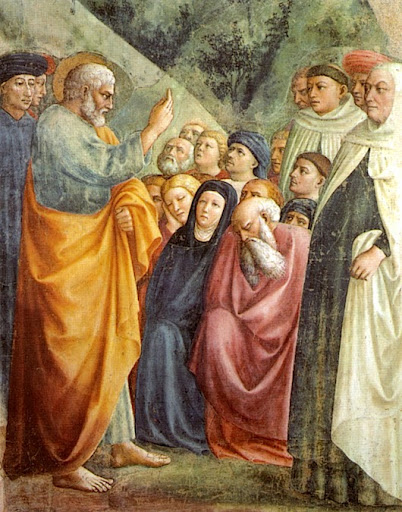
The apostles screamed at each other

Cappella brancacci Predica di San Pietro restaurato Masolino

This morning, Pope Francis has started a new series of Wednesday General Audience talks about the family, given that we are in the year between two synods on the subject. Instead of launching straight into it, Francis today focused on last October’s Synod. After first thanking the media for their extensive coverage, he criticized them for reporting on the synod as if it had been a sports event, with opposing sides fighting each other, and then proceeded to provide his own account:

“Above all I have asked the Synod Fathers to speak frankly and with courage, and to listen with humility, to say all they had in their hearts, with courage. During the Synod there was no prior censorship, there wasn’t. Everyone could, even he had to, say what he had in his heart, what he thought sincerely. ‘But, Father, this will lead to arguments.’ That’s true, we saw how the apostles argued. The text says: a strong argument followed. They screamed at each other, the apostles, yes! Because they were seeking the will of God about the Gentiles, whether they could enter the Church or not. It was a new thing. Always, when you seek the will of God, in a synodal assembly, there are different points of view and there are arguments and that is not a bad thing! As long as it is approached with humility and a spirit of service to the assembly of brothers. But, it would have been a bad thing, eh!, to have prior censorship. No, no, everyone had to say what they thought.”

Francis then proceeded to present a walk-through of the Synod’s milestones, as has been covered previously on this blog, and then proceeded to reflect again on the confrontational nature of some of the proceedings:

“Some of you may ask: ‘But, father, have the Fathers fought?’. I don’t know about fighting, but they have raised their voices, yes, really, eh! And this is freedom, it is the freedom that’s in the Church. Everything happened “cum Petro et sub Petro,” that is, with the presence of the Pope, which is a guarantee for all of freedom and trust, and the guarantee of orthodoxy. And in the end, in my speech I gave a synthetic reading of the synodal experience.”

After emphasizing that there are only three official documents resulting from last October’s synod: the final message, the final report (Relatio Synodi) and his closing speech, Pope Francis spoke about what the synod is:

“We need to know that the synod is not a parliament, with the representative of this church, that church, another church … No, it’s not that. They are representatives, yes, but the structure is not parliamentary. It is totally different. The Synod is a protected space so that the Holy Spirit may work; there was no clash between factions, as in a parliament, which is licit in a parliament, but an exchange among Bishops, which came after a long process of preparation and now continues in further work, for the good of families, the Church and society. It’s a process, it is the normal synodal journey. Now this Relatio [Synodi] returns to the particular Churches, and in those Churches the work of prayer, reflection and fraternal discussion continues, in order to prepare for the next Assembly. This is the Synod of Bishops. We entrust it to the protection of the Virgin Mary our Mother. May she help us to follow the will of God, taking pastoral decisions that help the family most and best. I ask you to accompany this synodal journey until the next synod with prayer. May the Lord enlighten us, help us progress to the maturity of what we have to say to all the Churches as Synod. And it is important for you to pray for this. Thank you.”

I find Francis’ clarity very encouraging here and I believe that the openness of discussion that I saw during the Synod even just from the outside is very positive for the Church. After all, what is at stake is of great importance and discerning how to remain faithful to Jesus’ Good News today is a constant challenge. I very much look forward to what Pope Francis will speak about next Wednesday!

Harmony in diversity

Turkey popejpeg 01dca c0 327 5242 3382 s561x327

10380974 837984076265611 4582951503244712748 n

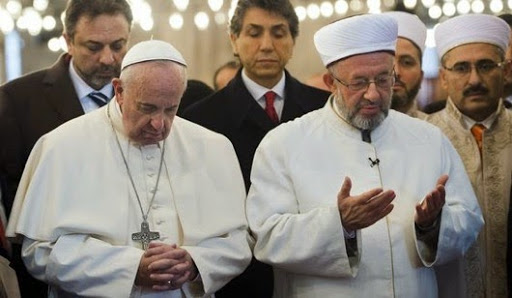
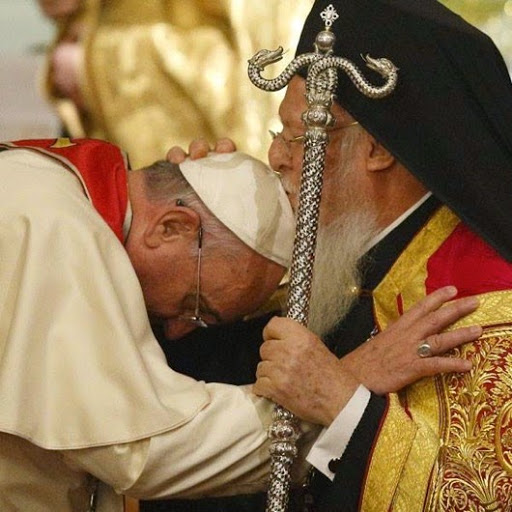
Last weekend Pope Francis visited Turkey, a country where 99.8% of the population is Muslim and where there are only about 35,000 Roman Catholics – truly a peripheral choice, fitting perfectly into Francis’ focus throughout his pontificate. What I would like to do in this post is just to pick out a couple of my favorites from among the things the pope said and share with you three photos – the two at the top, of Francis praying with Istanbul’s Grand Mufti Rahmi Yaran in the Blue Mosque and the one in the middle of Francis – and with him the entire Roman Church – being blessed (and kissed on the head) by Ecumenical Patriarch Bartholomew I.

In his first address in Turkey, to civil authorities, Francis emphasized the centrality of human dignity and brotherhood:

“Today what is needed is a dialogue which can deepen the understanding and appreciation of the many things which we hold in common. Such a dialogue will allow us to reflect sensibly and serenely on our differences, and to learn from them.

There is a need to move forward patiently in the task of building a lasting peace, one founded on respect for the fundamental rights and duties rooted in the dignity of each person. In this way, we can overcome prejudices and unwarranted fears, leaving room for respect, encounter, and the release of more positive energies for the good of all.

To this end, it is essential that all citizens – Muslim, Jewish and Christian – both in the provision and practice of the law, enjoy the same rights and respect the same duties. They will then find it easier to see each other as brothers and sisters who are travelling the same path, seeking always to reject misunderstandings while promoting cooperation and concord. Freedom of religion and freedom of expression, when truly guaranteed to each person, will help friendship to flourish and thus become an eloquent sign of peace.”

Later during the first day, Francis addressed the president of the Diyanet, the Department For Religious Affairs, denouncing religious extremism and fundamentalism:

“Particular concern arises from the fact that, owing mainly to an extremist and fundamentalist group, entire communities, especially – though not exclusively – Christians and Yazidis, have suffered and continue to suffer barbaric violence simply because of their ethnic and religious identity. They have been forcibly evicted from their homes, having to leave behind everything to save their lives and preserve their faith. This violence has also brought damage to sacred buildings, monuments, religious symbols and cultural patrimony, as if trying to erase every trace, every memory of the other.

As religious leaders, we are obliged to denounce all violations against human dignity and human rights. Human life, a gift of God the Creator, possesses a sacred character. As such, any violence which seeks religious justification warrants the strongest condemnation because the Omnipotent is the God of life and peace. The world expects those who claim to adore God to be men and women of peace who are capable of living as brothers and sisters, regardless of ethnic, religious, cultural or ideological differences.”

The next day, during his homily at the Catholic Cathedral of the Holy Spirit in Istanbul, Francis focused first on the fundamental role of the Holy Spirit in our lives and then on the nature of diversity in unity:

“When we pray, it is because the Holy Spirit inspires prayer in our heart. When we break the cycle of our self-centredness, and move beyond ourselves and go out to encounter others, to listen to them and help them, it is the Spirit of God who impels us to do so. When we find within a hitherto unknown ability to forgive, to love someone who doesn’t love us in return, it is the Spirit who has taken hold of us. When we move beyond mere self-serving words and turn to our brothers and sisters with that tenderness which warms the heart, we have indeed been touched by the Holy Spirit.

It is true that the Holy Spirit brings forth different charisms in the Church, which at first glance, may seem to create disorder. Under his guidance, however, they constitute an immense richness, because the Holy Spirit is the Spirit of unity, which is not the same thing as uniformity. Only the Holy Spirit is able to kindle diversity, multiplicity and, at the same time, bring about unity. When we try to create diversity, but are closed within our own particular and exclusive ways of seeing things, we create division. When we try to create unity through our own human designs, we end up with uniformity and homogenization. If we let ourselves be led by the Spirit, however, richness, variety and diversity will never create conflict, because the Spirit spurs us to experience variety in the communion of the Church. […] Saint Basil the Great’s lovely expression comes to mind: “Ipse harmonia est”, He himself is harmony.

The temptation is always within us to resist the Holy Spirit, because he takes us out of our comfort zone and unsettles us; he makes us get up and drives the Church forward. It is always easier and more comfortable to settle in our sedentary and unchanging ways. In truth, the Church shows her fidelity to the Holy Spirit in as much as she does not try to control or tame him. And the Church shows herself also when she rejects the temptation to look only inwards. We Christians become true missionary disciples, able to challenge consciences, when we throw off our defensiveness and allow ourselves to be led by the Spirit. He is freshness, imagination and newness.”

On the Saturday evening then came a particularly moving moment of “mystical tenderness” (as Fr. Antonio Spadaro, SJ put it), shown in the following photo and following these words by Pope Francis, addressed to the Patriarch Bartholomew:

“Andrew and Peter heard [the promise of joy]; they received this gift. They were blood brothers, yet their encounter with Christ transformed them into brothers in faith and charity. In this joyful evening, at this prayer vigil, I want to emphasize this; they became brothers in hope – and hope does not disappoint us! What a grace, Your Holiness, to be brothers in the hope of the Risen Lord! What a grace, and what a responsibility, to walk together in this hope, sustained by the intercession of the holy Apostles and brothers, Andrew and Peter! And to know that this shared hope does non deceive us because it is founded, not upon us or our poor efforts, but rather upon God’s faithfulness.

With this joyful hope, filled with gratitude and eager expectation, I extend to Your Holiness and to all present, and to the Church of Constantinople, my warm and fraternal best wishes on the Feast of your holy Patron. And I ask a favour of you: to bless me and the Church of Rome.”

IMG 4226

The final day of Francis’ trip – Sunday 30th November, the feast day of St. Andrew, patron saint of the Orthodox Church – started with an address during the Orthodox Divine Liturgy at the Patriarchal Church of St. George in Istanbul, where his focus was on the relationship between the Catholic and Orthodox Churches and where he first underlined deeply personal nature of the Christian life:

“Meeting each other, seeing each other face to face, exchanging the embrace of peace, and praying for each other, are all essential aspects of our journey towards the restoration of full communion. All of this precedes and always accompanies that other essential aspect of this journey, namely, theological dialogue. An authentic dialogue is, in every case, an encounter between persons with a name, a face, a past, and not merely a meeting of ideas.

This is especially true for us Christians, because for us the truth is the person of Jesus Christ. The example of Saint Andrew, who with another disciple accepted the invitation of the Divine Master, “Come and see”, and “stayed with him that day” (Jn 1:39), shows us plainly that the Christian life is a personal experience, a transforming encounter with the One who loves us and who wants to save us. In addition, the Christian message is spread thanks to men and women who are in love with Christ, and cannot help but pass on the joy of being loved and saved. Here again, the example of the apostle Andrew is instructive. After following Jesus to his home and spending time with him, Andrew “first found his brother Simon, and said to him, ‘We have found the Messiah’ (which means Christ). He brought him to Jesus” (Jn 1:40-42). It is clear, therefore, that not even dialogue among Christians can prescind from this logic of personal encounter.”

Next, Francis reiterated the Vatican II Unitatis Redintegratio position that the Catholic Church recognizes that the Orthodox Churches “possess true sacraments, above all – by apostolic succession – the priesthood and the Eucharist, whereby they are still joined to us in closest intimacy” and that “it is of the greatest importance to preserve and support the rich patrimony of the Eastern Churches.” He then set out his vision for the road towards full communion:

“I believe that it is important to reaffirm respect for this principle as an essential condition, accepted by both, for the restoration of full communion, which does not signify the submission of one to the other, or assimilation. Rather, it means welcoming all the gifts that God has given to each, thus demonstrating to the entire world the great mystery of salvation accomplished by Christ the Lord through the Holy Spirit. I want to assure each one of you here that, to reach the desired goal of full unity, the Catholic Church does not intend to impose any conditions except that of the shared profession of faith.”

And finally, he called for joint action already, as a consequence of being Jesus’ disciples, in three areas: the poor, the victims of conflicts and young people.

Next followed a common declaration by Pope Francis and Patriarch Bartholomew, of their desire “to intensify our efforts to promote the full unity of all Christians, and above all between Catholics and Orthodox. […] asking our faithful to join us in praying “that all may be one, that the world may believe” (Jn 17:21).” And finally, Pope Francis went to meet with young refugees from Turkey, Syria and Iraq who were being looked after by Salesians in Istanbul, where he said:

“Dear young people, do not be discouraged. It is easy to say this, but please make an effort not to be discouraged. With the help of God, continue to hope in a better future, despite the difficulties and obstacles which you are currently facing. […] Remember always that God does not forget any of his children, and that those who are the smallest and who suffer the most are closest to the Father’s heart.”

As has been customary on Pope Francis’ trips, there was a press conference this time too during the return flight, where journalists could ask him questions directly. Here I’d just pick out his answer to a question about what praying in the Blue Mosque meant for him:

“I went there, to Turkey, as a pilgrim, not as a tourist. And I went there primarily for the feast [of St. Andrew] that we celebrated today: I came precisely to share it with Patriarch Bartholomew, with a religious motive. But then, when I went to the mosque, I could not say, “No, now I’m a tourist.” No, it was all religious. And I saw that wonderful place! The mufti explained things well to me, with such gentleness, and also using the Qur’an, which speaks of Mary and John the Baptist, he explained everything to me … That’s when I felt the need to pray. And I said: “Shall we pray a bit?” – “Yes, yes,” he said. And I prayed for Turkey, for peace, for the mufti … for all … for myself, since I need it … I prayed, really … And I prayed for peace, above all. I said, “Lord, let’s put an end to these wars …” So, it was a moment of sincere prayer.”

Pope Francis’ Universe

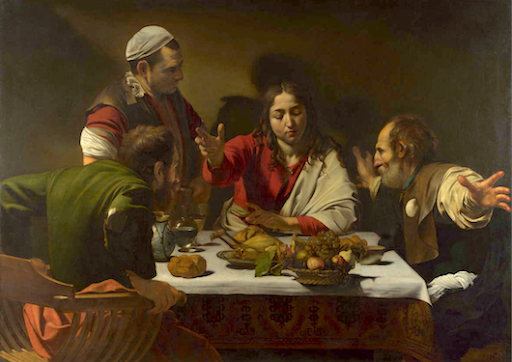
Caravaggio

As I outlined in the first installment of this series, I am in the process of looking at how the universe is being thought of from different perspectives and by thinkers of different backgrounds. After a brief look at Chiara Lubich’s intellectual visions concerning creation, I would now like to share a high-level view of how Pope Francis has been speaking about this topic.

The first thing to note is that he uses the terms “universe,” “creation,” and “nature” (with the odd mention of “cosmos”) interchangeably, while referring to social, economic and cultural spheres when speaking about the “world.” With this categorization, we can look at what Francis thinks the universe is, how he speaks about approaching and understanding it, what value he gives it and what relationship he proposes for us to have with it.

The most important point in terms of which to read all that follows is the intimate relationship Francis sees between God and “the universe, the precious gift of the Creator”:

“[T]he Holy Trinity […] leads us to contemplate and worship the divine life of the Father, the Son and the Holy Spirit: a life of communion and perfect love, origin and aim of all the universe and of every creature: God.” (Angelus, 15th June 2014)

Not only is the universe God’s gift to us and a gift that has both source and destination in the inner life of the Trinity, but it is also permeated by God’s presence:

“God and Christ walk with us and are present also in nature, as the Apostle Paul affirmed in his address at the Areopagus: “In Him we live and move and have our being” (Acts 17:28). When we read in Genesis the account of Creation, we risk imagining that God was a magician, with such a magic wand as to be able to do everything. However, it was not like that. He created beings and left them to develop according to the internal laws that He gave each one, so that they would develop, and reach their fullness. He gave autonomy to the beings of the universe at the same time that He assured them of his continual presence, giving being to every reality.” (Address to Pontifical Academy of Sciences, 27th October 2014)

God is paradoxically, simultaneously present throughout the universe, giving it being, and at the same time investing it with laws and autonomy. He desires its development, but remains close to his creation. Francis then, in the same speech, elaborates on the significance of these God-given laws of nature:

“The beginning of the world was not the work of chaos, which owes its origin to another, but it derives directly from a Supreme Principle who creates out of love. The Big-Bang, that is placed today at the origin of the world, does not contradict the divine intervention but exacts it. The evolution in nature is not opposed to the notion of Creation, because evolution presupposes the creation of beings that evolve.”

The world is not arbitrary, but has order, which it turn leads to repeatability and therefore rationality, making the universe knowable – an aspect of God’s gift that Francis values highly, and about which he speaks in the context of its relationship with faith and truth in the encyclical Lumen Fidei (§34):

“A common truth intimidates us, for we identify it with the intransigent demands of totalitarian systems. But if truth is a truth of love, if it is a truth disclosed in personal encounter with the Other and with others, then it can be set free from its enclosure in individuals and become part of the common good. [… F]aith is not intransigent, but grows in respectful coexistence with others. One who believes may not be presumptuous; on the contrary, truth leads to humility, since believers know that, rather than ourselves possessing truth, it is truth which embraces and possesses us. Far from making us inflexible, the security of faith sets us on a journey; it enables witness and dialogue with all. Nor is the light of faith, joined to the truth of love, extraneous to the material world, for love is always lived out in body and spirit; the light of faith is an incarnate light radiating from the luminous life of Jesus. It also illumines the material world, trusts its inherent order and knows that it calls us to an ever widening path of harmony and understanding. The gaze of science thus benefits from faith: faith encourages the scientist to remain constantly open to reality in all its inexhaustible richness. Faith awakens the critical sense by preventing research from being satisfied with its own formulae and helps it to realize that nature is always greater. By stimulating wonder before the profound mystery of creation, faith broadens the horizons of reason to shed greater light on the world which discloses itself to scientific investigation.”

Believing in God being the creator of the universe is not an alternative to a scientific world view, but its enabler for the Christian scientist, who trusts in the inherent order of their object of inquiry and who responds to God’s invitation to know Him also through His creation. Francis elaborates on this point in his apostolic exhortation Evangelii Gaudium (§242-243), also calling for a multidisciplinary approach to understanding the universe:

“Whereas positivism and scientism “refuse to admit the validity of forms of knowledge other than those of the positive sciences”,[190] the Church proposes another path, which calls for a synthesis between the responsible use of methods proper to the empirical sciences and other areas of knowledge such as philosophy, theology, as well as faith itself […]. Faith is not fearful of reason; on the contrary, it seeks and trusts reason, since “the light of reason and the light of faith both come from God”[191] and cannot contradict each other. […]

The Church has no wish to hold back the marvellous progress of science. On the contrary, she rejoices and even delights in acknowledging the enormous potential that God has given to the human mind. Whenever the sciences – rigorously focused on their specific field of inquiry – arrive at a conclusion which reason cannot refute, faith does not contradict it. […]”

In fact, on a separate occasion, Francis puts the Church’s appreciation of science in maternal terms: “as a mother rejoices and is rightly proud as her children grow “in wisdom, and age and grace” (Lk 2:52)” and adds art to the modes of engagement with the universe, saying:

“In every age the Church has called upon the arts to give expression to the beauty of her faith and to proclaim the Gospel message of the grandeur of God’s creation, the dignity of human beings made in his image and likeness, and the power of Christ’s death and resurrection to bring redemption and rebirth to a world touched by the tragedy of sin and death.”

The sense of awe and wonder that drive both rational and artistic engagement with the universe (for believers and non-believers alike) is further emphasized in one of Francis’ catecheses about the Holy Spirit:

“When our eyes are illumined by the Spirit, they open to contemplate God, in the beauty of nature and in the grandeur of the cosmos, and they lead us to discover how everything speaks to us about Him and His love. All of this arouses in us great wonder and a profound sense of gratitude! It is the sensation we experience when we admire a work of art or any marvel whatsoever that is borne of the genius and creativity of man: before all this, the Spirit leads us to praise the Lord from the depths of our heart and to recognize, in all that we have and all that we are, an invaluable gift of God and a sign of his infinite love for us.”

And to round out this picture of how a knowledge of the universe complements faith, it is worth reading Pope Francis’ words from this year’s Epiphany homily, where he places the two side-by-side as “great books”:

“[O]ur life is a journey, illuminated by the lights which brighten our way, to find the fullness of truth and love which we Christians recognize in Jesus, the Light of the World. [… E]very person has two great “books” which provide the signs to guide this pilgrimage: the book of creation and the book of sacred Scripture. What is important is that we be attentive, alert, and listen to God who speaks to us, who always speaks to us.”

Pope Francis also points to Jesus himself having made use of this “book of creation” in his own teaching:

“When he speaks to the people, Jesus uses many parables: in language understandable to everyone, with images from nature and from everyday situations.”

Far from being optional or even frowned upon, knowledge of the material world is a guide to the Christian as is that of Scripture, which is further underlined by the universe being seen as good (as opposed to evil or even just neutral):

“In the first Chapter of Genesis, right at the beginning of the Bible, what is emphasized is that God is pleased with his creation, stressing repeatedly the beauty and goodness of every single thing. At the end of each day, it is written: “God saw that it was good” (1:12, 18, 21, 25): if God sees creation as good, as a beautiful thing, then we too must take this attitude and see that creation is a good and beautiful thing.” (General Audience, 21st May 2014)

““And God saw that it was good” (Gen 1:12, 18, 21, 25). The biblical account of the beginning of the history of the world and of humanity speaks to us of a God who looks at creation, in a sense contemplating it, and declares: “It is good”.” (Vigil for Peace, 7th September 2013)

What then ought to be our attitude towards a universe that we can relate to in truth (through knowledge), beauty (through the senses and art) and goodness (through contemplation)? Francis’ answer, unsurprisingly, is “respect and gratitude”:

“[I]f God sees creation as good, as a beautiful thing, then we too must take this attitude and see that creation is a good and beautiful thing. […] Creation is not some possession that we can lord over for our own pleasure; nor, even less, is it the property of only some people, the few: creation is a gift, it is the marvellous gift that God has given us, so that we will take care of it and harness it for the benefit of all, always with great respect and gratitude. […] We must protect creation for it is a gift which the Lord has given us, it is God’s present to us; we are the guardians of creation. When we exploit creation, we destroy that sign of God’s love. To destroy creation is to say to God: “I don’t care”. And this is not good: this is sin.”

An important aspect here is the harnessing of the universe for the good of all, which Francis also ties to the universe’s “grammar”:

“The human family has received from the Creator a common gift: nature. The Christian view of creation includes a positive judgement about the legitimacy of interventions on nature if these are meant to be beneficial and are performed responsibly, that is to say, by acknowledging the “grammar” inscribed in nature and by wisely using resources for the benefit of all, with respect for the beauty, finality and usefulness of every living being and its place in the ecosystem. Nature, in a word, is at our disposition and we are called to exercise a responsible stewardship over it.”

And on another occasion he then links the care for nature to the care we must have for one another:

“All of creation forms a harmonious and good unity, but above all humanity, made in the image and likeness of God, is one family, in which relationships are marked by a true fraternity not only in words: the other person is a brother or sister to love, and our relationship with God, who is love, fidelity and goodness, mirrors every human relationship and brings harmony to the whole of creation. God’s world is a world where everyone feels responsible for the other, for the good of the other.”

In summary, Francis’ universe is a gratuitous gift from God whose being He sustains and in which He is close to us, but also where He instituted laws and, at the same time, autonomy. It is a gift that has its origin and being in God and its destiny too, via its being harnessed for the good of all. It is a gift that exhibits goodness and beauty and whose nature can be expressed in truth. As a result it invites respectful stewardship for the good of all, contemplation and rational understanding. Francis, using a rich metaphor, therefore issues an “appeal for respect and protection of the entire creation which God has entrusted to man, not so that it be indiscriminately exploited, but rather made into a garden.”

The Extraordinary Synod: Family, Church, God

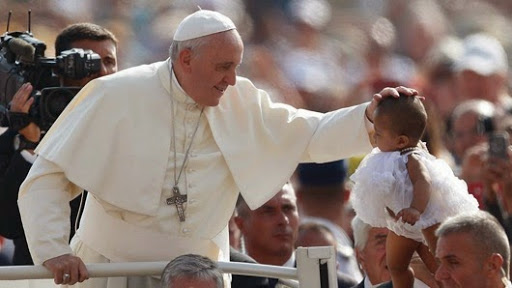
Francis w baby

[Guest post: The following is a talk about the Extraordinary Synod on the Family given at a retreat by Dr. Ján Morovič, which is reproduced here with the author’s permission.]

What I’d like to do today is to give you an overview of the Extraordinary Synod on the Family that took place from 5th to 19th October, by covering the following:

  • First, to give you an “executive summary” in Pope Francis’ own words from a week ago,
  • second, walk you through the process that is underway towards a renewal of how families are cared for by the Church and how they form part of the Church,
  • third, give you a flavor of the key topics discussed during the Synod,
  • fourth, focus on Francis’ role in the Synod,
  • and finally, argue that what is at stake here both goes far beyond the family, and doesn’t 🙂

Francis’ executive summary

The best, most concise exposition of why there is a need for the question of the family to be addressed today and, therefore, of why there was a need for the Synod that concluded a couple of weeks ago, comes from Pope Francis himself, who addressed a meeting of the Schönstatt movement last Saturday with the following words:

“The Christian family, the family, marriage, have never been attacked as much as now. Attacked directly or attacked as a matter of fact. Maybe I am mistaken, and the historians of the Church could tell us, but the family is being beaten, is being bastardized, as if it were just a loose association, as if you could call anything a family. And then, how many wounded families there are, how many broken down marriages, how much relativism there is, as far as the understanding of the sacrament of marriage is concerned. From the sociological point of view, from the point of view of human values, and from the point of the Catholic sacrament, the Christian sacrament, there is a crisis of the family. It gets beaten up from all sides. It ends up being very wounded.

So, we have no choice but to do something. So, what can we do? Yes, we can give nice talks, declare some nice principles, this we do have to do for sure to have clear ideas. Look, these things you are proposing, they are not marriage. It is an association, but it is not marriage. Sometimes it is necessary to say things very clearly. And they must be said. But, the pastoral help that is needed is body to body. Accompanying. And this means loosing time. The greatest teacher of how to lose time is Jesus. He lost time by accompanying, helping consciences mature, healing wounds, teaching. Accompanying means to share a journey.

Evidently, the sacrament of marriage has been devalued. And, unconsciously, there has been a move from the sacrament to the ritual. A reduction of sacrament to ritual. This leads to thinking about the sacrament as a social matter. Yes, with religious elements, for sure, but the strong point being the social. […] The social aspect obscures that which is most important about marriage, which is union with God.”

With the above landscape in mind, consisting of the scaramentality of marriage, its being under attack, the ubiquity of wounded families, the need for imitating Jesus’ closeness to all, and the importance of understanding marriage as union with God, let’s look at how the Church arrived at this Synod and what journey it is on, moving forward.

The process

The Extraordinary Synod on the Family, whose full title is: “Pastoral Challenges of the Family in the Context of Evangelisation,” was called by Pope Francis in October 2013. It being an extraordinary synod, as opposed an ordinary one, taking place at regular intervals, points directly to its purpose being to “deal with matters which require a speedy solution” (Code of Canon Law, canon 346 §2). And the fact that it was announced as part of a pair of Synods – the one we just had, and its follow-up that will take place from 4th to 25th October 2015 – indicates the complexity of the topic, and the need for a year’s work and discernment to be part of the process.

Within weeks of the Synod’s announcement last October, a preparatory document was published by the Synod’s secretariat, consisting both of some thoughts on the key challenges facing the family and – in an unprecedented move – a questionnaire that was sent to dioceses around the world for completion. It is a questionnaire that asked very open and direct questions about what of the Church’s teaching was understandable, and what positions were held with regard to its teaching on abortion, contraception, same-sex marriage, etc. Importantly, many dioceses opened the questionnaire up to the public (e.g., including Brentwood and Westminster), which resulted in a very large-scale response.

The Synod secretariat’s next move was to publish an extensive summary (the “instrumentum laboris”) of the responses at the end of June. This was a great move of openness and transparency, further underlined by its very frank presentation of the questionnaire’s responses. There was both a reinforcing of positives here – i.e., the continuing recognition of the value and beauty of marriage – and an identification of and admission to problems – e.g., the general lack of an understanding of the Church’s teaching, a loss of meaning of the concept of “natural law,” the damage caused by the sexual scandals in the Church, and the mounting external and internal pressures that families face today.

Next, the Synod Fathers, comprising heads of all local episcopal conferences, the heads of some religious orders and a number of members directly appointed by Pope Francis, were asked to submit written statements in response to the “instrumentum laboris.” The Synod’s secretariat then summarized these in its first working document – the “relatio ante disceptationem,” whose reading took place during the first morning of the Synod. A week of interventions followed – including “witnesses” from married couples at the beginning of each of a day’s two sessions, after which an updated working document was produced – the “relatio post disceptationem.” Note, that it was written single-handedly by Archbishop Bruno Forte, appointed to this role directly by Pope Francis. The following week saw work in groups of around 30 people each that resulted in feedback to the small team in charge of editing the working document and producing the official outcome of the Synod. Finally, this “Relatio Synodi” was voted on, paragraph by paragraph, and published as a guide for what topics to deepen during the following year.

Next year, the second Synod, still on the topic of the Family, will result in proposals to the Holy Father, who can then freely choose how to take them into account in the measures he takes with regard to the care for and role of families in the Church. When looking at the details of the content discussed at the Synod, it is worth noting the very loose relationship between the Synod on the New Evangelization that took place in 2011 and Pope Francis’ Evangelii Gaudium, that, procedurally, follows from it. In the end, the paradigm that applies here is the Jesuit concept of “You discern, we discern, I decide.”

The topics

Turning to what was discussed at the Synod, I’d like to pick out some key themes for you, without being comprehensive, as it may otherwise turn into sounding like a shopping list, and I’d like to focus on the areas that have received either the greatest support or where there was most debate. Before diving into these “hot” topics, it is worth noting that the sacramentality and indissolubility of marriage, its being a source of joy, its being between a man and a woman, and the sanctity of life that originates, runs its course and completes its earthly journey there, were unanimously reaffirmed. There was also broad agreement on the need to revise and strengthen marriage preparation and accompanying of married couples, and the pressures following from economic hardship (unemployment, separation as a result of traveling for work, the inequitable treatment of women) and the tragedy of wars were also a theme running through the Synod.

Subjects of evangelization

First, there was an emphasis on the family not only as object of evangelization (i.e., an entity to be evangelized), but also as its subject (an entity that evangelizes). In particular, movements like the Focolare and the Neocatecumenal Way (which were mentioned explicitly), were highlighted as examples of families carrying out evangelization by “patient and delicate accompanying” and by presenting “the attractive testimony of authentic Christian families.” As a consequence, it was also declared that “the Church must be more open to dialogue, and must listen more frequently (and not only in exceptional cases) to the experiences of married couples.”

A new language

Second, a very prominent topic throughout the Synod has been the call for a new language to be used when announcing the Gospel, calling for “forms and suitable language […] to be devised to proclaim that all are and remain God’s children and are loved by God the Father and the Church as Mother.” The need to listen to the world, so that it may listen to the Church was emphasized and it was noted that “dialogue may be based on important themes, such as the equal dignity of men and women and the rejection of violence.” As an example, “terms like “living in sin,” “intrinsically disordered,” and “contraceptive mentality” were singled out by the Synod Fathers as instances of “harsh language,” where there was a need for change that would demonstrate the Church’s openness and love.” Let me quote a passage from Dublin’s Archbishop Dairmuid Martin’s intervention that regards this point:

“To many the language of the Church appears to be a disincarnated language of telling people what to do, a “one way dialogue”. I am in no way saying that the Church is not called to teach. I am not saying that experience on its own determines teaching or the authentic interpretation of teaching. What I am saying is that the lived experience and struggle of spouses can help find more effective ways of expression of the fundamental elements of Church teaching. Jesus himself accompanied his preaching the good news with a process of healing the wounded and welcoming those on the margins. His teaching was never disincarnated and unmoved by the concrete human situation in which people could come to be embraced by the Good News. Jesus’ care for the sick and the troubled and those weighed down by burdens is the key which helps to understand how he truly is the Son of God.”

I also found the words of our Cardinal Vincent Nichols, the next day, to be a great example of what this new language might look like:

“I don’t doubt that most young people aspire to having their own family, having their own family within the stable relationship between husband and wife, having that family with a sense of permanence and a permanent, faithful commitment. Nobody wants a wife or a husband who is unfaithful. And so what we have to get across to people is that casual relationships before marriage is actually being casual with somebody’s future husband or wife. And its that sense of the real value that’s written in us, its in the hearts of people, that they aspire to, that has consequences for how we behave today as well.”

Seeds of the Word

Third, one of the most revolutionary ideas of the Synod is that of recognizing whatever good there is also under imperfect circumstances, which the “relatio post disceptationem” puts as follows:

“Some ask whether the sacramental fullness of marriage does not exclude the possibility of recognizing positive elements even the imperfect forms that may be found outside this nuptial situation, which are in any case ordered in relation to it. The doctrine of levels of communion, formulated by Vatican Council II, confirms the vision of a structured way of participating in the Mysterium Ecclesiae by baptized persons. […] (§18)

Realizing the need, therefore, for spiritual discernment with regard to cohabitation, civil marriages and divorced and remarried persons, it is the task of the Church to recognize those seeds of the Word that have spread beyond its visible and sacramental boundaries. Following the expansive gaze of Christ, whose light illuminates every man (cf. Jn 1,9; cf. Gaudium et Spes, 22), the Church turns respectfully to those who participate in her life in an incomplete and imperfect way, appreciating the positive values they contain rather than their limitations and shortcomings. (§20)”

The idea of “levels of communion” is with reference to how ecumenism is presented in Lumen Gentium (§15): “The Church recognizes that in many ways she is linked with those who, being baptized, are honored with the name of Christian, though they do not profess the faith in its entirety or do not preserve unity of communion with the successor of Peter.” It is also important to note that this analogy was proposed by Cardinal Christoph Schönborn of Vienna, who was the general editor of the current Catechism. Another way of looking at what these changes mean is what Antonio Spadaro SJ (the editor of Civiltà Cattolica, and Synod Father by direct papal appointment) tweeted about it: “Today […] we have seen a church that pays more attention to sowing seeds than to pulling out weeds.”

Mercy

Closely related to the above desire, to look for the traces of God’s presence under all circumstances, is the focus on mercy that has been the backbone of the Synod:

“[M]ercy is not a justification to sin but rather the sinner’s justification, to the extent that he converts and aims to sin no more. Mercy, the central theme of the God’s revelation, is highly important as a hermeneutic for the Church’s actions (cf. Evangelii gaudium, 193 ff.). Certainly, she does not do away with truth nor relativize it, but seeks to interpret it correctly in the hierarchy of truths (cf. Unitatis redintegratio, 11; Evangelii gaudium, 36-37). Nor does she do away with the demands of justice.” (Relatio ante disceptationem, 3b)

One of the Spanish-speaking Synod Fathers put this point particularly forcefully:

“Above all we must kneel before the Holy Spirit and remember that we aren’t the bosses of God’s mercy. We must remember that the mission that Jesus entrusted to his apostles, and by extension to us as their successors, is to evangelize and to heal. And this means, spreading the Good News.”

And finally, one of the English-speaking working groups feedback on the “relatio post disceptationem” has been the affirmation that mercy is needed by all of us:

“All of us need the help of the mercy of God. The mercy of God is not just a medicine, much less a consolation prize, for those who fail. None of us can be faithful without experiencing God’s mercy. No one should devalue the place of mercy in the economy of salvation.” (Relatio – Circulus Anglicus “B”)

Inclusion

A consequence of the above mercy is also the emphasis that inclusion has seen throughout the Synod, which was put particularly emphatically by the German Cardinal Reinhard Marx:

“We must be close to everyone, each with their particular circumstances. We must give them opportunities to find their place in the Church. No one is excluded! No one is redundant! No one is marginalized! Exclusion is not the language of the Church!”

It is also a point that Pope Francis underlined during the Angelus address he gave half-way through the Synod:

“The goodness of God has no boundaries and does not discriminate against anyone: this is why the feast of the Lord’s gifts is universal, for all. Everyone is given the opportunity to respond to his invitation, to his call; no one has the right to feel privileged or to an exclusive claim. All this leads us to overcome the habit of positioning ourselves comfortably in the middle, as did the chief priests and the Pharisees. This mustn’t be done; we must open ourselves to the peripheries, recognizing that even those who are on the margins, even one who is despised and rejected by society, is an object of God’s generosity. We are all called to not reducing the Kingdom of God to the confines of a “little church” – our “tiny little church” – but to widen the Church to the scale of the Kingdom of God. There is only one condition: to wear a wedding dress, which is showing love towards God and neighbor.”

The law of gradualness

Looking at the above, the mistaken impression may arise that there is a departure from a striving for perfection, or that virtue and a close adherence to the Church’s teaching and the Gospel are somehow secondary or optional. Such a reading of the Synod’s discussions would be missing an important point though:

“In the Christian life, the reception of Baptism brings the believer into the Church through the domestic church, namely, the family; thus beginning “a dynamic process [which] develops, one which advances gradually with the progressive integration of the gifts of God” (Familiaris Consortio, 9), in an ongoing conversion to a love which saves us from sin and gives us fullness of life.” (Relatio Synodi, §13)

Cardinal Marx, putting the above into his own words, declares that:

“On every human journey, including one that may be based on a mistake, there is growth and increasing maturity, there is improvement, there is something that can be lived through the spirit of the Gospel.”

The key here is that the recognition of goodness in imperfection is a stepping stone, the beginning of a journey towards fulness.

Divorced and remarried

The first case to which the above focus on inclusion, mercy and the recognition was applied, and one that has had a lot of media attention already before the synod, are the divorced and remarried, and the question of their access to the Eucharist. Here the main aspects of discernment revolved around, on the one hand, the indissolubility of marriage being recognized by all, and, on the other hand, there being differing conceptions of the Eucharist, ranging from a focus on a compliance with prerequisites by some and a focus on its being a healing gift by others. The latter is best represented by Fr. Adolfo Nicolas SJ, the Superior General of the Jesuits, saying: “A divorced person has suffered, but we withdraw medicine from him or her who needs it most. No, this cannot be!”

At the conclusion of the Synod, there was great variety in how this challenge is to be addressed, ranging from some, few, being emphatic about there being no way to provide the divorced and remarried with access to the Eucharist, to a variety of positions that called for further study and discernment both with an initial proposal for what a solution might look like, and without. Here the types of solutions ranged from individual, case-by-case discernment by the local bishop to prolonged penitential processes.

An example of the more cautious, yet not categorically opposed position here is that of Cardinal Angelo Scola:

“Personally, on a substantial level, I can not find an answer yet to the possibility that [the divorced and civilly remarried] could have access to sacramental communion without this clashing with the indissolubility of marriage. In short, indissolubility either has an impact on the reality of daily life, or remains a Platonic idea.”

The attitude to adopt already while potential solutions are considered was best expressed by Cardinal Godfried Danneels of Brussels:

“In the first place we are invited to greatly respect our brothers and sisters, the divorced and remarried. Mercy starts where we have unconditional respect for all who want to live within the Church but can’t marry again for the Church and receive Communion. […]

It is so important to speak with them, to let them speak about the beauty of marriage and the Christian family. Beauty is so powerful! This is obviously not esthetic beauty, but beauty who is the sister of truth and goodness. According to Aristotle “beauty is truth in all its glory”.”

Welcoming homosexual persons

The second case under discussion was the question of the Church’s relationship with gay people, where the “relatio post disceptationem” declared:

“Homosexuals have gifts and qualities to offer to the Christian community: are we capable of welcoming these people, guaranteeing to them a fraternal space in our communities? Often they wish to encounter a Church that offers them a welcoming home. Are our communities capable of providing that, accepting and valuing their sexual orientation, without compromising Catholic doctrine on the family and matrimony? (§50)

The question of homosexuality leads to a serious reflection on how to elaborate realistic paths of affective growth and human and evangelical maturity integrating the sexual dimension: it appears therefore as an important educative challenge. The Church furthermore affirms that unions between people of the same sex cannot be considered on the same footing as matrimony between man and woman. […] (§51)

Without denying the moral problems connected to homosexual unions it has to be noted that there are cases in which mutual aid to the point of sacrifice constitutes a precious support in the life of the partners. (§52)”

The above represents a very clear application of the desire to seek the presence of good under all circumstances and to recognize in it the potential for a journey towards perfection, not being exclusive of anyone. It was Cardinal Marx again who also put the position most bluntly here:

“[… I know] a homosexual couple who have been together for 30-35 years in a faithful relationship, which as a sexual relationship is not accepted by the Church, but they live together, one looks after the other, during the last phase of his life. Here, as Church, I cannot say that everything that these people have done during their lives is without value, because they have a homosexual relationship. […] It would be unthinkable to say that because you are homosexual, you can live nothing of the spirit of the Gospel. That’s unthinkable! At least for me.”

Archbishop Vincenzo Paglia, President of the Pontifical Council for the Family, also spoke about homosexual people with great warmth, putting the ball in our, the Church’s, court to make the first step:

“[Homosexuals] are our brothers or sisters. To be loved as children of God to the end, to be embraced, accompanied, sustained, to be close to. Another question is that of marriage. Because marriage, since the world has been the world, is between man and woman. […] Then … affection … well we can be attracted by anyone. What’s more, I wish for all of us that we would all love each other, so we aren’t like frigid sticks that don’t encounter each other! The challenge is how to be close to those who are maybe in difficulty, and here I believe that it is all of us, believers, who need to take the first step. Whoever is in difficulty is to be embraced and helped.”

Again, as in the case of the divorced and remarried, the path forward is not clear and there was a great deal of difference in opinion on this subject (including objections to the use of “welcoming” with reference to gays), but that we must – as followers of Jesus – direct a merciful, loving gaze at them too is crystal clear. Not because they are gay or divorced, but because we are all children of God, members of the one family.

Francis’ role

Having given you a taster of what the process has been and a flavor of what has been discussed and how, I would like to turn our attention to Pope Francis’ presence in the above picture, and I would just like to pick out a few of the key moments, since I think they offer a model that we can learn from also.

First, I’d like to give you a sense of the timescale and consistency of Francis’ vision. Already during the meeting of cardinals before the consistory that elected him, the then-cardinal Bergoglio said:

“Holy Week challenges us to step outside ourselves so as to attend to the needs of others: those who long for a sympathetic ear, those in need of comfort or help. We should not simply remain in our own secure world, that of the ninety-nine sheep who never strayed from the fold, but we should go out, with Christ, in search of the one lost sheep, however far it may have wandered.”

And it is on the back of this vision that he is elected, and it is a vision he re-iterates the very next day, when addressing the cardinals:

“[A]ll together, pastors and faithful, we will make an effort to respond faithfully to the eternal mission: to bring Jesus Christ to humanity, and to lead humanity to an encounter with Jesus Christ: the Way, the Truth and the Life, truly present in the Church and, at the same time, in every person.”

Note the focus on bringing Jesus to humanity and on his pointing to His presence in every person. Eight months later, he reaffirms this commitment in his apostolic exhortation – Evangelii Gaudium, a magisterial document of the Church, where he says:

“Everyone can share in some way in the life of the Church; everyone can be part of the community, nor should the doors of the sacraments be closed for simply any reason. This is especially true of the sacrament which is itself “the door”: baptism. The Eucharist, although it is the fullness of sacramental life, is not a prize for the perfect but a powerful medicine and nourishment for the weak.”

And finally, on the eve of this Synod on the Family, Francis’ homily focuses on excessive burdens and on “God’s dream”:

“[E]vil pastors lay intolerable burdens on the shoulders of others, which they themselves do not lift a finger to move (cf. Mt 23:4). We too, in the Synod of Bishops, are called to work for the Lord’s vineyard. […] We are all sinners and can also be tempted to “take over” the vineyard, because of that greed which is always present in us human beings. God’s dream always clashes with the hypocrisy of some of his servants. […] My Synod brothers, to do a good job of nurturing and tending the vineyard, our hearts and our minds must be kept in Jesus Christ by “the peace of God which passes all understanding” (Phil 4:7). In this way our thoughts and plans will correspond to God’s dream: to form a holy people who are his own and produce the fruits of the kingdom of God (cf. Mt 21:43).”

Taken with everything he has done during the year and a half between his election and the Synod, he couldn’t have been clearer about what he wants to see from his brothers, and, so – after encouraging them to speak their minds freely on the first morning of the Synod, he spends the following two weeks attending all but one of the sessions (skipping only one due to a General Audience) and doing so in silence. This, to me, is a remarkable approach and one that makes me immediately think about how Chiara saw Mary in Paradise – “as the blue of the sky contains sun and moon and stars.” In fact, Cardinal Gianfranco Ravasi pointed out that Pope Francis’s silence was fundamental for the Synod’s discussions to be possible, quoting the Latin saying “Roma locuta, causa finita.” If Francis had spoken, it would have been the end of the discussion.

What Francis did at the end of the Synod is another important lesson though. First, he had the entire final report – the “Relatio Synodi” published, instead of only the paragraphs that received 2/3rds of the Synod Fathers’ votes, as follows from the Synod’s constitution. Not only that, but he ordered for the vote counts to be published for each paragraph too. This ensured that all topics discussed during the first Synod would be deepened over the next year and discussed again at next year’s Synod – including those that did not get a 2/3rds majority, which were all of the controversial ones regarding the challenges of welcoming divorced and gay people, and ones that spoke about the need to recognize the presence of the seeds of the Word in imperfect circumstances.

To further underline his resolve and his commitment to the need for an opening and a going out to the peripheries that he has been pioneering since before his election, Francis gives an unscheduled closing speech that effectively upstages the Synod’s final report.

There, he first chastises the Synod Fathers for having succumbed to some of four types of temptation:

“- One: the temptation of hostile rigidity, that is, wanting to enclose oneself in the written (the letter) and not allowing oneself to be surprised by God, the God of surprises (the spirit); within the law, in the certainty of what we know and not of what we still need to learn and achieve. Since the time of Jesus, there has been the temptation of the zealots, the scrupulous, the cautious, the – today – so-called “traditionalists” and even the intellectuals.

– The temptation of destructive do-goodery, which in the name of a false mercy bandages wounds without first curing and medicating them; which treats symptoms and not their causes and roots. It is the temptation of the “do-gooders”, of the fearful and even the so-called “progressives and liberals.”

– The temptation to turn stone into bread so as to break a long, heavy and painful fast (cf. Lk 4:1-4), and also to turn bread into stone and throw it at sinners, the weak and the sick (cf. Jn 8.7), that is, to turn it into “unbearable burdens” (Lk 10:27).

– The temptation to come down from the cross, to please people, and not to stay, to fulfill the will of the Father; to bow to a worldly spirit instead of purifying it and bending it to the Spirit of God.

– The temptation to neglect the “deposit of faith”, not considering themselves custodians, but masters or owners, or, on the other hand, the temptation to ignore reality by using meticulous language and language so polished that saying many things result in not having said anything! Such language used to be called “byzantine”, I think, such language …”

Next, he reiterates what the Church is:

“And this is the Church, the Lord’s vineyard, the fertile Mother and caring [female] Teacher, who is not afraid to roll up her sleeves to pour oil and wine on the wounds of men (cf. Lk 10: 25-37); who does not look at humanity from a glass castle to judge or categorize people. This Church is the One, Holy, Catholic, Apostolic and composed of sinners, in need of His mercy. This is the Church, the true bride of Christ, seeking to be faithful to her spouse and to his doctrine. It is the Church who is not afraid of eating and drinking with prostitutes and tax collectors (Luke 15). The Church that has doors wide open to receive the needy, the repentant and not only the righteous or those who think they are perfect! The Church that is not ashamed of the fallen brother and does not pretend not to see him, what’s more, she feels involved and almost obliged to raise him and encourage him to continue his journey, and she accompanies him to the final encounter with her ​​Spouse, in the heavenly Jerusalem.

This is the Church, our mother! And when the Church, in the variety of its charisms, is expressed in communion, she can make no mistakes: this is the beauty and strength of the sensus fidei, of that supernatural sense of faith, which is bestowed by the Holy Spirit so that, together, we can all enter into the heart of the Gospel and to learn to follow Jesus in our lives, and this must not be seen as a source of confusion and discomfort.”

And, finally, after quoting an extensive excerpt from an address Pope Benedict XVI gave about who the pope is, he concludes by speaking to those who have been misusing the law as a veto against the renewal that the Holy Spirit has been driving in the Church since the first Pentecost, by quoting canon law to them:

“So, the Church is Christ’s – she is His bride – and all the bishops, in communion with the Successor of Peter, have the task and the duty of guarding her and serving her, not as masters but as servants. The Pope, in this context, is not the supreme lord but rather the supreme servant – the “servant of the servants of God”; the guarantor of the obedience and the conformity of the Church to the will of God, to the Gospel of Christ, and to the Tradition of the Church, putting aside every personal whim, despite being – by the will of Christ Himself – the “supreme Pastor and Teacher of all the faithful” (Can. 749) and despite enjoying “supreme, full, immediate, and universal ordinary power in the Church” (cf. Cann. 331-334).”

“You discern, we discern, I decide.” 🙂

What is at stake

To conclude this long, but still only very sketchy and incomplete run through the Extraordinary Synod on the Family, I would like to argue that it hasn’t really been about the family. Much greater things are at stake here than “just” the nature of how man and woman unite to welcome each other and be open to new life.

What is at stake here is the very nature of the Church. Is she restricted to the virtuous few, to the wholly compliant, to the pious and proper, to the i dotters and t crossers? Or is she the mother who seeks out her children wherever they may be, welcoming them with open arms and an even more open heart, healing their wounds, but also delighting in their child-like achievements, and enveloping them in a warm embrace? Francis’ position is very clear here, but so is that of many of our bishops and pastors. Archbishop Philip Tartaglia of Glasgow puts it as follows:

“[T]he Church has to find a way to speak St Paul’s words of love, which compassionately excuse and forgive, but which also heal and renew and lift up again; where forgiveness is not accommodation or indifference but genuine and sometimes hard-won reconciliation, engendering new trust, new hope, new endurance, and new faithfulness, a new page in the story of love.”

And the notes from one of the Synod’s sessions emphasize:

“[T]he Church is not a customs [checkpoint], but rather the house of the Father, and must therefore offer patient accompaniment to all people, including those who find themselves in difficult pastoral situations. The true Catholic Church encompasses healthy families and families in crisis, and therefore in her daily effort of sanctification must not show indifference in relation to weakness, as patience implies actively helping the weakest.”

In fact, what is at stake here is not only what the family is, who the Church is, but also who God is. Here, our understanding of both Church and family flow from who we believe God is, and Pope Francis again places a crystal-clear image in front of us, an image projected from the words of Jesus about his Father, brought into focus by the Holy Spirit’s presence today:

“God is good to us, freely offering us his friendship, his joy, salvation, but often it is us who do not accept his gifts, we place our material concerns, our interests in the first place and also when the Lord calls us, it often seems to bother us.” (Angelus, 12 October 2014)

“God is always new; He never denies himself, never says that what He said was wrong, never, but He always surprises us.” (Homily at Santa Marta, 13 October 2014)

“Our name is in God’s heart, is in God’s bowels, just as the baby is inside its mother. Our joy lies in our being elected. We cannot understand this with our head alone. We cannot understand this even with our heart. To understand this we must enter into the Mystery of Jesus Christ. The Mystery of His beloved Son: ‘He has poured out his blood for us in abundance, with all wisdom and intelligence, making known to us the mystery of His will’.” (Homily at Santa Marta, 17 October 2014)

Yet, in spite of having said that more than the family is at stake, it is also true to say that we have been talking about the family all along, which becomes clear through the words of St. John Paul II: “[T]he primordial model of the family is to be sought in God himself, in the Trinitarian mystery of life. […] The family itself is the great mystery of God.” (Letter to Families, 1994, §6, §19)

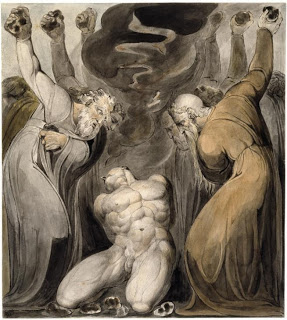
The family: union with God

8417364534 92a9f089c2 z

On Saturday, Pope Francis met with members of the Schönstatt Apostolic Movement in the Vatican and answered some of their questions. Since I haven’t found the full text in English anywhere, and since the topic of most of the questions was the family, I was keen to hear Francis’ words this soon after the conclusion of the Synod.

Instead of an extensive analysis, I would just like to share the following translated transcript of the introduction to his first answer, which I read as a beautiful “relatio synodi” put in Francis’ own words:

“The Christian family, the family, marriage, have never been attacked as much as now. Attacked directly or attacked as a matter of fact. Maybe I am mistaken, and the historians of the Church could tell us, but the family is being beaten, is being bastardized, as if it were just a loose association, as if you could call anything a family. And then, how many wounded families there are, how many broken down marriages, how much relativism there is, as far as the understanding of the sacrament of marriage. From the sociological point of view, from the point of view of human values, and from the point of the Catholic sacrament, the Christian sacrament, there is a crisis of the family. It gets beaten up from all sides. It ends up being very wounded.

So, we have no choice but to do something. So, what can we do. Yes, we can give nice talks, declare some nice principles, this we do have to do for sure to have clear ideas. Look, these things you are proposing, they are not marriage. It is an association, but it is not marriage. Sometimes it is necessary to say things very clearly. And they must be said. But the pastoral help that is needed is body to body. Accompanying. And this means loosing time. The greatest teacher of how to lose time is Jesus. He lost time by accompanying, to help consciences mature, to heal wounds, to teach. Accompanying means to share a journey.

Evidently the sacrament of marriage has been devalued. And, unconsciously, there has been a move from the sacrament to the ritual. A reduction of sacrament to ritual. This leads to thinking about the sacrament as a social matter. Yes, with religious elements, for sure, but the strong point being the social. […] The social aspect obscures that which is most important about marriage, which is union with God.”

And this, in turn, made me think of St. John Paul II’s profound words on the same subject:

“[T]he primordial model of the family is to be sought in God himself, in the Trinitarian mystery of life. […] The family itself is the great mystery of God.” (Letter to Families, 1994, §6, §19)
Very much is at stake here. Not only the family, but our relationship with God too. The God of mercy and vicinity, who invites us to share in the life of his being family.