Synod14: A reality check

Francis synod

If you are a regular on this blog, you’ll know that I have been following the Extraordinary Synod on the Family very closely. I have seen all the press conferences, read all the documents, watched all the interviews, waded through the, sadly mostly morass, of tweets tagged with #synod14, and have written blog posts daily. At the end of the Synod’s two weeks, I felt a great sense of joy and I delighted at the whole process, which, to my mind, was an example of a shared journey, of transparency, and of a group of bishops and lay people striving for the good of the family, with a tremendous sense of seriousness and honesty.

When I then read the first reports on Saturday evening, and then during the course of today in the general press, about what this Synod has arrived at, I have to admit that I came away from them with disappointment. I shouldn’t have been that naive, since this seems to be the norm in how anything moderately nuanced gets reported. From the perspective of the media, the result has been some variant of the following Guardian headline: “Catholic bishops veto gay-friendly statements leaving Pope Francis the loser.”

What I have seen over the last two weeks couldn’t be further from a loss for Pope Francis, first of all because that is a meaningless way of looking at the situation. And even if one were to apply the loss/victory categories to the Synod, the opposite would be my conclusion. Let me therefore lay out what I believe just happened, in as blunt terms as I can, and, please, bear with me while I take a couple of steps back to do this picture justice.

In the beginning was the Word …

No, let me not go back that far just yet (although that verse from the Johannine prologue is highly relevant to one of the keys to the Synod that I will return to in a later post) and instead start with a thought from Pope Benedict XVI’s resignation letter, where he assesses the current situation in the world as follows:

“[T]oday’s world [is] subject to so many rapid changes and shaken by questions of deep relevance for the life of faith”

Questions of deep relevance need to be addressed and Benedict does not have the strength to do it. So, he does what a true servant of servants must, and vacates the See of Peter. A conclave is called and cardinals present their visions for the Church. One Jorge Bergoglio presents the following program:

“Holy Week challenges us to step outside ourselves so as to attend to the needs of others: those who long for a sympathetic ear, those in need of comfort or help. We should not simply remain in our own secure world, that of the ninety-nine sheep who never strayed from the fold, but we should go out, with Christ, in search of the one lost sheep, however far it may have wandered.”

He gets elected Pope Francis and, the next day, in his first address to the cardinals since his election he declares:

“[A]ll together, pastors and faithful, we will make an effort to respond faithfully to the eternal mission: to bring Jesus Christ to humanity, and to lead humanity to an encounter with Jesus Christ: the Way, the Truth and the Life, truly present in the Church and, at the same time, in every person.”

Then follow months of Francis putting his mission to welcome and accompany not only every single person who comes his way, but to go out of his way to reach out to those who may feel far from the Church. His correspondence with the atheist Eugenio Scalfari, his iPhone video to Evangelical Christians in the US and his resounding “Who am I to judge them?” with regard to gays are just a couple of examples off the top of my head.

Eight months after his election and to drive home the message that being a Church that is open and welcoming of all is a must, Francis pens the magnificent apostolic exhortation Evangelii Gaudium – a magisterial document of the Catholic Church, where he declares in the section entitled “A mother with an open heart” that:

“Everyone can share in some way in the life of the Church; everyone can be part of the community, nor should the doors of the sacraments be closed for simply any reason. This is especially true of the sacrament which is itself “the door”: baptism. The Eucharist, although it is the fullness of sacramental life, is not a prize for the perfect but a powerful medicine and nourishment for the weak.[51] These convictions have pastoral consequences that we are called to consider with prudence and boldness. Frequently, we act as arbiters of grace rather than its facilitators. But the Church is not a tollhouse; it is the house of the Father, where there is a place for everyone, with all their problems.” (§47)

A whole year later, and a year where an outreach to the peripheries, an openness to all, regardless of how “proper” or well-ordered their lives are, have been Francis’ daily mission, he has the following to say on the eve of the Synod – just in case someone hasn’t been listening during the preceding year and a half:

“The temptation to greed is ever present. We encounter it also in the great prophecy of Ezekiel on the shepherds (cf. ch. 34), which Saint Augustine commented upon in one his celebrated sermons which we have just reread in the Liturgy of the Hours. Greed for money and power. And to satisfy this greed, evil pastors lay intolerable burdens on the shoulders of others, which they themselves do not lift a finger to move (cf. Mt 23:4)

We too, in the Synod of Bishops, are called to work for the Lord’s vineyard. […] We are all sinners and can also be tempted to “take over” the vineyard, because of that greed which is always present in us human beings. God’s dream always clashes with the hypocrisy of some of his servants. We can “thwart” God’s dream if we fail to let ourselves be guided by the Holy Spirit. The Spirit gives us that wisdom which surpasses knowledge, and enables us to work generously with authentic freedom and humble creativity.

My Synod brothers, to do a good job of nurturing and tending the vineyard, our hearts and our minds must be kept in Jesus Christ by “the peace of God which passes all understanding” (Phil 4:7). In this way our thoughts and plans will correspond to God’s dream: to form a holy people who are his own and produce the fruits of the kingdom of God (cf. Mt 21:43).”

Note two things about what Francis says here: First, God’s dream is a holy people who are his own and who are looked after by his servants, servants who are not to overburden them. Second, he quotes Scripture and a saint to them [remember this for contrast with how he speaks to the Synod Fathers after the Synod].

A week of the Synod later, during which Francis attends almost every single session (skipping one due to the General Audience on the Wednesday), but during which he does not intervene, the interim report of the Synod is published – written by Archbishop Bruno Forte, whom Francis directly appointed to the job of doing so. What does the interim report (the “relatio post disceptationem”) say? Well, amongst other things:

“[I]t is the task of the Church to recognize those seeds of the Word that have spread beyond its visible and sacramental boundaries. Following the expansive gaze of Christ, whose light illuminates every man (cf. Jn 1,9; cf. Gaudium et Spes, 22), the Church turns respectfully to those who participate in her life in an incomplete and imperfect way, appreciating the positive values they contain rather than their limitations and shortcomings. […]

In this respect, a new dimension of today’s family pastoral consists of accepting the reality of civil marriage and also cohabitation, taking into account the due differences. Indeed, when a union reaches a notable level of stability through a public bond, is characterized by deep affection, responsibility with regard to offspring, and capacity to withstand tests, it may be seen as a germ to be accompanied in development towards the sacrament of marriage. […]

Homosexuals have gifts and qualities to offer to the Christian community: are we capable of welcoming these people, guaranteeing to them a fraternal space in our communities? Often they wish to encounter a Church that offers them a welcoming home. Are our communities capable of providing that, accepting and valuing their sexual orientation, without compromising Catholic doctrine on the family and matrimony?”

The Pope listened to everyone speaking their mind and then had “his man” pen the key takeaways – recognize a participation in the life of the Gospel no matter under what circumstances it happens, be welcoming, look for ways for everyone, who wants to, to find their place in the Church.

A week later, during which significant resistance is shown by some cardinals to the interim report, a final report is produced that tones down the interim reports’ language, but that still speaks about all the topics mentioned in the interim report. The final report is voted on paragraph by paragraph, but instead of only those paragraphs that have reached the 2/3 majority needed for them to be official proposals from the Synod to the Pope, all paragraphs are published on the Pope’s orders, including the data on how many votes each paragraph received. The purpose of this final document of the Extraordinary Synod on the Family is that it sets the agenda for the work of this, next year that leads to the Ordinary Synod on the Family in October 2015. Keeping all topics from the interim report in the final report means that they will get discussed both over the course of this year and at the next Synod.

Is that the end of the story? Not at all! What Pope Francis does next is to completely upstage the final report of the Synod, by delivering an amazing closing speech. Why does he do that? Because this Synod is not about its final document – it is the kick-off for a year of discernment and work towards the next Synod, after which proposals are going to be made to the Pope.

So, what did Pope Francis say at the end of this year’s Synod? First, he thanked all for their great effort and then he moved straight to telling them the temptations he saw them struggle with: “the temptation of hostile rigidity,” “the temptation of destructive do-goodery,” “the temptation to turn stone into bread and also to turn bread into stone,” “the temptation to come down from the cross” and “the temptation to neglect the “deposit of faith” and the temptation to ignore reality.” Ouch!

Then he proceeds to spell out, yet again!, what he is looking for:

“And this is the Church, the Lord’s vineyard, the fertile Mother and caring [female] Teacher, who is not afraid to roll up her sleeves to pour oil and wine on the wounds of men (cf. Lk 10: 25-37); who does not look at humanity from a glass castle to judge or categorize people. This Church is the One, Holy, Catholic, Apostolic and composed of sinners, in need of His mercy. This is the Church, the true bride of Christ, seeking to be faithful to her spouse and to his doctrine. It is the Church who is not afraid of eating and drinking with prostitutes and tax collectors (Luke 15). The Church that has doors wide open to receive the needy, the repentant and not only the righteous or those who think they are perfect! The Church that is not ashamed of the fallen brother and does not pretend not to see him, what’s more, she feels involved and almost obliged to raise him and encourage him to continue his journey, and she accompanies him to the final encounter with her ​​Spouse, in the heavenly Jerusalem.”

But he doesn’t leave it there and in true Steve Jobs fashion pulls a “one more thing”:

“We will speak a little bit about the Pope, now, in relation to the Bishops [laughing]. So, the duty of the Pope is that of guaranteeing the unity of the Church; it is that of reminding the faithful of their duty to faithfully follow the Gospel of Christ; it is that of reminding the pastors that their first duty is to nourish the flock – to nourish the flock – that the Lord has entrusted to them, and to seek to welcome – with fatherly care and mercy, and without false fears – the lost sheep. I made a mistake here. I said welcome: [rather] to go out and find them.”

Francis pulls a great in-joke here, since the word “welcome” as applied to homosexuals was one of the most contested points in the interim report. Note the serrated edge that the above (“I made a mistake here. I said welcome”) gets in light of what Francis says at the end of his speech. First, however, he reads to them from one of Benedict XVI’s General Audiences:

“His duty is to remind everyone that authority in the Church is a service, as Pope Benedict XVI clearly explained, with words I cite verbatim: “The Church is called and commits herself to exercise this kind of authority which is service and exercises it not in her own name, but in the name of Jesus Christ… through the Pastors of the Church, in fact: it is he who guides, protects and corrects them, because he loves them deeply. But the Lord Jesus, the supreme Shepherd of our souls, has willed that the Apostolic College, today the Bishops, in communion with the Successor of Peter… to participate in his mission of taking care of God’s People, of educating them in the faith and of guiding, inspiring and sustaining the Christian community, or, as the Council puts it, ‘to see to it… that each member of the faithful shall be led in the Holy Spirit to the full development of his own vocation in accordance with Gospel preaching, and to sincere and active charity’ and to exercise that liberty with which Christ has set us free (cf. Presbyterorum Ordinis, 6)… and it is through us,” Pope Benedict continues, “that the Lord reaches souls, instructs, guards and guides them. St Augustine, in his Commentary on the Gospel of St John, says: ‘let it therefore be a commitment of love to feed the flock of the Lord’ (cf. 123, 5); this is the supreme rule of conduct for the ministers of God, an unconditional love, like that of the Good Shepherd, full of joy, given to all, attentive to those close to us and solicitous for those who are distant (cf. St Augustine, Discourse 340, 1; Discourse 46, 15), gentle towards the weakest, the little ones, the simple, the sinners, to manifest the infinite mercy of God with the reassuring words of hope (cf. ibid., Epistle, 95, 1).”

In other words, Francis is saying: what I have set out before you at the beginning of the Synod is pretty much what Benedict asked of you four years ago and what I have been telling you day in, day out, for the last year and a half.

And, just to sharpen the point a touch – and make it more directly understandable for those who have been misusing the law as a veto against accepting change – Francis concludes by quoting canon law to them (a. k. a. reading them the riot act!):

“So, the Church is Christ’s – she is His bride – and all the bishops, in communion with the Successor of Peter, have the task and the duty of guarding her and serving her, not as masters but as servants. The Pope, in this context, is not the supreme lord but rather the supreme servant – the “servant of the servants of God”; the guarantor of the obedience and the conformity of the Church to the will of God, to the Gospel of Christ, and to the Tradition of the Church, putting aside every personal whim, despite being – by the will of Christ Himself – the “supreme Pastor and Teacher of all the faithful” (Can. 749) and despite enjoying “supreme, full, immediate, and universal ordinary power in the Church” (cf. Cann. 331-334).”

Boom! Oh, you think my saying “welcoming” was a “mistake”? Think again.

“Catholic bishops veto gay-friendly statements leaving Pope Francis the loser.” Not even close.
Synod14: A Church composed of sinners

Francis uj

The work of the Extraordinary Synod on the Family has concluded today with a vote on the final report – the “Relatio Synodi”, which is now available in the full, Italian original (including data on how many of the Synod Fathers were in favor of or not in favor of each of the Relatio’s 62 paragraphs.

Instead of taking at look at the Relation, I would like to share some passages from the closing address of Pope Francis, who spent the last two weeks without intervening in the Synod, since – as Card. Ravasi said in the press conference earlier today, the saying “Roma locuta, causa finita” applies – if Francis had spoken it would have been the end of the discussion. Instead, as Ravasi pointed out, the Pope’s silence was fundamental for the Synod’s discussions to be possible.

Now that the Synod has concluded, Pope Francis could speak again, and speak he did!1

After thanking all for the shared journey of the past days and highlighting the positive, mutual help and collaboration among all involved, Francis turned to the challenges, in the form of five temptations that the Synod Fathers faced:

“- One: the temptation of hostile rigidity, that is, wanting to enclose oneself in the written (the letter) and not allowing oneself to be surprised by God, the God of surprises (the spirit); within the law, in the certainty of what we know and not of what we still need to learn and achieve. Since the time of Jesus, there has been the temptation of the zealots, the scrupulous, the cautious, the – today – so-called “traditionals” and even the intellectuals.

The temptation of destructive do-goodery, which in the name of a false mercy bandages wounds without first curing and medicating them; which treats symptoms and not their causes and roots. It is the temptation of the “do-gooders”, of the fearful and even the so-called “progressives and liberals.”

The temptation to turn stone into bread so as to break a long, heavy and painful fast (cf. Lk 4:1-4), and also to turn bread into stone and throw it at sinners, the weak and the sick (cf. Jn 8.7), that is, to turn it into “unbearable burdens” (Lk 10:27).

The temptation to come down from the cross, to please people, and not to stay, to fulfill the will of the Father; to bow to a worldly spirit instead of purifying it and bending it to the Spirit of God.

The temptation to neglect the “deposit of faith, not considering themselves custodians, but masters or owners, or, on the other hand, the temptation to ignore reality by using meticulous language and language so polished that saying many things result in not having said anything! Such language used to be called “byzantine”, I think, such language …”

While the above are strong accusations, Francis does not list them out of a desire to tell the Synod Fathers off, but sees them as a sign of the reality and seriousness of the work done over the preceding two weeks:

“Dear brothers and sisters, temptations must neither scare nor disconcert us, or even discourage us, because no disciple is greater than his master; therefore since Jesus was tempted – and even called Beelzebul (cf. Mt 12:24) – his disciples should not expect better treatment.

Personally I would have been very worried and saddened, if there hadn’t been these temptations and these animated discussions; this movement of the spirits, as St. Ignatius (EE 6) called it, if all were in agreement or silent in a false, quietist peace. Instead I saw and heard – with joy and gratitude – speeches and interventions full of faith, doctrinal and pastoral zeal, wisdom, frankness, courage and boldness [parresia]. And I felt that was put in front of your eyes was the good of the Church, of families and the “suprema lex”, the “salus animarum” (cf. Can. 1752). And this always – as we have said here, in the hall – without ever putting into question the fundamental truths of the Sacrament of Marriage: indissolubility, unity, fidelity and procreation, that openness to life (cf. Cann. 1055, 1056 and Gaudium et Spes, 48).”

Next, Francis presents his vision of the Church – a Church welcoming of all, open to all:

“And this is the Church, the Lord’s vineyard, the fertile Mother and caring [female] Teacher, who is not afraid to roll up her sleeves to pour oil and wine on the wounds of men (cf. Lk 10: 25-37); who does not look at humanity from a glass castle to judge or categorize people. This Church is the One, Holy, Catholic, Apostolic and composed of sinners, in need of His mercy. This is the Church, the true bride of Christ, seeking to be faithful to her spouse and to his doctrine. It is the Church who is not afraid of eating and drinking with prostitutes and tax collectors (Luke 15). The Church that has doors wide open to receive the needy, the repentant and not only the righteous or those who think they are perfect! The Church that is not ashamed of the fallen brother and does not pretend not to see him, what’s more, she feels involved and almost obliged to raise him and encourage him to continue his journey, and she accompanies him to the final encounter with her ​​Spouse, in the heavenly Jerusalem.

This is the Church, our mother! And when the Church, in the variety of its charisms, is expressed in communion, she can make no mistakes: this is the beauty and strength of the sensus fidei, of that supernatural sense of faith, which is bestowed by the Holy Spirit so that, together, we can all enter into the heart of the Gospel and to learn to follow Jesus in our lives, and this must not be seen as a source of confusion and discomfort.”

Wow! This is indeed the Church, my Church, and the Church I am proud for all of my friends to meet.

Francis then continues with this magnificent line of thought, but, for today that’s all from me :).


1 Since, at the time of writing this post, only the Italian version has been made available, the following is my, rough translation.

Synod14: Exclusion is not the language of the Church

Francis inclusion

Like all this week, today too is best started with Pope Francis’ homily, which is not only a source of joy and edification, but also an answer to the incessant question on the lips of all Synod pundits this week about what he thinks.

Today Pope Francis focused on the first reading (Ephesians 1:11-14) in which St. Paul tells us that “God not only chose us, but [he] gave us a style, a way of life, which is not only a list of habits, it is more: it is an identity”:

“Our identity is precisely this seal, this power of the Holy Spirit, that we all have received in Baptism. And the Holy Spirit has sealed our hearts, and more, walks with us. This Spirit, that was promised us – that Jesus promised us – this Spirit not only gives us an identity, but it is also a down payment on our inheritance. With Him, Heaven begins. We are already living in this Heaven, this eternity, because we have been sealed by the Holy Spirit, which is the very beginning of Heaven: it was our down payment; we have it in hand. We have Heaven in hand with this seal.”

This is very much in line with St. John Paul II saying that “Eschatology has already begun with the coming of Christ,” and it leads Francis to warn against a “dulling down” of our Christian identity:

“This is the lukewarm Christian. It is a Christian who, yes, goes to Mass on Sundays, but whose identity is not visible in his way of life. He may even live like a pagan, but he is a Christian. Being lukewarm. Dulling down our identity. And the other sin, of which Jesus spoke to his disciples, and which we heard: ‘Beware of the leaven of the Pharisees, which is hypocrisy.’ ‘Pretending’: I pretend to be a Christian, but am not. I am not transparent, I say one thing – ‘yes, yes I am a Christian’ – but I do another, something that is not Christian”

And, finally, Francis points to what is needed: “Love, joy, peace, patience, kindness, goodness, faithfulness, gentleness, self-control. And this is our path to Heaven, it is our road, so that Heaven may begin here.”

With the above it mind, I would just like to share some of the highlights of today’s press conference with Synod participants, where I will focus in particular on the words of Cardinal Reinhard Marx, who – to my mind – spoke with great clarity and charity today. To begin with Cardinal Marx declared that the answer to the question of whether anything will come out of this process as to be a “clear yes.”

“The Holy Father doesn’t invite for two Synods just to hear at the end that we can keep repeating what we have always been saying. […] He expects input from us that leads ahead, that opens doors, that points to ways of proclaiming the Gospel of the family in a clearer, more intensive way. Also in conversation with the people. Not just by quoting ourselves, but by being in dialogue about what moves people.”

Commenting on the work of the Synod, Marx pointed to its purpose being both to develop and to “sharpen” the material it deals with. When asked what he thought the Pope thinks about the question of access to the Eucharist for the divorced and remarried, Cardinal Marx said: “The spokesperson of the Pope is Fr. Lombardi.” while pointing at him and giving a big smile :). He then proceeded to comment on it being a key question of how irregular circumstances are approached:

“circumstances that don’t fit the sacramental scheme of marriage, but that are not entirely devoid of value. There are examples here of people who are on a journey, people who live in broken relationships, yet who live elements of good community. Fundamentally this is the question. […] And here it is my opinion that we must find a different language. We have to make it clear that this is not about black or white, all or nothing, but that the circumstances of people are more difficult. And that’s also how I’d interpret the Pope’s words in Evangelii Gaudium. I have to interpret it in this way. First, it is about seeing people in their circumstances, including the good that is alive in their circumstances. And that is why I believe we have to develop further in this area.”

In response to a question asking for clarification about where the Synod is heading with regard to homosexuals, Marx provides the following, beautifully clear and personal piece of thinking:

“Here it is fundamentally about looking at individual cases. The Catechism of the Catholic Church is clear that homosexuals are not condemned because of their orientation; the sexual practice, the sexual relationship cannot be accepted. This applies to other aspects too. But not everything is to be evaluated with an equal measure of negativity. [… I know] a homosexual couple who have been together for 30-35 years in a faithful relationship, which as a sexual relationship is not accepted by the Church, but they live together, one looks after the other, during the last phase of his life. Here, as Church, I cannot say that everything that these people have done during their lives is without value, because they have a homosexual relationship. This is what it is about, that one can differentiate here. Then, someone who is in a different relationship every day, will receive a different assessment in terms of spiritual accompaniment, that someone who tries to be chaste, or who is striving towards faithfulness, a faithful relationship. We are still not at the destination, where we could say: “Aha! Now we can say that all is in order.” Of course. But I can’t just say that everything is either black or white. And it is difficult to make this understood sometimes and it is also the responsibility of individual pastoral care. […] Maybe this cannot be encapsulated in rules, that may be correct, but nonetheless I can share a journey with them and also experience a maturing. No question about it! That is possible. On every human journey, including one that may be based on a mistake, there is growth and increasing maturity, there is improvement, there is something that can be lived through the spirit of the Gospel. It would be unthinkable to say that because you are homosexual, you can live nothing of the spirit of the Gospel. That’s unthinkable! At least for me.”

Then, in the context of a question about the divorced and remarried, Marx declared forcefully:

“We must be close to everyone, each with their particular circumstances. We must give them opportunities to find their place in the Church. No one is excluded! No one is redundant! No one is marginalized! Exclusion is not the language of the Church!”

In response to a question about the principle of gradualness, Marx emphasized that:

“We must take the circumstances of an individual seriously. […] In the relationships among people, which have become so varied, we must recognize the good they contain in terms of the Gospel being lived by them, without giving up the aim of sacramental marriage. But there is a variety of ways that lead there.”

Cardinal Marx’s next answer, to the question of whether the teaching of the Church can change, was particularly important, and presented the same position as shared by Archbishop Paglia the other day and by Pope Francis on many occasions:

“Of course! Of course! Two thousand years of Church history isn’t a repetition of always the same. First of all, the teaching of the Church isn’t a static collection of statements that just sit there, but a development. The teaching of the Church does not change, it gets understood more deeply. […] It is not like doctrine is given and we try to apply it. Instead, doctrine too is in dialogue with the pastoral.1 For example, the decision of John XXIII to call for a pastoral Council, is a dogmatic decision. This is not about saying: “Here is something solid that doesn’t move and our problem is only about how to make people understand it.” Then it looks like it is people who are the problem. But that can’t be! Doctrine is given, yes, it doesn’t answer to the spirit of the times, but it can develop. Benedict XVI […] said, with reference to the Council, that it wasn’t a hermeneutic of rupture, of discontinuity, but a hermeneutic of reform. And this reform, naturally, also affects what is being said about teaching. Otherwise we wouldn’t need theology anymore. A new discovery, a deeper discovery of what is meant by the truth of Christ, of what the Gospel wants to tell us today. The truth isn’t a system, the truth is a person, with whom we speak. Just to say that the Church’s teaching will never change, in this sense, that is too narrow a view. At it’s core, Catholic truth and what the Gospel tells us remain unchanged, but whether we have discovered everything, whether we have found everything, that I dare to doubt.”

All I can say to that is: Amen! 🙂


1 Note that this point has been mistranslated by some as “doctrine is communicated pastorally,” which is a different position altogether.

Synod14: God knew me before He created the world

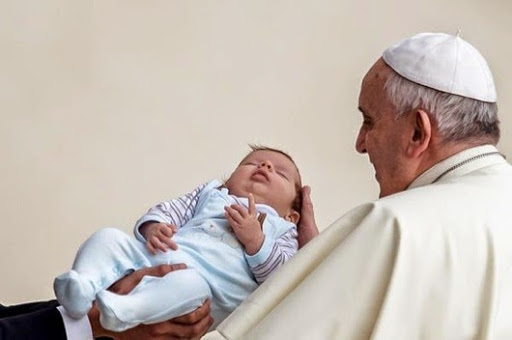
Pope baby

Putting to one side a variety of great interviews that I have come across over the course of the last day, my focus today will be on the summaries of the 10 working groups (“circoli minori”) that have worked on refining the “relatio post disceptationem” since it was published on Monday morning and that have presented their conclusions to the whole Synod today. The team preparing the final “relatio” of the Synod will now take these 10 sets of inputs and work over the next day and a half to arrive at the final document of the current, extraordinary Synod. This in turn will be the basis for work over the course of the following year, which in turn will provide an input to the pope following which he will take his decisions. It is a long process (thank God!) and one that allows for deep understanding and a shared journey to be traversed.

Before looking at the working group syntheses, let me just quote from Pope Francis’ homily from this morning, where he stresses the importance of giving praise to God and of remembering who we are in His eyes:

“Prayers of praise bring us the joy of being happy before the Lord. Let’s make a real effort to rediscover this! However, the starting point is remembering this choice: God chose me before the creation of the world.

This is impossible to understand or even imagine: The fact that the Lord knew me before the creation of the world, that my name was in the Lord’s heart. This is the truth! This is the revelation! If we do not believe this then we are not Christian! We may be steeped in a theist religiosity, but not Christian! The Christian is a chosen one, the Christian is someone who has been chosen in God’s heart before the creation of the world. This thought also fills our hearts with joy: I am chosen! It gives us confidence.

Our name is in God’s heart, is in God’s bowels, just as the baby is inside its mother. Our joy lies in our being elected. We cannot understand this with our head alone. We cannot understand this even with our heart. To understand this we must enter into the Mystery of Jesus Christ. The Mystery of His beloved Son: ‘He has poured out his blood for us in abundance, with all wisdom and intelligence, making known to us the mystery of His will’. And this is a third attitude to have: entering into the Mystery.”

It is with the above image of the human person that Francis arrives at the imperative to closeness, to accompanying, to a shared journey.

Turning to the working group summaries (which weigh in at 12K words), what I’d like to do is group their content into themes, rather than keep to an arrangement by working group.1

  1. An explicit setting out of the Christian understanding of marriage. The final document ought “to speak of human life, marriage and family life, as we know it to be revealed to us by God through reason and faith, both aided by the grace of God, [… to] proclaim the truth of the Gospel, the truth of human life and sexuality as revealed by Christ” [AA] “It is important that the Scriptural foundation for marriage, as well as the teaching found in Tradition, be made clear in the document from its beginning in order to build the framework for the issues to be discussed.” [AC] (+ [AB], [IA], [IB], [IC], [HB])
  2. An emphasis on the centrality of the Gospel. ““Listening” or “seeing” must always be through the lens of the Gospel.” [AA] (+ [AC], [IA], [IB], [IC])
  3. A need to evidence continuity. “The pastoral character of this Synod, ought to show even more clearly that there is no break between doctrine and pastoral care, but that the latter is based on the former and expresses its truth in the daily life of the Christian community. In the words of St. Gregory the Great: “Pastoral commitment is the proof of love.” […] This also implies the need to highlight that we are always faced with a progressive development of doctrine.” [IB]
  4. Being explicit about recognizing the need for change in imperfect situations. A call to “honestly recognizing and acknowledging sinful situations, and searching for ways to invite conversion of heart.” [AA] “It seems that there is a fear of expressing an opinion on several issues that have by now become dominant cultural expressions. This does not seem consistent with the prophetic mission of the Church.” [IB] “The Relatio [ought to] reiterate explicitly the doctrine on marriage, family and sexuality, without hesitating to relying on the categories of “sin” and “adultery” and “conversion,” with respect to situations which are objectively contrary to the Gospel of the family.” [IC]
  5. An emphasis on mercy. “All of us need the help of the mercy of God. The mercy of God is not just a medicine, much less a consolation prize, for those who fail. None of us can be faithful without experiencing God’s mercy. No one should devalue the place of mercy in the economy of salvation.” [AB] “The context of and the challenges of the family raise the need for the Church to repeat words of the Gospel combining hope with truth and mercy, looking to engage with the concrete lives of people, bringing about a re-emergence of the desire for God in them.” “The Gospel of mercy is an indispensable, integral part of truth itself and truth, therefore, can not be reduced to the mere observance of a pastoral attitude towards people.” [IC] “Knowing that the greatest mercy is to speak the truth with love (St. Augustine), we go beyond compassion. As merciful love attracts and unites, so it also transforms and exalts and calls to conversion. (cf. John 8:1– 11).” [HA]
  6. The need to clarify or more broadly apply the principle of graduality. To show that “we are not speaking of the GRADUALITY of DOCTRINE of faith and morals, but rather the gradual moral growth of the individual in his or her actions.” [AA] “The group expressed concern about an over emphasis on the term “positive elements” when speaking of civil marriage and cohabitation. It preferred language which would address the law of gradualness as a way to enter into a pastoral dialogue with [them]. […] The law of gradualness always involves a progression and a conversion towards the full ideal.” [AB] “We felt it necessary to carefully define the meaning of the law of gradualness, which should not be understood as gradualness of the law. Gradualness should not make insipid the challenge of the Gospel to conversion, to “go and sin no more”, as Jesus said to the woman caught in adultery. The aim of recognizing gradualness should be to draw people closer to Christ.” [AC] There is a danger that the principle of graduality “would make one think that the difficulties of married life ought to lead to a reduction of the full meaning of the vocation to marriage itself.” [IA] (+ [IC])
  7. An expression of support and encouragement for those who are living marriage faithfully. The relatio ought to “express words of encouragement and support to those who are faithfully living out their marriage vows and bringing up their families according to the teaching of the Church.” [AA] It ought “to provide an enthusiastic message which would encourage and inspire hope for those Christian families who despite many challenges and even failures – strive every day to live out faithfully and joyfully their mission and vocation within the Church and society. […] The main thrust should be to encourage those who are committed and witness to the Christian ideal and who struggle day by day, with the help of God’s grace to realize that ideal.” [AB] (+ [AC], [HA])
  8. A re-balancing of the document between problems and a positive message, in favor of the latter. “We should not fall into the trap of thinking, or in some way conveying, that marriage and family are a failure, no longer appropriate to our times.” [AC] (+ [AB], [IB], [HB])
  9. The presentation of an attractive message about the family. The relatio “should direct itself towards young people, to help them understand and be attracted by the Christian vision of marriage and the family, in a world in which they are exposed to many contradictory visions.” [AB] “We must not lose sight of the fact that there are many marriages that – despite the ups and downs of life – do radiate harmony and love, where children are raised in a safe environment, are nurtured and educated in virtue and the values taught to us by Christ, and where the family is truly a domestic Church.” [AC] Marriage is a ““mutual gift of self.” Like this a strong emphasis is given to Christ the Lord, Bridegroom of the Church: a spousal relationship that began with the Incarnation, made complete on Calvary and current for humanity through the gift of the Holy Spirit in the sacraments; only in this way are the beauty and attractiveness of spousal and family life made to shine as signs of the love of Christ.” [IA] The family is “a school for sanctification, in which the path of holiness of the spouses and of children is nurtured and followed[. It] must be a special nursery for vocations to the priesthood and the consecrated life. For these reasons, the Church proclaims the value and beauty of the family, by which it provides service to a world that yearns for illumination by the light of hope.” [IC] (+ [HB])
  10. A focus on openness to life. “In many areas of the world children are seen as a burden rather than a gift of God. The group stressed that children are really the supreme gift of marriage. Hence, while not making the other purposes of matrimony of less account, the true practice of conjugal love will help couples to be ready with generous hearts to cooperate with the love of the Creator who through them will enlarge and enrich His own family day by day.” [AB] (+ [HA])
  11. An emphasis on the mystical and self-giving nature of sex. “The gift of self in marriage, which in some way manifests the self-giving of Jesus Christ to his people, reaches its fullest expression in sexual intercourse, where the couple express their total giving of self to other, emotionally, physically and spiritually, and not as a selfish self-gratification. It is in such self-giving that we become more human and more Christ-like.” [AC] (+ [HA])
  12. Addressing the needs of older people. “The lengthening of life is creating situations of serious difficulty that the Church should not be unprepared for, but, on the contrary, should have a far-sighted perspective on, by offering pastoral commitments that make its presence and its closeness clear. There are households of elderly people reduced to poverty, lonely elderly people far from the rest of their family and households of elderly people deprived of hope, with the sole desire for death. These realities challenge us and require a credible answer. Our silence would be harmful.” [IB]
  13. An emphasis on the goodness found in all people. We want to “acknowledge that there are seeds of truth and goodness found in the persons involved [in lifestyles that do not lead to human fulfillment], and through dedicated pastoral care these can be appreciated and developed.” [AA] The ““desire for family” is sown by the Creator in the heart of every person, even those faithful who, for various reasons,do not live fully in line with the Word of Christ.” [IC] (+ [IA], [HA])
  14. An emphasis on being a welcoming Church. We have a “strong desire to invite and embrace sincere Catholics who feel alienated from the family of the Church because of irregular situations.” [AB] We want “to care for individuals with same sex attraction, providing for them in the family of the Church, always protecting their dignity as children of God, created in his image. Within the Church, they should find a home” [AB] “We rightly wish to welcome, without judgement or condemnation, those who, for some reason, are not yet able to express life-long commitment in a marriage between a man and a woman. We wish also to give them encouragement, to help them recognize their own goodness, and to care for them as Christ cares for his sheep. We wish them to know that they are loved by God and rejected neither by him nor the Church. […] The document must be a positive expression of the Church’s love for all people, the love which knows no bounds and which welcomes sinners and those who are made to be on the fringes of society.” [AC] (+ [HA])
  15. A reiteration of the need for accessible language. We must “use language which does not hurt people but which encourages them and helps them in their journey to God. It must speak the Truth of the Gospel clearly and directly, using language that cannot be interpreted by some to be condemning them, but rather expressing the Church’s deep interest and care for them.” [AA] “The group felt that it could well draw on the testimonies – and the language – of the lay men and women who addressed the Synod. […] The narrative [should not] end up marginalizing or discouraging those [who] are still struggling.” [AB] To “leverage on the positive elements that are already present in imperfect family experiences.” [IC]
  16. A variety of positions were taken with regard to the reception of the Eucharist by the divorced and remarried: some against [AA], others in favor of access on a case-by-case basis [AB], others proposing specific conditions under which it could be possible [IC], others asking for further study of the arguments [IA] [HB], while others did not mention it [AC], [IB], [HA].
  17. The suggestion for pastors to recognize their own failures “and their inadequacies in fostering support for families.” [AB]
  18. Emphasizing the positive role of lay movements. ([IB], [IC], [HA])
  19. Emphasizing the role of women. [IA]
  20. A recognition of the family as the subject of pastoral work. [IA] (+ [HA])
  21. Surprise at the publication of the “relatio post disceptationem”. [AC] [IC]

Finally, let me conclude with a passage that spoke to me particularly strongly, from the summary of the Anglicus B working group:

“Very often when we find the courage to knock on forbidden doors what we discover surprises us: what we encounter inside is the loving presence of God which helps us to address the challenges of today, no longer on our terms, but in new ways which might otherwise have been unimaginable. Knocking on forbidden or unaccustomed doors involves risk and courage. Fear and anxiety of what we think are forbidden doors may mean excluding opening ourselves to the God who always surprises.”


1 Since I don’t speak French, I’ll only look at 8 of the 10 groups here. Note also that I have tagged quotes with a two-letter code. The first letter indicates the language group: A – Anglicus (English), I – Italicus (Italian) and H – Hibericus (Spanish), and the second letter which of the two (A, B) or three (A, B, C) groups speaking the same language is meant. Indicating groups at the end of a point in brackets means that they too brought up a topic, even if I don’t quote them verbatim.

Synod14: Be open to God’s surprises

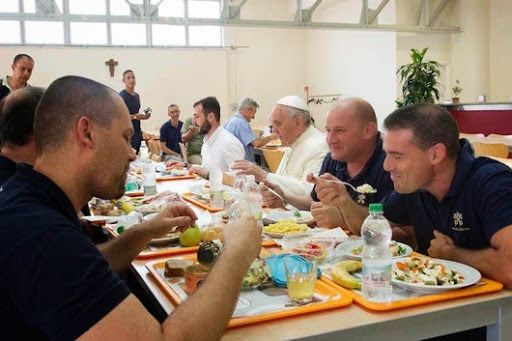
Cafeteria pope

Yesterday’s “relatio post disceptationem” has lead to an avalanche of reactions – many positive but many also very negative. Before looking at some of them, it is worth taking a look at Pope Francis’ beautiful homily (on Luke 11:29-32) at Santa Marta before the document was presented, since it further fleshes out his vision:

“Why were these Doctors of the Law unable to understand the signs of the times? Why did they demand an extraordinary sign (which Jesus later gave to them), why they did not understand? First of all, because they were closed. They were closed within their system, they had perfectly systemized the law, it was a masterpiece. Every Jews knew what they could do and what they could not do, how far they could go. It was all systemized. And they were safe there. […]

They did not understand that God is the God of surprises, that God is always new; He never denies himself, never says that what He said was wrong, never, but He always surprises us. They did not understand this and they closed themselves within that system that was created with the best of intentions and asked Jesus: ‘But, give us a sign’. And they did not understand the many signs that Jesus did give them and which indicated that the time was ripe. Closure! Second, they had forgotten that they were a people on a journey. On a path! And when we set out on a journey, when we are on our path, we always encounter new things, things we did not know.

And this should make us think: am I attached to my things, my ideas, [are they] closed? Or am I open to God’s surprises? Am I at a standstill or am I on a journey? Do I believe in Jesus Christ – in Jesus, in what he did: He died, rose again and the story ended there – Do I think that the journey continues towards maturity, toward the manifestation of the glory of the Lord? Am I able to understand the signs of the times and be faithful to the voice of the Lord that is manifested in them? We should ask ourselves these questions today and ask the Lord for a heart that loves the law – because the law belongs to God – but which also loves God’s surprises and the ability to understand that this holy law is not an end in itself.”

Even though Francis has not spoken during the Synod, other than opening it and setting the tone for the discussions, his daily homilies are very much aimed at it, and none more so than yesterday morning’s one. With that key in mind, let’s turn to his homily from this morning (on Luke 11:37-41):

“Jesus condemns this cosmetic spirituality, of appearing to be good, beautiful, but the truth inside is another thing! Jesus condemns the people of good manners but bad habits, of habits that can’t be seen but are done in secret. But the appearance is right: these people who liked to go for walks in the squares, to be seen praying, wearing the ‘make-up’ of a little weakness when fasting … Is the Lord like that? You saw that there are two, but related, adjectives that he uses here: greed and wickedness.

What counts is faith. But what faith? That which is ‘working through love’.1 Jesus says the same to the Pharisee. A faith that is not merely reciting the Creed: we all believe in the Father, the Son and the Holy Spirit, in eternal life … We all believe! But this is a static faith, not active. What is true in Jesus Christ is the actions that come from faith, or rather the faith that becomes active in love, that turns to alms. Alms in the broadest sense of the word: breaking away from the dictatorship of money, the idolatry of money. Every greed leads us away from Jesus Christ.”

Wow! This is truly a return to the Early Church and not the “laxity” or “modernism” for which yesterday’s “relatio” has been criticised so broadly and so harshly by many. It is, as Fr. Antonio Spadaro SJ, who said that “at the Synod one looks with the eyes of the shepherd who looks for every sheep, starting from the lost ones”2 and that “Today in the “relatio” we have seen a church that pays more attention to sowing seeds than to pulling out weeds.”3With all of the above under out belts, let’s look at the official notes from the free discussion that immediately followed the presentation of the “relatio” yesterday. To begin with it was acknowledged that the document represents the preceding week’s work well and that it:

“reveals the Church’s love for the family faithful to Christ, but also her capacity to be close to humanity in every moment of life, to understand that, behind the pastoral challenges, there are many people who suffer. The Synod, it was emphasised, should have the watchful gaze of the shepherd who devotes his life to his sheep, without a priori judgement.”

For the sake of balance, it was suggested that:

“while the Church must welcome those in difficulty, it would be useful to speak more widely about those families who remain faithful to the teachings of the Gospel, thanking them and encouraging them for the witness they offer. From the Synod it emerged more clearly that indissoluble, happy marriage, faithful for ever, is beautiful, possible and present in society, therefore avoiding a near-exclusive focus on imperfect family situations.”

Having the week’s summary also lead to the identification of important themes that haven’t received adequate coverage and it was suggested what is needed is:

“giving more emphasis to the theme of women, their protection and their importance for the transmission of life and faith; to include consideration of the figure of grandparents within the family unit; more specific reference to the family as a “domestic Church” and the parish as a “family of families”, and to the Holy Family, an essential model for reference. In this respect, it was also suggested that the family and missionary role in proclaiming the Gospel in the world be further promoted.”

The other interventions were focused on being careful about a sense of balance and of not loosing sight of what is good while being merciful to what is imperfect.

While the focus of the Synod has been very positive and optimistic, in my opinion, and my own impression of it is one of unreserved admiration and a joy because of the greater love that the Church will be able to show all – both within it and without,4 there have also been very negative reactions. And I believe it is important to hear them, try to understand them, and find ways to make their authors too feel welcome in the Church. Here the most prominent negative voice so far has been that of Archbishop Stanisław Gądecki, head of the Polish Bishops’ Conference, who said that the “relatio” is “not acceptable to many bishops,” that it “departs from the teaching of John Paul II, and even that traces anti-marriage ideology can be seen in it,” adding that:

“Our main task is to support the family pastorally, not to attack her, by exposing difficult situations that do exist, but that do not make up the core of the family itself and that do not do away with the need for support, which should be given a good, normal, ordinary families who are struggling not so much for survival as for faithfulness. […]

[The “relatio”], instead of presenting incentives for faithfulness, family values​​, seems to accept everything as is. It creates the impression that the teaching of the Church has been merciless, while it now starts a teaching of mercy.”


1 cf. Galatians 5:6.
2 cf. Luke 15:1-7.
3 cf. Matthew 13:24-30.
4 Not to mention that this kind of opening is precisely what I have been hoping for when Pope Francis was elected :).

Synod14: God does not discriminate

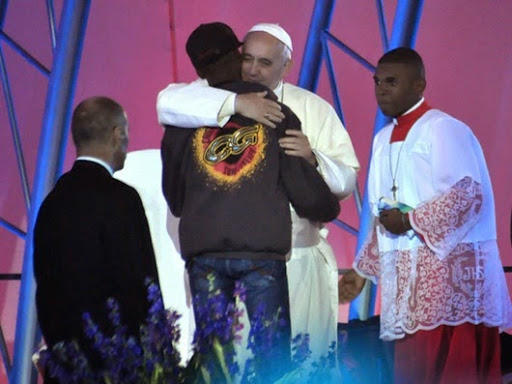
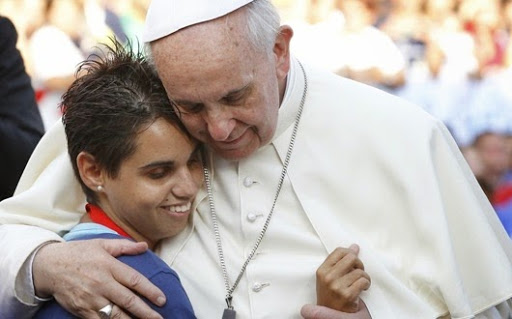
Pope Francis embraces a young man at World Youth Day Rio in 2013

Even though there haven’t been any press conferences or synodal meetings today, more interviews with Synod Fathers have been published over the course of the last day.

Probably the most dramatic have been the words of Archbishop Diarmuid Martin of Dublin, who pointed to significant changes: “[T]his synod cannot simply repeat what was said twenty years ago. It has to find new language, to show that there can be development of doctrine, and that there has been a willingness to listen to what emerged in the questionnaires that went out and what emerged in the synod itself.” He then went on to emphasize the inherent reality of marriage as opposed to its being though of as an imposed teaching:

“There’s a move away from simply an understanding of the church’s teaching on marriage as something that is taught to people – and a greater understanding of the fact that sacramental marriage is an ecclesial reality.

It’s not just a blessing on two spouses. The couple who are married sacramentally develop an ecclesial status for their own lives, but also, as in every other sacrament, for the building of the church.

So in many ways we have to find a way in which the lived experience of this ecclesial reality of marriage … is almost in its own way something that the church learns from rather than simply tries to carry out an external survey of it. That’s certainly one of the changes.”

Finally, Archbishop Martin underlined the need for recognizing the good in people’s lives:

“I meet people in my diocese every, including the poorest people, who live in very difficult situations, and who truly live the values ​​of loyalty, dedication to their children, but they would never be able to express this using the formulations of our theology: but this does not mean they do not live their reality. We need to have a new kind of dialogue with families and a new language.”

The very positive spirit of the Synod can also be felt from comments made by Bishop Oscar Gerardo Fernández Guillén, head of the Bishops’ Conference of Costa Rica who said:

“Even though we face dramatic situations and it could seem like all is lost, that is now how it is. Let us go to the Lord with a humble attitude: He will know how to sustain us and know how to carry us forward.”

The Venezuelan Archbishop Diego R. Padrón Sánchez was equally positive:

“We must announce the joy of living in a family. We are all Church and that is how we must also feel. The Church does not discriminate against anyone, least of all against those who are facing difficulties.”

Cardinal Zenon Grocholewski, prefect of the Congregation for Catholic Education, argued for the need present Christian anthropology in a way shares its beauty:

“I think that the anthropology that we have, and therefore the concept of marriage, is really fantastic, brilliant. If we could explain this to the world of today, it would be a great success. Many do not understand the concept of natural law, but this is fundamentally about understanding what is right and good, according to the light of human reason, for people, for humanity and the long term. It is not, in fact, about ensuring temporary, short-lived pleasure, but about what is good for humanity, for certain progress, for the growth of humanity. We can now see a big gap between scientific and technical progress and, on the other hand, the disgrace regarding the growth of people: there is so much hunger in the world, so many wars, so much hatred, such a lack of respect for people, and we see so much persecution. We have to think of the welfare of humanity. We must not think only of well-being technically, but of that of the human being. I think that this Synod will go in the following direction: how to help people today to live better, to contribute to real progress.”

Cardinal Angelo Scola of Milan, also spoke very clearly about a need for change with regard to homosexual persons: “There is no doubt that we have been slow in assuming a fully respectful view of the dignity and equality of homosexuals.” With regard to communion for the divorced and civilly remarried, Cardinal Scola expressed clear doubts though:

“Personally, on a substantial level, I can not find an answer yet to the possibility that [the divorced and civilly remarried] could have access to sacramental communion without this clashing with the indissolubility of marriage. In short, indissolubility either has an impact on the reality of daily life, or remains a Platonic idea.”

The highlight of today, and the strongest indicator that substantial changes are on the horizon, has been Pope Francis’ magisterial Angelus address, where he insists on God not discriminating against anyone and explaining today’s Gospel reading about the parable of the wedding feast (Matthew 22:1-14) thus:

“Jesus speaks about the answer given to God’s invitation – represented by a king – to attend a wedding banquet. The invitation has three characteristics: gratuity, scale, and universality. Those invited are many, but something surprising happens: none of the selected ones agree to take part in the celebration, saying that they have something else to do; indeed showing some indifference, alienation, even annoyance. God is good to us, freely offering us his friendship, his joy, salvation, but often it is us who do not accept his gifts, we place our material concerns, our interests in the first place and also when the Lord calls us, it often seems to bother us.

Some guests even mistreat and kill the servants who deliver the invitation. But, despite a lack of reception on the part of those who are called, God’s plan is not interrupted. Faced with the refusal of the first guests, he does not lose heart, does not cancel the party, but extends his invitation beyond all reasonable limits and sends his servants into the streets and to the crossroads to gather all those they find. It is ordinary people, the poor, abandoned and destitute, both the good and and bad – yes, even those who are bad are invited – without distinction. And the hall is filled with the “excluded”. The Gospel, rejected by someone, find an unexpected warm welcome in so many other hearts.

The goodness of God has no boundaries and does not discriminate against anyone: this is why the feast of the Lord’s gifts is universal, for all. Everyone is given the opportunity to respond to his invitation, to his call; no one has the right to feel privileged or to an exclusive claim. All this leads us to overcome the habit of positioning ourselves comfortably in the middle, as did the chief priests and the Pharisees. This mustn’t be done; we must open ourselves to the peripheries, recognizing that even those who are on the margins, even one who is despised and rejected by society, is an object of God’s generosity. We are all called to not reducing the Kingdom of God to the confines of a “little church” – our “tiny little church” – but to widen the Church to the scale of the Kingdom of God. There is only one condition: to wear a wedding dress, which is showing love towards God and neighbor.”

Wow!

Synod14: Mercy, compassion and comprehension

Synod

As has been the case all week, interviews with synod participants emerge after the day’s sessions conclude, and yesterday saw comments from several of the Synod Fathers regarding the need to refresh the language used by the Church.

Cardinal André Vingt-Trois argued that the language used today is akin to the “technical” language used by physicians and that it is necessary to:

“find modes of expression and modes of communication that will allow [the Church] to announce the good news so that it may be heard. When a physician makes a diagnosis, he uses terms to designate precisely the disease in question, but these terms, if he tells them to the patient, he will not understand them. Therefore, he must explain the diagnosis with words that are not technical words. In theology, it is the same thing. When one addresses people to announce the good news of Christ, one does not teach a theology course. One tells them the contents of the theology but with a vocabulary they can understand. I was a professor of theology. When I taught a theology course, I did not give a sermon; that is another literary genre.”

Comments made in September by Bishop Johann Bonny of Antwerp, Belgium also underlined that couples living in irregular circumstances:

“deserve more respect and a more nuanced evaluation than the language of certain church documents appears to prescribe. The mechanisms of accusation and exclusion they have the potential to activate can only block the way to evangelization.”

And an interview with Cardinal Christoph Schönborn contained further reference to a change of mindset to one where the good is appreciated even amidst imperfection and taken as a starting point:

“I can look at an imperfect situation from two sides, and both sides are justified. I can look at what is missing, and I can see what is already there. When couples live together in a stable, faithful relationship, one could say that is not a sacramental marriage, that there is something missing, but one could also say that it is a beginning, that there is already something there. Pope Francis had encouraged the Austrian bishops to look at what was already there and to accompany it towards something more complete and more perfect.”

Cardinal Reinhard Marx applied the same optics to gay relationships:

“One simply cannot say that a faithful homosexual relationship that has held for decades is nothing, as that is too “forceful” a standpoint. We just mustn’t lump things together and measure everything with the same yardstick, but must differentiate and take a closer look, which doesn’t mean that I endorse homosexuality as a whole.”

Cardinal Donald Wuerl then commented on the big picture within which the above considerations of language and the recognition of the good are set:

“I think what’s becoming more and more, at least, in my mind, it’s one thing to doctrinally state the obvious. It’s another thing to take that and get it to work in the concrete order where people live.

Now you don’t deny the doctrine, in any way, but you have to make it apply to people. That’s going to be the challenge, and I think that’s what the Holy Father is calling us to do.

He’s saying, We know this, we believe this, this is what is at the heart of our teaching. But how do you meet people where they are? And bring them as much of that as they can take, and help them get closer?

That’s going to be the challenge. That’s going to be the really difficult part. How do you help people live all the beauty of family life when some of them may not have experienced what we know to be family?”

Yesterday afternoon then saw an important move by Pope Francis (that I’d characterise as “stacking the deck,” which is not to suggest anything underhand, since the Synod is not a democratic process, but one of joint listening to the Holy Spirit and discernment, where the decisions that follow are taken by the Pope), when he appointed six additional members to the committee that will write the final report of the Synod – the “Relatio Synodi.” The new members are:

Cardinal Gianfranco Ravasi, president of the Vatican’s Pontifical Council for Culture.
Cardinal Donald W. Wuerl, archbishop of Washington, D.C., appointed recently by Pope Francis to the Congregation for Bishops.
Archbishop Victor Manuel Fernandez, rector of the Pontifical Catholic University of Argentina.
Archbishop Carlos Aguiar Retes of Mexico, president of CELAM, the Latin American bishops’ conference.
Archbishop Peter Kang U-Il of South Korea.
Father Adolfo Nicolás Pachón of Spain, superior general of the Jesuit order.

If you have been reading this blog at all, or even if you have only seen an earlier post on the Synod, it should be clear what this choice means for the document that is due on Monday.

Yesterday afternoon also saw the 10th and final of this week’s sessions, where “fraternal delegates” (i.e., representatives of other churches) spoke. Here the official notes expressed a great consensus among all speakers that the challenges facing the family are common to all Christians. The need for appropriate marriage preparation was a common theme too as was the desire to practice compassion, mercy and comprehension:

“[I]t is essential to listen to those who find themselves in difficult family situations, who are in need of mercy and compassion every day, as the Church wishes always to help those who suffer, looking both at the Sacred Scriptures and at the problems of contemporary life. […] The wish was expressed for listening and comprehension, far from any form of condemnation, in relation to homosexual persons, while emphasising that marriage is a union between a man and a woman. Particular attention was shown towards children born in difficult context and for all victims of violence, especially women and minors, as the defence of the most vulnerable, of those who have no voice of their own – believers or otherwise – is common to all Christians.”

Some differences were presented too:

“for example on the theme of birth control, underlining the freedom of conscience of believers, while always respecting the meaning of love and marriage. Furthermore, in relation to second marriages, it was said by the Orthodox delegates that these in any case constitute a deviation and while they are celebrated, it is after a period of accompaniment on the part of the Church in an attempt to bring married couples towards reconciliation.”

Synod14: Speak clearly, don’t be afraid to offend me

Francis hug

Today saw the first two sessions (“congregations” in Vatican-speak) of the two-week-long extraordinary bishops’ Synod on the family, and I would just like to pick out a couple what I saw as their highlights. First, however, it is worth going back to yesterday’s opening mass of the Synod, when Pope Francis had some warnings for his brother bishops, that clearly set the tone that he expects from the next two weeks’ work:

“The temptation to greed is ever present. […] Greed for money and power. And to satisfy this greed, evil pastors lay intolerable burdens on the shoulders of others, which they themselves do not lift a finger to move (cf. Mt 23:4)

We too, in the Synod of Bishops, are called to work for the Lord’s vineyard. Synod Assemblies are not meant to discuss beautiful and clever ideas, or to see who is more intelligent… They are meant to better nurture and tend the Lord’s vineyard, to help realize his dream, his loving plan for his people. In this case the Lord is asking us to care for the family, which has been from the beginning an integral part of his loving plan for humanity.

We are all sinners and can also be tempted to “take over” the vineyard, because of that greed which is always present in us human beings. God’s dream always clashes with the hypocrisy of some of his servants. We can “thwart” God’s dream if we fail to let ourselves be guided by the Holy Spirit. The Spirit gives us that wisdom which surpasses knowledge, and enables us to work generously with authentic freedom and humble creativity.”

This morning, more along good cop lines, his brief opening remarks then presented the method he would like participants to follow, which builds on clarity, openness, boldness (parrhesia) and tranquility:

“A basic general condition is this: to speak clearly. No one must say: “This can’t be said; he will think of me this way or that …” It is necessary to say everything that is felt with parrhesia. After the last Consistory (February 2014), in which there was talk of the family, a Cardinal wrote to me saying: too bad that some Cardinals didn’t have the courage to say some things out of respect for the Pope, thinking, perhaps, that the Pope thought something different. This is not good; this is not synodality, because it is necessary to say everything that in the Lord one feels should be said, with human respect, without fear. And, at the same time, one must listen with humility and receive with an open heart what the brothers say. Synodality will be exercised with these two attitudes.

Therefore, I ask you, please, for these attitudes of brothers in the Lord: to speak with parrhesia and to listen with humility.

And do so with much tranquillity and peace, because the Synod always unfolds cum Petro et sub Petro, and the Pope’s presence is the guarantee for all and protection of the faith.”

The first session then saw Cardinal Erdő present a 7.5K-word opening document – the “relatio ante disceptationem” – that is effectively the first follow-up to the “Instrumentum Laboris” in which the results of the preceding worldwide questionnaire were summarised. Erdő’s report is based on the written contributions made by the Synod Fathers ahead of the Synod’s opening and, together with the discussions that will last all this week and then in smaller groups next week, it will contribute to the final document that will be submitted to Pope Francis at the conclusion of this process.

As you’d expect, Erdő’s report broadly follows the structure of the Instrumentum Laboris, kicking off with an assessment of the challenges faced today on an individual level:

Many people today have difficulty in thinking in a logical manner and reading lengthy documents. We live in an audio-visual culture, a culture of feelings, emotional experiences and symbols. […]

Many look upon their lives not as a life-long endeavour but a series of moments in which great value is placed on feeling good and enjoying good health. From this vantage point, any firm commitment seems insurmountable and the future appears threatening, because it may happen that in the future we will feel worse. Even social relationships may appear as limitations and obstacles. Respect and “seeking the good” of another person can even call for sacrifice. Isolation is oftentimes linked, therefore, with this cult of a momentary well-being.

How this general disposition (which would not have come as a surprise to Aristippus or Epicurus some 2400 years ago) impacts the position and perception of marriage is addressed next, where there is a balance between challenges and the persistent beauty of the Church’s central teaching:

Avoiding marriage is seen as not only a sign of individualism but also a symptom of the crisis of a society already burdened by formalisms, obligations and bureaucracy. […]

The obligations arising from marriage must not be forgotten, but seen as the demands of the gift which the gift itself makes possible. […]

[The Church’s] teaching [on the family] enjoys a broad consensus among practicing Catholics. This is the case, particularly with regard to the indissolubility of marriage and its sacramental nature among those who are baptized. The teaching on the indissolubility of marriage as such is not questioned. Indeed, it is unchallenged and for the most part observed also in the pastoral practice of the Church with persons who have failed in their marriage and seek a new beginning.

Homosexuality, gender-based discrimination and gender theory get covered next, with a refreshing degree of frankness:

[T]here is a broad consensus that people with a homosexual orientation should not be discriminated against, as reiterated in The Catechism of the Catholic Church (2357-2359). Secondly, it is quite clear that the majority of the baptized — and all episcopal conferences — do not expect that these relationships be equated with marriage between a man and a woman, nor is there a consensus among a vast majority of Catholics on the ideology of gender theories. […]

[M]any want to see a change in the traditional roles in society which are culturally conditioned and in discrimination against women, which continues to be present, without denying, in the process, the differences by nature between the sexes and their reciprocity and complementarity.

The focus is then broadened to a societal level and an acute analysis of the external pressures incident on the family is presented:

We are not dealing with only problems involving individual behaviour but the structures of sin hostile to the family, in a world of inequality and social injustice, of consumerism, on the one hand, and poverty, on the other. Rapid cultural change in every sphere is distorting families, which are the basic unit of society, and putting into question the traditional family culture and oftentimes destroying it. On the other hand, the family is fast becoming the last welcoming human reality in a world determined almost exclusively by finance and technology. A new culture of the family can be the starting point for a renewed human civilization. […]

The widespread difficulty in creating a serene atmosphere of communication in some families is due to multiple factors: business and economic worries; differing views on the upbringing of children from various models of parenting; a reduction in time for dialogue and relaxation. In addition, there are disruptive factors like separation and divorce, with the consequences of a blended family, and, conversely, single parenting, where a relationship with the other parent is confused or limited, if not totally absent. Finally, this lack of communication can result from a widespread selfish mentality that closes in upon itself, with the disturbing consequence of the practice of abortion. The same selfishness can lead to the false idea of parents that children are objects or their property, who can be produced by them as they desire.

Then comes one of my favourite part, where the need for accompanying, for inclusion and for the proclamation of God’s fatherhood and the Church’s motherhood follows:

[T]hought needs to be given on how best to accompany people who find themselves in these situations [of marriage difficulty], so they do not feel excluded from the life of the Church. Finally, forms and suitable language needs to be devised to proclaim that all are and remain God’s children and are loved by God the Father and the Church as Mother. […]

Indeed, God never tires of forgiving the sinner who repents and he does not tire of giving him this possibility again and again. This mercy is not a justification to sin but rather the sinner’s justification, to the extent that he converts and aims to sin no more.

Mercy then gets the central place is requires, with a beautifully succinct paragraph:

Mercy, the central theme of the God’s revelation, is highly important as a hermeneutic for the Church’s actions (cf. Evangelii gaudium, 193 ff.). Certainly, she does not do away with truth nor relativize it, but seeks to interpret it correctly in the hierarchy of truths (cf. Unitatis redintegratio, 11; Evangelii gaudium, 36-37). Nor does she do away with the demands of justice. Consequently, mercy does not take away the commitments which arise from the demands of the marriage bond. They will continue to exist even when human love is weakened or has ceased. This means that, in the case of a (consummated) sacramental marriage, after a divorce, a second marriage recognized by the Church is impossible, while the first spouse is still alive.

Another highlight then is the following section, where the good that is there in civil marriages and even in some forms of cohabitation is called out. This is very much in the spirit of Evangelii Gaudium, where Pope Francis calls for a discernment of what there is of God in every context:

[A] new dimension of pastoral care of the family today reveals itself through considering the reality of civil marriages and, despite the differences, even cohabitation. Consequently, when these relationships are obviously stable in a publicly recognized legal bond, they are characterized by deep affection, display a parental responsibility towards their offspring and an ability to withstand trials and they can be seen as a seed to be nurtured on the path towards celebrating the Sacrament of Marriage. […] The Church cannot fail to take advantage of an opportunity, even in situations which, at first sight, are far from satisfying the criteria of the Gospel, and to draw close to people in order to bring them to a conscious, true and right decision about their relationship.

After an extensive coverage of how the challenges facing those who got divorced and civilly remarried, the report says something that I find tremendously positive and a great example of how we, Catholics, can also look to other Christian churches for inspiration:

The Instrumentum laboris relates that some responses suggest further examining the practice of some of the Orthodox Churches, which allows the possibility of a second or third marriage, marked by a penitential character (cf. 95). Examining this matter is necessary to avoid any questionable interpretations and conclusions which are not sufficiently well-founded. In this regard, studying the history of the discipline of the Churches in the East and West is important. Possible contributions might also come from considering the disciplinary, liturgical and doctrinal traditions of the Eastern Churches.

Finally, Cardinal Erdő’s report concludes with a crescendo:

If we look at the origins of Christianity, we see how it has managed — despite rejection and cultural diversity — to be accepted and welcomed for the depth and intrinsic force of its message. Indeed, Christian revelation has manifested the dignity of the person, not to mention love, sexuality and the family.

The challenge for this synod is to try to bring back to today’s world, which in some way resembles that of the early days of the Church, the attractiveness of the Christian message about marriage and the family, highlighting the joy which they give, but, at the same time, respond, in a true and charitable way (cf. Eph 4:15), to the many problems which have a special impact on the family today and emphasizing that true moral freedom does not consists in doing what one feels or living only by one’s feelings but is realized only in acquiring the true good.

In a real way, we are called upon, above all, to put ourselves alongside our sisters and our brothers in the spirit of the Good Samaritan (cf. Lk 10: 25-37): being attentive to their lives and being especially close to those who have been “wounded” by life and expect a word of hope, which we know only Christ can give us (cf. Jn 6:68).

Francis in Korea: Come to my house, enter my heart

140818151053 pope comfort women s036314271 story tablet

Three weeks ago Pope Francis made a five-day visit to South Korea where he again spoke with great clarity about a number of topics and where he gave witness to the Good News of the Gospel by actions at least as much as by words. Instead of providing a comprehensive account of the trip, which can be found in many other places, I would just like to bring together my favorite passages from the around 15 talks he gave there.

Upon his arrival, Francis presented his approach to diplomacy:

“The quest for peace also represents a challenge for each of us, and in a particular way for those of you dedicated to the pursuit of the common good of the human family through the patient work of diplomacy. It is the perennial challenge of breaking down the walls of distrust and hatred by promoting a culture of reconciliation and solidarity. For diplomacy, as the art of the possible, is based on the firm and persevering conviction that peace can be won through quiet listening and dialogue, rather than by mutual recriminations, fruitless criticisms and displays of force.”

Followed by a reflection on how peace, justice and development are interrelated:

“Peace is not simply the absence of war, but “the work of justice” (cf. Is 32:17). And justice, as a virtue, calls for the discipline of forbearance; it demands that we not forget past injustices but overcome them through forgiveness, tolerance and cooperation. It demands the willingness to discern and attain mutually beneficial goals, building foundations of mutual respect, understanding and reconciliation. May all of us dedicate these days to peace, to praying for it and deepening our resolve to achieve it.”

And finally, he underlined the universal need of being heard:

“How important it is that the voice of every member of society be heard, and that a spirit of open communication, dialogue and cooperation be fostered. It is likewise important that special concern be shown for the poor, the vulnerable and those who have no voice, not only by meeting their immediate needs but also by assisting them in their human and cultural advancement.”

Later that same day, when addressing the Korean bishops, Francis warned them against becoming an affluent, middle class Church where the poor do not feel at home and that becomes mediocre:

“There is a danger, a temptation which arises in times of prosperity: it is the danger that the Christian community becomes just another “part of society”, losing its mystical dimension, losing its ability to celebrate the Mystery and instead becoming a spiritual organization, Christian and with Christian values, but lacking the leaven of prophecy. When this happens, the poor no longer have their proper role in the Church. This is a temptation from which particular Churches, Christian communities, have suffered greatly over the centuries; in some cases they become so middle class that the poor even feel ashamed to be a part of them. It is the temptation of spiritual “prosperity”, pastoral prosperity. No longer is it a poor Church for the poor but rather a rich Church for the rich, or a middle class Church for the well-to-do. Nor is this anything new: the temptation was there from the beginning. Paul had to rebuke the Corinthians in his First Letter (11:17), while the Apostle James was even more severe and explicit (2:1-7): he had to rebuke these affluent communities, affluent Churches for affluent people. They were not excluding the poor, but the way they were living made the poor reluctant to enter, they did not feel at home. This is the temptation of prosperity. I am not admonishing you because I know that you are doing good work. As a brother, however, who has the duty to confirm his brethren in the faith, I am telling you: be careful, because yours is a Church which is prospering, a great missionary Church, a great Church. The devil must not be allowed to sow these weeds, this temptation to remove the poor from very prophetic structure of the Church and to make you become an affluent Church for the affluent, a Church of the well-to do – perhaps not to the point of developing a “theology of prosperity” – but a Church of mediocrity.”

The next day, on 15th August, Francis had his first meeting with youth gathered from all over Asia, where he first recalled the need for the Church to “be a seed of unity for the whole human family,” and then proceeded to reflect on an experience shared before his address that was about the challenges of discerning one’s vocation:

“What Marina said really struck me: about the conflict she felt in her life. What to do in this situation? Take up the path of consecrated life, religious life, or study to be better able to help others.

This is only an apparent conflict, because when the Lord calls, he always does so for the good of others, whether it is through the religious life, the consecrated life, or as a lay person, as the father or mother of a family. The goal is the same: to worship God and to do good to others. What should Marina do, and the many others of you who are asking the same question? I once asked it myself: What path should I choose? But you do not have to choose any path! The Lord must choose it! Jesus has chosen it! You have to listen to him and ask: Lord, what should I do?

This is the prayer that a young person should make: “Lord what do you want from me?” With prayer and the advice of some good friends – laity, priests, religious sisters, bishops, popes (even the Pope can offer some good advice!) – you can find the path that the Lord wants for you.”

He then went on to underline the fundamental simplicity of love:

“The path of love is simple: love God and love your neighbor, your brother or sister, the one at your side, who needs love and so many other things. “But Father, how do I know that I love God?” Only if you love your neighbor, if you do not hate your neighbor and do not harbor hatred in your heart, do you love God. This is the sure proof.”

Later that day Francis paid a surprise visit to the Jesuit HQ in Korea, where he said the following to his brothers:

“There are no wounds that can’t be consoled by the love of God. This is how we must live: seeking Jesus Christ so that we may carry this love to consoling wounds, healing wounds. […] God always consoles, always waits, always forgets, always forgives. There are many wounds in the Church. Wounds that are often provoked by ourselves, practicing Catholics and ministers of the Church.

Don’t tell off the people of God anymore! Console the people of God! Often our clerical attitudes lead to clericalism that harms the Church so much. Being a priest does not result in the status of public officials, but of shepherd. Please, be shepherds and not public officials. And when you are in the confessional, remember that God never tires of forgiving. Be merciful!”

Two days later, Francis met bishops from all over Asia to whom he spoke about the simultaneous need for a clear sense of one’s own identity and of openness and receptivity to others, as the basis for dialogue:

“But in undertaking the path of dialogue with individuals and cultures, what should be our point of departure and our fundamental point of reference, which guides us to our destination? Surely it is our own identity, our identity as Christians. We cannot engage in real dialogue unless we are conscious of our own identity. We can’t dialogue, we can’t start dialoguing from nothing, from zero, from a foggy sense of who we are. Nor can there be authentic dialogue unless we are capable of opening our minds and hearts, in empathy and sincere receptivity, to those with whom we speak. In other words, an attentiveness in which the Holy Spirit is our guide. […] And if our communication is not to be a monologue, there has to be openness of heart and mind to accepting individuals and cultures. Fearlessly, for fear is the enemy of this kind of openness.”

And he proceeded to warn against becoming bogged down in formalism, superficiality and easy answers:

“Without a grounding in Christ, the truths by which we live our lives can gradually recede, the practice of the virtues can become formalistic, and dialogue can be reduced to a form of negotiation or an agreement to disagree. An agreement to disagree… so as not to make waves… This sort of superficiality does us great harm. […] Then […] there is [… another] temptation: that of the apparent security to be found in hiding behind easy answers, ready formulas, rules and regulations. Jesus clashed with people who would hide behind laws, regulations and easy answers… He called them hypocrites. Faith by nature is not self-absorbed; it “goes out”. It seeks understanding; it gives rise to testimony; it generates mission. In this sense, faith enables us to be both fearless and unassuming in our witness of hope and love. Saint Peter tells us that we should be ever ready to respond to all who ask the reason for the hope within us (cf. 1 Pet 3:15). Our identity as Christians is ultimately seen in our quiet efforts to worship God alone, to love one another, to serve one another, and to show by our example not only what we believe, but also what we hope for, and the One in whom we put our trust (cf. 2 Tim 1:12).”

Next, Francis insisted on the need for acceptance of others (“Come to my house, enter my heart.”) which has a profound basis in Jesus’ incarnation and in us all being children of the one Father. Empathy and a welcoming of others are core to Christianity and fear for one’s own identity is wholly unwarranted:

“[T]ogether with a clear sense of our own Christian identity, authentic dialogue also demands a capacity for empathy. For dialogue to take place, there has to be this empathy. We are challenged to listen not only to the words which others speak, but to the unspoken communication of their experiences, their hopes and aspirations, their struggles and their deepest concerns. Such empathy must be the fruit of our spiritual insight and personal experience, which lead us to see others as brothers and sisters, and to “hear”, in and beyond their words and actions, what their hearts wish to communicate. In this sense, dialogue demands of us a truly contemplative spirit of openness and receptivity to the other. I cannot engage in dialogue if I am closed to others. Openness? Even more: acceptance! Come to my house, enter my heart. My heart welcomes you. It wants to hear you. This capacity for empathy enables a true human dialogue in which words, ideas and questions arise from an experience of fraternity and shared humanity. If we want to get to the theological basis of this, we have to go to the Father: he created us all; all of us are children of one Father. This capacity for empathy leads to a genuine encounter – we have to progress toward this culture of encounter – in which heart speaks to heart. We are enriched by the wisdom of the other and become open to travelling together the path to greater understanding, friendship and solidarity. “But, brother Pope, this is what we are doing, but perhaps we are converting no one or very few people…” But you are doing it anyway: with your identity, you are hearing the other. What was the first commandment of God our Father to our father Abraham? “Walk in my presence and be blameless”. And so, with my identity and my empathy, my openness, I walk with the other. I don’t try to make him come over to me, I don’t proselytize. Pope Benedict told us clearly: “The Church does not grow by proselytizing, but by attracting”. In the meantime, let us walk in the Father’s presence, let us be blameless; let us practice this first commandment. That is where encounter, dialogue, will take place. With identity, with openness. It is a path to greater knowledge, friendship and solidarity. As Saint John Paul II rightly recognized, our commitment to dialogue is grounded in the very logic of the incarnation: in Jesus, God himself became one of us, shared in our life and spoke to us in our own language (cf. Ecclesia in Asia, 29).”

And finally, Francis places the importance of a shared journey above the others’ conversion and distances the Church from ideas of conquest:

“I am not referring to political dialogue alone, but to fraternal dialogue… “But these Christians don’t come as conquerors, they don’t come to take away our identity: they bring us their own, but they want to walk with us”. And the Lord will grant his grace: sometimes he will move hearts and someone will ask for baptism, sometimes not. But always let us walk together. This is the heart of dialogue.

The next day, during a meeting with religious leaders, Francis returns to the importance of shared journeying:

“Life is a journey, a long journey, but a journey which we cannot make by ourselves. We need to walk together with our brothers and sisters in the presence of God. So I thank you for this gesture of walking together in the presence of God: that is what God asked of Abraham. We are brothers and sisters. Let us acknowledge one another as brothers and sisters, and walk together.”

And finally, during the flight back to Rome, Francis again answers questions put to him there and then by the journalists on board, where three stood out for me in particular. First, in response to being asked about whether he isn’t concerned that his gesture of wearing a yellow ribbon (a sign of solidarity with the victims of the Sewol ferry disaster) might be misunderstood politically, Francis answers:

“Whenever you find yourself facing human suffering, you have to do what your heart tells you to. Then people will say: “He did it for this or that political reason”; let them say what they want. But when you think of these men and woman, these fathers and mothers who have lost their children, their brothers and sisters, of the immense pain of such a disaster, I don’t know, my heart.. I am a priest and I feel the need to draw near! That’s how I feel; that is the first thing. I know that the comfort that any word of mine might give is no cure, it doesn’t bring the dead back to life, but human closeness at these times gives us strength, there is solidarity… […] I would like to add something. I took this (holding up a ribbon). After I carried it for half a day – I took it for solidarity with them – somebody came up to me and said: It’s better to take that off… You should be neutral …” “But listen, where human suffering is involved, you can’t be neutral”. That was my answer; that’s how I feel.”

Second, in response to a question about military intervention in Iraq and also addressing the topic of torture, Francis says:

“Thank you for your very clear question. In these cases, where there is an unjust aggression, I can only say that it is licit to stop the unjust aggressor. I emphasize the word: “stop”. I’m not saying drop bombs, make war, but stop the aggressor. The means used to stop him would have to be evaluated. Stopping an unjust aggressor is licit. But we also need to remember! How many times, with this excuse of stopping an unjust aggressor, the powers have taken over peoples and carried on an actual war of conquest! One nation alone cannot determine how to stop an unjust aggressor. After the Second World War, there was the idea of the United Nations: that is where discussion was to take place, to say: Is this an unjust aggressor? It would seem so. How do we stop him?” This alone, nothing else. Second, minorities. Thanks for using that word. Because people say to me: “the Christians, the poor Christians…” And it is true, they are suffering, and martyrs, yes, there are many martyrs. But there are also men and women, religious minorities, not all Christians, and all are equal before God. To stop an unjust aggressor is a right of humanity, but it is also a right of the aggressor to be stopped in order not to do evil. […]

Today, torture is an almost, I would say, ordinary means used in intelligence work, in trials… And torture is a sin against humanity, it is a crime against humanity. And to Catholics, I say: to torture a person is a mortal sin; it is a grave sin, but even more, it is a sin against humanity.”

And third, in a question about his upcoming encyclical on ecology, Francis spoke again about the relationship between science and faith, being more specific about how he sees the value of science in the context of this document of Catholic teaching:

“[T]here are also scientific hypotheses [to be taken into account], some of them quite solid, others not. In this kind of encyclical, which has to be magisterial, one can only build on solid data, on things that are reliable. If the Pope says that the earth is the centre of the universe, and not the sun, he errs, since he is affirming something that ought to be supported by science, and this will not do. That’s where we are at now. We have to study the document, number by number, and I believe it will become smaller. But to get to the heart of the matter and to what can be safely stated. You can say in a footnote: “On this or that question, there are the following hypotheses…”, as a way of offering information, but you cannot do that in the body of encyclical, which is doctrinal and has to be sound.”

Who are children of God?

45460002 aboud mustafa jamie areen avery2

Catholics? Christians? “Good” people?

No.

In total disagreement with the author of yesterday’s “Thoughts on today’s Mass,” distributed in my parish, who said that “we are not naturally children of God: we become so by baptism, when God adopts us as his own. Otherwise to call God our Father would be a bold presumption,” I would like to show that the Catholic Church teaches that every single human being is a child of God. Using the idea of being God’s child as the basis of separation, the basis of an “us,” as opposed to a ”them,” is perverse and absolutely not what the Catholic Church teaches, in spite of the official-looking material handed out in some of its parishes.

To begin with, Jesus – the Son of God – himself recognizes familial status universally, when he says that “whoever does the will of my heavenly Father is my brother, and sister, and mother” (Matthew 12:50) and St. Paul too picks up on the key being adherence to God’s will: “For those who are led by the Spirit of God are children of God” (Romans 8:14).

That such adherence to the will of God is open to everyone – whether they believe in God or not – and that it is at the heart of what the Catholic Church believes, is very clear from Nostra Aetate, the declaration issued during the Second Vatican Council by Pope Paul VI, which says in its closing paragraph:

“We cannot truly call on God, the Father of all, if we refuse to treat in a brotherly way any man, created as he is in the image of God. Man’s relation to God the Father and his relation to men his brothers are so linked together that Scripture says: “He who does not love does not know God” (1 John 4:8).

No foundation therefore remains for any theory or practice that leads to discrimination between man and man or people and people, so far as their human dignity and the rights flowing from it are concerned.

The Church reproves, as foreign to the mind of Christ, any discrimination against men or harassment of them because of their race, color, condition of life, or religion. On the contrary, following in the footsteps of the holy Apostles Peter and Paul, this sacred synod ardently implores the Christian faithful to “maintain good fellowship among the nations” (1 Peter 2:12), and, if possible, to live for their part in peace with all men, so that they may truly be sons of the Father who is in heaven.”

And this is also reflected in what the Catechism teaches about the opening words of the Our Father, the prayer Jesus taught:

“God’s love has no bounds, neither should our prayer. Praying “our” Father opens to us the dimensions of his love revealed in Christ: praying with and for all who do not yet know him, so that Christ may “gather into one the children of God.” God’s care for all men and for the whole of creation has inspired all the great practitioners of prayer; it should extend our prayer to the full breadth of love whenever we dare to say “our” (§2793)

Note in particular the thought-provoking idea in the above of Catholics praying with those who don’t know Jesus. Even in a fundamentally religious act the desire of Catholics is to be united with those who don’t share their beliefs!

And if the above weren’t enough to categorically declare that Catholics consider every human being to be a child of God and therefore also their brother or sister, let’s see what the last three popes had to say on the subject:

  1. “We must never forget that every person, from the moment of conception to the last breath, is a unique child of God and has a right to life.” Pope Saint John Paul II (Address at the Ceremony of the Anointing Of The Sick, Southwark’s Cathedral, London, 28 May 1982)
  2. “God is the origin of the existence of every creature, and the Father in a unique way of every human being: he has a unique, personal relationship with him or her.” Pope Benedict XVI (Sunday Angelus address, 8 January 2012)
  3. “Since many of you are not members of the Catholic Church, and others are not believers, I cordially give this blessing silently, to each of you, respecting the conscience of each, but in the knowledge that each of you is a child of God. May God bless you!” Pope Francis (Audience to Representatives of the Communications Media, 16th March 2013 – the day after his election!)
  4. “Every human being is a child of God! He or she bears the image of Christ! We ourselves need to see, and then to enable others to see, that migrants and refugees do not only represent a problem to be solved, but are brothers and sisters to be welcomed, respected and loved.” Pope Francis (Message for the World Day of Migrants and Refugees, 5 August 2013)

I rest my case.