Francis: Happiness, in ten simple steps

Francis happiness

Yesterday, Pope Francis’ interview with the Argentine Vivir (a Sunday magazine of the Clarin daily) included 10 tips for how to be happy. Their language is simple, and I believe their applicability is very broad and likely to resonate with believers and non-believers alike. While I think that they are essentially an application of his Evangelii Gaudium to the broad readership of a magazine, the way they are posed largely avoids religious terminology,1 even though they have deep roots in Jesus’ life and teaching.

Even though the 77 minute interview from which they are taken is not available yet, these 10 pieces of advice are contained in the four minute extract that Clarin have already published on their website in Spanish:2

  1. Live and let live. “Here the Romans have a saying that we can follow like a thread: “Go ahead and let others go ahead too.” Live and let live, that is the first step towards peace and joy.”
  2. Giving oneself to others. “If one stays still, they run the risk of being selfish. And still water is the first to spoil.”
  3. Moving like a peaceful oasis. “In Don Segundo Sombra there is a beautiful image of someone who reflects on their own life. He says that as a youth he was a rocky stream that moved everything in its path; as an adult he was a river that moved ahead and that in old age he felt in motion, but slowly like a peaceful oasis [“remansado” in the original]. I would use the image of the poet and writer Ricardo Güiraldes, this last adjective “remansado.” The capacity to move with kindness and humility, the peaceful oasis of life. Old people have this wisdom, they are the memory of a nation. And a nation that does not look after its old people has no future.
  4. Playing with kids. “Consumerism has lead us to an anxiety about losing a healthy culture of leisure, reading, enjoying art. These days I rarely hear confessions, but in Buenos Aires I used to do that a lot and when a young mum came to me, I asked her: “How many children do you have? Do you play with them?” And it was a question she did not expect, but I said to her that playing with kids is key, it is a healthy culture. It is difficult, parents go to work early and at times return when the kids are already sleeping, it is difficult, but it has to be done.”
  5. Spending Sundays with the family. “The other day, in Campobasso, I went to a meeting between the worlds of academia and the world of labor, and both were demanding Sundays without work. Sunday is for the family.”
  6. Helping young people find employment. “We have to be creative with their age group. If there is a lack of opportunity, they will fall prey to drugs. And the suicide index among young people without employment is very high. The other day I read, but I don’t trust it because it is not scientific data, that there are 75 million unemployed young people below the age of 25.3 It is not enough to feed them: we have to make up one-year courses for them to learn plumbing, becoming an electrician or a builder. Bringing bread home is what gives you dignity.”
  7. Looking after nature. “We have to look after creation and we are not doing it. It is one of the greatest challenges we have.”
  8. Quickly forgetting about the negative. “The need to speak ill of another indicates low self-esteem, in other words: I feel so low that instead of rising, I lower the other. Quickly forgetting what is negative is healthy.”
  9. Respecting those who think differently. “We may trouble others by our testimony, so that we may both progress in our communication, but the worst that can happen is religious proselytism, which paralyzes: “I dialogue with you to convince you.” No! Each one dialogues from their own identity. The Church grows by attraction, not by proselytism.”
  10. Actively seeking peace. “We are living in times of many wars. In Africa, wars look like tribal wars, but they are something else. War destroys. And the call for peace has to be shouted. Peace at times gives the impression of stillness, but it is never stillness, it is always an active peace.”

I particularly like Francis’ words on respect – both in general (delighting in the progress of others like in one’s own) and in dialogue (worry/unsettle – yes, set out to convince – no), on playing with kids, on a forgetfulness of the negative and on challenges (lack of peace, youth unemployment, selfishness combatted by self-giving) have to be faced actively (but an activity that is kind and humble). To suggest that the above is un-Christian (or even a-Christian) is being blinded by packaging and a subscription to dualism instead of the realization that God’s love extends to all, regardless of their beliefs.


1 Unsurprisingly, but sadly, he has already been criticized for the non-religious terms in which he has expressed his advice, e.g., here.
2 The following, crude translation is mine and follows the interview’s transcript here.
3 In fact the International Labor Organization (a UN agency) places worldwide youth unemployment at 73 million, which supports Francis’ figure. In terms of individual countries, according to government statistics there were “817,000 young people aged 16-24 […] unemployed in March to May 2014” in the UK. And in Argentina the figure is around the 2.5 million mark according to the Peace Child International NGO, while in the US there were 3.5 million unemployed 16-24 year olds in 2013, according to the ILO. Fact-check: done!

Where nothing articulate can be said

Lama sabachthani

The idea of God crying out in forsakenness, nailed to a cross like a criminal, is both deeply disturbing (hence the frequent denial of its “reality”) and a window onto Jesus’ new commandment: “I give you a new commandment: love one another. As I have loved you, so you also should love one another.” (John 13:34). It is an event that has not only occupied theologians and mystics, but has also attracted non-believers and has been written about on this blog several times. Today, I’d like to look at how Hans Urs von Balthasar, St. John Paul II, Gianfranco Ravasi and Chiara Lubich understood it and what consequences they drew from it.

Von Balthasar, like Pope Francis in Evangelii Gaudium (“Jesus’ sacrifice on the cross is nothing else than the culmination of the way he lived his entire life.” §269), argues for a deep continuity between Jesus’ life and teaching and his abandonment on the cross:

“The inarticulate cry of the cross of Jesus is no denial of his articulate proclamation to his disciples and to the people… instead it is the final end of all those articulations… which he utters with the greatest force where nothing articulate can be said any longer.” (The Whole in the Fragment)

To von Balthasar, Jesus’ forsakenness is not failure, but culmination, and this perspective can also be seen in St. John Paul II’s thought where he presents it as necessary for God’s “full solidarity” with humanity:

“[O]n Jesus’ lips the “why” addressed to God was also [… an expression of] pained bewilderment at that suffering which had no merely human explanation, but which was a mystery of which the Father alone possessed the key. Therefore, […] the question contained a theological significance in regard to the sacrifice whereby Christ, in full solidarity with sinful humanity, had to experience in himself abandonment by God.”

During that same General Audience in 1988, John Paul II also presents a synthesis of positions that argue for and against the “reality” of Jesus’ abandonment on the cross:

“If Jesus felt abandoned by the Father, he knew however that that was not really so. He himself said, “I and the Father are one” (Jn 10:30). Speaking of his future passion he said, “I am not alone, for the Father is with me” (Jn 16:32). Jesus had the clear vision of God and the certainty of his union with the Father dominant in his mind. But in the sphere bordering on the senses, and therefore more subject to the impressions, emotions and influences of the internal and external experiences of pain, Jesus’ human soul was reduced to a wasteland. He no longer felt the presence of the Father, but he underwent the tragic experience of the most complete desolation.

Here one can sketch a summary of Jesus’ psychological situation in relationship to God. The external events seemed to manifest the absence of the Father who permitted the crucifixion of his Son, though having at his disposal “legions of angels” (cf. Mt 26:53), without intervening to prevent his condemnation to death and execution. In Gethsemane Simon Peter had drawn a sword in Jesus’ defense, but was immediately blocked by Jesus himself (cf. Jn 18:10 f.). In the praetorium Pilate had repeatedly tried wily maneuvers to save him (cf. Jn 18:31, 38 f.; 19:4-6, 12-15); but the Father was silent. That silence of God weighed on the dying Jesus as the heaviest pain of all […].

In the sphere of feelings and affection this sense of the absence and abandonment by God was the most acute pain for the soul of Jesus who drew his strength and joy from union with the Father. This pain rendered all the other sufferings more intense. That lack of interior consolation was Jesus’ greatest agony.”

While the above may at first look like a variant of the naive arguments for the unreality of Jesus’ abandonment by the Father, which revolve around the claim that Jesus knew he wasn’t “really” abandoned, John Paul II’s position is more nuanced. He both affirms Jesus’ knowledge of the Father’s presence and the fullness of Jesus experiencing the Father’s absence. Unlike the naive positions that present knowledge as a mitigating factor, John Paul II does not hesitate to describe Jesus’ soul as a “wasteland” and his experience as being one of “most complete desolation.” It is essentially a third-person, “objective” view that recognizes the continuing presence of the Father while Jesus fully experiences his absence on the cross. In many ways this is akin to a Christian, who sees their atheist friends’ sincerity, recognizing that their friends live in the absence of an experience of God, while they themselves see both their own and their friends’ lives unfolding in His presence. This is not to deny the “reality” of the atheist experience (qua experience) while at the same time situating it within one’s own understanding of reality. I believe such a parallel also underlines John Paul II’s claim that Jesus’ abandonment on the cross was necessary for the sake of “full solidarity” with all of humanity – both with those who believe in God and who do not.

John Paul II’s analysis does seem to me to be the key also to understanding why many theologians wrestle with with the contradiction of Jesus’ forsakenness on the cross. Even Cardinal Ravasi, who in one context affirms the reality of Jesus’ forsakenness (even calling it “salvific atheism”), in another context speaks both about His being our “brother also in the tragedy of the absence of God” and at the same time about it not being possible to “classify that cry as a sign of despair and almost of disbelief.”

Beyond considerations about the reality of Jesus’ forsakenness and its central role in God’s closeness to humanity, what is its practical impact though? What difference does it mean to me, as a Christian, that Jesus experienced such complete desolation? Here the insights of the Servant of God Chiara Lubich are key, since she recognized in Jesus’ forsakenness the key to uniting herself both to God and to every neighbor she encountered, to the point of declaring Jesus Forsaken to be her spouse.

In a talk from 1971,1 Lubich shares her insight into Jesus’ forsakenness being the pinnacle of his self-giving:

“He had given everything.

First, a life lived beside Mary in hardship and obedience.

Then, three years of mission, revealing the Truth, giving witness to the Father, promising the Holy Spirit, and working all kinds of miracles of love.

Finally, three hours on the cross, from which he gave forgiveness to his executioners, opened paradise to the thief, gave his mother to us, and ultimately gave his body and blood, after having given them mystically in the Eucharist.

He had nothing left but his divinity.

His union with the Father, that sweet and ineffable union with the One who had made him so powerful on earth as the Son of God and so regal on the cross, that feeling of God’s presence had to disappear into the depths of his soul and no longer make itself felt, separating him somehow from the One with whom he had said to be one: “The Father and I are one” (Jn 10:30). In him love was annihilated, the light extinguished, wisdom silenced.”

Left in a state of complete self-noughting, “where nothing articulate can be said,” what choice did he have left?

“To formulate a question was the only way Jesus could then possibly express himself; that loud cry is the Word which is no longer word, which therefore, cannot be understood and explained as word. It is the indescribable reality which is so beyond what words that are uttered in the created world can express. It is the sub-word; that which is chosen by the Powers of Heaven to bear the Eternal ultra- word.”

What was the point of such complete annihilation though? Here Lubich presents a deeply logical argument:

“So he made himself nothing to make us share in the All; a worm2 of the earth, to make us children of God.

We were cut off from the Father. It was necessary that the Son, in whom all of us were represented, should experience separation from the Father. He had to experience being forsaken by God so that we might never be forsaken again.

He had taught that no one has greater love than one who lays down his life for his friends. He who was Life laid down his whole self. This was the culminating point, love’s most beautiful expression. He loved in God’s way! With a love as big as God!”

Most importantly though, Jesus Forsaken was not of academic interest to Lubich, who – with her companions and a growing number of sympathizers and followers – sought to put the Gospel into practice in everything she did, but a person with whom she developed a close relationship:

“He drew us to himself; we discovered him everywhere: in every physical moral or spiritual pain. They were shadows of his great suffering. […] Then we saw him in every neighbor who was suffering. […] Every personal suffering also appeared to us as a countenance of Jesus forsaken to be loved and wanted in order to be with him and like him, so that through the death of ourselves […], he might give life to us and to many others.”

In fact, Lubich understood that such a relationship with Jesus Forsaken, a becoming another Jesus Forsaken, is the way to profound relationships of unity:

“In his testament Jesus had said: “With me in them and you in me, may they be so perfected in unity” (Jn 17:23). If Jesus was in me, if Jesus was in the other, and if Jesus was in all, at that moment we were perfected in unity. […] Jesus forsaken is the model for those who must build unity with others. I cannot enter into another spirit if I am rich of my own. To love others I must constantly make myself so poor in spirit that I possess nothing but love. Love is empty of itself. Jesus forsaken is the perfect model of one who is poor in spirit. He is so poor that he has not even God, so to speak. He does not feel God’s presence.”

And finally, picking up on a theme so close to Pope Francis’ heart, Lubich points to the simultaneous closeness to humanity and God that Jesus’ forsakenness brings about, where He becomes the void that bridges the finite with the infinite:

“In his forsakenness Jesus seems to be nothing but a man, and so never had he been as close to us human beings as in that moment and never, therefore, had he loved so much. At the same time, never had he been so close to the Father; it is out of love for him that he dies in that way.”


1 Which was also my source for the quotes from von Balthasar’s “The Whole in the Fragment” above.
2 “But I am a worm, not a man, scorned by men, despised by the people.” (Psalms 22:7)

Gifts of the Holy Spirit

Mnemosyne

Pope Francis uses virtually every opportunity he gets to speak about the Holy Spirit, with whom he calls Christians to have a personal relationship:

“We believe in God who is Father, who is Son, who is Holy Spirit. We believe in Persons, and when we talk to God we talk to Persons: or I speak with the Father, or I speak with the Son, or I speak with the Holy Spirit. And this is the faith. [… Not, a]n ‘all over the place – god,’ a ‘god-spray’ so to speak, who is a little bit everywhere but who no-one really knows anything about.”

But, who is this third person of the Trinity? The most concise characterization that Francis provides here is that the Holy Spirit is “God active in us,” the one who, as Jesus said, “will guide [us] to all truth” (John 16:13), and he expands on this by saying that the Holy Spirit is:

“the soul, the life blood of the Church and of every individual Christian: He is the Love of God who makes of our hearts his dwelling place and enters into communion with us. The Holy Spirit abides with us always, he is always within us, in our hearts.”

Because of his being active in the present, the Holy Spirit “is always somewhat ‘the unknown’ of the faith,” and consequently the reactions to his promptings can at times be less than positive, to the point of annoyance:

“Even among us, we see manifestations of this resistance to the Holy Spirit. Actually, to say it clearly, the Holy Spirit annoys us. Because he moves us, he makes us journey, he pushes the Church to go forward. And we are like Peter at the Transfiguration: ‘Oh, how wonderful it is for us to be here, all together!’ But let it not inconvenience us. We would like the Holy Spirit to doze off. We want to subdue the Holy Spirit. And that just will not work. For he is God and he is that wind that comes and goes, and you do not know from where. He is the strength of God; it is he who gives us consolation and strengthen to continue forward. But to go forward! And this is bothersome. Convenience is nicer. You all could say: ‘But Father, that happened in those times. Now we are all content with the Holy Spirit’. No, that is not true! This is still today’s temptation.”

If the Church is guided by the promptings of the Holy Spirit, she too will exude courage, candor and freedom, as Francis said during the Regina Caeli address this Pentecost, adding:

“Take note: if the Church is alive, she must always surprise. It is incumbent upon the living Church to astound. A Church which is unable to astound is a Church that is weak, sick, dying, and that needs admission to the intensive care unit as soon as possible!”

But how can I tell whether I am listening to the Holy Spirit and allowing myself to be guided by him? Here a great check-list are his gifts, which Pope Francis spoke about in a series of Wednesday general audiences that concluded only last week.

The seven gifts of the Holy Spirit, as laid out in the Catechism (§1831) and as discussed by Francis, are: wisdom, understanding, counsel, fortitude, knowledge, piety and fear of the Lord, which “complete and perfect the virtues of those who receive them.” However, when Pope Francis met with a stadium-full of members of the Charismatic Renewal movement, and when he asked them which was the first gift of the Holy Spirit (an obvious trick question, that was met with embarrassed awkwardness :), he said: “It is the gift of himself, the one who is love and who makes us fall in love with Jesus.”

Instead of attempting a synthesis of the seven already synthetic general audience talks, I would just like to pick out my favorite passages from each one next:

  1. Wisdom “is the grace of being able to see everything with the eyes of God. It is simply this: it is to see the world, to see situations, circumstances, problems, everything through God’s eyes. [… T]his comes from intimacy with God, from the intimate relationship we have with God, from the relationship children have with their Father. [… T]he Holy Spirit thus makes the Christian “wise”. Not in the sense that he has an answer for everything, that he knows everything, but in the sense that he “knows” about God, he knows how God acts, he knows when something is of God and when it is not of God.”
  2. Understanding “is a grace which [… gives] the ability to go beyond the outward appearance of reality and to probe the depths of the thoughts of God and his plan of salvation. […] This of course does not mean that a Christian can comprehend all things and have full knowledge of the designs of God: all of this waits to be revealed in all its clarity once we stand in the sight of God and are truly one with Him. However, as the very word [“l’intelletto” in Italian] suggests, understanding allows us to “intus legere”, or “to read inwardly”: this gift enables us to understand things as God understands them, with the mind of God. […] Jesus himself told his disciples: I will send you the Holy Spirit and he will enable you to understand all that I have taught you [cf. John 16:13]. To understand the teachings of Jesus, to understand his Word, to understand the Gospel, to understand the Word of God.”
  3. Counsel “is the gift through which the Holy Spirit enables our conscience to make a concrete choice in communion with God, according to the logic of Jesus and his Gospel. […] In intimacy with God and in listening to his Word, little by little we put aside our own way of thinking, which is most often dictated by our closures, by our prejudice and by our ambitions, and we learn instead to ask the Lord: what is your desire? What is your will? What pleases you? In this way a deep, almost connatural harmony in the Spirit grows and develops within us and we experience how true the words of Jesus are that are reported in the Gospel of Matthew: “do not be anxious how you are to speak or what you are to say; for what you are to say will be given to you in that hour; for it is not you who speak but the spirit of your Father speaking through you” (10:19-20). It is the Spirit who counsels us, but we have to make room for the Spirit, so that he may counsel us. And to give space is to pray, to pray that he come and help us always.”
  4. Fortitude. “[T]hrough the gift of fortitude, the Holy Spirit liberates the soil of our heart, he frees it from sluggishness, from uncertainty and from all the fears that can hinder it, so that Lord’s Word may be put into practice authentically and with joy. The gift of fortitude is a true help, it gives us strength, and it also frees us from so many obstacles. […] The Apostle Paul said something that will benefit us to hear: “I can do all things in him who strengthens me” (Philippians 4:13). When we face daily life, when difficulties arise, let us remember this: “I can do all things in him who strengthens me”. The Lord always strengthens us, he never lets strength lack. The Lord does not try us beyond our possibilities. He is always with us.”
  5. Knowledge “is a special gift, which leads us to grasp, through creation, the greatness and love of God and his profound relationship with every creature. When our eyes are illumined by the Spirit, they open to contemplate God, in the beauty of nature and in the grandeur of the cosmos, and they lead us to discover how everything speaks to us about Him and His love. All of this arouses in us great wonder and a profound sense of gratitude! [… I]f God sees creation as good, as a beautiful thing, then we too must take this attitude and see that creation is a good and beautiful thing. […] Creation is ours so that we can receive good things from it; not exploit it, to protect it. God forgives always, we men forgive sometimes, but creation never forgives and if you don’t care for it, it will destroy you.”
  6. Piety “indicates our belonging to God and our profound relationship with Him, a bond that gives meaning to our life and keeps us sound, in communion with Him, even during the most difficult and tormenting moments. […] It is a relationship lived with the heart: it is our friendship with God, granted to us by Jesus, a friendship that changes our life and fills us with passion, with joy. Thus, the gift of piety stirs in us above all gratitude and praise. [… S]ome think that to be pious is to close one’s eyes, to pose like a picture and pretend to be a saint. In Piedmont we say: to play the “mugna quacia” [literally: the pious or serene nun]. This is not the gift of piety. The gift of piety means to be truly capable of rejoicing with those who rejoice, of weeping with those who weep, of being close to those who are lonely or in anguish, of correcting those in error, of consoling the afflicted, of welcoming and helping those in need. The gift of piety is closely tied to gentleness. The gift of piety which the Holy Spirit gives us makes us gentle, makes us calm, patient, at peace with God, at the service of others with gentleness.”
  7. Fear of the Lord reminds us “of how small we are before God and of his love and that our good lies in humble, respectful and trusting self-abandonment into his hands. This is fear of the Lord: abandonment in the goodness of our Father who loves us so much. […] It does not mean being afraid of God: we know well that God is Father, that he loves us and wants our salvation, and he always forgives, always; thus, there is no reason to be scared of him! […] It is precisely in experiencing our own limitations and our poverty, however, that the Holy Spirit comforts us and lets us perceive that the only important thing is to allow ourselves to be led by Jesus into the Father’s arms. […] When we are pervaded by fear of the Lord, then we are led to follow the Lord with humility, docility and obedience. This, however, is not an attitude of resignation, passivity or regret, but one of the wonder and joy of being a child who knows he is served and loved by the Father. Fear of the Lord, therefore, does not make of us Christians who are shy and submissive, but stirs in us courage and strength! It is a gift that makes of us Christians who are convinced, enthusiastic, who aren’t submissive to the Lord out of fear but because we are moved and conquered by his love! To be conquered by the love of God! This is a beautiful thing. To allow ourselves to be conquered by this love of a father, who loves us so, loves us with all his heart.”

What struck me first as I read Francis’ words is how the gifts of the Holy Spirit are extraordinary (knowledge of whether something is of God, an understanding with the mind of God, communion with God, freedom from uncertainty, contemplation of God, friendship with God, being led by Jesus) and how no sane person could claim to have the means of achieving them. Were I to say that I can “think with the mind of God,” I would be a good candidate for being committed to a mental asylum. That is precisely not what Francis is saying though. He is at pains to differentiate the gifts of the Holy Spirit from self-delusional claims of omniscience, “full knowledge of the designs of God,” or self-originating sanctity. The key idea here is that these extraordinary realities are gifts as opposed to achievements – and they are gifts whose effects come about “little by little,” as we make ourselves receptive of them, by putting aside our ways of thinking, our ambitions and prejudices. The relationship with the Holy Spirit is one of contradictions, of extremes: on the one hand it calls for child-like trust and self-effacing humility, on the other hand it brings passion, freedom and joy.

Francis in Jerusalem: brothers in mercy

Francis rabi imam

[Long read.]

Last weekend saw Pope Francis’ visit to the Holy Land, during which he delivered 15 scheduled speeches and made several spontaneous stops that have been in the headlines all over the world. Here I don’t mean to re-tell his whirlwind visit, since that has already been done very well elsewhere, but just to pick out some of my favorite moments from the homilies and addresses he delivered during that 3-day period (in chronological order).

First, there was his homily during a mass in Amman on 24th May (note the focus on diversity in unity, which is one of the key themes of the whole trip):

“The mission of the Holy Spirit, in fact, is to beget harmony – he is himself harmony – and to create peace in different situations and between different people. Diversity of ideas and persons should not trigger rejection or prove an obstacle, for variety always enriches. So today, with fervent hearts, we invoke the Holy Spirit and ask him to prepare the path to peace and unity.”

Second, he addressed refugees and disabled young people in Bethany (note the use of humility as a means of closeness to Jesus and his damning words addressed to the arms trade):

“Coming here to the Jordan to be baptized by John, Jesus showed his humility and his participation in our human condition. He stooped down to us and by his love he restored our dignity and brought us salvation. Jesus’ humility never fails to move us, the fact that he bends down to wounded humanity in order to heal us: he bends down to heal all our wounds! […]

[A]s we observe this tragic conflict, seeing these wounds, seeing so many people who have left their homeland, forced to do so, I ask myself: who is selling arms to these people to make war? Behold the root of evil! Hatred and financial greed in the manufacturing and sale of arms. This should make us think about who is responsible for this situation, for providing arms to those in conflict and thereby sustaining such conflict. Let us think about this and with sincere hearts let us call upon these poor criminals to change their ways.”

The next day (25th May), Pope Francis then addressed President Mahmoud Abbas and the Palestinian authorities, where he concluded his speech as follows (note the reference to God’s almightiness, which is very prominent in Islam, the reference to brotherhood, and the Arabic greeting at the end):

“Mr President, dear brothers and sisters gathered here in Bethlehem: may Almighty God bless you, protect you and grant you the wisdom and strength needed to continue courageously along the path to peace, so that swords will be turned into ploughshares and this land will once more flourish in prosperity and concord. Salaam!”

Later the same day, Francis then delivered a homily in Manger Square, Bethlehem, from which I’d like to quote more extensively, since it provides a great insight about the importance he gives children:

“The Child Jesus, born in Bethlehem, is the sign given by God to those who awaited salvation, and he remains forever the sign of God’s tenderness and presence in our world. The angel announces to the shepherds: “This will be a sign for you: you will find a child…”. […]

The Child of Bethlehem is frail, like all newborn children. He cannot speak and yet he is the Word made flesh who came to transform the hearts and lives of all men and women. This Child, like every other child, is vulnerable; he needs to be accepted and protected. Today too, children need to be welcomed and defended, from the moment of their conception.

Sadly, in this world, with all its highly developed technology, great numbers of children continue to live in inhuman situations, on the fringes of society, in the peripheries of great cities and in the countryside. All too many children continue to be exploited, maltreated, enslaved, prey to violence and illicit trafficking. Still too many children live in exile, as refugees, at times lost at sea, particularly in the waters of the Mediterranean. Today, in acknowledging this, we feel shame before God, before God who became a child.

And we have to ask ourselves: Who are we, as we stand before the Child Jesus? Who are we, standing as we stand before today’s children? Are we like Mary and Joseph, who welcomed Jesus and care for him with the love of a father and a mother? Or are we like Herod, who wanted to elim- inate him? Are we like the shepherds, who went in haste to kneel before him in worship and offer him their humble gifts? Or are we indifferent? Are we perhaps people who use fine and pious words, yet exploit pictures of poor children in order to make money? Are we ready to be there for children, to “waste time” with them? Are we ready to listen to them, to care for them, to pray for them and with them? Or do we ignore them because we are too caught up in our own affairs?”

In the same location, Francis then issued an invitation to prayer for peace (which was very quickly accepted by both parties – within a matter of hours):

“In this, the birthplace of the Prince of Peace, I wish to invite you, President Mahmoud Abbas, together with President Shimon Peres, to join me in heartfelt prayer to God for the gift of peace. I offer my home in the Vatican as a place for this encounter of prayer.

All of us want peace. Many people build it day by day through small gestures and acts; many of them are suffering, yet patiently persevere in their efforts to be peacemakers. All of us – especial- ly those placed at the service of their respective peoples – have the duty to become instruments and artisans of peace, especially by our prayers.”
Francis bartholomew slab

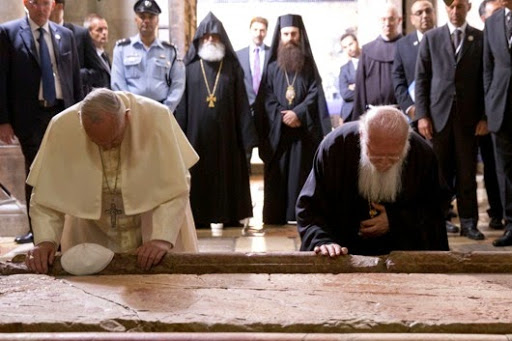
From the perspective of ecumenism, the most important speech was then the one Pope Francis delivered at the Holy Sepulchre in Jerusalem, in the presence of Patriarch Bartholomew (note its supporting pillars being mercy, forgiveness, joy and unity, and the fractal nature of ecumenism – from the visible union among Christian churches to the ecumenism of everyday acts of closeness):

“Let us receive the special grace of this moment. We pause in reverent silence before this empty tomb in order to rediscover the grandeur of our Christian vocation: we are men and women of resurrection, and not of death. From this place we learn how to live our lives, the trials of our Churches and of the whole world, in the light of Easter morning. Every injury, every one of our pains and sorrows, has been borne on the shoulders of the Good Shepherd who offered himself in sacrifice and thereby opened the way to eternal life. His open wounds are like the cleft through which the torrent of his mercy is poured out upon the world. Let us not allow ourselves to be robbed of the basis of our hope, which is this: Christòs anesti! Let us not deprive the world of the joyful message of the resurrection! And let us not be deaf to the powerful summons to unity which rings out from this very place, in the words of the One who, risen from the dead, calls all of us “my brothers” (cf. Mt 28:10; Jn 20:17). […]

We know that much distance still needs to be travelled before we attain that fullness of communion which can also be expressed by sharing the same Eucharistic table, something we ardently desire; yet our disagreements must not frighten us and paralyze our progress. We need to believe that, just as the stone before the tomb was cast aside, so too every obstacle to our full communion will also be removed. This will be a grace of resurrection, of which we can have a foretaste even today. Every time we ask forgiveness of one another for our sins against other Christians and every time we find the courage to grant and receive such forgiveness, we experience the resurrection! Every time we put behind us our longstanding prejudices and find the courage to build new fraternal relationships, we confess that Christ is truly risen! Every time we reflect on the future of the Church in the light of her vocation to unity, the dawn of Easter breaks forth!”

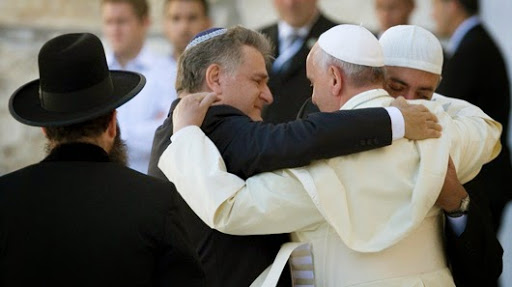
On the final day (26th May), Pope Francis addressed the Gran Mufti of Jerusalem, where he concluded with a call to brotherhood:

“Dear brothers, dear friends, from this holy place I make a heartfelt plea to all people and to all communities who look to Abraham: may we respect and love one another as brothers and sisters! May we learn to understand the sufferings of others! May no one abuse the name of God through violence! May we work together for justice and peace! Salaam!”

Then, Francis changed his plans and instead of having lunch at the Notre Dame of Jerusalem Center, he turned up at a Franciscan friary instead, insisting that nothing be changed in either the refectory customs or the day’s menu.
Francis holocaust survivor hand

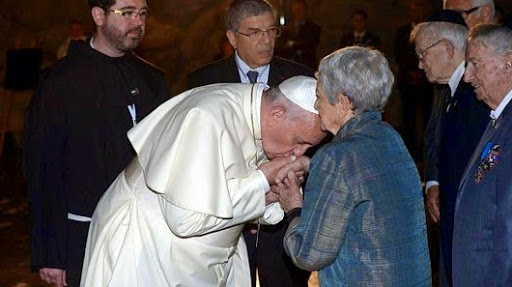
For me the most important moment of the trip was Francis’ visit to the Yad Vashem Memorial, from where I’d like to quote almost his entire address, without commentary:

““Adam, where are you?” (cf. Gen 3:9). Where are you, o man? What have you come to? In this place, this memorial of the Shoah, we hear God’s question echo once more: “Adam, where are you?” This question is charged with all the sorrow of a Father who has lost his child. The Father knew the risk of freedom; he knew that his children could be lost… yet perhaps not even the Father could imagine so great a fall, so profound an abyss! Here, before the boundless tragedy of the Holocaust, That cry – “Where are you?” – echoes like a faint voice in an unfathomable abyss…

Adam, who are you? I no longer recognize you. Who are you, o man? What have you become? Of what horror have you been capable? What made you fall to such depths?

Certainly it is not the dust of the earth from which you were made. The dust of the earth is some- thing good, the work of my hands. Certainly it is not the breath of life which I breathed into you. That breath comes from me, and it is something good (cf. Gen 2:7).

No, this abyss is not merely the work of your own hands, your own heart… Who corrupted you? Who disfigured you? Who led you to presume that you are the master of good and evil? Who convinced you that you were god? Not only did you torture and kill your brothers and sisters, but you sacrificed them to yourself, because you made yourself a god.

Today, in this place, we hear once more the voice of God: “Adam, where are you?”

From the ground there rises up a soft cry: “Have mercy on us, O Lord!” To you, O Lord our God, be- longs righteousness; but to us confusion of face and shame (cf. Bar 1:15).

A great evil has befallen us, such as never happened under the heavens (cf. Bar 2:2). Now, Lord, hear our prayer, hear our plea, save us in your mercy. Save us from this horror.”

Finally, Francis also celebrated mass at the Upper Room, where he spoke about what its meaning is for us (note the emphasis on friendship, service and family – both the importance of families in the Church, and the Church being a family):

“The Upper Room speaks to us of service, of Jesus giving the disciples an example by washing their feet. Washing one another’s feet signifies welcoming, accepting, loving and serving one another. It means serving the poor, the sick and the outcast, those whom I find difficult, those who annoy me. […]

The Upper Room also reminds us of friendship. “No longer do I call you servants – Jesus said to the Twelve – but I have called you friends” (Jn 15:15). The Lord makes us his friends, he reveals God’s will to us and he gives us his very self. This is the most beautiful part of being a Christian and, especially, of being a priest: becoming a friend of the Lord Jesus, and discovering in our hearts that he is our friend. […]

[T]he Upper Room reminds us of the birth of the new family, the Church, our holy Mother the hierarchical Church established by the risen Jesus; a family that has a Mother, the Virgin Mary. Christian families belong to this great family, and in it they find the light and strength to press on and be renewed, amid the challenges and difficulties of life. All God’s children, of every people and language, are invited and called to be part of this great family, as brothers and sisters and sons and daughters of the one Father in heaven.”

Differing currents of thought: fact or fiction?

Polyhedron

[Warning: Long read.]

One of my favorite passages in Evangelii Gaudium – Pope Francis’ apostolic exhortation, and de facto blueprint for the future of the Church – regards diversity of theological thought, where he says:

“Within the Church countless issues are being studied and reflected upon with great freedom. Differing currents of thought in philosophy, theology and pastoral practice, if open to being reconciled by the Spirit in respect and love, can enable the Church to grow, since all of them help to express more clearly the immense riches of God’s word.” (§40)

With the above model in mind, let me take you through the latest moves in a “cognitive reconciliation” process that has been underway for many years now and that I have commented on before: the dispute between the Congregation for the Doctrine of the Faith (CDF) and the Leadership Conference of Women Religious (LCWR). As you can see from the previous post, my take on the situation was in agreement with the CDF, especially after reading the LCWR’s “Systems Thinking Handbook” (where only the last of these three terms seemed to apply). In fact, I came away thinking that the CDF were being quite soft on the LCWR, whose Handbook could clearly be seen not to be Catholic, even by a non-theologian. As such, I felt that the CDF were doing their job both with precision and with prudence, which is no mean feat.

Last week then saw the next round of talks between the two parties, which Cardinal Müller kicked off with talk that reiterated the previous assessment’s validity and that lamented the limited cooperation of the LCWR over the last months. There, Müller, whose fan I have been for a long time, focused on criticizing the LCWR’s “focalizing of attention […] around the concept of Conscious Evolution,” as expounded by Barbara Marx Hubbard, even leading to “some religious Institutes modify[ing] their directional statements to incorporate concepts and undeveloped terms from Conscious Evolution.” Müller then spoke very directly about what the CDF (which he heads) thought of Conscious Evolution:

“Again, I apologize if this seems blunt, but what I must say is too important to dress up in flowery language. The fundamental theses of Conscious Evolution are opposed to Christian Revelation and, when taken unreflectively, lead almost necessarily to fundamental errors regarding the omnipotence of God, the Incarnation of Christ, the reality of Original Sin, the necessity of salvation and the definitive nature of the salvific action of Christ in the Paschal Mystery.”

And, again I have to say that I am 100% with Müller and that the above statement is an expression of tact and restraint that I personally would find hard to maintain. Marx Hubbard’s “Conscious Evolution” is muddled, buzzword-addled gibberish that at best aspires to pseudo-philosophy. It has nothing whatsoever to do with Christianity and in no sane context would it even be considered a “current of thought in philosophy, theology [or] pastoral practice.” To borrow another Marx’s linguistic device, I’d say that Conscious Evolution is to thought what military justice is to justice. It’s as if the LCWR took a shampoo ad (with its micro-ceramides and nanosphere complexes) as the starting point for a new theory of cosmogeny. If, after reviewing the Conscious Evolution website, you arrive at a different conclusion, please, proceed to ordering the official “EvolvePac” – the “Evolutionary Tool-Kit to-go” (and it is unlikely that I’ll ever see you here again).

So far, so good. “But,” you might ask, “what does this have to do with Evangelii Gaudium?” And you’d be right to question my train of though here, since the above is just an instance of a speck of dust being flicked off the Church’s shoulder. There is no question of a diversity of thought having to be “reconciled by the Spirit.”

Let’s therefore turn to another part of Cardinal Müller’s talk, where he criticizes the LWCR for their non-compliance with the CDF’s order that “speakers and presenters at major programs [are to] be subject to approval by the [the CDF’s] Delegate,” Archbishop Peter Sartain. Müller then proceeds to reiterate why this provision has been put into place, and to give an example:

“This provision has been portrayed as heavy-handed interference in the day-to-day activities of the Conference. For its part, the Holy See would not understand this as a “sanction,” but rather as a point of dialogue and discernment. […]

An example may help at this point. It saddens me to learn that you have decided to give the Outstanding Leadership Award during this year’s Assembly to a theologian criticized by the Bishops of the United States because of the gravity of the doctrinal errors in that theologian’s writings. This is a decision that will be seen as a rather open provocation against the Holy See and the Doctrinal Assessment. Not only that, but it further alienates the LCWR from the Bishops as well.”

What piqued my interest here is that the theologian in question is not named and furthermore that no comment is made by Müller on what it is about their writings that’s amiss (cf. the very clear and direct criticism and naming of Marx Hubbard). Also, a careful reading of his words shows that the objection here is firstly to the process having ignored a provision put in place by the CDF (who does have legal authority over the LCWR) and secondly to the lack of unity with the local Church in the USA.

I was curious though to understand what doctrinal errors the US bishops have found and who the theologian was, so, I dug a bit deeper.

It turns out that the theologian is Dr. Elizabeth Johnson – a Distinguished Professor of Theology at the Jesuit Fordham University in New York City and that the bone of contention with the USCCB is her book “Quest for the Living God.” Having read the USCCB’s assessment of her book made me even more curious, since it sounded to me like its central point was the incompleteness of Johnson’s book (i.e., a focusing only on some aspects, like the economy of the Trinity and not its immanence, or an overemphasis of others, like that of apophasis to the point of denying analogy in the context of our capacity to know anything about God) and that “the book is directed primarily to an audience of non-specialist readers and is being used as a textbook for study of the doctrine of God.”

The next step was obvious – to get a copy of Johnson’s book and see for myself. Here I have to say that I can very clearly identify the basis of the USCCB’s criticism – looking at the cited passages and reading around them provides a picture that is fairly represented in the USCCB’s assessment and, unlike Johnson in her response to the assessment, I don’t believe there has been any misunderstanding.

However, I’d like to argue that Johnson’s case is categorically different from the new-age self-help of the LCWR Handbook or the pseudo-philosophy of Marx Hubbard’s “Conscious Evolution.” Johnson is no charlatan – far from it! Reading her book gives a clear sense both of a sharp and erudite mind and of a person intent on seeking to encounter and understand God (a point also underlined by the USCCB being at pains to emphasize that theirs is “no judgment of the personal intention of the author”). Her writing is full of statements like “theology today […] seeks understanding of God at once contemporaneous with culture and resistant to its wrongs,” or that “[i]nsight develops […] from heart to head to hands,” and that:

“Signifying the Creator, Savior, and Lover of all the world, the whole cosmos as well as all human beings, the phrase “the living God” elicits a sense of ineffable divine mystery on the move in history, calling forth our own efforts in partnership while nourishing a loving relationship at the center of our being: “my heart and my flesh sing for joy to the living God” (Psalm 84:2).”

I have to say that the above could well have come from Pope Francis, Cardinal Ravasi or even Cardinal Müller. Hers is very much Christian and (part of) Catholic thought and clearly a candidate for the kind of process proposed in Evangelii Gaudium. While I agree with the USCCB’s assessment that her writing is misleading (by being incomplete and aimed at a broad audience), I do also think that it is rich in insight and that the response should have been to initiate dialogue, which, sadly has not taken place – also to Prof. Johnson’s disappointment. I believe that it would be well possible for Johnson to extend what she has written in a way that would not change her position, while making its relationship with the Church’s teaching explicit rather than ambiguous to a theologically untrained reader.

To conclude, let me just refer to Cardinal Kasper, who has been asked about this case during his visit to the US this week and who has been quoted as saying: “Sometimes the CDF views things a bit narrowly. Aquinas was condemned by his bishop. So Johnson is in good company.” I believe it is the CDF’s job to view things narrowly, but also that it is the whole Church’s job to be broad and to facilitate exactly the kind of “differing currents of thought” that Pope Francis speaks about in Evangelii Gaudium.

The Ethiopian eunuch: a case study in mercy

Ethiopian eunuch

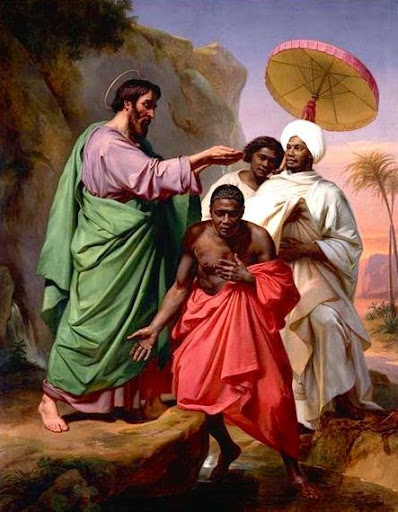
Today’s first reading, from the Acts of the Apostles (8:26-40), tells the story of St. Philip’s journey from Jerusalem to Gaza, during which he meets the chief treasurer of the Queen of Ethiopia, who is a eunuch (i.e., man castrated to become a more trustworthy and disinterested servant). The eunuch is reading from the book of Isaiah and, upon being asked by Philip whether he understands what he reads, Philip is invited to join the eunuch in his chariot to explain it to him. The passage in question was:

“Like a sheep he was led to the slaughter,
and as a lamb before its shearer is silent,
so he opened not his mouth.

In (his) humiliation justice was denied him.
Who will tell of his posterity?
For his life is taken from the earth.”
(cf Isaiah 53:7-8)

Philip told the eunuch that the passage was about Jesus and proceeded to tell him more. When they came to some water, the eunuch said: “Look, there is water. What is to prevent my being baptized?” (Acts 8:36). And Philip baptized him.

You might think: “so what?,” but the above is actually quite an important passage given what is going on in the Church today, since, I believe, it gives an example of what being welcoming of everyone and focused on mercy mean. The eunuch in question here wasn’t just some guy who wanted to be baptized and whom Philip baptized as a matter of fact, to boost statistics.

The Hebrew Bible is very clear that “the law forbids the community of the Lord to accept anyone who has undergone destruction or removal of their sexual organs” (cf. Deuteronomy 23:2), as is certainly the case with eunuchs. Since St. Philip – like Jesus – was a Jew, and Jesus’ followers at that time were part of the Jewish community, these restrictions would have been know to him and there would have been an obligation to honor and adhere to them. Nonetheless, it must have been Jesus’ imperative to “Go, therefore, and make disciples of all nations, baptizing them in the name of the Father, and of the Son, and of the holy Spirit” (Matthew 28:19) that lead Philip to baptize – and thereby welcome into the community of Jesus’ followers – not only a non-Jew, but a member of a different race and of a sexual minority, explicitly outlawed by the Old Testament. None of these obstacles mattered to him, since “[t]he Spirit said to Philip, “Go and join up with that chariot.”” (Acts 8:29).

Pope Francis’ homily from this morning also deals with this first reading, instead of the Gospel as is more customary, and focuses on Philip’s attitude towards the eunuch:

“It’s impossible to evangelize without dialogue. It’s impossible. Because you must begin from where the person is, who is to be evangelized. And how important this is. ‘But, father, so much time is wasted because every person has their own story, comes with this or that, their own ideas …’ And, time is wasted. God wasted more time when he created the world, and He did well to do so! Dialogue. Waste time with that person because that person is whom God wants you to evangelize, what’s most important is that you give them the news about Jesus. But the way they are, not the way they ought to be: the way they are now.

Let’s think about these three moments of evangelization: the docility to evangelize; to do what God is asking, secondly, dialogue with people – but in dialogue, one begins from where they are – and thirdly, trusting in grace: grace is more important than all of bureaucracy. ‘What prevents this?’ Remember this. Often we in the Church are a factory of obstacles, because of which people can’t arrive at grace. May the Lord help us to understand this.”

Here, I believe, it is important to bear in mind what Francis means by “evangelizing,” which is “[t]o give witness with joy and simplicity to what we are and what we believe in.” There is no compulsion here, no obligation, no proselytizing. And that St. Philip had the same attitude is clear also from it being the eunuch’s initiative to become baptized. What struck me here is also the great simplicity and obviousness of his request: “Look, there is water. What is to prevent my being baptized?” Having received Jesus’ Good News from Philip, the eunuch has a new optics, through which the obstacles of old become invisible and it is only God’s welcome that can be seen. For the Church to then turn to this guy and say: “Sorry, mate, but you don’t qualify,” would have been absurd and is not at all what St. Philip did.

This brings me to a superb interview with Cardinal Walter Kasper, given to Commonweal magazine during his visit to the USA this week, where he speaks about mercy as follows:

“[The] ontological understanding of God was so strong that justice became the main attribute of God, not mercy. Thomas Aquinas clearly said that mercy is much more fundamental because God does not answer to the demands of our rules. Mercy is the faithfulness of God to his own being as love. Because God is love. And mercy is the love revealed to us in concrete deeds and words. So mercy becomes not only the central attribute of God, but also the key of Christian existence. Be merciful as God is merciful. We have to imitate God’s mercy. […]

Mercy concerns not only individuals. It also an imperative for the church itself. The church defined itself at the Second Vatican Council as a sacrament of God’s grace. How can the church be sacramental, a sign and instrument of mercy, when she herself doesn’t live out mercy? So many people do not perceive the church as merciful. It’s hard. […]

There are those who believe the church is for the pure. They forget that the church is also a church of sinners. We all are sinners. And I am happy that’s true because if it were not then I would not belong to the church. It’s a matter of humility.”

The key idea to me here is Kasper’s beautifully synthetic: “God does not answer to the demands of our rules. Mercy is the faithfulness of God to his own being as love.” Our own openness to others must be informed by a desire to share with them the joy that we have received from being brothers and sisters of Jesus and we must be weary of placing obstacles between them and God – no matter what they might be.

Francis’ new bishops

That Pope Francis lives a simple life and seeks closeness to people is well known, documented and broadly admired. However, the question of whether his personal conduct has any effect beyond the Pope himself is regularly put on the table, in the context of concerns about whether the Church as a whole is in the process of changing or whether it “only” has an admirable leader. I have to say that this type of question is well founded, since the Catholic Church has 1.2 billion members, over 400 000 priests and around 5000 bishops, and asking whether the behavior of one person, even if it is its leader, can lead to change in that of over a billion is eminently reasonable.

As a result of the above concern, that I shared, I have been keeping an eye on reports about the new bishops who have been appointed since Pope Francis’ election as well as on reports about the conduct of other bishops. Instead of dwelling on surgical interventions, like the removal of the German “bishop of bling,” the Bishop of Limburg Franz-Peter Tebartz-van Elst, I would like to share with you three examples – two of newly-appointed bishops and one of an established bishop’s change of judgment.

Bishop john keenan
Fr. John (wearing a black t-shirt) with a group of students from Glasgow University at the World Youth Day in Brazil last year.

The first instance of a Pope-Francis-like bishop that I noticed was that of John Keenan, the newly-consecrated Bishop of Paisley. His first move was reported by a Scottish daily, The Herald, by saying that he “has shunned the more comfortable address [of the bishop’s residence] to move into a parish house in a housing scheme in an area of multiple deprivation.” Why did Bishop John do that? His answer was: “[T]o be close to the people of our times,” and he went on to describe his choice as follows:

“I’ve just come from living in a university chaplaincy with a dozen students so I’ve been living surrounded with the buzz of life and fun. When I was thinking about becoming a bishop I was keen to take as much of that into my new life, finding people who could form a family with me and support me. Priests in Paisley found me a place in St Laurence’s, Greenock. I am living with the parish priest, Father Gerry McNellis, lots of parishioners come in and out of the house and it has the sound of laughter that makes me feel at home. I celebrate the parish Mass and am getting to know the people and that’s perfect for me.”

The buzz of life and living in a family are the key here, which then lead to change: “When people see a church not just giving to the poor and the excluded but being among them and living with them joyfully, then they will really begin to believe there is a way out of the vicious cycle of living for yourself in your own little bubble.”

Bishop carl kemme
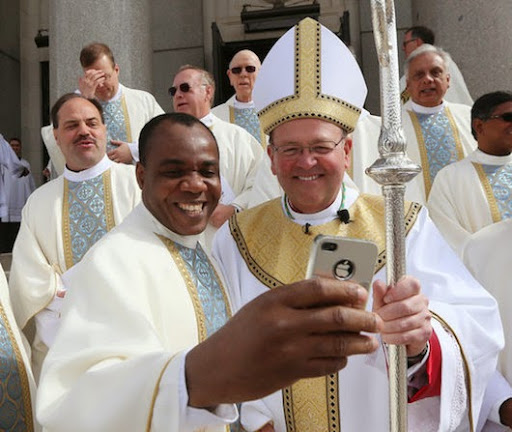
Bp. Carl in a “selfie” after his consecration.

Next, I read about Carl Kemme, the new Bishop of Wichita, who was consecrated last Thursday and whose choice of how to celebrate the event was very much Francis-like. The Wichita Eagle reported it as follows:

“Kemme has decided to have his pre-ordination luncheon with friends and family […] across the street from the cathedral at the Lord’s Diner, which serves dinner each night to the needy. The diner’s staff members will prepare the luncheon. “I’ve asked that the meal be … just a simple meal that we can share in the same place where our brothers and sisters … rely on that for their daily bread,” Kemme said.”

That this is inspired by Francis’ example is something that Bishop Carl is explicit about: “His simplicity, his humility, the fact he’s chosen to live in a simpler place and to ride in a regular car and to prefer not the trappings of the pontificate but the real ministry of it I think signals to the whole world and certainly to the church of a whole new dynamic.” And his reaction to first receiving the news is also telling: “Without a doubt, Pope Francis could have chosen a far more qualified candidate. But in God’s mysterious plan, he has chosen me, which is a humbling and sobering experience. I receive all of this as a sign of how God often chooses the least qualified, the weak and the sinful to accomplish his mission in the world.”

Bishop wilton gregory
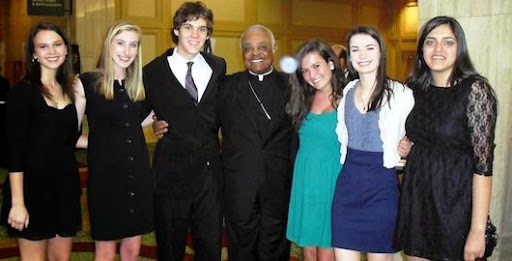
Abp. Wilton with youth from the Society of St. Vincent de Paul.

The final example I’d like to share is of a different kind. It concerns Archbishop Wilton D. Gregory, who has been in office for 10 years and who was consecrated bishop another 11 years before he took on his current post. To resolve space limitations at his Atlanta cathedral, he was planning to move out of his residence, so that other priests could move in, and he was going to have a new archbishop’s residence built with donated money and land. As the New York Times reported, the plan was to build a “$2.2 million, 6,000-square-foot mansion, with plenty of room to host and entertain.” A choice, which in the past would not have been frowned upon since it has to be borne in mind that this was going to be not only the accommodation of the current archbishop, but serve other current and future needs of the Church as well.

However, already during his first meeting with the media since his election, Pope Francis has called for “a church which is poor and for the poor,” and Archbishop Wilton’s plans were out of sync. The key here is that he himself admitted so when he publicly apologized for them, after concerns were raised by lay members of his diocese. In spite of following a selfless decision making process, which he openly shared with his diocese, Abp. Wilton nonetheless took full responsibility, by saying:

“What we didn’t stop to consider, and that oversight rests with me and me alone, was that the world and the church have changed. […] I failed to consider the impact on the families throughout the Archdiocese who, though struggling to pay their mortgages, utilities, tuition and other bills, faithfully respond year after year to my pleas to assist with funding our ministries and services. I failed to consider the difficult position in which I placed my auxiliary bishops, priests, deacons and staff who have to try to respond to inquiries from the faithful about recent media reports when they might not be sure what to believe themselves. I failed to consider the example I was setting for the young sons of the mother who sent the email message with which I began this column.”

And he proceeded to apologize unreservedly and repeatedly: “To all of you, I apologize sincerely and from my heart.” and to put a clear, new process in place, demonstrating again his commitment to listening and his openness to change:

“It is my intention to move deliberately forward and to do a better job of listening than I did before. When I thought this was simply a matter of picking up and moving from one house to a comparable one two miles away, we covered every angle from the fiscal and logistical perspectives, but I overlooked the pastoral implications. I fear that when I should have been consulting, I was really only reporting, and that is my failure. To those who may have hesitated to advise me against this direction perhaps out of deference or other concerns, I am profoundly sorry.

There are structures already in place in the Archdiocese from which I am able to access the collective wisdom of our laity and our clergy. In April I will meet with the Archdiocesan Council of Priests, and in early May our Archdiocesan Pastoral Council (a multi-cultural group of Catholics of all ages, representing parishes of all sizes, who serve as a consultative body to me) will convene. I will ask for the Finance Council of the Archdiocese to schedule an extraordinary meeting. At each of these meetings I will seek their candid guidance on how best to proceed.”

While the examples of Bishops John and Carl are greatly encouraging, I am most impressed by Archbishop Wilton – a bishop of 21 years experience who is ready to take responsibility, apologize for an error of judgment and bring about change in his diocese. His example is one of profound humility and illustrates Pope Francis’ insistence on the need to acknowledge our failings without letting them hold us back from change and constant renewal.

St. John Paul II’s encyclical of suffering

Jp2 cross s

Since writing my previous post of thanksgiving to St. John Paul II, ahead of his and St. John XXII’s canonization last Sunday, I kept coming back to thinking about another aspect of his life that has great importance for me. Beyond his words and actions, his perseverance in suffering, especially during the last 15 years of his pontificate (i.e., since the onset of Parkinson’s), has always been an inspiration and an example for me.

Cardinal Bertone put this aspect of St. John Paul II’s life best, when he said that “suffering was another one of his encyclicals.” And by considering it alongside his writings, the most obvious parallel to draw is with the encyclical Salvifici Doloris, which he wrote about suffering some six years after being elected Pope and where one of the key passages for me is the following (§23):

“Those who share in Christ’s sufferings have before their eyes the Paschal Mystery of the Cross and Resurrection, in which Christ descends, in a first phase, to the ultimate limits of human weakness and impotence: indeed, he dies nailed to the Cross. But if at the same time in this weakness there is accomplished his lifting up, confirmed by the power of the Resurrection, then this means that the weaknesses of all human sufferings are capable of being infused with the same power of God manifested in Christ’s Cross. In such a concept, to suffer means to become particularly susceptible, particularly open to the working of the salvific powers of God, offered to humanity in Christ. In him God has confirmed his desire to act especially through suffering, which is man’s weakness and emptying of self, and he wishes to make his power known precisely in this weakness and emptying of self. This also explains the exhortation in the First Letter of Peter: “Yet if one suffers as a Christian, let him not be ashamed, but under that name let him glorify God.””

The absurdity and scandal of a suffering God – and of suffering man – are not explained away or justified, but become invitations to participate in the suffering of Jesus, which demonstrates the extent of God’s love for man.

About fifteen years after writing the above words, and while visiting the sick in a hospital in Mexico City, St. John Paul II returned the the same theme and elaborated it further:

“Seen in this way, pain, disease and the dark moments of human existence acquire a profound and even hopeful dimension. One is never alone in facing the mystery of suffering: we are with Christ who gives meaning to the whole of life: moments of joy and peace, as well as those of affliction and grief. With Christ everything has meaning, even suffering and death; without him, nothing can be fully understood, not even those legitimate pleasures which God has associated to different moments of human life.”

Thinking about St. John Paul II’s health, one can wonder whether his remaining in office was good for the leadership of the Church, whether it wouldn’t have been better if he had resigned, and one can wonder whether such thoughts even entered the Pope’s head, or whether he had continued in his role out of inertia. The answer to the second part of the question is clear from the revision of his own Last Will that he made in the year 2000 and where he added:

“On May 13, 1981, the day of the attack on the Pope during the general audience in St. Peter’s Square, Divine Providence saved me in a miraculous way from death. The One Who is the Only Lord of life and death Himself prolonged my life, in a certain way He gave it to me again. From that moment it belonged to Him even more. I hope He will help me to recognize up to what point I must continue this service to which I was called on Oct. 16, 1978. I ask him to call me back when He Himself wishes. “In life and in death we belong to the Lord … we are the Lord’s.” (cf. Romans 14,8). I also hope that, as long as I am called to fulfill the Petrine service in the Church, the Mercy of God will give me the necessary strength for this service.”

To answer the first doubt, we need look no further than to the homily given by his successor, Benedict XVI, during the beatification of St. John Paul II, where he said:

“[T]he Lord gradually stripped him of everything, yet he remained ever a “rock”, as Christ desired. His profound humility, grounded in close union with Christ, enabled him to continue to lead the Church and to give to the world a message which became all the more eloquent as his physical strength declined. In this way he lived out in an extraordinary way the vocation of every priest and bishop to become completely one with Jesus, whom he daily receives and offers in the Church.”

Leadership of the Church is not about organizational shrewdness, effective policies or vigor (all of which are good, but secondary) – instead it is about an imitation of its head – Jesus. And as such, there is no doubt in my mind that St. John Paul II remained an exemplary leader until his very last moments on Earth. His public and persistent acceptance of frailty, suffering and weakness were as much evidence of his following in Jesus’ footsteps, as his rallying against the mafia, his effort to establish brotherly relationships with other religions, or his forgiving his would-be assassin. Pope Benedict XVI, addressing the Pontifical Council for pastoral healthcare professionals, explained St. John Paul II’s witness as follows:

“The mystery of suffering seems to blur the face of God, making Him almost a stranger, or even identifying him as being responsible for human suffering, but the eyes of faith are able to look deeply into this mystery. God became incarnate, He came to be close to man, even in the most difficult situations, He did not eliminate suffering, but in the Risen Crucified One, the Son of God suffered unto death, even death on a cross, He reveals that His love goes even deeper into the abyss of man to give him hope. The Crucified is risen, death has been illuminated by the morning of Easter: ‘God so loved the world that he gave his only Son, that whoever believes in him shall not perish but have eternal life’ (Jn 3.16). […] The testimony of the last years of John Paul II’s life teach us this: “An unshakable faith pervaded his physical weakness, making his illness, lived for love of God, the Church and the world, a actual participation in the journey of Christ to Calvary. The following of Christ did not spare Blessed John Paul II to take up his cross every day until the end, to be like his only Master and Lord.””

As I was thinking about what it is about St. John Paul II’s example that attracted me so much, I was visiting the Sagrada Familia in Barcelona, and I went to spend some time in front of Jesus in the Eucharist – if you convince a guard that you realize you are in an actual church, you are granted access to a small, walled-off fragment of the basilica where the tabernacle is situated. In the midst of the roar of a throng of tourists, I looked at the inscription on the tabernacle, which read: “Jo sóc la vida” (“I am the life” – cf. John 14:6) and something went “click” in my mind.1 A following of Jesus means an identification of life with Him and it is this that St. John Paul II did. His was an imitation of Jesus in all aspects of life – the joyous and the sorrowful, and a realization that the way to the joy of the resurrection that is mirrored in the joys of life passes through the sorrow of the crucifixion, which we can participate in, in its sufferings.

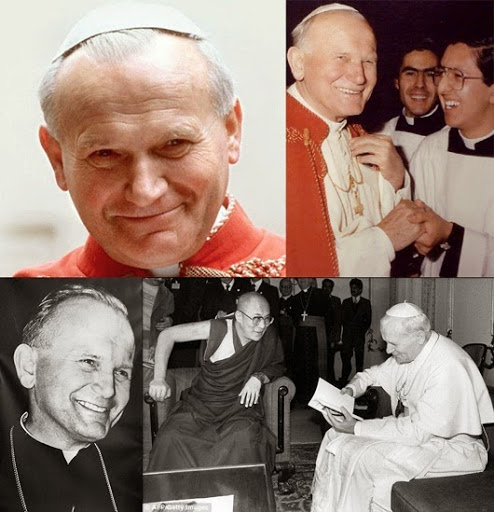
Just to dispel a potential misunderstanding that might arise from having spent 1500 words talking about suffering and that might suggest a preference for or a seeking out of suffering, let me say that this is not what Christianity is about. Instead it is all about joy, but a joy that embraces and subsumes the difficult and painful moments of life – like a profound beauty that also elevates and incorporates ugliness. In the end though it is about joy and beauty, like St. John Paul too emphasized when he insisted that “We are an Easter people” and when Pope Francis criticized “Christians whose lives seem like Lent without Easter” and who look like “sourpusses.” Let me therefore leave you with a couple of photos of St. John Paul II, from which it can be seen that he was anything but a sourpuss 🙂

Jp2 smiles


1 Not that I think the mind is mechanical :).

Subirachs’ Passion Façades

Subirachs

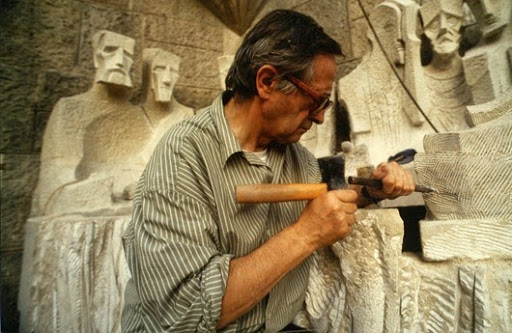
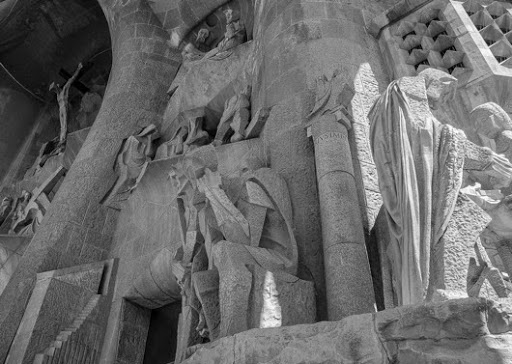
My favorite building in the world is the Basilica of the Sagrada Familia in Barcelona, where its Passion Façade in particular is an exceptional creation and object for contemplation. Its creator, the Catalan sculptor Josep Maria Subirachs,1 who died three weeks ago, was an adherent of the New Figuration movement that brought figurative elements back to sculpture in the 1960s and which Subirachs explains as follows:

“The images of the artists of the new figuration are used in the same way in which abstract artists use form: transformed into signs; because of this, abstract art does not represent but it does signify. Therefore, new figuration too does not represent anything but does signify, which makes me want to call it significative figuration.”

When Subirachs was then asked to create the Sagrada Familia’s Passion Façade, depicting the last two days of Jesus’ life, his two conditions were that he would not imitate Gaudí and follow his own, free creativity instead, and that he would live in the grounds of the church, like Gaudi – whom he admired – lived. While being granted these two requests (and being heavily criticized for his choices subsequently), Subirachs nonetheless was keen to embody Gaudí’s vision, which was the following:

“Some might find this Façade too extravagant; but I would like it to inspire fear, and I would not spare the use of chiaroscuro, of motives of entry and exit, all that results in the most theatrical effect. What’s more, I am prepared to sacrifice the construction of the church itself, to break arches and cut columns, to transmit the bloodiness of the Sacrifice.”

How Subirachs did it though is very different from what Gaudí would have done. For a start, Gaudí considered curves – round, organic shapes – to be “the line of God.” “Instead,” Subirachs says, “my shapes are very geometric, with flat faces and sharp edges, and provide the drama that the scene I am representing needs.” There is also a minimalism in Subirachs’ approach, e.g., where he leaves out the two thieves crucified either side of Jesus and a depiction of Jesus’ entry into Jerusalem on Palm Sunday, which were in Gaudí’s plans, for the sake of a “simple, didactic message.” Such minimalism is at the core of what Subirachs considers to be the essence of sculpture, which is “getting rid of everything that is unnecessary.”

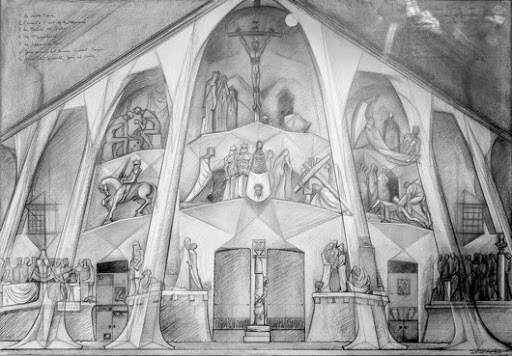
Just to get a sense of how Subirachs approached the depiction of Jesus’ passion, the following shows the plan he drew up before proceeding to create the sculptures:

Passion facade plan

The story, which Subirachs wanted to be “cinematographic,” starts with the last supper at the bottom left and then snakes its way to the top right where the entombment of Jesus is shown. A golden statue depicting the resurrected Jesus is then located between the towers erected above the façade.

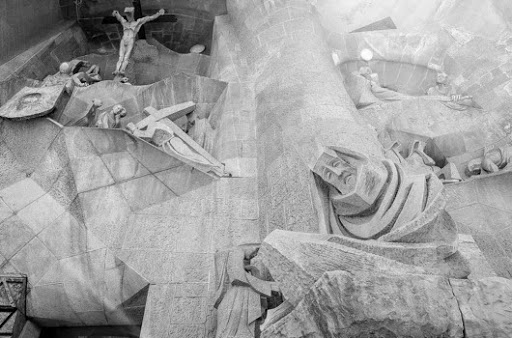
To get a better sense of what the above plan lead to, take a look at the following collection of photos. However, this is just a poor substitute for being there in person. Every time I go to see the Passion Façade, something new stands out for me, and yesterday was no different. What struck me was how the layout of the story, in the boustrophedonic sequence that Subirachs chose, results in three of the characters that betrayed Jesus – Judas, Pilate and Peter – all being depicted in the bottom layer. This, in turn, allows for a viewing of the Passion from their perspectives – with the consequences of their actions (or the source of his sorrows, in Peter’s case) projecting out from them and reinforcing the cause of their grief. In the two following photos you can see the “Passion of Pilate” followed by the “Passion of Peter.”

Passion of pilate

Passion of peter

This also reminded me of Pope Francis’ Palm Sunday homily, where he discarded his prepared text and instead proceeded to reflect on the question of where each one of us fits into Jesus’ Passion, asking: “Where is my heart? Which of these persons am I like?” Subirachs’ Passion Façade is a meditation on the last hours of Jesus life, but (borrowing Benedict XVI’s words about Gaudí) made “not with words but with stones, lines, planes, and points.”


1 If you understand Catalan, there is a great hour-long documentary about Subirachs available here.

Viri probati: priesthood for married men

Johannes30070 036L

It looks like Pope Francis has started testing the waters for the possibility of reintroducing the option of having married priests in the Roman Catholic Church. In an audience with him,1 Erwin Kräutler, the bishop of Xingu in the Brazilian rainforest, raised the challenges of the shortage of priests. Bishop Kräutler told the Pope about only having 27 priests for 800 communities with 700 000 faithful in the Amazonian rainforest, which means that each parishioner only has access to the Eucharist 2-3 times per year.

Francis’ response was that local bishops know the needs of their people best and that they must be courageous and make proposals for new solutions. Bishops mustn’t act alone and should instead first agree in their local bishops’ conferences about proposals for reform, before then bringing them to Rome. This was followed by the topic of the possibility of ordaining married “viri probati” (“proven/tested men”) as priest,2 which lead Pope Francis to sharing the situation in a Mexican diocese, where there is a married, permanent deacon in every parish, but many do not have a priest. These 300 deacons, however, cannot celebrate the mass. How could this continue? It is here that bishops should make proposals.

That, in a nutshell, is Bishop Kräutler’s account of his conversation with Pope Francis, which The Tablet reported on 10th April in an article entitled “Pope says married men could be ordained – if world’s bishops agree.” Not exactly the letter of the original report, but, I’d say, in agreement with its spirit (the audience with Pope Francis points to a broader consultation process than just a yes/no about ordaining proven married men to the priesthood, and by the sounds of it, it was Kräutler who brought up the topic).

During the following days there then came a number of statements by bishops regarding the question of “viri probati,” in general being in favor of it. Among them are three English and Welsh bishops: Thomas McMahon, the previous Bishop of Brentwood, in whose diocese there were 20 former Anglican married priests, who said:

“I would be saying personally that my experience of married priests has been a very good one indeed. I think people in those parishes where they have been placed have taken to them very well indeed. People look to their priest as a man of God, to lead them to God. If he is a real pastor at their service then it is rather secondary as to whether he is married or not.”

Bishop Seamus Cunningham of Hexham and Newcastle also expressed his support and Bishop Tom Burns of Menevia (Cardiff) said that “These married men would bring a wider experience and understanding to priestly ministry.” A couple of days ago, Archbishop Diarmuid Martin of Dublin also expressed his openness to considering the proposal, while emphasizing the importance to act in unity with the whole Church and with the Pope.

There have also been voices of support for this option in the past: Bishop Manfred Scheuer of Innsbruck in Austria declared himself in favor in 2011, while pointing out his skepticism about whether this would be a measure for addressing the shortage of priests though. Cardinal Timothy Dolan of New York, in the book-length interview, stated that he could see the priestly ordination of viri probati happening, but that he too had reservations about it being a solution to current shortage.

And, let’s not forget Pope Benedict XVI himself allowing for the future priestly ordination of married men in in the context of the Personal Ordinariate established by the apostolic constitution Anglicanorum Coetibus (as opposed to only considering it a transitory measure for the initial transferees from the Anglican Communion).

The concept of “viri probati” dates back to the first century, where it is referred to in a letter (§42:4) by Pope St. Clement I, albeit in a different context – that of candidates for being appointed bishops and deacons in general. The idea there was that the men in question had a track record of living a Christian life, before they were considered for ordination. This is already what is in place for married permanent deacons (a practice re-introduced by Vatican II and having resulted in 16 000 married men being ordained and active as deacons today in the US alone), where the minimum requirement (Can. 1031 §2) for a candidate is the age of 35 years (and the consent of his wife! :).

Essentially this new proposal sounds to me like an opening of priestly ordination to those who today are married deacons or who would become married deacons in the future.

Personally I think this is a good idea, but – like Bishop Scheuer and Cardinal Dolan – I don’t believe it would make a dramatic difference to the number of priests. It is not like there are huge numbers of married men vying for the priesthood and I believe vocations among them are going to be scarce. Not only will they need to have had the vocation to receive the sacrament of marriage (as opposed to just have gotten married) but they will then also need to feel the subsequent call to the priesthood. By probability theory alone I would expect this to be a small number. However, for that small number – even if it only ever applied to one – I’d be in favor of admitting them to the priesthood. Why? Mainly because Jesus did so himself – among the apostles, at the very least St. Peter (the first pope! and a viro very much probato) was married (cf. Matthew 8:14) and chances are that some of the other apostles were too. If it was good enough for Jesus, it sure is good enough for me!

What I find by far more encouraging – and a source of joy – is the process that has already taken place and that is being put into practice by Pope Francis: a bishop comes to see him, shares a concern with him and proposes a solution. Francis encourages him, invites him to consult with his brother bishops and asks him to then escalate the proposal to the universal Church’s level, for discernment by himself. Francis also emphasizes the importance of unity and invites the expression of opinion by others. Other bishops step forward and express their views. All of this within the course of days and in the absence of any formal process and without intermediaries and bureaucrats wedged between the Bishop of Rome and his brother Bishops from around the world. This is what collegiality is about, as Vatican II presents in in Lumen Gentium (§22), and it is finally being put into practice. Ad maiorem Dei gloriam!


1 The news was also picked up by the German branch of Vatican Radio some days later.
2 Note, that this is not the same as opening up the possibility of getting married to priest – a practice that has never existed in the Catholic Church. The question on the table is about married men being ordained priests, not vice versa.