A joy that’s made for sharing

Francis eg

[Guest post: The following is a talk about Pope Francis’ Evangelii Gaudium, given by my bestie, Dr. Ján Morovič, at a retreat. Reproduced here with the author’s permission]

Among papal documents, apostolic exhortations serve the purpose of calling to action, and Pope Francis’ Evangelii Gaudium (The joy of the Gospel) does exactly that – it invites us to share with others the joy we have received from putting the Gospel into practice. It also shows us that sharing is a direct consequence of joy, and that such sharing is preceded by God’s presence in the life of every person.

Evangelii Gaudium is in many ways an extraordinary text. First, because of its directness, e.g., when Pope Francis says that “neither the Pope nor the Church have a monopoly on the interpretation of social realities or the proposal of solutions to contemporary problems” (§184), and when he laments the “unwelcoming atmosphere of some of our parishes and communities, or [… a] bureaucratic way of dealing with problems.” Second, because of its eclectic imagery, e.g., warning us against becoming “sourpusses” (§85) or suggesting that the Church “is not [like a] sphere […], where every point is equidistant from the centre, and [where] there are no differences between them[ … but instead that it is like a] polyhedron, which reflects the convergence of all its parts, each of which preserves its distinctiveness” (§236). And third, because of the broad variety of topics that Pope Francis covers there:

  • He emphasizes the importance of reaching out to those who live at the peripheries – both in economic and spiritual terms, (§20)
  • he desires a Church that “has been out in the streets” instead of one that is entangled in “obsessions and procedures,” (§49)
  • he speaks out against today’s “throw away culture” and the fiction of “trickle down theories of economic growth” leading to justice and inclusion (§54),
  • he warns against the worldliness of “a purely subjective faith” or of a “self-absorbed […] trust in [one’s] own powers” (§94),
  • he calls for “a more incisive female presence in the Church” (§103),
  • he provides practical tips for giving better sermons (§135),
  • he highlights the need for not only embracing the poor but also for learning from them and being evangelized by them (§198),
  • he talks about the principles of “building a people in peace, justice and fraternity,” (§221)
  • he underlines the importance of dialogue with science, other Christians, other religions and those with no religious beliefs, (§257)
  • and he reflects on the role of Mary, as the “Mother of the living Gospel” (§287).

Pope Francis’ thoughts on each of the above subjects are true gems – full of insight, derived from putting the Gospel into practice and presented with razor-sharp clarity, directness and vivid imagery. Each of them – and others besides – could be taken as a starting point for deeper reflection and be further studied, elaborated and put into practice.

While I found Francis’ words on topics like the economy, dialogue, peace and the poor very enriching, and while these stood out for me when I first read Evangelii Gaudium, I would instead like to focus now on three themes that emerged for me when I re-read the exhortation’s 52 000 words a second time. I have since also seen these popping up in his more recent talks and have also found them when reading the sermons from his time as the archbishop of Buenos Aires.

The three themes are:

  • what Christian joy means and how experiencing it compels us to share it,
  • how such sharing is directed absolutely at every single person – without exception, and
  • how the desire to share the joy of the Gospel leads to the realization that God is already present everywhere, and that it is not only a matter of us bringing his gifts to others but that he has given them gifts for us too.

It is an image of a virtuous cycle of light, radiating from the Trinity and infinitely reflected and amplified in all of creation. I believe, these themes are also the roots of the analyses and recommendations that make up the exhortation’s 100 pages and that they can therefore also serve as keys for later reflecting on them.

The joy of feeling loved

Already in it’s first paragraph, Evangelii Gaudium highlights that joy is a consequence of meeting Jesus, who has a “boundless and unfailing love” for us that “fills the hearts and lives of all who encounter” him. The result is a “joy [that] is constantly born anew” (§1) and that leads to a “personal certainty that, when everything is said and done, we are infinitely loved” (§6). This in turn leads Pope Francis to extending an invitation “at this very moment, to a renewed personal encounter with Jesus Christ, or at least an openness to letting him encounter [us]” (§3). Taking up this “most exciting invitation” then leads to the presence of “God with his people in the midst of a celebration overflowing with the joy of salvation” (§4) that Pope Francis let’s the prophet Zephaniah describe for us:

“The Lord, your God is in your midst, a warrior who gives you the victory; he will rejoice over you with gladness, he will renew you in his love; he will exult over you with loud singing, as on a day of festival” (Zephaniah 3:17)

Francis then proceeds to underline the ubiquity of such joy derived from God’s presence among us and of it being right to delight in it:

“This is the joy which we experience daily, amid the little things of life, as a response to the loving invitation of God our Father: “My child, treat yourself well, according to your means… Do not deprive yourself of the day’s enjoyment” (Sirach 14:11, 14). What tender paternal love echoes in these words!” (§4)

Not only is joy a clear theme already for the people of Israel, but it is repeatedly underlined by Jesus too during his time with the apostles:

“The Gospel, radiant with the glory of Christ’s cross, constantly invites us to rejoice. […] His message brings us joy: “I have said these things to you, so that my joy may be in you, and that your joy may be complete” (John 15:11). Our Christian joy drinks of the wellspring of his brimming heart.” (§5)

The joy of the Gospel that Francis speaks about is not a naïve escapism, or only a perk of good times. Instead, it must permeate all of a Christian’s life, like it did that of Jesus:

“I realize of course that joy is not expressed the same way at all times in life, especially at moments of great difficulty. Joy adapts and changes, but it always endures, even as a flicker of light born of our personal certainty that, when everything is said and done, we are infinitely loved. I understand the grief of people who have to endure great suffering, yet slowly but surely we all have to let the joy of faith slowly revive as a quiet yet firm trust, even amid the greatest distress.” (§6)

Francis reminds us that the promise of joy comes from Jesus himself, who said “You will be sorrowful, but your sorrow will turn into joy” (John 16:20) and that a lack of trust in it “is a defeatism which turns us into querulous and disillusioned pessimists, “sourpusses”,” (§85) it makes our “lives seem like Lent without Easter” (§6).

Personally, Francis’ words have been an examination of conscience for me and I have found his positioning of joy as a benchmark of a genuine relationship with Jesus and those around me a great help. It also reminded me of a chat I had with Hans (the responsible for men focolarini) when I was around 20 years old, who told me – in the context of discerning my vocation – “You will know that you have made the right choice, because you will be happy.” These words have stayed with me since and have proven invaluable in trying to understand God’s will at particularly important moments. In this sense, and well aligned with Francis, joy is not only a reward and an effect, but can also be an indicator.

Thinking about what Francis emphasizes about joy, I am struck not only by its clear logic, but also by its close harmony with the Ideal. Already in the first six paragraphs, which have provided all of the above insights, there is reference to life in the present moment, to the presence of Jesus in the midst, to starting again, to joy flowing from suffering and to the primacy of love.

Joy compels us to share itself with everyone

A rich and deep joy, like the one Francis describes, is something that cannot be contained, something that we can’t keep just for ourselves. It is a joy that compels us to share itself with others. As Francis puts it:

“Thanks solely to this encounter […] with God’s love, which blossoms into an enriching friendship, we are liberated from our narrowness and self-absorption. We become fully human when we become more than human, when we let God bring us beyond ourselves in order to attain the fullest truth of our being. Here we find the source and inspiration of all our efforts at evangelization. For if we have received the love which restores meaning to our lives, how can we fail to share that love with others? […] What kind of love would not feel the need to speak of the beloved, to point him out, to make him known?” (§8, 264)

Such a joy-inducing encounter with Jesus cannot be lived alone; it would make us burst if we didn’t share it and pass it on to others.

In the same breath as pointing out the necessity of inviting others to participate in the joy of the Gospel, Francis insists that it is intended for all, without exception. It is not only meant for those whom we like, for fellow Christians, or even for all men and women of good will.

“[I]t is vitally important for the Church today to go forth and preach the Gospel to all: to all places, on all occasions, without hesitation, reluctance or fear. The joy of the Gospel is for all people: no one can be excluded.” (§23)

And he adds later:

“Wherever the need for the light and the life of the Risen Christ is greatest, [the Church] will want to be there.” (§30)

As an example of such great need, Francis provides an analysis of how making everything disposable in contemporary culture leads not only to a marginalization but even to a total exclusion of some people from society:

“We have created a “throw away” culture which is now spreading. It is no longer simply about exploitation and oppression, but something new. Exclusion ultimately has to do with what it means to be a part of the society in which we live; those excluded are no longer society’s underside or its fringes or its disenfranchised – they are no longer even a part of it. The excluded are not the “exploited” but the outcast, the “leftovers”.” (§53)

Francis’ insistence on universality and on the desire of sharing the joy we have received from Jesus is also very much like how Chiara Lubich saw the consequences of unity, as she describes in a letter from 1948:

“The happiness we experience in the unity that you [Jesus] have given us through your death is something we wish to give to all those who pass next to us! We can’t keep it just for ourselves seeing that there are so many who hunger and thirst for this fullness of peace, this infinite joy that we were experiencing!”

But how do we help others develop a relationship with Jesus that then gives them access to His joy? Here, Francis makes several suggestions throughout Evangelii Gaudium. The first is to think about how it was that we grew our own relationship with Jesus and to pass that on to those we meet:

“All of us are called to offer others an explicit witness to the saving love of the Lord, who despite our imperfections offers us his closeness, his word and his strength, and gives meaning to our lives. In your heart you know that it is not the same to live without him; what you have come to realize, what has helped you to live and given you hope, is what you also need to communicate to others. Our falling short of perfection should be no excuse; on the contrary, mission is a constant stimulus not to remain mired in mediocrity but to continue growing.” (§121)

The second piece of advice is to be attentive to unexpected, informal moments that are open to our sharing of Jesus’ joy with others:

“Today, as the Church seeks to experience a profound missionary renewal, there is a kind of preaching which falls to each of us as a daily responsibility. It has to do with bringing the Gospel to the people we meet, whether they be our neighbours or complete strangers. This is the informal preaching which takes place in the middle of a conversation, something along the lines of what a missionary does when visiting a home. Being a disciple means being constantly ready to bring the love of Jesus to others, and this can happen unexpectedly and in any place: on the street, in a city square, during work, on a journey.” (§127)

The third recommendation, or better put, an invitation, is to imitate Jesus’ own method of sharing his Good News, which is that of “closeness.” Let me quote the entire paragraph in which Francis sets this method out, as I consider it to be one of the great jewels in this document:

“Jesus himself is the model of this method of evangelization which brings us to the very heart of his people. How good it is for us to contemplate the closeness which he shows to everyone! If he speaks to someone, he looks into their eyes with deep love and concern: “Jesus, looking upon him, loved him” (Mark 10:21). We see how accessible he is, as he draws near the blind man (cf. Mark 10:46-52) and eats and drinks with sinners (cf. Mark 2:16) without worrying about being thought a glutton and a drunkard himself (cf. Matthew 11:19). We see his sensitivity in allowing a sinful woman to anoint his feet (cf. Luke 7:36-50) and in receiving Nicodemus by night (cf. John 3:1-15). Jesus’ sacrifice on the cross is nothing else than the culmination of the way he lived his entire life. Moved by his example, we want to enter fully into the fabric of society, sharing the lives of all, listening to their concerns, helping them materially and spiritually in their needs, rejoicing with those who rejoice, weeping with those who weep; arm in arm with others, we are committed to building a new world. But we do so not from a sense of obligation, not as a burdensome duty, but as the result of a personal decision which brings us joy and gives meaning to our lives.” (§269)

And finally, Francis also provides a particularly lucid synthesis of the basic principles of how to share the Gospel with others:

“All […] have a right to receive the Gospel. Christians have the duty to proclaim the Gospel without excluding anyone. Instead of seeming to impose new obligations, they should appear as people who wish to share their joy, who point to a horizon of beauty and who invite others to a delicious banquet.” (§15)

And he concludes by paraphrasing Benedict XVI: “It is not by proselytizing that the Church grows, but “by attraction”.”

When I think about my own experience in terms of relationships with others and with God, I clearly recognize the closeness that Francis speaks about and that he identifies as Jesus’ method. Spending a Saturday putting up shelves with one person, driving for hours to pick up some leaflets with another, or sharing a room with someone I have never met before but whose obvious love towards me was the start of a strong friendship, are all specific events, with names and dates, that stick in my mind as moments characterized by closeness. Closeness that attracted me to the other person’s choice of God, that filled me with joy and that built a lasting bond.

Wherever we go, Jesus is already there

Leaving our excursion through Evangelii Gaudium at this point – after having looked at what Francis means by the joy of the Gospel and how he sees it as something that we want to and must share with all – would already be an enriching experience. However, I believe that there is a third strand in Francis’ thought that very much complements the first two and that gives them a new dimension, which is both humbling and empowering. This third dimension is the realization that our efforts to share the joy of the Gospel with others aren’t a matter of us being in possession of Jesus and playing the role of grandees whose generosity provides Him to others. Francis puts it very clearly already in the third paragraph of Evangelii Gaudium:

“The Lord does not disappoint those who take this risk [- the risk of being open to an encounter with Him]; whenever we take a step towards Jesus, we come to realize that he is already there, waiting for us with open arms.” (§3)

When I read these words now, they strike me as having great importance, but I have to admit that they only made me stop when I read them a second time, after hearing the talk Francis gave to missionary families from the Neocatechumenal Way, before their setting off for faraway destinations. There he expands on the idea of God always preceding us:

“[W]herever you may go, it would do you well to think that the Spirit of God always gets there ahead of us. The Lord always precedes us! … Even in the most faraway places, even in the most diverse cultures, God scatters everywhere the seeds of his Word. [… We need to learn] how to recognize the need of the Gospel, which is present everywhere, but also that action that the Holy Spirit has accomplished in the life and in the history of every people.”

These words immediately resonated with the relationships I have with friends from other religions, agnostics and atheist. It seemed to me like Francis put my own experiences in new terms, yet terms that fit them like a glove. Thinking about the close friends I have who are agnostics or atheist, and reflecting on the gifts I have received from them, I can identify features in them that do indicate actions of the Holy Spirit and seeds of the Word.

Armed with this insight from the talk to the Neocatechumenal Way, re-reading Evangelii Gaudium now looked like it was peppered with references to evangelization being a following after Jesus rather than a striking out into the unknown or a bringing of light into total darkness.

In fact, Francis takes this idea even further, by insisting that the gifts God gave others are there also for us to discover and enjoy:

“If we really believe in the abundantly free working of the Holy Spirit, we can learn so much from one another! It is not just about being better informed about others, but rather about reaping what the Spirit has sown in them, which is also meant to be a gift for us.” (§246)

He then proceeds to apply this insight also to the followers of non-Christian and non-Abrahamic religions by saying that:

“God’s working in them tends to produce signs and rites, sacred expressions which in turn bring others to a communitarian experience of journeying towards God. While these lack the meaning and efficacy of the sacraments instituted by Christ, they can be channels which the Holy Spirit raises up in order to liberate non-Christians from […] immanentism or from purely individual religious experiences. The same Spirit everywhere brings forth various forms of practical wisdom which help people to bear suffering and to live in greater peace and harmony. As Christians, we can also benefit from these treasures built up over many centuries, which can help us better to live our own beliefs.” (§254)

In other words, the Holy Spirit guides the followers of other religions too on our collective journey towards God and helps them along the way with gifts that are treasures for us too and that also enrich our own beliefs and lives.

Finally, and more surprisingly, Francis looks for the footsteps of the Holy Spirit not only in other religions, where he follows the clear example of Vatican II, but also in secularized urban environments, where he encourages us to develop a new optics:

“We need to look at our cities with a contemplative gaze, a gaze of faith which sees God dwelling in their homes, in their streets and squares. God’s presence accompanies the sincere efforts of individuals and groups to find encouragement and meaning in their lives. He dwells among them, fostering solidarity, fraternity, and the desire for goodness, truth and justice. This presence must not be contrived but found, uncovered.” (§71)

Reading the above passage made me think, e.g., of Grayson Perry’s Reith Lectures from last year, where he spoke about art and where he noted the challenges of an artist’s pursuit of their calling in a world whose default method is “detached irony.” His response was to declare that “perhaps the most shocking tactic that’s left to artists these days is sincerity.” To my mind this is very much aligned with Francis’ words.

I also see the above passage as a concrete plan for how I can better relate to my colleagues and acquaintances in whose lives I see a great deal of good, often sought under challenging family and personal circumstances, but very clearly lived both for individual good and for the good of all. Instead of only feeling a desire to share Jesus’ love with them, I can also be more attentive to recognizing God’s presence in their lives – an aspect that I was already aware of but that Francis’ words have brought out with greater clarity.

In summary, Francis places repeated emphasis on God’s preceding us wherever we go to spread the joy of the Good News. Be it far away lands with cultures very different from our own, or the cities we live in and from whose culture religion is largely absent. In all of these cases the Holy Spirit is at work though, for the good of those, whose lives he enters without their even being aware of it, but also for our own benefit. God’s presence among all who sincerely seek meaning, harmony, peace, beauty and goodness awaits us with open arms and is ready to reciprocate our sharing of the joy of the Gospel.

Francis fights fundamentalism

20110311 gor chakhal

A new book by Pope Francis, entitled “Beauty will teach the world,” was published today in Italian and the daily La Repubblica has already released an excerpt. There Francis speaks out against fundamentalism, and while his thoughts are very much along the lines of the understanding of truth that he laid out in the letter to Scalfari, their freshness and forcefulness expand the scope and intensity of the previous sketch. Since I haven’t found an English translation yet, the following is my own, rough attempt.

In the published excerpt, Francis starts with an analysis of fundamentalism, portrayed as a flavor of insecurity and cowardice:

“What is apparent is the fact that during the course of history there has been an explosion, and there continues to be an explosion also today, of fundamentalisms. At their heart, these systems of thought and conduct are absolutely outdated, mummified, and serve as bunkers. Fundamentalism grows from the rigidity of a single thought, inside which a person protects itself from sources of instability (and from crises) in exchange for a certain existential calm. Fundamentalism does not allow for shades of meaning or second thoughts, simply because it is afraid and – specifically – it is afraid of the truth. The person who hides in fundamentalism is someone who is afraid to set out on a journey in search of truth. They already “possess” the truth, they have already acquired it and used it as a defensive means; therefore they experience each discussion as personal aggression.”

Francis then presents an alternative view of the truth – not as defense mechanism and aggression, but as a shared gift, very much reminiscent also of Dr. Slipper’s paper on “cognition by mutual reflection”:

“Our relationship to the truth isn’t static, because the Supreme Truth is infinite and can always be known better; it is always possible to immerse oneself into greater depth in it. The apostle Peter asks of Christians to be ready to “give an explanation”1 of their hope; which means that the truth, on which we base existence, must open itself to dialogue, to the difficulties that others show us or that circumstances present us with. Truth is always “reasonable,” even when I may not be, and the challenge is to remain open to the point of view of the other, without turning our convictions into an immovable whole. Dialogue does not mean relativism, but a “logos” that is shared, reason that offers itself in love, to build together a reality that is more and more liberating every time.”

Dialogue therefore fosters a sharing in truth and freedom, built on mutual openness, and Francis proceeds to project the consequences of such an attitude even further, calling it a “virtuous cycle”:

“In this virtuous cycle, dialogue uncovers the truth and the truth is nourished by dialogue. Careful listening, respectful silence, sincere empathy, an authentic making oneself available to the stranger and the other, are essential virtues that are to be fostered and transmitted in today’s world. God himself calls us to dialogue, he calls and summons us by his Word, the Word that has abandoned every nest and shelter to make itself human.”

Dialogue is presented here not only as something that is a good thing to do, but – for Christians – as a direct call from God and an example set by Him, which in turn opens new dimensions:

“As a result, three, intimately interlinked, dimensions of dialogue appear: one between the person and God – the one that we Christians call prayer, one among human beings themselves, and a third one, of dialogue with oneself. Through these three dimensions the truth grows, consolidates itself and extends over time. […] At this point we have to ask ourselves: what do we mean by the truth? Seeking the truth is different from finding formulae for possessing and manipulating it to one’s own liking.”

An aspect of the above that I particularly like is the order in which Francis presents the dimensions of dialogue: God, others, self … With this framework in place, he proceeds to emphasize the role of humility in the quest for truth:

“The search involves the totality of the person and of being. It is a journey that fundamentally involves humility. With the firm conviction that no one is sufficient for themselves and that it is dehumanizing to use others as means for being sufficient for oneself, the search for the truth embarks on this laborious journey, often artisanal, with a humble heart that refuses to quench its thirst with standing waters.

A fundamentalist “possession” of the truth lacks humility: it tries to impose itself on others by a gesture that, in and of itself, is self-defensive. The search for truth does not quench the roaring thirst. An awareness of “wise ignorance”2 lets us continually restart the journey. A “wise ignorance” that, with life’s experiences, becomes “learned.” We can affirm without fear that the truth isn’t had, is not possessed: it is encountered. For us to desire it, it must cease to be the one that can be possessed. The truth opens itself, uncovers itself to those who – in turn – open themselves to her. The word truth, precisely in its Greek sense of aletheia, suggests that which manifests itself, that which uncovers itself, that which reveals itself by means of a miraculous and gratuitous apparition. The Hebrew sense, instead, of the term emet, unites the meaning of the true with that of the certain, stable, that which does not lie or deceive. The truth, therefore, has a dual connotation: it is a manifestation of the essence of things and persons, that in their opening up of their innermost selves give us the certainty of their authenticity, the reliable proof that invites us to believe in them.”

How does such a concept of certainty mesh with the humility Francis called for earlier on?

“Such certainty is humble, because it simply “lets the other be” it its manifestation, and does not subject it to our needs or demands. This is the first justice that we owe others and ourselves: to accept the truth of what we are, to tell the truth of what we think. Our painful political history has tried many times to gag them. Very often the use of euphemisms has anesthetized us or made us fall asleep before her. But, the time has come to rejoin, to twin ourselves with the truth that needs to be announced prophetically, with justice authentically restored. Justice only springs forth when the circumstances, that we are betrayed and deceived by in our historical destiny, are called by their names. And by doing this, we accomplish one of the principal services of responsibility due to future generations.”

The above seems very clear to me: the need for dialogue and humility that Francis starts out with is motivated by the need for an honest understanding and acceptance of reality, whose denial and distortion otherwise go against the good of all. To conclude the excerpt, Francis pulls back from truth, to reveal her sisters – goodness and beauty:

“The truth is never found by herself. Together with her there are goodness and beauty. Or, better put, the Truth is good and beautiful. An Argentinian thinker used to say: “A truth that is not entirely good always hides some goodness that is not entirely true.” I insist: these three go together and it is neither possible to find nor seek one without the others. It is a reality that is very different from the simple “possession of truth” claimed by fundamentalism: they take formulae in and of themselves as valid, emptied of goodness and beauty, and they try to impose themselves on others with aggression and violence, doing evil and conspiring against life itself.”

As soon as a proper translation becomes available, I’ll point to it here, but I hope that even my broken attempts at rendering Pope Francis’ thoughts in English will give you a sense of his concerns and his positioning of the truth as part of a set with goodness and beauty and as a gift received with others in response to openness, dialogue and a journey shared.


1 “Always be ready to give an explanation to anyone who asks you for a reason for your hope.” (1 Peter 3:15)
2 I guess this is in reference to the Socratic: “I am wiser than this man; for neither of us really knows anything fine and good, but this man thinks he knows something when he does not, whereas I, as I do not know anything, do not think I do either. I seem, then, in just this little thing to be wiser than this man at any rate, that what I do not know I do not think I know either.” (Plato, Apology 21d)

Serra: space in the flesh

Serra threats of hell

[Warning: long read – again]

It might seem strange to start a post about the sculptor Richard Serra by referring to Pope Francis’ homily from last Friday morning, but I hope you’ll bear with me while I do it anyway and that you won’t interpret it as an attempt to imbue Serra’s work with religious motives, which I believe it does not have. Instead, my reason for starting out with the following quote is that I believe both Richard Serra and Pope Francis give great importance to physicality, as is apparent from the examination of conscience proposed here by the pope and as I will try to spell out in greater detail with regard to Serra’s work:

“Am I embarrassed by the flesh of my brother or sister? When I give alms, do I let the coins fall without touching his hand? And if by chance I touch him, do I do this? [he asked mimicking a gesture of repulsion with his hand] When I give alms, do I look my brother or sister in the eyes? When I know a person is sick do I visit him or her? Do I greet them with tenderness?”

That the pope emphasizes physicality – using the word “flesh” 13 times last Friday morning – is, I believe, motivated by a desire to counter the ever-recurrent dualist distortion of Christianity that considers only the spirit to be good while equating matter with evil. This is categorically not Jesus’ message and, to my mind, Serra’s work is a great way also for a Christian (and everyone else too) to understand why, in an experiential rather than a moral or intellectual way.

What Richard Serra does, in my opinion, is to heighten the potential for an immediate experience of space, mass, scale, orientation and matter in a way that is difficult to be had directly in nature, where these experiences are admixed with those of other properties or qualities. The result can be awe and an experience of profound beauty (that is not to be sought only in the superficially aesthetic), which – while, as far as I can tell, not intended by their author – make Richard Serra’s work precisely what the composer James MacMillan pinpointed as the key feature of art: “a window on to the mind of God.”

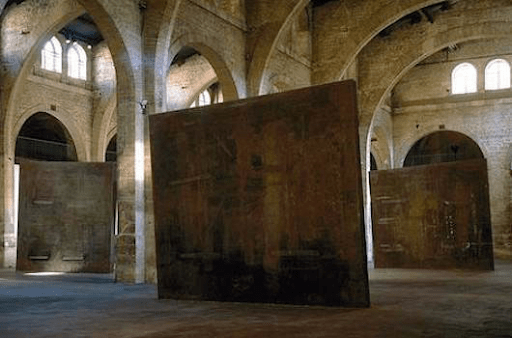
To begin with, speaking about Richard Serra’s work faces the same challenges as appreciating any piece of art, in that no verbal account is going to suffice as a surrogate for direct experience. In fact, Serra himself argues this point very starkly, when asked to describe his “Delineator” (shown next):1

Serra delineator

“What happens with Delineator is that the only way to understand this work is to experience the place physically, and you can’t have an experience of space outside of the place and the space you’re in. Any linguistic mapping or reconstruction by analogy, or any verbalization or interpretation or explanation, even of this kind, is a linguistic debasement, in a sense, because it isn’t even true in a parallel way.”

Nonetheless, Serra does say more about Delineator elsewhere, which highlights some of his concerns and the mental model he uses for thinking about his own work:

“The sculpture defines a definite space inside the room. […] The juxtaposition of steel plates forming this open cross generates a volume of space which has an inside and an outside, openings and directions, aboves, belows, rights, lefts – coordinates to your body that you understand when you walk through it. Noe you might say that that sounds quite esoteric. Well, one of the things that you get into as you become more in tune with articulating space is that space systems are different than linguistic systems in that they are nondescriptive. The conclusion I’ve come to is that philosophy and science are descriptive disciplines, whereas art and religion are not.”

So, if you haven’t seen any of his work and tried to circumnavigate and “inhabit” it, I would very much encourage you to try to do so, if you get a chance. Personally, I have had experiences akin to what Serra speaks about above, when I saw his “Seven plates, six angles” (below) at the Gagosian in New York. The overwhelming sensation I had was of a heightened awareness of scale, volume and proportion, but also – unexpectedly – of space and mass. In some sense, my extensive use of photos in this post is futile – like showing you images of alien foodstuffs that you have not tasted, so, please, consider them tokens or bookmarks – i.e., pointers for your own future experience.

Serra 7 plates 6 angles

When asked about the relation of one of his pieces, shown at the Tate in London, to the building it was exhibited in, Serra made another important observation about what his work intends to be (and one that rang very true to me in retrospect):

“I did not want to enter into an affirmative dialogue with the building. I did not want to mirror face-value language, the physiognomy of the architecture. I wanted to deal with the volume, weight, mass and directionality of the space. [… I] wanted to make a sculpture out of the whole volume […] I wanted to make the volume of the space tangible, so that it is understood immediately, physically, by your body.”

The idea that the sculpture is not solely the object Serra created, but that it is that object in relation to the space it is situated in, is a paradigm shift and the key to understanding his insistence on making site-specific work even in the case of indoor sculptures. And even when a piece is shown in multiple locations over time, its placement in every one of those spaces results in multiple sculptures involving the one Serra-made object (that naïvely might be identified as the sculpture in full).

Beyond the paradigm shift from objects to entire spaces, Serra also broadens the palette of sculptural considerations:

“There’s a difference between walking into a telephone booth and a football stadium. If you take those two extremes and make the idea very subtle, then you can say there’s a difference between walking to the left and walking to the right, between the experience of the concave and convex, between something leaning right and something leaning left. How do you know that to be a different experience in terms of your daily life? And if it is, is it meaningful? The degree of meaningfulness depends on the limitations of the viewer. I think it is very difficult to introduce large-scale works into the public arena inasmuch as I am not interested in complicity or affirmation.

[…]

Compared to that of vertical sculpture, the ideas of sculpture existing horizontally are basically different concepts about construction, are basically different concepts about how we live in the world. On a simple, perceptual level, a modular unit extending above your eye-level becomes foreshortened as it rises, while the horizontal modular unit implies an infinite vanishing point. […] The cultural symbolic iconography of verticality versus horizontality is most apparent in the cross, where the vertical expresses transcendence and the horizontal expresses materiality.”

While Serra is clear about his interests being “nonutilitarian, nonfunctional” and declaring that “any use [of sculpture] is a misuse,” as well as anticipating limited audience appreciation (likening it to “poetry and experimental film” :)), he at the same time has a profound message behind his work:

“We are all restrained and condemned by the weight of gravity. […] The constructive process, the daily concentration and effort appeal to me more than the light fantastic, more than the quest for the ethereal. Everything we choose in life for its lightness soon reveals its unbearable weight. We face the fear of unbearable weight of repression, the weight of constriction, the weight of government, the weight of tolerance, the weight of resolution, the weight of responsibility, the weight of destructions, the weight of suicide, the weight of history which dissolves weight and erodes meaning to a calculated construction of palpable lightness.”

In many ways, the above strikes me as having affinities with Christianity, where Serra’s “Everything we choose in life for its lightness soon reveals its unbearable weight.” can be seen as a complement of Jesus’ “But seek first the kingdom of God and his righteousness, and all these things will be given you besides.” (Matthew 6:33).

A further aspect of Serra’s weight versus lightness statement (made in 1988) is its echoing of Milan Kundera’s novel “The Unbearable Lightness of Being,” published only four years earlier, where its author too makes a play for weight over lightness:2

“The heaviest of burdens is therefore simultaneously an image of life’s most intense fulfillment. The heavier the burden, the closer our lives come to the earth, the more real and truthful they become. Conversely, the absolute absence of burden causes man to be lighter than air, to soar into heights, take leave of the earth and his earthly being, and become only half real, his movements as free as they are insignificant. What then shall we choose? Weight or lightness?”

What, you may ask, is my point though? I hope that the above highlighted a couple of aspects of Serra’s work, which I have found to be deeply engaging and appealing. First, that he has invented a whole new concept of sculpture whose building blocks are not only form, texture, composition and proportion, but also mass, space, directionality and orientation, rendering an entire space a sculpture. Second, that his work is deeply rooted in the entirety of art and philosophy, without these being prerequisites for its appreciation and experience. Third, that experiencing his work, which explicitly shuns religious motives, does shed light on deeply Christian concepts and is therefore also of spiritual value to a Christian viewer at least.

As such, it shouldn’t come as a surprise to you, when I tell you that Richard Serra is probably my favorite sculptor (alongside Michelangelo, Rodin and Giacometti) and I hope that you will appreciate his work too when you next see one of his pieces.


1 All Richard Serra quotes here are from “Writings/Interviews.”
2 Both, probably, derived from Nietzsche’s concept of eternal recurrence, where the permanent (heavy) is contrasted against the fleeting (light).

Kasper’s family: the domestic church

City of churches 1918 1 jpg HalfHD

[Warning: long read]

Even though I only meant to translate from and comment on the first half of Cardinal Kasper’s talk at the extraordinary consistory of cardinals two weeks’ ago, I realized that its middle part – where Kasper focuses on the sacrament of marriage and then speaks about the family as domestic Church – has not received much coverage either (with all attention being directed at the two scenarios he sketched out that constitute a 5% of what he said …). With that in mind – and assuming you are interested in what follows, I would recommend you to take a quick look at the previous post, which covers the general framework in which Kasper then gives thought to how the family could be better welcomed by the Church.

Following the presentation of the principles of how the Gospel is to be understood, how the concept of a gift is central and how God places trust in man and woman and of the subsequent Scriptural exegesis both of the ideal and reality of the family, covered before, Kasper moves on to discuss why marriage is indissoluble:

“[T]he doctrine of the indissolubility of the marital bond […] persists also where, humanly, marriage breaks down. Many today have trouble with understanding it. This doctrine cannot be understood as a kind of metaphysical hypostasis beside or above the personal love of the spouses; on the other hand it isn’t fully accounted for by reciprocal affective love and doesn’t die with it. It is Gospel, or definitive word and permanently valid promise. As such, it takes humans and their freedom seriously. It is precisely due to human dignity that definitive decisions can be taken. These belong in a permanent way to the history of a person; they characterize it in a lasting way; it is not possible to take them back and pretend as if they had never been made. When they are broken, a deep wound results. Wounds can be healed, but the scar remains and continues to trouble; but one can and must continue to live even if that requires effort. Similarly the good news of Jesus is that, thanks to the mercy of God, those who convert can be forgiven, healed and start anew.”

Wow! I have never heard the indissolubility of marriage tied to freedom in this way, or to mercy. It is an understanding of faith like this that makes Pope Francis’ choice of Kasper very clear …

Next comes the passage where the family – based on the indissoluble bond of marriage – is likened to the Church and where Kasper introduces the “law of gradualness” that he then builds on in later parts of his talk:

“Just like the Church is on a journey of conversion and renewal, so marriage too finds itself on the way of the cross and of resurrection, under the law of gradualness of continuing to grow in ever new ways and greater depth in the mystery of Christ. This law of gradualness1 seems to me something of great importance for the life and for the pastoral care of marriage and the family. It doesn’t mean a gradualness of the law, but a gradualness, which means growth, in the understanding and putting into practice of the law of the Gospel, which is a law of freedom (James 1:25, 2:12),2 but which has today become often difficult for many of the faithful. They require time and patient accompanying along their journey.”

Next, Kasper outlines what he sees as the sources of the current crisis of the family:

“[T]he nuclear family, which developed only during the 18th century from the extended family of the past, has ended up in a structural crisis. Modern conditions of work and accommodation have resulted in a separation between accommodation, places of work and places where free time is spent and therefore have lead to a break-up of the home as the social unit. For work reasons, fathers are often away from the family for prolonged periods; women too, for work reasons, are often only partly present in the family. Due to current conditions being hostile to the family, the modern nuclear family finds itself in difficulty.”

What is the answer to these challenges? Is Kasper suggesting some sort of return to the pre-18th-century model? Not quite (and this was to be expected given his thoughts in the opening parts of the talk):

“What we need are extended families of a new kind. For nuclear families to survive, they need to be inserted into new family units that span generations and in which it is above all the grandfathers and grandmothers who take on important roles, into inter-familiar circles of close ones and friends where children can find refuge in the absence of their parents and where single old people, the divorced and single parents can find a kind of home.”

Kasper suggests that the above extended families and “circles” have hints of a “domestic Church” that he further elaborates on next:

“How to define these domestic Churches? They are a Church in miniature inside the Church. They make the local Church present in the concrete life of the people. In fact, where two or three meet in the name of Christ, he is in their midst (Matthew, 18:20). […] Through the Holy Spirit, they have the sensus fidei, the sense of faith, an intuitive sense of faith and of living according to the Gospel. They are not only object but also subject of pastoral care for families. Above all by their example, they can help the Church to enter more deeply into the word of God and to put it into practice in a way that is more full of life. Since the Holy Spirit has been given to the Church in its entirety, they mustn’t isolate themselves in a sectarian way from the broader communion of the Church. This “catholic principle” preserves the Church from disintegrating into single, autonomous, free Churches. Through such unity in multiplicity, the Church is also a sacramental sign of unity in the world.”

One thing that strikes me as important in the above is also how Kasper positions the domestic Churches – families as being important for the Church as a whole – even in core aspects like the growing understanding of the word of God. It is not like the Church in its entirety is putting itself into a position where it knows best and is the source of support for families. Instead, the relationship is very much reciprocal, which is further highlighted in the following passage, where Kasper also returns to the importance of accompanying those who suffer from the break-down of the family:

“Families need the Church and the Church needs families for the sake of being present at the center of life, where modern life takes place. Without the domestic Churches the Church is a stranger to the concrete reality of life. Only through families can it be a home where people are at home. Its being understood as domestic Church is therefore fundamental for the future of the Church and for the new evangelization. Families are the first and best messengers of the Gospel of the family. They are they way of the Church. […] Thinking about the importance of the family for the future of the Church, the rapidly growing number of broken families appears as an even greater tragedy. There is a lot of suffering. [… W]e must change the paradigm and must – like the Good Samaritan (Luke 10:29-37) – look at the situation also from the point of view of those who suffer and ask for help.”

It is only at this point that Kasper starts talking about the challenges of divorce and re-marriage and proceeds to sketch out two scenarios of how the Church could handle them differently. But, that will have to remain for another time. For now, let me just flag up one of Pope Francis’ morning sermons (from last Friday), where he again emphasizes the key in this context:

“When [… the] leaving [of] one’s father and mother, and joining oneself to a woman, and going forward … when this love fails – because many times it fails – we have to feel the pain of the failure, we must accompany those people who have had this failure in their love. Do not condemn. Walk with them – and don’t practice casuistry on their situation.”


1 As far as I can tell, this “law of gradualness” comes from John Paul II’s Familiaris Consortio (§34): “Married people too are called upon to progress unceasingly in their moral life, with the support of a sincere and active desire to gain ever better knowledge of the values enshrined in and fostered by the law of God. They must also be supported by an upright and generous willingness to embody these values in their concrete decisions. They cannot however look on the law as merely an ideal to be achieved in the future: they must consider it as a command of Christ the Lord to overcome difficulties with constancy. “And so what is known as ‘the law of gradualness’ or step-by-step advance cannot be identified with ‘gradualness of the law,’ as if there were different degrees or forms of precept in God’s law for different individuals and situations. In God’s plan, all husbands and wives are called in marriage to holiness, and this lofty vocation is fulfilled to the extent that the human person is able to respond to God’s command with serene confidence in God’s grace and in his or her own will.”” Although I also found it in the I Ching here, where it says: “[The] principle of gradual development can be applied to other situations as well; it is always applicable where it is a matter of correct relationships of co-operation, as for instance in the appointment of an official. The development must be allowed to take its proper course. Hasty action would not be wise.”
2 “But the one who peers into the perfect law of freedom and perseveres, and is not a hearer who forgets but a doer who acts, such a one shall be blessed in what he does.” and “So speak and so act as people who will be judged by the law of freedom.”

Kasper’s family: beauty in the battlefield

Comedy 1921 by Paul Klee 011

[Warning: long read – again.]

While the family is a constant and core feature of human existence that has the potential to strongly shape its members’ lives, the forms it takes today are more diverse than they have probably ever been. At the same time, the Church, at least seemingly, presents a single one of the many alternatives in practice today as the ideal and even penalizes the others. This, undoubtedly results in distance being put between the Church and those whose family lives don’t conform to its ideals, which is a serious problem for the Church, whose mission is to be close to all.

As a result, Pope Francis has put a process in motion to study the current situation of the family and explore ways of the Church being more open and welcoming, while at the same time – and here lies the true challenge – remaining faithful to Jesus’ teachings and the prompting of the Holy Spirit. The form taken by the process are two bishops’ synods – one this year and one next year – where the subject will be discussed and proposals put to the Holy Father for approval. To begin with, a questionnaire has already been circulated to dioceses around the world, in which both priests and lay faithful were asked to provide feedback on a wide variety of questions to do with the family in a broad sense. Many of these surveys have already concluded, with some bishops’ conferences even choosing to publish their result that so far consistently show a gap between Church teaching and practice by the Church’s members. An unsurprising result, but one whose openness and honest is nonetheless a positive sign.

Beyond the questionnaire, the next significant step taken by Pope Francis has been to ask Cardinal Walter Kasper to prepare an address to the extraordinary consistory of cardinals that took place in the Vatican two weeks ago. The resulting two-hour talk was greatly praised afterwards by Pope Francis, by referring to his work the next day as “doing theology on one’s knees.” The first thing to note here is that Cardinal Kasper is not in any formal way related to the family – he is neither in charge of the Pontifical Council for the Family nor the Congregation for the Doctrine of the Faith, whose heads would have been the obvious choices if the criterion had been about formal scopes or responsibilities. Instead, Francis picks one of his favorite theologians (as he said already during the first Angelus after his election) – a retired Cardinal, who had previously been in charge of working towards Christian unity and who has played important roles in improving relationships with Jews. Second, it is worth being aware of the fact that Kasper’s speech was initially not meant for publication and was instead intended only for the cardinals present at the consistory. Nonetheless, ten days after he delivered it, and following extensive media coverage of its summary and some leaked passages, the full text is now available in Italian.

Instead of attempting a detailed commentary on Kasper’s words, I would like to focus on passages from the opening parts of his speech, where he lays out the basic principles and reflects on what is immutable versus what can (and has been) changed during the Church’s long history as far as the family is concerned. Kasper then proceeds to sketch out two ideas of what could be done differently for civilly remarried divorcees – if that is what you are interested in, there has been plenty of coverage of their details, and an English translation of the relevant passages is available here.

To my mind those two proposals are the least interesting part of Kasper’s thought, since, as he states from the outset, his aim is only to provide a “kind of overture that leads towards the theme, in the hope that in the end we will receive a sym-phony, or a harmonious whole of all the voices in the Church, including those that at the moment are partly dissonant.” Kasper wants to set the scene and provide a framework in which all can come together.

The first, to my mind beautiful and lucid, insight regards an understanding of what the Gospel is and of how it relates to the Church’s teaching:

“The Gospel, believed in and lived by the Church, is the source of all truth, of salvation and of practice. This means that the teaching of the Church is not a stagnant lake, but instead a torrent that springs from the source of the Gospel, in which flows the experience of faith of the people of God of all the ages. It is a tradition that is alive and that today, as on many other occasions during the course of history, has arrived at a critical point and that, in view of the “signs of the times,” requires continuation and deepening.

What then is this Gospel? It isn’t a legal code. It is the light and strength of life that is Jesus Christ. It gives what it asks for. Only in its light and in its strength is it possible to understand and observe the commandments. […] Without the Spirit that works in our hearts, the letter of the Gospel is a law that kills (2 Corinthians 3:6).1 Therefore the Gospel of the family does not want to be a burden, but instead, as far as being a gift of faith, an uplifting news, light and strength of the life of the family.”

The second cornerstone is about the nature of the sacraments and their interdependence with faith:

“The sacraments, including that of marriage, are sacraments of faith. […] The Second Vatican Council [… says about the sacraments:] “They not only presuppose faith, but […] they also nourish, strengthen, and express it.” (SC 59) The sacrament of marriage too can become efficacious and be lived only in faith. Therefore, the essential question is: how is the faith of the future spouses? […] Many persons are baptized but not evangelized. Put in paradoxical terms, they are baptized catechumens, if not baptized pagans.”

These may sound like harsh words – and they are! – but I believe they, sadly, express a widespread reality whereby there is broad lack of understanding about faith among Catholics.

The third opening consideration brings together the dynamism of the Gospel and the indispensability of faith, and relates them to how God participates in our lives:

“God is a God of the journey: in the history of salvation he has journeyed with us. Today he has to walk the Earth again with the persons of the present. He doesn’t want to impose faith on no one. He can only present it and propose it as a way of happiness. The Gospel can convince only by means of itself and by its profound beauty.”

In summary, I see Kasper as setting a scene in which the Gospel is a source of joy, where it is through faith and with open eyes that it guides and delights the followers of Jesus. It is not to be imposed, nor is it to be read as a rule-book, and taking its consequences out of context is lethal.

Next, Kasper proceeds to lay out the basic principles of the ideal family, all by reference to the first book of Genesis:2

  1. “God created mankind in his image; in the image of God he created them; male and female he created them.” (Genesis 1:27) Here Kasper focuses on the relationship between man and woman and on it being based on the concepts of love and gift: “Man and woman are given as gifts by God one for the other. They have to complement and sustain each other, delight each other and find joy in each other. Both, man and woman, inasmuch as they are image of God, have the same dignity. There is no room for discrimination against the woman. But man and woman aren’t simply equal. Their equality in dignity is based on creation, just like their diversity. […] The equal dignity of their diversity explains the attraction between the two […] Wanting to make them equal on ideological grounds destroys erotic love. The Bible understands this love as union for the sake of becoming one flesh, which means one community of life, which included sex, eros and human friendship. In this complete sense, man and woman are created for love and are an image of God, who is love (1 John 4:8). […] When a partner deifies the other and expects that they prepare heaven on earth for them, the other necessarily feels that too much is being asked of them; they can do nothing but disappoint. Many marriages fail as a result of such excessive expectations. The community of life of man and woman, together with their children, can be happy only if they see each other as reciprocal gifts that transcend each one of them.”
  2. “God blessed them and God said to them: Be fertile and multiply” (Genesis 1:28) Kasper’s focus here is on God’s trust: “Responsible parenthood has a more profound meaning than that which is usually attributed to it. It means that God entrusts the most precious gift he can give, which means human life, to the responsibility of man and woman. The can decide responsibly the number and timing of the birth of their children. They have to do it responsibly in front of God and by respecting the dignity and the good of their partner, responsibly with regard to the good of their children, responsibly in view of the future of society and while respecting human nature. The result though isn’t a casuistic, but instead a form whose specific putting into practice is entrusted to the responsibility of man and woman. They are given the responsibility over the future. The future of humanity passes through the family.”
  3. “[F]ill the earth and subdue it” (Genesis 1:28) becomes interpreted by Kasper as a call to filling the world with a culture of love: “These words are not meant as submission or violent domination. The second creation account here speaks about cultivating and caring for (2:15). […] With this cultural mission, the relationship between man and woman transcends them again. It isn’t mere sentimentalism that revolves around oneself; it mustn’t close itself in on itself, but open itself towards a mission for the world. The family is not only a private community of persons. It is the fundamental and vital cell of society. […] It is fundamental for the birth of a culture of love and for a humanization and personalization of society, without which it would become an anonymous mass. In this sense it is possible to speak about a social and political role of the family.”

The family, as presented here by Kasper, is an exciting and grand participation, of humans as God’s partners, in the life of God, which is called to bringing love both ad intra and ad extra.

As soon as Kasper presents the ideal of the family, he is quick to point out that this ideal is “not the reality of the family [and that …] the Bible knows it.” The root cause is that “the alienation of man from God has as its consequence alienation in man and among persons,” which also projects onto the family:

“The first alienation happens between man and woman. They experience shame, one in front of the other (3:10). This shame demonstrates that the original harmony between body and spirit has been disturbed and that man and woman are alienated from one another. Affection degenerates into desire and domination of man over woman (3:16). They reproach and accuse each other (3:12). Violence, jealousy and discord creep into marriage and the family.”

Kasper also points out that the marital infidelities that the Bible recounts are even part of Jesus’ family tree, which “includes two women (Tamar and Uriah’s wife) who are considered sinners (Matthew 1:3). Jesus too had ancestors who didn’t come from a “good family,” and whom it would have been preferable not to speak about. The Bible here is very realistic, very honest.” He then goes on to warn against a distorted, idealized view:

“When we speak about the family and about the beauty of the family, we mustn’t start from an unrealistic, romantic image. We must also see the hard realities and participate in the sadness, the worries and the tears of many families. Biblical realism can in fact offer us a certain consolation. It shows us that what we lament is not something of today and that it has always been like that. We mustn’t give in to the temptation of idealizing the past and then, as happens in many cases, see the present merely as a history of decadence.”

To conclude his reflection on the family, which starts out from the ideals derived from Genesis, chapter 1, and then proceeds through the failures catalogued in both Old and New Testaments, Kasper finishes on a positive note, again derived from Scripture:

“In the end, the third chapter of Genesis kindles a light of hope. Throwing man out of paradise, God gave him hope for accompanying him on his journey. That which tradition defines as the protoevangelium (Genesis 3:15), can also be understood as the protoevangelium of the family. From its descendants a Savior will be born. The genealogies of Matthew and Luke (Matthew 1:1-7; Luke 3:23-28) witness that from the sequence of generations, even with its jolts and jerks, in the end a Savior is born. God can write straight even along crooked lines. Therefore, when we accompany people along their journeys, we mustn’t be prophets of doom, but instead bearers of hope, who offer consolation and who, even in difficult situations, encourage people to go ahead.”

The picture here is very much of hope with eyes wide open and of pursuing a great ideal even in the midst of failure and weakness. In the second half of his talk (that’s right – the above are just a couple of pieces from the first half!), Kasper then proceeds to look at how the various painful situations that families find themselves in can be approached, with a focus on how those who got divorced and the subsequently civilly re-married could be accompanied and included. Since this second half of Kasper’s talk is receiving good coverage in the media, I will limit myself to the above framework that I translated from the Italian full text and commented on above. To give you a sense of where Kasper is going in the second half of his talk, let me just quote one line from it: “The Church must be a home for all, in which all must be able to feel at home and like in a family.” Amen!

[UPDATE (4 March 2014): I have changed my mind and have continued with translating passages from and commenting on the second part of Kasper’s talk here. There he takes us through his analysis of the indissolubility of marriage, of the causes of the breakdown of the nuclear family and proposes the domestic Church as the way forward.]


1 “[W]ho has indeed qualified us as ministers of a new covenant, not of letter but of spirit; for the letter brings death, but the Spirit gives life.”
2 Here he is in good company with John Paul II’s “theology of the body” whose conclusions are also well reflected in Kasper’s thought.

An ecumenism of brotherhood

Francis abp welby

[Warning: long read.]

Already St. Paul was faced with factions and divisions among the earliest followers of Jesus – to the point of frustration, in the face of groups declaring their allegiance to one or other leader: “[I]t has been reported to me about you, my brothers, by Chloe’s people, that there are rivalries among you. I mean that each of you is saying, “I belong to Paul,” or “I belong to Apollos,” or “I belong to Cephas,” or “I belong to Christ.” Is Christ divided? Was Paul crucified for you? Or were you baptized in the name of Paul?” (1 Corinthians 1:11-13). In other words: “Pull yourselves together!”

That there are divisions among Christians is a scandal and one that both mocks Jesus’ own call for his followers to be united and for us to love each other like ourselves. It is no wonder then that ecumenism – the desire to see all Christians reunited after centuries of divisions – is one of the most prominent themes of Pope Francis’ preaching and actions. To get a sense of how he is approaching this challenge (or “opportunity,” as it would be put using a politically-correct vocabulary), it is worth taking a look at what he has said on the subject so far. The following is, therefore, my attempt to pull all of Francis’ remarks on ecumenism together in one place (in chronological order):

  1. When addressing the Archbishop of Canterbury in June ’13, Francis focuses on ecumenism as a shared journey, undertaken with Jesus in our midst:

    “The unity we so earnestly long for is a gift that comes from above and it is rooted in our communion of love with the Father, the Son and the Holy Spirit. As Christ himself promised, “where two or three are gathered in my name, there am I in the midst of them” (Mt 18:20). Let us travel the path towards unity, fraternally united in charity and with Jesus Christ as our constant point of reference.”

  2. Later that month, addressing the Ecumenical Patriarch of Constantinople, Francis draws attention to ecumenism not being about a lowest common denominator, but instead about an exchange of riches and a seeking of truth:1

    “It comforts me, knowing that Catholics and Orthodox share the same conception of dialogue that doesn’t seek a theological minimalism on which to reach a compromise, but that rather is based on the deepening of the truth that Christ has given to his Church and that we, moved by the Holy Spirit, never cease to understand better. This is why we shouldn’t be afraid of encounter and true dialogue. It doesn’t distance us from the truth but rather, through an exchange of gifts, leads us, under the guidance of the Spirit of truth, to the whole truth.”

  3. In his address to Baselios Marthoma Paulose II, Catholicos of the Malankara Orthodox Syrian Church in September ’13, Francis calls for a culture of encounter instead of clashes, emphasizing both the need of individual effort and the work of the Holy Spirit:

    “I believe that on the ecumenical path it is important to look with trust to the steps that have been completed, overcoming prejudices and closed attitudes which are part of a kind of “culture of clashes” and source of division, and giving way to a “culture of encounter”, which educates us for mutual understanding and for working towards unity. Alone however, this is impossible; our witnesses and poverty slow the progress. For this reason, it is important to intensify our prayer, because only the Holy Spirit with his grace, his light and his warmth can melt our coldness and guide our steps towards an ever greater brotherhood.”

  4. In “the” interview to Jesuit magazines later that month, Francis emphasized the mutual enrichment that is a consequence of ecumenism: “In ecumenical relations it is important not only to know each other better, but also to recognize what the Spirit has sown in the other as a gift for us.”
  5. During a general audience at the end of September ’13, Francis emphasized two points with regard to ecumenism: first that there is an abundance of riches that Christians already share:

    “There is one body, that of Christ which we receive in the Eucharist; one Spirit, the Holy Spirit that animates and constantly recreates the Church; one hope, eternal life; one faith, one Baptism, one God, Father of us all (cf. vv. 4-6). The richness of what unites us!”

    second, that the work for communion among all Christians starts with each one of us – in the family, parishes, … rather than being something removed from the lives of individuals:

    “Each one should ask himself today: do I make unity grow in the family, in the parish, in the community or am I a motive of division, of hardship? Do I have the humility to heal with patience, with sacrifice, the wounds to communion?”

    and, finally, a reminder that Christian unity is not principally a matter of political negotiation, but a gift received from God:

    “[W]ho is the motor of this unity of the Church? It is the Holy Spirit. Our unity is not primarily the fruit of our consensus, of our effort to be in agreement, but it comes from Him who makes unity in diversity, which is harmony.”

  6. When addressing the president of the Lutheran World Federation in October ’13, Francis positions unity among Christians as a consequence of each individual, community and church drawing closer to Jesus and as being in proportion to the sincerity with which it is asked for: “In the measure in which we draw closer to our Lord Jesus Christ in humility of spirit, we are certain to draw closer to one another. And, in the measure in which we ask the Lord for the gift of unity, we are sure that he will take us by the hand and be our guide.” In other words, both as a consequence of fidelity and as a gift.
  7. A week later, in a letter to the World Council of Churches, Francis effectively calls for action as one Christian community, even in the face of our existing differences:

    “In fidelity to the Gospel, and in response to the urgent needs of the present time, we are called to reach out to those who find themselves in the existential peripheries of our societies and to show particular solidarity with the most vulnerable of our brothers and sisters: the poor, the disabled, the unborn and the sick, migrants and refugees, the elderly and the young who lack employment.”

  8. In an interview for the La Stampa Italian daily in December ’13, Francis further sharpened his insistence on what Christians all have in common:

    “Today there is an ecumenism of blood. In some countries they kill Christians for wearing a cross or having a Bible and before they kill them they do not ask them whether they are Anglican, Lutheran, Catholic or Orthodox. Their blood is mixed. To those who kill we are Christians. We are united in blood, even though we have not yet managed to take necessary steps towards unity between us and perhaps the time has not yet come. Unity is a gift that we need to ask for. I knew a parish priest in Hamburg who was dealing with the beatification cause of a Catholic priest guillotined by the Nazis for teaching children the catechism. After him, in the list of condemned individuals, was a Lutheran pastor who was killed for the same reason. Their blood was mixed. The parish priest told me he had gone to the bishop and said to him: “I will continue to deal with the cause, but both of their causes, not just the Catholic priest’s.” This is what ecumenism of blood is.”

  9. At the end of the Week of Prayer for Christian Unity at the end of January ’14, Francis highlighted that Christian unity won’t be something that suddenly happens at the end of a process, but that it is instead a journey that we share already now:

    “We have all been damaged by these divisions. None of us wishes to become a cause of scandal. And so we are all journeying together, fraternally, on the road towards unity, bringing about unity even as we walk. […] Unity will not come about as a miracle at the very end. Rather, unity comes about in journeying; the Holy Spirit does this on the journey. If we do not walk together, if we do not pray for one another, if we do not collaborate in the many ways that we can in this world for the People of God, then unity will not come about! But it will happen on this journey, in each step we take. And it is not we who are doing this, but rather the Holy Spirit, who sees our goodwill.”

  10. On 18th February Pope Francis then addressed the attendees of a Evangelical Christians, via a video recorded by his friend – the Anglican Bishop Tony Palmer on his iPhone. Not only was the form of the message refreshingly friendly and informal, but its content too is significant in the completely fraternal level at which Francis places himself and the gathering he addresses. The very direct identification of past disagreements as sins on both side, the acknowledgement of God’s action among the gathering he addresses and his emphasis on the need for encounter and the recognition of each other as brothers further underline where he is coming from:2

    Dear brothers and sisters, excuse me because I speak in Italian, but I am not speaking English. But, I will speak no Italian, no English, but heartfully. It is a simpler and more authentic language and this language of the heart has a special style and and a special grammar. A simple grammar. Two rules: Love God above all else, and love the other because they are your brother and sister. With these two things we go ahead. I am here with my brother, with my brother bishop, Tony Palmer. We have been friends for years. […] It is a pleasure to greet you. A joyful and wishful greeting. Joyful, because it fills me with joy to know that you are together to give praise to Jesus Christ, the only Lord. And to pray to the Father and receive the Spirit. This gives joy, because it can be seen that the Lord works all over the world.

    And wishful because … Well, what happens with us is what also happens in some neighborhoods where there are some families who love each other and other families who don’t. Families who come together and families who separate and we are a bit – I’ll use the word – a bit separated. Separated because sins have separated us, our sins. The misunderstandings throughout history. It has been a long road of communitarian sin. But who is to blame? We all are to blame. We are all sinners. Only one is just – the Lord.

    I am wishful for this separation to end and for communion to come. I am wishful for that embrace that Holy Scripture speaks about when Joseph’s brothers, starving, went to Egypt so that they could buy food to eat. They went to buy, they had money, but they couldn’t eat the money! And there they found something more than food, they found their brother. All of us have “currency.” The currency of culture, the currency of our history, and lots of cultural riches and religious ones, of diverse traditions. But we have to come together as brothers. And we must cry together like Joseph did. This crying will unite us – the crying of love. I am talking to you as your brother. And I speak to you like this, simply. With joy and wishfulness. Let us make our wishfulness grow, because this will push us to find each other, to embrace each other and to praise Jesus Christ as the only Lord of history. […] I ask you to bless me and I bless you – from brother to brother.”

  11. That emphasis on Jesus being the center of Christian life is then taken further in Francis’ Angelus message3 last Sunday, where he insisted that :

    “Saint Paul explains that […] the community does not belong to the apostles, but it is them – the apostles – who belong to the community; but the community, in its entirety, belongs to Christ!

    From this belonging derives the fact that in Christian communities – dioceses, parishes, associations, movements – differences mustn’t contradict the fact that we all, through Baptism, have the same dignity: we are all all, in Jesus Christ, sons and daughters of God. And this is our dignity: in Jesus Christ we are sons and daughters of God! Those who have received a ministry of leadership, of preaching, of administering the Sacraments, mustn’t consider themselves to in possession of special powers, masters, but place themselves at the service of the community, helping it along the journey of holiness with joy. […]

    May the Lord give us the grace to work for the unity of the Church, of building this unity, because unity is more important than conflicts! The unity of the Church is of Christ, conflicts are problems that are not always of Christ. […]

    Pray for us [the new Cardinals, made the previous day, and the pope], that we may be good servants: good servants, not good masters! All together, bishops, priests, consecrated persons and faithful laity, we have to give witness of a Church faithful to Christ, animated by the desire to serve brothers and sisters and ready to reach out with prophetic courage towards the spiritual expectations and needs of men and women of our times.”

All of this is a lot to take in, but for me there are a couple of key points that Francis has made. First, that neither those who persecute or denigrate Christians, nor God, make distinctions between the different denominations. Second, that there are degrees of unity and that we can make it grow by working together for the good of all – including those who are not Christians, thereby contributing also to universal brotherhood (as stated also in Evangelii Gaudium §245). Third, that no one owns the Christian “brand” but Jesus himself. We are all on a level playing field, all having made mistakes, but all being recipients of God’s gifts and in a position to help, accompany and support each other. Fourth, that ecumenism is not akin to mergers and acquisitions or to a peace treaty – it is not about compromise or a lowest common denominator. The name of the game is truth, and differences, instead, are riches that will be brought together by the actions of the Holy Spirit. Fifth, ecumenism is both God’s work and ours and is part of our broader obligation – in response to Jesus’ own testament4 – to work towards unity in all contexts, which also reminds me of a great piece of advice by St. Ignatius of Loyola: “Pray as though everything depended on God. Work as though everything depended on you.”


1 Echoing one of Pope Benedict XVI’s most daring statements on the subject: “[T]he search for knowledge and understanding always has to involve drawing closer to the truth. Both sides in this piece-by-piece approach to truth are therefore on the path that leads forward and towards greater commonality, brought about by the oneness of the truth. As far as preserving identity is concerned, it would be too little for the Christian, so to speak, to assert his identity in a such a way that he effectively blocks the path to truth. Then his Christianity would appear as something arbitrary, merely propositional. He would seem not to reckon with the possibility that religion has to do with truth. On the contrary, I would say that the Christian can afford to be supremely confident, yes, fundamentally certain that he can venture freely into the open sea of the truth, without having to fear for his Christian identity.”
2 The following is my translation of the original Italian – except for the first few sentences (transcribed in italics), which Francis speaks in (broken) English – another great gesture :).
3 Since the English version of the full text is not available yet, the following is my own, crude rendition. 4 “I pray not only for them, but also for those who will believe in me through their word, so that they may all be one, as you, Father, are in me and I in you, that they also may be in us, that the world may believe that you sent me.” (John 17:20-22)

The Spirit of God always gets there first

Aiweiwei unilever banner 0

Today Pope Francis gave a stunning speech to around 8000 members, families of the Neocatechumenal Way (a million-strong Catholic movement focused on the Christian formation of adults), ahead of their departure for missions across the world. Before he gave them his blessing, he addressed them with words of advice, all of which I highly recommend. Instead of reflecting on his speech in full, I’d like to focus only on a single point he makes, which stopped me in my tracks as I read it, by its beauty, humility and post hoc obviousness :). Here is what Pope Francis presented as his second of (yes, you guessed it) three points1 of advice:

“[W]herever you may go, it would do you well to think that the Spirit of God always gets there ahead of us. The Lord always precedes us! … Even in the most faraway places, even in the most diverse cultures, God scatters everywhere the seeds of his Word. From here, flows the necessity to give special attention to the cultural context in which you […] will go to work: it consists of an environment often very different from the one from which you come. Many of you will have to work hard to learn the local language, sometimes it will be difficult, and this effort is appreciated. Even more important will be your commitment to “learn” the culture you will encounter, knowing how to recognize the need of the Gospel, which is present everywhere, but also that action that the Holy Spirit has accomplished in the life and in the history of every people.”

To make the most of the above, let’s also put Pope Francis’ closing remarks during the same address on the table:

“I encourage you to bring everywhere, even in the most de-Christianized environments, especially in the existential peripheries, the Gospel of Jesus Christ. Evangelize with love, bring to everyone the love of God. Tell everyone you will meet on the streets of your mission that God loves man as he is, even with his limits, with his mistakes, with his sins. For this, he sent his Son, so that he could take our sins upon himself. Be messengers and witnesses of the infinite goodness and the inexhaustible mercy of the Father.”

What emerges here is a very powerful picture, to my mind, where Francis first points out a consequence of Christian faith that is often overlooked especially when thinking about non-Christian contexts, which is that God is already there even before the first Christian arrives to announce the Good News. A Christian sent to “the most de-Christianized environments” is not the one bringing God to a place from which He is absent! Instead, they need to realize not only that God is already there (to suggest anything else would be heresy), but also that God’s presence brings fruits. A Christian needs to recognize that God is present in a non-Christian culture, that “God scatters everywhere the seeds of his Word.”2 Their reverence for God’s Word then obligates them to recognize also the “action that the Holy Spirit has accomplished in the life and in the history of every people.” The Christian does not arrive as the exclusive bearer of God to a place from where He is lacking, but instead as a fellow recipient of God’s Word. What a different perspective this is from the caricature of proselytism!

The second moment in Pope Francis’ advice that struck me is guidance on the kerygma to be used by the missionaries, where the emphasizes that “God loves man as he is, even with his limits, with his mistakes, with his sins.” God’s love is not conditional, or requiring merit. It is not a “do X, Y and Z and you will become worthy.” Instead, the missionaries are to announce to the people they’ll find at the peripheries of de-Christianized environments that God loves them as they are.

Wow! The mindset Pope Francis offers here is a breath of fresh air.3

As I thought about the above, I realized that I’d be making a mistake though if I thought about Francis’ words as advice that these Neocatechumenal types needed to hear. His words are addressed to me too. I too am often in “de-Christianized environments,” with their own “culture” and I too need to recognize that in those environments too God is natively at work, that I too can look for traces of His presence and His action also in these non-Christian contexts. This does not absolve me from sharing my Christian faith, but it further underlines the fact that I am sharing it with equals – with brothers and sisters.


1 The first point emphasizes the importance of these missionaries being united with the local Churches in the places they are being sent to – a very important point! – and the third – also super important! – is his insisting on the need for missionaries being merciful towards each other and leaving everyone free to change their minds about following the Neocatechumenal Way. Both of these, which in fact mirror some of the criticisms leveled at the Neocatechumenal Way, would be worth reflecting on and I may well return to them in the future.
2 A clear reference to the Ad Gentes Vatican II decree, which makes the same point: “In order that they may be able to bear more fruitful witness to Christ, let [Christians] be joined to those men by esteem and love; let them acknowledge themselves to be members of the group of men among whom they live; let them share in cultural and social life by the various. undertakings and enterprises of human living; let them be familiar with their national and religious traditions; let them gladly and reverently lay bare the seeds of the Word which lie hidden among their fellows.” This, in turn is at least a 2nd century AD idea by Justin Martyr
3 And, no, I don’t mean to suggest this in contrast to what his predecessors have done. It is more a matter of emphasis and directness of language rather than a change in guidance or dogma. See also footnote 2 …

The Church is not only for good people

Dsm02 wordle

Due to the brief break in masses at Pope Francis’ residence – the Domus Sanctæ Marthæ – over the Christmas holidays, the set of 43 sermons he delivered there since the beginning of September until the end of 2013 can be considered their second season.1 In this post, I will again look at his sermons’ textual features, compare them against the first season and share with you some of my favorite moments from Francis’ homilies during this period, that haven’t already been referred to in the blog posts I wrote over the same period, which are frequently inspired by them or at least make reference to them.

In terms of the latest season’s language, it very much remained like that of the the first, with a heavy focus on Jesus – by far the most frequently used word throughout. The remaining nine of the top ten most frequently-used words were: God, Lord, you, our, him, Church, people, life and Christian (in that order) which means that eight of the top words from the first season remained unchanged, with only “love” and “what” dropping our of the top ten, being replaced by “Christian” and “people.” The specific shifts of these words are also worth noting from the following figure:

S02vs01

While even a relatively small dataset like the above fifty pairs of word frequencies is big enough to have lots read into it, it’d still venture to make the following observations: first, that “Lord” no longer outweighs “God,” second that the gap between the frequency of “our” versus “you” has dropped significantly and third that “Church” and “people” are on almost equal footing instead of the former being said almost twice as often as the latter in the previous season. I don’t mean to build an elaborate analysis on the above features, but they strike me as indicators of an even greater closeness between Francis and his audience.

Worth noting is also the further reduced Gunning-Fog readability Index (from an already very low 6.6 to 6.3), which indicates an increased ease of the text and that this is achieved at the same time as an almost doubling of the text’s lexical density (from 15.2 to 25.3). All of this points to Francis’ words being very accessible, while at the same time holding substance.

Both as an example of his style and as a way to pick out some of my favorite moments from these last three months, the following five are passages from Francis’ homilies that particularly spoke to me:

  1. “Those who live judging their neighbor, speaking ill of their neighbor, are hypocrites, because they lack the strength and the courage to look to their own shortcomings. The Lord does not waste many words on this concept. Further on he says that he who has hatred in his heart for his brother is a murderer. In his first letter, John the Apostle also says it clearly: anyone who has hatred for his brother is a murderer, he walks in darkness, he who judges his brother walks in darkness. And so, every time we judge our brothers in our hearts – or worse still when we speak ill of them with others, we are Christian murderers: A Christian murderer…. It’s not me saying this, it’s the Lord. And there is no place for nuances. If you speak ill of your brother, you kill your brother. […] Gossip always has a criminal side to it. There is no such thing as innocent gossip. […] Some may say that there are persons who deserve being gossiped about. But it is not so: Go and pray for him! Go and do penance for her! And then, if it is necessary, speak to that person who may be able to seek remedy for the problem. But don’t tell everyone! Paul had been a sinner, and he says of himself: I was once a blasphemer, a persecutor, a violent man. But I have been mercifully treated. Perhaps none of us are blasphemers – perhaps … But if we ever gossip we are certainly persecutors and violent. We ask for grace so that we and the entire Church may convert from the crime of gossip to love, to humility, to meekness, to docility, to the generosity of love towards our neighbor.” (13th September)
  2. “You can’t govern without loving the people and without humility! And every man, every woman who has to take up the service of government, must ask themselves two questions: ‘Do I love my people in order to serve them better? Am I humble and do I listen to everybody, to diverse opinions in order to choose the best path.’ If you don’t ask those questions, your governance will not be good. The man or woman who governs – who loves his people is a humble man or woman.” (16th September)
  3. “The Church is not the Church only for good people. Do we want to describe who belongs to the Church, to this feast? The sinners. All of us sinners are invited. At this point there is a community that has diverse gifts: one has the gift of prophecy, another of ministry, who teaching … We all have qualities and strengths. But each of us brings to the feast a common gift. Each of us is called to participate fully in the feast. Christian existence cannot be understood without this participation. ‘I go to the feast, but I don’t go beyond the antechamber, because I want to be only with the three or four people that I am familiar with …’ You can’t do this in the Church! You either participate fully or you remain outside. You can’t pick and choose: the Church is for everyone, beginning with those I’ve already mentioned, the most marginalized. It is everyone’s Church!” (5th November)
  4. “When we look at a father or a mother who speaks to their little child, we see that they become little and speak with a voice of a child and with the manners of children. Someone looking in from the outside think, ‘This is ridiculous!’ They become smaller, right there, no? Because the love of a father and a mother needs to be close. I say this word: to lower themselves to the world of the child … If the father and mother spoke to them normally, the child would still understand; but they want to take up the manner of speaking of the child. They come close, they become children. And so it is with the Lord. The Greek theologians explained this attitude of God with a somewhat difficult word: “syncatabasis” or “the humble and accommodating disposition of God who lowers Himself to make Himself one of us.”” (12th December)
  5. “There is a third coming of the Lord: that of every day. The Lord visits His Church every day! He visits each of us, and so our souls as well experience something similar: our soul resembles the Church, our soul resembles Mary. The Desert Fathers say that Mary, the Church and our souls are feminine, and that what is said about one can be said analogously of the others. Our soul is also in waiting, this waiting for the coming of the Lord – an open soul that calls out, ‘Come, Lord.’” (23rd December)

1 For a review of the “first season,” see here.

This is what the Gospel looks like

Pope disfigured man

Pope Francis has given another interview – this time to Andrea Tornielli (a contributor to the always up-to-date Vatican Insider blog) at the Italian La Stampa newspaper – and the following are some of my favorite passages:1

“[Christmas] speaks to us of tenderness and hope. When God meets us, he tells us two things. The first one is: have hope. God always opens doors, he never closes them. He is the dad who opens doors for us. Second: don’t be afraid of tenderness. When Christians forget about hope and tenderness, they become a cold Church that doesn’t know where to go and that entangles itself into ideologies, into worldly attachments. Instead, God’s simplicity tells you: go forward, I am a Father who caresses you. I am scared when Christians lose hope and the capacity to embrace and caress.”

Christmas is about hope and warmth, fueled by and in imitation of God and directed towards others.

“What we read in the Gospels is an announcement of joy. The evangelists have described a joy. No consideration is given to the unjust world, to how God could be born into such a world. All this is the fruit of our own contemplations: the poor, the child that has to be born in uncertainty. is born into a precarious situation. Christmas was not a condemnation of social injustice, of poverty; instead, it was an announcement of joy. Everything else are conclusions that we draw. Some are correct, others are less so, and others still are ideologized. Christmas is joy, religious joy, God’s joy, interior, luminous, of peace.”

Christmas is, first and foremost, joy. Let’s not rush to its implications at the expense of overlooking that deep joy that it heralds.

“A teacher of life for me has been Dostoevskij, and a question of his, both explicit and implicit, has always gone around in my heart: “Why do children suffer?” There is no explanation. […] In front of a suffering child, the only prayer that comes to me is the prayer why. Why, Lord? He doesn’t explain anything to me. But I feel that he is looking at me. So I can say: You know the why, I don’t it and You don’t tell me, but You are looking at me and I trust You, Lord, I trust your gaze.”

Suffering can’t – and mustn’t! – be explained away, but it can be lived while trusting in God’s loving gaze.

“The other day at the Wednesday General Audience, there was a young mother with her baby that was only a few months old, behind one of the barriers. As I passed by, the baby cried a lot. The mother was caressing it. I said to her: madam, I think the little one is hungry. She replied: Yes, it’s probably time … I responded: But, give it something to eat, please! She was shy and didn’t want to breastfeed in public, while the Pope was passing. So, I wish to say the same to humanity: give something to eat! That woman had milk to give to her child, in the world we have enough food to feed everyone.”

There is food for everyone – let’s not make our shyness an obstacle for it to get to its rightful recipient.

“Marxist ideology is wrong. But in my life I have met many Marxists who are good people, so I don’t feel offended.”

Don’t conflate ideology with its adherents. Even wrong ideologies have good people following then.

“During these first nine months, I have received visits from many Orthodox brothers, Bartholomew, Hilarion, the theologian Zizioulas, the Copt Tawadros: this last one is a mystic, he’d enter the chapel, remove his shoes and go to pray. I felt like their brother. They have apostolic succession, I received them as brother bishops. It is painful that we are not yet able to celebrate the Eucharist together, but there is friendship. I believe that the way forward is this: friendship, common work, and prayer for unity. We blessed each other, one brother blesses the other, one brother is called Peter and the other Andrew, Mark, Thomas …”

I have no comment to add – only to say how it warms my heart to hear Francis refer to the Orthodox patriarchs as his brothers and liken their relationship to those among the apostles. This is very much in continuation of the tremendous advances made by John Paul II and Benedict XVI, but I am moved by the beauty of the simplicity with which Francis puts the situation.

“I knew a parish priest in Hamburg who was dealing with the beatification cause of a Catholic priest guillotined by the Nazis for teaching children the catechism. After him, in the line of condemned individuals, was a Lutheran pastor who was killed for the same reason. Their blood became mixed. That parish priest told me he had gone to the bishop and said to him: “I will continue to deal with the cause, but for both of them, not just the Catholic priest’s.” This is the ecumenism of blood.”

That we are followers of Jesus, regardless of what Church we belong to is a matter that goes to the bone, into our blood. There we are already one.

“We must try to facilitate people’s faith, rather than control it. Last year in Argentina, I condemned the attitude of some priests who would not baptize the children of unmarried mothers. This is a sick mentality.”

We are not gate-keepers, but each other’s brothers and sisters instead.

“A few months ago, an elderly cardinal said to me: “You have already started the reform of the Curia with your daily masses at St. Martha’s.” This made me think: reform always begins with spiritual and pastoral initiatives rather than with structural changes.”

Structures must be a consequence of life and the best leadership is by example. This point of Pope Francis’ is also in sync with my previous criticisms of his actions being explained away as only “pastoral” and with comments made by Fr. Antonio Spadaro in the New Yorker interview, where he says, when asked about the style-versus-substance debate concerning Pope Francis: “Style is not just the cover of the book. It’s the book itself! Style is the message. The substance is the Gospel. This is what the Gospel looks like.”


1 Please, note that the following quotes are close to the official English translation, but that I have modified them here and there based on the Italian original – not necessarily in the belief of making them “better” – only with the aim of preserving some of the nuances of how Pope Francis expresses himself.

Possessed by truth: a journey

Color of truth

[Warning: long read.]

One of the points made by Pope Francis in his letter to Eugenio Scalfari at the beginning of September regarded the nature of truth, which he likened to a relationship and which he argued “embraces and possesses us” instead of us possessing it. In this post, I would like to revisit this passage and look at it, and related statements made by Cardinal Gianfranco Ravasi, through the lens of philosophy.

The question of truth is one of the central concerns of philosophy and theories about it impact a vast variety of other aspects of rational enquiry. Since it is such a central theme, my attempt to look at Francis’ and Ravasi’s words from the point of view of philosophy will necessarily be in the form of a very roughly-ground lens1 indeed and all that I can hope to convey are blurry silhouettes. To keep the argument at a high level (as much as I would love to delve into the depths, e.g., of Alfred Tarski’s approach), I will mostly stick to summaries provided in the Stanford Encyclopedia’s “truth” entry and round it out by headlines from the “truth” entry in the Wikipedia.

With the caveats out of the way, let’s first look at the concept of truth most akin to what is typically meant by this word in “ordinary language” (i.e., language as used without the machinery of technical definitions – effectively the language spoken by “the man on the Clapham omnibus” to borrow an expression from English law). Here, an expression, statement, declaration, description, account, etc. is true if it matches how things actually are. If I say “there is a cat on the mat” and there actually is a cat on the mat then what I have said is true. What does philosophy make of the concept though and how does it deal with the pandora’s box that spills out left, right and center, when a basic idea like truth is subjected to scrutiny and deconstruction (in “ordinary language” terms).

As the King said to Alice, very gravely, let’s begin at the beginning – or at least reasonably close to it – and look at how Aristotle (who had something to say about pretty much everything) thought of the truth. In his Metaphysics, he declares: “to say of what is that it is, and of what is not that it is not, is true” (Book 4, Part 7). This, in fact, is close to the everyday meaning of the word and a variant of what today would be called the correspondence theory of truth – a theory still adhered to by many philosophers today and a theory (or class of theories) that I too consider to be best representative of my own understanding.

Put in more contemporary terms, “[a] belief is true if and only if it corresponds to a fact.” There is immediately a host of questions that spring up: is belief the only possible “truth-bearer” or are there others, what is the nature of correspondence, and what is a fact and can there be other “truth-makers”? Put in more generic terms, the above definition becomes: “a truth-bearer is true if and only if it corresponds to a truth-maker.” Here truth-bearers include entities like beliefs, propositions, sentences or utterances, truth-makers can be entities like a world that exists objectively (i.e., independently of the ways we think about it or describe it), electrodes connected to a brain’s nerve endings in a jar, states of a self’s consciousness and correspondence can refer to a match on the truth-bearer’s structure to the truth maker’s structure or just to convention (i.e., the “situationist” argument). As is obvious, a sprawling tree of choices grows from under our feet even just by enumerating some of the options, never mind engaging with them.

As should be obvious from the “truth is truth-bearer corresponding to truth-maker” way of posing of the correspondence theory of truth, the schema lends itself to modification and also to analysis using mathematical, formal languages methods (as Tarski did – more about that in a future post …). Still using my ultra-rough lens, let’s next look at G. E. Moore and Bertrand Russell’s identity theory of truth, where “corresponding” becomes “being identical to” – i.e. “a true proposition is identical to a fact […] Propositions are what are believed, and give the contents of beliefs. They are [..] the primary bearers of truth. When a proposition is true, it is identical to a fact, and a belief in that proposition is correct.” This is essentially a flavor of the correspondence theory, cutting out the bearer-maker dichotomy.

The most substantial competing theory of truth though is the coherence theory, whose basic idea can be put as: “A belief is true if and only if it is part of a coherent system of beliefs.” Truth here is not constrained to individual truth-bearers (instead whole systems of beliefs are the primary truth-bearers) and is “not simply a test or criterion for truth. Far from being a matter of whether the world provides a suitable object to mirror a proposition, truth is a matter of how beliefs are related to each-other. [… It] insists that truth is not a content-to-world relation at all; rather, it is a content-to-content, or belief-to-belief, relation.”

Extending the two basic concepts of correspondence versus coherence are a host of other, more recent approaches. Here pragmatist theories (e.g., as propagated by C. S. Peirce) make truth be about its practical value, since “[t]rue beliefs are guaranteed not to conflict with subsequent experience.” Verificationism instead “holds that a claim is correct just insofar as it is in principle verifiable, i.e., there is a verification procedure we could in principle carry out which would yield the answer that the claim in question was verified. [.. T]ruth just is verifiability.” Deflationist theories (e.g., as put forward by Gotlob Frege) argue that there is no property of something being true – that the concept is redundant. “[A]ppearances of the expression ‘true’ in our sentences are redundant, having no effect on what we express.” Constructivist theories instead hold “that truth is constructed by social processes, is historically and culturally specific, and that it is in part shaped through the power struggles within a community.” This is, e.g., the truth theory that underlies gender theory. A related, democratized, alternative is consensus theory where “truth is whatever is agreed upon.”

In summary, and in Cardinal Ravasi’s words:

“There are essentially two opposing approaches to the concept. The first is a relativistic, subjective view which sees Truth as a sort of Medusa‐like figure, constantly changing appearance depending on the circumstances. [… This view argues] that Truth does not in itself have any ontological basis and, for this reason, should be left free to follow the course of continual change.

The second approach to Truth […] holds that there is an objective – or rather, transcendent – Truth. [… Here] an emblematic image is provided in Plato’s Phaedrus, where the soul is likened to a chariot that flies across the plain of Truth. […] Adorno, in interpreting one of the aphorisms of Truth in his Minima Moralia, maintained that “one does not have [the Truth], but is in it.” Hence, humanity, finding itself within the womb of Truth, uses the mind to take it in, to become familiar with it, to investigate and illuminate it. There is clearly an attempt to combine the two aspects: on the one hand, a Truth which precedes us; on the other, a Truth which the individual must choose to enter. We read in Robert Musilʹs The Man Without Qualities that: “The Truth is not a precious stone to be kept in a casket, but a sea in which to immerse oneself”. This approach emphasizes the primacy – or precedence – of Truth, which is to be understood not as dominion but rather as illumination: a Truth more complex than mere rational knowledge.”

In fact, it is the above concepts – from a talk by Ravasi in 2009 – that, to my mind, underpin Pope Francis’ response to Eugenio Scalfari a couple of months ago and already the positioning of truth in Francis and Benedict XVI’s Lumen Fidei: “truth leads to humility, since believers know that, rather than ourselves possessing truth, it is truth which embraces and possesses us. Far from making us inflexible, the security of faith sets us on a journey; it enables witness and dialogue with all.”

With all of that under our belts, let’s take a fresh look at Francis’ response to Scalfari:

“I would not speak about “absolute” truths, even for believers, in the sense that absolute is that which is disconnected and bereft of all relationship. Truth, according to the Christian faith, is the love of God for us in Jesus Christ. Therefore, truth is a relationship. As such each one of us receives the truth and expresses it from within, that is to say, according to one’s own circumstances, culture and situation in life, etc. This does not mean that truth is variable and subjective, quite the contrary. But it does signify that it comes to us always and only as a way and a life. Did not Jesus himself say: “I am the way, the truth, and the life?” In other words, truth, being completely one with love, demands humility and an openness to be sought, received and expressed. Therefore, we must have a correct understanding of the terms and, perhaps, in order to overcome being bogged down by conflicting absolute positions, we need to redefine the issues in depth. I believe this is absolutely necessary in order to initiate that peaceful and constructive dialogue.”

Armed with my rough, philosophical lens, the above looks to me very much like a correspondence theory: correspondence here is the relationship Francis speaks about, the truth-maker is God and his creation and the truth-bearer are my own, circumstance-, culture-, language-relative beliefs, thoughts and utterances. The truth-maker is absolute and objective, while the truth-bearer is ultimately its opposite: relative, in flux and existentially subjective. The image of a journey and of being embraced express the entities of this scheme in an intuitive way. On the one hand, the givenness and quiddity of the landscape, which envelops the traveller, and on the other hand, the subjective, observer-dependent experiences of it, had by the pilgrim (the “For now we see through a glass, darkly.” of St. Paul (1 Corinthians 13:12)). What makes this paradigm profoundly Christian though is what Francis points to when he identifies truth with “the love of God for us in Jesus Christ.” The truth-maker is reaching out to the truth-bearer across the absolute-relative chasm, placing himself in relationship with His creatures, who are to Him like a dimensionless point is to the unbounded hyper-dimensional space.

Before you change channels, just bear with me while I try to put the above in other, less faith-dependent words. The concept of truth presented by Francis, as I understand it, is one that maintains the realism2 of a classical correspondence theory of truth, while acknowledging elements of contemporary truth theories that point to the impact of social, historical, conventional, linguistic and individually-subjective factors on the truth-bearers. Unlike truth theories that are marked by an absence of realism (e.g., coherence, pragmatist, verificationist and constructivist ones), here the imperfect and inherently subjective truth-bearers are still in relationship with their truth-makers. Up to this point, the theory does not make recourse to Christian beliefs and could just as easily be held by an atheist, in my opinion. Where it diverges is then in the belief that the truth-maker is not only an objective reality but also a personal agent who actively seeks to relate to the subject owning the truth-bearers. I didn’t say I’d put it more simply 🙂


1 Apologies to my überbestie MR – a fully-qualified and practicing professional philosopher – for bringing the name of philosophy into disrepute. I am sure she could have done a far superior job of the following.
2 And by “realism” I mean that the truth-makers are posited to exist independently of the truth-bearer’s circumstances – not the typical, ordinary-language meanings of the term.