Death and resurrection

FrancisFerula3 zpsc3324b49

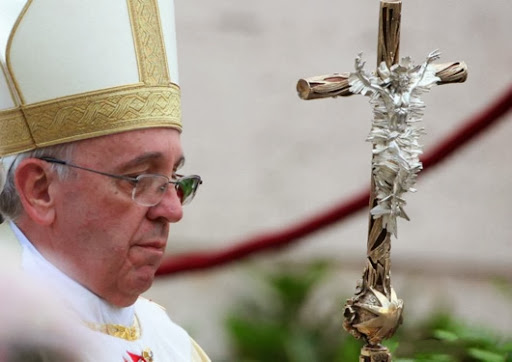
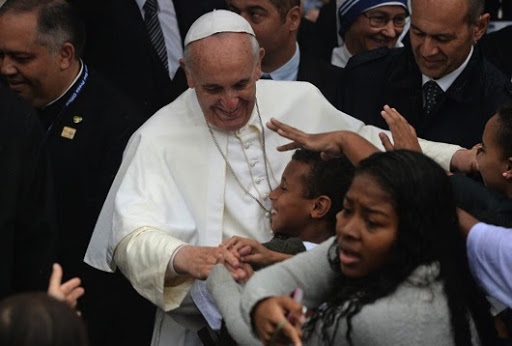
Imagine what the most offensive, sacrilegious and vile depiction of Jesus could be. Now look at the staff (a “ferula”) that Pope Francis holds in the above photo. Is that what you expected? I hope not, but if you googled “pope francis new ferula,” all you’d find is outrage, offence and adjectives like “misconceived,” “bizarre,” “ugly,” “offensive,” “nasty” and “profane.” Not only would these be outliers further down the search results, but it would be literally all you’d find – and I spent a couple of days trying to find anything positive at all about this new liturgical object used by Pope Francis.

So, why is it that this staff causes so much offense? If you abstract away the, sadly, harsh language of the reactions published so far, by sources who self-apply the “traditionalist” label, the root of the outrage is the depiction of the risen Christ instead of the crucified one. In most cases this is presented as being self-evidently an aberration, and one of the sources points to an encyclical by Pope Pius XII and quotes the following fragment:

““…one would be straying from the straight path … were he to order the crucifix so designed that the divine Redeemer’s body shows no trace of His cruel sufferings” (Pius XII, Encyclical Mediator Dei, par. 62).”

When I saw this, I immediately thought: “Great! Finally something specific and something that is likely to be usable against the new staff’s detractors.” As with most fanatics, their quoting of scriptures or other texts tends to be very selective and even just the immediate neighborhood of their snippets is likely to be their undoing. The same scenario applies here, if you look at the expanded quote below, still just staying within paragraph 62 and the opening sentence of paragraph 63 of Pius XII’s Mediator Dei:

“Assuredly it is a wise and most laudable thing to return in spirit and affection to the sources of the sacred liturgy. For research in this field of study, by tracing it back to its origins, contributes valuable assistance towards a more thorough and careful investigation of the significance of feast-days, and of the meaning of the texts and sacred ceremonies employed on their occasion. But it is neither wise nor laudable to reduce everything to antiquity by every possible device. Thus, to cite some instances, one would be straying from the straight path were he to wish the altar restored to its primitive tableform; were he to want black excluded as a color for the liturgical vestments; were he to forbid the use of sacred images and statues in Churches; were he to order the crucifix so designed that the divine Redeemer’s body shows no trace of His cruel sufferings […] Clearly no sincere Catholic can refuse to accept the formulation of Christian doctrine more recently elaborated and proclaimed as dogmas by the Church, under the inspiration and guidance of the Holy Spirit with abundant fruit for souls, because it pleases him to hark back to the old formulas.”

Before looking at the point about crucifixes that vexes Francis’ detractors, let’s just look at Pius XII’s categorical denunciation of traditionalism! The Holy Spirit is constantly active in the Church and more recent elaborations of teaching supersede older ones. By his own words, Pius XII is setting the scope of his own teaching to expire upon being superseded by that of his successors, so even if his words had been in conflict with Francis’ staff, Francis actions would take precedent and would do so by Pius XII’s own teaching.

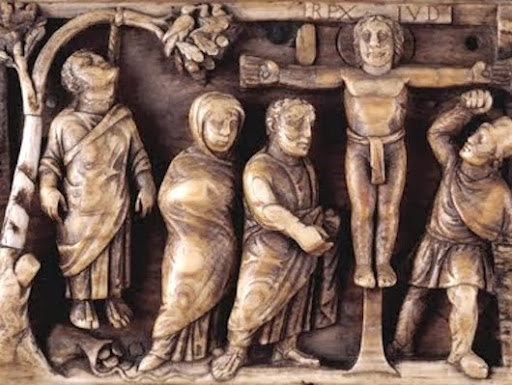
Now, let’s think about what Pius XII actually said about crucifixes, where he objects to them being “so designed that the divine Redeemer’s body shows no trace of His cruel sufferings.” Is he saying that the risen Christ mustn’t be depicted? Not at all. Only that the corpus shall show the traces of crucifixion torture, which early crucifixes did not show. Up until the early 5th century, only crosses and not crucifixes (i.e., crosses with a corpus) were used – and even those only sparsely. The next period then saw depictions of Jesus’ body on crosses, but in the form of unrealistic representations, like the following one, which is among the earliest ones:

Crucifixion earliest narrative rep ivory casket 420 30 rome brit museum

Here Jesus is upright, looking ahead, showing strength. What is Pius XII saying though? That our 5th century brothers and sisters were “straying from the straight path”? Certainly not! Only that if we imitated them in the misguided belief of the past having been a truer, purer, more genuine Christianity, we would be the ones straying and denying the Holy Spirit.

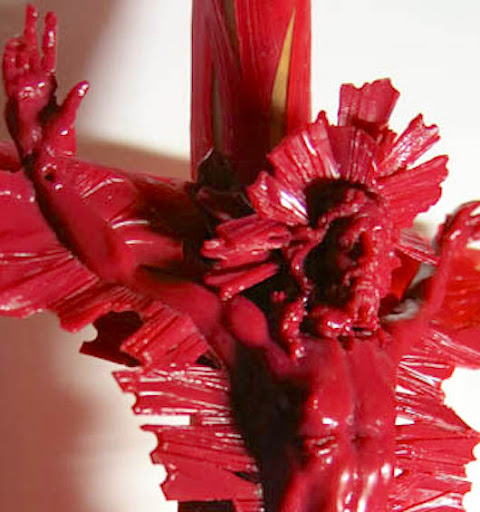
So, my reading of Pius XII is that we are to be open to the Holy Spirit now and that he underlined the importance of depicting the signs of the crucifixion horrors in crucifixes. Let’s now take a closer look at Francis’ new staff – the “crux gloriosa” and examine more closely the choices made by its author, the Roman sculptor Maurizio Lauri:

Papa francesco croce cimasa cera 3

From the above wax cast of the staff, it can clearly be seen that Jesus’ body bears the “trace[s] of His cruel sufferings” – his wrists are pierced,1 his side shows a swollen stab wound, his hands look mangled. This is not the Christus victor depiction of the first nine centuries, but instead a form that incorporates the “Christus mortuus” features whose importance Pius XII insisted upon too.

I believe the crucifix on Pope Francis’ new ferula displays a great degree of continuity with the last two millennia of depicting Jesus’ passion (incidentally, in a particular way with the San Damiano cross through which St. Francis heard Jesus speak to him). While clearly showing that Jesus’ execution on the cross was barbaric and crushing, it also depicts the inexorable link between this suffering, which Jesus underwent out of love, and the resurrection that followed it and that engenders mercy, hope and joy. Rather than in any way negating the monumental scale of Jesus’ suffering, the Lauri ferula projects it towards the resurrection that followed His excruciating death. It seems to me like Lauri was giving form to St. Paul saying: “we do see Jesus crowned with glory and honor because he suffered death” (Hebrews 2:9).

Finally, I have also been struck by the provenance of the materials used for making the Lauri ferula. The staff and crucifix atop it are made of mahogany, bronze and silver, where the metals were mined by Goldlake – an Italian company operating in Honduras and working to explicitly ethical standards, in partnership with local churches in both countries. During the presentation of the ferula to Franics, the CEO of Goldlake – Giuseppe Colaiacovo, explained: “Your holiness […] we would like to present you with this object, made from the materials of the earth, which therefore are poor materials, but which then become transformed by the artistic spirit.” Not only do I see a tremendously orthodox and historically grounded theology behind the form of the ferula, but its material provenance itself bears a positive message in itself.


1 A fact worthy of note by itself, since it is in agreement with recent research that shows how Jesus was nailed to the cross not by his palms, as is typical in depictions of the crucifixion, but by his wrists.

The tyranny of absolutism

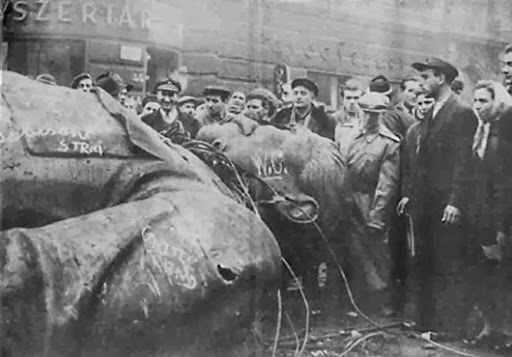
Stalin

Walking home this evening I felt like Douglas Hofstadter may have felt when coming up with the central idea of his spectacular Gödel, Escher, Bach book. Unlike his realization about a “golden braid” linking the thoughts of Kurt Gödel, M. C. Escher and Johann Sebastian Bach, which all shed light on infinity, I felt like I saw a way to connect the seemingly opposed words of Popes Benedict XVI and Francis with regard to relativism.

Benedict XVI famously attacked relativism in his sermon during the opening mass of the conclave that elected him, saying:

“To have a clear faith, according to the creed of the Church, is often labeled as fundamentalism. While relativism, that is, allowing oneself to be carried about with every wind of “doctrine,” seems to be the only attitude that is fashionable. A dictatorship of relativism is being constituted that recognizes nothing as absolute and which only leaves the “I” and its whims as the ultimate measure.”

The message here is very clear – the arbiter of truth and falsehood as well as good and evil has become the individual, with no intrinsic meaning left for these concepts beyond what each person chooses to invest them with for themselves. It is not only a relativity of meaning but also a solitude – I have my truth and you yours and that is the end of the story. In his book-length interview with Benedict XVI (“Light Of The World”), Peter Seewald, gets Benedict to elaborate on the above idea, when he says:

“It is obvious that the concept of truth has become suspect. Of course it is correct that it has been much abused. Intolerance and cruelty have occurred in the name of truth. To that extent people are afraid when someone says, “This is the truth”, or even “I have the truth.” We never have it; at best it has us. No one will dispute that one must be careful and cautious in claiming the truth. But simply to dismiss it as unattainable is really destructive.

A large proportion of contemporary philosophies, in fact, consist of saying that man is not capable of truth. But viewed in that way, man would not be capable of ethical values, either. Then he would have no standards. Then he would only have to consider how he arranged things reasonably for himself, and then at any rate the opinion of the majority would be the only criterion that counted. History, however, has sufficiently demonstrated how destructive majorities can be, for instance, in systems such as Nazism and Marxism, all of which also stood against truth in particular.

[…] That is why we must have the courage to dare to say: Yes, man must seek the truth; he is capable of truth. It goes without saying that truth requires criteria for verification and falsification. It must always be accompanied by tolerance, also. But then truth also points out to us those constant values which have made mankind great. That is why the humility to recognize the truth and to accept it as a standard has to be relearned and practiced again.”

Essentially, Benedict says that just because we cannot possess the truth, it does not mean that “the” truth does not exist. Our access to it is imperfect and tolerance and caution are called for, but denying its existence (just because of our epistemological constraints) is a dangerous path to follow. The picture from the above is very clear – relativism (making one’s “I” the ultimate arbiter of truth) is a tyranny and a reliance of one’s self is dangerous.

Fast-forward to this morning’s interview1 with Pope Francis talking to Eugenio Scalfari and take a look at what he has to say on the subject:

“Scalfari: Your Holiness, is there is a single vision of the Good? And who determines it?

Francis: Each of us has their own vision of Good and also of Evil. We have to encourage him to proceed towards that which he thinks is Good.

Scalfari: Your Holiness, you have already written it in the letter you addressed to me. Conscience is autonomous, you said, and everyone must obey their own conscience. I think that’s one of the most courageous passages spoken by a Pope.

Francis: And I repeat it here. Each one has their own idea of Good and of Evil and must choose to follow Good and fight Evil as they understand them. This would suffice to make the world a better place.”

“Each one has their own idea of Good and Evil […] as they understand them.” But, this sounds precisely like the relativism (the “I” being arbiter of truth) that Benedict denounced and declared a destructive danger. Are Francis and Benedict disagreeing here? Is Francis changing Church teaching?

I don’t think so. Instead, I believe, that their apparent opposition flows from the different perspectives from which they speak about truth and good and evil. Benedict describes what you’d see from God’s perspective: truth is absolute and denying its existence and substituting one’s whims for it, just because humans can’t access it, is a mistake. Francis, instead looks at the picture from the perspective of the individual: trust your conscience’s discernment between good and evil and choose good. Each human has a conscience by means of which they can discern (to varying degrees of faithfulness – “At present we see indistinctly, as in a mirror” as St. Paul says in 1 Corinthians 13:12) a reflection of the absolute truth. It is the same landscape, but Benedict looks down from the mountaintop while Francis looks up from the valley.

Applying this to myself, I can simultaneously believe in absolute truth and goodness, while being aware of my own inability to grasp them fully (or even with a known level of (in)accuracy). This epistemic constraint in no way undoes the meaningfulness of pursuing goodness and truth and instead makes tolerance and dialogue necessary. It also means that – as Francis said in the same interview – “Proselytism is pompous foolishness that has no sense. We must get to know each other and listen to each other and grow our understanding of the world around us.” I believe we are all accessing fragments of the one Truth,2 which makes me want to know what you have understood as much as deepening my understanding of my own faith.


1 The English translation sadly has some serious issues at the time of this post’s writing (the tile itself being seriously mistranslated), as a result of which I started from it but made adjustments based on reading the Italian original.
2 This is consonant with Francis saying, still in this same interview that “I believe in God. Not a Catholic God, there is no Catholic God, there is God.”

Just war?

Ploughshares

[Warning: long read :)]

Jesus was a pacifist. To deny this in the face of his own words – “But I say to you, whoever is angry with his brother will be liable to judgment.” (Matthew 5:22), “But I say to you, love your enemies, and pray for those who persecute you.” (Matthew 5:44), “But I say to you, offer no resistance to one who is evil. When someone strikes you on (your) right cheek, turn the other one to him as well.” (Matthew 5:39) and “Put your sword back into its sheath, for all who take the sword will perish by the sword.” (Matthew 26:52) – would be sheer dishonesty.

How about the Church though, has it stuck to Jesus’ pacifist position? Let’s see what it says in the Catechism:

“(§2304) Respect for and development of human life require peace. Peace is not merely the absence of war, and it is not limited to maintaining a balance of powers between adversaries. Peace cannot be attained on earth without safeguarding the goods of persons, free communication among men, respect for the dignity of persons and peoples, and the assiduous practice of fraternity.

(§2307) The fifth commandment forbids the intentional destruction of human life. Because of the evils and injustices that accompany all war, the Church insistently urges everyone to prayer and to action so that the divine Goodness may free us from the ancient bondage of war.

(§2308) All citizens and all governments are obliged to work for the avoidance of war. However, “as long as the danger of war persists and there is no international authority with the necessary competence and power, governments cannot be denied the right of lawful self-defense, once all peace efforts have failed.” (Gaudium et Spes, 79 § 4)

(§2309) The strict conditions for legitimate defense by military force require rigorous consideration. The gravity of such a decision makes it subject to rigorous conditions of moral legitimacy. At one and the same time:

  • the damage inflicted by the aggressor on the nation or community of nations must be lasting, grave, and certain;
  • all other means of putting an end to it must have been shown to be impractical or ineffective;
  • there must be serious prospects of success;
  • the use of arms must not produce evils and disorders graver than the evil to be eliminated.

The power of modern means of destruction weighs very heavily in evaluating this condition. These are the traditional elements enumerated in what is called the “just war” doctrine. The evaluation of these conditions for moral legitimacy belongs to the prudential judgment of those who have responsibility for the common good.

(§2314) “Every act of war directed to the indiscriminate destruction of whole cities or vast areas with their inhabitants is a crime against God and man, which merits firm and unequivocal condemnation.” (Gaudium et Spes, 80 § 3)”

While the above does talk about circumstances under which war is justified, it is a last resort, acceptable under the simultaneous satisfaction of specific conditions listed above, and has self-defense as its purpose, with indiscriminate destruction and the devastating effects of modern means of warfare ringing alarm bells. During the progress of such self-defense (the only possible trigger for just military action), the Catechism further emphasizes that “The Church and human reason both assert the permanent validity of the moral law during armed conflict. “The mere fact that war has regrettably broken out does not mean that everything becomes licit between the warring parties.” (Gaudium et Spes, 79 § 4)” and proceeds to warn against the abuses so endemic in war and against the accumulation of arms. Finally, the Catechism draws attention to the root causes, of which war can be a symptom, and calls for their treatment:

“(§2317) Injustice, excessive economic or social inequalities, envy, distrust, and pride raging among men and nations constantly threaten peace and cause wars. Everything done to overcome these disorders contributes to building up peace and avoiding war.”

And Pope Francis, where does he stand? There can be no doubt here that he, like Jesus, is an absolute pacifist:

“War is madness. It is the suicide of humanity. It is an act of faith in money, which for the powerful of the earth is more important than the human being. For behind a war there are always sins. [… War] is the suicide of humanity, because it kills the heart, it kills precisely that which is the message of the Lord: it kills love! Because war comes from hatred, from envy, from desire for power, and – we’ve seen it many times – it comes from that hunger for more power.” (Homily at Domus Sanctae Marthae, 2 June 2013).

“We have perfected our weapons, our conscience has fallen asleep, and we have sharpened our ideas to justify ourselves. As if it were normal, we continue to sow destruction, pain, death! Violence and war lead only to death, they speak of death! Violence and war are the language of death! […]

My Christian faith urges me to look to the Cross. How I wish that all men and women of good will would look to the Cross if only for a moment! There, we can see God’s reply: violence is not answered with violence, death is not answered with the language of death. In the silence of the Cross, the uproar of weapons ceases and the language of reconciliation, forgiveness, dialogue, and peace is spoken. […]

violence and war are never the way to peace! Let everyone be moved to look into the depths of his or her conscience and listen to that word which says: Leave behind the self-interest that hardens your heart, overcome the indifference that makes your heart insensitive towards others, conquer your deadly reasoning, and open yourself to dialogue and reconciliation. Look upon your brother’s sorrow and do not add to it, stay your hand, rebuild the harmony that has been shattered; and all this achieved not by conflict but by encounter! […]

Let the words of Pope Paul VI resound again: “No more one against the other, no more, never! … war never again, never again war!” (Address to the United Nations, 1965).” (Prayer Vigil for Peace, 7 September 2013)

And Francis is not alone is his radical stance against war, Blessed Pope John Paul II said that “War should belong to the tragic past, to history: it should find no place on humanity’s agenda for the future” and that “Humanity should question itself, once more, about the absurd and always unfair phenomenon of war, on whose stage of death and pain only remain standing the negotiating table that could and should have prevented it.” Benedict XVI too was clear about war being a failure: “War, with its aftermath of bereavement and destruction, has always been deemed a disaster in opposition to the plan of God, who created all things for existence and particularly wants to make the human race one family.”

So, you may ask, what is the point of writing about the attitude of Jesus, the Church and recent popes with regard to war, when it is so obviously pacifist and admitting of military self-defense only under almost theoretical, extreme conditions and applying to specific parts of an armed conflict? Sadly there are other, vocal proponents of a very different take on this topic, who – to my mind unbelievably – present their positions as Catholic and who tend to trace them to statements like the following one by George Weigel, who feels supported by Sts. Augustine and Thomas Aquinas:

“Thus those scholars, activists, and religious leaders who claim that the just war tradition “begins” with a “presumption against war” or a “presumption against violence” are quite simply mistaken. It does not begin there, and it never did begin there. To suggest otherwise is not merely a matter of misreading intellectual history (although it is surely that). To suggest that the just war tradition begins with a “presumption against violence” inverts the structure of moral analysis in ways that inevitably lead to dubious moral judgments and distorted perceptions of political reality.”

With Jesus and the Church’s position having been stated with such force and clarity over the last decades, I won’t even go to the trouble of addressing positions like Weigel’s point-by-point and would just like to note that they are akin to reading St. Paul and arguing in favor of slavery today. Positions that may be textually consistent with the source they claim justifies them, but that both miss the original author’s intentions (just think about what slavery would be like if “master” and “slave” followed St. Paul’s advice1) and the fact that the Church is the living Mystical Body of Jesus that has considerably matured over the last 2000 years.


1 “Slaves, be obedient to your human masters with fear and trembling, in sincerity of heart, as to Christ, not only when being watched, as currying favor, but as slaves of Christ, doing the will of God from the heart, willingly serving the Lord and not human beings, knowing that each will be requited from the Lord for whatever good he does, whether he is slave or free. Masters, act in the same way toward them, and stop bullying, knowing that both they and you have a Master in heaven and that with him there is no partiality.” (Ephesians 6:5-9) A classic “infiltrate and destroy from within” tactic if ever I saw one.

Benedict XVI – Odifreddi: searching for Truth, with gloves off

Boxing gloves

[Warning: long read :)]1

If you are even remotely interested in the dialogue between faith and reason, between religion and science, the last fortnight has to be among the most electrifying periods in the history of mankind. Not only did it kick-off with the beautifully sincere and profound move by Pope Francis in his letter to the atheist journalist Eugenio Scalfari, but it saw the publication of “the” interview that Pope Francis gave to Jesuit media and in which he spoke about science in terms that, to my mind, take the Church’s appreciation of science further than ever before. And if that wasn’t enough, today saw the publication of extracts from an 11-page letter that Pope Emeritus Benedict XVI wrote to the Italian atheist mathematician Prof. Piergiorgio Odifreddi, in response to his book “Caro Papa ti scrivo: Un matematico ateo a confronto con il papa teologo” (“Dear Pope, I write to you: An atheist mathematician confronting the theologian pope”).

Looking at the two letters (or, more precisely, the extracts from Benedict’s versus the full text of Francis’), Francis’ and Scalfari’s style is like a polite, yet illuminating, exchange between two gentlemen over a cup of tea, while Benedict’s and Odifreddi’s exchange is like a bare-knuckle fist-fight between a pair of prize-winning boxers who in the end sincerely shake hands and respect each other, but without giving an inch during the fight itself.

To begin with, let’s take a quick look at Odifreddi’s opening move – his 204-page book, addressed to Benedict as “between colleagues” – from a maths to a theology professor. Early on, Odifreddi identifies a point in common with Benedict’s thought, by pointing to the following passage from Benedict’s Regensburg address:

“the experience […] of the fact that despite our specializations which at times make it difficult to communicate with each other, we made up a whole, working in everything on the basis of a single rationality with its various aspects and sharing responsibility for the right use of reason”

While Odifreddi identifies this – the adherence to reason – as a common point of departure, he quickly objects to Benedict’s excessive use of it (“your almost obsessive use of the word “reason,” repeated around forty times, akin to a musical motif or continuous base”) and to the “scandalous” words from Benedict’s sermon before the conclave that elected him:

“[H]aving a clear faith based on the Creed of the Church is often labeled as fundamentalism. Whereas relativism, that is, letting oneself be “tossed here and there, carried about by every wind of doctrine”, seems the only attitude that can cope with modern times. We are building a dictatorship of relativism that does not recognize anything as definitive and whose ultimate goal consists solely of one’s own ego and desires.”

While being critical of Benedict’s words, Odifreddi argues that “both religion and science are perceived as antidemocratic and absolutist” as a result of their focus on “ultimate truths” and then proceeds to arguing against a series of passages from Benedict’s “Introduction To Christianity” and his Jesus of Nazareth trilogy.

Since it is the full, fine detail that is key to understanding the nature of what is going on between Odifreddi and Benedict, let me just pick out a single point of contention (from among many important and interesting ones that I hope to return to soon!),2 which Benedict objected to most forcefully and which the following passage from Odifreddi’s book sums up nicely:

“There is little to say about the historical Jesus, literally, because there are virtually no traces of him in the official history of the period. In total, there are only few tens of lines about him in the works of Pliny, Tacitus, Suetonius and Flavius Josephus. Some are of uncertain interpretation, like the “Chrestus” of Suetonius. Others are of dubious authenticity, like the interpolation of Flavius Josephus. […] If, therefore, Jesus truly existed, he must have been irrelevant to his contemporaries, beyond the narrow circle of his relatives, friends and followers.”

Odifreddi further accuses Benedict of side-stepping questions of fact by saying to him: “you seem uninterested in (or seem interested in not) discussing the historicity of the Gospels and the facts that they report” and attributes to him an opposition to historical-critical methods of Biblical interpretation, by quoting Benedict as saying that they “can effectively become an instrument of the Antichrist.”

Benedict’s response here is as sharp as the jab he received:

“What you say about the figure of Jesus is not worthy of your scientific status. If you put the question as if nothing were, ultimately, known about Jesus, as a historical figure, as if nothing were ascertainable, then I can only firmly invite you to become more competent from a point of view of history. To this end I particularly recommend to you the four volumes that Martin Hengel (exegete at the Protestant Faculty of Theology of Tübingen) has published with Maria Maria Schwemer: it is an excellent example of historical precision and of vast breadth of historical information. […] Further I have to forcefully reject your affirmation (pp. 126) according to which I have presented historical-critical exegesis as an instrument of the Antichrist. Discussing the account of Jesus’ temptations, I have only recalled Soloviev’s thesis, according to whom historical-critical exegesis may also be used by the Antichrist – which is an unquestionable fact. At the same time, however, I have always – and in particular in the foreword to the first volume of my book on Jesus of Nazareth – made it evidently clear that historical-critical exegesis is necessary for a faith that does not propose myths using historical images, but demands true historicity and therefore has to present historical reality in its affirmations also in a scientific way. Because of this, it is not correct either that you say that I have been interested only in meta-history: on the contrary, all my efforts have had as their objective to show that the Jesus described in the Gospels is also the real, historical Jesus; that it is a matter of history that really took place.”

Uff … I have to be honest and admit that I was at first a bit uneasy about the tone of both Odifreddi and Benedict, neither of whom are pulling punches and both of whom are blunt to say the least. Looking more closely though, and reflecting on my professional experience as a scientist, I recognize that this is the tone and strength of academic argument and doing anything less would be dishonest on the part of both the professor and the ex-professor. This is a very different context from the Francis-Scalfari one and it demands the unforgiving rigor, precision and detail of the quotes shown above. Treating Benedict like any other academic shows Odifreddi’s respect for him (which he is explicit about when saying “Having read his Introduction to Christianity, […] I realized that the faith and doctrine of Benedict XVI, unlike that of others, were sufficiently solid and fierce that they could very well face and sustain frontal attack.”) Benedict is equally complimentary about Odifreddi, when he tells him that he “considers very positively the fact that you […] have sought such an open dialogue with the faith of the Catholic Church and that, in spite of all the differences, in the central themes, there is no lack of convergence at all.”

What this, academic, dialogue is truly about is put best – and to my mind beautifully lucidly – by Odifreddi, who says that:

“[The aim], obviously, was not to try and “convert the Pope,” but instead to honestly present to him the perplexity, and at times incredulity, of a mathematician with regard to faith. Analogously, the letter from Benedict XVI does not try to “convert the atheist,” but to direct at him his own, honest, symmetrical perplexity, and at time incredulity, of a very special believer with regard to atheism. The result is a dialogue between faith and reason, which, as Benedict XVI notes, has allowed both of us to confront each other frankly, and at times also bluntly, in the spirit of the Courtyard of the Gentiles that he himself has initiated in 2009. […] Divided in almost everything, but joined by at least one objective: the search for Truth, with a capital “T”.”

Wow! I have to say I am very impressed with Odifreddi (having come to this clearly as Benedict XVI fan) and I look forward to seeing his next steps in this full-contact dialogue. In many ways, I believe, that the most important thing to take away from this first encounter is the seriousness and complete transparency, with which both parties approached the challenge of dialogue – a dialogue that is not a watering-down or a “playing nice” but a striving for Truth, regardless of how vast the abyss may appear between its opposing cliffs. It would be a mistake to get stuck on whether I happen to agree with one side or the other, as it would miss the masterclass in serious dialogue that we have just witnessed. In many ways, I read Odifreddi’s closing thoughts as a transposition – from an intra-Christian to a Christian-atheist setting – of Francis’ call to an ecumenism that starts now, while there are clear differences between the parties, when he says in “the” interview: “We must walk united with our differences: there is no other way to become one. This is the way of Jesus.”


1 Apologies, again, for the rough translation from Italian – once “official” translations are available, I’ll point you to them.
2 I can’t not mention the following zinger from Benedict, which points to the widespread use of “science fiction” in science, in response to Odifreddi’s claiming that it was religion that practiced the genre. Benedict here says, referring to Heisenberg and Schrödinger’s theories, and adding Dawkins’ “selfish gene” to the list, that “I’d call them “science fiction” too, in the good sense: they are visions and anticipations, to arrive at true knowledge, but they are, indeed, only imagination with which we try to get closer to reality.” 🙂 I agree and I’ll definitely pick this line up in a future post.

Science grows Church’s understanding

350px God the Geometer0

As was immediately clear from a first reading, “the” interview given by Pope Francis last Thursday to Jesuit magazines is a text rich both in spiritual and intellectual treasures and will be a prominent trigger of reflection for a long time to come.

Today I’d like to take a closer look at a passage from it that has immediately caught my eye, but that received little attention so far. It addresses the relationship between science and religion in a, to my mind, very positive way:

“[H]uman self-understanding changes with time and so also human consciousness deepens. Let us think of when slavery was accepted or the death penalty was allowed without any problem. So we grow in the understanding of the truth. Exegetes and theologians help the church to mature in her own judgment. Even the other sciences and their development help the church in its growth in understanding. There are ecclesiastical rules and precepts that were once effective, but now they have lost value or meaning. The view of the church’s teaching as a monolith to defend without nuance or different understandings is wrong.”

While the opposition between science and religion certainly does not apply to the Catholic Church – with Blessed Pope John Paul II’s landmark encyclical Fides et Ratio being a categorical statement of the mutual benefits of faith and reason and with Pope Benedict XVI having spoken of the necessity of dialogue between science and faith 1 – Francis’ positioning of science as “helping the church in its growth in understanding” is a significant move. Like with many of Francis’ statements, it could be argued that they contain nothing new (Fides et Ratio already saying that “science can purify religion from error and superstition”) or that they are only new in style – and in some sense that is true, since he is firmly rooted in the Church, but it would, I believe, also miss an important nuance.

While I have always read Fides et Ratio as positioning faith and reason as separate, but mutually “strengthening” entities,2 here I see Francis presenting theology and science as two activities whose results both help the Church, the former leading to mature judgment while the latter resulting in increased understanding. This is a picture that does not place theology in a privileged, internal position with regard to the Church, and science as an external, while admittedly positive, activity, but positions both as engines of progress that deepen our humanity.3

While the above is clearly my reading and attempted unpacking of Francis’ condensed thought, I believe it is compatible with another of the important points he makes in “the” interview, namely that the Church is the “faithful people of God,”4 and that “‘thinking with the church’ [does not mean] only thinking with the hierarchy of the church,” that it “does not concern theologians only.” Seen in this way, “[t]he church is the totality of God’s people” and is therefore formed as much by theology as by science. Science becomes an internal concern of the Church – the People of God – and its advances and insights form her teaching from within.5 In many ways this also reminds me of Francis’ address to Brazil’s “leaders of society” during his visit in July, where he emphasizes that Christianity “combines transcendence and incarnation” and “faith and reason unite, the religious dimension and the various aspects of human culture – art, science, labour, literature…”

The above sketch, which I don’t believe I am bolting on to Francis’ thought, strikes me as a natural evolution of the solid foundations that John Paul II laid down, and I am curious to see whether it will find support in his future teaching.


0 I don’t mean to distract, but note the fractal in this 13th century illuminated illustration!
1 “In the great human enterprise of striving to unlock the mysteries of man and the universe, I am convinced of the urgent need for continued dialogue and cooperation between the worlds of science and of faith in the building of a culture of respect for man, for human dignity and freedom, for the future of our human family and for the long-term sustainable development of our planet. Without this necessary interplay, the great questions of humanity leave the domain of reason and truth, and are abandoned to the irrational, to myth, or to indifference, with great damage to humanity itself, to world peace and to our ultimate destiny.” (Pope Benedict XVI, Address To The Pontifical Academy Of Sciences, 8 November 2012)
2 As Lumen Fidei puts it in §32.
3 Echoing the affirmation in Fides et Ratio that “Men and women have at their disposal an array of resources for generating greater knowledge of truth so that their lives may be ever more human.”
4 The definition presented in Lumen Gentium, as Francis points out.
5 This is not a conflation of the two – theology and science – but a recognition of their equal import for the Church’s progress.

Do MOOCs float on water?

Moo

[WARNING: long read :)]1

The classical test for witchcraft is to see whether the accused floats on water, since – and this ought to be self-evident – witches don’t. The logic is impeccable and the argument waterproof (pardon the pun), as long as pesky bystanders don’t volunteer alternatives for aquatically buoyant entities like apples, cherries, very small rocks, lead or ducks, which is precisely what I intend to do to the following argument by Prof. Jonathan Malesic against Massive Open Online Courses (MOOCs):2

“The grounds for a social-justice case against MOOCs are even stronger within the Catholic tradition. In his 1981 encyclical on work, Laborem Exercens, Pope John Paul II acknowledged that technology can aid our work, but he also warned that it can become an “enemy” by displacing workers and robbing work of its rightful meaning. The threat is that technology will depersonalize both the work and the worker, who is, the pope argued, “the primary basis of the value of work.”

[…] MOOCs undercut that value for academic workers. [… T]he endgame for MOOCs is the supplanting of local, in-person labor by technologically mediated remote labor. The human educator, who is the source of education’s greatest value but also its greatest expense, is meant to become dispensable. […] MOOC providers will profit at the cost of faculty jobs. The dignity of faculty as workers will be damaged.”

Here a MOOC is “an online course aimed at large-scale interactive participation and open access via the web” (so its Wikipedia definition), and Malesic means “not replacing human labor (here, faculty) with cheaper, less effective machine labor” by “social justice.” Based on such a threat of larger Catholic universities “pushing smaller Catholic colleges […] out of business” by providing courses using the MOOC approach (and objecting also to the lack of “dialogue and physical proximity” implicit in their nature), Malesic proceeds to categorize their impact as “social injustice” and interpret Blessed Pope John Paul II’s encyclical “Laborem Exercens” as condemning them and rendering them un-Catholic.

You could certainly argue about the pros and cons of MOOCs – and Malesic too acknowledges some of their pros: “access to college-level instruction for people who have been excluded because of poverty, remoteness, or others’ prejudice,” but to argue not only that they are incompatible with Catholicism but also that such a view derives from John Paul II’s teaching is asking for a rebuttal.

Before proceeding to Laborem Exercens, let me put my cards on the table. I, already having postgraduate qualifications, have signed up to several MOOCs (on Coursera and Udacity) and have greatly enjoyed some of them (e.g., the superb “A Brief History of Humankind” by Dr. Yuval Noah Harari). Do I think they are a replacement for “traditional” education? No. Do I think they are incompatible with my Catholic beliefs? Absolutely not! If anything, I see them as great new elements to incorporate into the kind of education that Prof. Malesic too promotes – one where there is personal contact between educator and student. Beyond their expanding the means that an educator has at their disposal, by, e.g., allowing for a course to partly consist of students participating in a MOOC and then having follow-up discussions or supplemental material facilitated by their “physically proximal” educator, MOOCs also do provide access to education to those who would otherwise not have it, as Prof. Malesic too concedes. Beyond such, systemic benefits of MOOCs, there are also already some very personal success stories of those who have taken them, like that of Khadijah Niazi from Lahore, who took the Udacity Artificial Intelligence MOOC aged 10, then their physics course two years later and has since spoken at Davos alongside the worlds educational elite. Is that un-Catholic? Hardly. Is there a need for carefully considering how to best take advantage of MOOCs? Sure. But that’s not what I’d like to focus on in this post.

Instead, my aim here is to examine Prof. Malesic’s claim that John Paul II’s Laborem Exercens (LE) leads to a classification of MOOCs as socially unjust and therefore to be boycotted by Catholic universities and colleges.

Let’s start at the beginning, with LE’s opening sentence:

“Through work man must earn his daily bread and contribute to the continual advance of science and technology and, above all, to elevating unceasingly the cultural and moral level of the society within which he lives in community with those who belong to the same family.”

Hmm … sounds to me like the focus in LE will be not only work and the important considerations of social justice and dignity that it entails, but also progress on all fronts: science, technology, culture and morality. That’s more like the JP2 I know from his other writings, instead of the Luddite suggested by Prof. Malesic’s interpretation. To get a fuller picture of JP2’s thought (from 1981), let’s proceed to read what he says about technological progress:

“[W]e are witnessing the transformations made possible by the gradual development of science and technology. Historically speaking, this, taken as a whole, has caused great changes in civilization, from the beginning of the “industrial era” to the successive phases of development through new technologies, such as the electronics and the microprocessor technology in recent years.

While it may seem that in the industrial process it is the machine that “works” and man merely supervises it, making it function and keeping it going in various ways, it is also true that for this very reason industrial development provides grounds for reproposing in new ways the question of human work. Both the original industrialization that gave rise to what is called the worker question and the subsequent industrial and post-industrial changes show in an eloquent manner that, even in the age of ever more mechanized “work”, the proper subject of work continues to be man.”

Oh … wait … So, we need to “repropose” what constitutes human work, instead of getting stuck in superficial appearances? How does JP2 suggest we do that?

“The development of industry and of the various sectors connected with it, even the most modern electronics technology, especially in the fields of miniaturization, communications and telecommunications and so forth, shows how vast is the role of technology, that ally of work that human thought has produced, in the interaction between the subject and object of work (in the widest sense of the word). Understood in this case not as a capacity or aptitude for work, but rather as a whole set of instruments which man uses in his work, technology is undoubtedly man’s ally. It facilitates his work, perfects, accelerates and augments it. It leads to an increase in the quantity of things produced by work, and in many cases improves their quality. However, it is also a fact that, in some instances, technology can cease to be man’s ally and become almost his enemy, as when the mechanization of work “supplants” him, taking away all personal satisfaction and the incentive to creativity and responsibility, when it deprives many workers of their previous employment, or when, through exalting the machine, it reduces man to the status of its slave.”

The point I am hearing here is that technology, which “is undoubtedly man’s ally,” makes us look at human work not only from the narrow perspective of an individual’s “capacity or aptitude” but to consider the tools at their disposal (and these include MOOCs!) as being their extensions. While JP2 rightly points to the dangers of a “mechanization” of work that robs man of creativity and responsibility (just think of the sweatshops that many goods used today are produced in), of people being deprived of previous employment or becoming slaves of technology, he still can’t quite bring himself to labeling technology as man’s enemy, even when it is abused, applying the qualifier “almost.” Looking back at Prof. Malesic’s words, I believe it is clear that new technology poses dangers, and JP2’s teaching attests to that, but I can’t read Laborem Exercens as placing technology and man being the primary basis for the value of work at odds. The following passage makes this particularly clear:

“Working at any workbench, whether a relatively primitive or an ultramodern one, a man can easily see that through his work he enters into two inheritances: the inheritance of what is given to the whole of humanity in the resources of nature, and the inheritance of what others have already developed on the basis of those resources, primarily by developing technology, that is to say, by producing a whole collection of increasingly perfect instruments for work. In working, man also “enters into the labour of others”. Guided both by our intelligence and by the faith that draws light from the word of God, we have no difficulty in accepting this image of the sphere and process of man’s labour. It is a consistent image, one that is humanistic as well as theological. […] If some dependence is discovered in the work process, it is dependence on the Giver of all the resources of creation, and also on other human beings, those to whose work and initiative we owe the perfected and increased possibilities of our own work. All that we can say of everything in the production process which constitutes a whole collection of “things”, the instruments, the capital, is that it conditions man’s work; we cannot assert that it constitutes as it were an impersonal “subject” putting man and man’s work into a position of dependence.”

I have to say I find the above quite beautiful. Not only does JP2 explicitly deny technology the capacity to enslave man (it is a tool, whose use is at the discretion of man), but he presents a Trinitarian-like model, where man’s work places him in relationship with God and his neighbor – the fundamental context for the entirety of Christian life.

Before leaving Laborem Exercens, it is worth seeing what JP2 has to say about the changes that technology brings to white collar workers:

“Movements of solidarity in the sphere of work-a solidarity that must never mean being closed to dialogue and collaboration with others- can be necessary also with reference to the condition of social groups that were not previously included in such movements but which, in changing social systems and conditions of living, are undergoing what is in effect “proletarianization” or which actually already find themselves in a “proletariat” situation, one which, even if not yet given that name, in fact deserves it. This can be true of certain categories or groups of the working “intelligentsia”, especially when ever wider access to education and an ever increasing number of people with degrees or diplomas in the fields of their cultural preparation are accompanied by a drop in demand for their labour. This unemployment of intellectuals occurs or increases when the education available is not oriented towards the types of employment or service required by the true needs of society, or when there is less demand for work which requires education, at least professional education, than for manual labour, or when it is less well paid. Of course, education in itself is always valuable and an important enrichment of the human person; but in spite of that, “proletarianization” processes remain possible.”

What JP2 means here by “proletariat” are workers who, “reacti[ng] against the degradation of man as the subject of work, and against the unheard-of accompanying exploitation in the field of wages, working conditions and social security for the worker” follow a call to solidarity and common action. Again there is a very clear recognition of the challenges associated with the many aspects of work, and a prophetic anticipation of the consequences of a wider access to education, but JP2 is clear about “education in itself [being] always valuable and an important enrichment of the human person.”

If anything, Blessed Pope John Paul II unequivocally endorses the good inherent in technological advances and education and does so with his eyes wide open – pointing to the dangers and challenges they entail. Laborem Exercens, when taken in its entirety (and I thank Prof. Malesic for the impetus), presents a truly cosmic view of work – an activity that places one in relation not only with one’s neighbors, but – via education – also with those who have contributed to the advances of science and technology in the past (echoing Newton’s “If I have seen further it is by standing on the shoulders of giants.”), with nature and with God. Technology and education are shown as being integral to man, as opposed to external entities, and as such inherently good. Their use has clear risks and dangers, but it is their prudent and socially-aware employment that is the solution, instead of a shunning and boycotting.


1 Many thanks to my überbestie PM for his nihil obstat!
2 If, for some strange reason, the opening paragraph seems like an enigma wrapped in a riddle, you might want to consult the opera omnia of MPFC, internalizing the following (abridged) passage in particular:
BEDEMIR: Quiet, quiet. Quiet! There are ways of telling whether she is a witch.
CROWD: Are there? What are they?
BEDEMIR: Tell me, what do you do with witches?
CROWD: Burn, burn them up!
BEDEMIR: And what do you burn apart from witches?
VILLAGER #2: Wood!
BEDEMIR: So, why do witches burn?
[pause]
VILLAGER #3: B–… ’cause they’re made of wood…?
BEDEMIR: Good!
CROWD: Oh yeah, yeah…
BEDEMIR: So, how do we tell whether she is made of wood?
VILLAGER #1: Build a bridge out of her.
BEDEMIR: Aah, but can you not also build bridges out of stone?
VILLAGER #2: Oh, yeah.
BEDEMIR: Does wood sink in water?
VILLAGER #1: No, no.
VILLAGER #2: It floats! It floats!
BEDEMIR: What also floats in water?
VILLAGER #3: Very small rocks!
VILLAGER #2: Mud!
ARTHUR: A duck.
CROWD: Oooh.
BEDEMIR: Exactly! So, logically…,
VILLAGER #1: If… she.. weighs the same as a duck, she’s made of wood.
BEDEMIR: And therefore–?
VILLAGER #1: A witch!
CROWD: A witch!

Priests as welcomers and accompaniers

Emmaus

This morning Pope Francis met with Rome’s priests at the basilica of St. John Lateran and, following some brief, opening remarks, spent two hours in a Q&A with them. The meeting was private and away from the lenses and microphones of journalist, but details of Pope Francis’ words have been emerging during the course of the day.

To begin with, the priests invited to the meeting were sent a letter that Francis wrote in 2008, while still a cardinal and archbishop of Buenos Aires, in which he reflects on the implications of the Aparecida document on the priesthood. There, Francis starts out by defining the “identity of the priest in relation to a community, with two characteristics. First, as “gift,” as opposed to “delegate” or “representative.” Second, in terms of faithfulness to the call of the Master, instead of “management.”” Francis then emphasizes that identity means belonging: “The priest belongs to the People of God, from which he has been drawn, to which he has been sent, and a part of which he is.” This communitarian aspect is further emphasized in the Aparecida document, which in its §156 affirms that “a constitutive dimension of the Christian event is belonging to a concrete communion in which we can be part of an ongoing experience of discipleship and communion with the successors of the apostles and with the successor of Peter.”

Further along in this preparatory document for today’s meeting, Francis emphasizes the joint importance of truth and mercy, which in the Aparecida document (§199) is presented thus: “to care for the flock entrusted to them and to seek out who have strayed furthest [… that they may be] servant-of-life-priests: who are alert to the needs of the poorest, committed to the defense of the rights of the weakest, and promoters of the culture of solidarity. The need is also for priests full of mercy.” Finally, Francis proposes to priests to be “enamored disciples,” since, “logically the missionary dimension is born from the interior experience of a love of Jesus Christ.” His letter to the Argentinian priests is a beautiful document in its entirety, and the above is meant to serve only as context for the very telegraphic details that have emerged so far from today’s private meeting with the priests of Rome.

The most extensive source of information so far has been an article in today’s Roma Sette, a website of the Diocese of Rome, where the following snippets are shared:

  1. Francis kicked off the Q&A by stating that “he considered himself above all to be a priest, and now as Pope he was afraid of feeling otherwise. “I would be afraid of feeling a bit more important; I am afraid of that, because the devil is cunning … and makes you think you have power, that you can do this and that … But thanks to God, I haven’t yet lost that fear, and if once you see that I have lost it, please, tell me, and if you can’t tell me privately, say it publicly, but say it: ‘Look, convert!’ It’s clear, isn’t it?”.” Wow! This is pretty strong stuff and it paints such a vivid picture – one that reminds me of St. Peter in the Early Church, as its head, but one that listens (cf. Galatians 2:11-14 where Paul says: “And when Cephas came to Antioch, I opposed him to his face because he clearly was wrong.” – i.e., the “Incident at Antioch”).
  2. A focus again on the “existential peripheries” that Francis has spoken about before. Here, he adds that such peripheries also refer to “weak and poor thought.” Francis also added that “reality is better understood from the periphery and not from the centre, which, instead, runs the risk of degenerating.”
  3. Francis acknowledges the “serious problems of the Church,” but without being pessimistic. “The Church does not crumble. The Church has never been as well as today, it is a beautiful moment for the Church, it is enough to read its history. There are saints recognized even by non-Catholics – let’s think of Blessed Teresa – but there is also the everyday holiness of ordinary mothers and women, of men who work every day for their families, and this brings us hope. Holiness is greater than scandals.” As an example of everyday holiness, he gives the example of a woman he spoke to over the phone the previous day (!), who is a “cleaner at Buenos Aires airport and who supports her drug-addicted, unemployed son: “This is holiness.””
  4. He also speaks about the fatigue that priests feel, remembering the expression John Paul II used in his “Redemptoris Mater,” where he speaks about Mary’s “particular heaviness of heart” (§17). Francis says that “when a priest is in touch with his people, he gets tired. Faced with this tiredness, there is only Jesus’ answer: be with the poor, announce the Gospel and go ahead.” Here Francis also differentiates between different kinds of tiredness: “When a priest is in contact with his people, he works, but he sleeps well. When a priest is not in contact with his people, he works, but he works badly and sleeps badly. … When a priest is in contact with his people, who have many real needs, need for God, then this requires serious effort – but they are the needs of God, no?, that seriously make you tired, and there is no need for sleeping pills.”
  5. Beyond fatigue, priests can also experience what St. John of the Cross called the “Dark Night of the Soul”: “there is a final effort, which is necessary at the moment that there should be triumph. … This happens when a priest questions himself about his existence, he looks within himself at the path he has followed, at the sacrifices he has made, the children he has not had and asks if perhaps he made a mistake, if his life was a failure [… John the Baptist,] in the darkness of his confinement experienced the darkness of his soul, and sent his disciples to ask Jesus if it was He Who awaited him.”
  6. Francis then proposes the following solution both to fatigue and existential darkness: “So, what can a priest do when he lives the experience of John the Baptist? Pray, to the point of falling asleep before the Tabernacle, but stay there.” Also important are “closeness with other priests and closeness of the bishop.” Francis then goes on to underline this last point: “Us bishops have to be close to priests, we have to love our neighbors, and our closest neighbors are the priests. The closest neighbors of the bishop are the priests. [applause] The opposite is true too, eh? [laughter, applause]: the closest neighbor of the priests must be the bishop: the closest neighbor. The bishop says: my closest neighbors are my priests. This exchange is beautiful, no? I believe this to be the most important moment of closeness, between bishop and priests: this moment without words, because there are no words for this fatigue.” Another great piece of advice by Pope Francis, which very much reminds me of the key moment in Herman Hesse’s Siddhartha, where the eponymous protagonist communicates wordlessly with the ferryman Vasudeva in a moment of profound union.
  7. Another remedy against fatigue and darkness is the memory “of one’s vocation, entering seminary, one’s priestly ordination: memory is the life-blood of the Church.” Francis invites all priests to remember their initial falling in love with Jesus, the moment when they first felt Jesus’ gaze on them. “For me this is the key point: that a priest has the capacity to return in memory to his first love. … A Church that loses her memory is an electronic Church, without life.”
  8. Francis also insisted that priest extend a “heartfelt welcome” so that “the faithful feel at home.” Referring in particular to couples who live together outside marriage, Francis emphasized the need for welcome – a welcome in truth. “Always speak the truth, knowing that the truth is not exhausted by a dogmatic definition, but that it inserts itself in the love and the fullness of God.” The priest therefore has to “accompany.” We just have to think of the disciples of Emmaus and how “the Lord has accompanied them and warmed their hearts.”
  9. Here Francis emphasizes the importance of creativity instead of novelty: “[do not] confuse creativity with making something new. Creativity is finding the path to proclaim the Gospel and … this is not easy. It is not simply a question of changing things. It is something different, it comes from the spirit and passes through prayer and dialogue with people, with the faithful. […] The Code of Canon Law give us many, many possibilities, so much freedom to look for these things. … We must find those moments to welcome and receive the faithful, when they enter the parish church for one reason or another.”
  10. Francis also addressed the topic of remarried divorcees: “The problem cannot be reduced merely to a matter of who can receive communion or not, because to pose the question in these terms does not enable an understanding of the real problem. … It is a serious problem regarding the Church’s reponsibility towards families living in this situation. … The Church must now do something to solve the problem of marriage annulment.”
  11. He also warned against economic interests by saying: “There must be a cordial welcome so that those who go to Church feel at home. They feel comfortable and do not feel as if they are being exploited. … When people feel there are economic interests at work, they stay away”.
  12. Finally, Francis advised the priests of his diocese to beware of both severe and lax priests. “Instead, the merciful priest proclaims that ‘God’s truth is this, so to speak, dogmatic or moral truth’, but always accompanied by God’s love and patience. Do not panic – the good God awaits us. … We must always keep in mind the word ‘accompany’ – let us be travelling companions. Conversion always takes place on the street, not in the laboratory”. This, to my mind is a fundamental point – the distinction among lax, strict and merciful – a point I didn’t get before. It made me realize that mercy involves adherence to the truth (which laxity lacks) while loving (which strictness misses).

As a married person, I am grateful to Pope Francis for these profound directions, addressed to the priests of Rome, and I feel that a lot of what he says applies equally to me and is a challenge that I too want to accept and respond to.

UPDATE (18 September 2013): Yesterday several Vatican sources (e.g., VIS, L’Osservatore Romano and Radio Vaticana) have published further details of Pope Francis’ words from the meeting with Roman clergy, which have now been added to the above post.

Pope Francis’ letter to non-believers

Pope 2509845b

That Pope Francis cares deeply for non-believers1 is nothing new, with his previous declaration that Jesus has redeemed atheists too having lead both to very positive responses and to a great media muddle. In today’s issue of the Italian newspaper La Repubblica, Francis continues in this dialogue with non-believers by responding to questions sent to him by the atheist journalist Eugenio Scalfari regarding Francis’ encyclical Lumen Fidei, and I would like to share my favorite parts of his letter with you here.2

Francis starts out by arguing that dialogue between the followers of Jesus and non-believers is “necessary and valuable” today for two reasons: First, the paradox that “Christian faith, whose novelty and impact on human life have since the beginning been expressed through the symbol of light, has become branded as the darkness of superstition that is opposed to the light of reason,” resulting in an absence of communication between Christian and Enlightenment-based contemporary culture. Second, for those who seek “to follow Jesus in the light of faith, […] this dialogue is not a secondary accessory[, but …] an intimate and indispensable expression of faith instead.” This, Francis argues, is expressed by §34 of Lumen Fidei, from which he proceeds to quote:

“Clearly, then, faith is not intransigent, but grows in respectful coexistence with others. One who believes may not be presumptuous; on the contrary, truth leads to humility, since believers know that, rather than ourselves possessing truth, it is truth which embraces and possesses us. Far from making us inflexible, the security of faith sets us on a journey; it enables witness and dialogue with all.”

After a beautiful exposition of how Francis himself came to believe in God and how the Christian faith has Jesus’ incarnation and resurrection at its heart, through which all of humanity is shown God’s love and connectedness to each other – to every single human being,3 he proceeds to answering the three questions Scalfari put to him.

The first of Scalfari’s questions regards whether “the God of Christians forgives those who don’t believe and don’t seek faith.” Here Francis’s response, which I particularly like, is the following:

“Given that – and this is the fundamental point – the mercy of God has no limits if one turns to Him with a sincere and contrite heart, the question for those who don’t believe in God is about obeying one’s own conscience. Sin, also for those who don’t have faith, occurs when one goes against conscience. Listening and obeying to it means, in fact, taking decisions in the face of what becomes understood as good or as bad. And it is on the basis of this decision that the goodness or evil of our actions plays out.”

Wow! While this is in some sense nothing more than what the Catechism has been saying explicitly since Vatican II, having it presented in the above universal way is great. I have often argued in exactly these terms and have faced quizzical looks from other Catholics, who wouldn’t quite believe it. It also confirms me in the answer I have given to several of my best, atheist or agnostic friends when they have asked me whether they should want to believe in God, which was “no,” with the caveat of seeking to be honest in front of their consciences.

Scalfari’s second question asks whether “thinking that there is no absolute and therefore no absolute truth either, but only a series of relative and subjective truths, is a mistake or a sin.” Great question! 🙂 To this Francis responds by saying:

“To begin with, I wouldn’t talk, not even to those who believe, about “absolute” truth, in the sense that the absolute is that which is disconnected, which is devoid of any relation. Now, the truth, according to Christian faith, is the love of God for us in Jesus Christ. Therefore, the truth is a relationship! It is also true that each one of us takes it, the truth, and expresses it by departing from oneself: from one’s history and culture, the circumstances in which one lives, etc. This does not mean though that the truth is variable and subjective. Instead, it means that it gives itself to us always and only as a journey and a life. Didn’t maybe Jesus say the same: “I am the way and the truth and the life.”?4 In other words, truth, being ultimately all one with love, requires humility and openness when sought, accepted and expressed. Therefore, it is necessary to understand each other’s terminology better, and, maybe, to avoid the constraints of an opposition that is … absolute, deepen the framing of the question. I believe that this is absolutely necessary today, so that a serene and constructive dialogue can take place.”

Another fantastic answer! Anyone who has tried to pigeonhole Francis as a populist, as opposed to the thinker that Benedict XVI undoubtedly is, can proceed to eat their own words …

The third, and final of Scalfari’s questions asks whether “the disappearance of humans from Earth would also mean a disappearance of thought that is capable of thinking God.” Here, Francis’ answer, which I won’t translate in full, revolves around arguing that, in his experience and those of many others, God is not an idea, but a “reality with a capital ‘R’.” Instead of going into more detail here, I’d instead like to translate Francis’ closing thoughts, before which he expresses his hope that his reflections would be “received as a tentative and provisional response, but one that is sincere and faithful to the invitation of walking along a stretch of road together.”:

“The Church, believe me, in spite of all the slowness, the unfaithfulness, the mistakes and sins that it may have committed and may yet commit in those who compose it, has no other meaning and end than that of living and giving testimony to Jesus: Him who has been sent by the Father “to bring glad tidings to the poor, to proclaim liberty to captives and recovery of sight to the blind, to let the oppressed go free, and to proclaim a year acceptable to the Lord” (Luke 4:18-19).”

I have to say I am delighted by these words of Pope Francis – both the emphasis on conscience that I have held dear for a long time and the insights about truth as relationship and love – and I would be keen to hear from my atheist, agnostic, humanist (and even Christian 🙂 friends what they made of them.

UPDATE (12 Sept. 2013): This morning Vatican Radio broadcast a short interview with Cardinal Gianfranco Ravasi on the topic of Pope Francis’ letter discussed above (which is now available in an official English translation here). Ravasi, who leads the Pontifical Council for Culture and in its context the “Courtyard of the Gentiles” initiative, whose aim is dialogue with non-believers, naturally welcomed Francis’ letter with great positivity, including it among the initiatives foundational documents. He then also proceeds to elaborate on the, to my mind key, point Francis made about the truth being a relationship:

“Already Plato affirmed [that the truth is a relationship] when he said that the chariot of the soul runs along the plane of truth, which means that the truth is not a cold reality like a precious stone that you can put in your pocket. Instead, it is an immense plane, a horizon – or, to use another image by a writer from the last century5 – we can say that the truth is a sea that one enters and navigates. So, in this light, I believe that the concept of truth not as absolute, but personal, interpersonal, will be very fruitful for dialogue, without losing the dimension of objectivity, of identity in itself, typical of the truth.”


1 Picking what term to use to refer to those who do not believe in God is tricky and I am going with the term Francis is using himself, not necessarily because I believe it is the most appropriate one, but because my aim here is to share his message with you today. I am mindful though of Prof. Cox’s point about the undesirability of negative labels, but since the positive alternatives (e.g., humanist) may not be self-applied by all whom the Pope intends to address here, I am sticking with his terminology. If you belong to his target audience (and to some extent everyone does – including me, a Catholic) and have a suggestion for what term to use, please, let me know.
2 Since I haven’t found an English translation of this article yet, the following quotes are my own crude translations, for which I apologize in advance.
3 I’d like to return to this great synthesis of Christianity in a future post and, if you understand Italian, I’d wholeheartedly recommend reading the full letter to you straight-away.
4 John 14:6.
5 Ravasi refers to this quote in an earlier talk, where he attributes it to Musil’s The Man Without Qualities, although I couldn’t find it there.

Liberation Theology rehabilitated

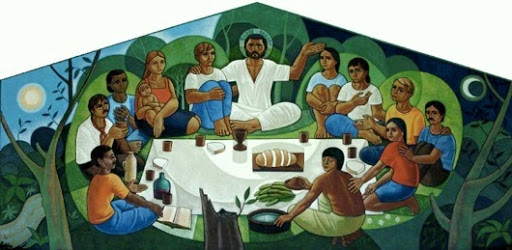
Santa cena teologia liberacion

Pope Francis is about to meet with the founder of Liberation Theology, Fr. Gustavo Gutiérrez, thanks to the current head of the Congregation for the Doctrine of the Faith (CDF) – Archbishop Gerhard Ludwig Müller, which – on the face of it – is a 180° turn versus its past condemnations by the Vatican. Taken superficially, it is a meeting between Francis and a proponent of a theology that has been categorically denounced both by Blessed Pope John Paul II and his successor, Pope Benedict XVI.

A closer look reveals quite a different picture though:

  1. Fr. Gutiérrez, unlike other teachers of Liberation Theology (e.g., Leonardo Boff), has never been censured by the Vatican.
  2. John Paul II and Benedict XVI never condemned Liberation Theology as such, but only those variants of it that placed Marxist analysis at their cores and thereby de-Christified it. In fact, Benedict XVI (then then-Cardinal Ratzinger) is quite clear about the distinction in the “instruction” he published in 1984 as the head of the CDF:

    “The aspiration for ‘liberation’, as the term itself suggests, repeats a theme which is fundamental to the Old and New Testaments. In itself, the expression “theology of liberation” is a thoroughly valid term: it designates a theological reflection centered on the biblical theme of liberation and freedom, and on the urgency of its practical realization. […] The warning against the serious deviations of some “theologies of liberation” must not be taken as some kind of approval, even indirect, of those who keep the poor in misery, who profit from that misery, who notice it while doing nothing about it, or who remain indifferent to it. The Church, guided by the Gospel of mercy and by the love for mankind, hears the cry for justice and intends to respond to it with all her might.”

  3. Instead of this being a change brought in by Francis, the re-visiting of the position taken with respect to Liberation Theology escalated when Benedict XVI appointed Müller as the head of the CDF in 2011 – Müller, who was known to be a personal friend of Gutiérrez, whom he considered as his mentor and whose summer lectures he has been attending annually since 1998 in Peru.
  4. While the new attitude is a change version previous positions, it is not a change as far as Marxist-based flavors of Liberation Theology go. Instead, it is a sign of support for those strands of Liberation Theology that have presented social justice and a focus on the poor on a wholly Christian basis. Fr. Juan Carlos Scannone, one of Pope Francis’ former professors puts it as follows: “In the Argentinean Liberation Theology, social Marxist analysis is not used, but rather a historical-cultural analysis, not based on class warfare as a determining principle for the interpretation of society and history.”

To get a sense of why Müller, who is clearly the catalyst behind the rehabilitation of some strands of Liberation Theology, took an interest in it, it is worth taking a look at the speech1 he gave at the Pontifical Catholic University of Peru in 2008, when it awarded him an honorary doctorate.

There, Müller starts by admitting that he had read expositions of Liberation Theology as well as their criticisms by the CDF, before meeting Gutiérrez, but that his engagement with them was purely theoretical. His initial attitude was one of skepticism and concern about both a danger of leading to violence and a naïveté with regard to the application of Marxist principles. Attending a seminar lead by Gutiérrez then turned him “from academic reflection on a new theological concept to experience with the men and women for whom this theology had been developed.” From the start, Gutiérrez emphasized that Liberation Theology was about theology and not politics, with the aim “to understand the world, history and society and transform them in light of the God’s own supernatural revelation as savior and liberator of man.” The “point of departure” is very clearly put by Müller as follows:

“How one can speak of God in the face of human suffering, of the poor who don’t have sustenance for their children, or the right to medical assistance, or access to education, who are excluded from social and cultural life, marginalized and considered a burden and a threat to the lifestyle of the wealthy few.

These poor are not an anonymous mass. Each one of them has a face. How can I as a Christian, priest or layman, whether through evangelization or scientific theological work, talk about God and His Son who became man and died for us on the cross and bear witness to Him, if I don’t want to build another theological system in addition to the existing one, except by saying to the specific poor person face to face: God loves you and your inalienable dignity is rooted in God. How does one make Biblical considerations real in individual and collective life, when human rights originate in the creation of man in the image and likeness of God.”

Müller then moves on to what I believe is the core of his message, when he speaks about not only attending courses about Liberation Theology in various Latin American countries, but also their being accompanied by:

“long weeks of pastoral work in the Andean region, especially in Lares in the Archdiocese of Cuzco. There the faces acquired names and became personal friends, this experience of universal Communion in the love of God and neighbor, which must be the essence of the Catholic Church. Finally it was a deep joy for me when in 2003, in Lares, in the Archdiocese of Cuzco, being already a bishop, I could administer the sacrament of Confirmation to young people whose parents I had already known for a long time and whom I myself had baptized.

Hence I have not been speaking of liberation theology in an abstract and theoretical way, much less ideologically to flatter progressive church groups. Similarly I have no fear that this may be interpreted as a lack of orthodoxy. Gustavo Gutiérrez’s theology, regardless of which angle you look at it from, is orthodox because it is orthopractic and teaches us proper Christian action because it comes from true faith.”

Müller’s assessment of Liberation Theology comes not only from a reading of and reflection on its teachings, but from him personally having put it into practice and experienced its fruits. It is these fruits that reinforce the truth of its principles, whose flowing from “true faith” can be inferred from them. It is a “see, judge, act” process, which Müller says “has been decisive in my own theological development” and which follows Jesus’ own words as regards orthopraxy:

“Beware of false prophets, who come to you in sheep’s clothing, but underneath are ravenous wolves. By their fruits you will know them. Do people pick grapes from thornbushes, or figs from thistles? Just so, every good tree bears good fruit, and a rotten tree bears bad fruit. A good tree cannot bear bad fruit, nor can a rotten tree bear good fruit. Every tree that does not bear good fruit will be cut down and thrown into the fire. So by their fruits you will know them.” (Matthew 7:15-20).

UPDATE (13 September 2013): The Catholic New Service has just tweeted that the Vatican has confirmed that a meeting between Pope Francis and Fr. Gutiérrez took place two days ago.


1 The original, Spanish version can be found here. Note that the English text used above includes my adjustments based on this original (e.g., at one point “imperdible” is translated as “amazing” in the English referred to above, while I render it as “inalienable”).

Francis in Rio: we’re ALL brothers and sisters

Francis favela

[Warning: Long read! 🙂 The following are my favorite bits from the many talks and homilies Pope Francis gave last week in Brazil. The originals span 30K words, while the following comes in at just above 3K. As you will see, it is more of a collection of gems than an attempt to comment on them, which I am sure I’ll get to in due course. For now I just wanted to give you my “best of” of Francis’ spectacular week in Brazil.]

Last week saw the 28th World Youth Day take place in Rio de Janeiro in Brazil, where as many as 3.7 million young people participated in a variety of events and during which time Pope Francis went on a pilgrimage to the Marian shrine of Aparecida, met with local bishops as well as the leadership of the Latin American Bishops’ Conference (CELAM) and visited one of Rio’s favelas. Instead of giving you a run-through of the week’s proceedings, let me instead just pick out my favorite bits.

Before digging into Francis’ 30K words spoken publicly last week, it might again be interesting to see the ones he used most frequently, with the top 50 being the following:
Wyd2013

Even just from the above, it is clear both that his emphasis, as ever, is on Jesus, but it can also be seen that he had a particular concern for emphasizing our communion among ourselves and with Him – the Church. Looking at the other words, there is a high frequency of active verbs: make, work, come, love, hope, see, ask, know, encounter – and his frequent use of the word “Aparecida” also stands out. Here, the references are not so much to the place of pilgrimage as to the document written there in 2007 by the Latin American bishops, under the leadership of the then-cardinal Bergoglio. A document that Francis has referred to several times already and with even greater frequency during his visit to Brazil.

Already the day before his departure for Rio, Francis set out his expectations by saying: “All those who come to Rio want to hear Jesus’ voice, to listen to Jesus: ‘Lord, what should I do with my life? What path I should take?’” During the flight from Rome he then spoke briefly to the journalists on his plane, starting by saying that he doesn’t give interviews (a point worth remembering once we’ll come to the spectacular interview he gave during the flight back 🙂 and going on to outline his intentions for the trip, where his aim is:

“to reach out to young people, not in isolation but rather within the larger fabric of society. When we isolate them, we do them an injustice because young people already belong in several ways … they belong to a family, a country, a culture and a faith. […] It’s true, of course, that youth are the future of a people. They’re the future because they have the strength, as young people, to move forward. But those at the other extremity of life, the elderly, are also the future of a people. A people has a future if it moves forward with both these ends – young people with their strength to go forward and the elderly because they’re the ones who offer us the wisdom of life.”

Upon arrival in Rio, Francis heads to the Guanabara Palace for an official welcome, where he starts his speech by saying: “I have neither silver nor gold, but I bring with me the most precious thing given to me: Jesus Christ!,” which again underlines the constant focus on Jesus and a preference for the poor.

Two days later, Francis travels to the Marian shrine of Aparecida, where he starts off by emphasizing the role of Mary: “When the Church looks for Jesus, she always knocks at his Mother’s door and asks: “Show us Jesus”. It is from Mary that the Church learns true discipleship. That is why the Church always goes out on mission in the footsteps of Mary.” Francis then proceeds to talk about “three simple attitudes: hopefulness, openness to being surprised by God, and living in joy” and has the following to say about the last one:

“Christians are joyful, they are never gloomy. God is at our side. We have a Mother who always intercedes for the life of her children, for us […]. Jesus has shown us that the face of God is that of a loving Father. Sin and death have been defeated. Christians cannot be pessimists! They do not look like someone in constant mourning. If we are truly in love with Christ and if we sense how much he loves us, our heart will “light up” with a joy that spreads to everyone around us.”

The next morning Francis headed to the Varginha which is part of the Manguinhos Favela in Rio and said the following to the community assembled in a football field:

“From the start, my wish in planning this visit to Brazil was to be able to visit every district throughout the nation. I would have liked to knock on every door, to say “good morning”, to ask for a glass of cold water, to take a cafezinho, to speak as one would to family friends, to listen to each person pouring out his or her heart – parents, children, grandparents. […]

I am well aware that when someone needing food knocks at your door, you always find a way of sharing food; as the proverb says, one can always “add more water to the beans”! And you do so with love, demonstrating that true riches consist not in material things, but in the heart![…]

No amount of “peace-building” will be able to last, nor will harmony and happiness be attained in a society that ignores, pushes to the margins or excludes a part of itself. A society of that kind simply impoverishes itself, it loses something essential. Let us always remember this: only when we are able to share do we become truly rich; everything that is shared is multiplied! The measure of the greatness of a society is found in the way it treats those most in need, those who have nothing apart from their poverty!”

From the favela, Francis headed for an unscheduled meeting with Argentinian youth in Rio’s cathedral, where he indicated his expectations for when they return home from the World Youth Day:

“I would like us to make noise, I would like those inside the Dioceses to go out into the open; I want the Church to be in the streets; I want us to defend ourselves against all that is worldliness, comfort, being closed and turned within – Parishes, colleges and institutions must get out otherwise they risk becoming NGOs, and the Church is not a Non-Governmental Organization. […] Young people and old people in this moment of history are condemned to the same destiny: exclusion. Don’t let yourselves be excluded!”

Next, Francis headed to the St Francis of Assisi hospital, located in the run-down Tijuca district of northern Rio de Janeiro, where young Franciscan friars and sisters care for the poorest and most marginalized slum dwellers. His message was again about brotherhood and he returned to the image of the “flesh of Christ” that he spoke of on previous occasions:

“[W]hen Francis embraced a leper, this brother, suffering and an outcast, [he] was the “mediator of light … for Saint Francis of Assisi” (Lumen Fidei, 57), because in every suffering brother and sister that we embrace, we embrace the suffering Body of Christ. Today, in this place where people struggle with drug addiction, I wish to embrace each and every one of you, who are the flesh of Christ, and to ask God to renew your journey, and also mine, with purpose and steadfast hope. […] We all need to look upon one another with the loving eyes of Christ, and to learn to embrace those in need, in order to show our closeness, affection and love.”

This same Thursday, that Francis started in Aparecida, continued in the favelas, the cathedral of Rio and finally the hospital caring for drug addicts, concluded with a prayer service on Copacabana beach with the World Youth Day pilgrims, whom he addressed as follows:

“[T]oday you are all here, or better yet, we are all here together as one, in order to share the faith and the joy of an encounter with Christ, of being his disciples. […] Today Christ asks each of us again: Do you want to be my disciple? Do you want to be my friend? Do you want to be a witness to my Gospel? […] I think the answer is yes, because here today, it is good for all of us to be gathered together around Jesus! It is he who welcomes us and who is present in our midst here in Rio. […] Certainly, possessions, money and power can give a momentary thrill, the illusion of being happy, but they end up possessing us and making us always want to have more, never satisfied. “Put on Christ” in your life, place your trust in him and you will never be disappointed!”

On Saturday, Francis first met with Brazil’s political, cultural and business leaders, whom he addressed by touching on on “cultural tradition, joint responsibility for building the future, and constructive dialogue in facing the present moment”:

“Memory of the past and utopian vision of the future meet in the present. […]

[A]n integral humanism and the culture of encounter and relationship: this is the Christian way of promoting the common good, the joy of living. Here, faith and reason unite, the religious dimension and the various aspects of human culture – art, science, labour, literature… Christianity combines transcendence and incarnation; it has the capacity to bring ever new vitality to thought and life, in the face of the threat of frustration and disillusionment which can creep into hearts and spread in the streets.

No one should be denied what is necessary and everyone should be guaranteed dignity, fraternity and solidarity: this is the road that is proposed. In the days of the prophet Amos, God’s frequent warning was already being heard: “They sell the righteous for silver and the needy for a pair of sandals – they … trample down the head of the poor into the dust of the earth and push the afflicted out of the way” (Amos 2:6-7). The outcry, the call for justice, continues to be heard even today.

Between selfish indifference and violent protest there is always another possible option: that of dialogue. Dialogue between generations, dialogue within the people, because we are all that people, the capacity to give and receive, while remaining open to the truth. […] Others always have something to give me, if we know how to approach them in a spirit of openness and without prejudice. This open spirit, without prejudice, I would describe as “social humility”, which is what favours dialogue. Only in this way can understanding grow between cultures and religions, mutual esteem without needless preconceptions, in a climate that is respectful of the rights of everyone. Today,either we take the risk of dialogue, we risk the culture of encounter, or we all fall; this is the path that will bear fruit.”

From the encounter with secular society, Francis proceeds to celebrating mass with priests, religious and seminarian in Rio’s cathedral and speaks to them about the call by God, to proclaim the Gospel and to “promote the culture of encounter”:

“It is not pastoral creativity, or meetings or planning that ensure our fruitfulness, but our being faithful to Jesus, who says insistently: “Abide in me and I in you” (John 15:4). And we know well what that means: to contemplate him, to worship him, to embrace him, especially through our faithfulness to a life of prayer, and in our daily encounter with him, present in the Eucharist and in those most in need. “Being with” Christ does not isolate us from others. Rather, it is a “being with” in order to go forth and encounter others.

We cannot keep ourselves shut up in parishes, in our communities, when so many people are waiting for the Gospel! It is not enough simply to open the door in welcome, but we must go out through that door to seek and meet the people! Let us courageously look to pastoral needs, beginning on the outskirts, with those who are farthest away, with those who do not usually go to church. They are the V.I.P.s invited to the table of the Lord… go and look for them in the nooks and crannies of the streets.”

After lunch with the Brazilian bishops and cardinals, Francis addresses the following words to them:

“[H]umility is one of God’s essential features, part of God’s DNA.

Let us read once again […] the story of Emmaus (cf. Luke 24:13-15). The two disciples have left Jerusalem. They are leaving behind the “nakedness” of God. They are scandalized by the failure of the Messiah in whom they had hoped and who now appeared utterly vanquished, humiliated, even after the third day (vv. 17-21). Here we have to face the difficult mystery of those people who leave the Church, who, under the illusion of alternative ideas, now think that the Church – their Jerusalem – can no longer offer them anything meaningful and important. […] Perhaps the Church appeared too weak, perhaps too distant from their needs, perhaps too poor to respond to their concerns, perhaps too cold, perhaps too caught up with itself, perhaps a prisoner of its own rigid formulas, perhaps the world seems to have made the Church a relic of the past, unfit for new questions; perhaps the Church could speak to people in their infancy but not to those come of age. It is a fact that nowadays there are many people like the two disciples of Emmaus; not only those looking for answers in the new religious groups that are sprouting up, but also those who already seem godless, both in theory and in practice.

Faced with this situation, what are we to do?

We need a Church unafraid of going forth into their night. We need a Church capable of meeting them on their way. We need a Church capable of entering into their conversation. We need a Church able to dialogue with those disciples who, having left Jerusalem behind, are wandering aimlessly, alone, with their own disappointment, disillusioned by a Christianity now considered barren, fruitless soil, incapable of generating meaning.”

In the evening Francis was back with the young people on Copacabana beach, talking to them about being a disciple and a missionary, by analogy with three different uses of a field: as a place for sowing, as a training ground and as a construction site:

“Jesus offers us something bigger than the World Cup! He offers us the possibility of a fulfilled and fruitful life; he also offers us a future with him, an endless future, eternal life. But he asks us to train, “to get in shape”, so that we can face every situation in life undaunted, bearing witness to our faith. How do we get in shape? By talking with him: by prayer, which is our daily conversation with God, who always listens to us. By the sacraments, which make his life grow within us and conform us to Christ. By loving one another, learning to listen, to understand, to forgive, to be accepting and to help others, everybody, with no one excluded or ostracized.”

On Sunday Francis returned to say mass on Copacabana beach, to a crowd of 3 million, and continued with the theme of mission:

“Jesus did not say: “go, if you would like to, if you have the time”, but he said: “Go and make disciples of all nations.” Sharing the experience of faith, bearing witness to the faith, proclaiming the Gospel: this is a command that the Lord entrusts to the whole Church, and that includes you; but it is a command that is born not from a desire for domination, from the desire for power, but from the force of love, from the fact that Jesus first came into our midst and did not give us just a part of himself, but he gave us the whole of himself, he gave his life in order to save us and to show us the love and mercy of God. Jesus does not treat us as slaves, but as people who are free, as friends, as brothers and sisters; and he not only sends us, he accompanies us, he is always beside us in our mission of love.

Where does Jesus send us? There are no borders, no limits: he sends us to everyone. The Gospel is for everyone, not just for some. It is not only for those who seem closer to us, more receptive, more welcoming. It is for everyone. Do not be afraid to go and to bring Christ into every area of life, to the fringes of society, even to those who seem farthest away, most indifferent. The Lord seeks all, he wants everyone to feel the warmth of his mercy and his love.”

After lunch, Francis addressed the leadership of the Council of Bishops’ Conferences of Latin America and the Caribbean, CELAM, with a rich speech, from which I’d just like to pick out a couple of points:

“Christ’s followers are not individuals caught up in a privatized spirituality, but persons in community, devoting themselves to others.

Is pastoral discernment a habitual criterion, through the use of Diocesan Councils? Do such Councils and Parish Councils, whether pastoral or financial, provide real opportunities for lay people to participate in pastoral consultation, organization and planning? The good functioning of these Councils is critical. I believe that on this score, we are far behind. […] As pastors, bishops and priests, are we conscious and convinced of the mission of the lay faithful and do we give them the freedom to continue discerning, in a way befitting their growth as disciples, the mission which the Lord has entrusted to them? Do we support them and accompany them, overcoming the temptation to manipulate them or infantilize them?

Responding to the existential issues of people today, especially the young, listening to the language they speak, can lead to a fruitful change, which must take place with the help of the Gospel, the magisterium, and the Church’s social doctrine. The scenarios and the areopagi involved are quite varied. For example, a single city can contain various collective imaginations which create “different cities”. If we remain within the parameters of our “traditional culture”, which was essentially rural, we will end up nullifying the power of the Holy Spirit. God is everywhere: we have to know how to find him in order to be able to proclaim him in the language of each and every culture; every reality, every language, has its own rhythm.

Every utopian (future-oriented) or restorationist (past-oriented) impulse is spiritually unhealthy. God is real and he shows himself in the “today”. With regard to the past, his presence is given to us as “memory” of his saving work, both in his people and in each of us as individuals; with regard to the future, he gives himself to us as “promise” and hope. In the past God was present and left his mark: memory helps us to encounter him; in the future is promise alone… […] The “today” is closest to eternity; even more: the “today” is a flash of eternity. In the “today”, eternal life is in play.”

Before embarking on the journey back to Rome, Francis met with the volunteers who had helped out with the World Youth Day and addressed the following words to them on the subject of vocations:

“God calls you to make definitive choices, and he has a plan for each of you […]. God calls each of us to be holy, to live his life, but he has a particular path for each one of us. Some are called to holiness through family life in the sacrament of Marriage. Today, there are those who say that marriage is out of fashion; in a culture of relativism and the ephemeral, many preach the importance of “enjoying” the moment. They say that it is not worth making a life- long commitment, making a definitive decision, “for ever”, because we do not know what tomorrow will bring. I ask you, instead, to be revolutionaries, to swim against the tide; yes, I am asking you to rebel against this culture that sees everything as temporary and that ultimately believes that you are incapable of responsibility, that you are incapable of true love. I have confidence in you and I pray for you. Have the courage “to swim against the tide”. Have the courage to be happy.”

Finally, the return flight itself was one of the highlights of this trip, as Francis spent an hour and twenty minutes answering unvetted questions from the journalist on board his plane. I wonder what brought about this change of attitude in Francis, who on the outbound flight declared that he doesn’t do interviews, but I am glad he changed his mind :). Of the many interesting, and masterfully answered questions, let me just pick out the following few:1

“[In response to a question asking Francis why he didn’t address the topics of abortion and same sex marriage:]

Francis: The Church has already expressed itself clearly about this. There was no need to return to it, like there was no need to talk about fraud, or lying, or other topics about which the Church has a clear doctrine.

Patricia Zorzan: But this is a question that interests young people …

Francis: Yes, but there was no need to speak about this, but rather about positive things that open the way ahead for kids. Isn’t that true? Furthermore, young people know perfectly well what the position of the Church is!

Patricia Zorzan: What is the position of Your Holiness, could you tell us?

Francis: That of the Church. I am a son of the Church!

[Asked about the role of women in the Church, Francis responded:]

A Church without women is like the college of apostles without Mary. The role of the woman in the Church is not only maternity, being the mum of a family, it is stronger: she is the icon of the Virgin, of the Madonna; her who helps to grow the Church! Think that the Madonna is more important than the Apostles! She is more important! The Church is female: she is Church, she is a spouse, she is a mother. But the role of the woman in the Church mustn’t end up being just that of a mum, a worker, limited … No! It is something else! […] It is impossible to think of a Church without women, but women who are active in the Church. […] In the Church one has to think of a woman from this perspective: making risky choices, but as women. This has to be explained better. I believe that we haven’t done a deep theology of the woman in the Church yet. She can only do this or that, now she is an altar server, now she reads a reading, she is the president of Caritas … But, there is more! There is a need for a profound theology of the woman. This is what I think.

[In response to another journalist’s question Francis returns to this topic:]

I would like to explain a bit what I have said about the participation of women in the Church: it mustn’t be limited to them being an altar server, president of the Caritas, a catechist … No! It has to be more, but profoundly more, also mystically more, with regard to what I have said about the theology of the woman. And, as far as the ordination of women, the Church has spoken and says: “No.” John Paul II said it with a definitive formulation. That one is closed, that door, but I would like to tell you one thing about it. I have already said it, but I’ll repeat it. The Madonna, Mary, was more important than the Apostles, than bishops, that deacons and than priests. The woman, in the Church, is more important than bishops and than priests; how, is what we need to try and explain better, because I believe that we are missing a theological explanation of this. Thank you.

[Finally, the answer that most stirred the media (for, I believe, good reasons), was in response to a two-part question, whose second part was about the “gay lobby”]

[…] You mention the gay lobby. Uff! [Mah! in Italian :)] A lot is being written about the gay lobby. So far I have not met anyone who’d give me their Vatican ID card with “gay” on it. They say that there are some of them. I believe that when one meets a person like that, it is necessary to distinguish between the fact of it being a gay person and the fact of lobbying, because lobbying is never good. That is bad. If a person is gay and they seek the Lord and have good will, who am I to judge them? The Catechism of the Catholic Church explains this in a very beautiful way. It says: “these persons mustn’t be marginalized for this, they need to be integrated in society.” The problem is not having this tendency, no, we must be brothers, because this is one, but there are others and others. The problem is lobbying: a lobby of misers, a lobby of politicians, a lobby of masons, many lobbies. This is the most serious problem for me. I thank you very much for having asked me this question. Thank you very much!”

In spite of this being a long post, the passages I picked here are just a skimming of the surface of Francis’ spectacular week in Brazil and there will be a lot to think about and internalize in the coming weeks and months. From everything I have read, and from the videos I have seen of Francis speak, by far the most consistent message that I have heard is the emphasis on us all – Christians or not – being brothers and sisters and the need for dialogue, encounter and love. Every person must be loved first, before anything else can be said or done. It is this profound conviction that, I believe, drives Francis to reaching out to all who are in any way marginalized: the poor, the young and elderly, women, gays. It is not some politicking, demagoguery or a giving–in to external pressures that are at play, but a consistent and universal reading of brotherhood and sisterhood.

A final comment I’d like to make regards the frequent insistence over the last days that Francis is not changing Church teaching and that he couldn’t even if he wanted to. While it remains to be seen what changes to Church teaching will result from his unquestionable change of tone and emphasis, I believe that the signs are very strong already: the admission that the theology of the woman is lacking, the outreach to gays (and even the use of the word “gay”!), and his response to a question about the divorced and re-married (that I didn’t quote above) are all pointers that have an unmistakeable direction. To claim that Francis, the head and supreme legislator of the Catholic Church, successor of Peter to whom Jesus said: “I will give you the keys to the kingdom of heaven. Whatever you bind on earth shall be bound in heaven; and whatever you loose on earth shall be loosed in heaven.” (Matthew 16:19), cannot change Church teaching is astonishingly naïve and historically uninformed. Francis insists that he is a “son of the Church,” but let’s not be blind to the fact that it is a Church where, as Francis said, “[t]he “today” is closest to eternity.”


1 For the full, official Italian transcript see here, and for notes from one of the journalists in English, go here. The English in this post is my own, crude, strepidotious, but close, translation from the Italian (and where available, Spanish).