Le Corbusier: the sacred cubic centimeter

Le corbusier

Having come across yet another profoundly misguided piece on church architecture, and not feeling like rehashing previous posts on the subject,1 I instead set out to learn more about Le Corbusier, whose name the aforementioned piece took in vain.

Le Corbusier defined architecture as “giving living form to dead material” and elaborated on its dual nature of construction and art as follows:

“You employ stone, wood and concrete, and with these materials you build houses and palaces. That is construction. Ingenuity is at work. But suddenly you touch my heart, you do me good, I am happy and I say: “This is beautiful.” That is Architecture. Art enters in.”

Even before turning to church architecture, there is a great sense of focus not only on beauty but also on the sacred in Le Corbusier’s thought:

“One preoccupation has concerned me compulsively; to introduce into the home a sense of the sacred; to make the home the temple of the family. From that moment on, everything changed. A cubic centimetre of housing was worth gold, represented possible happiness. With such an idea of dimension and purpose, today you can build a temple to meet family needs beside the very cathedrals.” (Mise Au Point)2

How does one infuse matter with life, introduce the sacred into every cubic centimeter of a home? Again, Le Corbusier’s thoughts are illuminating:

“I am not faultless or simple, I am filled with turmoil and undercurrents. When pondering and working out a project (town planning, architecture or painting), always a long process, I bring into focus, I realise, I come to the point. I have made an immense effort without a word spoken; over the drawing boards of my office […] I do not speak; my private office (used for patient research) […] is opened to no one. There I am alone. Never in my life have I “explained” a painting. The painting will go out and will be loved or hated, understood or not. Do you think that bothers me! (How could it bother me?)” (The Chapel at Ronchamp, 1957)
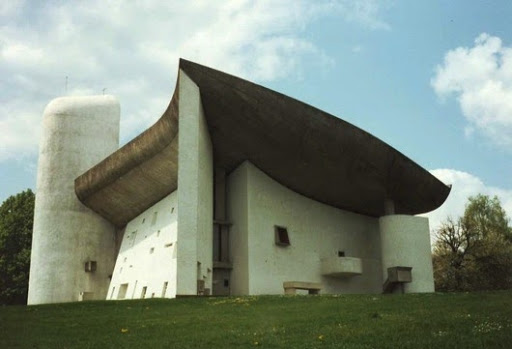
Ronchamp chapelle le Corbusier
This attitude of infusing matter with purpose, with intention, and doing so in a subtle, hinting rather than overpowering way comes to the fore again when Le Corbusier inaugurates one of his greatest masterpieces – the Chapel of Our Lady of the Height in Ronchamp:

This is “a project difficult, meticulous, primitive, made strong by the resources brought into play, but sensitive and informed by all-embracing mathematics which is the creator of that space which cannot be described in words. A few scattered symbols, a few written words telling the praises of the Virgin. The cross – the true cross of suffering – is raised up in this space; the drama of Christianity has taken possession of the place from this time onwards. […] I give you this chapel of dear, faithful concrete, shaped perhaps with temerity but certainly with courage in the hope that it will seek out in you (as in those who will climb the hill) an echo of what we have drawn into it.” (Le Corbusier’s dedication speech at the chapel’s inauguration, June 25 1955)

To my mind all of the above exudes a profound love of beauty and of the sacred, and a desire to offer it to others in a way that is inviting instead of imposing. Yet, in the course of reading about Le Corbusier, I kept coming across two criticisms leveled against his work. First, that it is inferior to renaissance and antique architecture and that this inferiority stems from ignorance. It is an argument that baffled me from the start, and that I see directly countered when reading about Le Corbusier’s reaction to the Acropolis:

“In 1910 I spent six weeks at the Parthenon. At the age of 23 my consciousness had determined its future direction. “Laborious hours in the revealing light of the Acropolis. Perilous hours which brought a distressing doubt about the (real) strength of our strength, the (real) art of our art. Those who, practising the art of architecture, find themselves at a point in their career,their brain empty, and heart broken with doubt in face of the task of giving living form to dead material, will realise the despondency of soliloquies amongst the ruins. Very often I left the Acropolis, my shoulders bowed with heavy foreboding, not daring to face the fact that one day I would have to practise. The Parthenon is a drama …”” (The Chapel at Ronchamp, 1957)

The second criticism is even more ad hominem and one that I find deeply repugnant. It is an objection to Le Corbusier’s lack of faith and adherence to Catholicism, put forward as a disqualifying obstacle regarding his involvement in church architecture. Such an attitude is exemplified by the following criticism directed at the Dominican3 Fr. Marie-Alain Couturier, O.P., who commissioned Le Corbusier’s work on the Monastery of Sainte-Marie-de-La-Tourette:

“By mistaking the “spirit of the age,” or Zeitgeist, for the Holy Spirit, Couturier assisted in the production of structures by famous modernist architects at the expense of the essential features of Catholic artistic work. […] Couturier placed his trust in artists, believing that all true art revealed something of the sacred. Since true art could only be revealed by true artists, he therefore sought the services of the masters of his time, Catholic or not, to reach the sacred through the production of a supposedly “true” art.”

I couldn’t disagree more! Like Fr. Couturier, and, incidentally, Pope Paul VI,4 I too firmly believe that “all true art reveal[s] something of the sacred.”

La tourette

In response to these criticisms, it is worth noting two aspects to Le Corbusier, the first of which is his directness and honesty about his beliefs:

“I am not a churchgoer myself, but one thing I do know is that every man has the religious consciousness of belonging to a greater mankind, to a greater or lesser degree, but in the end he is part of it. Into my work I bring so much effusion and intense inner life that it becomes something almost religious. […] People were at first surprised to see me participating in a sacred art. I am not a pagan. Ronchamp is a response to a desire that one occasionally has to extend beyond oneself, and to seek contact with the unknown.”

To leave a reflection on Le Corbusier’s compatibility with Christianity there would be unfair though and could leave a sense of vagueness and hand-waving. Instead, let me conclude by sharing with you the following passage from his book, “When Cathedrals Were White”:

“But those of us who live intensely in the present moment of modem times,[…] have extended our sympathy to all the world and to all times. We have rediscovered life and the axis of all human marvels and agonies. We are far from the theatrical stage which tries to place events of qualitative interest above and outside of human labors. We plunge into daily realities, are face to face with consciousness itself. […] Life bursts forth everywhere, outside the studios where art is “made,” outside of the small circles where it is talked about, outside of the writings in which the spirit of quality is isolated, localized, and disintegrated. […] Every day, every hour, the Earth sees splendors surging up which are truths and present-day beauty. Ephemeral perhaps! Tomorrow, new truths and new beauties bloom. The day after tomorrow, etc. … Thus life is replenished, full. Life is beautiful! We do not have-do we?-any intention or claim to fix the destiny of the eternal things of the future? Everything, at every hour, is only the work of the present moment. The present moment is creative, creating with an unheard-of intensity.”

If that is not Christian thought (albeit thought by a non-Christian), then I don’t know what is, and to support my claim I only need to look as far as Jesus’ own words:

“Therefore I tell you, do not worry about your life, what you will eat [or drink], or about your body, what you will wear. […] Look at the birds in the sky; they do not sow or reap, they gather nothing into barns, yet your heavenly Father feeds them. Are not you more important than they? Can any of you by worrying add a single moment to your life-span? Why are you anxious about clothes? Learn from the way the wild flowers grow. They do not work or spin. But I tell you that not even Solomon in all his splendor was clothed like one of them. If God so clothes the grass of the field, which grows today and is thrown into the oven tomorrow, will he not much more provide for you, O you of little faith? So do not worry and say, ‘What are we to eat?’ or ‘What are we to drink?’ or ‘What are we to wear?’ […] But seek first the kingdom (of God) and his righteousness, and all these things will be given you besides. Do not worry about tomorrow; tomorrow will take care of itself.” (Matthew 6:25-34)


1 The only point I’ll allow myself to make on account of refuting the ludicrous idea that church architecture has had a golden age in some past centuries is to quote from a great post on the Idle Speculations blog, which presents the killer argument that “[i]n Roman times, the early Roman basilicas were of course based on the public buildings of ancient Rome.” The tradition of church architecture is to be contemporary and not a saccharine pastiche of past forms, like the examples touted as successful by blogs like the one that triggered the present post.
2 A great source on Le Corbusier has for me been the excellent “Le Corbusier in Detail” by Flora Samuel, where this quote too can be found.
3 I am becoming quite a fan of the Dominicans, given also their links with Camus, mentioned here before.
4 “[T]he Church of the council declares to you through our voice: if you are friends of genuine art, you are our friends.” (Council Closing Messages December 8, 1965 By Pope Paul To Council Fathers)
Lumen Fidei: Love and truth are inseparable

Pope 001 4 3 rx513 c680x510

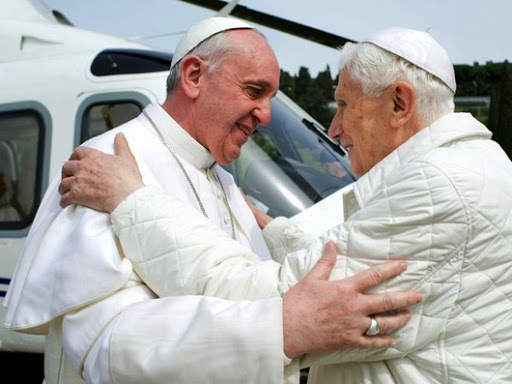
Pope Benedict XVI’s long-awaited encyclical on faith (completing the trilogy of encyclicals with those on love and hope) and Pope Francis’ equally eagerly awaited first encyclical are out – and they are one and the same – the encyclical entitled “Lumen Fidei” – “The Light of Faith.” As Francis puts it, “It’s an encyclical written with four hands, so to speak, because Pope Benedict began writing it and he gave it to me. It’s a strong document. I will say in it that I received it and most of the work was done by him and I completed it.”

I couldn’t agree more – it is a very strong document indeed, and one rich in insights that merit reflection and repeated analysis. It is a document that is beautifully written, in rich yet purposeful language, with razor-sharp logic and with a tremendous openness to the world as it is today. The references alone are worth highlighting, as they range from theological classics like the works of St. Augustine and St. Thomas Aquinas, through ancient non-Christian texts like the writings of Celsus, up to more recent and also critical voices like Nietzsche, Wittgenstein or T. S. Eliot. This is not a piece of propaganda, but a carefully thought out presentation of what faith means to a Christian, from a Catholic perspective, and how it relates not only to matters internal to the Church but to secular thought as well. As such, if you are not a Christian and curious about what we mean when way talk about faith, I would recommend a reading of Lumen Fidei (a recommendation I don’t make lightly).1

Since Lumen Fidei is a hefty document, and one where “padding” is minimal, I won’t even attempt an overview of the topics it touches upon and will instead just highlight the section where Benedict and Francis talk about how faith, truth, knowledge and love are related.

This train of thought starts already in the introductory chapter:

“Faith […] appear[s] to some as an illusory light, preventing mankind from boldly setting out in quest of knowledge. The young Nietzsche encouraged his sister Elisabeth to take risks, to tread “new paths… with all the uncertainty of one who must find his own way”, adding that “this is where humanity’s paths part: if you want peace of soul and happiness, then believe, but if you want to be a follower of truth, then seek”. Belief would be incompatible with seeking. From this starting point Nietzsche was to develop his critique of Christianity for diminishing the full meaning of human existence and stripping life of novelty and adventure. Faith would thus be the illusion of light, an illusion which blocks the path of a liberated humanity to its future.”

Faith is here portrayed as an illusion that at best can be an anxiolytic, but that is opposed to a seeking of truth and to free human fulfillment. This is certainly a view I have come across in person and I was pleased to see it be the position with which Lumen Fidei sets out to contrast it’s understanding, where it first declares what it understands by faith, before then considering its consequences:

“Christian faith is […] faith in a perfect love, in its decisive power, in its ability to transform the world and to unfold its history. “We know and believe the love that God has for us” (1 John 4:16). In the love of God revealed in Jesus, faith perceives the foundation on which all reality and its final destiny rest. […] Our culture has lost its sense of God’s tangible presence and activity in our world. We think that God is to be found in the beyond, on another level of reality, far removed from our everyday relationships. But if this were the case, if God could not act in the world, his love would not be truly powerful, truly real, and thus not even true, a love capable of delivering the bliss that it promises. It would make no difference at all whether we believed in him or not. Christians, on the contrary, profess their faith in God’s tangible and powerful love which really does act in history and determines its final destiny: a love that can be encountered, a love fully revealed in Christ’s passion, death and resurrection.”

To my mind the above does two important things: first, it underlines that faith is all about love and second, that this love is real here and now – that it is an incarnate, material, tangible love and not some ethereal, abstract, wholly otherness. Lumen Fidei goes on to underlining these important features of faith:

“Far from divorcing us from reality, our faith in the Son of God made man in Jesus of Nazareth enables us to grasp reality’s deepest meaning and to see how much God loves this world and is constantly guiding it towards himself. This leads us, as Christians, to live our lives in this world with ever greater commitment and intensity.”

Having established the focus of faith on love and on its incarnation in the world, Lumen Fidei, proceeds to linking it to truth:

“Faith without truth does not save, it does not provide a sure footing. It remains a beautiful story, the projection of our deep yearning for happiness, something capable of satisfying us to the extent that we are willing to deceive ourselves. Either that, or it is reduced to a lofty sentiment which brings consolation and cheer, yet remains prey to the vagaries of our spirit and the changing seasons, incapable of sustaining a steady journey through life. […] Only to the extent that love is grounded in truth can it endure over time, can it transcend the passing moment and be sufficiently solid to sustain a shared journey. If love is not tied to truth, it falls prey to fickle emotions and cannot stand the test of time. True love, on the other hand, unifies all the elements of our person and becomes a new light pointing the way to a great and fulfilled life. Without truth, love is incapable of establishing a firm bond; it cannot liberate our isolated ego or redeem it from the fleeting moment in order to create life and bear fruit.”

This, to me, is both a beautiful and a particularly lucid way of putting faith’s dependence on truth, knowledge and honesty. Looking back to the quote from Nietzsche’s letter to his sister, the above agrees with him on the deficiency of the kind of faith Nietzsche criticizes as being divorced from the truth and points to a (Hegelian dialectic) resolution of the initial, seeming opposition.

Lumen Fidei then goes further and emphasizes that it is not only “love [that] needs truth, [but that] truth also needs love.”:

“Love and truth are inseparable. Without love, truth becomes cold, impersonal and oppressive for people’s day-to-day lives. The truth we seek, the truth that gives meaning to our journey through life, enlightens us whenever we are touched by love. One who loves realizes that love is an experience of truth, that it opens our eyes to see reality in a new way, in union with the beloved. […] It is a relational way of viewing the world, which then becomes a form of shared knowledge, vision through the eyes of another and a shared vision of all that exists. [… F]aith-knowledge does not direct our gaze to a purely inward truth. The truth which faith discloses to us is a truth centred on an encounter with Christ, on the contemplation of his life and on the awareness of his presence. Saint Thomas Aquinas speaks of the Apostles’ oculata fides — a faith which sees! — in the presence of the body of the Risen Lord. With their own eyes they saw the risen Jesus and they believed.”

Since they derive from love, faith and truth are neither a private matter, nor are they oppressive, imposing or colonizing:

“But if truth is a truth of love, if it is a truth disclosed in personal encounter with the Other and with others, then it can be set free from its enclosure in individuals and become part of the common good. As a truth of love, it is not one that can be imposed by force; it is not a truth that stifles the individual. […] Clearly, then, faith is not intransigent, but grows in respectful coexistence with others. One who believes may not be presumptuous; on the contrary, truth leads to humility, since believers know that, rather than ourselves possessing truth, it is truth which embraces and possesses us. Far from making us inflexible, the security of faith sets us on a journey; it enables witness and dialogue with all.”

The above is a great manifesto not only for a Christian’s understanding of their own faith but of its inherent pointing outward towards others, with an openness and a welcoming disposition aimed at profound dialogue.2Unsurprisingly, the above faith sees science as a great good and sees itself as being a source of wonder that is also the motivational root cause of scientific endeavor, as readily agreed to by atheist and religious scientists alike:

“Nor is the light of faith, joined to the truth of love, extraneous to the material world, for love is always lived out in body and spirit; the light of faith is an incarnate light radiating from the luminous life of Jesus. It also illumines the material world, trusts its inherent order and knows that it calls us to an ever widening path of harmony and understanding. The gaze of science thus benefits from faith: faith encourages the scientist to remain constantly open to reality in all its inexhaustible richness. Faith awakens the critical sense by preventing research from being satisfied with its own formulae and helps it to realize that nature is always greater. By stimulating wonder before the profound mystery of creation, faith broadens the horizons of reason to shed greater light on the world which discloses itself to scientific investigation.”

I have barely scratched the surface of Lumen Fidei here, but what I have found has been a joy to read, reflect on and try to share with you here. Thank you, Benedict and Francis, for such a beautiful piece of thinking!


1 Plus, if you are interested, take a look at the second paragraph here for a suggestion of how to read both this blog and the Lumen Fidei encyclical.
2 I can’t not mention again one of Benedict XVI’s most astonishingly beautiful insights that is echoed here: “As far as preserving identity is concerned, it would be too little for the Christian, so to speak, to assert his identity in a such a way that he effectively blocks the path to truth. Then his Christianity would appear as something arbitrary, merely propositional. He would seem not to reckon with the possibility that religion has to do with truth. On the contrary, I would say that the Christian can afford to be supremely confident, yes, fundamentally certain that he can venture freely into the open sea of the truth, without having to fear for his Christian identity.” (Christmas Greetings to the Roman Curia, 2012)

Lumen Gentium: in heaven and on earth

Sutherland

Continuing in the series on Vatican II, let me resume a reading of Lumen Gentium, where the last post looked at its sixth chapter, addressing the role of the religious (i.e., those who have taken vows of poverty, chastity and obedience). In its penultimate, seventh chapter, Lumen Gentium turns to the relationship between the Church on earth and the Church in heaven. As the full title of the chapter – “The eschatological nature of the pilgrim church and its union with the church in heaven” – sets out in a nutshell, the focus here is on the final purpose of the Church on earth (its eschatology) and its union with the Church in heaven. This may at first seem like just a bit of jiggery-pokery, and to be honest, when I read it for the first couple of times, I was at a loss to extract from it more than a sentence’s worth of essence. Repeated reflection, an overflowing measure of enlightenment from John Paul II,1 and a personal experience I already shared here, have all lead me to what I’ll try to set out next.2

The best way to approach this chapter is to let John Paul II lead us to what is novel about it:3

“It can be said that until recently the Church’s catechesis and preaching centered upon an individual eschatology [… and] this pastoral style was profoundly personal: “Remember that at the end you will present yourself before God with your entire life. Before His judgment seat you will be responsible for all of your actions” […] The vision proposed by the Council, however, was that of an eschatology of the Church and of the world.”

Returning to Lumen Gentium, the opening paragraph of chapter 7 declares that:

“The Church, to which we are all called in Christ Jesus, and in which we acquire sanctity through the grace of God, will attain its full perfection only in the glory of heaven, when there will come the time of the restoration of all things.(cf. Acts 3:21) At that time the human race as well as the entire world, which is intimately related to man and attains to its end through him, will be perfectly reestablished in Christ. (cf. Ephesians 1:10)”

The first insight then is that the final purpose (eschatology) of the human person is not their individual, singular business, but fundamentally a property of a community – the Church. It is not I, alone, self-sufficiently and relying on my individual powers only, who sets out into the deep, but the I-we of the Church. Returning to a frequently emphasized point in previous parts of Lumen Gentium, here too the focus is on the Church being Jesus’ Body, where it is His “having been lifted up from the earth [that] has drawn all to Himself. (cf. John 12:32.)” Jesus draws all to himself and takes us (an all-inclusive “us”) with Him to our ultimate destiny.

The nature of the eschatology referred to extensively in this chapter merits greater reflection, in particular in terms of its timing. A naïve approach could lead us to thinking of it as referring to an event in some distant future (at the “end of time”), while what John Paul II puts forward is a very different perspective:

“[What the] Gospel teaches about God requires a certain change in focus with regard to eschatology. First of all, eschatology is not what will take place in the future, something happening only after earthly life is finished. Eschatology has already begun with the coming of Christ. The ultimate eschatological event was His redemptive Death and His Resurrection. This is the beginning of “a new heaven and a new earth” (cf. Revelation 21:1). For everyone, life beyond death is connected with the affirmation: “I believe in the resurrection of the body,” and then: “I believe in the forgiveness of sins and in life everlasting.” This is Christocentric eschatology.”

John Paul II again pivots what may have become a diffuse, deformed view and returns its focus to Jesus – it is His coming that has brought us into the final chapter of creation. As Lumen Gentium puts it:

“Already the final age of the world has come upon us and the renovation of the world is irrevocably decreed [… T]he promised restoration which we are awaiting has already begun in Christ, is carried forward in the mission of the Holy Spirit and through Him continues in the Church in which we learn the meaning of our terrestrial life through our faith, while we perform with hope in the future the work committed to us in this world by the Father, and thus work out our salvation.”

This then is the second insight: we are not just waiting around for the world to come to an end, instead we are in the “Last Days” and are active participants in the universe completing its function and returning to perfection in God. This is an understanding that neither lets us “check out” of the world’s affairs (instead obliging us to engage in them for the good of all), nor does it amount to being a millenarianist Doomsday cult (since Jesus himself assured the apostles that “of that day and hour no one knows, neither the angels of heaven, nor the Son, but the Father alone.” (Matthew 24:36)).

While some of us have already completed their earthly journey and form the heavenly Church, others are still “exiles on earth,” proceeding along it “groan[ing] and travail[ing] in pain” (cf. Romans 8:19-23). The two communities are not separate entities though, and instead:

“form one Church and cleave together in Him. (cf. Ephesians 4:16) […] For by reason of the fact that those in heaven are more closely united with Christ, they establish the whole Church more firmly in holiness, lend nobility to the worship which the Church offers to God here on earth and in many ways contribute to its greater edification. (cf. 1 Corinthians 12:12-27)”

The Church in heaven and on earth is the one Mystical Body of Christ. As a consequence, “the pilgrim Church from the very first ages of the Christian religion has cultivated with great piety the memory of the dead [… and] has always believed that the apostles and Christ’s martyrs who had given the supreme witness of faith and charity by the shedding of their blood, are closely joined with us in Christ.” This then is the third insight – communion is not only among those of us who are alive on earth today and with Jesus whose body we form, but equally with those who have gone before us. While the death of loved ones is unquestionably and profoundly painful, it is not a separation, but, paradoxically, a coming closer “by reason of the fact that those in heaven are more closely united with Christ.” In many ways, the 14th Dalai Lama’s tweet from yesterday is also very well aligned with the concept of the Mystical Body that pervades Lumen Gentium as well as Sacrosanctum Concilium, when he says: “we develop care and concern by thinking of others not as ‘them’ but ‘us’”.

Not only is such union the case with those close to me, but with all, and in a particular way with the saints: “For just as Christian communion among wayfarers brings us closer to Christ, so our companionship with the saints joins us to Christ, from Whom as from its Fountain and Head issues every grace and the very life of the people of God.” Instead of being only examples, through their intimate union with Jesus, I personally am united with them too.

On the subject of saints, Lumen Gentium also cautions against superficial excesses and underlines the fact that the Christian life is always directed towards the Trinity:

“the authentic cult of the saints consists not so much in the multiplying of external acts, but rather in the greater intensity of our love, whereby, for our own greater good and that of the whole Church, we seek from the saints “example in their way of life, fellowship in their communion, and aid by their intercession.” [… O]ur communion with those in heaven […] in no way weakens, but conversely, more thoroughly enriches the […] worship we give to God the Father, through Christ, in the Spirit.”

Instead of being a bit of esoteric navel-gazing, the insights about how the Church is one across heaven and earth, with Jesus at its head and as its heart, firmly place the focus on the importance of community, on acting in the world for its good and on the persistence of relationships beyond death and with all.


1 See the “Does “Eternal Life” exist?” chapter of his beautifully profound Crossing the Threshold of Hope.
2 Yes, I am going to send you to the second paragraph of a previous post, in case you are not a Catholic and would like my perspective on how to read the rest of this post.
3 Emphasis preserved from original text.

Me atheist, you Vatican spokesman

Chinese whispers

The journalistic farce that followed Pope Francis’ now-famous “atheists” homily is best viewed through Monty Python lenses, where it is in many ways like the final scene of the Life of Brian.1 There, a centurion comes to rescue Brian from the cross, but when he asks “Where is Brian of Nazareth?!” everyone volunteers, even to the point of one of the other crucifixion victims saying “I’m Brian, and so’s my wife!”

Let’s backtrack though and see what happened step by step. First, there was Francis’ homily itself:

“The Lord has redeemed all of us, all of us, with the Blood of Christ: all of us, not just Catholics. Everyone! ‘Father, the atheists?’ Even the atheists. Everyone! And this Blood makes us children of God of the first class! We are created children in the likeness of God and the Blood of Christ has redeemed us all! And we all have a duty to do good. And this commandment for everyone to do good, I think, is a beautiful path towards peace. If we, each doing our own part, if we do good to others, if we meet there, doing good, and we go slowly, gently, little by little, we will make that culture of encounter: we need that so much. We must meet one another doing good. ‘But I don’t believe, Father, I am an atheist!’ But do good: we will meet one another there.”

When I first read this, a couple of hours after Francis delivered it during his 7 am Domus Sanctae Marthae mass on 22nd May, I felt great joy and gratitude for having a Pope who is open and welcoming to all – just like Jesus was. I thought no more about it, since it seemed to me to be just a re-iteration – albeit a very welcome and clear one – of what the Church has been teaching consistently since Vatican II.2 In essence, Francis was saying that we hope to see atheists in heaven as much as we hope to be there ourselves. This is not to impose beliefs on those who believe neither in God nor in the existence of heaven, but to assure them that we, Catholics (and many other Christians too), believe in a God who loves all and welcomes all, regardless of their beliefs.

When I then looked at Twitter later in the day, I saw it ablaze with two types of reactions: very positive ones both from Christians and atheists, welcoming the invitation to dialogue and the appreciation of the good done by atheists (e.g., see the Huffington Post article from the same day and note the Pope’s homily being the second most shared piece on Reddit) and very critical ones – mainly from “traditional” Catholics (e.g., see a particularly forceful and conceited criticism here).

The day ended well for this story though, with a spot-on rebuke of Francis’ critics from a 1964 homily of the then-Fr. Joseph Ratzinger, shared in a blog post by Anna Williams:

“It seems as if we want to be rewarded, not just with our own salvation, but most especially with other people’s damnation—just like the workers hired in the first hour. That is very human, but the Lord’s parable [of the workers in the vineyard (Matthew 20:1-6)] is particularly meant to make us quite aware of how profoundly un-Christian it is at the same time.”

So far, so good: another great homily by Pope Francis, mostly positive and some negative reactions and a great put-down of the critics to round out the day.

The next morning, the weather turned though and a farce of epic proportion began brewing with the news of a Vatican spokesperson having issued a correction of Pope Francis’ words. As far as I can tell, the source of this red herring was a post on cnn.com, which stated that “On Thursday, the Vatican issued an “explanatory note on the meaning to ‘salvation.’” The Rev. Thomas Rosica, a Vatican spokesman, said that people who [are] aware of the Catholic church “cannot be saved” if they “refuse to enter her or remain in her.”” This was quickly picked up by media outlets around the world, with headlines like: “Vatican Clarifies Pope’s ‘Atheist’ Remarks,” “Vatican corrects Pope: Atheists are still going to hell,” and “Not so fast: Vatican says Pope Francis got it wrong, atheists do go to hell.”

It was immediately clear to me that something didn’t add up here: first, Fr. Thomas Rosica isn’t “a Vatican spokesman” (Fr. Federico Lombardi being “the” Vatican spokesperson, who has been in office for many years),3 second, “people who are aware of the Catholic Church and are not in her cannot be saved” is not at all what the Catechism says4 and third, any member of the Catholic Church (never mind a priest or Vatican member of staff) who felt it to be their job to issue an “explanatory note” about the Pope’s words off their own back and unprompted by the Pope better check themselves, before they wreck themselves.

In any case, I was curious to see this alleged “explanatory note,” so I (foolishly!) headed over to the Vatican website, where – naturally – there was no trace of it. Instead, I tracked it down on zenith.org here and I found – as I should have anticipated – that it was actually not a bad commentary on Francis’ words (and, no, it did not contain the offensive quote on “being aware of the Catholic Church” attributed to it on cnn.com). So, the facts of the matter are that the Vatican never issued any communication to “correct” Francis’ words and Fr. Rosica actually did a good job of commenting on the Pope’s words in my opinion (if you take care to read the whole text rather than pick phrases out of context – or even misquote them).

Like in so many cases before (did anyone say “Jesus’ wife”?), this incident was a display of journalistic ineptitude, carelessness and superficiality.

To conclude though I’d rather leave you on a positive note – a quote from Pope John Paul II’s address to the United Nations from 1995, which Fr. Rosica quoted in his explanatory note:

“Because of the radiant humanity of Christ, nothing genuinely human fails to touch the hearts of Christians. Faith in Christ does not impel us to intolerance. On the contrary, it obliges us to engage others in a respectful dialogue. Love of Christ does not distract us from interest in others, but rather invites us to responsibility for them, to the exclusion of no one and indeed, if anything, with a special concern for the weakest and the suffering. Thus, as we approach the two thousandth anniversary of the birth of Christ, the Church asks only to be able to propose respectfully this message of salvation, and to be able to promote, in charity and service, the solidarity of the entire human family.”

[UPDATE] I actually started writing this post several days ago and I was beginning to wonder whether it still made sense to publish it, since the events it speaks about took place two weeks ago. Surely the storm in a teacup would have died down since then and Francis’ words would be seen for what they were. Last night and then this morning I saw two articles that changed my mind though: first, one by the otherwise very cogent Fr. Alexander Lucie-Smith, who concluded his latest blog post with the following: “Heresy, and atheism, produce nothing beautiful. They can’t. They are stony barren fields.” and second, a post by the atheist Herb Silverman, whose take on the matter is that “Perhaps Pope Francis forgot to run this concession by the papal censors, because the following day the Vatican announced a do-over. The Rev. Thomas Rosica, a Vatican spokesman, said that those who are aware of the Catholic Church “cannot be saved” if they “refuse to enter her or remain in her.” […] So Rev. Rosica is simply reiterating the traditional Catholic position that atheists can go to hell.” Sadly, this post still has currency, but I hope that you have found it to be of some interest.


1 And those of you who are well versed in all matters Python, will also have spotted the direct reference to the “nurse” sketch, which is closely related to the present matter too.
2 For previous coverage of how the Church relates to atheists, see the following posts.
3 Though he did translate for Lombardi during the last conclave, so the mixup could be excused – if the source were not supposed to be engaged in journalism.
4 What the Catechism actually says is this: “Hence they could not be saved who, knowing that the Catholic Church was founded as necessary by God through Christ, would refuse either to enter it or to remain in it.” (§846)
Knowing and necessary – two very strong words, on a very different end of the scale to being aware that the Catholic Church exists! In effect it means that if you act against your own certain conviction that being in the Catholic Church is necessary for salvation, you are choosing to reject it and it is your freedom that is being respected instead of you being excluded.

The church that can(not) change

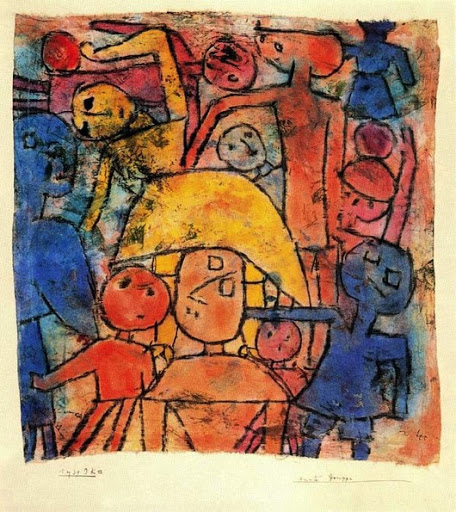
Paul Klee Colourful Group

A criticism frequently leveled at the Church is that it is set in its ways and that – unlike science – new inputs have no impact on its tenets. In a word, the Church comes across as static, in a world whose rate of change increases and that adapts and adjusts itself continuously. The end result is the appearance of mismatch and alienation, and Church representatives saying things like “These are the teachings of the church and they’re unchangeable truths.” does not help.

There is a very serious problem with statements like the above though and I am just saying so from the perspective of the Church itself, rather than as a criticism from outside. The problem is that such statements negate Jesus’ own words: “I have much more to tell you, but you cannot bear it now. But when he comes, the Spirit of truth, he will guide you to all truth.” (John 16:12-13). They deny “inspiration” received from the Holy Spirit and consider the Church’s teaching to be an immutable monolith obtained in one go rather than the gradual understanding of its full revelation in the person of Jesus. In fact Pope Francis himself reminds us that “throughout the history of salvation, whenever God reveals himself, He brings newness — God always brings newness — and demands our complete trust” and then goes on to challenge us:

“Are we open to God’s surprises? Or are we closed and fearful before the newness of the Holy Spirit? Do we have the courage to strike out along the new paths which God’s newness sets before us, or do we resist, barricaded in transient structures which have lost their capacity for openness to what is new?”

This is not to say that everything is open to change, but to be very clear about change being a core feature of Christian faith and consequently of the Church’s teaching too.

“OK,” you say “but does the Church actually change what it teaches?” Instead of answering that with a categorical “yes” and a lot of handwaving, let me present the following, very specific, example that I came across by accident some time ago. It concerns the question of “mixed marriages,” which here refers to marriages between one Catholic and one Christian, but non-Catholic spouse.

Let’s first look at how such marriages were spoken of in 1893, in Pope Leo XIII’s Constanti Hungarorum encyclical:

“[T]o remove the source of many evils, it is of utmost importance that pastors never cease to admonish their flocks to refrain as far as possible from entering into mixed marriages. Let the faithful correctly understand and resolutely remember that it is their duty to regard with horror such marriages, which the Church has always detested. They are to be abhorred for the reason which we emphasized in another letter, “They offer the opportunity for a forbidden sharing and participation in sacred things; they create a danger to the religion of the Catholic partner; they are an impediment to the virtuous education of children and very often cause them to become accustomed to viewing all religions as equal because they have lost the power of discriminating between the true and the false.” (Pope Leo XIII, Arcanum)”

Uff … “source of many evils,” “regard with horror,” “the Church has always detested,” “to be abhorred,” “impediment to the virtuous education of children [… who lose] the power of discriminating between the true and the false.” Sounds nasty!

Scroll ahead 100 years and look at what the 1993 Catechism of the Catholic Church says on the exact same subject (§1633-1637):

“[Mixed marriage] requires particular attention on the part of couples and their pastors. […] Difference of confession between the spouses does not constitute an insurmountable obstacle for marriage, when they succeed in placing in common what they have received from their respective communities, and learn from each other the way in which each lives in fidelity to Christ. But the difficulties of mixed marriages must not be underestimated. They arise from the fact that the separation of Christians has not yet been overcome. The spouses risk experiencing the tragedy of Christian disunity even in the heart of their own home. […] Through ecumenical dialogue Christian communities in many regions have been able to put into effect a common pastoral practice for mixed marriages. Its task is to help such couples live out their particular situation in the light of faith, overcome the tensions between the couple’s obligations to each other and towards their ecclesial communities, and encourage the flowering of what is common to them in faith and respect for what separates them.”

Hmm … “learn from each other the way in which each lives in fidelity to Christ,” “tragedy of Christian disunity […] in the heart of their own home,” “encourage the flowering of what is common to [the couple] in faith and respect for what separates them.” From abhorrently horrific, conscience-distorting evil to a challenging miniature laboratory of ecumenism where “fidelity to Christ” mutually enriches spouses – all in the space of 100 years. Not bad …

Jesus laughed

Jesus laughed

In many ways I find the subject of today’s post among the most difficult to talk about as, to me, it is akin to asking whether Jesus looked people in the eye when he spoke to them (or whether he looked down at his feet instead). Neither is mentioned in the Bible, yet both seem equally self-evident to me. I have yet to meet a loving, kind, compassionate person whom I haven’t also seen and heard laughing. So why is it that I am even writing about this topic?

The most immediate reason is a message I received from my bestie ML a couple of days ago, in which he shares a frustration that I too have had for years: the tendency of some to make a science out of distinguishing between joy and “mere fun,” branding one as a deplorable, shallow waste of time while extolling the other as a good, clean, Christian virtue. The point here isn’t that no distinctions ought to be made between varieties of enjoyment (the joy of mutual love, of a joke shared among friends, of delighting in success not being consubstantial with sadism or schadenfreude), but that such an enterprise bears the great risk of draining the joy out of Christian life through a process of abstract analysis and categorization that leaves one dour and cold.

In fact, the above thoughts were triggered by one of Pope Francis’ homilies from last week, where he says:

“A Christian is a man and a woman of joy. Jesus teaches us this, the Church teaches us this, in a special way in this liturgical time. What is this joy? Is it having fun? No: it is not the same. Fun is good, eh? Having fun is good. But joy is more, it is something else. […] Fun, if we want to have fun all the time, in the end becomes shallow, superficial, and also leads us to that state where we lack Christian wisdom. […] Joy is another thing. Joy is a gift from God. It fills us from within. It is like an anointing of the Spirit. [… On the other hand, s]ometimes melancholy Christian faces have more in common with pickled peppers than the joy of having a beautiful life.”

Clearly Francis distinguishes between fun that becomes shallow and joy that “fills us from within,” but he also warns against the lifelessness that follows from an absence of joy and that this is not Christian.

Having read and re-read Francis’ sermon many times over the last days, I am coming to the conclusion that the distinction ought not to be between fun and joy but between fun that leads to or subsists in joy and fun that does not and that leads to resentment, frustration and disappointment. In fact, Francis himself says that “Having fun is good[, b]ut joy is more” and I believe that this leads to a reading not of dichotomy but of set relationships, where fun and joy overlap. I’d like to go a step further though and argue that if joy is sought on the back of avoiding fun then only the latter is likely to be be achieved. Fun is a context in which relationships are built and avoiding it or looking down on it will eventually cut a person off from their neighbors – precisely the neighbors Jesus asks me to love like myself.

If I just look at my best friends, I can say with confidence that the moments that have lead to the birth of friendship have been ones of fun and joy – of delighting in each other, of recognizing oneself in the other, of having fun being together. This is not all that friendship is and moments of difficulty and suffering certainly test and strengthen it, but ultimately, as John Paul II said: “We are an Easter people.” Being an “Easter people” means both understanding the fundamental value that suffering has and realizing that its embracing is not for its own sake but as a means that leads to the joy of the resurrection.

But where does the question about whether Jesus laughed fit into this picture? It comes precisely from concerns about fun: should it be discredited or seen as a potential contributor to love and joy. At least up until the middle ages, many viewed laughter with deep-seated suspicion, but there were also those, like Erasmus of Rotterdam, who wrote the “Morias Enkomion” (“In Praise of Folly”) to his friend, St. Thomas More, who were its proponents. I don’t mean to mount an extensive defense of Jesus’ having laughed here – it is not something I believe is necessary and if you are convinced he never laughed, then Billy Graham would tell you: “I feel sorry for [you], because a balanced sense of humor can save us from taking ourselves too seriously, and help us see through the pride and pretense of our sinful world.” If, however, you’d like to see such a defense of laughter, others have done so very well already and I’d just pick out two: first, there are the very interesting scriptural pointers by the Protestant Rev. Kuiper and second, the great defense of humour by the Jesuit Fr. Martin, both of which I very much recommend.

To conclude on a fun note, let me leave you with a couple of examples of humor and laughter from the bible and the sayings of the saints (who are always a great weather vane for orthopraxy):

  1. St. Sarah (yes, “Old Testament” figures are held up as saints in the Catholic Church), who is the patron saint of laughter, laughed when God told her she’d get pregnant in her nineties: “God has given me cause to laugh, and all who hear of it will laugh with me.” (Genesis 21:6). Not only did Sarah laugh, but her son was named Isaac, which means “He laughed.”
  2. Jesus, during the “Sermon on the Plain” says: “Blessed are you who are now weeping, for you will laugh.” (Luke 6:21).
  3. Jesus often employs humor (which does not preclude him making important points at the same time) – e.g., as in the “eye of the needle” image: “[I]t is easier for a camel to pass through the eye of a needle than for one who is rich to enter the kingdom of God.” (Matthew 19:24).
  4. I have previously argued that the opening line of the Johannine prologue has the structure of a joke.
  5. When St. Thomas More is about to be executed for disobeying Henry VIII, he pulls his beard off the chopping block and tells the executioner: “This hath not offended the king.”
  6. In instructions to fellow nuns, St. Teresa of Ávila said: “What would happen if we hid what little sense of humor we had? Let each of us humbly use this to cheer others.”
  7. When asked by a journalist “How many people work in the Vatican?,” Blessed Pope John XXIII replied: “About half.”

🙂

Look at Mary, see Jesus

8717839098 b716ba634d

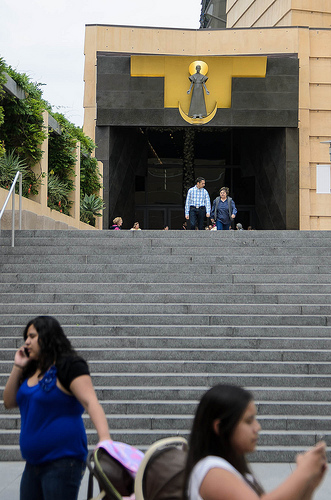
Last week I visited the Cathedral of Our Lady of the Angels in Los Angeles1 and it struck me that the statue above its entrance showed something akin to an optical illusion. Already when seen from afar, the statue above the main doors of the cathedral presented a somewhat ambiguous figure – the short hair, bare arms and forward facing palms were more consonant with an adolescent Jesus, prefiguring his later crucifixion wounds, while the context (i.e., it being the Cathedral of Our Lady and “the medium [being] the message” as McLuhan put it), the moon at the figure’s feet and the placement of the belt on the robe pointed to Mary, albeit posed in a highly unusual way.

In fact, if you look at the typical silhouettes of a statue of Mary (left – where her cloak dominates the outline), the LA statue (center) and a statue of Jesus (right – where head and hands are clearly distinct from the torso) you’ll see where my ambiguity came from:

Silhouette

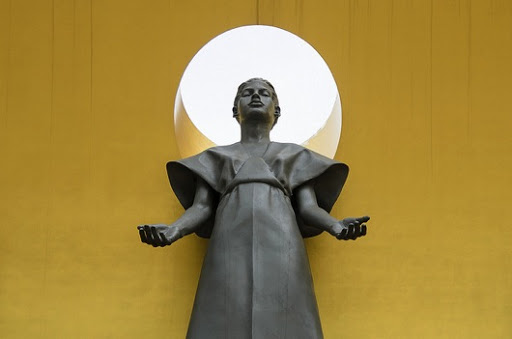
Even up close this ambiguity does not resolve itself:

8716719089 f0a29367d0 z

The muscular arms as well as the scale of the hands are consistent with a young man, while the dress becomes more clearly female and the face is sufficiently androgynous to allow both for a male and a female reading. In the end I am left with a feeling akin to viewing the rabbit-duck in that I can both resolve the ambiguity in Mary’s and in Jesus’ favor.

What the sculptor Robert Graham has achieved here – at least through my eyes, is to put in bronze the key to Mary being the model Christian. Saint Louis Marie de Montfort put it as follows: “We never give more honor to Jesus than when we honor his Mother, and we honor her simply and solely to honor him all the more perfectly. We go to her only as a way leading to the goal we seek – Jesus, her Son.” And Pope Benedict XVI simply expressed it by saying that we look to Christ by “going towards Mary who shows us Jesus.” Instead of seeking fame and glory for herself, her whole life was one of self-effacing humility, a constant pointing beyond herself – to Jesus – to the point of becoming transparent.


1 For more about the cathedral’s architecture see here.

Joy and humility, instead of rules and political correctness

Francis cast

What would it be like if the Pope were just a simple parish priest, saying daily morning masses in a small side-chapel and addressing a few simple words to his small flock. Well, that is precisely what has been going on since around a month ago in the Domus Sanctae Marthae – the Vatican guest house, where Pope Francis choses to reside and where he says daily morning mass. He invites various small groups of Vatican employees and addresses short sermons to them that are always rooted in the mass readings of the day and that have an immediately accessible style. Reading excerpts from these short homilies has been a daily joy for me over these last weeks and I would here like to share my favorite bits with you. If you’d like to follow these very short sermons yourself, the quickest way is to look at the Vatican Radio website, where they get published a couple of hours after their delivery.

Instead of trying to be in any way comprehensive, let me just pick out a few gems and leave you to follow up on their context if you wish. First, here are a couple of excerpts that show Francis’ take on what it means to be a Christian:

  1. Wonder and joy: “Wonder is a great grace, the grace that God gives us in our encounter with Jesus Christ. It is something that draws us outside of ourselves with joy … it is not a mere enthusiasm like that of sports fans when their favorite team wins, but it’s something deeper. Of course we cannot live forever in a state of wonder, but it is the beginning which leads to spiritual consolation. It is the consolation of those who have encountered Jesus Christ.”
  2. God spray: “Faith is not an impalpable presence, like an essence of mist that spreads around without really knowing what it is. God is a concrete ‘Person,’ and therefore faith in Him comes from a living encounter, which we experience as tangible. We believe in God who is Father, who is the Son, who is the Holy Spirit. We believe in people, and when we talk to God we talk to People: I speak with the Father, with the Son or with the Holy Spirit. And this is the faith. But faith is a gift, the Father gives it. This faith that makes us strong, it makes us joyful, this faith that always begins with the encounter with Jesus.”
  3. Facing difficulties: “When there are difficulties, we need to look closely at them, and confront them and speak about them. But never hide them. We must not be afraid of problems: Jesus himself said to his disciples: ‘It is I. Do not be afraid’. In life’s difficulties, with problems, with new things that we must face: the Lord is always with us. We may make mistakes, certainly, but he is always with us and says: ‘You made a mistake, now get back on the right path.’ Masquerading life, disguising life, is not a very good way to behave: no no. Life is what it is, that’s the reality. It’s exactly as God wants it to be, or as God allows it to be, it is what it is, and we have to accept it as it is.”
  4. Gossip: “When we prefer to gossip, gossip about others, criticize others – these are everyday things that happen to everyone, including me – these are the temptations of the evil one who does not want the Spirit to come to us and bring about peace and meekness in the Christian community. These struggles always exist in the parish, in the family, in the neighborhood, among friends. Instead, keep quiet and if you have something to say, say it to the interested parties, to those who can remedy the situation, but not to the entire neighborhood.”
  5. Love instead of rules: “The Lord saves us by His love: not with a letter, nor with a decree, but with his love, a love so great that it led him to send his Son, who, became one of us, walked with us, and this saves us. We are worthy, we are men and women of hope: this is what it means to be saved by love. The problem is that sometimes we want to save ourselves, and we believe we can do it, for example basing our security on money – and we think: ‘I have money, I am secure, I have it all, there are no worries, I have dignity: the dignity of a rich person.’ This is not enough. Think of the parable of the Gospel, of the man who had the full granary, who said, ‘I’ll make another to get more, and then I’ll sleep soundly,’ and the Lord says, ‘You fool! This evening you will die.’ That salvation is wrong, it is a temporary salvation, it is also only apparent salvation.”
  6. Normality, not magic: “God does not act like a fairy with a magic wand. Rather, he gives grace and says, as he said to all those he healed, ‘Go, walk.’ He says the same to us: ‘Move forward in your life, witness to everything the Lord does with us.’ Triumphalism is not of the Lord. The Lord came to Earth humbly; he lived his life for 30 years; he grew up like a normal child; he experienced the trial of work and the trial of the Cross. Then, in the end, he rose from the dead. The life of the Christian consists of a normality that is lived daily with Christ.”
  7. Forgiveness: “St. Paul said that his glory was Christ crucified in his sins. Why? Because he, in his sins, found Christ crucified who forgave him. In the middle of the ‘night,’ the many ‘nights,’ the many sins that we commit, because we are sinners, there is always the embrace of the Lord that helps us say: ‘This is my glory. I am a poor sinner, but You are my Savior.’ We think of how nice it is to be saints, but also how nice it is to be forgiven.”
  8. Peace: “Even in the most painful tests, a Christian never loses the peace and presence of Jesus. With a little courage we can pray: ‘Lord, grant me this grace which is the hallmark of our encounter with you: spiritual consolation and peace.’ A peace that we cannot lose because it is ours, it is the Lord’s true peace that cannot be bought or sold. It is a gift from God.”

Francis also presents are very beautiful view of the Church, both by pointing to its treasures and by warning against its pitfalls:

  1. Taming the Holy Spirit: “The Holy Spirit upsets us because it moves us, it makes us walk, it pushes the Church forward. We wish to calm down the Holy Spirit, we want to tame it and this is wrong. The Holy Spirit gives us the strength to go forward but many find this upsetting and prefer the comfort of the familiar. Nowadays everybody seems happy about the presence of the Holy Spirit, but it’s not really the case and there is still that temptation to resist it. The Second Vatican council was a beautiful work of the Holy Spirit. But 50 years later, have we done everything the Holy Spirit was asking us to do during the Council? The answer is ‘No.’ We celebrate this anniversary, we put up a monument but we don’t want it to upset us. We don’t want to change and what’s more there are those who wish to turn the clock back. This is called stubbornness and wanting to tame the Holy Spirit. The same thing happens in our personal life. The Spirit pushes us to take a more evangelical path but we resist this.”
  2. Saints v. ideologues: “The Word of Jesus goes to the heart because it is the Word of love, it is a beautiful word and brings love, makes us to love. But, ideologues cut off the road of love, and also that of beauty. And when ideology enters into the Church, when ideology enters into our understanding of the Gospel, no authentic comprehension is possible. And these ideologues, on the road of duty, load everything on the shoulders of the faithful. The ideologues falsify the gospel. Every ideological interpretation, wherever it comes from – is a falsification of the Gospel. And these ideologues – as we have seen in the history of the Church – end up being intellectuals without talent, ethicists without goodness – and let us not so much as mention beauty, of which they understand nothing. Rather, the path of love, the way of the Gospel, is simple: it is the road that the Saints understood. The saints are those who lead the Church forward! The road of conversion, the way of humility, of love, of the heart, the way of beauty …”
  3. The Church dormant: “The early Christians had nothing but the power of baptism that gave them their apostolic courage, the strength of the Spirit. I think of us, the baptized: do we really have this strength – and I wonder – do we really believe in this? Is Baptism enough? Is it sufficient for evangelization? Or do we rather ‘hope’ that the priest should speak, that the bishop might speak … and what of us? Then, the grace of baptism is somewhat closed, and we are locked in our thoughts, in our concerns. Or do we sometimes think: ‘No, we are Christians, I was baptized, I made Confirmation, First Communion … I have my identity card alright. And now, go to sleep quietly, you are a Christian.’ But where is this power of the Spirit that carries us forward? We need to be faithful to the Spirit, to proclaim Jesus with our lives, through our witness and our words. When we do this, the Church becomes a mother church that produces children and more children, because we, the children of the Church, we carry that. But when we do not, the Church is not the mother, but the babysitter, that takes care of the baby – to put the baby to sleep. It is a Church dormant. Let us reflect on our Baptism, on the responsibility of our Baptism.”
  4. Mother, not domestic administrator: “We, the women and men of the Church, we are in the middle of a love story: each of us is a link in this chain of love. And if we do not understand this, we have understood nothing of what the Church is. The Church does not grow by human strength. Some Christians have gone wrong for historical reasons, they have taken the wrong path, they have raised armies, they have waged wars of religion: that is another story, that is not the story of love. Yet we learn, with our mistakes, how the story of love goes. But how does it increase? Jesus said simply: like the mustard seed, it grows like yeast in the flour, without noise. The Church is not just another organization: she is Mother. How would you feel if someone said: she’s a domestic administrator? ‘No, I am the mother!’ And the Church is Mother. And we are in the middle of a love story that continues thanks to the power of the Holy Spirit. All of us together are a family in the Church, who is our Mother.”
  5. Humility, not conquest: “The style of evangelical preaching should have this attitude: humility, service, charity, brotherly love. ‘But … Lord, we must conquer the world!’ That word, conquer, doesn’t work. We must preach in the world. The Christian must not be like soldiers who when they win the battle make a clean sweep of everything. The Christian proclaims the Gospel with his witness, rather than with words. As St. Thomas Aquinas says: “A great soul that is not afraid of great things, that moves forward towards infinite horizons, and the humility to take into account the small things.” This is divine, it is like a tension between the great and the small. The triumph of the Church is the Resurrection of Jesus. But there is first the Cross. Today we ask the Lord to become missionaries in the Church, apostles in the Church but in this spirit: a great magnanimity and also a great humility. So be it.”

Synthetic life: out of bounds or cause for optimism?

Synthetic dna s

Take bottles of the chemicals that constitute living organisms and by following a process that does not involve re-using parts of living beings arrive at a new, living creature. That would the the synthetic creation of life from scratch.1

The pioneer of this strand of scientific endeavor is the biologist Dr. J. Craig Venter, who was among the first to sequence the human genome, and who is now seemingly nearing the first synthetic creation of life from fully non-living components. A prequel to this upcoming breakthrough has been the 2010 insertion of synthetic, man-made DNA into a bacteria, which resulted in the first living organism with an entirely artificial genome. While this had elements of being synthetic life, it was only partially so and Dr. Venter’s team is continuing in their quest. Last year they then passed the landmark of the first software simulation of an entire organism, and only last month Dr. Venter announced that his team is close to creating a living being from scratch. Their initial aim is to use the process for positive ends by creating artificial life that can “eat pollution and generate energy.”

While the scientific achievement of synthesizing life would unquestionably be a huge success (and the steps taken by Dr. Venter’s team already are!), there are also important ethical questions to consider, with multiple experts offering their assessments, from among which I would just like to offer two perspectives, at first introduced only anonymously:

Statement A: “All available evidence goes to show that there is no unmediated passage from non-life to life. [… A]ll living beings receive their life from a principle outside themselves, which is itself capable of infusing life; this we call God.”

Statement B: “If it is used to promote the good, to treat pathologies, we can only be positive[. …] If it turns out not to be [used] to respect the dignity of the person, then our judgment would change. [… Dr Venter’s work is a] further sign of intelligence, God’s gift to understand creation and be able to better govern it.”

The first statement is a classic “God of Gaps” stance, infused both with a lack of scientific understanding (i.e., missing the importance of the steps already made towards synthetic life and underestimating the likelihood of their ultimate success) and with a mistaking of a purely philosophical construct for the personal God of Abraham, Jesus and the Church. Statement A’s god is banished into ever-narrower, farther-removed spheres and serves a strictly soulless, utilitarian end. This god is now a workaround for the specter of infinite causal chains and now for the magical-seeming wafer-thin sliver wedged between not-life and life. If you have read this blog, you will know where Statement A comes from, and if not then I just apologize that I will not revealed its source, which I have already afforded more than its fair share of publicity. All I will say is that it is taken from a “catholic” newsletter that is broadly distributed in the UK.

I believe the best way to show how un-Christian the above is, is to contrast it with what Pope Francis said during the sermon of last Thursday’s morning mass in the chapel of the Domus Sanctae Marthae, where he is staying and where he has been inviting various groups working at the Vatican to celebrate mass with him:2

“But who is this God you believe in? An ‘all over the place – god’, a ‘god-spray’ so to speak, who is a little bit everywhere but who no-one really knows anything about? We believe in God who is Father, who is Son, who is Holy Spirit. We believe in Persons, and when we talk to God we talk to Persons: or I speak with the Father, or I speak with the Son, or I speak with the Holy Spirit. And this is the faith.”

You can just picture it: a storeroom somewhere, with a spray bottle with “life” written on it in black Sharpie, a box on another shelf with the “first mover” label beginning to peel, a pair of jars in the corner – one labelled “irresistible force,” the other “immovable object” – lids screwed tightly in place. All waiting to kick into action whenever necessary.

Let’s turn to Statement B, which directs its gaze to the good that synthetic life could do, while being conscious of its dangers, and which categorizes the intelligence that has lead to it as a good whose source is God. The source of this statement is a combination of what Archbishop Rino Fisichella, the then president of the Pontifical Academy for Life, and Cardinal Angelo Bagnasco, president of the Italian Bishops’ Conference, had to say when Dr. Venter announced the incorporation of fully synthetic DNA in a bacteria in 2010. It is a statement that views scientific progress as a means for greater good, as a way of deepening our understanding of how the universe that God created and sustains in its entirety operates, and as a licit use of the gift of reason, which also springs from God. The possibility of man-made, synthetic life is placed wholly inside God and seen as having a clear potential for good when used responsibly.


1 Although not “from scratch” in the Carl Sagan sense: “If you wish to make an apple pie from scratch, you must first invent the universe.”
2 This time it was the turn of the Italian State Police who serve the Vatican area.

Skin and heart, not antiques or novelties

Past present future 3 john kennard

Where does Pope Francis stand on the perennial question of reform versus continuity, progress versus tradition? His sermon during yesterday morning’s Chrism mass made it very clear – like Benedict XVI, who referred to it as “reform in continuity,” Francis too rejects a focus on tradition alone (calling it “antiques”) as well as on progress alone (“novelties”) and instead calls us to “put [our] own skin and [our] own heart on the line” and to live in the midst of our communities, sharing the life of our neighbors. Another way of reading the popes’ position is to cast it in terms of past, present and future, with a firm focus on living in the present moment instead of a nostalgia for a past Golden Age or a putting off of life until a bright future dawns.

While it contains a clear position on where Francis’ priorities lie, yesterday morning’s sermon – which I recommend highly in full – will, in my opinion, go down as the founding moment of a renewal of the priesthood, with the following being its key moments:

“[T]he anointing that [priests] receive is meant in turn to anoint God’s faithful people, whose servants they are; they are anointed for the poor, for prisoners, for the oppressed.[…]

A good priest can be recognized by the way his people are anointed. This is a clear test. When our people are anointed with the oil of gladness, it is obvious: for example, when they leave Mass looking as if they have heard good news. Our people like to hear the Gospel preached with “unction”, they like it when the Gospel we preach touches their daily lives, when it runs down like the oil of Aaron to the edges of reality, when it brings light to moments of extreme darkness, to the “outskirts” where people of faith are most exposed to the onslaught of those who want to tear down their faith. […]

We need to “go out”, then, in order to experience our own anointing, its power and its redemptive efficacy: to the “outskirts” where there is suffering, bloodshed, blindness that longs for sight, and prisoners in thrall to many evil masters. It is not in soul-searching or constant introspection that we encounter the Lord[…]

Those who do not go out of themselves, instead of being mediators, gradually become intermediaries, managers. We know the difference: the intermediary, the manager, “has already received his reward”, and since he doesn’t put his own skin and his own heart on the line, he never hears a warm, heartfelt word of thanks. This is precisely the reason why some priests grow dissatisfied, become sad priests, lose heart and become in some sense collectors of antiques or novelties – instead of being shepherds living with “the smell of the sheep”, shepherds in the midst of their flock, fishers of men. […]

It is not a bad thing that reality itself forces us to “put out into the deep”, where what we are by grace is clearly seen as pure grace, out into the deep of the contemporary world, where the only thing that counts is “unction” – not function – and the nets which overflow with fish are those cast solely in the name of the One in whom we have put our trust: Jesus.”

Wow! What a wake up call! And before you think: “Yeah! Them priests better get their act together,” let me just remind you (as I remind myself) that we all share in Jesus’ royal priesthood! When I heard Pope Francis say these words, I felt that he was addressing me. Do I share in the life of those around me? Do I live in their midst or am I withdrawn into introspection? These are undoubtedly great challenges, but ones that, I believe, will help all of us Christians to be more faithful followers of Jesus.

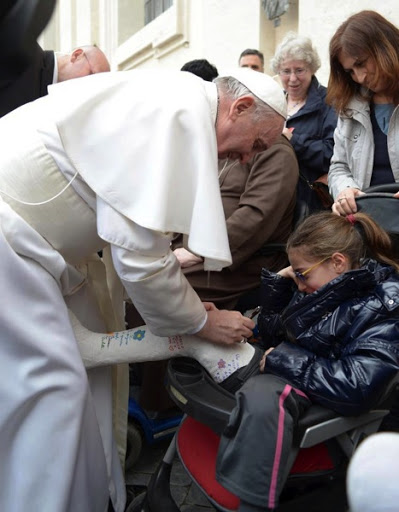
As is his trademark, Pope Francis proceeded to put his model of the priesthood into practice straight-away, by celebrating the Maundy Thursday mass in a juvenile detention center. Not only that, but he chose – against present liturgical law!1 – to wash the feet not of 12 men (which in the case of the popes’ Maundy Thursday masses have been priests), but of a group of youths, among whom were women as well as men and Muslims as well as Christians. This a shepherd in the midst of his flock, a fisherman putting “out into the deep”!

Not only his actions, but his words too, during the sermon of the same Maundy Thursday mass, illustrate his closeness and adaptation to the specific people he is with. The message he shares is universal, accessible to all and obviously comes from his heart:

“Help one another. This is what Jesus teaches us. This is what I do. And I do it with my heart. I do this with my heart because it is my duty, as a priest and bishop I must be at your service. But it is a duty that comes from my heart and a duty I love. I love doing it because this is what the Lord has taught me. But you too must help us and help each other, always. And thus in helping each other we will do good for each other.

Now we will perform the ceremony of the Washing of the Feet and we must each one of us think, Am I really willing to help others? Just think of that. Think that this sign is Christ’s caress, because Jesus came just for this, to serve us, to help us.”

This universality and at the same time specificity of his approach also shines through in his inviting ten parish priests from around Rome for lunch earlier that same day. One of the guests – the parish priest of the San Giacomo church in central Rome – reports:

“At first there was a bit of awkwardness – he is the pope after all – but he put everyone at ease. […] He didn’t want us to kiss his hand – instead he kissed each one of us. We asked him whether we could tell our parishioners that we had lunch with him and Francis told us to greet and bless them in his name. […] He also had a word of advice for each one of us. Since my parish is an inner city one, he invited me to keep my church open, as he already said during Wednesday’s general audience: “how sad to see closed churches!”. He told me that if the door is open, when someone passes by, they may enter and if they they also find a priest who is ready to hear their confession, it becomes an occasion for meeting Jesus and the Church.”


1 Although, personally and individually being the Catholic Church’s supreme and ultimate legislator, this is a moot point.