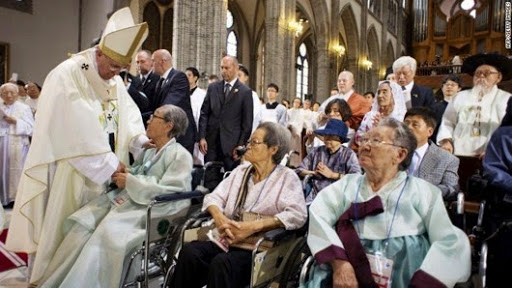
Three weeks ago Pope Francis made a five-day visit to South Korea where he again spoke with great clarity about a number of topics and where he gave witness to the Good News of the Gospel by actions at least as much as by words. Instead of providing a comprehensive account of the trip, which can be found in many other places, I would just like to bring together my favorite passages from the around 15 talks he gave there.Upon his arrival, Francis presented his approach to diplomacy:
“The quest for peace also represents a challenge for each of us, and in a particular way for those of you dedicated to the pursuit of the common good of the human family through the patient work of diplomacy. It is the perennial challenge of breaking down the walls of distrust and hatred by promoting a culture of reconciliation and solidarity. For diplomacy, as the art of the possible, is based on the firm and persevering conviction that peace can be won through quiet listening and dialogue, rather than by mutual recriminations, fruitless criticisms and displays of force.”
Followed by a reflection on how peace, justice and development are interrelated:
“Peace is not simply the absence of war, but “the work of justice” (cf. Is 32:17). And justice, as a virtue, calls for the discipline of forbearance; it demands that we not forget past injustices but overcome them through forgiveness, tolerance and cooperation. It demands the willingness to discern and attain mutually beneficial goals, building foundations of mutual respect, understanding and reconciliation. May all of us dedicate these days to peace, to praying for it and deepening our resolve to achieve it.”
And finally, he underlined the universal need of being heard:
“How important it is that the voice of every member of society be heard, and that a spirit of open communication, dialogue and cooperation be fostered. It is likewise important that special concern be shown for the poor, the vulnerable and those who have no voice, not only by meeting their immediate needs but also by assisting them in their human and cultural advancement.”
Later that same day, when addressing the Korean bishops, Francis warned them against becoming an affluent, middle class Church where the poor do not feel at home and that becomes mediocre:
“There is a danger, a temptation which arises in times of prosperity: it is the danger that the Christian community becomes just another “part of society”, losing its mystical dimension, losing its ability to celebrate the Mystery and instead becoming a spiritual organization, Christian and with Christian values, but lacking the leaven of prophecy. When this happens, the poor no longer have their proper role in the Church. This is a temptation from which particular Churches, Christian communities, have suffered greatly over the centuries; in some cases they become so middle class that the poor even feel ashamed to be a part of them. It is the temptation of spiritual “prosperity”, pastoral prosperity. No longer is it a poor Church for the poor but rather a rich Church for the rich, or a middle class Church for the well-to-do. Nor is this anything new: the temptation was there from the beginning. Paul had to rebuke the Corinthians in his First Letter (11:17), while the Apostle James was even more severe and explicit (2:1-7): he had to rebuke these affluent communities, affluent Churches for affluent people. They were not excluding the poor, but the way they were living made the poor reluctant to enter, they did not feel at home. This is the temptation of prosperity. I am not admonishing you because I know that you are doing good work. As a brother, however, who has the duty to confirm his brethren in the faith, I am telling you: be careful, because yours is a Church which is prospering, a great missionary Church, a great Church. The devil must not be allowed to sow these weeds, this temptation to remove the poor from very prophetic structure of the Church and to make you become an affluent Church for the affluent, a Church of the well-to do – perhaps not to the point of developing a “theology of prosperity” – but a Church of mediocrity.”
The next day, on 15th August, Francis had his first meeting with youth gathered from all over Asia, where he first recalled the need for the Church to “be a seed of unity for the whole human family,” and then proceeded to reflect on an experience shared before his address that was about the challenges of discerning one’s vocation:
“What Marina said really struck me: about the conflict she felt in her life. What to do in this situation? Take up the path of consecrated life, religious life, or study to be better able to help others.This is only an apparent conflict, because when the Lord calls, he always does so for the good of others, whether it is through the religious life, the consecrated life, or as a lay person, as the father or mother of a family. The goal is the same: to worship God and to do good to others. What should Marina do, and the many others of you who are asking the same question? I once asked it myself: What path should I choose? But you do not have to choose any path! The Lord must choose it! Jesus has chosen it! You have to listen to him and ask: Lord, what should I do?This is the prayer that a young person should make: “Lord what do you want from me?” With prayer and the advice of some good friends – laity, priests, religious sisters, bishops, popes (even the Pope can offer some good advice!) – you can find the path that the Lord wants for you.”
He then went on to underline the fundamental simplicity of love:
“The path of love is simple: love God and love your neighbor, your brother or sister, the one at your side, who needs love and so many other things. “But Father, how do I know that I love God?” Only if you love your neighbor, if you do not hate your neighbor and do not harbor hatred in your heart, do you love God. This is the sure proof.”
Later that day Francis paid a surprise visit to the Jesuit HQ in Korea, where he said the following to his brothers:
“There are no wounds that can’t be consoled by the love of God. This is how we must live: seeking Jesus Christ so that we may carry this love to consoling wounds, healing wounds. […] God always consoles, always waits, always forgets, always forgives. There are many wounds in the Church. Wounds that are often provoked by ourselves, practicing Catholics and ministers of the Church.Don’t tell off the people of God anymore! Console the people of God! Often our clerical attitudes lead to clericalism that harms the Church so much. Being a priest does not result in the status of public officials, but of shepherd. Please, be shepherds and not public officials. And when you are in the confessional, remember that God never tires of forgiving. Be merciful!”
Two days later, Francis met bishops from all over Asia to whom he spoke about the simultaneous need for a clear sense of one’s own identity and of openness and receptivity to others, as the basis for dialogue:
“But in undertaking the path of dialogue with individuals and cultures, what should be our point of departure and our fundamental point of reference, which guides us to our destination? Surely it is our own identity, our identity as Christians. We cannot engage in real dialogue unless we are conscious of our own identity. We can’t dialogue, we can’t start dialoguing from nothing, from zero, from a foggy sense of who we are. Nor can there be authentic dialogue unless we are capable of opening our minds and hearts, in empathy and sincere receptivity, to those with whom we speak. In other words, an attentiveness in which the Holy Spirit is our guide. […] And if our communication is not to be a monologue, there has to be openness of heart and mind to accepting individuals and cultures. Fearlessly, for fear is the enemy of this kind of openness.”
And he proceeded to warn against becoming bogged down in formalism, superficiality and easy answers:
“Without a grounding in Christ, the truths by which we live our lives can gradually recede, the practice of the virtues can become formalistic, and dialogue can be reduced to a form of negotiation or an agreement to disagree. An agreement to disagree… so as not to make waves… This sort of superficiality does us great harm. […] Then […] there is [… another] temptation: that of the apparent security to be found in hiding behind easy answers, ready formulas, rules and regulations. Jesus clashed with people who would hide behind laws, regulations and easy answers… He called them hypocrites. Faith by nature is not self-absorbed; it “goes out”. It seeks understanding; it gives rise to testimony; it generates mission. In this sense, faith enables us to be both fearless and unassuming in our witness of hope and love. Saint Peter tells us that we should be ever ready to respond to all who ask the reason for the hope within us (cf. 1 Pet 3:15). Our identity as Christians is ultimately seen in our quiet efforts to worship God alone, to love one another, to serve one another, and to show by our example not only what we believe, but also what we hope for, and the One in whom we put our trust (cf. 2 Tim 1:12).”
Next, Francis insisted on the need for acceptance of others (“Come to my house, enter my heart.”) which has a profound basis in Jesus’ incarnation and in us all being children of the one Father. Empathy and a welcoming of others are core to Christianity and fear for one’s own identity is wholly unwarranted:
“[T]ogether with a clear sense of our own Christian identity, authentic dialogue also demands a capacity for empathy. For dialogue to take place, there has to be this empathy. We are challenged to listen not only to the words which others speak, but to the unspoken communication of their experiences, their hopes and aspirations, their struggles and their deepest concerns. Such empathy must be the fruit of our spiritual insight and personal experience, which lead us to see others as brothers and sisters, and to “hear”, in and beyond their words and actions, what their hearts wish to communicate. In this sense, dialogue demands of us a truly contemplative spirit of openness and receptivity to the other. I cannot engage in dialogue if I am closed to others. Openness? Even more: acceptance! Come to my house, enter my heart. My heart welcomes you. It wants to hear you. This capacity for empathy enables a true human dialogue in which words, ideas and questions arise from an experience of fraternity and shared humanity. If we want to get to the theological basis of this, we have to go to the Father: he created us all; all of us are children of one Father. This capacity for empathy leads to a genuine encounter – we have to progress toward this culture of encounter – in which heart speaks to heart. We are enriched by the wisdom of the other and become open to travelling together the path to greater understanding, friendship and solidarity. “But, brother Pope, this is what we are doing, but perhaps we are converting no one or very few people…” But you are doing it anyway: with your identity, you are hearing the other. What was the first commandment of God our Father to our father Abraham? “Walk in my presence and be blameless”. And so, with my identity and my empathy, my openness, I walk with the other. I don’t try to make him come over to me, I don’t proselytize. Pope Benedict told us clearly: “The Church does not grow by proselytizing, but by attracting”. In the meantime, let us walk in the Father’s presence, let us be blameless; let us practice this first commandment. That is where encounter, dialogue, will take place. With identity, with openness. It is a path to greater knowledge, friendship and solidarity. As Saint John Paul II rightly recognized, our commitment to dialogue is grounded in the very logic of the incarnation: in Jesus, God himself became one of us, shared in our life and spoke to us in our own language (cf. Ecclesia in Asia, 29).”
And finally, Francis places the importance of a shared journey above the others’ conversion and distances the Church from ideas of conquest:
“I am not referring to political dialogue alone, but to fraternal dialogue… “But these Christians don’t come as conquerors, they don’t come to take away our identity: they bring us their own, but they want to walk with us”. And the Lord will grant his grace: sometimes he will move hearts and someone will ask for baptism, sometimes not. But always let us walk together. This is the heart of dialogue.
The next day, during a meeting with religious leaders, Francis returns to the importance of shared journeying:
“Life is a journey, a long journey, but a journey which we cannot make by ourselves. We need to walk together with our brothers and sisters in the presence of God. So I thank you for this gesture of walking together in the presence of God: that is what God asked of Abraham. We are brothers and sisters. Let us acknowledge one another as brothers and sisters, and walk together.”
And finally, during the flight back to Rome, Francis again answers questions put to him there and then by the journalists on board, where three stood out for me in particular. First, in response to being asked about whether he isn’t concerned that his gesture of wearing a yellow ribbon (a sign of solidarity with the victims of the Sewol ferry disaster) might be misunderstood politically, Francis answers:
“Whenever you find yourself facing human suffering, you have to do what your heart tells you to. Then people will say: “He did it for this or that political reason”; let them say what they want. But when you think of these men and woman, these fathers and mothers who have lost their children, their brothers and sisters, of the immense pain of such a disaster, I don’t know, my heart.. I am a priest and I feel the need to draw near! That’s how I feel; that is the first thing. I know that the comfort that any word of mine might give is no cure, it doesn’t bring the dead back to life, but human closeness at these times gives us strength, there is solidarity… […] I would like to add something. I took this (holding up a ribbon). After I carried it for half a day – I took it for solidarity with them – somebody came up to me and said: It’s better to take that off… You should be neutral …” “But listen, where human suffering is involved, you can’t be neutral”. That was my answer; that’s how I feel.”
Second, in response to a question about military intervention in Iraq and also addressing the topic of torture, Francis says:
“Thank you for your very clear question. In these cases, where there is an unjust aggression, I can only say that it is licit to stop the unjust aggressor. I emphasize the word: “stop”. I’m not saying drop bombs, make war, but stop the aggressor. The means used to stop him would have to be evaluated. Stopping an unjust aggressor is licit. But we also need to remember! How many times, with this excuse of stopping an unjust aggressor, the powers have taken over peoples and carried on an actual war of conquest! One nation alone cannot determine how to stop an unjust aggressor. After the Second World War, there was the idea of the United Nations: that is where discussion was to take place, to say: Is this an unjust aggressor? It would seem so. How do we stop him?” This alone, nothing else. Second, minorities. Thanks for using that word. Because people say to me: “the Christians, the poor Christians…” And it is true, they are suffering, and martyrs, yes, there are many martyrs. But there are also men and women, religious minorities, not all Christians, and all are equal before God. To stop an unjust aggressor is a right of humanity, but it is also a right of the aggressor to be stopped in order not to do evil. […]
Today, torture is an almost, I would say, ordinary means used in intelligence work, in trials… And torture is a sin against humanity, it is a crime against humanity. And to Catholics, I say: to torture a person is a mortal sin; it is a grave sin, but even more, it is a sin against humanity.”
And third, in a question about his upcoming encyclical on ecology, Francis spoke again about the relationship between science and faith, being more specific about how he sees the value of science in the context of this document of Catholic teaching:
“[T]here are also scientific hypotheses [to be taken into account], some of them quite solid, others not. In this kind of encyclical, which has to be magisterial, one can only build on solid data, on things that are reliable. If the Pope says that the earth is the centre of the universe, and not the sun, he errs, since he is affirming something that ought to be supported by science, and this will not do. That’s where we are at now. We have to study the document, number by number, and I believe it will become smaller. But to get to the heart of the matter and to what can be safely stated. You can say in a footnote: “On this or that question, there are the following hypotheses…”, as a way of offering information, but you cannot do that in the body of encyclical, which is doctrinal and has to be sound.”
 eyebeleave