The human and the divine

Patterns of light

Sir Terry Pratchett, who died yesterday and whose books have given me a great deal of joy over the last 20 years, expressed my gut reaction to crowds very well when he said that: “[t]he intelligence of that creature known as a crowd is the square root of the number of people in it.”1 While I don’t have a phobia of crowds, I’d always prefer a walk in a forest over “relaxing” on a packed beach, a stroll around good architecture to queueing at some movie-themed attraction, or a chat with friends in a quiet pub over a party in a sports bar.

These preferences (and prejudices) of mine were again reinforced when I recently spent a weekend at a holiday camp. There was a lot to like about it, no doubt – spending time with my family, a change of environment, clean air, eating out … But it also came with an ample and ready supply of that “creature known as a crowd.” The place was packed to bursting point! My aversion to such an environment was particularly heightened when, at one point, my spouse and younger son left me in a large “leisure pool” and set off to go down some slides.

As I stayed behind in the pool I felt like a sardine who had to be oiled to be squeezed into a tight tin. And I didn’t feel any bonhomie towards my fellow sardines either, I can tell you that for nothing.

Floating there, my mind started wandering and I went back to Cardinal Ravasi’s beautiful piece of thinking on secularity and secularism, and landed on his declaration that Christianity “doesn’t call us to detach ourselves from reality towards mythical or mystical heavens.” The truth of his statement struck me and reminded me of the importance of living neither in the good memories of the past nor in the promises of a potential future, but right here, in the present. As I looked around, it was still the same “creature known as a crowd” that surrounded me, but its individual members now presented an invitation and challenge to me. Can I see them as my brothers and sisters, as the presence of God, or do I let myself be enslaved by my prejudices?

I felt like I was on holy ground (like Pope Francis said to confessors yesterday: “We are ministers of mercy thanks to God’s mercy, and we must never lose this view to the supernatural that makes us truly humble, welcoming and merciful towards every brother and sister who wishes to confess. … Every faithful penitent who approaches the confessional is ‘sacred ground’.”). Ashamed of my self-centeredness, but encouraged by the open arms extended to me in the present moment.

At that point, my mind turned to that extraordinary meditation by Chiara Lubich, the seventh anniversary of whose death it is tomorrow, which she entitled “The great attraction of modern times” and where she wrote:

This is the great attraction of modern times:
to penetrate to the highest contemplation
while mingling with everyone,
one person alongside others.
I would say even more:
to lose oneself in the crowd
in order to fill it with the divine,
like a piece of bread
dipped in wine.
I would say even more:
made sharers in God’s plans for humanity,
to embroider patterns of light on the crowd,
and at the same time to share with our neighbor
shame, hunger, troubles, brief joys.
Because the attraction
of our times, as of all times,
is the highest conceivable expression
of the human and the divine,
Jesus and Mary:
the Word of God, a carpenter’s son;
the Seat of Wisdom, a mother at home.

Thinking about Lubich’s and Ravasi’s words made me realize: Yes, we are not called to a detachment from reality in favor of some heavens in an ephemeral beyond, but to a discovery of those mystical heavens in the reality around us. To a discovery by participation and a facilitation of others’ participation in it with us.


1 Not wanting to nitpick, but I’d adjust Sir Terry’s words along the following lines, to impose a mathematically more severe expression of prejudice against crowds: “The intelligence of that creature known as a crowd is one over the square root of the number of people in it.”

Le Corbusier: the sacred cubic centimeter

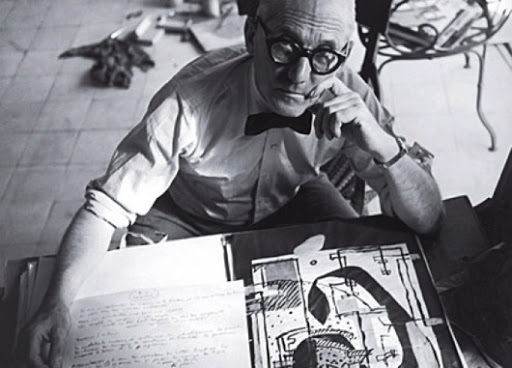
Le corbusier

Having come across yet another profoundly misguided piece on church architecture, and not feeling like rehashing previous posts on the subject,1 I instead set out to learn more about Le Corbusier, whose name the aforementioned piece took in vain.

Le Corbusier defined architecture as “giving living form to dead material” and elaborated on its dual nature of construction and art as follows:

“You employ stone, wood and concrete, and with these materials you build houses and palaces. That is construction. Ingenuity is at work. But suddenly you touch my heart, you do me good, I am happy and I say: “This is beautiful.” That is Architecture. Art enters in.”

Even before turning to church architecture, there is a great sense of focus not only on beauty but also on the sacred in Le Corbusier’s thought:

“One preoccupation has concerned me compulsively; to introduce into the home a sense of the sacred; to make the home the temple of the family. From that moment on, everything changed. A cubic centimetre of housing was worth gold, represented possible happiness. With such an idea of dimension and purpose, today you can build a temple to meet family needs beside the very cathedrals.” (Mise Au Point)2

How does one infuse matter with life, introduce the sacred into every cubic centimeter of a home? Again, Le Corbusier’s thoughts are illuminating:

“I am not faultless or simple, I am filled with turmoil and undercurrents. When pondering and working out a project (town planning, architecture or painting), always a long process, I bring into focus, I realise, I come to the point. I have made an immense effort without a word spoken; over the drawing boards of my office […] I do not speak; my private office (used for patient research) […] is opened to no one. There I am alone. Never in my life have I “explained” a painting. The painting will go out and will be loved or hated, understood or not. Do you think that bothers me! (How could it bother me?)” (The Chapel at Ronchamp, 1957)
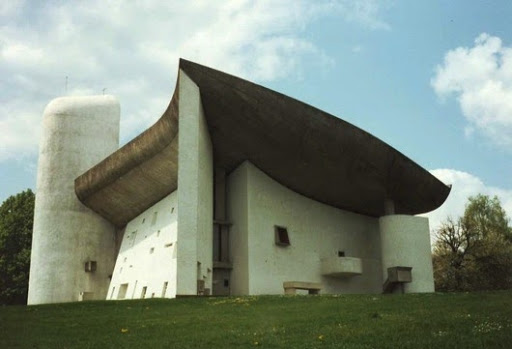
Ronchamp chapelle le Corbusier
This attitude of infusing matter with purpose, with intention, and doing so in a subtle, hinting rather than overpowering way comes to the fore again when Le Corbusier inaugurates one of his greatest masterpieces – the Chapel of Our Lady of the Height in Ronchamp:

This is “a project difficult, meticulous, primitive, made strong by the resources brought into play, but sensitive and informed by all-embracing mathematics which is the creator of that space which cannot be described in words. A few scattered symbols, a few written words telling the praises of the Virgin. The cross – the true cross of suffering – is raised up in this space; the drama of Christianity has taken possession of the place from this time onwards. […] I give you this chapel of dear, faithful concrete, shaped perhaps with temerity but certainly with courage in the hope that it will seek out in you (as in those who will climb the hill) an echo of what we have drawn into it.” (Le Corbusier’s dedication speech at the chapel’s inauguration, June 25 1955)

To my mind all of the above exudes a profound love of beauty and of the sacred, and a desire to offer it to others in a way that is inviting instead of imposing. Yet, in the course of reading about Le Corbusier, I kept coming across two criticisms leveled against his work. First, that it is inferior to renaissance and antique architecture and that this inferiority stems from ignorance. It is an argument that baffled me from the start, and that I see directly countered when reading about Le Corbusier’s reaction to the Acropolis:

“In 1910 I spent six weeks at the Parthenon. At the age of 23 my consciousness had determined its future direction. “Laborious hours in the revealing light of the Acropolis. Perilous hours which brought a distressing doubt about the (real) strength of our strength, the (real) art of our art. Those who, practising the art of architecture, find themselves at a point in their career,their brain empty, and heart broken with doubt in face of the task of giving living form to dead material, will realise the despondency of soliloquies amongst the ruins. Very often I left the Acropolis, my shoulders bowed with heavy foreboding, not daring to face the fact that one day I would have to practise. The Parthenon is a drama …”” (The Chapel at Ronchamp, 1957)

The second criticism is even more ad hominem and one that I find deeply repugnant. It is an objection to Le Corbusier’s lack of faith and adherence to Catholicism, put forward as a disqualifying obstacle regarding his involvement in church architecture. Such an attitude is exemplified by the following criticism directed at the Dominican3 Fr. Marie-Alain Couturier, O.P., who commissioned Le Corbusier’s work on the Monastery of Sainte-Marie-de-La-Tourette:

“By mistaking the “spirit of the age,” or Zeitgeist, for the Holy Spirit, Couturier assisted in the production of structures by famous modernist architects at the expense of the essential features of Catholic artistic work. […] Couturier placed his trust in artists, believing that all true art revealed something of the sacred. Since true art could only be revealed by true artists, he therefore sought the services of the masters of his time, Catholic or not, to reach the sacred through the production of a supposedly “true” art.”

I couldn’t disagree more! Like Fr. Couturier, and, incidentally, Pope Paul VI,4 I too firmly believe that “all true art reveal[s] something of the sacred.”
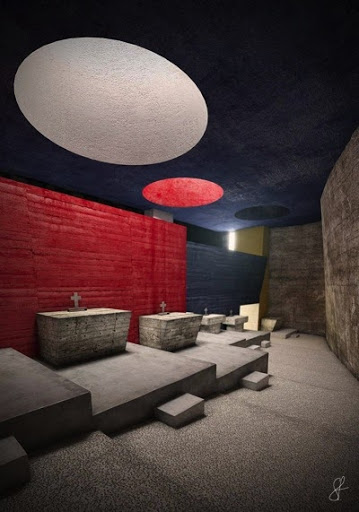
La tourette

In response to these criticisms, it is worth noting two aspects to Le Corbusier, the first of which is his directness and honesty about his beliefs:

“I am not a churchgoer myself, but one thing I do know is that every man has the religious consciousness of belonging to a greater mankind, to a greater or lesser degree, but in the end he is part of it. Into my work I bring so much effusion and intense inner life that it becomes something almost religious. […] People were at first surprised to see me participating in a sacred art. I am not a pagan. Ronchamp is a response to a desire that one occasionally has to extend beyond oneself, and to seek contact with the unknown.”

To leave a reflection on Le Corbusier’s compatibility with Christianity there would be unfair though and could leave a sense of vagueness and hand-waving. Instead, let me conclude by sharing with you the following passage from his book, “When Cathedrals Were White”:

“But those of us who live intensely in the present moment of modem times,[…] have extended our sympathy to all the world and to all times. We have rediscovered life and the axis of all human marvels and agonies. We are far from the theatrical stage which tries to place events of qualitative interest above and outside of human labors. We plunge into daily realities, are face to face with consciousness itself. […] Life bursts forth everywhere, outside the studios where art is “made,” outside of the small circles where it is talked about, outside of the writings in which the spirit of quality is isolated, localized, and disintegrated. […] Every day, every hour, the Earth sees splendors surging up which are truths and present-day beauty. Ephemeral perhaps! Tomorrow, new truths and new beauties bloom. The day after tomorrow, etc. … Thus life is replenished, full. Life is beautiful! We do not have-do we?-any intention or claim to fix the destiny of the eternal things of the future? Everything, at every hour, is only the work of the present moment. The present moment is creative, creating with an unheard-of intensity.”

If that is not Christian thought (albeit thought by a non-Christian), then I don’t know what is, and to support my claim I only need to look as far as Jesus’ own words:

“Therefore I tell you, do not worry about your life, what you will eat [or drink], or about your body, what you will wear. […] Look at the birds in the sky; they do not sow or reap, they gather nothing into barns, yet your heavenly Father feeds them. Are not you more important than they? Can any of you by worrying add a single moment to your life-span? Why are you anxious about clothes? Learn from the way the wild flowers grow. They do not work or spin. But I tell you that not even Solomon in all his splendor was clothed like one of them. If God so clothes the grass of the field, which grows today and is thrown into the oven tomorrow, will he not much more provide for you, O you of little faith? So do not worry and say, ‘What are we to eat?’ or ‘What are we to drink?’ or ‘What are we to wear?’ […] But seek first the kingdom (of God) and his righteousness, and all these things will be given you besides. Do not worry about tomorrow; tomorrow will take care of itself.” (Matthew 6:25-34)


1 The only point I’ll allow myself to make on account of refuting the ludicrous idea that church architecture has had a golden age in some past centuries is to quote from a great post on the Idle Speculations blog, which presents the killer argument that “[i]n Roman times, the early Roman basilicas were of course based on the public buildings of ancient Rome.” The tradition of church architecture is to be contemporary and not a saccharine pastiche of past forms, like the examples touted as successful by blogs like the one that triggered the present post.
2 A great source on Le Corbusier has for me been the excellent “Le Corbusier in Detail” by Flora Samuel, where this quote too can be found.
3 I am becoming quite a fan of the Dominicans, given also their links with Camus, mentioned here before.
4 “[T]he Church of the council declares to you through our voice: if you are friends of genuine art, you are our friends.” (Council Closing Messages December 8, 1965 By Pope Paul To Council Fathers)
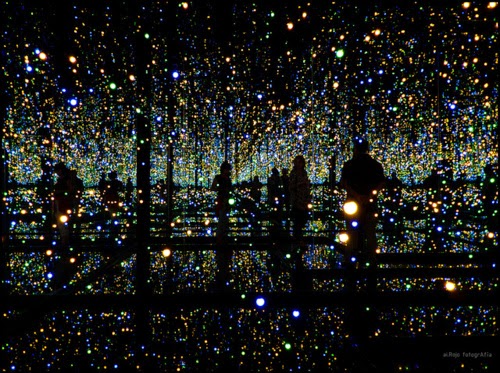
Skin and heart, not antiques or novelties

Past present future 3 john kennard

Where does Pope Francis stand on the perennial question of reform versus continuity, progress versus tradition? His sermon during yesterday morning’s Chrism mass made it very clear – like Benedict XVI, who referred to it as “reform in continuity,” Francis too rejects a focus on tradition alone (calling it “antiques”) as well as on progress alone (“novelties”) and instead calls us to “put [our] own skin and [our] own heart on the line” and to live in the midst of our communities, sharing the life of our neighbors. Another way of reading the popes’ position is to cast it in terms of past, present and future, with a firm focus on living in the present moment instead of a nostalgia for a past Golden Age or a putting off of life until a bright future dawns.

While it contains a clear position on where Francis’ priorities lie, yesterday morning’s sermon – which I recommend highly in full – will, in my opinion, go down as the founding moment of a renewal of the priesthood, with the following being its key moments:

“[T]he anointing that [priests] receive is meant in turn to anoint God’s faithful people, whose servants they are; they are anointed for the poor, for prisoners, for the oppressed.[…]

A good priest can be recognized by the way his people are anointed. This is a clear test. When our people are anointed with the oil of gladness, it is obvious: for example, when they leave Mass looking as if they have heard good news. Our people like to hear the Gospel preached with “unction”, they like it when the Gospel we preach touches their daily lives, when it runs down like the oil of Aaron to the edges of reality, when it brings light to moments of extreme darkness, to the “outskirts” where people of faith are most exposed to the onslaught of those who want to tear down their faith. […]

We need to “go out”, then, in order to experience our own anointing, its power and its redemptive efficacy: to the “outskirts” where there is suffering, bloodshed, blindness that longs for sight, and prisoners in thrall to many evil masters. It is not in soul-searching or constant introspection that we encounter the Lord[…]

Those who do not go out of themselves, instead of being mediators, gradually become intermediaries, managers. We know the difference: the intermediary, the manager, “has already received his reward”, and since he doesn’t put his own skin and his own heart on the line, he never hears a warm, heartfelt word of thanks. This is precisely the reason why some priests grow dissatisfied, become sad priests, lose heart and become in some sense collectors of antiques or novelties – instead of being shepherds living with “the smell of the sheep”, shepherds in the midst of their flock, fishers of men. […]

It is not a bad thing that reality itself forces us to “put out into the deep”, where what we are by grace is clearly seen as pure grace, out into the deep of the contemporary world, where the only thing that counts is “unction” – not function – and the nets which overflow with fish are those cast solely in the name of the One in whom we have put our trust: Jesus.”

Wow! What a wake up call! And before you think: “Yeah! Them priests better get their act together,” let me just remind you (as I remind myself) that we all share in Jesus’ royal priesthood! When I heard Pope Francis say these words, I felt that he was addressing me. Do I share in the life of those around me? Do I live in their midst or am I withdrawn into introspection? These are undoubtedly great challenges, but ones that, I believe, will help all of us Christians to be more faithful followers of Jesus.

As is his trademark, Pope Francis proceeded to put his model of the priesthood into practice straight-away, by celebrating the Maundy Thursday mass in a juvenile detention center. Not only that, but he chose – against present liturgical law!1 – to wash the feet not of 12 men (which in the case of the popes’ Maundy Thursday masses have been priests), but of a group of youths, among whom were women as well as men and Muslims as well as Christians. This a shepherd in the midst of his flock, a fisherman putting “out into the deep”!

Not only his actions, but his words too, during the sermon of the same Maundy Thursday mass, illustrate his closeness and adaptation to the specific people he is with. The message he shares is universal, accessible to all and obviously comes from his heart:

“Help one another. This is what Jesus teaches us. This is what I do. And I do it with my heart. I do this with my heart because it is my duty, as a priest and bishop I must be at your service. But it is a duty that comes from my heart and a duty I love. I love doing it because this is what the Lord has taught me. But you too must help us and help each other, always. And thus in helping each other we will do good for each other.

Now we will perform the ceremony of the Washing of the Feet and we must each one of us think, Am I really willing to help others? Just think of that. Think that this sign is Christ’s caress, because Jesus came just for this, to serve us, to help us.”

This universality and at the same time specificity of his approach also shines through in his inviting ten parish priests from around Rome for lunch earlier that same day. One of the guests – the parish priest of the San Giacomo church in central Rome – reports:

“At first there was a bit of awkwardness – he is the pope after all – but he put everyone at ease. […] He didn’t want us to kiss his hand – instead he kissed each one of us. We asked him whether we could tell our parishioners that we had lunch with him and Francis told us to greet and bless them in his name. […] He also had a word of advice for each one of us. Since my parish is an inner city one, he invited me to keep my church open, as he already said during Wednesday’s general audience: “how sad to see closed churches!”. He told me that if the door is open, when someone passes by, they may enter and if they they also find a priest who is ready to hear their confession, it becomes an occasion for meeting Jesus and the Church.”


1 Although, personally and individually being the Catholic Church’s supreme and ultimate legislator, this is a moot point.