Sun and moon and stars


Today is the feast day of the assumption of Mary into heaven. A unique honor reserved for Jesus’ mother who was not only conceived without original sin, lived a life without sin but was also lifted up into heaven at the end of her earthly journey.

To intuit the greatness of Mary and her key role in understanding both her son and the Trinity, the following is a fragment from one of the most recent mystical visions shedding light on her – that of Chiara Lubich in 1949:

“On that day I understood Mary, perhaps through an intellectual vision, as I had never seen her before. And now twelve years have passed since that day, but I still have the clear impression of the unexpected “greatness” that this discovery of the Mother of God in the Bosom of the Father made on me. As the blue of the sky contains sun and moon and stars, so Mary appeared to me, made by God so great as to contain God Himself in the Word.

I had never had such a notion of Mary, but there her divine [by participation] greatness was impressed upon my soul in such a way that I do not know how to say it again.

I can say only that no human reasoning would be able to render the idea.

That vision produced conviction.”
Victories of all kinds

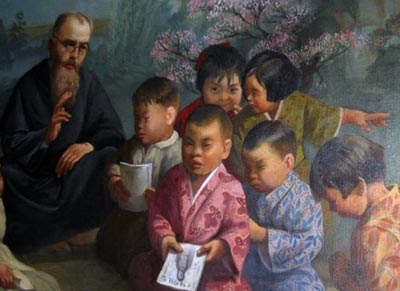
Fr. Maximilian

Today is the feast of one of the most heroic saints of modern times: St. Maximilian Kolbe, who gave his life for a fellow inmate at Auschwitz. When a prisoner escaped the camp, 10 inmates were to be executed as a reprisal. One of them was the young father of a family, who pleaded for mercy. In response Fr. Maximilian offered to take his place and the guards acquiesced. After a prolonged starvation during which he supported his fellows on death row and which made his guards’ patience run out, Fr. Maximilian was given a lethal injection, which killed him.

This much is generally known about him and it is indeed worthy of admiration and contemplation. Fr. Maximilian was also a person of great openness and learning, having spent many years in Japan, encountering Buddhism and Shintoism, and a person who stood up to the oppressive Nazi regime, having written articles and transmitted radio broadcasts calling for resistance, which ultimately got him sent to the death camp.

His act of heroism was not a momentary exception, but the fruit of a life dedicated to truth and love.

Here is what he has to say in his own words:

“No one in the world can change Truth. What we can do and and should do is to seek truth and to serve it when we have found it. The real conflict is the inner conflict. Beyond armies of occupation and the hetacombs of extermination camps, there are two irreconcilable enemies in the depth of every soul: good and evil, sin and love. And what use are the victories on the battlefield if we are ourselves are defeated in our innermost personal selves?”

Edith to Mary

Seint Edith Stein

Today is the 70th anniversary of the martyrdom of St. Edith Stein, one of the great saints of the 20th century and one of the patrons of Europe. Born a Jew, turned atheist, converted to Christianity, became a nun, was a great philosopher (student of Husserl, father of phenomenology) and champion of women’s rights, she finally gave her life for her faith, choosing to remain at Auschwitz with her fellow Jewish prisoners rather than using her baptism as a get out card. She is a towering example of a true disciple of Jesus.

The following is a poem she wrote to Mary on Good Friday 1938:

Today I stood with you beneath the cross
And felt more clearly than I ever did
That you became our Mother only there.

But those whom you have chosen for companions
To stand with you around the eternal throne,

They must stand with you beneath the Cross,
And with the lifeblood of their bitter pains,
Must purchase heavenly glory for those souls
Whom God’s own Son entrusted to their care.

Sunrise skirmish

Two men who wanted to see the sunrise would be foolish to argue about the place where it will appear and their means of looking at it, then to let their argument degenerate into a quarrel, from that to come to blows and in the heat of the conflict to gouge out each other’s eyes. There would no longer be any question then of contemplating the dawn …

Let us who wish to contemplate God purify our hearts by faith and heal them by means of peace; for the effort we make to love one another is already a gift from him to whom we raise our eyes.

Augustine of Hippo (354-430)
(quoted in Roots of Christian Mysticism)

Imbalance

As is a grain of sand weighed against a large amount of gold, so, in God, is the demand for equitable judgement weighed against his compassion. As a handful of sand in the boundless ocean, so are the sins of the flesh in comparison with God’s providence and mercy. As a copious spring could not be stopped up with a handful of dust, so the Creator’s compassion cannot be conquered by the wickedness of creatures.

Isaac of Niniveh (7th century)
(quoted in Roots of Christian Mysticism)

Who is a Christian?

What is

“Christ is the first-born of God, his Logos, in whom all people share. That is what we have learned and what we bear witness to … All who have lived in accordance with the Logos are Christians, even if they have been reckoned atheists, as amongst the Greeks Socrates, Heraclitus and the like.”

Justin (died 165) (quoted in Roots of Christian Mysticism)

Just to preempt a misinterpretation of the above, I don’t believe the idea is akin to the dubious posthumous baptisms practiced by some groups – instead it is an acknowledgement of the universality of Jesus’ message and a recognition by Justin (Christians) of its practicing and adherence to by others. It is not an imposed labeling of ‘good’ atheists as Christians against their will but an affirmation that being Jesus’ follower is about following his words (feeding the hungry, quenching their thirst, welcoming strangers, clothing the naked, caring for the sick, visiting prisoners, … (Matthew 25:31-46)). In many ways St. Justin’s statement is echoed in Pope Benedict’s point made during the homily at Freiburg airport last October:

“[A]gnostics, who are constantly exercised by the question of God, those who long for a pure heart but suffer on account of our[, the Church’s,] sin, are closer to the Kingdom of God than believers whose life of faith is “routine” and who regard the Church merely as an institution, without letting their hearts be touched by faith.”

Pope Benedict XVI

Freedom

He who created human beings in order to make them share in his own fullness so disposed their nature that it contains the principle of all that is good, and each of these dispositions draws them to desire the corresponding divine attribute. So God could not have deprived them of the best and most precious of his attributes: self-determination, freedom …

Gregory of Nyssa (330-395) quoted in Roots of Christian Mysticism