1515 words, 8 min read
Last Saturday, Cardinal Gianfranco Ravasi addressed a meeting entitled “Beauty will save the world, let us save beauty,” organized by Earth Day Italia, that took place in the Vatican’s church of St Stephen of the Abyssinians. In his talk, Cardinal Ravasi spoke about the etymology of the word for beauty in Hebrew, Greek and Italian, pointing to the fact that in all these languages the word either directly refers both to beauty and goodness, or at least has roots that do. After the Q&A that followed, Cardinal Ravasi then added a few words in defense of a certain kind of ugliness, lest beauty be misunderstood as aestheticizing. What follows is my translated transcript of the talk:
I would like to start from a thing that is the most material possible, the most limiting possible, which, however, is always fundamental for humanity: that is, the vocabulary, words. […] In the Bible, both the Old and New Testaments, using two completely different languages – Hebrew and Greek, and we are still at the point of vocabulary, words, which, on the other hand are the fundamental instruments of communication, we have a single word that contemporaneously expresses two realities that are different for us. In fact, in Hebrew there is the word ‘tov’ (טוֹב) that at the same time means good and beautiful. And in the New Testament, predominantly when a prominent figure or a significant act is to be described, the Greek word kalos (καλός) is used, which in the New Testament means good.
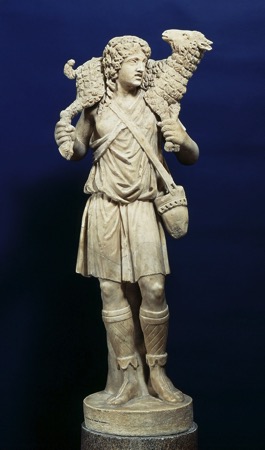
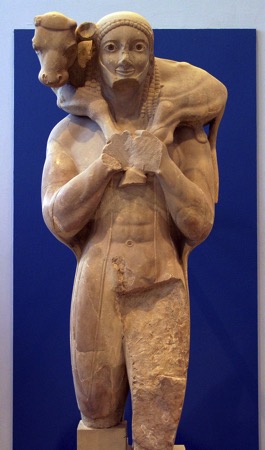
Let me give you an example that you all have in mind but about which you maybe do not have the idea of its original Greek basis. How does Jesus define himself in John’s Gospel? I am the good shepherd. I am sure you all have the famous statue of the good shepherd from the Vatican museums in mind, which is a Christian transcription of a Greek statue of the moscophoros. So, in Greek we have – listen! – “egō eimi ho poimēn ho kalos” (ἐγώ εἰμι ὁ ποιμὴν ὁ καλός.) “Ho kalos” – I am the beautiful shepherd, because these two realities must interweave among us.
With this background, let’s look at Italian. […] In Italian we have this word “bello”. Now, probably only few among you know […] that it has nothing to do with Latin. What does “bellum” mean in Latin? War. That has nothing to do with it. Think about the fact that the word “bello” is a deformation – or the synthesis, the portmanteau, if you will – of a late mediaeval Latin word which sounded like this: “bonicellus” which means good, pleasant, nice and which gradually became first bonellus and then bellum, but in Italian and not in Latin. So, you can see, that at the basis of the Italian word beautiful (“bello”) there is the word “good.”
Let’s now pass to another word, which is antipodean to the word beauty, which is “brutto” (ugly). In Italian there are two words that bud from it and these two other words have the same basis but are not synonymous with it, even if we may use them in an undifferentiated manner. We have the words “bruttezza” (ugliness) and the word “bruttura” (nastiness). The word “bruttezza” indicates an aesthetic quality while the word “bruttura” an ethical one. Imagine for a moment, without wishing to give offense since this applies to many other cities too, that we are going to a district at the peripheries of Rome. A dilapidated district, a district where there is exploitation and rampant overdevelopment, where blocks of flats are built on top of each other in all their ugliness (bruttezza). Such spaces also tend to become the sites of moral degeneration and of social degeneration. And so we arrive at the dimension of nastiness (bruttura).
This is why I am saying that the aesthetic question is also relevant to the ethical and social question. Imagine a kid, one of our kids, who comes out of one of these quarters, where he always sees a gray and rundown block of flats, a flowerbed – if there is one – that is always scruffy, streets that are littered with garbage … and he comes to the center and sees the splendor of architecture, of monuments, … What does he do? He slashes them. They mean nothing to him. Because, with the ethical dimension he has also lost the aesthetic one.
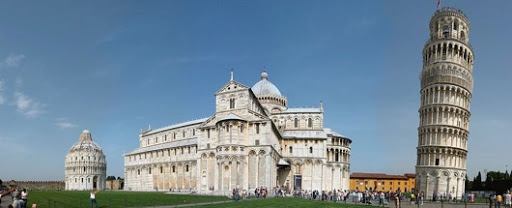
Instead, let’s imagine a kid in the 14th century, who’d leave his house in Siena, would enter the Square of Miracles and walk around in that quarter. Evidently here aesthetics in some way influenced a lifestyle. Naturally, subject to the limits of the weakness and the wickedness also of the human creature.
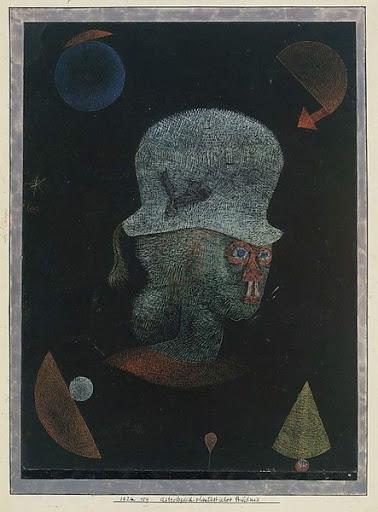
I conclude and would just like to remember [… a message from the bishops at the Second Vatican Council to artists that reflected on the despair caused by ugliness and nastiness] but in that same message there was also another consideration […] whose basis was that art and faith – both authentic: authentic art and authentic faith – are sisters. Why? And I’d like to answer that with the words of a great painter, Paul Klee, who wrote a very important definition of art: “Art does not represent the visible, but the invisible that is in the visible.” Transcendence. And what is it that religion does if not the same job? […] And finally I would like to quote a writer who is far from Christianity and who is also immoral in the eyes of Christianity: Henry Miller, who wrote Tropic of Cancer, Tropic of Capricorn. In a short essay, The Wisdom of the Heart, […] he wrote the following phrase: “Art, like faith, is good for nothing, other than to show the meaning of life.” And that is not little.
[… at the end of the Q&A that followed, Cardinal Ravasi added:]
I would like to conclude by speaking about ugliness. Let’s say straightaway that squalor is squalor and there is ugliness that is ugly. And we need the courage to say it. We have to say that we are being assaulted by ugliness and nastiness. But, having said this, I would now like to present an defense of ugliness, but of a particular ugliness. For many, and that is why I don’t like this expression that “beauty will save the world” so much, it has become a generally aestheticizing phrase.
We can see, and these are often the victims, with women that feminine beauty has become thought of exclusively as the fruit of an artificial operation applied to a person. To the point of having created an entire medical discipline whose criteria are aestheticizing ones, at times in the form of an external lucidity that, however, isn’t a profound transparency. I remember a beautiful poem by John Donne, this great 17th century English poet, which should be read in English. What does he do? He dedicates beautiful verses to the face of his wife, which by then is marked by a web of wrinkles. To this he says – and I agree fully, “I haven’t seen a season as beautiful as autumn.”1 Imagine what Roman autumn is like. It is infinitely more beautiful than summer.
This is why I said that I would like to present a sort of defense of ugliness. […] Beauty is not smoothness. It is not a dictation formed by beautiful words searched for in a dictionary, as Sunday poets often do. It is, instead, the capacity to capture the transcendent, to capture that which is not seen, but that which is the soul of reality. So, when you go and see an exhibition […] of Caravaggio, you can’t come out from it indignant because Caravaggio also touches evil.
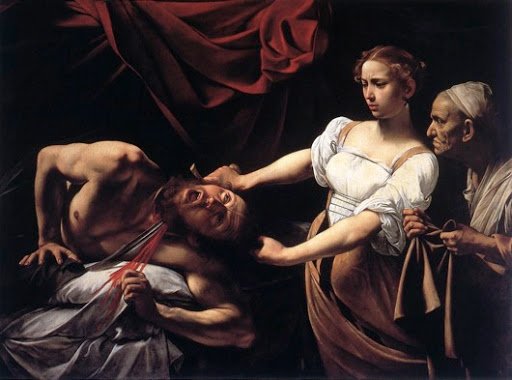
Without reflecting on evil, and evil is ugly, we wouldn’t have 60-70% of literature. It would not exist. We’d have to get rid of virtually all of Dostoyevsky. This is why I say that it is important to remember that the beautiful is also the groundwork, the pilgrimage, the entrance to the substratum, the underground (to use Dostoyevsky), the entering into a nest of vipers (to quote Mauriac) that represent humanity. When Rilke, who is one of the great poets that I love alongside Eliot, writes the Duino Elegies, how does he define beauty? He defines it as “the beginning of terror.” This is an impressive theophany that torments. Not being a writer or a poet I’ll give my voice to Virginia Woolf, when she too defines beauty saying: “Beauty has two faces, one of joy, one of anguish, both cutting, wounding the heart.” That is, beauty offends, disturbs, disconcerts, also. Let’s think of the Divine Comedy. The best part, they say paradoxically, is the Inferno. And this is precisely because the song wants to enter … and it is also right that we be able to see in something ugly, that may represent humanity’s breath of pain, that we try to look even there for what is truly beautiful that, in the end, however, redeems even evil. It is transfiguration. It is liberation.
1 I guess Cardinal Ravasi is referring to Elegy IX: The Autumnal.
 eyebeleave