Cardinal Burke’s confusion

Burke purple

2094 words, 11 min read

In what is fast becoming a series1, this post will pick up on just one of the 40 “truths” presented by Cardinal Raymond Leo Burke in his “Declaration of the truths relating to some of the most common errors in the life of the Church of our time” – a document he claims is being published in a “spirit of fraternal charity” and one that I wholeheartedly recommend not to read.

Just like with a punnet of strawberries, there are obvious places to look at here too, when trying to decide whether or not to buy it. An easy way to start is to review “truth” #28 on capital punishment, which reads as follows:

“In accordance with Holy Scripture and the constant tradition of the ordinary and universal Magisterium, the Church did not err in teaching that the civil power may lawfully exercise capital punishment on malefactors where this is truly necessary to preserve the existence or just order of societies (see Gen 9:6; John 19:11; Rom 13:1-7; Innocent III, Professio fidei Waldensibus praescripta; Roman Catechism of the Council of Trent, p. III, 5, n. 4; Pius XII, Address to Catholic jurists on December 5, 1954).”

This is a direct challenge to the recent change to the Catechism of the Catholic Church, effected by Pope Francis (who has “supreme, full, immediate, and universal ordinary power in the Church” (cf. Cann. 331-334)), which now states the following regarding the death penalty:

“Recourse to the death penalty on the part of legitimate authority, following a fair trial, was long considered an appropriate response to the gravity of certain crimes and an acceptable, albeit extreme, means of safeguarding the common good.

Today, however, there is an increasing awareness that the dignity of the person is not lost even after the commission of very serious crimes. In addition, a new understanding has emerged of the significance of penal sanctions imposed by the state. Lastly, more effective systems of detention have been developed, which ensure the due protection of citizens but, at the same time, do not definitively deprive the guilty of the possibility of redemption.

Consequently, the church teaches, in the light of the Gospel, that “the death penalty is inadmissible because it is an attack on the inviolability and dignity of the person”, and she works with determination for its abolition worldwide.”

Against this background, let us look at three aspects of Burke’s claim: first whether the Church erred, second, whether its tradition (on the basis of the references in this “truth”) has been constant and – most seriously – whether the lawfulness of capital punishment is in accordance with Holy Scripture.

First, the Catholic Church today does teach that the death penalty is always inadmissible as is set out by its supreme legislator (Pope Francis) and promulgated in its Catechism. Applying the Church’s past teaching to today – as Cardinal Burke does – is therefore an act of erring and in direct conflict with the Church’s Magisterium.2

Second, let’s take a closer look at the references to the “constant tradition of the ordinary and universal Magisterium” provided by Burke. The first of these is a passage from the 1566 Catechism of the Council of Trent, which reads as follows:

Execution Of Criminals

Another kind of lawful slaying belongs to the civil authorities, to whom is entrusted power of life and death, by the legal and judicious exercise of which they punish the guilty and protect the innocent. The just use of this power, far from involving the crime of murder, is an act of paramount obedience to this Commandment which prohibits murder. The end of the Commandment- is the preservation and security of human life. Now the punishments inflicted by the civil authority, which is the legitimate avenger of crime, naturally tend to this end, since they give security to life by repressing outrage and violence. Hence these words of David: In the morning I put to death all the wicked of the land, that I might cut off all the workers of iniquity from the city of the Lord.”

This is pretty clear: to preserve and secure human life, civil authority has the right to put criminals to death as a protective and punitive measure.

Let’s now look at the second of the two references for the constancy of tradition, a talk Pope Pius XII addressed to Italian lawyers in 1954, and at the only paragraph in that text that talks about the death penalty:

“The human judge, on the other hand, since he does not possess the omnipresence and omniscience of God, has the duty of forming for himself, before issuing the judicial sentence, a moral certainty, that is, one which excludes every reasonable and serious doubt about the external fact and the internal guilt. But he does not have immediate insight into the interior dispositions of the accused at the very moment of the crime; rather, in most cases the judge is not in a position to reconstruct them with absolute clarity from the arguments offered as proof, nor, often enough, from the very confession of the delinquent. But this difficulty should not be exaggerated, as though it were ordinarily impossible for a human judge to attain sufficient certainty, and therefore a solid foundation for a sentence. According to the cases, the judge will not fail to consult renowned specialists on the capacity and responsibility of the presumed criminal, and to take into consideration the findings of the modern sciences of psychology, psychiatry and characterology. If, despite all these precautions, there still remains a grave and serious doubt, no conscientious judge will proceed to pronounce a sentence of condemnation, all the more so when there is question of an irrevocable punishment, such as the death penalty.”

Hm … this is somewhat different from the first reference. Yes, the death penalty is not deemed inadmissible. However, it is presented as a case where the general challenges of ascertaining guilt and culpability, that are essential limitations of human judges as compared with God, the ultimate Judge, impose a heightened degree of caution and a heightened burden of proof on the jurist. Incidentally the whole text is set in the context of reforms being considered to the penal code and speaks about the relationship between crime and punishment, which it examines from psychological, juridical, moral and religious angles. Far from being a simple affirmation of the rights of the state, as set out by the Tridentine Catechism, Pius XII’s reflection is a careful, cautious one, calling for checks and balances commensurate with the irrevocability of capital punishment.

Moving beyond the two references provided to substantiate “constancy of tradition”, it is worth noting that the first mention of the death penalty in any conciliar document of the western Church comes on 6th July 1415, during the 16th session of the Council of Constance (none of the 15 councils that pre-date it, starting with the Council of Nicea in 325 AD, even mention the topic):

“Doctors who state that anybody subjected to ecclesiastical censure, if he refuses to be corrected, should be handed over to the judgment of the secular authority, are undoubtedly following in this the chief priests, the scribes and the pharisees who handed over to the secular authority Christ himself, since he was unwilling to obey them in all things, saying, It is not lawful for us to put any man to death; these gave him to the civil judge, so that such men are even greater murderers than Pilate.”

Again, this does not sound very “constant” (pun intended) with the Tridentine text. Church authorities handing transgressors over to secular authority are “greater murderers than Pilate”? But, isn’t the state perfectly within its rights to mete out the death penalty, as the Tridentine text suggests?

Let’s also bracket Burke’s references from the other end, with the wording of the Catechism as approved by St. John Paul II, where its §2267 sets out the Church’s position in 1992 (now replaced by Francis’ text quoted above):

“Assuming that the guilty party’s identity and responsibility have been fully determined, the traditional teaching of the Church does not exclude recourse to the death penalty, if this is the only possible way of effectively defending human lives against the unjust aggressor.

If, however, non-lethal means are sufficient to defend and protect people’s safety from the aggressor, authority will limit itself to such means, as these are more in keeping with the concrete conditions of the common good and more in conformity to the dignity of the human person.

Today, in fact, as a consequence of the possibilities which the state has for effectively preventing crime, by rendering one who has committed an offense incapable of doing harm – without definitely taking away from him the possibility of redeeming himself – the cases in which the execution of the offender is an absolute necessity “are very rare, if not practically nonexistent.””

Note again the tone of how the topic is dealt with, which is in continuity with Pius XII’s approach and takes it further still. Unlike the Tridentine text, capital punishment is a last resort and one whose likelihood of being legitimate is close to nil, if not nil.

Third, let’s turn to Burke’s claim that capital punishment is in accordance with Holy Scripture, and in particular with the two New Testament references. The first points to John 19:11, which goes: “Jesus answered [him], “You would have no power over me if it had not been given to you from above. For this reason the one who handed me over to you has the greater sin.”” Here the “him” is Pilate and reading the passage as condoning capital punishment is a rather lazy application of how this passage has been interpreted during the history of the Church (although not an uncommon one). While St. Augustine takes the reference to “from above” here as being “from God”, as in “all power comes from God”, to go from there to taking all application of power to be good is some stretch and one that both St. Augustine himself and later St. Thomas Aquinas refutes very clearly in his commentary on John’s Gospel:

“So, first Christ teaches Pilate about the source of his power; secondly, about the greatness of his sin.

In regard to the first he says, You would have no power over me unless it had been given you from above. He is saying in effect: If you seem to have some power, you do not have this from yourself, but it has been given to you from above, from God, from whom all power comes: “By me kings reign” (Prv 8:15). He says no power, that is, no matter how little, because Pilate did have a limited power under a greater one, the power of Caesar: “For I am a man under authority” (Mt 8:9).

Therefore, he concludes, he who delivered me to you, that is, Judas or the chief priests, has the greater sin. He says greater, to indicate that both those who delivered him up to Pilate and Pilate himself were guilty of sin.” (§2394-2396)

Far from suggesting that Pilate’s application of the death penalty to Jesus is a “good thing”, St. Thomas recognises it as a sin – as sin committed while exercising God-given power. Just by giving you a knife (that can be used for a lot of good), I am not condoning let alone approving everything you do with it.

The second reference, to Romans 13:1-7 again seems to be taken by Burke to follow the same pattern of equating the divine source of power with the goodness of its application. And it is St. Thomas Aquinas who succinctly debunks this misinterpretation of Scripture too:

“The order of authority derives from God, as the Apostle says [in Romans 13:1-7]. For this reason, the duty of obedience is, for the Christian, a consequence of this derivation of authority from God, and ceases when that ceases. But, as we have already said, authority may fail to derive from God for two reasons: either because of the way in which authority has been obtained, or in consequence of the use which is made of it.”

I’ll leave the analysis of the other 39 “truths” to the reader who chooses to ignore my advice …


1 For the previous one, on Cardinal Müller, see here.
2 I know that I am side-stepping the literal claim of “truth” #28 which is about whether the Church did or did not err in the past. This is a different question from whether its past teaching is true today.
Synod14: No distinction between us and them

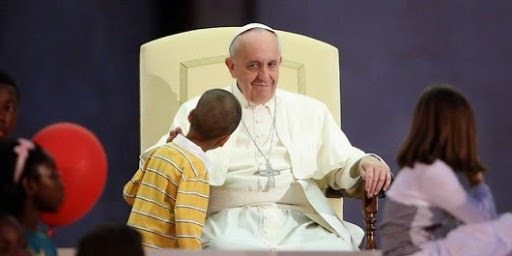
Pope francis boy

“After much debate had taken place, …” is not a quote from an article about the Synod, but about the Council of Jerusalem, from the Acts of the Apostles (15:7), where there was ample discord among participants, some favoring tradition – extending Jewish circumcision to all Christians – and others feeling compelled to change in response to a prompting from the Holy Spirit, put into words by St. Peter, the pope in office then, who said (15:9-11):

“[God] made no distinction between us and them, for by faith he purified their hearts. Why, then, are you now putting God to the test by placing on the shoulders of the disciples a yoke that neither our ancestors nor we have been able to bear? On the contrary, we believe that we are saved through the grace of the Lord Jesus, in the same way as they.”

I don’t know about you, but this very much reminds me of Pope Francis’ homilies from the last two days …

Reading the reports about the Synod since the “relatio post disceptationem” has been released could give one the sense that it has been a mistake, that it is leading to a schism, that what it says will be retracted and that there is huge opposition to its content in general. Not being at the Synod myself (obviously!), it is hard to get a sense of the temperature on the ground. While there is no shortage of positive, optimistic voices coming from there, e.g., Cardinal Lluís Martínez Sistach of Barcelona tweeting this morning that “The atmosphere at the Synod is one of communion and of being pastoral. The Church wants to become closer to and be with all the families of the world,” the vast majority of media outlets report mayhem (which, lets be honest, sells better than harmony :).

Without wanting to give too much oxygen to negativity, I would just like to point to a lack of subtlety in reporting the words of the Synod Fathers. E.g., taking Cardinal Raymond Burke’s words that the relatio “advances positions which many synod fathers do not accept and, I would say, as faithful shepherds of the flock cannot accept,” and presenting them as disagreement with the relatio is accurate. However, the same conclusion can’t be drawn from what Cardinal Wilfrid Napier saying:

“The message has gone out: This is what the synod is saying, this is what the Catholic church is saying. And it’s not what we’re saying at all. No matter how we try correcting that … there’s no way of retrieving it. The message has gone out and it’s not a true message. Whatever we say hereafter is going to be as if we’re doing some damage control.”

This is universally interpreted as “Cardinal Napier says, message of “relatio” is not true.” Hold on. Read it again. What does he actually say? What does he say the message is? He even spells it out: “The message has gone out: This is what the synod is saying, this is what the Catholic church is saying.” The message is that the content of the relatio expresses the consensus of the Synod and presents the teaching of the Church. That, as Cardinal Napier rightly says, is untrue. The “relatio” is a working document (as it states itself) put together by a committee as input to the discussions and adjustments that it is receiving as we speak, during this week’s work in smaller groups. It couldn’t possibly be an expression of the Synod’s consensus, since the Synod Fathers first saw it the morning it was publicly read out and streamed across the internet. I can very well see how this would be irritating to those at the Synod, regardless of what they think about the content.

With that out of the way, let me point you to a couple of interviews that have come out over the course of the last day and that I consider to have great beauty.

First, the following interview with a Rwandan couple – Jean Dieudonné and Emerthe Gatsinga, who are members of the Focolare Movement, who are at the Synod as “auditors,” and with whom I am in complete agreement, has been published on the Vatican Television YouTube channel:

“Jean: “Families need the help of the Church to deepen their faith. Because, with faith in Jesus one receives, one earns the strength to overcome various situations. When there is faith, when one has chosen to place Jesus at the first place in one’s life, everything is possible. Life is not always easy, but in Jesus we take strength for overcoming many difficulties.”

Eremite: “With faith, the husband gives dignity to the wife. This helps the development of the family, because they try to build it together, relying on love. Like that, the family can be promoted in a spirit of reciprocal love and also of mutual help.””

A brief interview with Archbishop Vincenzo Paglia, President of the Pontifical Council for the Family, again underlines what this Synod is about, with a constant thread of closeness to and love for all running through his words: 1

“There is a need for attentive listening and accompanying, because there are also wounded families. It is not like there is the category of the divorced and remarried, there are stories, at times even dramatic ones. The theme with highest priority is that of closeness to all of them, with no one excluded. Then, within this new horizon, there is also the question of access to the sacraments. And here I have to say that, once the indissolubility of marriage is confirmed, which is that the true marriage is the one that took place and the rest is not a marriage union, then there is a range of possibilities. Certainly there are still some clean-cut cases, but it seems to me that there should be openness to evaluate individual cases by bishops so that a closer, more direct solution may be found. […]

[Homosexuals] are our brothers or sisters. To be loved as children of God to the end, to be embraced, accompanied, sustained, to be close to. Another question is that of marriage. Because marriage, since the world has been the world, is between man and woman. […] Then … affection … well we can be attracted by anyone. What’s more, I wish for all of us that we would all love each other, so we aren’t like frigid sticks that don’t encounter each other! The challenge is how to be close to those who are maybe in difficulty, and here I believe that it is all of us, believers, who need to take the first step. Whoever is in difficulty is to be embraced and helped. […]

There is a greater understanding that to participate in the Eucharist also means to be in communion – not only by listening to the Word of God – Bread descended from Heaven – but also by being in communion with the body and blood of the Lord. In this sense, doctrine grows, expands, like each one of us. I, when I was ten years old, was very different from how I am now. I had hair and today I don’t anymore. But I am always Vincenzo! I am always me. And this is also how it is with Christianity. We mustn’t be rigid men made of marble, constrict ourselves, one the other hand we can’t stretch our necks to infinity either. I believe that the Gospel here is important. If we are faithful to the Gospel, we avoid all risks of turning Christianity into an ideology. The Gospel is the same, but the Spirit helps us to understand it in a way that fits the time in which we live. Today we are at the beginning of the 21st century. Many things have changed. We must be able to – and this is why the Spirit of the Lord is important – to speak the Gospel that has always been, in a way that the men and women of today may understand and put into practice.”

Cardinal Christoph Schönborn of Vienna gave an interview yesterday, in which he shared his experience of a gay couple with great humility: “In Vienna, I got to know two men of homosexual orientation who have been living together for some time in a civil partnership. And I have seen how they have been helping each other when one of them fell seriously ill. It was wonderful, both in human and Christian terms, how one has cared for the other, staying by his side. These are things that need to be recognized. Jesus said: tax collectors and prostitutes will precede you into the Kingdom of God.2 And he says this to us, us cardinals, bishops, priests. Many times, even if we do not approve of this form of sexuality, we can bow down in front of exemplary human behavior.” Schönborn, himself a son of divorced parents, then also spoke about the importance of putting children first when families fall apart, and gave a first-hand account:

“Those who get divorced and have children must never forget that they remain parents. They mustn’t allow for the weight of their failure to fall on the shoulders of their children. There is so much suffering today … I was thirteen years old [when my parents divorced]. It’s strange, but what stays with you is the dream that your parents get back together, until the end of their lives. It’s an instinctive thing, not rational. It is the heart. I know a lot of children in my situation. The dream remains for Mum and Dad to get back together.”

Another interview, very much worth reading in full, that has been published yesterday is with Bishop Anthony Borwah from Liberia, who was invited to participate at the Synod, but who has remained at home due to borders closing as a result of the outbreak of Ebola. At the beginning of the interview he says: “As Bishop of my people I carry within my heart their wounds and pains every moment of life here.” And this attitude also shines through the passage I would like to quote next, where he speaks about one of the sufferings of his people. His words struck me to be extremely Jesus-like:

“Generally the economy of the nation is in the pocket of few men, hence there is a lot of women prostitution. I often say that these prostitutes are prophets and friends of Jesus as they signify the inequality, marginalization and injustice meted out against the poor and nobodies of our society, especially women. Women are generally subject to men culturally, and are often subjected to brutal domestic violence and impoverishment. The government of President Ellen Johnson Sirleaf has done a lot to raise the dignity of womanhood in beloved Liberia, but the walk is still too long.”

Finally, to round out the above thoughts on the family, I would like to share a quote from the writings of the Servant of God Igino Giordani, who speaks about how he, a married man and father of four children, understood God’s plan for the family:

“The family is not closed in on itself, as if in a fortress, but it grows like a cell that lives for itself when it lives with its brothers. It communicates in some way with the whole of humanity, which has the potential to be the Church, which is the family of God the Father. As it participates in the ideals and hopes, joys and sorrows of the largest family, there is no danger of boredom and loneliness, and not even of being abandoned, for its individual members. From this communion, which carries with it the duties of apostolate, of charity and justice, towards society, it can be understood how great the scope of the social and spiritual responsibilities of marriage is.”


1 Like a lot of the text here, this too is my own, choppy translation, which seems even choppier to me in this case, since listening to Archbishop Paglia’s Italian has been a bit like drinking from a fire hose for me. Apologies for any gross misinterpretations.
2 cf. Matthew 21:31.

Synod14: We aren’t the bosses of God’s mercy

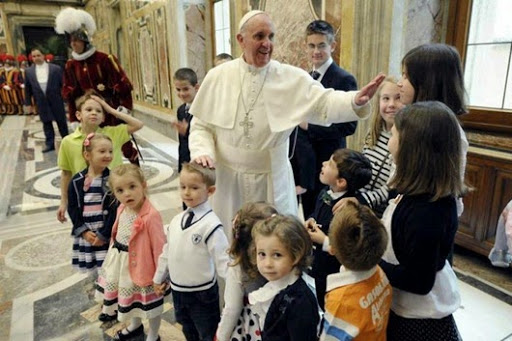
Francis kids

Since the close of yesterday’s sessions of the Extraordinary Synod on the Family, several interviews with or full texts of interventions by some Synod Fathers have been published.

The first of these I’d like to share is by Cardinal Godfried Danneels, the archbishop emeritus of Brussels, who’s contribution to the Synod was a plea for greater care for the divorced and remarried:

“God is just and merciful. He can’t contradict himself. He can separate good and evil in a great straddle. We, we have difficulty because we are only poor ballet dancers for a moment in the whole of history. […]

In the first place we are invited to greatly respect our brothers and sisters, the divorced and remarried. Mercy starts where we have unconditional respect for all who want to live within the Church but can’t marry again for the Church and receive Communion. […]

It is so important to speak with them, to let them speak about the beauty of marriage and the Christian family. Beauty is so powerful! This is obviously not esthetic beauty, but beauty who is the sister of truth and goodness. According to Aristotle “beauty is truth in all its glory”. Pulchrum est splendor veri.

Among our contemporaries there is much scepticism about the truth; even goodness can discourage, but beauty disarms. Beauty heals. Archimedes said about our world today, “Give me a place to stand and I will lift the world.”

The divorced and remarried are not the only suffering children, but there are far more than we think. My appeal – in all simplicity – is: to love God’s children. Their pain and suffering is often great. They don’t immediately ask for the regulations of the Church to change. Their cry is rather one to the shepherds with their hearts in the right place, why carry the wounded lamb on their shoulders. Beauty disarms. We hold the cards: there is indeed nothing more beautiful than Christian marriage and a deeply faithful family. But we must communicate the truth to divorced and remarried people – delicately – with the words of Saint Francis in mind, which he spoke to the superiors of his small communities, “never let anyone leave you in sadness”.”

Archbishop Denis Hart, the President of the Australian Bishop’s Conference, commented on the need for a new language – a “language of love” – and underlined the Church’s concern for all who suffer:

“[The] Catechism of the Catholic Church [speaks] about people being ‘disordered’, things being ‘intrinsically evil’. You say that to a parent who has a gay son or daughter and they just cannot understand that this child whom they love and who they have nurtured – might have chosen a thing that they don’t approve of – but is to be totally rejected because of that. And I think we have to be faithful to our doctrine and our teaching and practice have to go hand in hand, but we can do so with mercy and love and help people to realize that whatever may be the challenges that our in their life, they are respected and loved by the Church. […]

There are people who are separated and divorced, there are people who are same-sex attracted, there are people who are really struggling in their marriage, and wondering how they will go. The bishops have been emphasizing that we are pastors. When our people suffer we feel for them, when our people are bereaved we cry with them, when our people are burdened with sickness we struggle with them, when people are uncertain about where they can go or are suffering terrible material poverty the Church has to be there with them. I think this is the genius of Pope Francis. The great thing that concerns us in this is Synod is our love for our people and our ability to walk with them.”

There are, however, also voices at the Synod, like that of Cardinal Raymond Burke – the current Cardinal Prefect of the Supreme Tribunal of the Apostolic Signatura (whom Pope Francis removed from the Congregation for Bishops last year), who are opposed to a renewal of pastoral practice, e.g., saying that “[i]f homosexual relations are intrinsically disordered, which indeed they are — reason teaches us that and also our faith — then, what would it mean to grandchildren to have present at a family gathering a family member who is living [in] a disordered relationship with another person?”

There is also an important presence of members of other churches, religions and those who hold no religious beliefs at the Synod, who make important contributions. For example, the Anglican Rev. Paul Buttler, provided the following great synthesis of what the Synod is about:

“I think we actually need to reimagine family life again and help people grasp how important steadfastness, faithfulness to one another really is and offer much more support in times of difficulty. We have to be honest – the difficulties happen.”

Last night I also discovered a great blog by the Archbishop Droucher, president of the Canadian Conference of Catholic Bishops, where he recounts his experiences of the Synod, including a summary of his own intervention:

“What I especially wanted to say was that we should not only focus on what is negative in the world which is ours. True, there are many broken families, abandoned children, deeply wounded individuals. It is true that sexuality is often lived more as a leisure activity than as a true loving language of deep self-giving to another. It is also true that less and less couples are choosing marriage today. However, there are also positive realities in our world today. I named the commitment to equality between men and women in marriage, the refusal of all violence to children and women, the growing role of fathers in the affective life of their children, the place given to communication, mutual respect and healthy relationships. All of this is good and should be recognized and celebrated by Church leaders, creating openings for dialogue with society where the Church can proclaim its humanizing teaching on family, marriage and sexuality.”

I also liked Archbishop Droucher’s immediacy in his blog, where the follows his intervention’s summary by saying “And thus did I finish my four minutes of great nervousness (my hands were shaking) and adrenaline rush.” 🙂

Yesterday afternoon’s (8th) session was then focused on Christian education, where the French couple, Olivier and Xristilla Roussy, shared in their opening testimony that:

“Our mission as parents is above all to awaken our children to holiness. Like all of us, they too face the many temptations of the world and, with humility, we try to make them grow in freedom and generosity, to teach them the senses of discernment, decision making and perseverance. We help them develop their life project under the gaze of God. In spite of the difficult pace of modern life, we seek to be attentive to each one of them and give them plenty of time, both all together and individually.”

The notes provided about the following discussion started with:

“an invitation to the faithful to deepen their knowledge of Paul VI’s encyclical, Humanae Vitae, thus better understanding the meaning of the use of natural methods of fertility control and the non-acceptance of contraception. Union and procreation, it was said, are not separate from the conjugal act.”

The importance of appropriate marriage preparation was revisited, and – I believe, importantly – linked to the preparation for religious life:

“as its celebration seems to be increasingly reduced to the social and legal status, rather than a religious and spiritual bond. The preparatory course, it was noted, is often perceived by couples as an imposition, a task to complete without conviction, and as a result it is too brief. Since marriage is a vocation for life, preparation for it should be long and detailed, as in the case of preparation for religious life.”

The other side of the marriage preparation coin – that of the adequate preparation of priests to lead it – was addressed next:

“The Assembly went on to insist on the importance of good preparation for priests in relation to the pastoral care of marriage and the family, and remarked that homilies can be used as a special and effective moment for proclaiming the Gospel of the family to the faithful. It was commented that there is a need for formation and information, as the spiritual holiness of the priest, his creativity and his direct relationship with families are particularly appreciated by the faithful.”

This morning then saw experiences shared by couples and lay experts, who are not voting participants but “listeners” instead. Here the notes point to themes that were very much the same as during the preceding days, with an added emphasis on the need for closer collaboration between the laity and the Church’s hierarchy, also in the context of the laity’s involvement in public and secular life. The challenge of caring for the growing number of people living in solitude (irrespective of their association with the Church) was also highlighted during the following press conference. Importantly, Fr. Lombardi, also mentioned Pope Pius X’s “revolutionary” changes to the reception of the Eucharist by children as opposed to only adults as was previous practice. It was emphasized that this is a different context to the questions facing the divorced and remarried, but that there is precedent to substantial changes. The difficult effects of divorce on children were also lamented, of “ping-pong children” who are oscillating between their parents (and their new partners) and lack stability.

Fr. Manuel Dorantes, reporting on the Spanish speaking Synod Fathers’ contributions (with aplomb, I might add), quoted one of them as saying:

“Above all we must kneel before the Holy Spirit and remember that we aren’t the bosses of God’s mercy. We must remember that the mission that Jesus entrusted to his apostles, and by extension to us as their successors, is to evangelize and to heal. And this means, spreading the Good News.”

Calls for a greater involvement of lay persons, and women in particular, in ecclesiastical tribunals were also reported. Fr. Dorantes then quoted another of the Synod Fathers calling for a greater focus on children: “Brothers, I am the son of divorced parents and I, as their son, experienced the stigma of divorce directed at my parents and directed at me.”

This afternoon the Synod is hearing from “fraternal delegates” – i.e., representatives of other churches and religions, about which there will be a press conference tomorrow and on Monday, Cardinal Erdő will present the report reflecting the week’s contributions.