Amoris Lætitia: has anything changed?

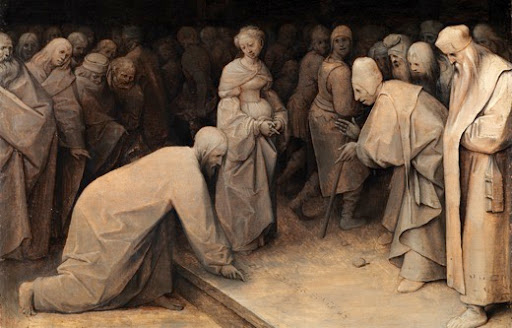
Brueghel jesus writing

1965 words, 10 min read

On the flight back from visiting refugees on the island of Lesbos (and bringing three Muslim families back with him to the Vatican!), Pope Francis was asked point blank: “[W]ith respect to the discipline that regulates access to the sacraments for the divorced and remarried, […] are there new, concrete possibilities that didn’t exist before the publication of the exhortation or not?” In other words, has anything actually changed, or is it “just” a rehashing of the previous status quo, albeit in nicer words.

To this, Francis responded with a clear: “I can say yes, many,” and then recommended a reading of Cardinal Christoph Schönborn’s presentation of Amoris Lætitia during the press conference on 8th April, when the exhortation was published. Pope Francis then added that Schönborn “is a great theologian. He was the secretary for the Congregation of the Doctrine of the Faith, and he knows the doctrine of the faith well. In that presentation, your question will find an answer.”

Before we take a look at what the cardinal said, let’s look at Pope Francis’ next answer from the same in-flight press conference, just to put the question about the divorced and re-married into context:

“One of the recent popes, speaking of the Council, said that there were two councils: the Second Vatican Council in the Basilica of St. Peter, and the other, the council of the media. When I convoked the first synod, the great concern of the majority of the media was communion for the divorced and remarried, and, since I am not a saint, this annoyed me a bit, and then made me sad. Because, thinking of those media who said, this, this and that, don’t they realize that that is not the important problem? Don’t they realize that instead the family throughout the world is in crisis? And the family is the basis of society. Do you not realize that young people don’t want to marry? Don’t you realize that the lack of jobs and employment opportunities mean that dad and mum take on two jobs, and children grow up alone and don’t learn to grow in dialogue with dad and mum? These are the big problems!”

Let’s turn to Cardinal Schönborn’s presentation of Amoris Lætitia (AL) now, to get a sense of what its impact on the divorced and re-married is.

First, Schönborn sets out the foundation of AL, which is universal inclusion:

“No-one must feel condemned, no-one is scorned. In this climate of welcome, the discourse on the Christian vision of marriage and the family becomes an invitation, an encouragement, to the joy of love in which we can believe and which excludes no-one, truly and sincerely no-one.”

Second, he highlights two modes of engagement that AL revolves around and emphasizes that they are directed towards all:

“In Evangelii Gaudium Pope Francis said that we must take of our shoes before the sacred ground of others (EG 36). This fundamental attitude runs throughout the Exhortation. And it is also provides the most profound reason for the other two key words, to discern and to accompany. These words apply not only to the so-called “irregular situation” (Pope Francis underlines this “so-called”) but rather for all people, for every marriage and for every family. Indeed, we are all journeying and we are all in need of “discernment” and “accompaniment”.”

Schönborn then acknowledges a potential misunderstanding of inclusion as “relativism,” “permissiveness,” “laxity” or “anything goes,” and juxtaposes it against an opposite, contrary danger of an “obsession with controlling and dominating everything.” As a means of navigating between these opposed dangers,

“Pope Francis often returns to the issue of trust in the conscience of the faithful: “We have been called to form consciences, not to replace them” (AL 37). The great question, obviously, is this: how do we form consciences? How do we arrive at what is the key concept of all this great document, the key to correctly understanding Pope Francis’ intentions: “personal discernment”, especially in difficult and complex situations? “Discernment” is a central concept in Ignatian exercises. Indeed, these must help to discern the will of God in the concrete situations of life. It is discernment that grants a person a mature character, and the Christian path should be of help in reaching this personal maturity: not forming automatons, externally conditioned and remote-controlled, but people who have matured in their friendship with Christ. Only when this personal “discernment” is mature is it also possible to arrive at “pastoral discernment”; which is important especially in “those situations that fall short of what the Lord demands of us” (AL 6).”

We now arrive at the point in AL (Chapter 8), where “the question of how the Church treats these wounds, of how she treats the failure of love” is addressed. The basis here is again a declaration of the desire to integrate, reinstate:

“With regard to those who are divorced and civilly remarried, [Pope Francis] states: “I am in agreement with the many Synod Fathers who observed that … the logic of integration is the key to their pastoral care. … Such persons need to feel not as excommunicated members of the Church, but instead as living members, able to live and grow in the Church and experience her as a mother who welcomes them always…” (AL 299).”

Schönborn then acknowledges the elephant in the room: “But what does this mean in practice? Many rightly ask this question,” and responds by saying that “The definitive answers are found in Amoris Lætitia, paragraph 300.” So, let’s take a look at it next in full:

“If we consider the immense variety of concrete situations such as those I have mentioned, it is understandable that neither the Synod nor this Exhortation could be expected to provide a new set of general rules, canonical in nature and applicable to all cases. What is possible is simply a renewed encouragement to undertake a responsible personal and pastoral discernment of particular cases, one which would recognize that, since “the degree of responsibility is not equal in all cases”, the consequences or effects of a rule need not necessarily always be the same. Priests have the duty to “accompany [the divorced and remarried] in helping them to understand their situation according to the teaching of the Church and the guidelines of the bishop. Useful in this process is an examination of conscience through moments of reflection and repentance. The divorced and remarried should ask themselves: how did they act towards their children when the conjugal union entered into crisis; whether or not they made attempts at reconciliation; what has become of the abandoned party; what consequences the new relationship has on the rest of the family and the community of the faithful; and what example is being set for young people who are preparing for marriage. A sincere reflection can strengthen trust in the mercy of God which is not denied anyone”. What we are speaking of is a process of accompaniment and discernment which “guides the faithful to an awareness of their situation before God. Conversation with the priest, in the internal forum, contributes to the formation of a correct judgment on what hinders the possibility of a fuller participation in the life of the Church and on what steps can foster it and make it grow. Given that gradualness is not in the law itself (cf. Familiaris Consortio, 34), this discernment can never prescind from the Gospel demands of truth and charity, as proposed by the Church. For this discernment to happen, the following conditions must necessarily be present: humility, discretion and love for the Church and her teaching, in a sincere search for God’s will and a desire to make a more perfect response to it”. These attitudes are essential for avoiding the grave danger of misunderstandings, such as the notion that any priest can quickly grant “exceptions”, or that some people can obtain sacramental privileges in exchange for favours. When a responsible and tactful person, who does not presume to put his or her own desires ahead of the common good of the Church, meets with a pastor capable of acknowledging the seriousness of the matter before him, there can be no risk that a specific discernment may lead people to think that the Church maintains a double standard.” (AL, §300)

Here, Schönborn singles out that those who expected a “new set of general rules” will be “disappointed” and that it is pastoral discernment instead that AL puts forward. This is covered in paragraphs 300-312 and contains the process and examination of conscience proposed in last year’s Synod by the German-language working group (§85 of the 2015 Relatio Finalis which is quoted above in AL §300).

The next big question then is about what Pope Francis says “in relation to access to the sacraments for people who live in “irregular” situations.” And the answer here is in the context presented in §300, where the formulaic is shunned in favor of personal and pastoral discernment:

““Discernment must help to find possible ways of responding to God and growing in the midst of limits. By thinking that everything is black and white, we sometimes close off the way of grace and of growth, and discourage paths of sanctification which give glory to God” (AL 205). [Pope Francis] also reminds us of an important phrase from Evangelii Gaudium, 44: “A small step, in the midst of great human limitations, can be more pleasing to God than a life which appears outwardly in order but moves through the day without confronting great difficulties” (AL 304). In the sense of this “via caritatis” (AL 306), the Pope affirms, in a humble and simple manner, in a note (351) that the help of the sacraments may also be given “in certain cases”. But for this purpose he does not offer us case studies or recipes, but instead simply reminds us of two of his famous phrases: “I want to remind priests that the confessional should not be a torture chamber but rather an encounter with the Lord’s mercy” (EG 44), and the Eucharist “is not a prize for the perfect but a powerful medicine and nourishment for the weak” (EG 47).”

Finally, Schönborn acknowledges the challenges of the above and sums up AL as follows:

“Pope Francis acknowledges this concern [of the “discernment of situations” not being regulated more precisely]: “I understand those who prefer a more rigorous pastoral care which leaves no room for confusion” (AL 308). However, he challenges this, remarking that “We put so many conditions on mercy that we empty it of its concrete meaning and real significance. That is the worst way of watering down the Gospel” (AL 311). Pope Francis trusts in the “joy of love”. Love is able to find the way. It is the compass that shows us the road. It is both the goal and the path itself, because God is love and love is from God. Nothing is more demanding than love. It cannot be obtained cheaply. Therefore, no-one should be afraid that Pope Francis invites us, with Amoris Lætitia, to take too easy a path. The road is not an easy one, but it is full of joy!”

Cardinal Christoph Schönborn’s presentation of Amoris Lætitia is very clear and the answer both to the question of whether anything has changed for the divorced and civilly remarried and to the question of whether anything has changed about their access to the Eucharist is a clear “Yes!”. However, it is a yes that is not in the form of a new decision tree, à la those used in call centers to deal with customer queries, but an invitation to a relationship of accompanying and discernment in which God’s will is sought and where God’s love and mercy flow.
Divorced from reality

Simulacrum

[Warning: long read, again :)]1

Starting this post is turning out to be more difficult than I anticipated, so, please, forgive my meta-cop-out for its opening line. I have now deleted four alternative openings – all failed attempts at arriving at the question that has been occupying me during the last several weeks. In fact, as framing the question (which tends to be halfway to answering it anyway) is the problem, I’ll tell you about its history for me instead.

One of my very best friends, SH, has once asked me (during the course of about a year’s worth of the most fantastic, enlightening – at least for me – and profound conversations) whether he, an agnostic, ought to want to believe in God. My immediate intuition at the time – and a view I still hold – was: “No.” I felt that it would be insincere to make oneself want to believe (if such a thing were even possible) and I was instead convinced that my friend was already living a life that was following Jesus’ example and if he were to become a believer it would not be as a result of setting out to do so. Put in other terms, I was not worried about my fiend and in fact considered him to be an example to me in orthopraxy (even with his lack of orthodoxy). This is the first marker in the landscape I would like to sketch out for you – an agnostic who lives by the Gospel.

Next, I’d like to bring in another strand that leads to my central question today. For a long time now I have felt a keen sense that the Church (i.e., me included!) must be open to all, welcoming of all, transmitting what Pope Francis refers to as the “warming of hearts” that Jesus’ presence effects. As a consequence, I have been very pleased by the Church’s openness towards atheists and agnostics (e.g., see Franics’ letter to Scalfari), by Her fresh attempts at engaging with homosexual persons (e.g. in Francis’ interview with Jesuit magazines) and by Her apparent concern for all who today are at Her periphery, including divorced and re-married persons (e.g., see Francis’ impromptu interview during the flight back from the Rio World Youth Day). All of this is a great source of joy to me and its opposites, which sadly still exist in the Church, pain me.

The third strand that leads to what I would like to talk about today is the perennial tension in the Church between safeguarding Jesus’ original, explicit teaching and listening to the Holy Spirit’s ever-new guidance in every present moment. Being a Christian is not about taking a piece of 2000-year-old text and solitarily reading it as a self-help book. Instead, it is membership in a body that has Jesus as its head and a vast throng of individuals – both alive today and already past their earthly pilgrimage – as its members. Starting from the apostles themselves, who saw, touched and lived with Jesus, through their followers and their followers’ followers down to the present day, this body – animated by the Holy Spirit – is the Church through whom Jesus walks the Earth today. What Jesus’ message is in 2013, is to be found here – in the Church. This means both that it is alive and dynamic and that it is – simultaneously – the same, one message that Jesus shared with his followers 2000 years ago: love your neighbors as yourself and God above all else (cf. Mark 12:30-31), give your life for your friends (John 15:13), feed the hungry, quench their thirst, clothe the naked, welcome strangers, visit prisoners (cf. Mathew 25:35-36), be peacemakers, merciful, meek (cf. Matthew 5:3-12), be shrewd as serpents and innocent as doves (Matthew 10:16).

The fourth strand is another tension that is part of the very fabric of the Church: Her perfection set against the flaws and failings of Her members. Here it is neither my weakness that makes aiming high futile, nor the holiness of Jesus that makes Him inaccessible. Instead I can choose to allow God’s love into my life without deluding myself into taking credit for its effects or thinking of myself as superior in any way. Dr. Sylvie Barnay put this beautifully in the opening chapter of the book “La grande meretrice” (co-authored with 6 other female historians and looking at the history of the criticisms typically leveled at the Church):2

“The Church remains […] on a journey towards sanctity, a sinner by nature, with the potential for being made perfect by grace. She is therefore neither the Church of the pure, nor a prostitute Church. She is the human Church who hopes to become divine.”

The fifth strand then is a specific confluence of the above four and gets at the specific topic that triggered this post: the challenge of how a person who got married, divorced and then (civilly) re-married participates in the life of the Church. They are not free to receive the Eucharist in the Catholic Church, since they are in a state inconsistent with the indissolubility of marriage that Jesus himself taught explicitly and categorically. As such they don’t live according to, or share with the Church in terms of, an important aspect of what it means to follow Jesus. As a consequence they cannot participate in the sacrament that is both the expression of and means to the unity of the Church. This is a very painful situation for remarried divorcees who desire union with the Church in its most profound gift – the Eucharist – as it is for the whole Church, and Pope Francis has dedicated the first synod of bishops of his pontificate to it and the topic of the pastoral care of families in general.

Francis’ attention to the suffering of remarried divorcees has already lead to a lot of discussion and even to the misinterpretation of a German diocese’s contribution to this discussion as an actual permission for remarried divorcees to receive the Eucharist (immediately followed by the Vatican calling for patience ahead of the coming synod). A couple of days later, Archbishop Müller (head of the Congregation for the Doctrine of the Faith) published an extensive treatise on the subject in L’Osservatore Romano. The gist of the argument is a categorical “no” to the idea of remarried divorcees receiving the Eucharist, and not only that, but a systematic closing-down of a number of potential counter-arguments and loop-holes. Müller essentially says: marriage is indissoluble as Jesus himself told us so directly and unambiguously. As such, those who act as if the sacrament of marriage were dissoluble are objectively at odds with the Church and can not participate in the sacrament that “effects and signifies” Her unity.

At first I was quite puzzled by Müller’s piece (while simultaneously being hugely impressed by the beauty of the argument’s exposition and the clarity of his thinking!) – not because I disagreed with it, on the contrary, everything he says is (as befits his job) highly orthodox and I am in full agreement with him, but because it – prima facie – flies in the face of Francis’ consistent message on this subject.

As is often the case with at-first-sight appearances, there is typically more beneath the surface. As I read Müller’s arguments, I started realizing what he is doing – he is crystalizing what the sacrament of marriage is, exposing its rock-solid foundations and being categorical about its value and centrality to Jesus’ teaching. Between the lines I hear him insisting: “The sacrament of marriage is indissoluble. Don’t look for answers to warming the hearts of remarried divorcees here. Look elsewhere!” To come up with an innovative solution, which the next synod will be devoted to and on which I believe both him and Francis are already at work, it is first essential to ensure that we don’t throw out the baby with the bath water, that we don’t dilute Jesus’ teaching and the immeasurable treasures it contains.

In fact, reading Müller more closely also shows that he is very much concerned for remarried divorcees and for all at the Church’s periphery:

“Clearly, the care of remarried divorcees must not be reduced to the question of receiving the Eucharist. It involves a much more wide-ranging pastoral approach, which seeks to do justice to to the different situations. It is important to realize that there are other ways, apart from sacramental communion, of being in fellowship with God. One can draw close to God by turning to him in faith, hope and charity, in repentance and prayer. God can grant his closeness and his salvation to people on different paths, even if they find themselves in a contradictory life situation.”

Far from just slamming a door shut, Müller calls for a broader view of the situation, which is also in line with another of Pope Francis’ hints on the subject. In his interview on the flight from Rio he quoted his predecessor in Buenos Aires, Cardinal Quarracino, as saying: “I consider half of today’s marriages to be invalid because people get married without realising it means forever. They do it out of social convenience, etc …” In other words, the sacrament of marriage is indissoluble, but not all that looks like sacramental marriage is – or indeed ever was – sacramental marriage. In light of this angle, Müller’s demarcation of marriage and reinforcement of its absolute indissolubility make great sense, as part to a new approach to determining whether in a given instance marriage was ever entered into or not.

I have to say I feel greatly encouraged by all of the above developments and by other statements that Pope Francis has made recently, underlining the sacramental, vocational nature and profound value of marriage. In fact, speaking to a group of young people in Assisi about a month ago, he was very explicit: “[Marriage] is a true and authentic vocation, as are the priesthood and the religious life.” I wholeheartedly agree, but I also think that this statement points to an elephant in the room: if marriage is a vocation like the priesthood and religious life, how come there is such a vast gap between how one prepares for it versus the other vocations. Entering a religious order involves years spent in preparation, passing through various forms of novitiate, being followed by a spiritual director, with the outcome not being a guaranteed admission to the order. Preparation for the priesthood is equally lengthy, with years of study, practical and spiritual preparation and discernment being exercised both by the candidate and the Church’s hierarchy. Marriage instead can be had within a matter of weeks (months at most – if we include the challenges of booking the reception venue :|) and after attending a variable number of “preparation” sessions with a total duration in single digit hours. Yet, once the sacrament is enacted, it is binding for life! No surprise that great suffering can come from such a lopsided and inadequate process.

I clearly don’t mean to say that no couple properly prepares for the sacrament of marriage, since I know many who have, but only that if it does, it is so independently of the marriage preparation provided by the Church. Maybe it would be better for fewer marriages to be entered into and for these to be the result of a couple’s response to a call from God to follow Him as a family, instead of the easy access + heavy penalties model in place today. While writing this, I hear alarm bells in my head though, reminding me that it is imperative for the Church to be open and welcoming to all and the challenge remains of how to achieve such openness while following the path Jesus has shown us.


1 Many thanks to my überbestie, PM, for the great chats we have had about this and related topics.
2 The crude translation from Italian here is all mine, as the book is, sadly, not available in English.