The only thing that’s changed is everything

Francis behind cross

2610 words, 13 min read

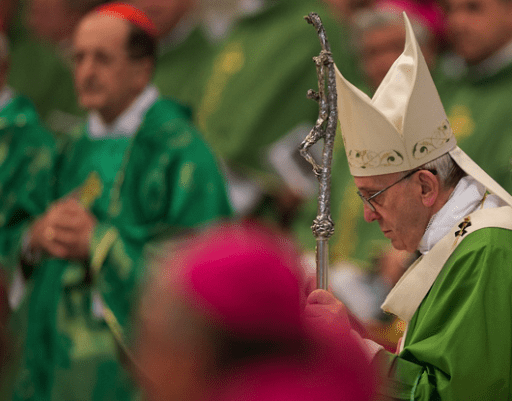
Yesterday, at the closing mass of the Synod on the Family, Pope Francis concluded his homily with the following words:

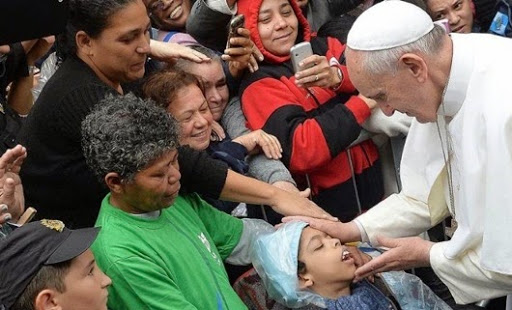
“There is a […] temptation, that of falling into a “scheduled faith”. We are able to walk with the People of God, but we already have our schedule for the journey, where everything is listed: we know where to go and how long it will take; everyone must respect our rhythm and every problem is a bother. We run the risk of becoming the “many” of the Gospel who lose patience and rebuke Bartimaeus. Just a short time before, they scolded the children (cf. Mark 10:13), and now the blind beggar: whoever bothers us or is not of our stature is excluded. Jesus, on the other hand, wants to include, above all those kept on the fringes who are crying out to him. They, like Bartimaeus, have faith, because awareness of the need for salvation is the best way of encountering Jesus. In the end, Bartimaeus follows Jesus on his path (cf. v. 52). He did not only regain his sight, but he joined the community of those who walk with Jesus. Dear Synod Fathers, we have walked together.”

To my mind, these few lines sum up the Synod perfectly, by presenting two poles: one, characterized by rules, clarity and predictability and the other by an path that twists and turns, that is full of surprises, but where we are walking not only among Jesus’ friends, but side-by-side with Jesus himself.

Detractors of the Synod have already declared it a failure, a preservation of the status quo, a “no change” of doctrine, a failure for not opening up access to the Eucharist for the divorced and remarried and a giving-in to African pressures on gays. They, however, are precisely the group for whom Pope Francis had harsh words in the speech he delivered after the Synod Fathers voted on the final report (the Relatio Finalis) paragraph-by-paragraph:

“[The Synod] was about bearing witness to everyone that, for the Church, the Gospel continues to be a vital source of eternal newness, against all those who would “indoctrinate” it in dead stones to be hurled at others. It was also about laying bare closed hearts that frequently hide even behind the Church’s teachings or good intentions, in order to sit in the chair of Moses, sometimes with superiority and superficiality, and judge difficult cases and wounded families.”

Instead of being a failure, I believe, that the Synod was a dramatic first step along the path that Pope Francis presented the week before, on the occasion of the 50th anniversary of the institution of the Synod of Bishops. In that landmark speech, Francis shared his vision of a synodal Church, a Church that is on a journey with Christ in the present moment:

“A synodal Church is a Church of listening, knowing that listening “is more than hearing”. It is a mutual listening in which everyone has something to learn. Faithful people, the College of Bishops, Bishop of Rome: each one listening to the others; and all listening to the Holy Spirit, the “Spirit of truth” (Jn 14:17), to know what he “says to the Churches” (Rev 2:7).”

In such a synodal Church, authority too changes, and becomes rooted in the cross, as Pope Francis explains:

“Let us never forget it! For the disciples of Jesus, yesterday, today and always, the only authority is the authority of service, the only power is the power of the cross, in the words of the Master: “You know that the rulers of the Gentiles lord it over them, and the great ones make their authority over them felt. But it shall not be so among you. Rather, whoever wishes to be great among you shall be your servant; whoever wishes to be first among you shall be your slave.”(Mt 20: 25-27). It shall not be so among you: in this expression we reach the heart of the mystery of the Church – “it shall not be so among you” – and receive the necessary light to understand hierarchical service.”

Pope Francis is also very clear, in the homily he delivered on the morning of the Synod’s last day, about a consequence of being a journeying, synodal Church also being constant change. However, since the journeying party includes Jesus, it is not a thrashing about or a bending with the wind. Instead it is a tight adherence to the person of Christ, while being immersed in the ever-changing now. A freedom with rather than a freedom from or a freedom to:

“The times change and we Christians must change continuously. We must change while being firm in our faith in Jesus Christ, firm in the truth of the Gospel, but our attitude must move continuously according to the signs of the times. We are free. We are free by the gift of freedom that Jesus Christ gave us. But it is our task to look at what happens inside us, to discern our feelings, our thoughts; and what happens outside us and to discern the signs of the times. With silence, with reflection and with prayer.”

All of the above is, to my mind a beautiful spelling out of what Pope Benedict XVI meant when he said, at the beginning of the 2012-13 Year of Faith, that faith “is no theory, but an encounter with a Person who lives within the Church.”

With the above perspective, of a community walking with Jesus, where service is the basis of authority and where life is full of surprises because we aren’t following a set of instructions, but developing a relationship with Jesus instead, let us look at what the Synod on the Family was all about.

First, the Synod was a resounding endorsement of the family, as Cardinal Schönborn put very clearly:

“I think that the principal message of this Synod is the theme of the Synod: that the Catholic Church around the world, with one billion and 200 million Catholics, have discussed the topic of marriage and the family for two years, with all its positives aspects and difficulties … This alone is a remarkable fact for our time, because the core of the message is this: a great yes to the family. The success of this Synod for me is a great yes to the family; that the family is not over, not an old model, but that it is a fundamental model of human society.”

Second, that this endorsement wasn’t just a pre-cooked message to be rubber-stamped, but that it was, instead, the result of an intense process of discernment, discussion and at times even outright verbal warfare both inside the Synod and by interests outside it. Just as examples, a letter from some cardinals to the pope got leaked and resulted in all sorts of recriminations, some cardinals accused others of being opposed to Jesus, and false news about the pope’s health was released two days before the final vote. The inappropriate nature of some of the behavior inside the Synod lead the German language working group to open their final report with the following words:

“We have observed the public statements of individual Synod Fathers regarding the people, content and course of the Synod with great dismay and sadness. This contradicts the spirit of walking together, the spirit of the Synod and its elementary rules. The images and comparisons used are not only coarse and wrong, but hurtful. We distance ourselves from them categorically.”

Third, that there was a great diversity among the Synod Fathers. One of the English language working group’s reports stated that “[o]n many […] points there was consensus, on others there was wide if not universal agreement, and on a few there was significant disagreement.” Pope Francis too saw this very clearly, when he said in his closing speech:

“[W]e have also seen that what seems normal for a bishop on one continent, is considered strange and almost scandalous for a bishop from another; what is considered a violation of a right in one society is an evident and inviolable rule in another; what for some is freedom of conscience is for others simply confusion. Cultures are in fact quite diverse, and each general principle needs to be inculturated, if it is to be respected and applied.”

To my mind this is a very positive picture, which sends a clear message that it is possible to talk about even divisive and sensitive topics openly in the Church.

Fourth, that there was a tremendous desire for unity in the Synod, in the face of the variety of disparate views represented in it. Two things evidence this very clearly. First, that all of the final report’s 94 points were accepted with a 2/3rds majority. In fact, the vast majority (something around 80% of the points) were accepted with near unanimity, and even the handful of more controversial points received support from over 2/3rds of the Synod Fathers. Second, that the German language working group, which included the strongest proponents of both positions in favor of least change (Cardinal Gerhard Ludwig Müller) and of most change (Cardinal Walter Kasper), arrived at unanimous support for all of its reports. Cardinal Reinhard Marx, who was also in that group, gave a very intimate account of how that came about in one of the official press conferences:

“You have to argue. You can’t say I have an opinion. You must be very clear in your knowledge, to quote St. Thomas and the others. When you listen for a few minutes to Cardinal Müller, Cardinal Kasper and Cardinal Schönborn discussing about St. Thomas that is very interesting and when they say St. Thomas said this or that then he really did. So, you have to be together and say: that is the meaning of St. Thomas. […] We had the will to make a text together. It was clear when we wouldn’t find unanimity but we tried to come together and also in the different points, for example regarding the divorced and remarried, we tried to make a text that everyone could accept as a proposal to the Holy Father. [Before the first set of reports we felt that other groups were looking to us to see whether we would find unanimity, given who we are in this group] and Cardinal Schönborn said: “The others are looking at us, so make an effort to come together.””

Fifth, the Synod presented the family as a subject, an agent, rather than an as an object, as something that needs to be managed. One of the Italian working groups put this particularly clearly:

“Given […] that evangelization is the duty of the whole Christian people, […] families, under the grace of the sacrament of marriage, need to become ever more subjects of pastoral care, expression of a mission that becomes visible through a concrete life, not something that is only theoretical but an experience of faith rooted in people’s real problems. Priests should therefore be trained to recognize families as subjects, valuing the skills and experiences of all: lay, religious and ordained.”

Sixth, that the sheer variety and breadth of family circumstances and factors affecting them requires closeness, tenderness and discernment to be the basis of sharing God’s love with all. No set of rules, laws, principles can be a substitute for personal relationships, and Pope Francis is very clear about this too:

“[T]he true defenders of doctrine are not those who uphold its letter, but its spirit; not ideas but people; not formulae but the gratuitousness of God’s love and forgiveness. This is in no way to detract from the importance of formulae, laws and divine commandments, but rather to exalt the greatness of the true God, who does not treat us according to our merits or even according to our works but solely according to the boundless generosity of his Mercy (cf. Rom 3:21-30; Ps 129; Lk 11:37-54). It does have to do with overcoming the recurring temptations of the elder brother (cf. Lk 15:25-32) and the jealous labourers (cf. Mt 20:1-16). Indeed, it means upholding all the more the laws and commandments which were made for man and not vice versa (cf. Mk 2:27).”

An example of this personal discernment-based approach is also the proposal in the final report regarding the divorced and re-married, which says (in §85-86):

“It is […] the task of pastors to accompany interested [divorced and civilly remarried] persons on the way of discernment in keeping with the teaching of the Church and the guidance of bishops. In this process it will be useful to make an examination of conscience through times of reflection and penitence. The divorced and remarried should ask themselves how they behaved toward their children when the conjugal union entered into crisis; if there were attempts at reconciliation; how is the situation with the abandoned partner; what consequences the new relationship has on the rest of the family and the community of the faithful; what example it offers to young people who must prepare for marriage. A sincere reflection can strengthen the trust in the mercy of God which is never denied to anyone. […] Therefore, while upholding a general norm, it is necessary to recognize that the responsibility regarding certain actions or decisions is not the same in all cases. Pastoral discernment, while taking account of the rightly formed conscience of persons, must take responsibility for these situations. Even the consequences of the acts carried out are not necessarily the same in all cases. The process of accompaniment and discernment directs these faithful to an awareness of their situation before God. Conversation with the priest, in the internal forum, contributes to the formation of a correct judgment on what hinders the possibility of a fuller participation in the life of the Church and the steps that can foster it and make it grow.”

Seventh, that mercy is the root of divine love [“Misericordia est radix amoris divini”] as already St. Thomas Aquinas taught and as Pope Francis again underlined as the Synod closed and as the opening of the Jubilee of Mercy approaches:

“The Church’s first duty is not to hand down condemnations or anathemas, but to proclaim God’s mercy, to call to conversion, and to lead all men and women to salvation in the Lord (cf. Jn 12:44-50). […] In effect, for the Church to conclude the Synod means to return to our true “journeying together” in bringing to every part of the world, to every diocese, to every community and every situation, the light of the Gospel, the embrace of the Church and the support of God’s mercy!”

One of the Synod Fathers, Fr. Antonio Spadaro SJ, the director of the Jesuit journal La Civiltà Cattolica, summed this up beautifully in a tweet today:

“After #Synod15 the #Jubilee switches from the binary logic of a door, open/closed, to that of a face, which vitally changes before another face.”


Just in case you are left feeling short-changed about the content of the final report, the scarcity of references to it in the above post are a consequence of two facts: first, that it has no magisterial value (i.e., it is not the Church speaking to its faithful or the world through it – instead, it is a collection of ideas that serve as input for Pope Francis), and, second, that it was the shared journey of the Synod Fathers that matters rather than that document – in keeping with Pope Francis’ call for being a synodal Church instead of one that feels herself best expressed in laws, rules or documents.

Synod15: Gospel is mercy, guilt is useless

Synod lay

In his intervention during a General Congregation last week, Cardinal Reinhard Marx spoke about two topics. First, the need for a renewed marriage preparation and the subsequent accompanying of married couples:

“The Church’s marriage preparation and accompanying must not be driven by moral perfectionism. Neither can pastoral care be one of the “all or nothing”. It is much more about a differentiated perception of the various life and love experiences of people. Our eyes should be directed less at what (still) does not succeed in life, or perhaps fails thoroughly, and more what already succeeds. It is usually not the raised finger, but the outstretched hand, that motivates people to pursue the path of sanctification. We need a ministry that values ​​the experience of people in loving relationships and that is able to awaken spiritual yearning. The sacrament of marriage is to be announced above all as a gift that enriches and strengthens marriage and family life, and less as an ideal that is to be achieved by human power. As essential as lifelong fidelity is to the unfolding of love, so the sacramental nature of marriage should not be reduced to its indissolubility. It is a comprehensive relationship that unfolds.”

Cardinal Marx then proceeds to argue for an admission of some divorced and civilly-remarried to the Eucharist, where the core of his argument is the following:

“From a perspective of sacramental theology, two things are to be borne in mind. Can we, in good conscience, exclude all divorced and civilly remarried faithful from the Sacrament of Reconciliation? Can we deny them a reconciliation with God and the sacramental experience of God’s mercy, even when they sincerely repent for the breakup of their marriage? Regarding the question of admission to sacramental communion, it must be remembered that the Eucharist not only represents the union of Christ and his Church, but that it also renews that union repeatedly and strengthens the faithful on their path of sanctification. Both these principles of admission to the Eucharist, namely the witness of the unity of the Church and a participation in the means of grace, can sometimes be in tension. The Council says in the Decree Unitatis Redintegratio (no. 8): “Witness to the unity of the Church very generally forbids common worship to Christians, but the grace to be had from it sometimes commends this practice.” Beyond Ecumenism, this statement is also of fundamental pastoral importance. In his Apostolic Exhortation Evangelii Gaudium, the Holy Father added, with reference to the teaching of the Church Fathers: “The Eucharist, although it is the fullness of sacramental life, is not a prize for the perfect but a powerful medicine and nourishment for the weak. These convictions have pastoral consequences that we are called to consider with prudence and boldness.” (no. 47)”

To bring this topic closer to lived experiences, Bishop Alonso Gerardo Garza spoke to the Synod about a boy from his diocese, who shared the Eucharist he received with his divorced and re-married parents:

“During catechism classes, what remained imprinted in his heart and in his mind were a few things: the first is that Jesus is really present in every part of the Eucharist, no matter how small, the second is the importance of not keeping Jesus only to ourselves, but to take him to our friends and families. Finally when communion was spoken about during catechism, there was also an emphasis on parents and godparents approach the sacrament of confession and the Eucharist.

In this boy, these concepts were very clear and they led him to giving a piece of the host that he received to his parents, because he saw that they are good, they accompanied him to catechism, they all went to church together and he did not understand why a priest could not give the host to them while he could receive it himself.”

When asked in an interview what he expects to see in terms of the divorced and re-married, Cardinal Donald Wuerl responded:

“I do not know what the result will be. But we have already got one, a really positive step: it is clear that Pope Francis wants a Church in which everyone’s concerns are heard. I do not know what will happen at the end of this week. It seems to me that the outcome of the synod is to tell the whole world that in the Catholic Church we can have arguments and that the principle of God’s love is the norm. We have to understand how to bring people to God.”

Surprisingly, even Cardinal Gerhard Ludwig Müller is reported by the German language Vatican Radio to have said that, in extreme cases, some divorced and civilly-remarried could be admitted to receiving the Eucharist (pointing to paragraph 84 of St. John Paul II’s Familiaris consortio, where such an option is proposed where repentance and abstinence from sexual intercourse are the conditions). Cardinal Müller added that “it would be possible to think more in this direction.”

In an interview yesterday, Fr. Antonio Spadaro, SJ spoke very clearly about a key challenge that underlies the topics discussed at the Synod, which is that of how the Church and world are to relate:

“You can not illuminate reality without having listened to it first. Man is not an alien element to the preaching of the Gospel: the Gospel is not an abstract doctrine that sets out to hit men from the outside, like a stone. It is to be incarnated in the lived lives, in experiences; sometimes also conflicting, sometimes instead serene … So, this dimension of the relationship with reality, with actual experience, is fundamental. The Gospel must enlighten lives in their concreteness.”

When asked about whether there is a need for a rediscovery of sin, Fr. Spadaro argued:

“The proclamation of the Gospel, i.e., that the Lord died for us, died for me, is not a proclamation of sin. So, it is important to understand the reality of the Gospel well. The proclamation of the Gospel is a proclamation of mercy: in the light of the mercy of the Lord’s forgiveness, I understand my sin, I comprehend my sin, because the risk is to fall into a kind of great sense of guilt. Then, if the perception of the merciful God is lacking, the sense of sin is only a sense of guilt, that is often useless.”

Synod14: Exclusion is not the language of the Church

Francis inclusion

Like all this week, today too is best started with Pope Francis’ homily, which is not only a source of joy and edification, but also an answer to the incessant question on the lips of all Synod pundits this week about what he thinks.

Today Pope Francis focused on the first reading (Ephesians 1:11-14) in which St. Paul tells us that “God not only chose us, but [he] gave us a style, a way of life, which is not only a list of habits, it is more: it is an identity”:

“Our identity is precisely this seal, this power of the Holy Spirit, that we all have received in Baptism. And the Holy Spirit has sealed our hearts, and more, walks with us. This Spirit, that was promised us – that Jesus promised us – this Spirit not only gives us an identity, but it is also a down payment on our inheritance. With Him, Heaven begins. We are already living in this Heaven, this eternity, because we have been sealed by the Holy Spirit, which is the very beginning of Heaven: it was our down payment; we have it in hand. We have Heaven in hand with this seal.”

This is very much in line with St. John Paul II saying that “Eschatology has already begun with the coming of Christ,” and it leads Francis to warn against a “dulling down” of our Christian identity:

“This is the lukewarm Christian. It is a Christian who, yes, goes to Mass on Sundays, but whose identity is not visible in his way of life. He may even live like a pagan, but he is a Christian. Being lukewarm. Dulling down our identity. And the other sin, of which Jesus spoke to his disciples, and which we heard: ‘Beware of the leaven of the Pharisees, which is hypocrisy.’ ‘Pretending’: I pretend to be a Christian, but am not. I am not transparent, I say one thing – ‘yes, yes I am a Christian’ – but I do another, something that is not Christian”

And, finally, Francis points to what is needed: “Love, joy, peace, patience, kindness, goodness, faithfulness, gentleness, self-control. And this is our path to Heaven, it is our road, so that Heaven may begin here.”

With the above it mind, I would just like to share some of the highlights of today’s press conference with Synod participants, where I will focus in particular on the words of Cardinal Reinhard Marx, who – to my mind – spoke with great clarity and charity today. To begin with Cardinal Marx declared that the answer to the question of whether anything will come out of this process as to be a “clear yes.”

“The Holy Father doesn’t invite for two Synods just to hear at the end that we can keep repeating what we have always been saying. […] He expects input from us that leads ahead, that opens doors, that points to ways of proclaiming the Gospel of the family in a clearer, more intensive way. Also in conversation with the people. Not just by quoting ourselves, but by being in dialogue about what moves people.”

Commenting on the work of the Synod, Marx pointed to its purpose being both to develop and to “sharpen” the material it deals with. When asked what he thought the Pope thinks about the question of access to the Eucharist for the divorced and remarried, Cardinal Marx said: “The spokesperson of the Pope is Fr. Lombardi.” while pointing at him and giving a big smile :). He then proceeded to comment on it being a key question of how irregular circumstances are approached:

“circumstances that don’t fit the sacramental scheme of marriage, but that are not entirely devoid of value. There are examples here of people who are on a journey, people who live in broken relationships, yet who live elements of good community. Fundamentally this is the question. […] And here it is my opinion that we must find a different language. We have to make it clear that this is not about black or white, all or nothing, but that the circumstances of people are more difficult. And that’s also how I’d interpret the Pope’s words in Evangelii Gaudium. I have to interpret it in this way. First, it is about seeing people in their circumstances, including the good that is alive in their circumstances. And that is why I believe we have to develop further in this area.”

In response to a question asking for clarification about where the Synod is heading with regard to homosexuals, Marx provides the following, beautifully clear and personal piece of thinking:

“Here it is fundamentally about looking at individual cases. The Catechism of the Catholic Church is clear that homosexuals are not condemned because of their orientation; the sexual practice, the sexual relationship cannot be accepted. This applies to other aspects too. But not everything is to be evaluated with an equal measure of negativity. [… I know] a homosexual couple who have been together for 30-35 years in a faithful relationship, which as a sexual relationship is not accepted by the Church, but they live together, one looks after the other, during the last phase of his life. Here, as Church, I cannot say that everything that these people have done during their lives is without value, because they have a homosexual relationship. This is what it is about, that one can differentiate here. Then, someone who is in a different relationship every day, will receive a different assessment in terms of spiritual accompaniment, that someone who tries to be chaste, or who is striving towards faithfulness, a faithful relationship. We are still not at the destination, where we could say: “Aha! Now we can say that all is in order.” Of course. But I can’t just say that everything is either black or white. And it is difficult to make this understood sometimes and it is also the responsibility of individual pastoral care. […] Maybe this cannot be encapsulated in rules, that may be correct, but nonetheless I can share a journey with them and also experience a maturing. No question about it! That is possible. On every human journey, including one that may be based on a mistake, there is growth and increasing maturity, there is improvement, there is something that can be lived through the spirit of the Gospel. It would be unthinkable to say that because you are homosexual, you can live nothing of the spirit of the Gospel. That’s unthinkable! At least for me.”

Then, in the context of a question about the divorced and remarried, Marx declared forcefully:

“We must be close to everyone, each with their particular circumstances. We must give them opportunities to find their place in the Church. No one is excluded! No one is redundant! No one is marginalized! Exclusion is not the language of the Church!”

In response to a question about the principle of gradualness, Marx emphasized that:

“We must take the circumstances of an individual seriously. […] In the relationships among people, which have become so varied, we must recognize the good they contain in terms of the Gospel being lived by them, without giving up the aim of sacramental marriage. But there is a variety of ways that lead there.”

Cardinal Marx’s next answer, to the question of whether the teaching of the Church can change, was particularly important, and presented the same position as shared by Archbishop Paglia the other day and by Pope Francis on many occasions:

“Of course! Of course! Two thousand years of Church history isn’t a repetition of always the same. First of all, the teaching of the Church isn’t a static collection of statements that just sit there, but a development. The teaching of the Church does not change, it gets understood more deeply. […] It is not like doctrine is given and we try to apply it. Instead, doctrine too is in dialogue with the pastoral.1 For example, the decision of John XXIII to call for a pastoral Council, is a dogmatic decision. This is not about saying: “Here is something solid that doesn’t move and our problem is only about how to make people understand it.” Then it looks like it is people who are the problem. But that can’t be! Doctrine is given, yes, it doesn’t answer to the spirit of the times, but it can develop. Benedict XVI […] said, with reference to the Council, that it wasn’t a hermeneutic of rupture, of discontinuity, but a hermeneutic of reform. And this reform, naturally, also affects what is being said about teaching. Otherwise we wouldn’t need theology anymore. A new discovery, a deeper discovery of what is meant by the truth of Christ, of what the Gospel wants to tell us today. The truth isn’t a system, the truth is a person, with whom we speak. Just to say that the Church’s teaching will never change, in this sense, that is too narrow a view. At it’s core, Catholic truth and what the Gospel tells us remain unchanged, but whether we have discovered everything, whether we have found everything, that I dare to doubt.”

All I can say to that is: Amen! 🙂


1 Note that this point has been mistranslated by some as “doctrine is communicated pastorally,” which is a different position altogether.

Synod14: Mercy, compassion and comprehension

Synod

As has been the case all week, interviews with synod participants emerge after the day’s sessions conclude, and yesterday saw comments from several of the Synod Fathers regarding the need to refresh the language used by the Church.

Cardinal André Vingt-Trois argued that the language used today is akin to the “technical” language used by physicians and that it is necessary to:

“find modes of expression and modes of communication that will allow [the Church] to announce the good news so that it may be heard. When a physician makes a diagnosis, he uses terms to designate precisely the disease in question, but these terms, if he tells them to the patient, he will not understand them. Therefore, he must explain the diagnosis with words that are not technical words. In theology, it is the same thing. When one addresses people to announce the good news of Christ, one does not teach a theology course. One tells them the contents of the theology but with a vocabulary they can understand. I was a professor of theology. When I taught a theology course, I did not give a sermon; that is another literary genre.”

Comments made in September by Bishop Johann Bonny of Antwerp, Belgium also underlined that couples living in irregular circumstances:

“deserve more respect and a more nuanced evaluation than the language of certain church documents appears to prescribe. The mechanisms of accusation and exclusion they have the potential to activate can only block the way to evangelization.”

And an interview with Cardinal Christoph Schönborn contained further reference to a change of mindset to one where the good is appreciated even amidst imperfection and taken as a starting point:

“I can look at an imperfect situation from two sides, and both sides are justified. I can look at what is missing, and I can see what is already there. When couples live together in a stable, faithful relationship, one could say that is not a sacramental marriage, that there is something missing, but one could also say that it is a beginning, that there is already something there. Pope Francis had encouraged the Austrian bishops to look at what was already there and to accompany it towards something more complete and more perfect.”

Cardinal Reinhard Marx applied the same optics to gay relationships:

“One simply cannot say that a faithful homosexual relationship that has held for decades is nothing, as that is too “forceful” a standpoint. We just mustn’t lump things together and measure everything with the same yardstick, but must differentiate and take a closer look, which doesn’t mean that I endorse homosexuality as a whole.”

Cardinal Donald Wuerl then commented on the big picture within which the above considerations of language and the recognition of the good are set:

“I think what’s becoming more and more, at least, in my mind, it’s one thing to doctrinally state the obvious. It’s another thing to take that and get it to work in the concrete order where people live.

Now you don’t deny the doctrine, in any way, but you have to make it apply to people. That’s going to be the challenge, and I think that’s what the Holy Father is calling us to do.

He’s saying, We know this, we believe this, this is what is at the heart of our teaching. But how do you meet people where they are? And bring them as much of that as they can take, and help them get closer?

That’s going to be the challenge. That’s going to be the really difficult part. How do you help people live all the beauty of family life when some of them may not have experienced what we know to be family?”

Yesterday afternoon then saw an important move by Pope Francis (that I’d characterise as “stacking the deck,” which is not to suggest anything underhand, since the Synod is not a democratic process, but one of joint listening to the Holy Spirit and discernment, where the decisions that follow are taken by the Pope), when he appointed six additional members to the committee that will write the final report of the Synod – the “Relatio Synodi.” The new members are:

Cardinal Gianfranco Ravasi, president of the Vatican’s Pontifical Council for Culture.
Cardinal Donald W. Wuerl, archbishop of Washington, D.C., appointed recently by Pope Francis to the Congregation for Bishops.
Archbishop Victor Manuel Fernandez, rector of the Pontifical Catholic University of Argentina.
Archbishop Carlos Aguiar Retes of Mexico, president of CELAM, the Latin American bishops’ conference.
Archbishop Peter Kang U-Il of South Korea.
Father Adolfo Nicolás Pachón of Spain, superior general of the Jesuit order.

If you have been reading this blog at all, or even if you have only seen an earlier post on the Synod, it should be clear what this choice means for the document that is due on Monday.

Yesterday afternoon also saw the 10th and final of this week’s sessions, where “fraternal delegates” (i.e., representatives of other churches) spoke. Here the official notes expressed a great consensus among all speakers that the challenges facing the family are common to all Christians. The need for appropriate marriage preparation was a common theme too as was the desire to practice compassion, mercy and comprehension:

“[I]t is essential to listen to those who find themselves in difficult family situations, who are in need of mercy and compassion every day, as the Church wishes always to help those who suffer, looking both at the Sacred Scriptures and at the problems of contemporary life. […] The wish was expressed for listening and comprehension, far from any form of condemnation, in relation to homosexual persons, while emphasising that marriage is a union between a man and a woman. Particular attention was shown towards children born in difficult context and for all victims of violence, especially women and minors, as the defence of the most vulnerable, of those who have no voice of their own – believers or otherwise – is common to all Christians.”

Some differences were presented too:

“for example on the theme of birth control, underlining the freedom of conscience of believers, while always respecting the meaning of love and marriage. Furthermore, in relation to second marriages, it was said by the Orthodox delegates that these in any case constitute a deviation and while they are celebrated, it is after a period of accompaniment on the part of the Church in an attempt to bring married couples towards reconciliation.”