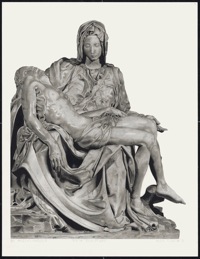
God is dead

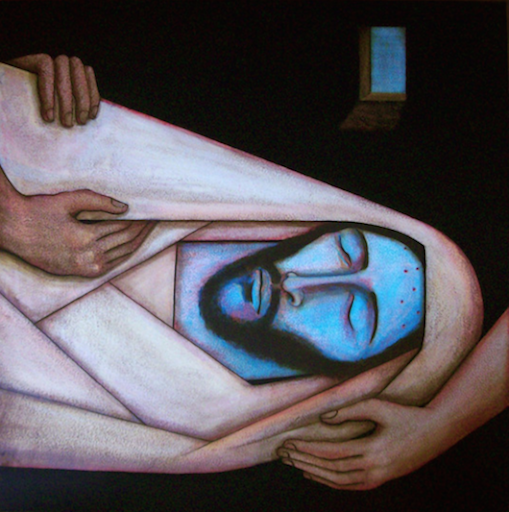
Jesus tomb obrien

Today the Church remembers that Jesus – fully man and fully God – was dead for over 24 hours – from Friday afternoon until the early hours of Sunday (Sunday, which in the Jewish week starts at sundown on Saturday). Just like Good Friday is an opportunity to remember his suffering and self-sacrifice, and Easter Sunday is a celebration of his resurrection, so today – Holy Saturday – is a day for remembering his death. The death of God.

I have always found the Easter Triduum a very special moment, since it is set up for a contemplation of Jesus’ death and resurrection in real time. The services are timed to coincide with the times recorded in the Gospels, which allows for a meditation on the Easter events at the pace at which they happened. They give a sense of scale.

This morning, when I went to pick up my son from the altar servers’ rehearsal for the evening’s vigil, I arrived early at the church and went straight to the side chapel where the tabernacle is located. As soon as I entered, I was reminded that today was an exceptional day, since the tabernacle, where the Eucharist is usually kept, was open and empty. Like the hospital room of a recently deceased patient. An absence with a very clear and strong message.

As I sat down, I realized that I won’t be spending time in Jesus’ presence and I quickly decided not to pretend otherwise and pray as if everything was normal. The emptiness of the tabernacle had to be taken seriously and responded to sincerely and honestly.

God is dead.

What must it feel like to believe that? To believe that there is no God, that there is no beloved in and beyond everything. Instead of paralysis, my thoughts turned to my close friends who are agnostics or atheists – the pull of transcendence was too strong. To be fully myself, I had to go beyond myself (to paraphrase Pope Francis’ Evangelii Gaudium, §8) even as I tried to stop short of rushing to God. A great conversation with my überbestie JMGR – in the midst of a buzzing conference – then came to mind, when I asked him about whether transcendence meant anything to him as an agnostic (as I was thinking about Kenan Malik’s article). Together we arrived at a definition in the absence of religious belief – that “my transcendence is another’s immanence.” Thinking more about it now, I see that this definition works also for a Christian – only an “other” becomes the “Other.”

As I thought of my atheist or agnostic friends, I felt a particular closeness to them and a joy even as I attempted the impossible – to imagine what it is to be like someone else. This joy of closeness, reminded me of Pope Francis declaring closeness to be Jesus’ own method of spreading his message (EG §269). Feeling pulled to return to a direct conversation with Jesus and away from my trying to contemplate his death, I made another attempt by trying to experience the physicality of the chapel as if it were a Serra. Since it wasn’t, that was a bit of an effort :), but the morning light that filled the simple space and the perspective that the rows of chairs emphasized, nonetheless gave me joy too. The joy of being, of relating, of seeing, of experiencing. Again, I couldn’t help but delight in God’s creation and feel his sustaining presence.

Even though my attempts at imagining the death of God ultimately failed, I was grateful for the opportunity that Holy Saturday gave me. An opportunity to think of my friends, to feel the wonder of being and to have the focus directed to a world where God’s presence is absent, but where there is friendship, goodness and beauty.

Paraphrasing Giles Fraser’s great Guardian article from this morning, I can say that I am about 1/365th atheist. And with that, it’s off to the Easter vigil.

Serra: space in the flesh

Serra threats of hell

[Warning: long read – again]

It might seem strange to start a post about the sculptor Richard Serra by referring to Pope Francis’ homily from last Friday morning, but I hope you’ll bear with me while I do it anyway and that you won’t interpret it as an attempt to imbue Serra’s work with religious motives, which I believe it does not have. Instead, my reason for starting out with the following quote is that I believe both Richard Serra and Pope Francis give great importance to physicality, as is apparent from the examination of conscience proposed here by the pope and as I will try to spell out in greater detail with regard to Serra’s work:

“Am I embarrassed by the flesh of my brother or sister? When I give alms, do I let the coins fall without touching his hand? And if by chance I touch him, do I do this? [he asked mimicking a gesture of repulsion with his hand] When I give alms, do I look my brother or sister in the eyes? When I know a person is sick do I visit him or her? Do I greet them with tenderness?”

That the pope emphasizes physicality – using the word “flesh” 13 times last Friday morning – is, I believe, motivated by a desire to counter the ever-recurrent dualist distortion of Christianity that considers only the spirit to be good while equating matter with evil. This is categorically not Jesus’ message and, to my mind, Serra’s work is a great way also for a Christian (and everyone else too) to understand why, in an experiential rather than a moral or intellectual way.

What Richard Serra does, in my opinion, is to heighten the potential for an immediate experience of space, mass, scale, orientation and matter in a way that is difficult to be had directly in nature, where these experiences are admixed with those of other properties or qualities. The result can be awe and an experience of profound beauty (that is not to be sought only in the superficially aesthetic), which – while, as far as I can tell, not intended by their author – make Richard Serra’s work precisely what the composer James MacMillan pinpointed as the key feature of art: “a window on to the mind of God.”

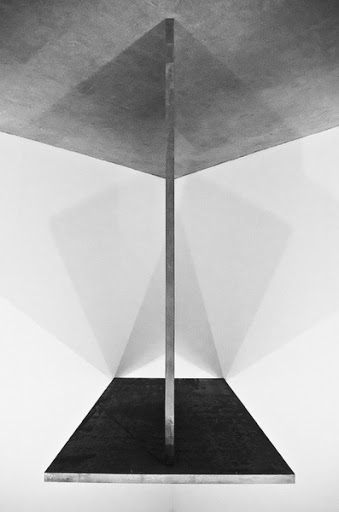
To begin with, speaking about Richard Serra’s work faces the same challenges as appreciating any piece of art, in that no verbal account is going to suffice as a surrogate for direct experience. In fact, Serra himself argues this point very starkly, when asked to describe his “Delineator” (shown next):1
Serra delineator

“What happens with Delineator is that the only way to understand this work is to experience the place physically, and you can’t have an experience of space outside of the place and the space you’re in. Any linguistic mapping or reconstruction by analogy, or any verbalization or interpretation or explanation, even of this kind, is a linguistic debasement, in a sense, because it isn’t even true in a parallel way.”

Nonetheless, Serra does say more about Delineator elsewhere, which highlights some of his concerns and the mental model he uses for thinking about his own work:

“The sculpture defines a definite space inside the room. […] The juxtaposition of steel plates forming this open cross generates a volume of space which has an inside and an outside, openings and directions, aboves, belows, rights, lefts – coordinates to your body that you understand when you walk through it. Noe you might say that that sounds quite esoteric. Well, one of the things that you get into as you become more in tune with articulating space is that space systems are different than linguistic systems in that they are nondescriptive. The conclusion I’ve come to is that philosophy and science are descriptive disciplines, whereas art and religion are not.”

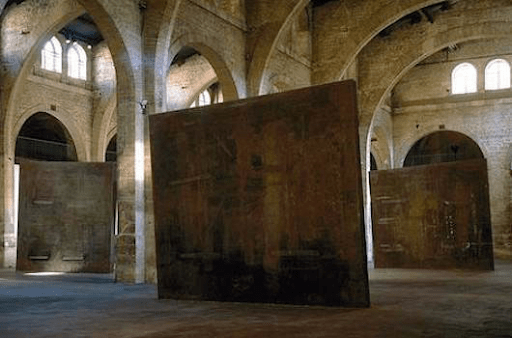
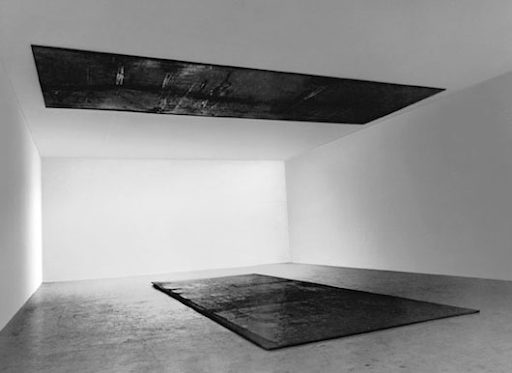
So, if you haven’t seen any of his work and tried to circumnavigate and “inhabit” it, I would very much encourage you to try to do so, if you get a chance. Personally, I have had experiences akin to what Serra speaks about above, when I saw his “Seven plates, six angles” (below) at the Gagosian in New York. The overwhelming sensation I had was of a heightened awareness of scale, volume and proportion, but also – unexpectedly – of space and mass. In some sense, my extensive use of photos in this post is futile – like showing you images of alien foodstuffs that you have not tasted, so, please, consider them tokens or bookmarks – i.e., pointers for your own future experience.
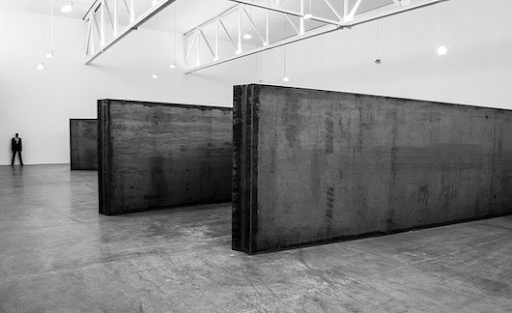
Serra 7 plates 6 angles

When asked about the relation of one of his pieces, shown at the Tate in London, to the building it was exhibited in, Serra made another important observation about what his work intends to be (and one that rang very true to me in retrospect):

“I did not want to enter into an affirmative dialogue with the building. I did not want to mirror face-value language, the physiognomy of the architecture. I wanted to deal with the volume, weight, mass and directionality of the space. [… I] wanted to make a sculpture out of the whole volume […] I wanted to make the volume of the space tangible, so that it is understood immediately, physically, by your body.”

The idea that the sculpture is not solely the object Serra created, but that it is that object in relation to the space it is situated in, is a paradigm shift and the key to understanding his insistence on making site-specific work even in the case of indoor sculptures. And even when a piece is shown in multiple locations over time, its placement in every one of those spaces results in multiple sculptures involving the one Serra-made object (that naïvely might be identified as the sculpture in full).

Beyond the paradigm shift from objects to entire spaces, Serra also broadens the palette of sculptural considerations:

“There’s a difference between walking into a telephone booth and a football stadium. If you take those two extremes and make the idea very subtle, then you can say there’s a difference between walking to the left and walking to the right, between the experience of the concave and convex, between something leaning right and something leaning left. How do you know that to be a different experience in terms of your daily life? And if it is, is it meaningful? The degree of meaningfulness depends on the limitations of the viewer. I think it is very difficult to introduce large-scale works into the public arena inasmuch as I am not interested in complicity or affirmation.

[…]

Compared to that of vertical sculpture, the ideas of sculpture existing horizontally are basically different concepts about construction, are basically different concepts about how we live in the world. On a simple, perceptual level, a modular unit extending above your eye-level becomes foreshortened as it rises, while the horizontal modular unit implies an infinite vanishing point. […] The cultural symbolic iconography of verticality versus horizontality is most apparent in the cross, where the vertical expresses transcendence and the horizontal expresses materiality.”

While Serra is clear about his interests being “nonutilitarian, nonfunctional” and declaring that “any use [of sculpture] is a misuse,” as well as anticipating limited audience appreciation (likening it to “poetry and experimental film” :)), he at the same time has a profound message behind his work:

“We are all restrained and condemned by the weight of gravity. […] The constructive process, the daily concentration and effort appeal to me more than the light fantastic, more than the quest for the ethereal. Everything we choose in life for its lightness soon reveals its unbearable weight. We face the fear of unbearable weight of repression, the weight of constriction, the weight of government, the weight of tolerance, the weight of resolution, the weight of responsibility, the weight of destructions, the weight of suicide, the weight of history which dissolves weight and erodes meaning to a calculated construction of palpable lightness.”

In many ways, the above strikes me as having affinities with Christianity, where Serra’s “Everything we choose in life for its lightness soon reveals its unbearable weight.” can be seen as a complement of Jesus’ “But seek first the kingdom of God and his righteousness, and all these things will be given you besides.” (Matthew 6:33).

A further aspect of Serra’s weight versus lightness statement (made in 1988) is its echoing of Milan Kundera’s novel “The Unbearable Lightness of Being,” published only four years earlier, where its author too makes a play for weight over lightness:2

“The heaviest of burdens is therefore simultaneously an image of life’s most intense fulfillment. The heavier the burden, the closer our lives come to the earth, the more real and truthful they become. Conversely, the absolute absence of burden causes man to be lighter than air, to soar into heights, take leave of the earth and his earthly being, and become only half real, his movements as free as they are insignificant. What then shall we choose? Weight or lightness?”

What, you may ask, is my point though? I hope that the above highlighted a couple of aspects of Serra’s work, which I have found to be deeply engaging and appealing. First, that he has invented a whole new concept of sculpture whose building blocks are not only form, texture, composition and proportion, but also mass, space, directionality and orientation, rendering an entire space a sculpture. Second, that his work is deeply rooted in the entirety of art and philosophy, without these being prerequisites for its appreciation and experience. Third, that experiencing his work, which explicitly shuns religious motives, does shed light on deeply Christian concepts and is therefore also of spiritual value to a Christian viewer at least.

As such, it shouldn’t come as a surprise to you, when I tell you that Richard Serra is probably my favorite sculptor (alongside Michelangelo, Rodin and Giacometti) and I hope that you will appreciate his work too when you next see one of his pieces.


1 All Richard Serra quotes here are from “Writings/Interviews.”
2 Both, probably, derived from Nietzsche’s concept of eternal recurrence, where the permanent (heavy) is contrasted against the fleeting (light).
Contemporary art and its enemies

To paraphrase Karl Popper, let me start by saying that it is “impossible to make art in such a way that it cannot be misunderstood.” Over the course of this last week I have come across no less than three articles in which Christian authors denounce the evils of contemporary art.

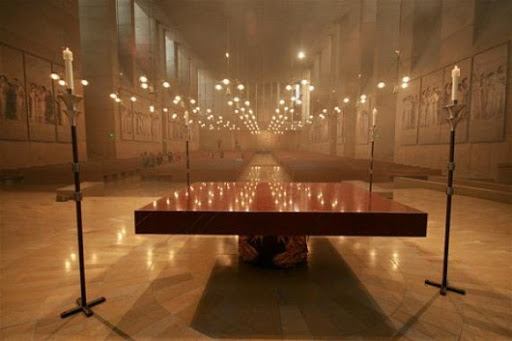
Cathedral our lady angels 4961 large slideshow

First, there is our old friend Nikos Salingaros – of Oakland Cathedral review fame, who has a go at the Cathedral of Our Lady of the Angels this time. His argument is again the same: “We have here a celebration of asymmetry, which might be understandable if there were a sound reason for it coming either from design necessities, or from religion.1 But there is none. The building’s asymmetry serves an essentially negative purpose: to deny coherence and harmony.2” And there is the usual litany of nonsensical gems like: “geometrical fundamentalism,” “naked concrete walls [being] ultimately unpleasant,” lacking “connective ornament,” and claiming that religion “has a natural affinity with traditional architectural expressions of coherence” before taking Antoni Gaudí’s3 name in vain. There is only one thing to say in response to this: bullspit! Instead of trying to debunk this junk head on, I think that I have a sense of the root cause of his confused misreading of this piece of architecture: an expectation of the literal. God is perfect harmony, so churches need to be perfectly symmetrical; the Church values continuity, so a church needs to look old; the soul needs to ascend to God, so there need to be vertical lines in the church’s geometry (and the list of naïveté goes on and on). What I believe this approach entirely misses are two key aspects of beauty: mystery and surprise! Why is it that an object evokes emotions, triggers reflection, prompts insight and delivers aesthetic joy and pleasure? Sure, there are plenty of theories, but periodically an artist comes along and creates a piece that breaks them, yet that is unmistakably appreciated as art. Surprise too is a key element of art, in my opinion, and the kind of literal expectations that Salingaros relies on would entirely eradicate it.

Second, I have made the virtual acquaintance of another budding art critic: Jimmy Akin, who takes it upon himself to have a go at the Vatican’s touring art exhibit: “The Vatican Splendors: A Journey Through Faith and Art,” exclaiming that the works “from the mid-2oth [sic] century onward were terrible.”4 Akin is much more to the point than Salingaros and doesn’t even feel the need to back up his claims – the art of the last 60+ years is just “terrible.” But what he lacks in specificity, he certainly makes up for in initiative, with the “brilliant” idea to do something about “all the lousy Catholic art” by “supporting Catholic art education so that we can get better Catholic artists.” So far so good – I am filled with anticipation of the centre of excellence he’ll propose to support and the examples of their great Catholic art, done right [no, not really]. Instead, Akin unveils the following “stupendously amazing” piece by a 12th grader:

Pieta drawing

And, just to underline the horrors of the “lousy” art we have had to put up with, he pulls out Pericle Fazzini’s “The Resurrection” situated in the Vatican’s Paul VI’s hall:

Paul vi resurrection

I am stunned by this guy’s barefacedness. How can he put a school-kid’s (admittedly skillfully executed) drawing of Michelangelo’s Pieta beside Fazzini’s masterpiece (a 66×23 foot bronze created it in 1977 and showing Jesus rising from the crater of a nuclear bomb) and say: more of the former and less of the latter, please! The mind boggles!

Third, I have come across a far more cogent, yet – to my mind – still misguided, piece by Francis Phillips. Here the composer James MacMillan is first quoted as saying that “[a]rt can be a window on to the mind of God. Through this window we can encounter beauty and divine truth” and I am thinking that I have finally come across a good piece on the subject, following the arid head banging of Salingaros and Akin. Sadly, Phillips decides to take us down a frustrating route too, by turning a promising piece into a crusade against the National Gallery in London showing Richard Hamilton’s “The Passage of the Angel to the Virgin.” The piece is a giclée photomontage that bases itself on Fra Angelico’s Annunciation, but with two female nudes where Fra Angelico has the angel Gabriel and the Virgin Mary. Phillips proceeds to label it as “scandalous,” as “shocking to Catholics, who have a particular reverence for the Virgin Mary,” as skewed for “[p]ortraying the Angel Gabriel as a young woman [since] the traditional Christian understanding of angels [is] as sexless spiritual beings”5 and as “desecrating.” Personally, I have a profound love for Mary and a deep gratitude to her for being the model of the perfect Christian, but I have to say that I disagree with all of the above. Since some of you may side with Phillips in your reaction to this piece, I will not reproduce it here, but only provide this (NSFW) link for those of you who choose to follow it. I have to say that I am not a fan of this piece by any means, but my reaction is one of curiosity about why Hamilton made the choices he made in it. Instead of a feeling of indignation, my response is more one of boredom and I would just walk past it and enjoy the rest of the National Gallery’s exquisite collection, instead of mounting a (failed) attempt to have it taken down, as Phillips did.

A point that seems to emerge to me from these last two articles is one of a decorative and exegetical role for art. A looking for pieces that would be good interior decoration for a church or that would illustrate a passage from Scripture or the Catechism. While some great art can certainly do that, it will do so in a way that transcends the simple, literal and functional. Other, equally great art would be entirely out of place as decoration though, yet would have the capacity to “be a window on to the mind of God.” I am certainly not thinking of Hamilton’s piece here, but more of something along the lines of Richard Serra’s work, such as his “Trip Hammer”:

Serra

Relegating “the mind of God” to decoration just seems like something that not even a heathen would do …

UPDATE (12/11/2012): My bestie JM went to visit the Cathedral of our Lady of the Angels, with my über-besties MR and RR, and had the following to say:

I went to visit the Cathedral last weekend, in anticipation of coming down either on the side of its supporters or detractors. Instead, while I am undeniably an outright fan of it as a place of worship, I have to say that it is so ugly on the outside that only its mother could love it. You would be forgiven for mistaking it for a car park or a storage facility, if it wasn’t for the separate bell tower carrying a cross and the rather beautiful statue of Mary above its main entrance.

The interior is another story and is an unreserved and total success. The space is vast without being overpowering; it is light and welcoming and beautifully laid out not only in the main nave but also with its numerous chapel-like spaces that face out and away from the building’s main volume. They, like the whole church, are bathed in natural light and house content as diverse as a shrine to Our Lady of Guadalupe, a Día de los muertos arrangement, a temporary exhibit by a local painter, artifacts from Pope John Paul II’s visit to LA and the confessionals. Outside too, the space is at the service of the community, with a great playground and a cafe/grill on the other side of a large square adjacent to the Cathedral.

In many ways this church is like one of those great Northern European cathedrals turned inside out. Instead of an ornate exterior and a plainer interior, here money has been spent on the interior space that church goers enjoy (including a great set of tapestries showing the communion of saints – and not only of canonized ones) while leaving the exterior plain and purely functional. Would I have preferred a more pleasing external architecture? No doubt! But, I believe the diocese spent their money where it matters to its members and visitors. This is a church that embraces those who come to it, instead of advertising itself to all. Not that the latter has little value, but I see why they would have favored the former. For some photos of my visit, see this Flickr set.


1 I wasn’t going to engage with this nonsense, but – come on! – to claim that there is no “religious” reason for asymmetry! How about the following (vastly incomplete) examples: good – evil, infinite – finite, uncreated – created, selfless – selfish. And the list could go on and on.
2 How about: to show movement, ascent, growth, a pull towards God?
3 To invoke Gaudí in an argument for traditional, symmetrical, literal architecture is just beyond nuts!
4 The hubris here would easily make Achilles’ dragging Hector’s lifeless body behind his chariot in front of the gates of Troy an act of level-headed diplomacy.
5 Not noticing the irony of this objection. Would the sexless angel better be portrayed as a man? Why?