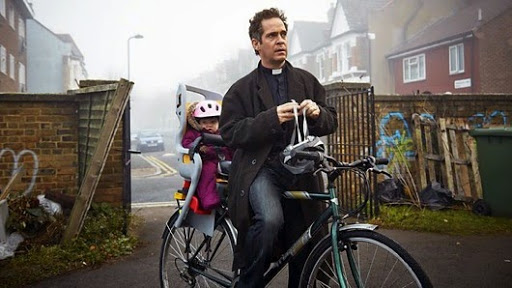
The BBC’s Rev: Christian or “just” nice?

Rev

One of my favorite TV series of all time is Rev – the BBC comedy about an Anglican priest in a London inner-city parish, with a minuscule congregation of misfits, and facing a barrage of trials both internal and from within and outwith the Anglican Church. The casting and acting are superb, the story lines varied, the contrast between the Rev’s psychology and the supporting cast’s caricatures comedic and the insightfulness of observation razor sharp.

Unlike other religiously-themed comedies, like the legendary Father Ted, Rev is not only about laughs, but very much also about a portrayal of a man’s sincere desire to love God and his fellow men and women. It is a love that falters and falls, but a love that is sincere and persistent.

In one episode we see the Rev go out of his way to be welcoming to a sinner (a sex offender just released from prison) in spite of his entire congregation’s opposition and his own revulsion. In another episode he struggles with his Church’s and his own views on homosexuality while going out of his way to be welcoming of his gay friends. In yet another episode he goes out of his way to work with the local Imam in spite of the humiliation that their financial imbalance brings him.

In fact, the formula of a Rev episode is a going out of one’s way, in pursuit of the excluded, the peripheral, the needy, regardless of the cost to oneself. And throughout these trials and adventures, the Rev converses with Jesus, with whom he pleads, to whom he complains, but in whom he trusts and whom he loves. In many ways, Rev expands on Blessed Mother Teresa’s saying: “God does not require that we be successful, only that we be faithful.”

Why, you may ask yourself, have I gone to the trouble of writing the above, albeit short, review of Rev? The reason is simple – an article in yesterday’s Telegraph, where Rev is denounced as un-Christian by reducing Christianity to being merely “nice” and leaving out “that Christians do nice things not just because they are nice people but because they are commanded to by scripture.” The article’s author then proceeds to list 8 “against”s that Christians need to be, and concludes with the following, peculiar piece of moral theology: “Christians who fail to point out these sins are surely as culpable as the people who commit them.”

However, the most offensive aspect of this article is not so much its twisted view of Christianity, but the following anti-atheist statement: “Nice atheists don’t have to [tell people when they’re going wrong] because there’s no commandment to rescue others from themselves.” This is offensive not only because it suggests that Christians only do what they do because they are commanded to do so – rather than because they (like all men and women!) are made in the image of God and have a deep-seated call to participate in the Trinity’s life of mutual self-giving – but also because it suggests that atheists don’t have a desire to correct wrongs. This is absurd, offensive and factually incorrect. Rather than try to build an extensive case, let me just point to a single counterexample: Albert Camus speaking to Dominicans about what atheists expect of Christians, showing great concern for them and being an exemplary “external” conscience for them.

In an attempt to bolster its credibility, the article also refers to Archbishop Justin Welby, who “disagrees with the show’s depiction of Anglican life because he notes that many churches are growing.” That is quite true – and a point I wholeheartedly agree with. However, it conveniently fails to mention that – in the same piece by the Archbishop – he also says that it is “great viewing.” Furthermore, the former Archbishop of Canterbury – Dr. Rowan Williams says that it tells us “something about the continuing commitment of the church to run-down and challenging areas. It also shows us someone who prays honestly.”

Finally, let me put one more card on the table – Pope Francis’ ever-versatile Evangelii Gaudium, where he has the following to say:

“[A] missionary style is not obsessed with the disjointed transmission of a multitude of doctrines to be insistently imposed. […] What counts above all else is “faith working through love” (Galatians 5:6). Works of love directed to one’s neighbour are the most perfect external manifestation of the interior grace of the Spirit: “The foundation of the New Law is in the grace of the Holy Spirit, who is manifested in the faith which works through love”. (St. Thomas Aquinas, Summa Theologica, I-II, q. 108, a. 1.)” (§35, §37)

Amazing mechanisms

Crab Nebula

During this Year of Faith, Pope Benedict XVI has started a series of sermons on the Creed, with the latest focusing on how one can come to know God. He starts out by emphasizing that God respects each person’s freedom and that, instead of us having to look for Him, He seeks us out and makes himself known to us. Nonetheless, Benedict picks out three sources for finding signs of God and exhorts believers to “[a]lways be ready to respond, but with gentleness and respect, to anyone who asks you for the hope that is in your hearts” (1 Peter 3:15) The Gospel needs to be communicated “joyfully, feeling it to be [one’s] own, through a life truly animated by faith, marked by charity, service to God and to others, and capable of radiating hope.”

The three sources of signs of God’s presence that Benedict puts forward are: “the world, man and faith”:

1. The world. “[D]azzled by the glitter of worldliness,” we are in danger of becoming blind to how the universe can fill us with wonder. Instead, “contemplat[ing] creation, its beauty, its structure” leads us to discover its “amazing mechanisms” and patterns that can lead to an intuition of the “Beautiful One” who is behind them. Benedict quotes Einstein here as saying that the laws of nature “reveal such a superior reason that all rational thought and human law is but a very insignificant reflection by comparison” (The World as I See it). This is not to be taken naively as: look at nature and you’ll instantly believe in God. That is not what Benedict means, nor would that respect our freedom. Instead, the point is: look around you, contemplate the beauty and intricacy of the universe, instead of just getting sucked into the consumerist rat-race, and you might discover God. This is not proselytism (with the emphasis on freedom and on it being up to God to call people, instead of saying that they ought to make the first move, or even be made to make it!) – his advice is good regardless of what you think about the likelihood of God’s existence and is very clearly mirrored in the mystical traditions of all religions and of contemplative practice outside religion.

2. Man. Benedict here quotes St. Augustine as saying: “God is closer to me than I am to myself” (cf. Confessions, III, 6, 11) and “truth dwells in the heart of man” (True Religion, 39, 72). “The ability to stop and take a deep look within ourselves and read that thirst for the infinite that we carry within” is at risk of being lost “in the noisy and distracted world in which we live.” Again Benedict basically says (to paraphrase him): “Don’t take my word for it – just give yourself a chance to reflect about yourself and the world you live in and I believe you will see signs of God’s presence.”

3. Faith. Here Benedict argues that looking at those who believe is a hint about God’s presence too:

He who believes is united with God, is open to His grace, to the power of charity. So his existence becomes a witness not of himself, but of the Risen Christ, and his faith is not afraid to show itself in everyday life, it is open to dialogue that expresses deep friendship for the journey of every man, and knows how to bring the light of hope to the need for redemption, happiness, and future.

This echoes Archbishop Williams’ recent words on what holy people are like and again underlines the “self-noughting” of those who truly believe in God and their friendship with and openness towards all. Benedict proceeds to spell out misconceptions of faith as “illusion, escapism, a comfortable shelter, sentimentality” and instead contrasts them agains what it is: an “involvement in every aspect of life.”

Finally, Benedict concludes with a call for all Christians to purify themselves and make themselves “conform to” Jesus also so that others may rid themselves of a misunderstanding of Christianity as a “mere system of beliefs.” Instead:

Christianity, before being a moral or ethical value, is the experience of love, of welcoming the person of Jesus. For this reason, the Christian and Christian communities must first look to and help others to look to Christ, the true path that leads to God.

What is a holy person like?

Butterfly wikimedia 0085 big

Last Sunday, Archbishop Rowan Williams met a group of young people in New Zealand and spoke to them about what it means to be a holy person. As will be no surprise to you, if you have been following this blog, his words were again a joy to read and I would just like to share my favorite bits with you.

The starting point of the talk is the apparent contrast of the Old Testament concept of holiness, where the emphasis is on being set apart, special, protected and the New Testament view which focuses on ubiquity (St. Paul’s addressing the first Christian communities as saints and holy people) and on the central importance of Jesus’ being involved intimately with human suffering, culminating in his crucifixion. This takes us to the realization that “[b]eing holy is being absolutely involved, not being absolutely separated.”

Instead of a holy person being “weird, […] drained of blood[, …] in a nutshell, not like us,” they go “into the heart of where it’s most difficult for human beings to be human”:

“And so Jesus goes outside the city, he goes to the place where people suffer and are humiliated, he goes to the place where people throw stuff out, including other people. [… The Christian idea of holiness is …] something to do with going where it’s most difficult in the name of the Jesus who went to where it was most difficult. And he wants us to be holy like that.”

As a result “there’s no contrast, no tension […] between holiness and involvement in the world. On the contrary, the most holy, who is Jesus, is most involved, most at the heart of human experience.” Instead of an irritating “saintliness, strictness, devoutness, goodness” that makes people around them feel “worse, guilty, inadequate,” holy people “make you feel better than you.”:

“But the holy person somehow enlarges your world, makes you feel more yourself, opens you up, affirms you. They’re not in competition; they’re not saying, ‘I’ve got something you haven’t’. They’re saying, ‘There’s an enormous amount of room for you in the world we occupy together.'”

This is not about complacency though, but about realizing that “it’s OK, we can start [here]. The world is big enough and God is big enough.” Saints “produce joy around them”; when you are with them “the landscape changes – there [is] a new light on it.” Holiness is not “a sort of extra special kind of goodness[, …] it’s not about competing levels of how good you are[, it’s] about enlarging the world, and it’s about involving in the world.”:

“[H]oly people, however much they may enjoy being themselves, just aren’t obsessively interested in themselves. They actually allow you to see, not them, but the world. They allow you to see not them, but God.[…]

[But], there’s the catch: if you want to be holy, stop thinking about it. If you want to be holy, look at God. If you want to be holy, enjoy God’s world, enter into it as much as you can in love and in service.”

These are just a couple of the bits I liked most from the talk and I’d encourage you to read it in full. What struck me as I was reading it was a very strong sense of knowing people just like that! I have been blessed, and keep being blessed, by knowing a number of holy people (a number that strikes me as being undeservedly large!) and counting them among my friends. Meeting them, or even receiving an email or text message from them, leaves me with precisely what Archbishop Williams says – a conviction that they have made me see the beauty of the world and God. As I know some of you are reading this: thank you!

Eternity today

Arcabas canaa l

Today the Church has launched its Year of Faith, whose announcement motivated me three months ago to start writing this blog. While the Year of Faith was its explicit impetus, my deeper reasons were both a desire to be clearer to myself about what it was that my faith meant to me and implied for me and a desire to make explicit my deep-seated conviction that imitating Jesus was not contrary to reason or to my scientific profession and that it ought to be more accessible to my friends with other religious beliefs or none. By this I don’t mean in any way an attempt to convince them of anything, but simply by making my faith explicit and by revealing its consequences and connections to the broader philosophical, cultural, artistic and scientific contexts, show that it makes sense and that it allows me to seek the goals and values that they themselves share. I was also keen to look for the underlying similarities among all who employ reason honestly and who seek the common good and to show that at this level are all close to one another. Whether this is something that has emerged from the last 68 posts is something you’ll have to judge for yourself. All I can say is that it has been a positive experience for me, especially in the cases where a post has lead to or was triggered by dialogue.

With that preamble out of the way, let me share with you my take on today’s opening of the Year of Faith by pulling together some of the points made by Pope Benedict XVI in his sermon during the opening mass, Archbishop Rowan Williamsaddress to the Bishops’ Synod yesterday and Patriarch Bartholomew I’s greeting this morning. This fact alone, of having the heads of the Roman Catholic, Anglican and Eastern Orthodox communities come together at the opening of this Year of Faith is great cause for enthusiasm to me, as it points to their shared belief in Jesus being present “where two or three are gathered together in [his] name” (Matthew 18:20) and in their shared commitment to “witness together to the Gospel message of salvation and healing for the least of our brethren: the poor, the oppressed, the forgotten in God’s world.” (Bartholomew I).

To my mind, Archbishop Williams’ talk yesterday did a great job of setting the scene by reflecting on what it is that attracts people to authentic, lived Christianity:

“[It is] the possibility, quite simply, of living more humanly – living with less frantic acquisitiveness, living with space for stillness, living in the expectation of learning, and most of all, living with an awareness that there is a solid and durable joy to be discovered in the disciplines of self-forgetfulness that is quite different from the gratification of this or that impulse of the moment.”

He argues, as do I, that the behavior to which authentic Christians are lead by their desire to imitate Jesus has universal value and is not something alien or parallel to what all others seek too. Williams follows the above with a warning though: “The man who seeks sincerity, instead of seeking truth in self-forgetfulness, is like the man who seeks to be detached instead of laying himself open in love.” (Henri de Lubac, Paradoxes of Faith, pp. 114) – striving to share with the world what it means to follow Jesus cannot be sought for its own sake as that defeats its own purpose. Such self-consciousness about one’s faith and its perception by others, by definition, cannot be overcome by being even more self-conscious about it:

“We have to return to St Paul and ask, ‘Where are we looking?’ Do we look anxiously to the problems of our day, the varieties of unfaithfulness or of threat to faith and morals, the weakness of the institution? Or are we seeking to look to Jesus, to the unveiled face of God’s image in the light of which we see the image further reflected in ourselves and our neighbours?”

In many ways it is like how Douglas Adams describes flying in the Hitchhiker’s Guide: a throwing of oneself to the ground and accidentally missing, by having been distracted at the critical moment. Sharing my faith is like throwing myself into following Jesus and being distracted by my friends. 🙂

What does it mean though to follow Jesus? How can you even try to imitate a carpenter, healer, prophet, teacher, … from two thousand years ago? Here Pope Benedict argues that we face a fundamental tension when striving to

“mak[e] the truth and beauty of the faith shine out in our time, without sacrificing it to the demands of the present or leaving it tied to the past: the eternal presence of God resounds in the faith, transcending time, yet it can only be welcomed by us in our own unrepeatable today.”

Applying Jesus’ message to the conditions we are in today is essential, but so is remaining faithful to it and this is the challenge that both the Second Vatican Council, which opened 50 years ago today, and this new Year of Faith strive to address. To Pope Benedict, the key though is the person of Jesus, through whom “God’s face is revealed to us.” “[T]he closer [we] get to him, the closer [we] get to the hearts of [our] brothers and sisters” (Chiara Lubich, Essential Writings, p.37; quoted by Archbishop Williams).

From individual to person

Community1

I am feeling quite “meta” today and have no less than four reasons for it: first, what I am about to discuss is fundamentally meta, second, the act of writing about it to you is an instance of it, third, it ties several of the strands that I started in previous posts together, and, fourth, it has come to me in a way that illustrates the topic itself (thanks to my bestie, Margaret, of ‘the God of Explanations’ fame). If that is not enough to pique your interest, let me add that it is centered around a talk given by one of my favorite contemporary thinkers – Dr. Rowan Williams, the Archbishop of Canterbury.

The subject of the talk is an exploration of what it means to be human and revolves around the distinction between an individual and a person. In customary magisterial fashion, Archbishop Williams ties together the thinking of St. Augustine, Orthodox and Catholic theologians (Vladimir Lossky and Robert Spaemann), a Russian and a French philosopher (Mikhail Bakhtin and René Descartes), a French thinker (Alexis de Tocqueville), a psychotherapist (Patricia Gosling) and an LSE sociologist (Richard Sennett). The argument begins by claiming that the relevant polarity is not between individualism and communitarianism but between the concepts of an individual and a person.

Here an individual is simply an example of a certain thing: e.g., Bob is an example of a human being, just like Fido is an example of a dog. Seen from this “atomic” perspective (where, incidentally, “individuum” is merely the latinized version of the Greek “atomos”), the individual is the center of their own world – its solid core. Even when they engage in relationships with others, they always have “the liberty of hurrying back home,” and the best relationship they can have with the world, that is separate from them and beyond them, is control. The consequences of such a view of what it is to be human are alienation, non-cooperation and unease with limits. This view is summed up clearly by de Tocqueville saying that “[e]ach person, withdrawn into himself, behaves as though he is a stranger in the destiny of all the others.” It is also the psychological and anthropological parallel of the epistemic approach pioneered by Descartes (and driven to its limit in the “brain-in-a-vat” scenario), that I also adapted in an earlier post and that, in art, is mirrored by Antony Gormley’s approach to sculpture.

The other concept of a human being is that of a person, where there is “something about us as a whole that is not defined just by listing the facts that happen to be true about us” and where a person is a “subject [that is] irreducible to its nature” (Lossky). Williams argues though that while “we know what we mean by personal/impersonal and persons in relation, […] we struggle to pin down what we mean that we cannot be reduced just to our nature.” He then goes on to postulating that “what makes me a person and distinct from another person is not a bundle of facts, but relations to others. I stand in the middle of a network of relations.” This leads to the definition of a person as the “point at which relationships intersect.”

Williams then moves on to the question of how one is to determine whether another is a human person and, following from the previous analysis, concludes that this cannot be done on the basis of a checklist for whether a given set of pre-requisites are present. Instead, we need to “form a relation, converse, to determine whether another is a person” and that language helps us to decide. He is quick here to move from a narrow concept of language as verbal only to a broad one that includes gestures and the “flicker of an eyelid.” This means that “[p]ersonal dignity or worth is ascribed to human individuals because, in a relationship, each of us has a presence or meaning in someone else’s existence. We live in another’s life. Living in the life of another is an implication of the profound mysteriousness about personal reality. Otherwise you end up with the model where somebody decides who is going to count as human.” Such a test of human personhood based on relateability very much reminded me of Turing’s test of machine intelligence, where the basis again is not a predetermined set of criteria, but the ability for a machine to converse with (relate to) a human person and for that person to recognize the machine as a person. Williams’ point about “each of us [having] a presence or meaning in someone else’s existence” also brought back echoes of Martini’s “the other is within us.”

How does the individual (which is by far the position with the strongest epistemic justification) see themselves as a person though? Here Williams quotes the following passage from Spaemann:

“Each organism naturally develops a system that interacts with its environment. Each creature stands at the center of its own world. The world only discloses itself as that which can do something for us; something becomes meaningful in light of the interest we take in it. To see the other as other, to see myself as his “thou” over against him, to see myself as constituting an environment for other centers of being, thus stepping out of the center of my world, is an eccentric position. […] As human beings in relationship, we sense that our environment is created by a relation with other persons; we create an environment for them and in that exchange, that mutuality, we discover what person means.”

How do you “step out” and assume an “eccentric position” tough? Here, Williams admits that such “stepping beyond one’s own individuality requires acts of faith. Living as a person is a matter of faith.” And I completely agree with him – strictly from a position of introspective enquiry, from Gormley’s “darkness of the body,” there is no fact-based way out. There is a need for a Kierkegaardianleap of faith,” but I would like to argue that it does not require a belief in God and in fact is akin to Eco’s communist acquaintance’s belief in the “continuity of life” discussed in an earlier post.

Finally, let’s also look at what Williams says about the aspect of personhood that is revealed as a consequence of belief in God:1

“Before personal relations, we are in relation with God. I am in relation to a non-worldly, non-historical attention which is God. My neighbor is always somebody who is in a relation with God, before they are in a relation with me. There is a very serious limit for me to make of my neighbor what I choose. They don’t belong to me and their relation to me is not what is true of them or even the most most important thing that is true of them. Human dignity – the unconditional requirement that we attend with reverence to one another – rests firmly on that conviction that the other is already related to something that isn’t me.”

In summary, a very clear picture emerges here, where I can think of myself as an individual – a world unto myself – or as the intersection of relations with others that allows me to go beyond myself and recognize in others that they are part of my world and I part of theirs. As a Christian this eccentricity also reveals to me that the relations I have with others build on the relations He has with them already and allow me to relate to Him not only in the intimacy of my self but also through my neighbors.


1 As an argument, this is essentially a variant of Bishop Berkeley’s response to the following challenge to his philosophy, where being is predicated on perceiving:

There was a young man who said God,
must find it exceedingly odd
when he finds that the tree
continues to be
when noone’s about in the Quad.

To which Berkeley responded with another limerick:

Dear Sir, your astonishment’s odd
I’m always about in the Quad
And that’s why the tree
continues to be
Since observed by, yours faithfully, God

:)))

WWJD

Pieter Brueghel the Elder Christus und die Ehebrecherin

Neither WWDC, nor WWJZD, but WWJD – “What would Jesus do?” A question that, in this specific form, originates in the writings of the US evangelical pastor Charles Sheldon, that has regained currency in the 1990s with evangelical youth groups and that has even been adopted by parts of the current Occupy movement (e.g., including protesters camped outside London’s St. Paul’s Cathedral).

It is not without critics though, such as the US evangelical and academic Dr. Conrad Gempf, who has the following to say:

“[The Early Church] didn’t copy Jesus. […] They didn’t walk on water. Jesus didn’t tell us to do what he did, he told us to do even greater things.”

To my surprise even the Archbishop of Canterbury, Dr. Rowan Williams, whom I greatly admire, has some things to say against WWJD:

“The Jesus we meet in the Bible is somebody who constantly asks awkward questions […] rather than just giving us a model of perfect behaviour.”

Instead of getting het up about the above, it is worth realising that the point of the criticisms is not about being against imitating Jesus (Dr. Williams starts his talk by saying “Well, an archbishop is hardly going to suggest that it isn’t a good question to ask!”). It is all about a well-founded concern regarding the dangers of oversimplification (maybe tinged also with a pinch of cynicism – that I too share – regarding the wearing of the now-popular WWJD bracelets). Simply mimicking Jesus’ actions verbatim, taken out of context and without the benefit of either an attempt to develop a relationship with him or of learning from how his followers have imitated him over the centuries, runs the risk of going off course.

Even if naive extremes, like attempting to walk on water, taking up carpentry or growing a beard are left to one side, there is still plenty of room for error, just like there would be with mindlessly applying the Golden Rule (“What do you mean? I would like it if you made me watch football!”). Dr. Williams comes to the following conclusion in his criticism of a headless use of WWJD:

“First, what changes things isn’t a formula for getting the right answer but a willingness to stop and let yourself be challenged right to the roots of your being. And second, we can find the courage to let this happen because we are let into the secret that we are in the hands of love, committed, unshakeable love.”

To me this doesn’t sound like he is challenging WWJD at all – he is merely highlighting two important aspects of it. WWJD? He would want to get to the root of things (“The truth will set you free.” (John 8:32)) and away from the formulaic. WWJD? He would place his trust in his Father, who is love (For God so loved the world that he gave his only Son.” (John 3:16)).

It is also worth noting that the idea of following the example Jesus set is fundamental to Christianity and has been a core part of it since day one. Jesus called the apostles to follow him (“Come after me, and I will make you fishers of men.” (Mark 1:17)), he called all to embrace their sufferings and follow him (“Whoever wishes to come after me must deny himself, take up his cross, and follow me.” (Matthew 16:24)) and his call has been heard by every generation of his followers (e.g., look at St. Augustine and St. Francis, who deeply believed in an imitation of Jesus, and at Thomas à Kempis’ book even entitled The Imitation of Christ).

Personally, asking myself the question of what Jesus would do is something I have been encouraged to practice since my childhood and is something that I see as an effective guide also for my sons. Even to a four-year-old the answer is obvious when the question is asked in a situation where they have to make a choice. Focusing on Jesus in a decision making moment helps to introduce the selfless, altruistic and loving into a context that may otherwise be steered to an excessive focus on oneself or on following conventions. And even when at times I cannot answer the question unequivocally, placing myself in front of Jesus is of value in and of itself.