The Saints, Our Friends: a children’s book

John of the cross

My besties PM and JM are launching their book entitled “The Saints, Our Friends,” from which we have already had a preview here some time ago. The book contains short stories from the lives of 19 Saints, Blesseds or Servants of God and is aimed at children around the age of 8-9 that can be enjoyed by younger kids too (4-5 probably being the youngest I’d read it to). Since tomorrow is the feast of St. John of the Cross, who is one of the 19 in the book, here is his story:

“Saint John of the Cross, who lived around five hundred years ago and was a friend of Saint Teresa of Ávila, was one of the greatest poets ever and is still famous for having written some of the most beautiful verses in the Spanish language. Listen to the following lines from his poem, The Dark Night of the Soul:

All in the dark went right,
Down secret steps, disguised in other clothes,
(O coming of delight!)
In dark when no one knows,
When all my house lay long in deep repose.

And in the luck of night
In secret places where no other spied
I went without my sight
Without a light to guide
Except the heart that lit me from inside.

It guided me and shone
Surer than noonday sunlight over me,
And lead me to the one
Whom only I could see
Deep in a place where only we could be.

How did you like that? Who do you think he was talking about at the end there? Yes, it was Jesus, who is in your heart too and who calls you to follow him and to love everyone you meet.

Do you think St. John wrote this poem while sitting on a beach or while walking through a calm forest? No, he wrote it in prison – a prison that his fellow monks put him in because they didn’t like what he was doing. All St. John wanted was to live simply and spend his life talking to Jesus in prayer and loving the people around him. The other monks found that too hard and because they didn’t want to give up their comforts, they turned on St. John.

Do you think he gave up? No, he stayed faithful to Jesus all his life and that is why he is a Saint.”

The book is available from MagCloud.com in print and from iTunes as an iBook. Printable coloring pages can be downloaded from primo3r.com and I wholeheartedly recommend it 🙂

In search of joy

Joy

As I haven’t managed to write a post here for over a week, I would just like to take the opportunity now to tie together a couple of the strands of the last seven days, which happen to have a shared theme of joy.

First, there is a talk by Pope Benedict XVI that I have been wanting to read for a while and that I finally got to last night. It is the first sermon he gave after the start of the Year of Faith, where he sets out to – what else – talk about the nature of faith. Amongst other things (and I encourage you to read the original in full), he says that “[f]aith is a gift of God, but it is also a deeply human and free act” and he asks himself how we can get “that openness of heart and mind […] to believe in the God.” The answer Benedict puts forward comes from Dei Verbum (§5): “To make this act of faith, the grace of God and the interior help of the Holy Spirit must precede and assist, moving the heart and turning it to God, opening the eyes of the mind and giving “joy and ease to everyone in assenting to the truth and believing it” (Second Council of Orange, Canon 7, 529 AD).” And this makes him conclude: “To believe is to trust freely and joyfully in God’s providential plan” and saying “yes” to God “transforms life, opens the way towards fullness of meaning, thus making it new, full of joy and of reliable hope.”

Second, this joy and freedom of choice (also supported by the ultimate emphasis placed on the freedom of conscience in the Catechism (§1790)) then lead to lives like those of the saints, whom Benedict considers to be “the greatest apologetic for our faith,” alongside art. The accessibility and attractiveness of the joy that another person has, was then one of the topics that I spoke about with my bestie JMGR – a (in my opinion accurately) self-proclaimed “born-again agnostic” :). While our beliefs and views cannot be transferred to another and can remain the subject of doubt and suspicion, the joy and goodness of another’s life is accessible to us regardless of what we think about their beliefs. We can recognize the goodness of the fruit and as a result be more receptive to listening to the tree. A related theme that came up during our chat was also the role of uncertainty in the context of building personal relationships. Acknowledging the fundamental limitations of knowledge (which make it impossible to go beyond one’s self epistemologically) can lead not to indifference or nihilism (which is exhausting) but instead to openness and a greater readiness to hear out those who hold other beliefs.

Third, preceding these explicit instances of thinking about joy as the primary focus, was my reflecting on the activities of aggressive atheists like Richard Dawkins and realizing that I should be grateful for them! On this blog alone, I have confronted their claims repeatedly (about goodness, rationality, science, cosmology) and have always come away from the process enriched both because I read up on the relevant science or philosophy and because I have discovered that the views held by the Church (through the Catechism, the teaching of the Popes or the insights of the Saints) are eminently rational, warmheartedly open and very much my own. There is also no denying the fact that the Church’s teaching has become what it is today also in response to attacks from militant atheists, which have meant that it had to think more carefully about how faith and reason relate and to clean itself from some aberrations that have crept in over the centuries.

Fourth, a very good friend of mine – MK – has been a constant source of joy to me over the last months, during which he has been battling with a serious, life-threatening disease. Throughout this time he has been sharing his experiences on Facebook and on a blog, where he chronicles his battling with the disease, while firmly keeping his sight set on God and on loving his neighbors. His blog is such a source of light for me that I could pick a paragraph at random and share it with you here. In fact, I am just going to share the beginning of what he wrote today:

“I am a child of God not by merit but by a gift of love from Him. Not only that, everybody else is a child of God and if God is our father, we are brothers and sisters, equal! Sounds obvious, but from my, our behaviour, we don’t treat each other as equal. How many times do I put me before loving God in my neighbour. I have all the experience in this and that, I know best, because I have done it before, I have a talent from God! More and more I discover that all these things are given into my hand to make his love visible! When I and my talents, inspirations and gifts from God get in the way of taking time to love my neighbour, it is always me. Where there is me there God can’t be! Here is the challenge: To love the way Jesus loved when he was on the cross, giving everything, becoming nothing out of love!”

True joy is rich, rewarding and all-encompassing. It is not a matter of only the good, easy times, but an insight and gift that transforms challenge, difficulty and suffering. My bestie Margaret once wrote the following to another bestie of ours – DF – and me: “Hope all is very very well (I mean, of course all manner of things are always well because we are loved immensely, so maybe I should wish that you are in the state where you are able to see that it is).” That too is joy and I couldn’t put it any better myself.

A universe from nothing

Dark energy
In 2009 Richard Dawkins introduced a talk by Lawrence Krauss by eulogizing about his work as follows: “[T]he study of origins, origins of all kinds, right across the board from the origin of the Universe to the origin of Life, to the origin of everything that you can think of [ – w]hat an amazingly exciting initiative.” Krauss himself – whose talk is entitled “A Universe From Nothing” – then goes on to extoll the virtues of wonder by saying that “scientists love mysteries. They love not knowing. That’s a key part of science. The excitement of learning about the Universe.” What a great way to start a talk: origins and wonder!

The only thing left for me to do to enjoy the rest of Krauss’ lecture about cosmology is to filter out the recurring jabs at “sterile” religion, “where the excitement is apparently knowing everything although clearly knowing nothing” and many more throughout the talk. In fact, Krauss’ and Dawkins’ view of religion reminds me very much of the view that young-earth creationists have of science – both equally ignorant of the other. Leaving those aside (engaging with them would be fruitless), this is what I understood as being Krauss’ argument for the Universe having come into being from nothing:

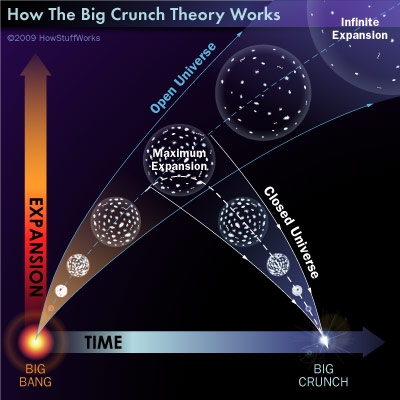
After establishing that the universe is expanding (with reference to Edwin Hubble’s discovery of it in the 1920s, who observed that all other galaxies were moving away from us and were doing so faster, the further away they were1), Krauss presents three alternatives for how that expansion may be occurring: “[A] closed Universe would expand and stop and then recollapse in a Big Crunch, the reverse of the Big Bang. An open Universe would expand forever and a flat Universe will expand and slow down and never quite stop.” The following illustration shows the open and closed cases – the flat one being similar to the open one, but having a limit (bound) to its (still infinite) expansion as opposed to being unbounded.

Big crunch open and flat universe

In the process of determining which of the three cases of expansion our Universe is undergoing, the challenge of measuring the mass of galaxies (to infer from them the curvature of their light-bending effects and therefore the curvature of the universe) and the whole universe arises and attempts to do so show that “most of the mass in [a] system of clusters of galaxies is not where the galaxies are. It’s between the galaxies. It is where nothing is shining.” This in turn leads to the realization that “dark matter is a new type of elementary particle,” which further complicates the quest for measuring the mass and energy of the universe.

The consequences of the universe being flat (i.e., expanding infinitely but asymptotically towards a limit) are then spelled out:

“It turns out that in a flat Universe, the total energy of the Universe is precisely zero. Because gravity can have a negative energy. So the negative energy of gravity balances out the positive energy of matter. What’s so beautiful about a Universe with total energy zero? Well, only such a Universe can begin from nothing. And that is remarkable, because the laws of physics2 allow Universes to begin from nothing! You don’t need a deity.3 You have nothing. Zero total energy and quantum fluctuations can produce a Universe.”

This nothing is further illustrated by results obtained recently about the mass of protons, where:

“it turns out most of the mass of the proton comes not from the quarks within a proton, but from the empty space between the quarks. These fields popping in and out of existence produce about 90% of the mass of a proton, and since protons and neutrons are the dominant stuff in your body, the empty space is responsible for 90% of your mass. So this empty space is vital to science and these calculations are vital to understanding not just protons, but electrons and atoms and produce the best comparisons.”

In other words, the nothing from which a universe can come into being is a “boiling bubbling brew of virtual particles that are popping in and out of existence” “because of the laws of quantum mechanics and special relativity.” This nothing is an “empty space” that is empty insofar as matter and gravity cancel out each other’s energy and insofar as quantum mechanics deals in fields that may or may not yield particles.

As far as this being what I understood, I actually find it quite beautiful – and Krauss would agree by saying that “the only mathematically beautiful Universe” is a flat one, like ours. There is a symmetry between positive and negative energy, light and dark matter, there is infinite expansion that is at the same time bounded, there is a constant dynamic of being potentially versus actually and there is a tremendous amount of beautiful science that has lead to this view of the universe. We have Lemaître’s and Hubble’s insights into the universe’s expansion, we have the astonishing work on measuring the universe’s curvature by means of looking at it’s background radiation, we have ways of measuring the mass of distant galaxies and their distances from us and so much more. From this point of view, I do recommend Krauss’ talk wholeheartedly.

Sadly, there is another side to it, which is its being peppered with jabs at religion and a profound ignorance of what many religious people believe. The underlying view of religious faith that informs the criticisms leveled against it here, and in many other atheist forums, seems to have people like Young-Earth creationists, Pentecostal snake-handlers and members of groups like the Westboro Baptist Church as their model. This is akin to me taking someone like Dr. Josef Mengele as the archetype of a scientist and projecting prejudices from him to all scientists. I have about as much in common with the lunacy of the above mentioned “religious” groups as with the barbarity of the above mentioned “scientist.”

Let me be a bit more specific though about why the religion-related claims of Krauss don’t stick, as it can otherwise seem like this is just a lot of hand-waving. First, let’s look at the cosmology (and cosmogeny) presented by Krauss, which postulates a coming-into-being of the universe from nothing. If anything, this scientific insight is fully consistent with the Christian account of creation, where God creates the world from nothing – hence the emblematic Latin phrase: “ex nihilo.” The Christian view of how the world came into being is not one of a God having inhabited space-time and then decided to turn parts of himself into planets, vegetation, animals, humans. Instead, the Catechism here affirms that “God gave a beginning to all that exists outside of himself” (§290), where (in some sense) there was nothing before: “All things came to be through him, and without him nothing came to be” (John 1:3). The Nicene Creed even speaks about God as the creator of “all things visible and invisible,” which can comfortably be applied to dark matter or the negative energy of gravity.

In fact, the Catechism (§296) is insistent on there having been nothing before the Universe started:

“We believe that God needs no pre-existent thing or any help in order to create, nor is creation any sort of necessary emanation from the divine substance. God creates freely “out of nothing”: “If God had drawn the world from pre-existent matter, what would be so extraordinary in that? A human artisan makes from a given material whatever he wants, while God shows his power by starting from nothing to make all he wants.” (St. Theophilus of Antioch, Ad Autolycum II)”

So, if anything, the model of a flat universe and of the nothingness that is at its origin is in perfect accord with what the Church has come to believe through revelation and the guidance of the Holy Spirit over the centuries (and as early as in the 2nd century in the writings of St. Theophilus!). There simply is no conflict here – listening to the science Krauss talks about just makes me delight in how much better we understand how it was that the universe came into being from nothing. I can therefore happily conclude, again with the Catechism (§283):

“The question about the origins of the world and of man has been the object of many scientific studies which have splendidly enriched our knowledge of the age and dimensions of the cosmos, the development of life-forms and the appearance of man. These discoveries invite us to even greater admiration for the greatness of the Creator, prompting us to give him thanks for all his works and for the understanding and wisdom he gives to scholars and researchers.”

Catholics (and adherents of many other Christian denominations and other religions) are in no way at odds with the advances of science, since – in addition to the benefits that it enables for the good of all, it sheds light on how the universe works and how it has worked since its beginning. Those who believe in God having created the universe (from nothing!), being the source of its laws and continuously sustaining its being can enjoy the advances of science as much as those who don’t hold those beliefs, and I wish that neither side would try to ridicule the other or force them to change their views!


1 Incidentally, it was Georges Lemaître – the Belgian priest and physicist, who made this realization based on Hubble’s data a couple of years before Hubble did.
2 It always baffles me how many atheists hail the latest developments of science as proofs of the non-existence of God, while quite happily relying on pre-existing “laws of physics.”
3 I. e., a “god of gaps” deity …

What is a holy person like?

Butterfly wikimedia 0085 big

Last Sunday, Archbishop Rowan Williams met a group of young people in New Zealand and spoke to them about what it means to be a holy person. As will be no surprise to you, if you have been following this blog, his words were again a joy to read and I would just like to share my favorite bits with you.

The starting point of the talk is the apparent contrast of the Old Testament concept of holiness, where the emphasis is on being set apart, special, protected and the New Testament view which focuses on ubiquity (St. Paul’s addressing the first Christian communities as saints and holy people) and on the central importance of Jesus’ being involved intimately with human suffering, culminating in his crucifixion. This takes us to the realization that “[b]eing holy is being absolutely involved, not being absolutely separated.”

Instead of a holy person being “weird, […] drained of blood[, …] in a nutshell, not like us,” they go “into the heart of where it’s most difficult for human beings to be human”:

“And so Jesus goes outside the city, he goes to the place where people suffer and are humiliated, he goes to the place where people throw stuff out, including other people. [… The Christian idea of holiness is …] something to do with going where it’s most difficult in the name of the Jesus who went to where it was most difficult. And he wants us to be holy like that.”

As a result “there’s no contrast, no tension […] between holiness and involvement in the world. On the contrary, the most holy, who is Jesus, is most involved, most at the heart of human experience.” Instead of an irritating “saintliness, strictness, devoutness, goodness” that makes people around them feel “worse, guilty, inadequate,” holy people “make you feel better than you.”:

“But the holy person somehow enlarges your world, makes you feel more yourself, opens you up, affirms you. They’re not in competition; they’re not saying, ‘I’ve got something you haven’t’. They’re saying, ‘There’s an enormous amount of room for you in the world we occupy together.'”

This is not about complacency though, but about realizing that “it’s OK, we can start [here]. The world is big enough and God is big enough.” Saints “produce joy around them”; when you are with them “the landscape changes – there [is] a new light on it.” Holiness is not “a sort of extra special kind of goodness[, …] it’s not about competing levels of how good you are[, it’s] about enlarging the world, and it’s about involving in the world.”:

“[H]oly people, however much they may enjoy being themselves, just aren’t obsessively interested in themselves. They actually allow you to see, not them, but the world. They allow you to see not them, but God.[…]

[But], there’s the catch: if you want to be holy, stop thinking about it. If you want to be holy, look at God. If you want to be holy, enjoy God’s world, enter into it as much as you can in love and in service.”

These are just a couple of the bits I liked most from the talk and I’d encourage you to read it in full. What struck me as I was reading it was a very strong sense of knowing people just like that! I have been blessed, and keep being blessed, by knowing a number of holy people (a number that strikes me as being undeservedly large!) and counting them among my friends. Meeting them, or even receiving an email or text message from them, leaves me with precisely what Archbishop Williams says – a conviction that they have made me see the beauty of the world and God. As I know some of you are reading this: thank you!

All saints

Saints friends

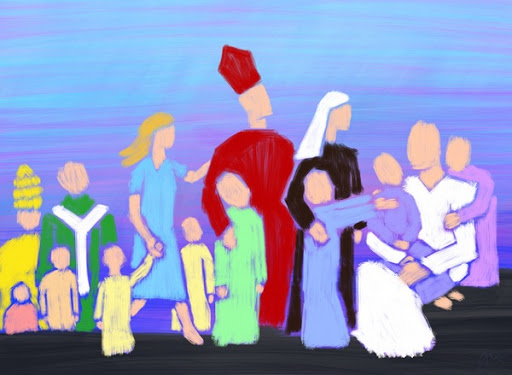
If you are a regular reader, you’ll know that the saints are very close to my heart and a frequent topic on this blog. Today, I’d just like to share the above painting with you (the cover of an book on saints for children, in preparation by my besties PM and JM) and the following quote:

“[O]nce you enter into friendship with God, everything in your life begins to change. … You are attracted to the practice of virtue. You begin to see greed and selfishness and all the other sins for what they really are, destructive and dangerous tendencies that cause deep suffering and do great damage. … You begin to feel compassion for people in difficulties and you are eager to do something to help them. … And once these things begin to matter to you, you are well on the way to becoming saints” (Benedict XVI, addressing Catholic pupils on 17 September 2010, during his visit to the UK)

Happy All Saints day!

Dei Verbum: a first look

Word made flesh 2

As set out in a previous post, I have embarked on a journey through the 16 Vatican II documents, starting with the dogmatic constitution Dei Verbum here.

Before getting into it, let me start with a few words to those of you – my friends! – who hold no or other beliefs about God than me. Without meaning to tell you what to do, I’d say that probably the best attitude to have when reading this post (and the rest of the series that will follow on Vatican II) is that of Thomas Nagel in his well-known paper entitled: “What is it like to be a bat?1 I don’t mean to get sidetracked here into his superb challenge to how consciousness is to be approached, but would just like to take some pointers from him on how one can consider the words of another, who holds different beliefs (and I am talking purely about understanding, without meaning to reduce relationships to knowledge alone). Nagel has the key insight that the question of what it is to be a bat is not about what it would be like for me to be a bat, but what it is for a bat to be a bat. “Yet if I try to imagine this, I am restricted to the resources of my own mind, and those resources are inadequate to the task. I cannot perform it either by imagining additions to my present experience, or by imagining segments gradually subtracted from it, or by imagining some combination of additions, subtractions, and modifications.” Just to avoid any misunderstanding, I believe these limitations apply in both directions. I too lack the direct experience of not believing in God or of holding other beliefs to my own, and therefore can only get so far with understanding what it is like to be an atheist or agnostic using my own “inadequate resources.” Sticking to Nagel’s example, trying to understand another person with whom I don’t share a key characteristic is like trying to understand from a bat what it is like to have sonar. Even if the bat could speak English, we wouldn’t have a shared vocabulary for it to quite get that across to me. In spite of such limitations, I hope that you will find interest in how Catholics look at the way they believe God has revealed himself to the world, which is precisely the subject of Dei Verbum.

Where else would the discourse start but with a quote from the New Testament, where John says the following:

“We announce to you the eternal life which dwelt with the Father and was made visible to us. What we have seen and heard we announce to you, so that you may have fellowship with us and our common fellowship be with the Father and His Son Jesus Christ” (1 John 1:2-3)

This puts us in a very clear context from the word go: that of continuity with Jesus’s disciples desiring to share what they have “seen and heard,” for the sake of building relationships with others and with God. The purpose of Dei Verbum then is to clarify how the above revelation of God to the world is to be understood. This revelation, where “the invisible God out of the abundance of His love speaks to men as friends and lives among them, so that He may invite and take them into fellowship with Himself.”

Dei Verbum proceeds to present different ways in which God has revealed and continues to reveal himself:

  1. Nature. “God, who through the Word creates all things and keeps them in existence, gives men an enduring witness to Himself in created realities” and “he ceaselessly kept the human race in His care, to give eternal life to those who perseveringly do good in search of salvation.” The message here is clear: God can be found in his creation,2 “known […] by the light of human reason” and all who live for others rather than themselves will find him.
  2. The people of Israel. “Then, at the time He had appointed He called Abraham in order to make of him a great nation. Through the patriarchs, and after them through Moses and the prophets, He taught this people to acknowledge Himself the one living and true God, provident father and just judge.” The books of the Old Testament “give expression to a lively sense of God, contain a store of sublime teachings about God, sound wisdom about human life, and a wonderful treasury of prayers, and in them the mystery of our salvation is present in a hidden way.” Even though these books “also contain some things which are incomplete and temporary, [we] should receive them with reverence.” “God, the inspirer and author of both Testaments, wisely arranged that the New Testament be hidden in the Old and the Old be made manifest in the New.”
  3. Jesus. “He sent His Son, the eternal Word, who enlightens all men, so that He might dwell among men and tell them of the innermost being of God.” God sends his Son, Jesus – the “eternal Word” – and through his life, teaching, death and resurrection, God shows himself directly to us and reveals himself in full intimacy.
  4. The Holy Spirit. For someone to “freely assent to the truth revealed by Him […], the grace of God and the interior help of the Holy Spirit must precede and assist” and “[t]o bring about an ever deeper understanding of revelation the same Holy Spirit constantly brings faith to completion.” While revelation is complete in the person of Jesus, the Holy Spirit (“the Spirit of truth”), whom Jesus sent to his followers after his resurrection, continues to deepen our understanding of it.

How is it then, that God’s revelation is preserved, maintained and spread? Jesus commissioned the Apostles to share with others “what they had received from [His lips], from living with Him, and from what He did, or what they had learned through the prompting of the Holy Spirit.” They were also prompted to “commit the message of salvation to writing” and, “to keep the Gospel forever whole and alive.” “[T]he Apostles left bishops as their successors, “handing over” to them “the authority to teach in their own place.” (St. Irenaeus, Against Heretics III, 3)” Since the words of the Gospel are put into practice by Jesus’ followers, and since the Holy Spirit inspires them, “there is a growth in the understanding of the realities and the words which have been handed down.” This to me is quite a key passage – the account of Jesus’s life and teaching is not a static piece of text, frozen in time, but instead a source of growing understanding and new insights brought about with the help of the Holy Spirit in those who follow Jesus: “[T]hus God, who spoke of old, uninterruptedly converses with the bride of His beloved Son; [through the] Holy Spirit, through whom the living voice of the Gospel resounds in the Church, and through her, in the world.” The upshot of this is a very tight link between Scripture (a record of Jesus’ life and teaching) and Tradition (Jesus’ followers’ growing insight into Scripture from putting it into practice and with the help of the Holy Spirit), interpreted over time by the successors of the Apostles.

How is one to understand the nature of Scripture though? Dei Verbum first reaffirms the Church’s belief in “the books of both the Old and New Testaments in their entirety, with all their parts, [being] sacred and canonical because written under the inspiration of the Holy Spirit, they have God as their author and have been handed on as such to the Church herself.” However, since they were written by men, we “should carefully investigate what meaning the sacred writers really intended, and what God wanted to manifest by means of their words.” Here, a distinction needs to be made between passages that are “historical, prophetic, poetic, or of other forms of discourse.” “[We] must investigate what meaning the sacred writer intended to express and actually expressed in particular circumstances by using contemporary literary forms in accordance with the situation of his own time and culture. [… D]ue attention must be paid to the customary and characteristic styles of feeling, speaking and narrating which prevailed at the time of the sacred writer, and to the patterns men normally employed at that period in their everyday dealings with one another.” This is as far from literalism as you can get – instead it is a teasing out of intention from a text anchored in a specific period of history and in a specific geographical location. No wonder its understanding has the potential to grow and for “new insights [to be] brought about”!

An important warning follows next in Dei Verbum: “serious attention must be given to the content and unity of the whole of Scripture if the meaning of the sacred texts is to be correctly worked out [and t]he living tradition of the whole Church must be taken into account along with the harmony which exists between elements of the faith.” Understanding what was meant by a passage from Scripture mustn’t be done on the basis of picking a couple of phrases out of the whole and trying to make sense of them from scratch. They are part of a textual corpus and there is a rich body of existing insight into them and interpretation of them, to which any new understanding can add. Preserving the message God sent us through his Son and the Holy Spirit – and understanding it in the context I am in – requires a careful and critical interaction with all of Scripture, in which the Church’s judgment plays a key guiding and interpretative role too. Ultimately, the aim is “that we may learn the gentle kindness of God, which words cannot express, and how far He has gone in adapting His language with thoughtful concern for our weak human nature” (St. John Chrysostom, On Genesis).

Within the New Testament, the Gospels have a special “preeminence,” “for they are the principal witness for the life and teaching of the incarnate Word.” Their authors wrote the four Gospels, “selecting some things from the many which had been handed on by word of mouth or in writing, reducing some of them to a synthesis, explaining some things in view of the situation of their churches and preserving the form of proclamation but always in such fashion that they told us the honest truth about Jesus. For their intention in writing was that […] we might know “the truth” concerning those matters about which we have been instructed.” To make these “words of God” “accessible at all times, the Church […] sees to it that suitable and correct translations are made into different languages, especially from the original texts of the sacred books.” Preference is given also to producing translations “with the separated brethren[…, so that] all Christians will be able to use them.”

Finally, all Christians are called to a frequent reading of Scripture and to accompany it with prayer, “so that God and man may talk together; for “we speak to Him when we pray; we hear Him when we read the divine saying.” (St. Ambrose, On the Duties of Ministers I)” In this way “the treasure of revelation, entrusted to the Church, may more and more fill the hearts of men.”

So, these are my 1500 word notes on the 6000 word Vatican II text 🙂 – if you are interested, do read it in full. I certainly got a lot out of it and feel very comfortable with what the Church teaches about Scripture: they are believed to be the true Words of God, but since they were recorded by humans and within the “literary forms” and cultural conventions of a specific place and time, the task of understanding what the authors’ intentions were and what God meant to communicate, is a delicate process. That it is a process is also key, to my mind – it is not like these 2000 year old texts can just be internalized immediately (no text can!). Instead, they require knowledge, discernment, an open mind and the willingness to hear what God has to say to me – here and now.

Lumen Gentium is up next, and since it has 27000 words, I reckon it will occupy me for a while :).


1 Thanks to my bestie, Margaret, for introducing me to this paper a good 10 years ago! If you are interested in consciousness at all, I highly recommend it in full.
2 Note, that this does not imply the lunacy of Creationism – instead, I read this as, with our best knowledge today, God sustaining a universe that he made to follow the (his!) Standard Model.

The agrapha: Jesus’ extra-canonical sayings

Elbuenpastor

Over the course of the last week I have come across a – to me previously unknown – source of Jesus’ sayings: the “agrapha,” and this straight from two places: first, Pope Benedict XVI’s off-the-cuff (!) remarks during the first day of the Bishops’ synod, where he quotes Origen quoting Jesus as saying “Whoever is close to me is close to the fire,” where the fire is God’s presence. Second, an article about the Servant of God Igino Giordani, where he reflects on Tertullian and St. Clement of Alexandria quoting Jesus as saying: “Have you seen your brother? You have seen your God.”

So, what are these “agrapha”? The word comes from the Greek agraphon – “non written” and refers to these sayings (sometimes also called logion/logia) not being found in the canonical Gospels, but instead having been (up to a point) handed down by word of mouth. As of today there are 21 that are generally though to be authentic, based on a specific set of criteria, spelled out in the Catholic Encyclopedia. They come from the rest of the New Testament (unsurprisingly) – i.e., being instances of someone quoting Jesus as opposed to Jesus being recorded as speaking directly as in the Gospels, from apocryphal sources – contemporary or near-contemporary sources to the Gospels that have not been included in the New Testament due to overall questions about their authenticity, from the Church Fathers – early Christian teachers quoting Jesus’ sayings passed down by verbal tradition and from the Oxyrhynchus Papyri – a set of manuscripts discovered in 1897 and 1904 dating from the early half of the 3rd century AD. While the current set numbers 21 such sayings, it is certainly open to extension if new sources are discovered and if their likelihood of authenticity is judged high. Also worth pointing out is the fact that these sayings are not attributed the same status as those of the canonical texts (more on that in the future post on Dei Verbum) and that a less stringent level of scrutiny is applied to them.

Nonetheless, if these sayings are likely to come from Jesus, there is great merit in knowing of them and understanding how they might shed new light on what is recorded about Jesus in the Gospels. Having the Pope himself quote one of them and having such a great Catholic writer as Igino Giordani reflect on them, should add further impetus to looking at them myself.

The following then are my favorites from among the full set found here, skipping ones found in the New Testament outside the Gospels, which are already familiar:

  1. Let your alm sweat in your hands until you know to whom to give it. (Didache, 1.6)
  2. Those who wish to see me and take hold of my kingdom must receive me in tribulation and suffering. (Barnabas, 7.11b)
  3. There shall be schisms and heresies. (St. Justin Martyr, Dialogue with Trypho, 35)
  4. In what things I take you [by surprise], in those things I also will judge.(ibid, 47)
  5. The days will come in which vines will grow, each having ten thousand shoots, and on each shoot ten thousand branches, and on each branch ten thousand twigs, and on each twig ten thousand clusters, and in each cluster ten thousand grapes, and each grape, when pressed, will give twenty-five measures of wine. And, when one of those saints takes hold of a cluster, another cluster will clamor: I am better, take me, bless the Lord through me! Similarly a grain of wheat also will generate ten thousand heads, and each head will have ten thousand grains, and each grain five double pounds of clear and clean flour. And the remaining fruits and seeds and herbiage will follow through in congruence with these, and all the animals using these foods which are taken from the earth will in turn become peaceful and consenting, subject to men with every subjection. (St. Irenaeus, Against Heresies, 5.33.3-4, quoting Jesus talking about what heaven will be like, his source being “Papias […] who was a[n] earwitness of John and companion of Polycarp”)
  6. Have you seen your brother? You have seen your God. (St. Clement of Alexandria, Miscellanies, 1.19)
  7. Ask for the great things, and the little things will be added unto you. (ibid, 1.24)
  8. With reason, then, the scripture, wishing us to become such kind of dialectics, exhorts: But become approved moneychangers, rejecting the [evil] things, and embracing the good. (ibid, 1.28)
  9. Love covers a multitude of sins. (ibid, 4.8)
  10. No man can obtain the heavenly kingdom that has not passed through temptation. (Tertullian, On Baptism, 20)
  11. How can you say: I have kept the law and the prophets? For it is written in the law: You shall love your neighbor as yourself. And behold, many of your brethren, sons of Abraham, are clad in filth, dying of hunger, and your house is full of many good things, and nothing at all goes out of it unto them. (Origen, On Mathew, 15)
  12. On account of the sick I was sick and on account of the hungry I was hungry and on account of the thirsty I was thirsty. (ibid, 13.2)
  13. He that is near me is near the fire. He that is far from me is far from the kingdom. (Origen, On Jeremiah, 20.3)
  14. If your brother sins in word […] and makes satisfaction to you, seven times a day receive him. Simon his disciple said to him: Seven times a day? The Lord responded and said to him: Still I say to you, until seventy times seven. For indeed in the prophets, even after they were anointed by the holy spirit, the speech of sin was found. (St. Jerome, Against Pelagius, 3.2)
  15. And taking them along he entered into the place of purification itself and was walking around in the temple. And there came a certain Pharisee, a high priest, Levi by name, and he joined them and said to the savior: Who allowed you to tread on this place of purification and see these holy vessels, neither having bathed nor the feet of your disciples having been baptized? But after having defiled it, you treaded on this holy place, which is clean, on which no other man unless he has bathed and changed his clothing treads, nor dares to look at these holy vessels. And the savior immediately stood with the disciples and answered him: You therefore, being here in the temple, are you clean? The former says to him: I am clean. For I bathed in the pool of David and by one ladder going down by another I went up, and I garbed myself in garments white and clean, and then went and looked upon these holy vessels. The savior answered to him and said: Woe, blind men who do not see. You bathed in these flowing waters in which dogs and swine are cast night and day, and washed and smeared the outside skin, which even the prostitutes and the flute-girls perfume and bathe and wipe and beautify for the desire of men, but within they are filled with scorpions and all evil. But I and my disciples whom you say have not been baptized have been immersed in waters of eternal life. (Papyrus Oxyrhynchus 840, 7b-45)
  16. Wherever there are two, they are not without God; and wherever there is one alone, I say I am with him. Raise the stone and there thou shalt find me; cleave the wood, and there am I. (Papyrus Oxyrhynchus 1)

What a rich harvest! There is much here to think and talk about, but I wanted to share it with you as soon as I could, hence the “bare” presentation. Enjoy!

St. Teresa of Ávila: children’s book sneak preview

Teresa avila

On today’s feast of St. Teresa of Ávila, I have a special treat for you: a sneak preview of an upcoming, illustrated book about saints for children by my besties PM and JM. What follows is St. Teresa’s story written for children in the 5-10 year age range:

Saint Teresa of Ávila
(Teresa Sánchez de Cepeda y Ahumada)
1515 AD (Ávila, Spain) – 1582 AD (Salamanca, Spain)
Feast day: 15 October

Saint Teresa of Avila, who lived in Spain and was a friend of Saint John of the Cross, wanted to follow Jesus ever since she was a little girl. At the age of seven she decided to give her life to Jesus and when she grew up she became a nun. Do you know what a nun is? Nuns are women who follow Jesus by spending long hours in prayer, by looking after the poor and sick, by teaching or by helping people in whatever way they can. Saint Teresa was a great nun! She reminded her sisters that it is important to be poor, like Jesus taught us, and she was also exceptionally good at praying.

Do you like to pray? How do you pray? What Saint Teresa understood was, that Jesus is our friend and that praying to him is just like talking to a friend. You can ask him for help, you can tell him what makes you happy or sad, you can thank him for all the good he has given you. If you like, try it next time you pray!

Saint Teresa was also very concerned for Jesus and wanted to make his suffering on the cross easier for him. Even though we weren’t there when Jesus died on the cross, we can still be close to him when we are ill, uncomfortable or in pain. Have you ever had a sore tooth, a scratch, a bruise or a bump? In all of these you can be close to Jesus and tell him that you love him.

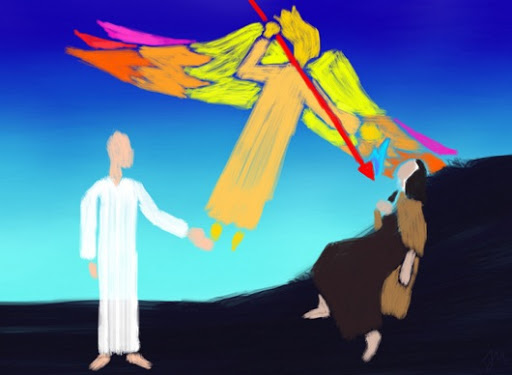
Jesus loved Saint Teresa so much that he even came to visit her – she could feel that he was in front of her even though she couldn’t see him with her eyes. The picture she saw when Jesus visited her, was of an angel who pierced her heart with a burning spear, which is very painful. But then the angel pulled his spear out and she felt great joy! This confirmed to her how important it is to love Jesus when we are in pain and that, if we do so, we will also share with him the joy of rising from the dead.

Quote:
Let nothing disturb you.
Let nothing make you afraid.
All things are passing.
God alone never changes.
Patience gains all things.
If you have God you will want for nothing.
God alone suffices.

If you have any feedback to pass on to PM and JM, please, leave it in the comments.

From individual to person

Community1

I am feeling quite “meta” today and have no less than four reasons for it: first, what I am about to discuss is fundamentally meta, second, the act of writing about it to you is an instance of it, third, it ties several of the strands that I started in previous posts together, and, fourth, it has come to me in a way that illustrates the topic itself (thanks to my bestie, Margaret, of ‘the God of Explanations’ fame). If that is not enough to pique your interest, let me add that it is centered around a talk given by one of my favorite contemporary thinkers – Dr. Rowan Williams, the Archbishop of Canterbury.

The subject of the talk is an exploration of what it means to be human and revolves around the distinction between an individual and a person. In customary magisterial fashion, Archbishop Williams ties together the thinking of St. Augustine, Orthodox and Catholic theologians (Vladimir Lossky and Robert Spaemann), a Russian and a French philosopher (Mikhail Bakhtin and René Descartes), a French thinker (Alexis de Tocqueville), a psychotherapist (Patricia Gosling) and an LSE sociologist (Richard Sennett). The argument begins by claiming that the relevant polarity is not between individualism and communitarianism but between the concepts of an individual and a person.

Here an individual is simply an example of a certain thing: e.g., Bob is an example of a human being, just like Fido is an example of a dog. Seen from this “atomic” perspective (where, incidentally, “individuum” is merely the latinized version of the Greek “atomos”), the individual is the center of their own world – its solid core. Even when they engage in relationships with others, they always have “the liberty of hurrying back home,” and the best relationship they can have with the world, that is separate from them and beyond them, is control. The consequences of such a view of what it is to be human are alienation, non-cooperation and unease with limits. This view is summed up clearly by de Tocqueville saying that “[e]ach person, withdrawn into himself, behaves as though he is a stranger in the destiny of all the others.” It is also the psychological and anthropological parallel of the epistemic approach pioneered by Descartes (and driven to its limit in the “brain-in-a-vat” scenario), that I also adapted in an earlier post and that, in art, is mirrored by Antony Gormley’s approach to sculpture.

The other concept of a human being is that of a person, where there is “something about us as a whole that is not defined just by listing the facts that happen to be true about us” and where a person is a “subject [that is] irreducible to its nature” (Lossky). Williams argues though that while “we know what we mean by personal/impersonal and persons in relation, […] we struggle to pin down what we mean that we cannot be reduced just to our nature.” He then goes on to postulating that “what makes me a person and distinct from another person is not a bundle of facts, but relations to others. I stand in the middle of a network of relations.” This leads to the definition of a person as the “point at which relationships intersect.”

Williams then moves on to the question of how one is to determine whether another is a human person and, following from the previous analysis, concludes that this cannot be done on the basis of a checklist for whether a given set of pre-requisites are present. Instead, we need to “form a relation, converse, to determine whether another is a person” and that language helps us to decide. He is quick here to move from a narrow concept of language as verbal only to a broad one that includes gestures and the “flicker of an eyelid.” This means that “[p]ersonal dignity or worth is ascribed to human individuals because, in a relationship, each of us has a presence or meaning in someone else’s existence. We live in another’s life. Living in the life of another is an implication of the profound mysteriousness about personal reality. Otherwise you end up with the model where somebody decides who is going to count as human.” Such a test of human personhood based on relateability very much reminded me of Turing’s test of machine intelligence, where the basis again is not a predetermined set of criteria, but the ability for a machine to converse with (relate to) a human person and for that person to recognize the machine as a person. Williams’ point about “each of us [having] a presence or meaning in someone else’s existence” also brought back echoes of Martini’s “the other is within us.”

How does the individual (which is by far the position with the strongest epistemic justification) see themselves as a person though? Here Williams quotes the following passage from Spaemann:

“Each organism naturally develops a system that interacts with its environment. Each creature stands at the center of its own world. The world only discloses itself as that which can do something for us; something becomes meaningful in light of the interest we take in it. To see the other as other, to see myself as his “thou” over against him, to see myself as constituting an environment for other centers of being, thus stepping out of the center of my world, is an eccentric position. […] As human beings in relationship, we sense that our environment is created by a relation with other persons; we create an environment for them and in that exchange, that mutuality, we discover what person means.”

How do you “step out” and assume an “eccentric position” tough? Here, Williams admits that such “stepping beyond one’s own individuality requires acts of faith. Living as a person is a matter of faith.” And I completely agree with him – strictly from a position of introspective enquiry, from Gormley’s “darkness of the body,” there is no fact-based way out. There is a need for a Kierkegaardianleap of faith,” but I would like to argue that it does not require a belief in God and in fact is akin to Eco’s communist acquaintance’s belief in the “continuity of life” discussed in an earlier post.

Finally, let’s also look at what Williams says about the aspect of personhood that is revealed as a consequence of belief in God:1

“Before personal relations, we are in relation with God. I am in relation to a non-worldly, non-historical attention which is God. My neighbor is always somebody who is in a relation with God, before they are in a relation with me. There is a very serious limit for me to make of my neighbor what I choose. They don’t belong to me and their relation to me is not what is true of them or even the most most important thing that is true of them. Human dignity – the unconditional requirement that we attend with reverence to one another – rests firmly on that conviction that the other is already related to something that isn’t me.”

In summary, a very clear picture emerges here, where I can think of myself as an individual – a world unto myself – or as the intersection of relations with others that allows me to go beyond myself and recognize in others that they are part of my world and I part of theirs. As a Christian this eccentricity also reveals to me that the relations I have with others build on the relations He has with them already and allow me to relate to Him not only in the intimacy of my self but also through my neighbors.


1 As an argument, this is essentially a variant of Bishop Berkeley’s response to the following challenge to his philosophy, where being is predicated on perceiving:

There was a young man who said God,
must find it exceedingly odd
when he finds that the tree
continues to be
when noone’s about in the Quad.

To which Berkeley responded with another limerick:

Dear Sir, your astonishment’s odd
I’m always about in the Quad
And that’s why the tree
continues to be
Since observed by, yours faithfully, God

:)))

Civil disobedience

399px Cloak of Conscience Closeup

One of the most common charges against “religious” people in general and Catholics in particular is that they surrender the use of their critical faculties and follow orders from their leaders like sheep. In other words: they are no trouble, they won’t break rank and are all-round model citizens.

Today I’d like to argue that this is as far from the truth as possible, and I will take advantage of the Vatican’s foreign secretary, Archbishop Dominique Mamberti’s address to the United Nations from last Monday, which in many ways tracks Pope Benedict XVI’s speech at the German Bundestag, delivered last year.

He starts by acknowledging the dangers that follow from the “financial crisis, which is worsening some humanitarian and environmental emergencies, does not seem yet to be over, and may even herald new and dangerous conflicts” and that spreading “the rule of law by every means becomes a particularly urgent task for a just, equitable and effective world governance.” Then, he fully aligns himself with the UN’s insistence on: “the unbreakable link between the rule of law and respect for human rights, […] the judicial control of laws and of executive power, […] transparency in acts of governance and the existence of public opinion capable of expressing itself freely.” Mamberti’s key point comes next though:

“The rule of law is also put at risk when it is equated with a legalistic mentality, with a formal and uncritical adherence to laws and rules, in an attitude which can even paradoxically degenerate into a means of abusing human dignity and the rights of individuals, communities and states, as happened during the totalitarian regimes of the 20th century. Furthermore, in the phrase “rule of law”, the concept “law” should be understood as “justice”.”

The first thing to note here is that it calls for critical thinking and, I believe, that, as far as they are rules, this warning also applies to Church teaching. Taking even the ‘rules’ that the Church presents to its members and applying them with a “legalistic mentality, with a formal and uncritical adherence” can lead to their perversion. The Church has very rightly emphasized a focus on deepening one’s relationship with Jesus during the upcoming Year of Faith, rather than talking about making oneself familiar with Church “rules.”

In case you think that this is just my own interpretation of Church teaching, as opposed to the official line, let me point to one of my favorite lines from the Catechism:

A human being must always obey the certain judgment of his conscience. If he were deliberately to act against it, he would condemn himself. (CCC, §1790)

In fact, this brings us back to Mamberti’s talk, where he affirms that justice is “proper and inalienable to the nature of every human being.” Bringing all of this together in fact puts a Catholic into a position of having to critically assess laws and being called both to strict adherence to those that are aligned with their conscience and to resistance against those that don’t. This is neither a position of blind obedience, nor one of disregard for the law, but a more complex, but far more personally and socially rewarding one, where discernment and prudence need to be exercised.

Let’s get back to Mamberti though and see what he has to say about justice:

“Man is not merely self-creating freedom. Man does not create himself. He is intellect and will, but he is also nature, and his will is rightly ordered if he respects his nature, listens to it and accepts himself for who he is, as one who did not create himself. In this way, and in no other, is true human freedom fulfilled, and it is only in this way that we can speak truly of the rule of law.”

The key here, to my mind, is that freedom is not arbitrary. You can’t just decide, with disregard for human nature and your conscience, what behavior to follow and expect that it will allow you to remain free.

Just to avoid giving the impression that this topic is in any way simple, Mamberti rightly recognizes that “[t]he question of how to recognize what is truly right and thus to serve justice when framing laws has never been simple, and today in view of the vast extent of our knowledge and our capacity, it has become still harder.” The more you know the more difficult certainty becomes, which echoes Socrates’ “The more I learn, the more I learn how little I know.” And, finally, he postulates a very clear link between a subversion of the law and the economic crisis that the world is in today:

“It is well known that, at the international level, there are interest groups present who, by means of formally legitimate procedures, are impacting on the policies of states in order to obtain multilateral norms which not only cannot serve the common good but which, under the guise of legitimacy, are in fact an abuse of norms and of international recommendations, as has been seen in the recent financial crisis.”

Even just the last 100 years have been addled with abuses of the law that were fully legal in the sense of not exhibiting procedural violations. It would be a mistake to think though that this is all in the past or that it only applies to regimes notorious for human rights abuses. Even in the “civilized West” there are attacks on the rights of peoples to express their desire for self-determination and on the practice of religious freedom. As St. Augustine said “Without justice – what else is the State but a great band of robbers?”