Serving the Church

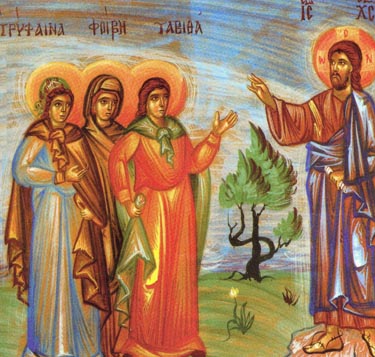
Christ calling Deaconesses to serve the Church

I am starting from scratch after having written a lengthy post on this topic already and realizing – after talking to my besties YYM1 and PM – that I was approaching the topic all wrong. I can still use all the research, but the tone had to change from the playful and partly sarcastic to what I am going to try next.

I feel that my being married, working at a tech company and being a lay person allows me to seek God without limits, to fully participate in the life of the Church and to have the path to sanctity wide open to me. At the same time I realize though that some of my Catholic sisters suffer from feeling the call to the priesthood and being faced with (a now final) barrier to it:

“I declare that the Church has no authority whatsoever to confer priestly ordination on women and that this judgment is to be definitively held by all the Church’s faithful.” (Ordinatio Sacerdotalis, §4)

At first sight (and maybe even after repeated reading) this might sound like an aspect of Church teaching that is simply out of date, that needs to catch up with the times and that can be summed up with the following:

“[T]here is an urgent need to achieve real equality in every area: equal pay for equal work, protection for working mothers, fairness in career advancements, equality of spouses with regard to family rights and the recognition of everything that is part of the rights and duties of citizens in a democratic State.” (Letter to Women, §4)

Now, maybe this will come as a surprise, but the author of both of the above quotes is the same person: Blessed Pope John Paul II, and you may ask yourself how he can at the same time talk about women’s rights and slam the door shut on the question of women priests. I believe the answer lies in the following (and, yes, it too is by John Paul II):

“If Christ […] entrusted only to men the task of being an “icon” of his countenance as “shepherd” and “bridegroom” of the Church through the exercise of the ministerial priesthood, this in no way detracts from the role of women, or for that matter from the role of the other members of the Church who are not ordained to the sacred ministry, since all share equally in the dignity proper to the “common priesthood” based on Baptism.” (Letter to Women, §11)

When I first saw this, a light went on in my mind after I read the words “an “icon” of his countenance.” Priests are Jesus’ proxies and transmit to us his presence in the Church and his being the source of the sacraments. When I attend mass, I experience a man saying the words that bring about the Eucharist, like I would have, had I been at the Last Supper; when I go to confession, I speak to a man, as I would have, had I been among Jesus’ disciples. Jesus having come into the world as a man rather than a woman is not an accident, nor is it a consequence of social conventions. I believe, that God became flesh as a baby boy, to use the male gender in a specific way, just like he sought consent from a girl to become His mother, again because of the specifics of the female gender. To read this as in any way discriminatory against women is incomprehensible to my mind, but I’ll leave that to another post.

Let me now put my last card on the table with regard to the priesthood. God’s call is ultimately the same for all of us: to choose Him as the first priority in our lives and to follow his new commandment of love. Placing something above a love for one’s neighbor and for God is a mistake, even if that something is the priesthood. If love for God and neighbor are missing, the priesthood becomes a millstone (“The road to hell is paved with the skulls of erring priests, with bishops as their signposts.” St. John Chrysostom) and if they are present, then it becomes secondary and one seeks specifics with humility. To come at the argument from a perspective of rights is also a category mistake. No one has the right to be made a priest, whether man or woman, and it is in all cases a gift that is received rather than an entitlement that can be claimed.

For now, let it suffice that my argument is this: the priesthood is only open to men, because Jesus was a man and because he indicated to us from the very beginning that it was through men that he wanted certain aspects of his ministry to be perpetuated. In this way, his ministers’ being male is integral to their being Jesus’ proxies and no matter what social or other developments ensue, the priesthood in the Catholic Church is going to remain restricted to them.

This is not the end of the story though, since we are ultimately all being called to be Jesus’ proxies: to be the means by which He can show His love to all. As a married, lay person I don’t feel in any way limited in the extent to which I can strive to imitate Jesus’ love for humanity, even if I don’t become a priest. But, and there is a but, there is a variety of other ways in which Jesus can be imitated and and in which Catholics can serve the Church (which is fundamentally also what the priesthood is about: service). Two of these, which today are not open to women, are the diaconate and the office of cardinal, and I would like to argue that they may both one day (hopefully soon) be conferred on women.

Bishop Emil Wcela has just published a very interesting article (that I recommend in full), entitled “Why not women?” It starts where the final word on women priests in the Catholic Church ends: by making a case for exploring the possibility of ordaining women as deacons. Wcela presents a compelling case, starting with evidence for deaconesses dating back right to the time of the apostles (giving the example of St. Phoebe, whom St. Paul calls a diakonos in his letter to the Romans (16:1) – although the meaning of the term is disputed) and dotted through the history of the church (including Pope Benedict VIII writing to the bishop of Porto to give him authority to ordain deaconesses). He the proceeds to give the example of deaconesses in other Christian churches, but is also clear about the fact that this is not the case in the Catholic Church at present.

Nonetheless, there has been a desire to explore its possibility since the Second Vatican Council, including a raising of the issue by the US bishops in a pastoral letter from 1992. 2009 then saw an important change to Canon law, which differentiates between the nature of the priestly and episcopal order and that of deacons, stating that bishops and priests “receive the mission and capacity to act in the person of Christ the Head; deacons, however, are empowered to serve the People of God in the ministries of the liturgy, the word and charity.” (Canon 1009 of the Code of Canon Law). This change removes the constraints that previous legislation placed on the diaconate and historical precedent further supports a future change in this area. Bishop Wcela finally notes that women already participate extensively in the Church’s ministry and that ordaining them as deacons would provide greater official recognition, confer the grace of the sacrament on them and give them access to ecclesiastical offices that require ordination. The article ends with a call to raising awareness of this opportunity and I would personally like to add my voice to it.

On a related note, Cardinal Timothy Dolan stated in an interview last March, that the office of cardinal is in principle open to women, since it does not require priestly or episcopal orders. He then proceeded to tell the story of how someone once suggested to Pope John Paul II to make Mother Teresa a cardinal, to which he replied: “I asked her – she doesn’t want to be one.” While the John Paul II – Mother Teresa story may be little more than an anecdote, it nonetheless expresses both the Church’s newfound openness and Mother Teresa’s humility beautifully. What is key here is the acknowledgement by one of the cardinals that his office is in principle not restricted to women.

I hope it is clear what I am getting at: the role of women in the Church is certainly not what it ought to be, but I see clear signs of a desire to change that, including at the highest levels. What it won’t be is an opening of the priesthood to women, but the diaconate and the office of cardinal are both on the horizon (hopefully even in my own lifetime). One point I would like to emphasize though is that the role of women in the Church needs to be all-pervasive and not only constrained to “women’s issues.” When one of the 23 women present at the Second Vatican Council – one of the Council Mothers – was asked what topics were discussed that related to women, she responded “We are now interested in everything.” As Fr. Fabio Ciardi, who was taught by Rosemary Goldie (another Council Mother) during his time at the Lateran University, said: “The temptation is to constrain women in the Church to dealing with topics that are about women, not knowing that all topics are about them and that they have a contribution to make to all of them.”


1 Thanks to YYM also for giving me probably the most acceptable label: “progressive orthodox.” It may sound like an oxymoron, but I shall wear it with pride :).
Mercy, not sacrifice

Jesus Heals 1 op 364x600

Today’s Gospel reading1 is definitely among my favorites, as it makes one thing very clear: Jesus did not come to set up a new club for the “good.” Instead, he and the Church are here for sinners:

While he was at table in his house, many tax collectors and sinners came and sat with Jesus and his disciples. The Pharisees saw this and said to his disciples, “Why does your teacher eat with tax collectors and sinners?” He heard this and said, “Those who are well do not need a physician, but the sick do. Go and learn the meaning of the words, ‘I desire mercy, not sacrifice.’ I did not come to call the righteous but sinners.” (Matthew 9:9-13)

Maybe the word “sinner” sounds uncomfortable, antiquated and out of fashion today, but I believe it can be read more broadly here as failure, outcast, disgraced, rather than only in the moral theology sense (i.e., as someone rejecting God’s call to love (cf. Catechism of the Catholic Church, §397)). I don’t mean set up failure in general and moral errors as an identity, but instead suggest that Jesus referred to the attitude of his “righteous” contemporaries towards those whom they considered failures. In other words, it is Jesus’ peers who equated sin not only with moral failure but also with mental or physical illness (considered to be a punishment for sin – either the patient’s own or that of their ancestors3) and with living at the margins of society.2 The “righteous” of the first century (and of today), considered sinners unworthy of Jesus’ company and would have preferred to have them out of sight. “Eugh, what do you want with those types, Jesus? They are not good, decent folk, pillars of the community, like us! They are not the sort of people who come to church!”

Jesus’ response is a sharp, sarcastic jab: “Go and learn the meaning of the words, ‘I desire mercy, not sacrifice.’ I did not come to call the righteous but sinners.” While I have for a long time though that Jesus refers to those that the Pharisees complain about as sinners, I now believe that a much better fit to this event is to take him as talking about the Pharisees themselves. By reprimanding them that God desires mercy, not sacrifice, he is charging them with having sinned against God’s call to love. The Pharisees are the ones in need of a physician too, but their self-righteousness blinds them to their own lack of openness and charity.

Applying this to myself makes me examine my own attitude to those that strike me as unfit for building relationships with. By sacrificing them to my own false sense of superiority (even if unwittingly at times), I place myself besides the Pharisees rather than in the circle around Jesus, where were are all weak, but where were have Him amongst us. I’ll start again tomorrow!


1 Incidentally, it is the feast of St. Matthew today, who’s call to follow Jesus precedes the passage quoted here.
2 Incredibly this attitude persists in some societies to this day …
3 See, e.g., “If you listen closely to the voice of the LORD, your God, and do what is right in his eyes: if you heed his commandments and keep all his statutes, I will not afflict you with any of the diseases with which I afflicted the Egyptians” (Exodus 15:26) and “For I, the LORD, your God, am a jealous God, inflicting punishment for their ancestors’ wickedness on the children of those who hate me, down to the third and fourth generation” (Exodus 20:5), but don’t ignore the next verse: “but showing love down to the thousandth generation of those who love me and keep my commandments.” which is another way of saying that God’s love is disproportionately greater than any punishment :). Also, see “The son shall not be charged with the guilt of his father, nor shall the father be charged with the guilt of his son. Justice belongs to the just, and wickedness to the wicked.” (Ezekiel 18:20) – just picking a single verse tends to be a great way to come up with nonsense …

Jesus’ wife: clicks, facts and ‘children in a marketplace’

King jesus wife

I wasn’t going to write about this, but then I received a direct (and very welcome) requests by my bestie PM, and with his help realized that there was a much more interesting angle to this story than the obvious (and not all that exciting) one.

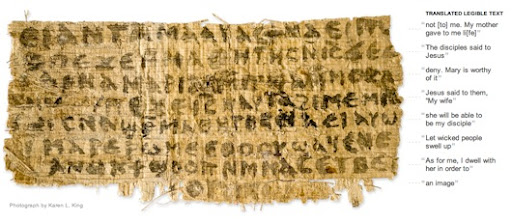
Let’s start with the facts of the matter: a fragment of Coptic script on papyrus that may date from the 4th century AD and that consists of 49.5 words in its English translation (see the top of this post) was presented at the International Congress of Coptic Studies on 18th September. The fragment contains no complete sentences and the sole reason for its overnight fame are the following words it contains:

Jesus said to them, “My wife

Looking at reports in the media, the following picture emerges:

“Even with many questions unsettled, the discovery could reignite the debate over whether Jesus was married, whether Mary Magdalene was his wife and whether he had a female disciple.” (New York Times)
“The discovery that some ancient Christians thought Jesus had a wife could shake up centuries-old Christian traditions” (Washington Post)
“A discovery by a Harvard researcher may shed light on a controversial aspect of the life of Jesus Christ.” (Huffington Post)
“A Harvard Divinity School professor’s interpretation of a scrap of fourth-century Egyptian papyrus that quotes Jesus Christ making reference to a wife could stoke new debates to the role of women in Christianity, theologians say.” (Boston Herald)
“An 4th century papyrus fragment could call centuries of celibacy into question.” (Time)

The message is clear: this is a major discovery that could alter that very foundations of Christianity in one fell swoop. As much fun as it would be to debunk statements like the above, it would be falling for a textbook straw man argument (as some have, while others, like Fr. James Martin, haven’t). Instead, let me defer any comment on the matter, until we see Dr. Karen L. King, the scholar who presented the fragment at the Congress, speak for herself. And what better way to do that than to refer to a draft of her peer-reviewed journal paper, to be published in the Harvard Theological Review (link courtesy of Harvard Magazine):

“This is the only extant ancient text which explicitly portrays Jesus as referring to a wife. It does not, however, provide evidence that the historical Jesus was married, given the late date of the fragment and the probable date of original composition only in the second half of the second century. Nevertheless, if the second century date of composition is correct, the fragment does provide direct evidence that claims about Jesus’s marital status first arose over a century after the death of Jesus in the context of intra-Christian controversies over sexuality, marriage, and discipleship.
[…]
The use of the term “gospel” here regards the probable genre of the work to which this fragment belonged (see below, “Genre”) and makes absolutely no claim to canonical status nor to the historical accuracy of the content as such. This invented reference in no way means to imply that this was the title in antiquity, or that “Jesus’s wife” is the “author” of this work, is a major character in it, or is even a significant topic of discussion—none of that can be known from such a tiny fragment. Rather the title references the fragment’s most distinctive claim (that Jesus was married), and serves therefore as a kind of short-hand reference to the fragment.”

Wait, what?! Unlike the cat-among-pigeons reaction of the media, Dr. King’s words (maybe with a little help from the journal’s reviewers 🙂 sound rational, factual and well representative of what this fragment may be: a text recorded probably in the 4th century AD that may be a copy of a 2nd century one, situated among the ’intra-Christian controversies’ of the day. No “Christianity 2.0”, no “we have had it all wrong for 2000 years” and no “shake up.”

In this (hopefully) more complete picture, Dr. King (who, after all was speaking at the Institutum Patristicum Augustinianum, which is part of the Pontifical Lateran University – i.e., popularly known as the “Pope’s University”!) comes up smelling of roses, while the various media reports happen to fit the topic that I actually wanted to talk about today like a glove! Namely, yesterday’s Gospel reading, in which Jesus vents his frustration with childish attitudes. In Luke 7:31-35 he is reported as saying the following:

“To what shall I compare the people of this generation?
What are they like?
They are like children who sit in the marketplace and call to one another,

‘We played the flute for you, but you did not dance.
We sang a dirge, but you did not weep.’

For John the Baptist came neither eating food nor drinking wine,
and you said, ‘He is possessed by a demon.’
The Son of Man came eating and drinking and you said,
‘Look, he is a glutton and a drunkard,
a friend of tax collectors and sinners.’
But wisdom is vindicated by all her children.”

When I read this, I could picture Jesus’ disbelief in the face of his contemporaries’ conduct (“What are they like?!”), who thought of John the Baptist as a nutter and of Jesus himself as a pig [my own words :] and who jumped at anything to push their own agendas. How little has changed in 2000 years!

Let me not finish on a negative note though as I do see this episode as positive overall. That a new fragment from the early days of Christianity has come to light is great (the more we know the better, since knowledge is power and the truth will set us free [apologies for this fragment–peddling – it just seemed fitting :]) and so is the scholarly integrity of Dr. King and her fellow coptologists, who can shed light on the history of this find and its place within the overall corpus of early Christian writings.


I know the media reports are a straw man, but a very juicy and tempting one, so let me just take one slash at it: Assuming the fragment’s authenticity (which I am in no position to question or believe in) places it into the 4th century. Taking it as a record of events from the first century is like someone discovering the following fragment from this post in the 38th century: “Newton wrote: ‘This quantity I designate by the name of aura” and considering it as a record of Newton’s words from 1687 …

On an entirely separate and unrelated note, let me just share what I found out about the following words that Jesus speaks in Luke’s Gospel: ‘We played the flute for you, but you did not dance. We sang a dirge, but you did not weep.’ This intrigued me straightaway and I first though that it may come from one of the Psalms or another part of the Bible. It seems instead that they were just part of a game that kids played at the time. Two groups would be formed – one playing jolly music and another a wailing funereal tune and they’d compete in who’d gather more followers as they moved through the streets. What a bizarre (but great 🙂 game! Thanks to St. Cyril of Alexandria for the tip!

Without words

Juan macias

The saint, whose feast is celebrated today, stands out from among his sainted brothers and sisters in that he never preached or wrote about his faith. Instead, St. Juan Macías, who was a Dominican lay brother and spent his life performing domestic and administrative tasks as his monastery’s porter, gave witness to his faith by welcoming and feeding the needy who came to his door for help. He lived his life in simplicity and frugality, serving his neighbors more eloquently than if he had been a great orator. Reading about his life made me think of last Sunday’s second reading, which ends as follows:

“So also faith of itself, if it does not have works, is dead. Indeed someone might say, “You have faith and I have works.” Demonstrate your faith to me without works, and I will demonstrate my faith to you from my works.” (James, 2:17-18)

A man the color of a sapphire

Meister des Hildegardis Codex 003

Tomorrow is the feast day of St. Hildegard of Bingen, a great 12th century German mystic who was a Benedictine Abbess, poet and composer and all round intellectual (having contributed not only to theology but also to medicine and science as well). Even though she has been venerated as a saint for centuries, she has only been formally canonized last May by Pope Benedict XVI, who also spoke about her in several of his sermons. There he emphasized her as a role model for spiritual leadership, since “she inspired holy emulation in the practice of good to such an extent that, as time was to tell, both the mother and her daughters competed in mutual esteem and in serving each other.”

Also with regard to her mystic visions he praised here humility, which at first made her doubt them and only when they received approval first from St. Bernard of Clairvaux and later from Pope Eugene III did she share them with her followers and the public. “The person endowed with supernatural gifts never boasts of them, never flaunts them and, above all, shows complete obedience to the ecclesial authority.” As far as she herself was concerned, this is how she described her visions:

“The vision fascinates my whole being: I do not see with the eyes of the body but it appears to me in the spirit of the mysteries…. I recognize the deep meaning of what is expounded on in the Psalter, in the Gospels and in other books, which have been shown to me in the vision. This vision burns like a flame in my breast and in my soul and teaches me to understand the text profoundly” (Epistolarium pars prima I-XC: CCCM 91).

From among her extensive visions that touched on virtually all aspects of Christianity, I would just like to pick out her vision of the Trinity, which struck me as particularly beautiful:

“Then I saw a bright light, and in this light the figure of a man the color of sapphire, which was all blazing with a gentle glowing fire. And that bright light bathed the whole of the glowing fire, and the glowing fire bathed the bright light; and the bright light and the glowing fire poured over the whole human figure, so that the three were one light in one power of potential.” (Scivias 2.2, quoted in Anne Hunt’s The Trinity: Insights from the Mystics, pp. 38).

In fact, the image at the top of the post is a representation of this vision from an early illuminated printed version. St. Hildegard explains this vision as follows:

“You see a bright light, which without any flaw of illusion, deficiency or deception designates the Father; and in this light the figure of a man the color of a sapphire, which without any flaw of obstinacy, envy or iniquity designates the Son, Who was begotten of the Father in Divinity before time began, and then within time was incarnate in the world in Humanity; which is all blazing with a gentle glowing fire, which fire without any flaw of aridity, mortality or darkness designates the Holy Spirit, by Whom the Only-Begotten of God was conceived in the flesh and born of the Virgin within time and poured the true light into the world.” (Scivias, 2.2.2, quoted in ibid).

What I find very attractive about St. Hildegard is the visual and allegorical nature of her mystical experiences (which she is careful to describe as spiritual rather than ocular) and their subtle beauty that is particularly clear in the above example.

A golden mouth against corruption

John chrysostom

Q: Which saint had (at least) four skulls?1
A: John Chrysostom – just ask a Russian, a Greek and two Italian churches who all claim to have it. 🙂

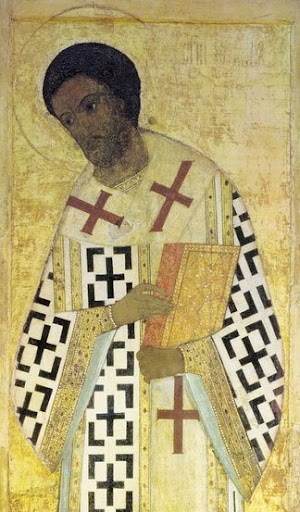
St. John Chrysostom, whose feast day it is tomorrow, is actually one of my favorite saints and I’m sure he won’t hold this joke against me. He is one of those saints – like Saint Pope Gregory the Great, whose thought had a wide-reaching influence on the Church during their lifetime and, even more impressively, still continues to have today (just note the 18 sections of the 1992 Catechism that cite him).

St. John’s epithet, Χρυσόστομος (Chrysostom) means “golden mouthed,” and if you start reading his many homilies and treatises you will soon appreciate his obvious rhetorical gift. The Church is fortunate to have had him on her side and to have had Jesus’ teaching so clearly, elegantly and effectively applied to his day. Take a look at the following quote on poverty and Church property (which applies today just as it did in the 4th century AD) and I hope you will agree with me:

“Do you wish to honour the body of Christ? Do not ignore him when he is naked. Do not pay him homage in the temple clad in silk, only then to neglect him outside where he is cold and ill-clad. He who said: “This is my body” is the same who said: “You saw me hungry and you gave me no food”, and “Whatever you did to the least of my brothers you did also to me”… What good is it if the Eucharistic table is overloaded with golden chalices when your brother is dying of hunger? Start by satisfying his hunger and then with what is left you may adorn the altar as well.”

(Evangelium S. Matthaei, hom 50:3-4; Cited by Blessed Pope John Paul II, Ecclesia de Eucharistia, footnote 34.)


1 Multi-skulled saints cannot be mentioned without telling a joke by an Irish relative of mine:

A rogue relic dealer kept selling skulls, claiming to be St. Oliver Plunkett’s, until one day a customer said to them: “This can’t be St. Oliver’s skull. I am a doctor and can tell you that this is the skull of a child and St. Oliver died in his fifties!” The dealer, thinking on their feet, retorted: “Well, of course it is a child’s skull. It is St. Oliver’s skull when he was a child!” 🙂

WWJD

Pieter Brueghel the Elder Christus und die Ehebrecherin

Neither WWDC, nor WWJZD, but WWJD – “What would Jesus do?” A question that, in this specific form, originates in the writings of the US evangelical pastor Charles Sheldon, that has regained currency in the 1990s with evangelical youth groups and that has even been adopted by parts of the current Occupy movement (e.g., including protesters camped outside London’s St. Paul’s Cathedral).

It is not without critics though, such as the US evangelical and academic Dr. Conrad Gempf, who has the following to say:

“[The Early Church] didn’t copy Jesus. […] They didn’t walk on water. Jesus didn’t tell us to do what he did, he told us to do even greater things.”

To my surprise even the Archbishop of Canterbury, Dr. Rowan Williams, whom I greatly admire, has some things to say against WWJD:

“The Jesus we meet in the Bible is somebody who constantly asks awkward questions […] rather than just giving us a model of perfect behaviour.”

Instead of getting het up about the above, it is worth realising that the point of the criticisms is not about being against imitating Jesus (Dr. Williams starts his talk by saying “Well, an archbishop is hardly going to suggest that it isn’t a good question to ask!”). It is all about a well-founded concern regarding the dangers of oversimplification (maybe tinged also with a pinch of cynicism – that I too share – regarding the wearing of the now-popular WWJD bracelets). Simply mimicking Jesus’ actions verbatim, taken out of context and without the benefit of either an attempt to develop a relationship with him or of learning from how his followers have imitated him over the centuries, runs the risk of going off course.

Even if naive extremes, like attempting to walk on water, taking up carpentry or growing a beard are left to one side, there is still plenty of room for error, just like there would be with mindlessly applying the Golden Rule (“What do you mean? I would like it if you made me watch football!”). Dr. Williams comes to the following conclusion in his criticism of a headless use of WWJD:

“First, what changes things isn’t a formula for getting the right answer but a willingness to stop and let yourself be challenged right to the roots of your being. And second, we can find the courage to let this happen because we are let into the secret that we are in the hands of love, committed, unshakeable love.”

To me this doesn’t sound like he is challenging WWJD at all – he is merely highlighting two important aspects of it. WWJD? He would want to get to the root of things (“The truth will set you free.” (John 8:32)) and away from the formulaic. WWJD? He would place his trust in his Father, who is love (For God so loved the world that he gave his only Son.” (John 3:16)).

It is also worth noting that the idea of following the example Jesus set is fundamental to Christianity and has been a core part of it since day one. Jesus called the apostles to follow him (“Come after me, and I will make you fishers of men.” (Mark 1:17)), he called all to embrace their sufferings and follow him (“Whoever wishes to come after me must deny himself, take up his cross, and follow me.” (Matthew 16:24)) and his call has been heard by every generation of his followers (e.g., look at St. Augustine and St. Francis, who deeply believed in an imitation of Jesus, and at Thomas à Kempis’ book even entitled The Imitation of Christ).

Personally, asking myself the question of what Jesus would do is something I have been encouraged to practice since my childhood and is something that I see as an effective guide also for my sons. Even to a four-year-old the answer is obvious when the question is asked in a situation where they have to make a choice. Focusing on Jesus in a decision making moment helps to introduce the selfless, altruistic and loving into a context that may otherwise be steered to an excessive focus on oneself or on following conventions. And even when at times I cannot answer the question unequivocally, placing myself in front of Jesus is of value in and of itself.

Catholics in a water park

This is not the sequel to Snakes on a Plane, but if you read various “Catholic” blogs, you could think that holding a youth day in a water park (and having mass during its course) was to Catholicism what Snakes on a Plane is to cinema. Before proceeding to the outburst in these blogs, let’s just take a quick look at the event’s announcement by the Diocese of Honolulu, which, apart from organizational details about the event that took place a week ago, includes the following quote from Pope Benedict XVI:

“Joy is at the heart of the Christian experience. [W]e experience immense joy, the joy of communion, the joy of being Christian, the joy of faith [… and w]e can see the great attraction that joy exercises. In a world of sorrow and anxiety, joy is an important witness to the beauty and reliability of the Christian faith.”

The theme of the year is then stated as “Rejoice in the Lord always” (Philippians 4:4) – i.e., the same theme as that of this year’s World Youth Day – and a key part of the program is a mass presided over by Larry Silva, the Bishop of Honolulu. And it is precisely this that so incensed my (at least by name) fellow Catholics.

I don’t want to pollute your mind too much, so let me just pick out a couple of choice cuts from among the dissenting blogs:

“Does it strike anyone else that “joy” is being confused with “frivolity” or “fun” in this case? Second, how exactly does spending a fun day at the water park “better equip” the youth for their “witness to Jesus”? And third, are the youth really going to be reflecting on the presence of God in their daily lives at this event? I have nothing against the kids (or the adults, for that matter) enjoying a day of fun at a water park, but let’s just call it what it is and not pretend it’s something else. And let’s not mix the sacred with the profane.” (Philothea on Phire)

“First, it could be argued that the location planned for Mass is a demeaning venue and contrary to the dignity due to the Blessed Sacrament. The focus of the surrounding environment of a water park screams personal fun and self-gratification rather than personal sacrifice and the selfless sacrifice of our Lord and Savior made present at the holy Sacrifice of the Mass with the real presence of His body and blood.” (Unam Sanctam Catholicam)

“I’m not sure I’ve ever noticed people doing much reflection at a water park. I have no idea how wading pools, slides, etc. contribute to a renewal of faith.” (Popin’ aint easy)

I’ll spare you all the other nonsense, including copious references to Canon Law and to the General Instructions of the Roman Missal (i.e., the mass manual), as the above should be plenty to last anyone for a good while. Fundamentally they boil down to an attempt to justify the underlying, grave misunderstanding shared by all of the three blogs mentioned above. Namely, that one’s Christian faith applies to some aspects of life – “the sacred” (self-sacrifice, reflection, selflessness, “witnessing to Jesus”) but not to others – “the profane” (fun, leisure, “enjoying a day at a water park,” “wading pools, slides, etc.”). In other words, we can be good Christians in church and when doing “spiritual” things, but everyday life is another, separate matter.

Such schizophrenic compartmentalization of life is, in fact one of the worst mistakes that the follower of any religion can make and that will ultimately either lead to psychological damage or to a very hollow, superficial religiosity that so many now rightly reject. What is the point of going to church if that is a self-contained, separate activity, unrelated to the real challenges and joys of life? It certainly wouldn’t be for the music …

Just to make it crystal clear that such dualism is not Christian, bear with me during this paragraph. Jesus himself says: “I am the light of the world. Whoever follows me will not walk in darkness, but will have the light of life.” (John 8:12), not “I’ll turn the lights on while you are at church, but you are on your own in the water park.” In fact, the whole underlying idea that there is a separation between God and non-God and the heresies that follow from it – starting with Docetism (that Jesus was just a spirit and therefore separate from the material world) and then spreading through various forms of Gnosticism (that the world was created by an imperfect/evil being and that there is a struggle between it and God) – were among the chief issues fought by the Church, starting with St. Irenaeus (my namesake) in the second century AD. St. Augustine puts it very well, as follows: “How is it, then, that I seek you, Lord? Since in seeking you, my God, I seek a happy life, let me seek you so that my soul may live, for my body draws life from my soul and my soul draws life from you” (Confessions 10:20) and St. John, in his first letter, then goes to the root: “God is love, and he who abides in love abides in God, and God abides in him” (1 John 4:16) Jesus asks us to follow him body and soul, weekdays and weekends, in secular contexts and religious ones and both when working and resting.

Finally, just in case you were wondering what sacrilegious frivolities and self-gratification I am trying to cover up with this post, here are two photos from last Sunday’s youth day at the Honolulu water park (taken from their Facebook page):

HawaiiHawaii2

Since the blogs I am arguing against here have all asked their readers to write to the Diocese of Honolulu to voice disagreement with their Youth Day, I would like to ask you to join me in writing to the Diocese of Honolulu (info@rcchawaii.org) and/or to their Office of Youth and Young Adult Ministry (hawaiicathyyam@rcchawaii.org) to share with them your appreciation for their good work, if you are that way inclined.

UPDATE: A reader has just shared with me the following email, received in response to their message of support sent to the Diocese of Honolulu:

Thank you very much for your note of support, which my staff and I appreciate very much. I wish our critics could have seen how reverent the young people were at the Mass, especially when they spontaneously knelt in the grass for the Eucharistic Prayer.

God bless you!

+ Larry Silva
Most Reverend Clarence (Larry) Silva
Bishop of Honolulu


Just FYI, here is the message I sent: “Dearest representatives of the Youth and Young Adult Ministry of the Diocese of Honolulu, since I have come across several blogs asking their readers to voice their disagreement with your Diocesan Youth Day held at a water park in Kapolei, Oahu on 1 September 2012, I would just like to express my gratitude to you for bringing Jesus to your youth and assure you of my support and prayers.”

Happy Birthday, Maryām!

Protectrix

Tomorrow is the feast of Mary’s nativity – her birthday 🙂 and, to be honest, it hasn’t meant a whole lot to me up until now. I greatly appreciated the feasts of Mary’s being mother of God (that opens the calendar year), of her sorrows, of her assumption into heaven (which coincides with my parents’ wedding anniversary and my younger son’s birth), of the annunciation and of her immaculate conception, but her birthday just seemed a bit of an add-on.

Trying to understand the significance of this feast, which is only one of three birthdays the Church celebrates (the others being those of John the Baptist and Jesus), I started looking at what has been said about it so far, and I have to say that most homilies that I came across were rather disappointing. Not necessarily as such, but with regard to shedding light on celebrating Mary’s birthday, rather than other aspects of her life.

Then I found this gem:

“The present Feast is for us the beginning of feasts. Serving as boundary to the law and to prototypes, at the same time it serves as a doorway to grace and truth. “For Christ is the end of the law” (Romans 10:4), Who, having freed us from the letter (of the law), raises us to spirit.” (St. Andrew of Crete, sermon on the Nativity of the Theotokos)

Wow! Reading this was a real ‘eureka’ moment for me as it does squarely hit the nail on its head. Mary’s birth can be seen as the start of Christianity, which becomes flesh in her some years later. It is the beginning of a new way, the breaking of prototypes, the transition from rules to life. I warmly recommend the whole sermon, which opens with the above lines and which, in its joyous tone, is a great fit for tomorrow’s celebration.

Martini: backstabber or faithful son?

Primus inter pares

You’ll know from a previous post here, that I am becoming a great fan of Cardinal Martini, whose funeral was celebrated two days ago and whose exchange of letters with Umberto Eco I enjoyed greatly. Upon hearing of his death, I was keen to learn more about him and I also eagerly read the last interview with him, published in the Corriere della Sera (and available in English translation here).

The interview took place on 8th August and asks Martini to comment on the state of the Church – a question he is very well positioned to answer and that he answers with great honesty. Martini says that the church is tired, culturally out of date, being weighted down by bureaucracy and basically showing the traits of a mature business rather than a dynamic start-up (my words :). The Church lacks the dynamism of John the Baptist and St. Paul, the faith of the Roman centurion (whose servant Jesus healed) and of St. Mary Magdalen and the closeness to the people that the Servant of God, Bishop Óscar Romero and the Jesuit martyrs of El Salvador had. Martini’s answer to this predicament is to involve more people from outside formal Church structures, to recognize our own errors and start a process of conversion, to return to the Word (i.e., to a personal closeness to the Gospel), to renew an adherence to the sacraments and to be open to all, regardless of what family and social circumstances they are in. Finally, he exhorts us to renew our faith, confidence and courage and to let ourselves be conquered by God’s love.

My immediate reaction was that of gratitude for such a greatly distilled analysis of where the Church is today, for the degree of honesty and self-criticism, for the concrete steps forward and for a final call to love.

The second hand, to form applause with Martini’s interview, then is the message that Pope Benedict XVI sent to his funeral. The pope picks a line from Psalm 119: “Your word is a lamp for my feet, a light for my path” to sum up the cardinal’s life, calls him a “generous and faithful pastor of the Church” and states that everything Martini did was “for the greater glory of God.” The pope then goes on to say that:

[h]e did so with a great openness of heart, never refusing to encounter and dialogue with anyone, responding concretely to the Apostle’s invitation to “always be ready to give an explanation to anyone who asks you for a reason for your hope ” (1 Peter 3:15).

Finally, he concludes by saying: “May the Lord, who guided Cardinal Carlo Maria Martini his whole life, receive this tireless servant of the Gospel and of the Church in the Heavenly Jerusalem.” Not only an elegant nod to Martini’s fondness for the earthly Jerusalem, but also an endorsement of his faithfulness to and inspiration from God.

If it were just for these two texts – the last interview with Martini and the pope’s message at his funeral – you could think that the two were uncontroversial parts of giving thanks for the life of a great son of the Church and, I believe you’d be right. A quick look at the press presents a very different picture though. The Independent calls Martini’s interview “a damning critique that has rocked the Catholic Church,” the Daily Mail calls it a “scathing attack,” the Belfast Telegraph says that the “Vatican is rocked by Cardinal Martini’s damning words from beyond the grave” and all news outlets latch on to Martini’s saying that “the Church is two hundred years behind.” Reading these and virtually all other reports (with the notable exception of Fr. Lucie-Smith’s blog), you’d think that Martini’s last interview was some kind of vengeful, underhand jab at the Church. Instead, I see Martini’s words as much more in line with Blessed Pope John Paul II’s emphasis on acknowledging past wrongs as a first step towards a renewal of the Church. E.g., in Incarnationis Mysterium he says that the Church “should kneel before God and implore forgiveness for the past and present sins of her sons and daughters” (Section 11), such humble repentance being in fact a common feature of the attitude of saints.


I’d first like to thank my bestie, PM, for suggesting this as a topic for a post 🙂

I also realize that I may come across as someone who unreservedly agrees with everything the Church and its representatives do. Let me assure you that this is far from the case and may in fact be more a consequence of my desire to focus on what is good and worth sharing rather than on presenting a complete, balanced view of how I see the Church. As an example of something that recently irked me, take a look at the third question in this very recent interview with Cardinal Cormac Murphy-O’Connor:

Q: At a lecture after Archbishop Vincent Nichols’ installation you urged Christians to treat atheists and agnostics with deep esteem. However, later you are quoted as saying that a lack of Faith is the ‘greatest of all evils’. You blamed atheism for war and destruction, and implied it was a greater evil than sin itself. Is this a contradiction, or were you misquoted?
[At this point Cardinal Cormac got up and went to his adjacent study. Perhaps this was an abrupt end to our interview? However, after a few minutes he returned with two books.]
A: Yes, I was misquoted – it was out of context. To get the full meaning of what I said, I would encourage [you] to study the books I have assembled ‘Faith in Britain’ and ‘Faith in Europe’.

No, thanks … If the Cardinal cannot address this, very good question in the interview and his only recourse is to bring back TWO books that the reader is to study and from which they are to distill what the Cardinal thinks, then in all likelihood those books are not going to be any help either. Seeing a response like this (and much of the lengthy interview) just makes me recoil in frustration and shake my head in disappointment …