
A very good friend of mine, MK, wrote the following on Facebook a couple of days ago: “I think that if Jesus was telling the parable of the good Samaritan today, maybe it would be the parable of the good gay.” And, as soon as I saw it, I “liked” it, since it seemed to fit Jesus’ choice of profile for that particular parable character like a glove – i.e., as someone who is frowned upon, mistrusted and seen as repulsive by “good” God-fearing folk, and with whom there is an us-versus-them that needs to be undermined.
A short while later I noticed that MK’s Facebook status had received 43 comments, dominated by outrage, exhortations to read St. Paul (undoubtedly a good idea, and one, which that comment’s author should also self-apply) and a bandying-about of phrases like “the truth of Christ” (as if there were different flavors of truth). There were also reasonable comments, but these formed a small minority among the sea of tirades that followed the outrageous suggestion that homosexuals could be thought of as today’s equivalent of first-century Judea’s Samaritans.
My immediate reaction to seeing this was to look more closely at the Good Samaritan parable and get a sense of how well founded MK’s suggestion for its contemporary adaptation is – not so much for the sake of assessing its reasonableness (which had intuitive appeal to me from the start), but to get a more specific sense of its context and exegesis.
To get an idea of how Jews and Samaritans got on with each other, Blessed John Henry Newman provides the following summary, after giving an account of mutual killings between the two peoples:
“[… T]he strongest expression of hatred the Jews could invent against Christ was ‘Thou art a Samaritan and hast a devil’ (John 8:48). [… I]f a Jew and a Samaritan met in a narrow way, they were particularly careful to avoid touching each fearing to receive pollution from the other.”
Saying “Samaritan” in the first century AD to an audience of Jewish lawyers (as Jesus – and, lets not forget, himself a Jew, did), seems to have been the same kind of trigger as saying “gay” is today to my friend’s “Christian” contacts. 1:0 to MK – the glove does indeed seem to fit.
Let me next take a look at how the last three popes have read this parable and see whether that sheds light on the transposition proposed by my friend.
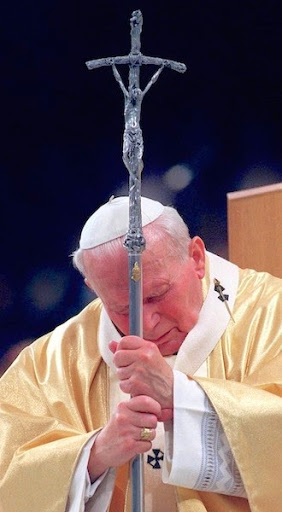
St. John Paul II spoke at length about the Parable of the Good Samaritan in his apostolic letter on suffering, Salvifici Doloris (§28):
“The parable of the Good Samaritan belongs to the Gospel of suffering. For it indicates what the relationship of each of us must be towards our suffering neighbour. We are not allowed to “pass by on the other side” indifferently; we must “stop” beside him. Everyone who stops beside the suffering of another person, whatever form it may take, is a Good Samaritan. This stopping does not mean curiosity but availability. It is like the opening of a certain interior disposition of the heart, which also has an emotional expression of its own. The name “Good Samaritan” fits every individual who is sensitive to the sufferings of others, who “is moved” by the misfortune of another. If Christ, who knows the interior of man, emphasizes this compassion, this means that it is important for our whole attitude to others’ suffering. Therefore one must cultivate this sensitivity of heart, which bears witness to compassion towards a suffering person. Some times this compassion remains the only or principal expression of our love for and solidarity with the sufferer.
Nevertheless, the Good Samaritan of Christ’s parable does not stop at sympathy and compassion alone. They become for him an incentive to actions aimed at bringing help to the injured man. In a word, then, a Good Samaritan is one who brings help in suffering, whatever its nature may be. Help which is, as far as possible, effective. He puts his whole heart into it, nor does he spare material means. We can say that he gives himself, his very “I”, opening this “I” to the other person. Here we touch upon one of the key-points of all Christian anthropology. Man cannot “fully find himself except through a sincere gift of himself” (Gaudium et Spes, 24). A Good Samaritan is the person capable of exactly such a gift of self.”
What strikes me here immediately are two things: first, the deep-seated universality of St. John Paul II’s words, addressed to “each of us,” “everyone,” “every individual,” where “Good Samaritan” status is predicated only on one’s capacity for “a gift of self.” Second, the imperative nature of his words which insist both on what we must do (being sensitive to, moved by and helping our suffering neighbors; being compassionate and self-giving) and what we are not allowed to do: be indifferent. This exegesis too easily extends to homosexuals, who are undoubtedly in a position of showing compassion to those around them and of selflessly coming to their aid.
Pope Benedict XVI adds further clarity to this universally-predicated imperative to love, in his exceptional piece of thinking: the encyclical Deus Caritas Est:
“14. […] Union with Christ is also union with all those to whom he gives himself. I cannot possess Christ just for myself; I can belong to him only in union with all those who have become, or who will become, his own. […] We become “one body”, completely joined in a single existence. Love of God and love of neighbour are now truly united: God incarnate draws us all to himself. […] the “commandment” of love is only possible because it is more than a requirement. Love can be “commanded” because it has first been given.
15. This principle is the starting-point for understanding the great parables of Jesus. […] The parable of the Good Samaritan (cf. Lk 10:25-37) offers two particularly important clarifications. Until that time, the concept of “neighbour” was understood as referring essentially to one’s countrymen and to foreigners who had settled in the land of Israel; in other words, to the closely-knit community of a single country or people. This limit is now abolished. Anyone who needs me, and whom I can help, is my neighbour. The concept of “neighbour” is now universalized, yet it remains concrete. Despite being extended to all mankind, it is not reduced to a generic, abstract and undemanding expression of love, but calls for my own practical commitment here and now. The Church has the duty to interpret ever anew this relationship between near and far with regard to the actual daily life of her members.”
For me, the most significant aspect of this passage is Benedict’s insistence on love being a commandment and on the justification of its imperative status being the precedent of God’s love. Since the source of this “obligation” to love is inexhaustible, its scope too is universal (as St. John Paul II already made clear). Furthermore, Benedict also calls for a keeping current of what such universality means in the present. This is very much in line with the current process of discernment underway in the Catholic Church, which is on the road to the second Synod on the Family this October. Specifically, the challenges of how to provide opportunities for homosexuals to feel part of the Church are on the table there too, which is easily read as an instance of Benedict’s “interpret[ing] ever anew this relationship between near and far.”
Finally, let’s hear what Pope Francis has to say about this parable:
“The Gospel passage from St Luke (10:25-37) tells of a certain man, half dead, who had been thrown into the street. Now by chance a priest was going down that road. A good priest, in his cassock: good, very good. He saw him and looked: I’ll be late for Mass, and he went on his way. He didn’t hear the voice of God there”. […] It is curious to note that only a man who habitually fled from God, a sinner, the Samaritan, was the very one who perceived the voice of God. He drew near to the man. He bound up his wounds, pouring on oil and wine; then he set him on his own beast. Oh how much time he lost: he brought him to an inn, and took care of him. He lost the whole evening! In the meantime, the priest arrived in time for the Holy Mass and all the faithful were content.
Why did the priest flee from God? Because his heart was closed. When your heart is closed you cannot hear the voice of God. Instead, it was a Samaritan on a journey who saw the wounded man and had compassion. His heart was opened, he had a human heart. His humanity enabled him to draw near.
The priest had a plan for his life: he wanted to write his own history well, according to God’s ways. But he was the one writing it. However, this other sinner allowed God to write the history of his life. He changed all his plans that evening because the Lord placed before him this poor, wounded man who had been thrown out onto the street.
I ask myself and I also ask you: do we allow God to write the history of our lives or do we want to write it? This speaks to us of docility: are we docile to the Word of God? Yes, I want to be docile, but are you able to listen to his Word, to hear it? Are you able to find the Word of God in the history of each day, or do your ideas so govern you that you do not allow the Lord to surprise you and speak to you?”
What strikes me here is the supremacy of openness over righteousness. Making oneself the ultimate judge (+ jury & executioner), instead of opening oneself up to discerning the will of God and listening to the promptings of the Holy Spirit through one’s conscience, leads to a spoiling even of things that are good in themselves and to an assumption of ultimate power by an imperfect subject. Instead, the admission of sinfulness, that Pope Francis (and before him the saints universally) has made for himself and that each one of us can recognize in our own lives, if we are sincere enough, helps us both to recognize brothers and sisters in all, without exception, and to open ourselves up to God’s surprises.
 eyebeleave