Evening came and morning followed: the roots of science in Genesis

Day and Night

The hallmarks of the scientific method include its basis in empirical evidence and its reliance on repeatability for the sake of verifying or falsifying hypotheses accounting for and predicting observations that can be aided by measurement. An aspect of the above that has interested me for a while now has been the nature of repeatability (or reproducibility), which certainly does make good intuitive sense, but where I had questions about whether some other principle couldn’t be used instead to form an equally consistent method of enquiry. Essentially, I was wondering to what extent the scientific method, as anchored in repeatability, allowed for a formalistic reading (like mathematics does – in contrast with conceiving of it as a form of realism).

The breakthrough for me came when my bestie NP wrote a soon to be published article to stimulate dialogue between science and faith and listed the following two of the assumptions of science: namely, that “the universe is intelligible […] and that it has a rational structure.” While both of these may sound self-evident and be taken for granted, having them called out made me think more carefully about intelligibility. What is it that renders an event or entity intelligible and how does a successful understanding demonstrate itself? Especially the latter is a staple of epistemology and the philosophy of science and I don’t mean to review the literature on explanatory power or models of scientific explanation like the deductive-nomological one here. Instead, I’d like to focus on the role of repeatability and to argue that it is necessary not only for science but that it is inextricable from any expression of reason.

The repeatability of events, of the meaning of concepts and of the modes of reasoning is essential to rationality. If such recurrence and persistence of relationships and states did not exist, then each event would be a one-off and it would be impossible to conceive of it using human reason. Language would not exist since words would at most be labels for individual entities and the games it relies on would be impossible too since they require regularity and repetition. Understanding of any kind would also be impossible since reflection and either deductive or inductive modes of analysis would have a sole window of opportunity in which to relate to an event or entity. There would be no laws, rules, regularities or even statistics, since everything that would be, would be a unique, a one-of-a-kind. This necessity of repeatability and its being a constituent of rationality are also expressed in Einstein’s definition of “Insanity: doing the same thing over and over again and expecting different results.”

In science, the insistence on repeatability is then anything but arbitrary and instead becomes an expression of its rationality. It can even be seen as closing the loop that starts with the assumption of the repeatability and regularity of phenomena by requiring of a theory to be repeatably applicable to their recurrences to merit the status of scientific. In other words, the requirement of repeatability in science mirrors the assumption of the repeatability in nature to which it strives to correspond.1

With the above thoughts in mind, and having read and hugely admired John Paul II‘s analysis of Genesis from the perspective of the human person, I proceeded to attempt an imitation from the point of view of science, knowing full well that it could at best be as if seen through a mirror, darkly. Nonetheless, I believe that I have found – to me – surprising traces of the scientific method in the first chapter of the Bible.2 Before making these explicit, I would like to emphasize that I am not looking for a justification of science in the Bible (it is solidly derived from reason alone as sketched out above as well) and neither am I setting out to anachronistically twist the Genesis text to fit contemporary thought (although I am necessarily looking at it from a contemporary perspective). Instead, inspired by John Paul II, I am attempting to look for the roots of what today is the scientific method and I would have been unperturbed even if I had found no traces of it there.

The first thing that struck me when re-reading Genesis 1 over the weekend is its use of the following, exact sentence to conclude the account of each “day” of creation: “Evening came, and morning followed—the [n-th] day.” (verses 5, 8, 13, 19, 23 and 31). Instead of the creation myth3 being a single “poof” event or a random sequence of entities popping into existence (à la Eddie Izzard’s great sketch4), it has a repeating structure as its backbone. Once set up on the first day (“God then separated the light from the darkness. God called the light “day,” and the darkness he called “night.”” 1:4-5), the alternation of day and night repeats itself and becomes subject to predictability and intelligibility.

The second feature of Genesis 1 that is worth noting in this attempt to trace the roots of science in the Torah is the repeated reference to visual observation. As early as verse 4, after the creation of light, we hear that “God saw that the light was good” and as far as the various translations and analyses I have seen, the term translated into English as “saw” does refer to ocular perception as opposed to just understanding in the abstract. Then, in verses 10 (after dry land is separated from water), 12 (after the introduction of vegetation), 18 (after the sky is populated), 21 (after fish and birds are created) and 25 (after animals living on land enter the scene) we are told repeatedly that “God saw that it was good.” From this perspective of visual perception, it is also worth noting that it is employed in a categorically different way once the two first humans are present.

Instead of vision only being a means for God to assess His own work, in His relationship with humans he calls them to use it as a source of evidence for His actions: “God also said: See, I give you every seed-bearing plant on all the earth and every tree that has seed-bearing fruit on it to be your food; and to all the wild animals, all the birds of the air, and all the living creatures that crawl on the earth, I give all the green plants for food.” (Genesis 1:29-30). In fact, the very last verse of Genesis 1 (verse 31), brings both visual observation and the repetitive, predictable nature of the universe together: “God looked at everything he had made, and found it very good. Evening came, and morning followed—the sixth day.”

What the above means to me is that Genesis, and therefore the whole of Judeo-Christian thought, is rooted in an account of creation that, albeit being in the form of a myth, has features that clearly contain two core aspects of the scientific method: repeatability and predictability on the one hand and sensory observation as a means of obtaining evidence on the other. While not a factual account of cosmogeny, Genesis nonetheless hints at how nature is to be approached also from the perspective of understanding it: that regularity can be expected and that the senses are a basis for engaging with it. Instead of being a source of superstition and confusion, the Bible to me is a source of gems that reinforce rather than oppose rationality.


1 I think it unlikely for this train of thought to be novel, so the absence of references is an expression of my ignorance rather than innovation. All I can offer here is the acknowledgement of Aristotle’s already realizing that “there is no science of the individual” (“If they are individual and not universal, real things will be just of the same number as the elements, and the elements will not be knowable.” Metaphysics XIII, 10).
2 I don’t wish to scare you off by setting out to link science directly to the Bible. Let me assure you that my intentions couldn’t be further from those who consider the universe to the 6000 years old or who run lunatic websites like answersingenesis.org (scarily that was the website that the vast majority of Google “science Genesis” searches point to). On the topic of answersingenesis.org, I was particularly struck by their attempt to distinguish between two flavors of science: historical (explaining past events) and operational (applied in the present for utilitarian ends). What the @#$%?!
3 I am using the term myth in the way in which John Paul II employed it: myth “does not refer to fictitious-fabulous content, but simply to an archaic way of expressing a deeper content.” (Man and Woman He Created Them).
4 “So then God created the world, and on the first day he created light and air and fish and jam and soup and potatoes and haircuts and arguments and small things and rabbits and people with noses and jam – more jam, perhaps – and soot and flies and tobogganing and showers and toasters and grandmothers and, uh … Belgium. And the second day he created fire and water and eggnog and radiators and lights and Burma and things that go “urh” and … and Colonel Gaddafi and Arthur Negus. On the third day he probably got lists and said, “I can’t remember what I’ve invented now. I’ve just been ad-libbing so far.”” (Eddie Izzard, Glorious, 1997)

Science and religion: a set-theoretic view

Universe

The question of how science and religion relate is a staple of this blog, yet in spite of numerous posts1 on this topic already, I feel the need to revisit it again (and probably not for the last time either). What I would like to give some thought to here, are different beliefs (or at least assumptions) about how God and the universe relate2 and the consequences they have on how science and religion are viewed.

For a change, let me start with what I believe myself and then proceed to contrast it with alternatives. To my mind, God infinitely exceeds the universe and is present everywhere and always – as St. Augustine puts it, God is “more inward to me than my most inward part; and higher than my highest.” (Confessions 3, 6). He has both created and sustains the universe, but does so in a way that is intelligible (and therefore also repeatable – the expectation of different outcomes when doing the same thing being one of the definitions of insanity, as Albert Einstein puts it). My position is therefore panentheistic (as opposed to pantheistic – God being equal to the universe – or deist, believing in a distant, separate God) and one that is fundamentally rational as opposed to fideist (a point also emphatically underlined by Benedict XVI during a general audience in November ’12). Here the universe, created “in and by” God,3 is both other than God and very much part of God and the top left quadrant of the diagram above is an attempt to depict it in terms of sets: the universe is represented by a circle, situated in an infinitely extending plane – God.

In this worldview, science is profoundly good not only because of the improvements to life that it can yield, but also because it tells me about how the universe that God created operates. It tells me about God in a way that is like learning about a mime artist by viewing their performance – the information is not immediate, but nonetheless leads to insights about the actor. Another source of understanding God comes to me from theology, which seeks to understand what God has revealed about himself through his relationship with the people of Israel, through his Son, Jesus and through his presence among his followers since then and into the present. These two sources of information about God are in perfect complementarity and equally fill me with wonder and admiration.

Yet science and religion (theology) are not the same – the former has methods finely tuned to bringing the laws of the universe to light and spans the sensible (empirical), while the latter has a span that exceeds that of science, by addressing the extra-empirical aspects of the universe (the whys and ought(’nt)s) as well as events and entities exclusive to its scope. This is not to place one above the other, but simply to put them in relationship as far as their scopes are concerned (bottom left quadrant of the above diagram).

In summary, my understanding of science and religion is that they jointly yield an understanding both of the world I live in and its source and purpose that I believe in. As John Paul II said, “Science can purify religion from error and superstition; religion can purify science from idolatry and false absolutes. Each can draw the other into a wider world, a world in which both can flourish.”

As for alternative views, a positioning of the world as separate from God and outside God, as shown on the right side of the above diagram, is also widespread among religious believers. Here God’s involvement in creation is only an initial impulse and setup, followed by a subsequent separation and distance. The scope of what science and religion have to talk about has no overlap.

My impression here is that this separation also extends into other spheres, beyond just the relationship between God and the universe. At times I come across (repulsive) statements that, e.g., imply that ethical behavior is “owned” by those who hold religious beliefs or that the same applies to truth or beauty.4 In my set theory of the God-universe relationship, all that is good, true and beautiful in the universe, and is accessible without faith, is mine and I just feel like I am being given more or being helped more to live it from my additional, extra-empirical sources.

I have a feeling that this (right) picture also applies to atheist believers, with the circle representing God removed. Here all that is believed to exist is the universe, which is being understood by scientific means and religion is a separate activity that has no corresponding object.

Finally, I suspect that those atheists, who don’t acknowledge that their position is a belief, operate on a worldview like mine (i.e., on the left above), but with the labels swapped. Claims about God are treated like claims about an entity enclosed in the universe and therefore fully subject to the methods of science. Religion too is an activity that can be fully reduced to scientific scrutiny just like any other human activity. If this is correct, then I can understand why atheists who fall in this category find religious belief as lacking in credibility, to the point of being hostile to it.

If any of you, my readers, identify with one of the positions other than mine, I would very much appreciate it if you let me know if I misunderstood something about it. And even if you agree with me, I’d be keen to hear from you :).


1 With previous looks at the science of creation from nothing, a mystical view of creation, the role of belief in science (also here), the dialogue between Chief Rabi Sacks and Prof. Dawkins, the ambiguous relationship between theory and evidence, the constraints of empiricism, the “God of gaps” caricature, atheism as a creed, the evidential equivalence of atheism and religious belief, Martini and Eco’s dialogue on ethics and a call for recognizing rationality in (some of) religion and science alike – to mention just a few :).
2 Many thanks to NP and AG with whom I have spoken about some aspects of this picture by email and over on Facebook over the last weeks. Their insights triggered a lot of interesting and valuable discussion.
3 “The universe, created in and by the eternal Word, the “image of the invisible God,” is destined for and addressed to man, himself created in the “image of God” and called to a personal relationship with God. Our human understanding, which shares in the light of the divine intellect, can understand what God tells us by means of his creation.” (Catechism of the Catholic Church, §299)
4 My friend, SC, told me of a particularly saddening and vile case of her parish priest telling her (at the age of 7) that she wasn’t even human, because she didn’t believe in God. This has nothing to do with Christianity as I understand it, as I hear it taught by the current and previous popes or presented in the Catechism. Instead, it is its perversion.

A universe from nothing

Dark energy
In 2009 Richard Dawkins introduced a talk by Lawrence Krauss by eulogizing about his work as follows: “[T]he study of origins, origins of all kinds, right across the board from the origin of the Universe to the origin of Life, to the origin of everything that you can think of [ – w]hat an amazingly exciting initiative.” Krauss himself – whose talk is entitled “A Universe From Nothing” – then goes on to extoll the virtues of wonder by saying that “scientists love mysteries. They love not knowing. That’s a key part of science. The excitement of learning about the Universe.” What a great way to start a talk: origins and wonder!

The only thing left for me to do to enjoy the rest of Krauss’ lecture about cosmology is to filter out the recurring jabs at “sterile” religion, “where the excitement is apparently knowing everything although clearly knowing nothing” and many more throughout the talk. In fact, Krauss’ and Dawkins’ view of religion reminds me very much of the view that young-earth creationists have of science – both equally ignorant of the other. Leaving those aside (engaging with them would be fruitless), this is what I understood as being Krauss’ argument for the Universe having come into being from nothing:

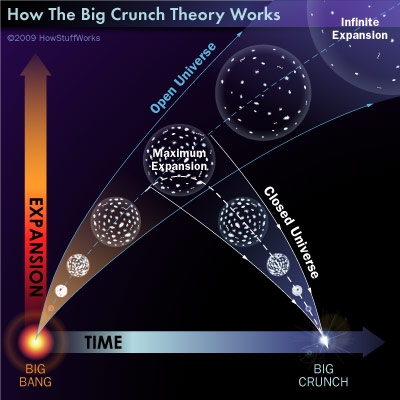
After establishing that the universe is expanding (with reference to Edwin Hubble’s discovery of it in the 1920s, who observed that all other galaxies were moving away from us and were doing so faster, the further away they were1), Krauss presents three alternatives for how that expansion may be occurring: “[A] closed Universe would expand and stop and then recollapse in a Big Crunch, the reverse of the Big Bang. An open Universe would expand forever and a flat Universe will expand and slow down and never quite stop.” The following illustration shows the open and closed cases – the flat one being similar to the open one, but having a limit (bound) to its (still infinite) expansion as opposed to being unbounded.

Big crunch open and flat universe

In the process of determining which of the three cases of expansion our Universe is undergoing, the challenge of measuring the mass of galaxies (to infer from them the curvature of their light-bending effects and therefore the curvature of the universe) and the whole universe arises and attempts to do so show that “most of the mass in [a] system of clusters of galaxies is not where the galaxies are. It’s between the galaxies. It is where nothing is shining.” This in turn leads to the realization that “dark matter is a new type of elementary particle,” which further complicates the quest for measuring the mass and energy of the universe.

The consequences of the universe being flat (i.e., expanding infinitely but asymptotically towards a limit) are then spelled out:

“It turns out that in a flat Universe, the total energy of the Universe is precisely zero. Because gravity can have a negative energy. So the negative energy of gravity balances out the positive energy of matter. What’s so beautiful about a Universe with total energy zero? Well, only such a Universe can begin from nothing. And that is remarkable, because the laws of physics2 allow Universes to begin from nothing! You don’t need a deity.3 You have nothing. Zero total energy and quantum fluctuations can produce a Universe.”

This nothing is further illustrated by results obtained recently about the mass of protons, where:

“it turns out most of the mass of the proton comes not from the quarks within a proton, but from the empty space between the quarks. These fields popping in and out of existence produce about 90% of the mass of a proton, and since protons and neutrons are the dominant stuff in your body, the empty space is responsible for 90% of your mass. So this empty space is vital to science and these calculations are vital to understanding not just protons, but electrons and atoms and produce the best comparisons.”

In other words, the nothing from which a universe can come into being is a “boiling bubbling brew of virtual particles that are popping in and out of existence” “because of the laws of quantum mechanics and special relativity.” This nothing is an “empty space” that is empty insofar as matter and gravity cancel out each other’s energy and insofar as quantum mechanics deals in fields that may or may not yield particles.

As far as this being what I understood, I actually find it quite beautiful – and Krauss would agree by saying that “the only mathematically beautiful Universe” is a flat one, like ours. There is a symmetry between positive and negative energy, light and dark matter, there is infinite expansion that is at the same time bounded, there is a constant dynamic of being potentially versus actually and there is a tremendous amount of beautiful science that has lead to this view of the universe. We have Lemaître’s and Hubble’s insights into the universe’s expansion, we have the astonishing work on measuring the universe’s curvature by means of looking at it’s background radiation, we have ways of measuring the mass of distant galaxies and their distances from us and so much more. From this point of view, I do recommend Krauss’ talk wholeheartedly.

Sadly, there is another side to it, which is its being peppered with jabs at religion and a profound ignorance of what many religious people believe. The underlying view of religious faith that informs the criticisms leveled against it here, and in many other atheist forums, seems to have people like Young-Earth creationists, Pentecostal snake-handlers and members of groups like the Westboro Baptist Church as their model. This is akin to me taking someone like Dr. Josef Mengele as the archetype of a scientist and projecting prejudices from him to all scientists. I have about as much in common with the lunacy of the above mentioned “religious” groups as with the barbarity of the above mentioned “scientist.”

Let me be a bit more specific though about why the religion-related claims of Krauss don’t stick, as it can otherwise seem like this is just a lot of hand-waving. First, let’s look at the cosmology (and cosmogeny) presented by Krauss, which postulates a coming-into-being of the universe from nothing. If anything, this scientific insight is fully consistent with the Christian account of creation, where God creates the world from nothing – hence the emblematic Latin phrase: “ex nihilo.” The Christian view of how the world came into being is not one of a God having inhabited space-time and then decided to turn parts of himself into planets, vegetation, animals, humans. Instead, the Catechism here affirms that “God gave a beginning to all that exists outside of himself” (§290), where (in some sense) there was nothing before: “All things came to be through him, and without him nothing came to be” (John 1:3). The Nicene Creed even speaks about God as the creator of “all things visible and invisible,” which can comfortably be applied to dark matter or the negative energy of gravity.

In fact, the Catechism (§296) is insistent on there having been nothing before the Universe started:

“We believe that God needs no pre-existent thing or any help in order to create, nor is creation any sort of necessary emanation from the divine substance. God creates freely “out of nothing”: “If God had drawn the world from pre-existent matter, what would be so extraordinary in that? A human artisan makes from a given material whatever he wants, while God shows his power by starting from nothing to make all he wants.” (St. Theophilus of Antioch, Ad Autolycum II)”

So, if anything, the model of a flat universe and of the nothingness that is at its origin is in perfect accord with what the Church has come to believe through revelation and the guidance of the Holy Spirit over the centuries (and as early as in the 2nd century in the writings of St. Theophilus!). There simply is no conflict here – listening to the science Krauss talks about just makes me delight in how much better we understand how it was that the universe came into being from nothing. I can therefore happily conclude, again with the Catechism (§283):

“The question about the origins of the world and of man has been the object of many scientific studies which have splendidly enriched our knowledge of the age and dimensions of the cosmos, the development of life-forms and the appearance of man. These discoveries invite us to even greater admiration for the greatness of the Creator, prompting us to give him thanks for all his works and for the understanding and wisdom he gives to scholars and researchers.”

Catholics (and adherents of many other Christian denominations and other religions) are in no way at odds with the advances of science, since – in addition to the benefits that it enables for the good of all, it sheds light on how the universe works and how it has worked since its beginning. Those who believe in God having created the universe (from nothing!), being the source of its laws and continuously sustaining its being can enjoy the advances of science as much as those who don’t hold those beliefs, and I wish that neither side would try to ridicule the other or force them to change their views!


1 Incidentally, it was Georges Lemaître – the Belgian priest and physicist, who made this realization based on Hubble’s data a couple of years before Hubble did.
2 It always baffles me how many atheists hail the latest developments of science as proofs of the non-existence of God, while quite happily relying on pre-existing “laws of physics.”
3 I. e., a “god of gaps” deity …

Divergent rays

Nasa sun

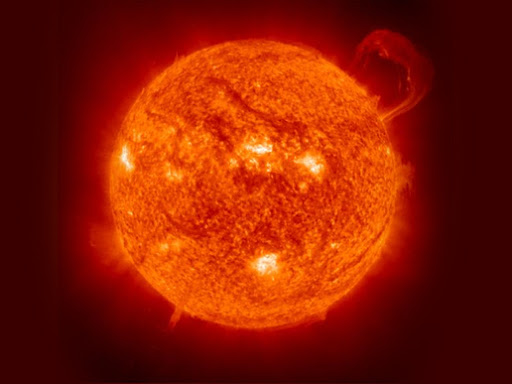
The Gospel verse “In the beginning was the Word” has been going around in my head, ever since it dawned on me last weekend that it clearly points to something having preceded it. Thinking more about it made me revisit a text (actually, various fragments of it, since it has, as yet, not been published in full) where Chiara Lubich recounts her “intellectual visions” of Paradise that started in 1949. In particular, I wanted to re-read how she described Jesus, the Word:

“I found myself […], as in a vision seen with the eyes of the soul, having come into the Bosom of the Father, who showed me, as it were, the inside of a sun that was all gold or flames of gold, infinite, but not frightening.”

“[F]rom the walls inside the Sun, the Father pronounced the word: Love, and this Word, concentrated in the heart of the Father, was his Son.”

The picture here is very vivid and in many ways like those of St. Hildegard of Bingen’s visions. It transmits a very clear sense of what it may have seemed like to be there “in the beginning.” Reading on, Chiara also shares the following vision of creation:

“When God created, He created all things from nothing because He created them from Himself: from nothing signifies that they did not pre-exist because He alone pre-existed (but this way of speaking is inexact as in God there is no before and after). He drew them out from Himself because in creating them He died (of love), He died in love, He loved and therefore He created.

As the Word, who is the Idea of the Father, is God, analogously the ideas of things, that “ab aeterno” are in the word, are not abstract, but they are real: word within the Word.

The Father projects them — as with divergent rays — “outside Himself,” that is, in a different and new, created dimension, in which he gives to them “the Order that is Life and Love and Truth.” Therefore, in them there is the stamp of the Uncreated, of the Trinity.”

I find the above paragraphs particularly important since they indicate several key ways of thinking about how God and the universe are related:

  1. That God (the Trinity, the Uncreated) can be found in nature since it bears His “stamp,”
  2. that Jesus – the Word – is not only God who made himself present in the world as a human being 2000 years ago, but is the very means by which the Father goes “outside Himself” in His Creation,
  3. that creation is an act of self-noughting love, and
  4. that creation can be thought of as a new dimension of God.

This relationship is clearly not that of a “God of gaps,” cobbled-on caricature, but a tightly-interwoven, integral, first-person communion. Creation is to God as the rays of the sun are to the sun.

In fact, the picture of the sun and its divergent rays (and the use of “picture” is very deliberate, given what follows), is also very much consonant with Wittgenstein’s thoughts on how a system (the world) and its meaning relate:

“The sense of the world must lie outside the world. In the world everything is as it is and happens as it does happen. In it there is no value—and if there were, it would be of no value.

If there is a value which is of value, it must lie outside all happening and being-so. For all happening and being-so is accidental.

What makes it non-accidental cannot lie in the world, for otherwise this would again be accidental.

It must lie outside the world.” (Tractatus Logico-Philosophicus, 6.41)

Where does this leave a Christian in terms of how science and revelation make sense of the world? I believe, James Clerk Maxwell put it very well: “I think Christians whose minds are scientific are bound to study science that their view of the glory of God may be as extensive as their being is capable.” It is with this mindset that Prof. John Lennox commented on the Higgs Boson discovery by saying “God created it, Higgs predicted it and Cern found it.” Instead of a conflict, the advances of science are as much a source of wonder and joy to a Christian as are the visions of those who seek God and to whom he makes himself known in entirely unscientific ways.

Bishops’ synod conclusions: faith open to reason and science

The Bishops’ synod on the New Evangelisation (i. e., a renewed sharing of the Good News with those who have drifted away from the Church) concluded on Friday and resulted in 58 “propositions” that were presented to the pope and that will form the basis of a future encyclical. If you are not into the whole synod thing, here are (telegraphically) at least the points that stood out for me:

  1. Not a proposition, but nonetheless worth noting, is the fact that the propositions were written in English rather than the usual Latin (although the authoritative final version will still use it) and that “with the kind permission of the Holy Father, Pope Benedict XVI, the provisional, unofficial English version, prepared under the auspices of the General Secretariat of the Synod of Bishops [which is normally kept confidential], is published in the Bulletin of the Holy See Press Office.”
  2. Prop. 8: “The world is God’s creation and manifests his love.” This presents a very positive view of the world, unlike attitudes in the past where “the world” was presented more like a necessary evil, in conflict with God.
  3. Prop. 12: The “hermeneutic of reform in continuity,” championed by Pope Benedict XVII is taken as the underlying method, as described here: “There is the “hermeneutic of reform”, of renewal in the continuity of the one subject-Church which the Lord has given to us. She is a subject which increases in time and develops, yet always remaining the same, the one subject of the journeying People of God. […] However, wherever this interpretation guided the implementation of the Council, new life developed and new fruit ripened” (Benedict XVI, Address to the Roman Curia, 22 December 2005)” I believe this shows very clearly an acknowledgement of the need to keep updating the Church and also the tension of this process with the need to stay faithful to Jesus’ teaching.
  4. Prop. 13: “believers must strive to show to the world the splendor of a humanity grounded in the mystery of Christ” Again there is recognition of the value of the natural (humanity) and a claim of its fulfilment in the divine (Jesus).
  5. Prop. 17: “It is necessary not only to show that faith does not oppose reason, but also to highlight a number of truths and realities which pertain to a correct anthropology, that is enlightened by natural reason. Among them, is the value of the Natural Law, and the consequences it has for the whole human society. The notions of “Natural Law” and “human nature” are capable of rational demonstrations, both at the academic and popular levels.” This was followed with a call to develop a “theology of credibility,” that expresses Church teaching in terms consistent with current scientific understanding.
  6. Prop. 20: “Christ, the “Good Shepherd” (cf. Jn 10:11) is the Truth in person, the beautiful revelation in sign, pouring himself out without measure. It is important to give testimony […], not only of his goodness and truth, but also of the fullness of his beauty. […] Beauty attracts us to love, through which God reveals to us his face in which we believe.”
  7. Prop. 54 (in full): “The dialogue between science and faith is a vital field in the New Evangelization. On the one hand, this dialogue requires the openness of reason to the mystery which transcends it and an awareness of the fundamental limits of scientific knowledge. On the other hand, it also requires a faith that is open to reason and to the results of scientific research.”
  8. Prop. 55: “believers and non-believers can dialogue about fundamental themes: the great values of ethics, art and science, and the search for the transcendent. This dialogue is directed in particular to “those to whom religion is something foreign, to whom God is unknown and who nevertheless do not want to be left merely Godless, but rather to draw near to him, albeit as the Unknown” (Benedict XVI, Address to the Members of the Roman Curia, 21 December 2009).”

I was pleased to see so much emphasis on reason, science and credibility and will try to do the little I can to contribute towards them myself.

Good means for good ends: induced pluripotency

Stem cells1

This year’s Nobel prize for medicine1 went to Shinya Yamanaka and John Gurdon for their work on changing adult cells into stem cells, which is a huge deal not only because of the great therapeutic benefits it will hopefully lead to (e.g., repairing heart tissue after a heart attack or reversing the effects of Alzheimer’s) but also because of how that will be achieved. To get a sense of the importance of this work, let’s first take a quick look at stem cells and then give some thought to the relevant ethics behind their use.

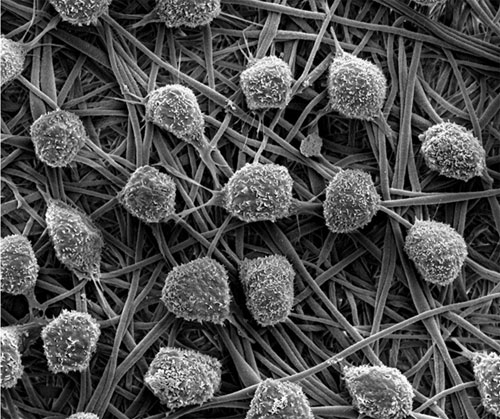
There are 230 different types of cells in a human body that compose its various organs, skeleton, nervous system, etc. and that can take a variety of forms and perform a variety of functions (from providing structural rigidity as bones via fighting off bacterial and viral intruders as lymphocytes to secreting hormones such as adrenal gland cells or lining various body cavities such as Boettcher cells). The key here is that there is a tremendous variety of them and that they differ greatly from one another. Looking at the beginning of the development of a human organism – i.e., the embryonic stage, however, shows that it is made up of identical cells at first and that this initial cell type – the stem cell – then differentiates into the great variety seen in the fully formed organism. Realizing that stem cells can develop into any other type of cell has great therapeutic potential, which is already being applied today, e.g., in the case of bone marrow transplants for treating leukemia. The greatest potential seen for stem cells though is to be able to take them and, by genetic engineering, “program” them to become specific other cell types that can then be used to “repair” a patient’s damaged tissues.

Where does one get a good supply of stem cells though? The most obvious answer is: from embryos. During the first 4-5 days after fertilization they consist of around 100 cells that form a sphere-like structure (the blastocyst), whose interior is lined with pluripotent stem cells – stem cells that have the potential to develop into almost any cell type.2 There is a problem here though, that, while the ends are noble – to cure illness, the means are not. An embryo is a human being and even though it just looks like a bunch of cells, it has its unique genetic makeup and potential that make it as a specific human person. Destroying it for the sake of “harvesting” stem cells is taking its life and no amount of arguing that it is done for a good cause undoes that plain fact. Further down the line this attitude also leads to ideas like conceiving a child for the therapeutic benefit of its sick sibling. The despair of a sick child’s parents here is fully understandable and not to be belittled or questioned, but it strikes me as a fundamentally degenerate reason for attempting to bring a new person into existence (for an opinion contrary to mine, see here). In any case, I don’t mean to focus here on attacking the use of embryonic stem cell, but instead to celebrate the discovery of an ethically sound alternative that also has distinct therapeutic benefits.

The discovery in question is a story of two parts. First, Gourdon in 1958 showed (and in 1962 published) that a cell from an adult frog’s intestine contained the full genetic code needed for the whole frog organism. Extracting the genetic information from the adult cell and transferring it into a frog egg resulted in a clone of the original frog. This was a key breakthrough since it showed that cell development is not unidirectional: a mature, differentiated cell nucleus can be made to become immature, undifferentiated. Second, Yamanaka in 2006 showed that it is not only the genetic information that is fully present in differentiated, adult cells, but that these cells can effectively be “reset” back to their stem cell origin. The result are induced pluripotent stem cells (iPSCs) – i.e., differentiated adult cells (e.g., skin) but that were chemically or virally transformed into stem cells and that can then be used therapeutically like embryonic stem cells. iPSCs also have additional therapeutic benefits in that their use would not require immunosuppressants (the cells coming from the same organism that they are later being inserted into) and also that they could be used to test the efficacy of potential treatments before they were given to a patient. In summary, this advance in medicine for which this year’s Nobel prize was awarded will, in the words of Prof Yamanaka, who started his career as a surgeon, “bring […] stem cell technology to the bedside, to patients, to clinic.”

The news of this year’s Nobel prize was wholeheartedly welcomed by the Church, with the European Community’s Bishops’ Conference affirming that it “is an important milestone in recognising the key role that non-embryonic stem cells play in the development of new, medical therapies, [leaving human embryonic stem cell research] ethically-problematic and scientifically and economically less promising.” To my mind the most important aspect of this Nobel prize from the ethical perspective is Prof. Yamanaka’s own experience though. In the scientific, peer-reviewed paper in the prestigious journal Cell, where he and his colleagues published their results, they already indicated that the motivation of their work were “ethical controversies.” In an article in the New York Times, the whole background is then revealed, as Prof. Yamanaka describes the epiphany he experienced while looking down a microscope in a fertility clinic: “When I saw the embryo, I suddenly realized there was such a small difference between it and my daughters. […] I thought, we can’t keep destroying embryos for our research. There must be another way.” To me the most overwhelming message here is that it is not at all as if science and religion were at war,3 but that it is a scientist’s own seeking not only of knowledge but also of goodness that leads to good ends and also to their achievement by good means.

UPDATE (16/10/2012): An article critical of Yamanaka’s work has appeared yesterday that argues that the “reprogramming” of adult stem cells was done based on genetic material originally derived from embryos. While this is certainly a relevant point, I don’t believe it changes the gist of my initial take on this work: Yamanaka himself used to work with embryonic stem cells and, following the insight he had about the embryos being similar to his daughters, he started working towards the use of adult stem cells only. Yes, the work he does now would not have been possible without his previous use of embryos (including the fact that he gained insights from them that he now benefits from), and the fact that embryos were destroyed in the past that are now benefiting the adult stem cell method is a loss of human life, but (and there is a but!), taking the view that this latest article does downplays the good means that Yamanaka has developed. Was it good that embryos were destroyed before – no, should it have been avoided – absolutely!, but: is it good that they are not being destroyed anymore – in my opinion, yes. I don’t mean to be too negative about this criticism though, as it is important to have as complete a picture as possible and as the points made do raise important ethical questions. Finally, I have to say I am impressed with the article’s author – Dr. Stacy Trasancos – who in fact followed up suggestions by some of her article’s commenters, who argued that the iPSC approach does not have to rely on human embryonic genetic material and has in fact found that this is likely to be possible. Her objections to the work so far still stand, but there is hope for a method that will not rely on the use of any embryonic material at all. An alternative statement of this position can also be found here.


1 Many thanks to my bestie, BM, who is a medical doctor, for proofreading this post and making sure I didn’t commit factual errors about cell biology that were too gross :).
2 With the exception of the placenta, which requires totipotent cells.
3 Although I do have to admit that such a view is not absent among representatives of either party, as I was sadly reminded by my bestie NP – a bona fide chemist working at Oxford, who recently spoke to a religious audience about the positive relationship between science and religion, only to be faced with a mixture of both positive and skeptical reactions.

Belief in theory moves mountains

Theory moves mountains s

Long before a piece of evidence is found for a theory, its postulators need to have faith in it, or at least entertain the possibility of its truth before they have the data to back it up. The first test(s) of a theory may well seem to disprove it, which in the absence of faith ought to be the end of it. However, even a simple, but sufficiently potent, idea carries the potential for “incomprehensible complexity” (see E. O. Wilson’s WWW Conference talk) and therefore also for an incomprehensible complexity in confronting it with evidence. Testing needs to be commensurately advanced relative to the theory for it to lead to either support for or conflict with it.

Many a beautiful theory may well lie dead as a result of an ugly fact (see Thomas Huxley), while the fact is simply not in correspondence with it, as a result of the grotesquely naïve view that a theory-fact mismatch always points the finger of blame at theory. Evidence is as much prone to error as the postulation of theories and all that one can hope to achieve in science is evidence-theory consistency. The absence of such understanding and a lack of faith in a fledgling theory are as damaging to science as is a disregard for data.

Science needs faith as much as religion does, for it to be capable of feats like landing a vehicle on Mars, propelling a human into space, setting off on a ship due west from Portugal in the anticipation of reaching land or building the dome of the cathedral in Florence. In all these cases, theory preceded evidential support and there was significant risk associated with failure, ranging from a huge waste of resources and careers being on the line to death. This is not to say that science and religion are the same, but simply to underline the fact that faith is needed in the practice of advancing science as much as it is for internalizing the doctrines of a religion (more on the role of evidence in the two cases another time :). While scientists (including myself) may rightly point to the fact that a theory ultimately needs to be matched up with reliable evidence for it to persist, I would like to argue that this in no way detracts from my claim that faith is fundamentally necessary for the practice of scientific enquiry and resulting advances, since evidence may often be decades away from theory (see Higgs’ theory postulated in 1964 and supported by evidence in 2012 – 48 years later!).

You may wonder, “Why are you bringing this topic up today?” The answer is simple – my besties PM and JMGR and I have been working on a theory that we postulated almost two years ago (and in a general form with PM five years ago) and it was in these last days that we have found the strongest evidence for it. Along the way we have been faced with a string of failures that could have meant the end of it and that would have resulted in us never discovering the groundbreaking results that now reward us for our persistence. I thank them both for their support!

[UPDATE (27/09/2012)]: I have just received a great message from my bestie, RR, who – unlike me: a peripheral tinkerer – is a real scientist (at Caltech, no less!) and who told me that I was “perfectly on mark with paragraph 3″ 🙂 Thanks for the nihil obstat, RR!

Lord Sacks, Prof. Dawkins, Archbishop Tutu and the Dalai Lama

Introspection 709731

Just a quick one today – a link to two fantastic videos:

  1. Yesterday the BBC broadcast the best program I have ever seen about the science-religion relationship, following Lord Sacks, the Chief Rabbi of the United Hebrew Congregations of the Commonwealth, talking to three non-believing scientists: Baroness Greenfield, Prof. Al-Khalili and Prof. Dawkins. I have to say that I fully agree with Lord Sack’s view, which in fact is pretty much what I got to in an earlier post. The most impressive thing to me was how he and Richard Dawkins arrived at consensus precisely about the need for rational, good-willed people to work together regardless of their religious or areligious views. I am now officially a huge fan of Lord Sacks (see also my post on one of his blog posts on how hatred and liberty cannot coexist).

    If you are in the UK, you can see the program on iPlayer here and I’ll look for a source accessible from outside the UK later.

    To whet your apetite in the meantime, here are just a couple of quotes:

    “Science takes things apart to see how they work. Religion puts things together to see what they mean.” Lord Sacks
    “There’s nothing quite as frightening as someone who knows they are ‘right’.” Michael Faraday (quoted by Baroness Greenfield)
    “For me religion at its best involves asking questions and challenging conventional assumptions.” Lord Sacks
    “The answer to bad religion is good religion, not no religion.” Lord Sacks

  2. A while ago Archbishop Tutu and the Dalai Lama had a chat via the Google+ ‘hangout’ videoconferencing feature. It is somewhat lengthy, but a joy to watch two friends having a great time. One of the gems was:

    Desmond Tutu: “Do you have an army?”
    Dalai Lama: “Yes, at the spiritual level! No weapons, but wisdom!”

Enjoy! 🙂

I say polygon, you say polyhedron


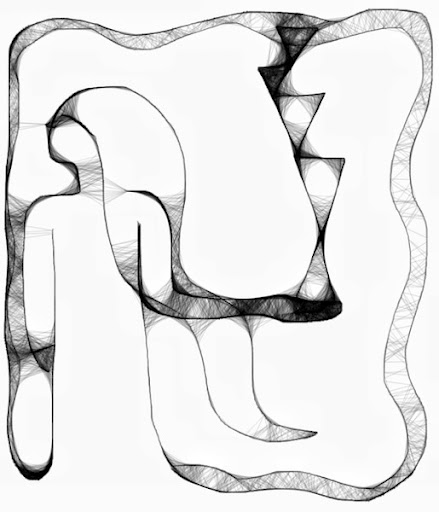
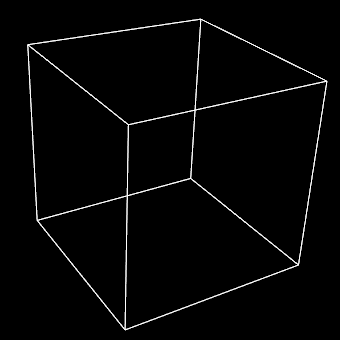
When you look at the above image, what do you see? Two triangles and five quadrangles, a cube or something else? Now, let’s turn to the following thought experiment:
You are strapped into a chair, your head held firmly in place, and you see a bright, diffuse screen in front of you, showing a series of black lines. You notice that the screen can go from an only-just visible black point at its periphery, via lines cutting across it or forming triangles with its edges, to closed squares or even constellations of polygons moving and morphing across it. You also notice that there are several knobs and levers at your disposal and that you can influence the shapes seen on the screen. Your task is to work out how the patterns you see are formed.

All you have access to in this case is a sequence of experiences of a two-dimensional, bounded world, yet through painstaking experiments you come to the realization that what you are seeing is consistent with there being a wireframe cube behind the screen. All the patters, the changes from one pattern to another and the lengths of edges could be the result of a wireframe cube casting a shadow. Once you arrive at your conclusion you are released from your restraints and are free to exit the room. As you do so, another person exits the room next to you. A quick chat reveals you had the same experience, but it turns out that they are convinced that it was just a computer screen rather that the silhouette of a mesh cube. You enter each other’s rooms and realize that they look identical! You believe their room shows a 3D cube’s shadow; they believe your room contains a 2D computer-driven display. You both look for a way to access what is behind the respective screens and after a while you find the rooms backing onto your two ones. Your screen and theirs were indeed driven differently: one was a display driven by a computer and the other a piece of translucent plexiglass having a backlit cube cast shadows on it. Which was which remains a secret guarded by the two of you.

Now, my question to you: who was the more rational participant in this experiment? The person postulating a 3D entity on the basis of strictly 2D evidence or the person whose theories remained firmly 2D, in line with the nature of their evidence?

I would like to argue that they were both equally rational and that the distinction between them was not along rational-irrational lines and to underline the fact that they were both deriving their world views from the same evidence.

What was the point of this whole exercise though? It was to propose that empirical evidence alone is not sufficient to constrain explanation to a solely empirical domain (even just the use of mathematics in science, with its universal quantifier is beyond the empirical) and that the exact same experiences can be held up as a basis for alternative theories.

The last exegetical point I’d like to make though is that the two protagonists of the thought experiment can learn a lot from each other. The person hypothesizing the 3D cube can lend the other means for simplification while the strictly 2D person can share a more refined understanding of 2D relationships, which also enrich the cube’s understanding.

Why is it that I am concerned by the evidence-theory relationship and try to dig into its nature? It is because this is a key stumbling block in the rapprochement between atheist scientists and the rational religious. The former don’t get how the latter can transcend evidence while the latter are threatened by the former’s insights into empirical evidence. The many-to-many nature of the evidence-theory relationship also underlies inter-religious dialogue. Since the transcendent is infinite, hyper-dimensional and vastly exceeding the fragmentary insights we can have of it, also in terms of aspects we don’t even know about!, it is understandable that different interpretations of its actions have been formed in different cultures and by different people. It would be short-sighted to stop at an incompatibility between the monotheism of some religions, the personal Trinitarian insight of Christianity, the polytheism of Hinduism and the apparent atheism of Buddhism (in the strict sense of atheism as opposed to its current use as anti-theism) and arrive at the erroneous conclusion that these religions talk about different things rather than differently about aspects of the same (please, don’t mis-read this as me saying that everything that all religions claim is true, that all religions are equally true or that religions can be freely intertwined and recombined. End of caveat :).

If there is a God, who is infinite, transcendent and vastly more complex than us, wouldn’t his actions as experienced in our limited realm lead precisely to the variety of religions as well as agnosticism and atheism that we see today?


Just a quick hat-tip to Flatland, to the Chinese Room thought experiment and to the story of the blind men and an elephant (and surely to many others :).

A self thinking thoughts that are (or, an invitation to epistemic honesty)

Gormley

Language.

Thought.

Being.

Self.

A much more honest kick-off to a quest for reliable knowledge than René’s “cogito ergo sum.” But where to go next? With a self thinking thoughts that are, how do we get to knowledge of a world beyond? I believe I can’t, or rather, that I can’t know. All I have access to is my self. How about sensory experiences though? Well, those are still only parts of me – the stream of images, sounds, smells, textures, temperatures, pressures, movements are nothing but events internal to me. Are they caused by a world beyond me? Just from what I have to go on, there is no way of telling.

You say though that you see the same moon, trees and world as I describe, so it must be other than both you and I. But, no … I only have my own experiences of you at my disposal and you may as easily be entirely part of me as an independent inhabitant of an external universe.

And, invoking Occam’s blade won’t get you anywhere either: surely a universe where only I, with my complex imagination, exist is simpler (but, I am not saying more believable) than one where myriads of entities inhabit a material world.

Admittedly, many have set out down this route (Descartes and Russell being only two of my many fellow travelers – needless to say, known to me only as parts of my self) but none, to my knowledge, have stayed true to their initial rigor.

The insurmountable epistemic chasm between the self and anything potentially beyond it is precisely that: an chasm insurmountable by knowledge. All I will ever have access to is me: whether it prima facie looks like you or an external world or not. With epistemic honesty no secunda facie is accessible and, I have to say that both René and Bertie have let themselves be blindsided by ‘reasonable’ arguments that made them fudge the chasm and build magnificent edifices of knowledge on air.

Maybe you’ll want to call my bluff (à la Camus’ Myth of Sisyphus, where he challenges all who truly believe life to be absurd to commit suicide) and either say: “Come on, old girl, you’ve had your fun. Surely you can’t believe this. Look around you: how could all this just be in your head?!” to which the answer should be obvious from the above.

Or, you could try a different, more subtle, line of attack: “If you really don’t think there is anything beyond yourself, why bother doing anything. Doesn’t it make progress, compassion, love and the suffering of others meaningless?” To which I’d admonish you with a quick: “Check yourself before you wreck yourself.” Why should the events that I only have access to via my own experiences be any less seriously confronted in the absence of knowledge of their origin? Experiencing what appears as someone else’s suffering is an experiencing of suffering and cries out for remedy and consolation. If anything, it makes all suffering my suffering and therefore gives its resolution heightened urgency and immediacy. All this is to address only a misinterpretation of what I have said though. Stating that nothing beyond the self can be known (since I only ever have access to myself) does not mean that beliefs cannot (or even ought not) be held about the existence of others or a shared world (or that reason cannot be applied to structuring, explaining and predicting experiences consistent with an external world). All it means is that these beliefs, if held, are not derived from experience but additional (though not contrary) to it.

I don’t see any reason to break with epistemic honesty and deny the epistemic inescapability of the self so that questions beyond the self can be addressed. All it takes is being honest about involving beliefs or at least assumptions.

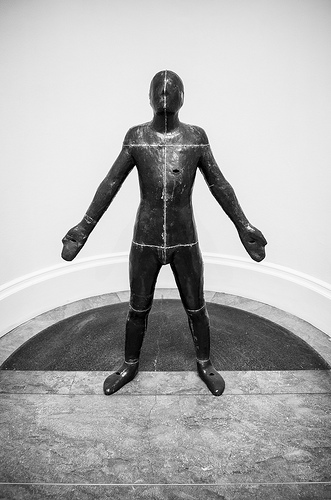
UPDATE (24/09/2012): Having just listened to Antony Gormley’s talk at the latest TED conference, I am delighted to see that his approach to sculpture very much parallels the above epistemological argument. Unlike ancient Greek sculptors, who tried to get at a sculpture trapped in a block of marble, so to speak from the outside, Gormley’s approach is the opposite. He starts from the “darkness of the body,” which he invites us to explore as follows:

“Do you mind if we do something completely different? Can we all just close our eyes for a minute? Now, this isn’t going to be freaky. It isn’t some cultic thing. (Laughter) It’s just, it’s just, I just would like us all to go there. So I’m going to do it too. We’ll all be there together.

So close your eyes for a minute. Here we are, in a space, the subjective, collective space of the darkness of the body. I think of this as the place of imagination, of potential, but what are its qualities? It is objectless. There are no things in it. It is dimensionless. It is limitless. It is endless.

Okay, open your eyes.

That’s the space that I think sculpture – which is a bit of a paradox, sculpture that is about making material propositions – but I think that’s the space that sculpture can connect us with.”

Gormley’s “darkness of the body” is where epistemic honesty needs to start and where it remains even when we open our eyes.