Francis’ new bishops

That Pope Francis lives a simple life and seeks closeness to people is well known, documented and broadly admired. However, the question of whether his personal conduct has any effect beyond the Pope himself is regularly put on the table, in the context of concerns about whether the Church as a whole is in the process of changing or whether it “only” has an admirable leader. I have to say that this type of question is well founded, since the Catholic Church has 1.2 billion members, over 400 000 priests and around 5000 bishops, and asking whether the behavior of one person, even if it is its leader, can lead to change in that of over a billion is eminently reasonable.

As a result of the above concern, that I shared, I have been keeping an eye on reports about the new bishops who have been appointed since Pope Francis’ election as well as on reports about the conduct of other bishops. Instead of dwelling on surgical interventions, like the removal of the German “bishop of bling,” the Bishop of Limburg Franz-Peter Tebartz-van Elst, I would like to share with you three examples – two of newly-appointed bishops and one of an established bishop’s change of judgment.
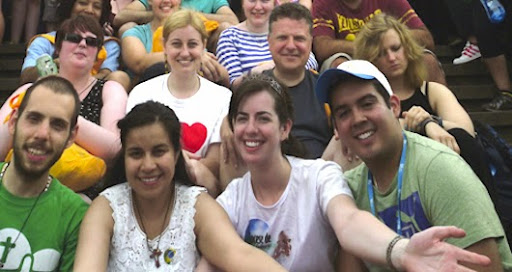
Bishop john keenan
Fr. John (wearing a black t-shirt) with a group of students from Glasgow University at the World Youth Day in Brazil last year.

The first instance of a Pope-Francis-like bishop that I noticed was that of John Keenan, the newly-consecrated Bishop of Paisley. His first move was reported by a Scottish daily, The Herald, by saying that he “has shunned the more comfortable address [of the bishop’s residence] to move into a parish house in a housing scheme in an area of multiple deprivation.” Why did Bishop John do that? His answer was: “[T]o be close to the people of our times,” and he went on to describe his choice as follows:

“I’ve just come from living in a university chaplaincy with a dozen students so I’ve been living surrounded with the buzz of life and fun. When I was thinking about becoming a bishop I was keen to take as much of that into my new life, finding people who could form a family with me and support me. Priests in Paisley found me a place in St Laurence’s, Greenock. I am living with the parish priest, Father Gerry McNellis, lots of parishioners come in and out of the house and it has the sound of laughter that makes me feel at home. I celebrate the parish Mass and am getting to know the people and that’s perfect for me.”

The buzz of life and living in a family are the key here, which then lead to change: “When people see a church not just giving to the poor and the excluded but being among them and living with them joyfully, then they will really begin to believe there is a way out of the vicious cycle of living for yourself in your own little bubble.”
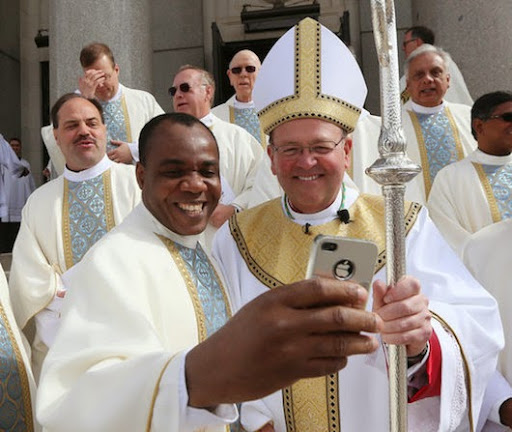
Bishop carl kemme
Bp. Carl in a “selfie” after his consecration.

Next, I read about Carl Kemme, the new Bishop of Wichita, who was consecrated last Thursday and whose choice of how to celebrate the event was very much Francis-like. The Wichita Eagle reported it as follows:

“Kemme has decided to have his pre-ordination luncheon with friends and family […] across the street from the cathedral at the Lord’s Diner, which serves dinner each night to the needy. The diner’s staff members will prepare the luncheon. “I’ve asked that the meal be … just a simple meal that we can share in the same place where our brothers and sisters … rely on that for their daily bread,” Kemme said.”

That this is inspired by Francis’ example is something that Bishop Carl is explicit about: “His simplicity, his humility, the fact he’s chosen to live in a simpler place and to ride in a regular car and to prefer not the trappings of the pontificate but the real ministry of it I think signals to the whole world and certainly to the church of a whole new dynamic.” And his reaction to first receiving the news is also telling: “Without a doubt, Pope Francis could have chosen a far more qualified candidate. But in God’s mysterious plan, he has chosen me, which is a humbling and sobering experience. I receive all of this as a sign of how God often chooses the least qualified, the weak and the sinful to accomplish his mission in the world.”
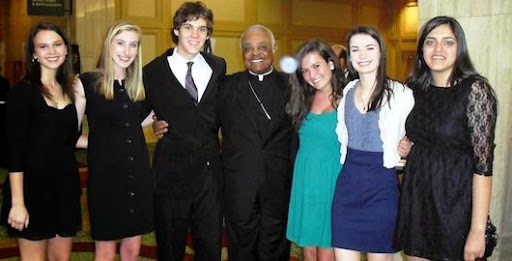
Bishop wilton gregory
Abp. Wilton with youth from the Society of St. Vincent de Paul.

The final example I’d like to share is of a different kind. It concerns Archbishop Wilton D. Gregory, who has been in office for 10 years and who was consecrated bishop another 11 years before he took on his current post. To resolve space limitations at his Atlanta cathedral, he was planning to move out of his residence, so that other priests could move in, and he was going to have a new archbishop’s residence built with donated money and land. As the New York Times reported, the plan was to build a “$2.2 million, 6,000-square-foot mansion, with plenty of room to host and entertain.” A choice, which in the past would not have been frowned upon since it has to be borne in mind that this was going to be not only the accommodation of the current archbishop, but serve other current and future needs of the Church as well.

However, already during his first meeting with the media since his election, Pope Francis has called for “a church which is poor and for the poor,” and Archbishop Wilton’s plans were out of sync. The key here is that he himself admitted so when he publicly apologized for them, after concerns were raised by lay members of his diocese. In spite of following a selfless decision making process, which he openly shared with his diocese, Abp. Wilton nonetheless took full responsibility, by saying:

“What we didn’t stop to consider, and that oversight rests with me and me alone, was that the world and the church have changed. […] I failed to consider the impact on the families throughout the Archdiocese who, though struggling to pay their mortgages, utilities, tuition and other bills, faithfully respond year after year to my pleas to assist with funding our ministries and services. I failed to consider the difficult position in which I placed my auxiliary bishops, priests, deacons and staff who have to try to respond to inquiries from the faithful about recent media reports when they might not be sure what to believe themselves. I failed to consider the example I was setting for the young sons of the mother who sent the email message with which I began this column.”

And he proceeded to apologize unreservedly and repeatedly: “To all of you, I apologize sincerely and from my heart.” and to put a clear, new process in place, demonstrating again his commitment to listening and his openness to change:

“It is my intention to move deliberately forward and to do a better job of listening than I did before. When I thought this was simply a matter of picking up and moving from one house to a comparable one two miles away, we covered every angle from the fiscal and logistical perspectives, but I overlooked the pastoral implications. I fear that when I should have been consulting, I was really only reporting, and that is my failure. To those who may have hesitated to advise me against this direction perhaps out of deference or other concerns, I am profoundly sorry.

There are structures already in place in the Archdiocese from which I am able to access the collective wisdom of our laity and our clergy. In April I will meet with the Archdiocesan Council of Priests, and in early May our Archdiocesan Pastoral Council (a multi-cultural group of Catholics of all ages, representing parishes of all sizes, who serve as a consultative body to me) will convene. I will ask for the Finance Council of the Archdiocese to schedule an extraordinary meeting. At each of these meetings I will seek their candid guidance on how best to proceed.”

While the examples of Bishops John and Carl are greatly encouraging, I am most impressed by Archbishop Wilton – a bishop of 21 years experience who is ready to take responsibility, apologize for an error of judgment and bring about change in his diocese. His example is one of profound humility and illustrates Pope Francis’ insistence on the need to acknowledge our failings without letting them hold us back from change and constant renewal.
Francis’ “grammar of simplicity”

Dsm01

Yesterday the 28th World Youth Day has come to a close in Rio de Janeiro and there would undoubtedly be a lot to say about it. Instead, I would like to look at a different, yet related, topic today, which is that of Pope Francis’ daily morning sermons, delivered at the Domus Sanctæ Marthæ (DSM). Since his election in March, Francis has been inviting different groups of Vatican staff and other visitors to join him for morning mass at his residence of choice, during which he’d deliver a short, off-the-cuff-style reflection, inspired by the day’s readings. Since these morning masses, and the homilies they contained, have now been suspended for the summer months, one can consider their first season, so to speak, as complete, and reflect on them as a whole. These, by my count 123, homilies form a corpus that is not only important in terms of the themes that it addresses, but also as a body of linguistic content, and it is both of these aspects that I would like to reflect on here.

Before proceeding to the DSM homilies, it is worth hearing the following point made by Francis on Saturday, during a lunch with Brazilian bishops, since it is the key to unlocking their language:

“Another lesson which the Church must constantly recall is that she cannot leave simplicity behind; otherwise she forgets how to speak the language of Mystery. Not only does she herself remain outside the door of the mystery, but she proves incapable of approaching those who look to the Church for something which they themselves cannot provide, namely, God himself. At times we lose people because they don’t understand what we are saying, because we have forgotten the language of simplicity and import an intellectualism foreign to our people. Without the grammar of simplicity, the Church loses the very conditions which make it possible “to fish” for God in the deep waters of his Mystery.”

With the above in mind, let’s turn to the DSM homilies. According to the Vatican’s spokesman, Fr. Federico Lombardi, the morning homilies are spontaneous instead of delivered from a prepared written text and a “‘complete’ publication, therefore, would necessarily entail a transcription and a reworking of the text at various points, given that the written form is different from the spoken one, which in this case is the original form chosen intentionally by the Holy Father.” The result would be “‘something else’, which isn’t what the Holy Father intends to do [with his daily homily] each morning.” As a result of this primarily spoken and spontaneous form of the morning homilies, only summaries and quotes from them are available, instead of full transcripts. These summaries, furthermore, include notes on who was present at the individual masses, on what the readings of the day were and addenda like “the Holy Father said,” “pope Francis noted,” etc.

As a direct linguistic analysis of the summaries would be skewed by the above additions, I first parsed the 123 summaries and removed from them any text that went beyond a transcript or paraphrasing of Pope Francis. The end result are 27K words, resulting in an average of 220 words per sermon, which corresponds to about half a page of written text. The end result are only snippets of what Francis said and a degree of separation between his full, albeit short, sermons and the record available publicly is inevitable, and indeed in accord with Francis’ own wishes.

Running a textual analysis on the above corpus yields very interesting results, which make plain the simplicity of the language Francis employs:

  1. The total of 27,132 words result from using only 4,118 different ones, which is less than the typical vocabulary of a 6-year-old.
  2. The Gunning fog readability score of the text, which derives from the number of words per sentence and the percentage of complex words used, is 6.6. This is at the very bottom end of the scale and matches that of the Bible (with popular novels coming in at 8-10 and academic texts at 15-20).
  3. The average sentence length here is 13 words, where 17 is typical and 11-13 is considered easy.
  4. Word length too is at the low end of the scale, with an average of 1.49 syllables per word (as compared with typical language having 1.66).

That Francis speaks simply can easily be seen when listening to him and the above just underlines how consistently and persistently he does so during his morning sermons.

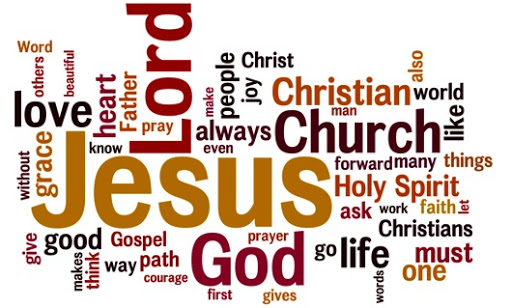
Turning to the content of his homilies, the word cloud at the top of this post shows the 50 most frequently used words, where font size is proportional to frequency. As can be seen immediately, “Jesus” is the word that Francis uses by far most often (2.3% of the time), followed by “Lord” (1.5%), where the two top words are in fact synonyms in this context. Comparing this to an analysis of his first sermons after being elected pope, it can be seen that his focus on the person of Jesus is a constant feature of his preaching. If we combine these two words, the second most frequent word becomes “our,” which, to my mind, underlines the sense one gets of Francis being one of us, referring to issues and ideas applicable to an “us” that includes him, rather than a “you” that he is removed from. Worth noting is also that the highest-ranked verb among the 4K words used in these homilies is “love” (7th among all words). A final point to pick up on in terms of word frequency is that of the top 50 words, only two imply obstacles or prohibition by themselves: “cannot” (48th) and “without” (49th). Looking at four word phrases, the most frequent one is “the word of God” (used 41 times in these 123 homilies) and in third place comes “the name of Jesus.” Francis continuously stays close to the person of Jesus, even just from the perspective of the vocabulary he employs, stays close to the congregation he addresses and is overwhelmingly positive.

Since I have already written at length about some of Francis’ DSM homilies in earlier posts, I would here just like to highlight some of the aspects that stood out to me while editing the text of these 123 sermons:

  1. Francis uses the term “pope” quite generously: he refers to the apostle Paul by saying that he “is a Pope, a builder of bridges.” and he also refers to Tawadros II in the same way, and has the following to say about him to the morning mass congregation: “Today there’s a good reason for joy in this house, where we are hosting the Pope of Alexandria, the Patriarch of the See of St Mark. He is a brother who has come to visit the Church of Rome to talk and to make a journey together.”
  2. Similes are a great favorite of Francis’, and he uses them liberally: “The confessional is not a laundromat,” “To solve the problems of life it is necessary to look reality in the face, ready like the goalkeeper of a football team to grab the ball whatever side it comes from,” that God is “not an indefinite God dispersed in the air like a spray”, that Jesus is “like an engineer, like an architect; He tells them what He will do: ‘I am going to prepare a place, in my Father’s house is my dwelling’,” that the Church is like a mother (“How would you feel if someone said: she’s a domestic administrator? ‘No, I am the mother!’ And the Church is Mother.”) and that some Christians are like pickled peppers (“Sometimes these melancholy Christians faces have more in common with pickled peppers than the joy of having a beautiful life”) are just a couple of examples.
  3. Francis draws inspiration from a very broad range of sources, including his grandmother (who’d tell him and other children in the family: ‘Look he is dead, but tomorrow he will be Risen!,’ when visiting the tomb on Good Friday), a man who worked for the diocese of Buenos Aires (“before going to do any of the things he had to do, he would always whisper to himself: ‘Jesus!’”), Pope Paul VI (who “said that you cannot advance the Gospel with sad, hopeless, discouraged Christians”), the martyrs of Nagasaki (“each one helped the other, they struggled mightily and spoke of Jesus as they awaited the moment of their death”), the garment factory collapse in Dhaka (which “killed hundreds of workers who were being exploited and who worked without the proper safety preoccupations. It is a title, which struck me the day of the tragedy in Bangladesh: ‘How to die for 38 euros a month’”), an electrician who prayed for his daughter’s recovery (“Miracles do happen. But we need to pray with our hearts: A courageous prayer, that struggles to achieve a miracle, not prayers of courtesy”) and a priest, who, when he was appointed bishop worried about his unworthiness (to which his confessor told him: “But do not worry. If after the mess Peter made of things, they made him Pope, then you go ahead!”).