
Holy Saturday: the logic of freedom

7060307609 632056d692 z

1864 words, 10 min read

A highlight of the Easter Triduum has for me always been Holy Saturday, when the tabernacle’s emptiness, the stripped altar and the absence of the Eucharist are all stark reminders of what a world without God’s incarnation as a fellow human would be like. It is, for me, a day for being particularly close to atheists and agnostics and for reflecting on the gift of Jesus’ friendship, whose enormity is heightened by its apparent absence.

I have, for some years now, had a feeling that there is much more to Holy Saturday than I am aware of, that Jesus’ participation in death is saying more than I am hearing. Against this background, I have come across Hans Urs von Balthasar’s “Mysterium Paschale: The Mystery of Easter”, whose 4th chapter is dedicated to Holy Saturday, and I would here like to give you a sense of the beautiful line of thought he sets out there.

Von Balthasar starts by tracing the origins of the idea of Jesus’ participation in death to the New Testament and argues for this being a consequence of redemption’s scope extending beyond the living. Jesus’ death here is a “being with” a “solidarity” with death as a human condition:

“‘[G]oing to the dead’, an expression justified, in our opinion, by I Peter 3, 19: ‘he went, poreutheis, and preached to the spirits in prison’—preached, that is, the ‘good news’ as I Peter 4, 6 adds by way of a self-evident clarification. […]

There is no difficulty about understanding this ‘going to the souls in prison’ as, first and foremost, a ‘being with’, and the ‘preaching’ in the same primary fashion as the publication of the ‘redemption’, actively suffered, and brought about by the Cross of the living Jesus—and not as a new activity, distinct from the first. For then the solidarity with the condition of the dead would be the prior condition for the work of redemption, whose effects would be deployed and exercised in the ‘realm’ of the dead, though that work itself would remain fundamentally finished (consummatum est!) on the Cross. In this sense the actively formulated term ‘preaching’ (I Peter 3, 19; in 4, 6 it is passive, evēngelisthē) should be conceived as the efficacious outworking in the world beyond of what was accomplished in the temporality of history.”

More important even than his descent and the being with the departed, is Jesus’ ascent from the dead, as a paving of the way for the resurrection of all:

“It is not the going to the dead which is important here—that is taken for granted, and identified, simply, with what it is to be genuinely dead—but rather the return from that bourn. God has not ‘left’ (or ‘abandoned’) Jesus ‘in Hades’ where he tarried; he has not let his Holy One see corruption. The accent is placed on the whence—the phrase ek nekrōn occurs some fifty times in the New Testament—a whence which implies a point of departure, namely, being with the dead. Death here is characterised by ‘pangs’, by ‘pains’ (?dines), and by its lust to seize and hold (krateisthai): but God is stronger than death. The only thing that matters is the facticity of the ‘being’ of the one who is dead in ‘death’ or—for this amounts to the same thing—in Hades, whose character is (objectively) referred to by the term ‘pains’. It is from thence that Jesus is ‘awoken’. […]

[I]n the Cross the power of Hell is already broken (down), the locked door of the grave is already burst open, yet Christ’s own laying in the tomb and his ‘being with the dead’ is still necessary, so that, on Easter Day, the common resurrection ek tōn nekrōn—with ‘Christ the first-fruits’—can follow.”

Von Balthasar then turns to the motivation for Jesus’ descent and again ascribes it to solidarity with the “unredeemed dead”, relying on St. Augustine who insists that Christ’s descent extended not only to the as-yet-unredeemed, but redemption-worthy, but also to those considered unworthy:

“The fact of being with the unredeemed dead, in the Sheol of the Old Testament, signifies a solidarity in whose absence the condition of standing for sinful man before God would not be complete. This is why Sheol must be understood in the classic Old Testament sense […]

Augustine distinguishes between a lower infernum (where the ‘rich man’ lives) and a higher (where Lazarus dwells, in the bosom of Abraham). The two are separated by a chaos magnum, yet both belong equally to Hades. That Christ descended even to the lower infernum, in order to ‘deliver from their sufferings tortured souls, that is, sinners’ (salvos facere a doloribus) Augustine regards as certain (non dubito). The grace of Christ redeemed all those who tarried there: adhuc requiro1. […]

This ultimate solidarity is the final point and the goal of that first ‘descent’, so clearly described in the Scriptures, into a ‘lower world’.

Looking at what the Early Fathers of the Church have written about Holy Saturday, von Balthasar presents the descent into hell as a matter of logical necessity, following from the incarnation. To become fully human, Christ had to participate in death too. Without this, his incarnation would have been incomplete, as would his redemptive action:

“And so, in order to assume the entire penalty imposed upon sinners, Christ willed not only to die, but to go down, in his soul, ad infernum. As early as the Fathers of the second century, this act of sharing constituted the term and aim of the Incarnation. The ‘terrors of death’ into which Jesus himself falls are only dispelled when the Father raises him again. According to Tertullian, the Son of God adapted himself to the whole law of human death: Huic quoque legi satisfecit, forma humanae mortis apud inferos functus2. The same affirmation is found in Irenaeus: Dominus legem mortuorum servavit, ut fieret primogenitus a mortuis.3 He insists on his own grounding principle, namely, that only what has been endured is healed and saved. Since above all this is a matter of penetrating into the realm of the inferi, so for Ambrosiaster in the Quaestiones ex Novo Testamento, Christ had to die so as to be capable of this step. Christ willed to be like us, says Andrew of Crete, in ‘walking amidst the shadows of death, in that place where souls had been bound with chains unbreakable’. All that only expresses the law of human death, thought through to its logical conclusion.”

Von Balthasar then draws our attention to a seemingly paradoxical aspect of Christ’s being among the dead – i.e., that is was a “solitary [being] with others” that did not come with a subjective experience:

“To the extent that the experience of death was objectively capable of containing an interior victory and thus a triumph over hostile powers, to that extent it was in no way necessary that this triumph be subjectively experienced. For precisely that would have abolished the law of solidarity. Let it not be forgotten: among the dead, there is no living communication. Here solidarity means: being solitary like, and with, the others.”

A further aspect of Christ’s being with the dead is that it is both an act of ultimate obedience and an act of the Trinity, where the self-noughting of its persons is enacted here in creation. This is also reminiscent of Slavoj Žižek’s concept of God taking into himself the gap that may otherwise be between Him and humanity:

“His being with the dead is an existence at the utmost pitch of obedience, and because the One thus obedient is the dead Christ, it constitutes the ‘obedience of a corpse’ (the phrase is Francis of Assisi’s)4 of a theologically unique kind. By it Christ takes the existential measure of everything that is sheerly contrary to God, of the entire object of the divine eschatological judgment, which here is grasped in that event in which it is ‘cast down’ (hormēmati blēthēsetai, Apocalypse 18, 21; John 12, 31; Matthew 22, 13). But at the same time, this happening gives the measure of the Father’s mission in all its amplitude: the ‘exploration’ of Hell is an event of the (economic) Trinity.”

Finally, von Balthasar brings his line of thought to its pinnacle, by presenting Jesus’ being among the dead as a logical consequence of his having received the power to judge from the Father and from Hell being the “supreme entailment of human liberty”. Without participating in it, and to do so as a human entails death, the transformation he brought about by his resurrection would have been incomplete.

“If the Father must be considered as the Creator of human freedom—with all its foreseeable consequences—then judgment belongs primordially to him, and thereby Hell also; and when he sends the Son into the world to save it instead of judging it, and, to equip him for this function, gives ‘all judgment to the Son’ (John 5, 22), then he must also introduce the Son made man into ‘Hell’ (as the supreme entailment of human liberty). But the Son cannot really be introduced into Hell save as a dead man, on Holy Saturday. This introducing is needful since the dead must ‘hear the voice of the Son of God’, and hearing that voice, ‘live’ (John 5, 15). The Son must ‘take in with his own eyes what in the realm of creation is imperfect, unformed, chaotic’ so as to make it pass over into his own domain as the Redeemer.”

To my mind, von Balthasar presents a beautiful insight into the events of Holy Saturday, whose coverage in Scripture is scant, by returning to a close reading of those passages, by understanding what the Early Church and the saints have written about it and by connecting it with the drama of salvation, which entails a transformation of creation as a whole. Only by being with the dead could Christ’s incarnation be complete and his redeeming power extend to the full scale of the consequences of human freedom.


1 “I yet enquire.”
2 “He also satisfied this law, enduring the form of human death in Hell.” De Anima, Chapter LIV.
3 “The Lord observed the law of the dead, that he would be the first-born from the dead.”
4 This is a reference to the following passage from St. Francis’ The Mirror of Perfection:

““Tell us, Father, what is perfect obedience?” To which he answered, speaking of true and perfect obedience under the figure of a corpse, “ Take a dead body and place it anywhere you please, it will not murmur at being moved, it will not change its position or cry out if you let it go. If you seat it on a throne it will not look up but down, and to clothe it in purple but makes it more pale. This is the type of perfect obedience, that asks not why he is moved, minds not where he is placed, nor insists upon being sent elsewhere. If he be promoted to office he still keeps humble, and the more he is honoured the more he counts himself unworthy.”
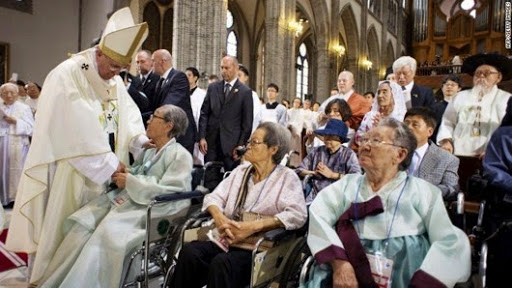
Francis in Korea: Come to my house, enter my heart

140818151053 pope comfort women s036314271 story tablet

Three weeks ago Pope Francis made a five-day visit to South Korea where he again spoke with great clarity about a number of topics and where he gave witness to the Good News of the Gospel by actions at least as much as by words. Instead of providing a comprehensive account of the trip, which can be found in many other places, I would just like to bring together my favorite passages from the around 15 talks he gave there.

Upon his arrival, Francis presented his approach to diplomacy:

“The quest for peace also represents a challenge for each of us, and in a particular way for those of you dedicated to the pursuit of the common good of the human family through the patient work of diplomacy. It is the perennial challenge of breaking down the walls of distrust and hatred by promoting a culture of reconciliation and solidarity. For diplomacy, as the art of the possible, is based on the firm and persevering conviction that peace can be won through quiet listening and dialogue, rather than by mutual recriminations, fruitless criticisms and displays of force.”

Followed by a reflection on how peace, justice and development are interrelated:

“Peace is not simply the absence of war, but “the work of justice” (cf. Is 32:17). And justice, as a virtue, calls for the discipline of forbearance; it demands that we not forget past injustices but overcome them through forgiveness, tolerance and cooperation. It demands the willingness to discern and attain mutually beneficial goals, building foundations of mutual respect, understanding and reconciliation. May all of us dedicate these days to peace, to praying for it and deepening our resolve to achieve it.”

And finally, he underlined the universal need of being heard:

“How important it is that the voice of every member of society be heard, and that a spirit of open communication, dialogue and cooperation be fostered. It is likewise important that special concern be shown for the poor, the vulnerable and those who have no voice, not only by meeting their immediate needs but also by assisting them in their human and cultural advancement.”

Later that same day, when addressing the Korean bishops, Francis warned them against becoming an affluent, middle class Church where the poor do not feel at home and that becomes mediocre:

“There is a danger, a temptation which arises in times of prosperity: it is the danger that the Christian community becomes just another “part of society”, losing its mystical dimension, losing its ability to celebrate the Mystery and instead becoming a spiritual organization, Christian and with Christian values, but lacking the leaven of prophecy. When this happens, the poor no longer have their proper role in the Church. This is a temptation from which particular Churches, Christian communities, have suffered greatly over the centuries; in some cases they become so middle class that the poor even feel ashamed to be a part of them. It is the temptation of spiritual “prosperity”, pastoral prosperity. No longer is it a poor Church for the poor but rather a rich Church for the rich, or a middle class Church for the well-to-do. Nor is this anything new: the temptation was there from the beginning. Paul had to rebuke the Corinthians in his First Letter (11:17), while the Apostle James was even more severe and explicit (2:1-7): he had to rebuke these affluent communities, affluent Churches for affluent people. They were not excluding the poor, but the way they were living made the poor reluctant to enter, they did not feel at home. This is the temptation of prosperity. I am not admonishing you because I know that you are doing good work. As a brother, however, who has the duty to confirm his brethren in the faith, I am telling you: be careful, because yours is a Church which is prospering, a great missionary Church, a great Church. The devil must not be allowed to sow these weeds, this temptation to remove the poor from very prophetic structure of the Church and to make you become an affluent Church for the affluent, a Church of the well-to do – perhaps not to the point of developing a “theology of prosperity” – but a Church of mediocrity.”

The next day, on 15th August, Francis had his first meeting with youth gathered from all over Asia, where he first recalled the need for the Church to “be a seed of unity for the whole human family,” and then proceeded to reflect on an experience shared before his address that was about the challenges of discerning one’s vocation:

“What Marina said really struck me: about the conflict she felt in her life. What to do in this situation? Take up the path of consecrated life, religious life, or study to be better able to help others.

This is only an apparent conflict, because when the Lord calls, he always does so for the good of others, whether it is through the religious life, the consecrated life, or as a lay person, as the father or mother of a family. The goal is the same: to worship God and to do good to others. What should Marina do, and the many others of you who are asking the same question? I once asked it myself: What path should I choose? But you do not have to choose any path! The Lord must choose it! Jesus has chosen it! You have to listen to him and ask: Lord, what should I do?

This is the prayer that a young person should make: “Lord what do you want from me?” With prayer and the advice of some good friends – laity, priests, religious sisters, bishops, popes (even the Pope can offer some good advice!) – you can find the path that the Lord wants for you.”

He then went on to underline the fundamental simplicity of love:

“The path of love is simple: love God and love your neighbor, your brother or sister, the one at your side, who needs love and so many other things. “But Father, how do I know that I love God?” Only if you love your neighbor, if you do not hate your neighbor and do not harbor hatred in your heart, do you love God. This is the sure proof.”

Later that day Francis paid a surprise visit to the Jesuit HQ in Korea, where he said the following to his brothers:

“There are no wounds that can’t be consoled by the love of God. This is how we must live: seeking Jesus Christ so that we may carry this love to consoling wounds, healing wounds. […] God always consoles, always waits, always forgets, always forgives. There are many wounds in the Church. Wounds that are often provoked by ourselves, practicing Catholics and ministers of the Church.

Don’t tell off the people of God anymore! Console the people of God! Often our clerical attitudes lead to clericalism that harms the Church so much. Being a priest does not result in the status of public officials, but of shepherd. Please, be shepherds and not public officials. And when you are in the confessional, remember that God never tires of forgiving. Be merciful!”

Two days later, Francis met bishops from all over Asia to whom he spoke about the simultaneous need for a clear sense of one’s own identity and of openness and receptivity to others, as the basis for dialogue:

“But in undertaking the path of dialogue with individuals and cultures, what should be our point of departure and our fundamental point of reference, which guides us to our destination? Surely it is our own identity, our identity as Christians. We cannot engage in real dialogue unless we are conscious of our own identity. We can’t dialogue, we can’t start dialoguing from nothing, from zero, from a foggy sense of who we are. Nor can there be authentic dialogue unless we are capable of opening our minds and hearts, in empathy and sincere receptivity, to those with whom we speak. In other words, an attentiveness in which the Holy Spirit is our guide. […] And if our communication is not to be a monologue, there has to be openness of heart and mind to accepting individuals and cultures. Fearlessly, for fear is the enemy of this kind of openness.”

And he proceeded to warn against becoming bogged down in formalism, superficiality and easy answers:

“Without a grounding in Christ, the truths by which we live our lives can gradually recede, the practice of the virtues can become formalistic, and dialogue can be reduced to a form of negotiation or an agreement to disagree. An agreement to disagree… so as not to make waves… This sort of superficiality does us great harm. […] Then […] there is [… another] temptation: that of the apparent security to be found in hiding behind easy answers, ready formulas, rules and regulations. Jesus clashed with people who would hide behind laws, regulations and easy answers… He called them hypocrites. Faith by nature is not self-absorbed; it “goes out”. It seeks understanding; it gives rise to testimony; it generates mission. In this sense, faith enables us to be both fearless and unassuming in our witness of hope and love. Saint Peter tells us that we should be ever ready to respond to all who ask the reason for the hope within us (cf. 1 Pet 3:15). Our identity as Christians is ultimately seen in our quiet efforts to worship God alone, to love one another, to serve one another, and to show by our example not only what we believe, but also what we hope for, and the One in whom we put our trust (cf. 2 Tim 1:12).”

Next, Francis insisted on the need for acceptance of others (“Come to my house, enter my heart.”) which has a profound basis in Jesus’ incarnation and in us all being children of the one Father. Empathy and a welcoming of others are core to Christianity and fear for one’s own identity is wholly unwarranted:

“[T]ogether with a clear sense of our own Christian identity, authentic dialogue also demands a capacity for empathy. For dialogue to take place, there has to be this empathy. We are challenged to listen not only to the words which others speak, but to the unspoken communication of their experiences, their hopes and aspirations, their struggles and their deepest concerns. Such empathy must be the fruit of our spiritual insight and personal experience, which lead us to see others as brothers and sisters, and to “hear”, in and beyond their words and actions, what their hearts wish to communicate. In this sense, dialogue demands of us a truly contemplative spirit of openness and receptivity to the other. I cannot engage in dialogue if I am closed to others. Openness? Even more: acceptance! Come to my house, enter my heart. My heart welcomes you. It wants to hear you. This capacity for empathy enables a true human dialogue in which words, ideas and questions arise from an experience of fraternity and shared humanity. If we want to get to the theological basis of this, we have to go to the Father: he created us all; all of us are children of one Father. This capacity for empathy leads to a genuine encounter – we have to progress toward this culture of encounter – in which heart speaks to heart. We are enriched by the wisdom of the other and become open to travelling together the path to greater understanding, friendship and solidarity. “But, brother Pope, this is what we are doing, but perhaps we are converting no one or very few people…” But you are doing it anyway: with your identity, you are hearing the other. What was the first commandment of God our Father to our father Abraham? “Walk in my presence and be blameless”. And so, with my identity and my empathy, my openness, I walk with the other. I don’t try to make him come over to me, I don’t proselytize. Pope Benedict told us clearly: “The Church does not grow by proselytizing, but by attracting”. In the meantime, let us walk in the Father’s presence, let us be blameless; let us practice this first commandment. That is where encounter, dialogue, will take place. With identity, with openness. It is a path to greater knowledge, friendship and solidarity. As Saint John Paul II rightly recognized, our commitment to dialogue is grounded in the very logic of the incarnation: in Jesus, God himself became one of us, shared in our life and spoke to us in our own language (cf. Ecclesia in Asia, 29).”

And finally, Francis places the importance of a shared journey above the others’ conversion and distances the Church from ideas of conquest:

“I am not referring to political dialogue alone, but to fraternal dialogue… “But these Christians don’t come as conquerors, they don’t come to take away our identity: they bring us their own, but they want to walk with us”. And the Lord will grant his grace: sometimes he will move hearts and someone will ask for baptism, sometimes not. But always let us walk together. This is the heart of dialogue.

The next day, during a meeting with religious leaders, Francis returns to the importance of shared journeying:

“Life is a journey, a long journey, but a journey which we cannot make by ourselves. We need to walk together with our brothers and sisters in the presence of God. So I thank you for this gesture of walking together in the presence of God: that is what God asked of Abraham. We are brothers and sisters. Let us acknowledge one another as brothers and sisters, and walk together.”

And finally, during the flight back to Rome, Francis again answers questions put to him there and then by the journalists on board, where three stood out for me in particular. First, in response to being asked about whether he isn’t concerned that his gesture of wearing a yellow ribbon (a sign of solidarity with the victims of the Sewol ferry disaster) might be misunderstood politically, Francis answers:

“Whenever you find yourself facing human suffering, you have to do what your heart tells you to. Then people will say: “He did it for this or that political reason”; let them say what they want. But when you think of these men and woman, these fathers and mothers who have lost their children, their brothers and sisters, of the immense pain of such a disaster, I don’t know, my heart.. I am a priest and I feel the need to draw near! That’s how I feel; that is the first thing. I know that the comfort that any word of mine might give is no cure, it doesn’t bring the dead back to life, but human closeness at these times gives us strength, there is solidarity… […] I would like to add something. I took this (holding up a ribbon). After I carried it for half a day – I took it for solidarity with them – somebody came up to me and said: It’s better to take that off… You should be neutral …” “But listen, where human suffering is involved, you can’t be neutral”. That was my answer; that’s how I feel.”

Second, in response to a question about military intervention in Iraq and also addressing the topic of torture, Francis says:

“Thank you for your very clear question. In these cases, where there is an unjust aggression, I can only say that it is licit to stop the unjust aggressor. I emphasize the word: “stop”. I’m not saying drop bombs, make war, but stop the aggressor. The means used to stop him would have to be evaluated. Stopping an unjust aggressor is licit. But we also need to remember! How many times, with this excuse of stopping an unjust aggressor, the powers have taken over peoples and carried on an actual war of conquest! One nation alone cannot determine how to stop an unjust aggressor. After the Second World War, there was the idea of the United Nations: that is where discussion was to take place, to say: Is this an unjust aggressor? It would seem so. How do we stop him?” This alone, nothing else. Second, minorities. Thanks for using that word. Because people say to me: “the Christians, the poor Christians…” And it is true, they are suffering, and martyrs, yes, there are many martyrs. But there are also men and women, religious minorities, not all Christians, and all are equal before God. To stop an unjust aggressor is a right of humanity, but it is also a right of the aggressor to be stopped in order not to do evil. […]

Today, torture is an almost, I would say, ordinary means used in intelligence work, in trials… And torture is a sin against humanity, it is a crime against humanity. And to Catholics, I say: to torture a person is a mortal sin; it is a grave sin, but even more, it is a sin against humanity.”

And third, in a question about his upcoming encyclical on ecology, Francis spoke again about the relationship between science and faith, being more specific about how he sees the value of science in the context of this document of Catholic teaching:

“[T]here are also scientific hypotheses [to be taken into account], some of them quite solid, others not. In this kind of encyclical, which has to be magisterial, one can only build on solid data, on things that are reliable. If the Pope says that the earth is the centre of the universe, and not the sun, he errs, since he is affirming something that ought to be supported by science, and this will not do. That’s where we are at now. We have to study the document, number by number, and I believe it will become smaller. But to get to the heart of the matter and to what can be safely stated. You can say in a footnote: “On this or that question, there are the following hypotheses…”, as a way of offering information, but you cannot do that in the body of encyclical, which is doctrinal and has to be sound.”

The demon of distance

Demon of distance

A couple of weeks ago, Cardinal Gianfranco Ravasi lead another of the “courtyard of the gentiles” events, aimed at providing a space for dialogue between non-believers and Catholics. This time it took place in Budapest and Cardinal Ravasi’s address focused on the fundamental Christian principles, from which its understanding of morality, economy and society derives.

These principles include those of the person (created in the image of God and intrinsically being in relationship with others), of autonomy (of the civil and religious spheres, following Jesus’ words: “Then repay to Caesar what belongs to Caesar and to God what belongs to God.” (Matthew 22:21)), of solidarity and of truth (that precedes and exceeds us and that we inhabit rather than possess1). Each of these four principles is insightfully presented and analyzed by Ravasi and I would recommend anyone to read his talk in full (at the time of writing this post, only available in Italian). Here, however, I would like to focus only on the principle of solidarity, which Ravasi further differentiates into its aspects of justice and love.

The starting point of the principle of solidarity in Christianity, like that of the other three principles too, is the incarnation: “And the Word became flesh” (John 1:14), as a result of which there is a link between faith and history, between religion and political and social life. Cardinal Ravasi also emphasized this point during his brief opening remarks of the entire event, where he pointed out that, while in Eastern religions saints tend to be depicted with closed eyes (indicating an interiority of focus), in Christian art saints are typically shown with their eyes wide open – projecting out into the world around them. What is needed, Ravasi concludes, is both an interiority and a having one’s eyes open to see the great political, economic, social and cultural problems of the world.

In this context, the principle of solidarity in Christianity has its roots already in the Genesis account of creation, where

“the fact of all of us being human is expressed by the noun “Adam,” which in Hebrew is ha-’adam,2 with the article (ha-) that simply means “the human.” is used to refer to humanity. Therefore there is in all of us a shared “adamness.” Solidarity is, therefore, structural to our fundamental anthropological reality. Religion expresses this anthropological unity using two terms that are two moral categories: justice and love. Faith takes solidarity, which is also at the basis of lay philanthropy, but goes beyond it. In fact, staying with John’s Gospel, during the last evening of his earthly life Jesus says a wonderful phrase: “No one has greater love than this, to lay down one’s life for one’s friends.” (John 15:13).”

To illustrate the two aspects of solidarity – justice and love, Ravasi takes advantage not only of Christian tradition, but also makes reference to Eastern thought, in the spirit of inter-religious dialogue.

To present the essence of justice, Ravasi quotes the 4th century saint, Ambrose of Milan:

“The earth was created as a common good for all, for the rich and for the poor. Why, then, O rich, do you usurp an exclusive right to the soil? When you help the poor, you, rich, don’t give them from your own, but you return to them their own. In fact, you alone use the common property, given for the use of all. The earth belongs to all, not only to the rich, therefore when you help the poor you give them back their due, instead of providing them with a gift of your own.” (On Naboth)

Turning to the second aspect of solidarity – love, Ravasi takes advantage of the following Tibetan parable, showing that religious cultures, that are undoubtedly diverse, do at their bases have touch-points and contacts:

“A man, walking through the desert, spots something strange in the distance. Fear starts welling up in him, since, in the absolute solitude of the steppe, such an obscure and mysterious reality – maybe an animal, a dangerous wild beast – can’t but unsettle. Moving ahead, the traveller discovers that he is not approaching a beast, but a person instead. But his fear does not pass. If anything, it grows, thinking that the person could be a robber. Nonetheless, he has no choice but to proceed, until arriving in the presence of the other. At this moment, the traveller lifts his gaze and, to his surprise, exclaims: “It is my brother, whom I haven’t seen for many years!””

Ravasi concludes his reflection on solidarity by noting that “distance generates fears and demons; one has to get close to the other to overcome fears, no matter how understandable they may be. Refusing to get to know the other and to encounter the other is the same as saying no to the love that springs from solidarity and that dissolves terror and generates a true society.”

Personally, I have found Cardinal Ravasi’s reflection highly compelling and enlightening, both due to its deep roots in Scripture and its open and broad perspective that is equally at ease with drawing on the rich sources of Christianity as it is to benefit from the insights of other religions, even in matters as fundamental and core to Christianity as its understanding of love. Specifically, I have also found the Tibetan parable to be a great reminder to attempt closeness with all, instead of remaining at a distance and being put off by distorted, prejudice-filled, blurry perception.


1 Ravasi addressed this concept of the truth several times already, e.g. see also its coverage in a previous post here.
2 For more on the Genesis account and ha-’adam, see John Paul II’s “Man and Woman He Created Them,” discussed here.