Cardinal Burke’s confusion

Burke purple

2094 words, 11 min read

In what is fast becoming a series1, this post will pick up on just one of the 40 “truths” presented by Cardinal Raymond Leo Burke in his “Declaration of the truths relating to some of the most common errors in the life of the Church of our time” – a document he claims is being published in a “spirit of fraternal charity” and one that I wholeheartedly recommend not to read.

Just like with a punnet of strawberries, there are obvious places to look at here too, when trying to decide whether or not to buy it. An easy way to start is to review “truth” #28 on capital punishment, which reads as follows:

“In accordance with Holy Scripture and the constant tradition of the ordinary and universal Magisterium, the Church did not err in teaching that the civil power may lawfully exercise capital punishment on malefactors where this is truly necessary to preserve the existence or just order of societies (see Gen 9:6; John 19:11; Rom 13:1-7; Innocent III, Professio fidei Waldensibus praescripta; Roman Catechism of the Council of Trent, p. III, 5, n. 4; Pius XII, Address to Catholic jurists on December 5, 1954).”

This is a direct challenge to the recent change to the Catechism of the Catholic Church, effected by Pope Francis (who has “supreme, full, immediate, and universal ordinary power in the Church” (cf. Cann. 331-334)), which now states the following regarding the death penalty:

“Recourse to the death penalty on the part of legitimate authority, following a fair trial, was long considered an appropriate response to the gravity of certain crimes and an acceptable, albeit extreme, means of safeguarding the common good.

Today, however, there is an increasing awareness that the dignity of the person is not lost even after the commission of very serious crimes. In addition, a new understanding has emerged of the significance of penal sanctions imposed by the state. Lastly, more effective systems of detention have been developed, which ensure the due protection of citizens but, at the same time, do not definitively deprive the guilty of the possibility of redemption.

Consequently, the church teaches, in the light of the Gospel, that “the death penalty is inadmissible because it is an attack on the inviolability and dignity of the person”, and she works with determination for its abolition worldwide.”

Against this background, let us look at three aspects of Burke’s claim: first whether the Church erred, second, whether its tradition (on the basis of the references in this “truth”) has been constant and – most seriously – whether the lawfulness of capital punishment is in accordance with Holy Scripture.

First, the Catholic Church today does teach that the death penalty is always inadmissible as is set out by its supreme legislator (Pope Francis) and promulgated in its Catechism. Applying the Church’s past teaching to today – as Cardinal Burke does – is therefore an act of erring and in direct conflict with the Church’s Magisterium.2

Second, let’s take a closer look at the references to the “constant tradition of the ordinary and universal Magisterium” provided by Burke. The first of these is a passage from the 1566 Catechism of the Council of Trent, which reads as follows:

Execution Of Criminals

Another kind of lawful slaying belongs to the civil authorities, to whom is entrusted power of life and death, by the legal and judicious exercise of which they punish the guilty and protect the innocent. The just use of this power, far from involving the crime of murder, is an act of paramount obedience to this Commandment which prohibits murder. The end of the Commandment- is the preservation and security of human life. Now the punishments inflicted by the civil authority, which is the legitimate avenger of crime, naturally tend to this end, since they give security to life by repressing outrage and violence. Hence these words of David: In the morning I put to death all the wicked of the land, that I might cut off all the workers of iniquity from the city of the Lord.”

This is pretty clear: to preserve and secure human life, civil authority has the right to put criminals to death as a protective and punitive measure.

Let’s now look at the second of the two references for the constancy of tradition, a talk Pope Pius XII addressed to Italian lawyers in 1954, and at the only paragraph in that text that talks about the death penalty:

“The human judge, on the other hand, since he does not possess the omnipresence and omniscience of God, has the duty of forming for himself, before issuing the judicial sentence, a moral certainty, that is, one which excludes every reasonable and serious doubt about the external fact and the internal guilt. But he does not have immediate insight into the interior dispositions of the accused at the very moment of the crime; rather, in most cases the judge is not in a position to reconstruct them with absolute clarity from the arguments offered as proof, nor, often enough, from the very confession of the delinquent. But this difficulty should not be exaggerated, as though it were ordinarily impossible for a human judge to attain sufficient certainty, and therefore a solid foundation for a sentence. According to the cases, the judge will not fail to consult renowned specialists on the capacity and responsibility of the presumed criminal, and to take into consideration the findings of the modern sciences of psychology, psychiatry and characterology. If, despite all these precautions, there still remains a grave and serious doubt, no conscientious judge will proceed to pronounce a sentence of condemnation, all the more so when there is question of an irrevocable punishment, such as the death penalty.”

Hm … this is somewhat different from the first reference. Yes, the death penalty is not deemed inadmissible. However, it is presented as a case where the general challenges of ascertaining guilt and culpability, that are essential limitations of human judges as compared with God, the ultimate Judge, impose a heightened degree of caution and a heightened burden of proof on the jurist. Incidentally the whole text is set in the context of reforms being considered to the penal code and speaks about the relationship between crime and punishment, which it examines from psychological, juridical, moral and religious angles. Far from being a simple affirmation of the rights of the state, as set out by the Tridentine Catechism, Pius XII’s reflection is a careful, cautious one, calling for checks and balances commensurate with the irrevocability of capital punishment.

Moving beyond the two references provided to substantiate “constancy of tradition”, it is worth noting that the first mention of the death penalty in any conciliar document of the western Church comes on 6th July 1415, during the 16th session of the Council of Constance (none of the 15 councils that pre-date it, starting with the Council of Nicea in 325 AD, even mention the topic):

“Doctors who state that anybody subjected to ecclesiastical censure, if he refuses to be corrected, should be handed over to the judgment of the secular authority, are undoubtedly following in this the chief priests, the scribes and the pharisees who handed over to the secular authority Christ himself, since he was unwilling to obey them in all things, saying, It is not lawful for us to put any man to death; these gave him to the civil judge, so that such men are even greater murderers than Pilate.”

Again, this does not sound very “constant” (pun intended) with the Tridentine text. Church authorities handing transgressors over to secular authority are “greater murderers than Pilate”? But, isn’t the state perfectly within its rights to mete out the death penalty, as the Tridentine text suggests?

Let’s also bracket Burke’s references from the other end, with the wording of the Catechism as approved by St. John Paul II, where its §2267 sets out the Church’s position in 1992 (now replaced by Francis’ text quoted above):

“Assuming that the guilty party’s identity and responsibility have been fully determined, the traditional teaching of the Church does not exclude recourse to the death penalty, if this is the only possible way of effectively defending human lives against the unjust aggressor.

If, however, non-lethal means are sufficient to defend and protect people’s safety from the aggressor, authority will limit itself to such means, as these are more in keeping with the concrete conditions of the common good and more in conformity to the dignity of the human person.

Today, in fact, as a consequence of the possibilities which the state has for effectively preventing crime, by rendering one who has committed an offense incapable of doing harm – without definitely taking away from him the possibility of redeeming himself – the cases in which the execution of the offender is an absolute necessity “are very rare, if not practically nonexistent.””

Note again the tone of how the topic is dealt with, which is in continuity with Pius XII’s approach and takes it further still. Unlike the Tridentine text, capital punishment is a last resort and one whose likelihood of being legitimate is close to nil, if not nil.

Third, let’s turn to Burke’s claim that capital punishment is in accordance with Holy Scripture, and in particular with the two New Testament references. The first points to John 19:11, which goes: “Jesus answered [him], “You would have no power over me if it had not been given to you from above. For this reason the one who handed me over to you has the greater sin.”” Here the “him” is Pilate and reading the passage as condoning capital punishment is a rather lazy application of how this passage has been interpreted during the history of the Church (although not an uncommon one). While St. Augustine takes the reference to “from above” here as being “from God”, as in “all power comes from God”, to go from there to taking all application of power to be good is some stretch and one that both St. Augustine himself and later St. Thomas Aquinas refutes very clearly in his commentary on John’s Gospel:

“So, first Christ teaches Pilate about the source of his power; secondly, about the greatness of his sin.

In regard to the first he says, You would have no power over me unless it had been given you from above. He is saying in effect: If you seem to have some power, you do not have this from yourself, but it has been given to you from above, from God, from whom all power comes: “By me kings reign” (Prv 8:15). He says no power, that is, no matter how little, because Pilate did have a limited power under a greater one, the power of Caesar: “For I am a man under authority” (Mt 8:9).

Therefore, he concludes, he who delivered me to you, that is, Judas or the chief priests, has the greater sin. He says greater, to indicate that both those who delivered him up to Pilate and Pilate himself were guilty of sin.” (§2394-2396)

Far from suggesting that Pilate’s application of the death penalty to Jesus is a “good thing”, St. Thomas recognises it as a sin – as sin committed while exercising God-given power. Just by giving you a knife (that can be used for a lot of good), I am not condoning let alone approving everything you do with it.

The second reference, to Romans 13:1-7 again seems to be taken by Burke to follow the same pattern of equating the divine source of power with the goodness of its application. And it is St. Thomas Aquinas who succinctly debunks this misinterpretation of Scripture too:

“The order of authority derives from God, as the Apostle says [in Romans 13:1-7]. For this reason, the duty of obedience is, for the Christian, a consequence of this derivation of authority from God, and ceases when that ceases. But, as we have already said, authority may fail to derive from God for two reasons: either because of the way in which authority has been obtained, or in consequence of the use which is made of it.”

I’ll leave the analysis of the other 39 “truths” to the reader who chooses to ignore my advice …


1 For the previous one, on Cardinal Müller, see here.
2 I know that I am side-stepping the literal claim of “truth” #28 which is about whether the Church did or did not err in the past. This is a different question from whether its past teaching is true today.
Natural law

Multiple exposure photograph human with nature 4

Last year’s Synod on the Family lamented an almost universal lack of understanding of the concept of “natural law” among the faithful, a principle that the Church relies on for the bulk of its moral teaching, which she sees as being shared by all of humanity. Her teaching on marriage and on human reproduction makes copious reference to the natural law, as does her social teaching. As a result, I would here like to review the foundations of what natural law is, how it fits into the bigger picture of the Church’s teaching and how access to it works. Since, like any aspect of the Church’s teaching, the understanding and consequences of natural law develop over time, let me look at a couple of sources in chronological order, starting with Aristotle and arriving at the current, 1993 Catechism.

Aristotle, in his Rhetoric points to a distinction between societal laws and laws that derive from nature and that supersede the conventions of a society. While doing so, he refers to examples from Greek literature that already at his time were “classics”:

“Universal law is the law of Nature. For there really is, as every one to some extent divines, a natural justice and injustice that is binding on all men, even on those who have no association or covenant with each other. It is this that Sophocles’ Antigone clearly means when she says that the burial of Polyneices was a just act in spite of the prohibition: she means that it was just by nature: “Not of to-day or yesterday it is, But lives eternal: none can date its birth.”

And so Empedocles, when he bids us kill no living creature, says that doing this is not just for some people while unjust for others: “Nay, but, an all-embracing law, through the realms of the sky Unbroken it stretcheth, and over the earth’s immensity.””

St. Augustine then emphasizes three very interesting things about natural law. First, that it relates to the orderedness of the universe (which is also its basis of intelligibility and of rationality in general):

“Therefore, let me explain briefly, as well as I can put it in words, the notion of that eternal law which is impressed upon our nature: ‘It is that law in virtue of which it is just that all things exist in perfect order.’” (De libero arbitrio, 1.8.18.)

Second, that such ontological order translates to a rational one and that acting in accordance with it leads to a well-ordered and fulfilled life:

“From this ineffable and sublime arrangement of affairs, then, which is accomplished by divine providence, a natural law [naturalis lex] is, so to speak, inscribed upon the rational soul, so that in the very living out of this life and in their earthly activities people might hold to the tenor of such dispensations.” (De Diversis Questionibus Octoginta Tribus)

“Whatever sets man above the beast, whether we call it ‘mind’ [mens] or ’spirit’ [spiritus] or, more correctly, both since we find both terms in Scriptures, if this rules over and commands the other parts that make up man, then man’s life is in perfect order … We are to think of a man well-ordered, therefore, when his reason rules over these movements of the soul, for we must not speak of right order, of or order at all, when the more perfect is made subject to the less perfect … It follows, therefore, that when reason, [ratio] or mind [mens], or spirit [spiritus], rules over the irrational movements of the soul, then that is in control in man which ought to be, by virtue of the law which we found to be eternal.” (De libero arbitrio, 1.8.18.)

Here the idea of a right order seems particularly well aligned also with the first (and again last) step of the Buddha’s Eightfold Path, which is right understanding and about which he says that it is “a knowledge and vision of things as they really are”.

Third, St. Augustine – rooted in St. Paul – is also very clear about natural law being accessible to all, regardless of their beliefs and he even goes as far as to recognize its knowledge in the “ungodly”:

“For who but God has written the law of nature (naturale legem) in the hearts of men? that law concerning which the apostle says: “For when the Gentiles, which have not the law, do by nature the things contained in the law, these, having not the law, are a law unto themselves: which show the work of the law written in their hearts, their conscience also bearing them witness and their thoughts the meanwhile accusing or else excusing one another, in the day when the Lord shall judge the secrets of men.” [Rom. 2:14-16] And therefore, as in the case of every rational soul, which thinks and reasons, even though blinded by passion, we attribute whatever in its reasoning is true, not to itself but to the very light of truth by which, however faintly, it is according to its capacity illuminated, so as to perceive some measure of truth by its reasoning.” (Commentary on the Sermon on the Mount)

“For hence it is that even the ungodly think of eternity, and rightly blame and rightly praise many things in the morals of men. And by what rules do they thus judge, except by those wherein they see how men ought to live, even though they themselves do not so live? And where do they see these rules? For they do not see them in their own [moral] nature; since no doubt these things are to be seen by the mind, and their minds are confessedly changeable, but these rules are seen as unchangeable by him who can see them at all; nor yet in the character of their own mind, since these rules are rules of righteousness, and their minds are confessedly unrighteous. Where indeed are these rules written, wherein even the unrighteous recognizes what is righteous, wherein he discerns that he ought to have what he himself has not? Where, then, are they written, unless in the book of that Light which is called Truth? Whence every righteous law is copied and transferred (not by migrating to it, but by being as it were impressed upon it) to the heart of the man that works righteousness; as the impression from a ring passes into the wax, yet does not leave the ring.” (De Trinitate, 14.15.21.)

St. Augustine paints a picture of great harmony here: the universe is ordered, reason recognizes that order and even those who do not live in sync with it understand that there is an order that is proper to human conduct and that is inscribed in nature.

Next, St. Thomas Aquinas develops the concept of natural law by thinking of it as a rational agent’s participation in God’s eternal reason:

“All things partake somewhat of the eternal law, insofar as, namely, from its being imprinted upon them, they derive their respective inclinations to their proper acts and ends. Now among all others, the rational creature is subject to divine providence in a more excellent way, insofar as it partakes of a share of providence, by being provident for itself and for others. Wherefore it has a share of the eternal reason, whereby it has a natural inclination to its proper act and end, and this participation of the eternal law in the rational creature is called the natural law.” (Summa q91, a2 (p20))

Going beyond just the concept of Natural Law, Thomas Aquinas takes a stab at spelling out its “first principles” as being the following: that good is to be done and pursued, and evil is to be avoided, that life is to be preserved, that one is to reproduce and raise one’s offspring and that knowledge and life in society are to be pursued:

“Whatever the practical reason naturally apprehends as man’s good (or evil) belongs to the precepts of natural law as something to be done or avoided. […]

All those things to which man has a natural inclination are naturally apprehended by reason as being good and, consequently, as objects of pursuit, and their contraries as evil and objects of avoidance. […] Wherefore the order of the precepts of the natural law is according to the order of natural inclinations.”

What is interesting here is that, in addition to the orderedness of reality being reflected in our understanding of it that St. Augustine spoke of, St. Thomas adds to it also a link to our inclinations, making being, understanding and desire all aligned with each other. Even though St. Thomas already speaks about limits to the understanding of natural law, and gives examples of it being overridden in some societies (e. g., “theft, although it is expressly contrary to the natural law, was not considered wrong among the Germans, as Julius Caesar relates.”), the overall picture is one of all-encompassing harmony.

In 1888 Pope Leo XIII picks up the subject of natural law in the context of his encyclical entitled Libertas (“freedom”). There he first challenges the notion of freedom being opposed to an adherence to laws, which he in turn equates with reason:

“Nothing more foolish can be uttered or conceived than the notion that, because man is free by nature, he is therefore exempt from law. Were this the case, it would follow that to become free we must be deprived of reason; whereas the truth is that we are bound to submit to law precisely because we are free by our very nature.”

Leo XIII then defines natural law as follows, identifying it again with reason:

“natural law […] is written and engraved in the mind of every man; and this is nothing but our reason, commanding us to do right and forbidding sin.”

and proceeds to elaborate on how God helps us to adhere to it in a way that does not cancel our freedom:

“To this rule of action and restraint of evil God has vouchsafed to give special and most suitable aids for strengthening and ordering the human will. The first and most excellent of these is the power of His divine grace, whereby the mind can be enlightened and the will wholesomely invigorated and moved to the constant pursuit of moral good, so that the use of our inborn liberty becomes at once less difficult and less dangerous. Not that the divine assistance hinders in any way the free movement of our will; just the contrary, for grace works inwardly in man and in harmony with his natural inclinations, since it flows from the very Creator of his mind and will, by whom all things are moved in conformity with their nature.”

The need for help with discerning natural law is also underlined in Pope Pius XII’s 1950 encyclical Humani Generis, where he writes:

“[T]he human intellect, in gaining the knowledge of such truths is hampered both by the activity of the senses and the imagination, and by evil passions arising from original sin. Hence men easily persuade themselves in such matters that what they do not wish to believe is false or at least doubtful.”

And with that we arrive at the Church’s present understanding of natural law, which is clearly set out in the current Catechism. There human rationality (which already to St. Augustine was key) is presented as the interface with the natural law [note also the referring to humans as animals, consistent with evolutionary continuity]:

“Alone among all animate beings, man can boast of having been counted worthy to receive a law from God: as an animal endowed with reason, capable of understanding and discernment, he is to govern his conduct by using his freedom and reason, in obedience to the One who has entrusted everything to him.” (§1951)

“Man participates in the wisdom and goodness of the Creator who gives him mastery over his acts and the ability to govern himself with a view to the true and the good. The natural law expresses the original moral sense which enables man to discern by reason the good and the evil, the truth and the lie.” (§1954)

The aims of natural law, it’s subsisting in reason and being accessible universally are spelled out next:

“The natural law states the first and essential precepts which govern the moral life. It hinges upon the desire for God and submission to him, who is the source and judge of all that is good, as well as upon the sense that the other is one’s equal. Its principal precepts are expressed in the Decalogue. This law is called “natural,” not in reference to the nature of irrational beings, but because reason which decrees it properly belongs to human nature. […] The natural law is nothing other than the light of understanding placed in us by God; through it we know what we must do and what we must avoid. God has given this light or law at the creation.” (§1955)

“The natural law, present in the heart of each man and established by reason, is universal in its precepts and its authority extends to all men. It expresses the dignity of the person and determines the basis for his fundamental rights and duties.” (§1956)

The Catechism then picks up on St. Thomas Aquinas’ point about variation in the application of natural law and presents a particularly useful way of looking at how our varying understanding of natural law differs from the immutable natural law itself (a relationship akin to that between science and the laws of nature):

“Application of the natural law varies greatly; it can demand reflection that takes account of various conditions of life according to places, times, and circumstances. Nevertheless, in the diversity of cultures, the natural law remains as a rule that binds men among themselves and imposes on them, beyond the inevitable differences, common principles.” (§1957)

“The natural law is immutable and permanent throughout the variations of history; it subsists under the flux of ideas and customs and supports their progress. The rules that express it remain substantially valid. Even when it is rejected in its very principles, it cannot be destroyed or removed from the heart of man. It always rises again in the life of individuals and societies.” (§1958)

While the Christian sources cited so far all speak about a close link between natural law and divine law, the vast majority of what they assert about it can, in my opinion, be considered even in the absence of theist beliefs and depends only on whether moral values can be discerned by reason or whether they are all solely the result of social convention or individual choice. E.g., whether the goodness of treating men and women equally can be arrived at by the use of reason alone or whether it is solely the result of a social contract. Whether we could all just agree on its opposite tomorrow or whether the rational appeal of it would persist against social consensus.

This is a question that has been controversial for centuries and I won’t even attempt to do it justice here, skipping even Hume’s famous distinction between is and ought (i.e., that what is (e.g., as in human nature) has no normative power), and I’ll just conclude with presenting a pair of opposite assessments of natural law from the atheist perspective.

The first is Mark Murphy’s flat-out declaration of their incompatibility in the Stanford Encyclopedia of Philosophy:

“If Aquinas’s view is paradigmatic of the natural law position, and these two theses — that from the God’s-eye point of view, it is law through its place in the scheme of divine providence, and from the human’s-eye point of view, it constitutes a set of naturally binding and knowable precepts of practical reason — are the basic features of the natural law as Aquinas understands it, then it follows that paradigmatic natural law theory is incompatible with several views in metaphysics and moral philosophy. On the side of metaphysics, it is clear that the natural law view is incompatible with atheism: one cannot have a theory of divine providence without a divine being.”

To me this sounds a bit tautological though in that it can be read as saying: the way St. Thomas Aquinas speaks about natural law is theist, therefore there is no atheist way of positing natural law. It does not engage with considering whether those aspects of Aquinas’ thought on natural law that are not theist (i.e., “human’s-eye point of view”) don’t also make sense in isolation (and would argue that they do).

Second, Murray Rothbard’s rebuttal of such a facile opposition to the concept of human nature in atheist thought, arguing precisely from a perspective of humans being just as much part of the material world as atoms, molecules and stones, all of which have specific shared features.

“It is indeed puzzling that so many modern philosophers should sniff at the very term “nature” as an injection of mysticism and the supernatural. An apple, let fall, will drop to the ground; this we all observe and acknowledge to be in the nature of the apple (as well as the world in general). Two atoms of hydrogen combined with one of oxygen will yield one molecule of water — behavior that is uniquely in the nature of hydrogen, oxygen, and water. There is nothing arcane or mystical about such observations. Why then cavil at the concept of “nature”? […] And yet, if apples and stones and roses each have their specific natures, is man the only entity, the only being, that cannot have one? And if man does have a nature, why cannot it too be open to rational observation and reflection? If all things have natures, then surely man’s nature is open to inspection; the current brusque rejection of the concept of the nature of man is therefore arbitrary and a priori.”

Considering all of the above, I believe there is a basis for recognizing that humans have rational access to innate moral values, from which normative laws can be derived. This does not necessitate a belief in a superhuman source of such laws (although for a Christian such a belief has added incentives for discernment and adherence) or a belief that those laws are perfectly and unchangeably known. In fact, the Church too recognizes that the natural law is not immediately accessible and that it subsists beneath our attempts to elucidate it, attempts that because of this alone need to continue and may yield evolving results. All that a subscription to the concept of natural law entails is a belief to there being values that derive from who humans are rather that only from our arbitrary consensus.

Synod14: A reality check

Francis synod

If you are a regular on this blog, you’ll know that I have been following the Extraordinary Synod on the Family very closely. I have seen all the press conferences, read all the documents, watched all the interviews, waded through the, sadly mostly morass, of tweets tagged with #synod14, and have written blog posts daily. At the end of the Synod’s two weeks, I felt a great sense of joy and I delighted at the whole process, which, to my mind, was an example of a shared journey, of transparency, and of a group of bishops and lay people striving for the good of the family, with a tremendous sense of seriousness and honesty.

When I then read the first reports on Saturday evening, and then during the course of today in the general press, about what this Synod has arrived at, I have to admit that I came away from them with disappointment. I shouldn’t have been that naive, since this seems to be the norm in how anything moderately nuanced gets reported. From the perspective of the media, the result has been some variant of the following Guardian headline: “Catholic bishops veto gay-friendly statements leaving Pope Francis the loser.”

What I have seen over the last two weeks couldn’t be further from a loss for Pope Francis, first of all because that is a meaningless way of looking at the situation. And even if one were to apply the loss/victory categories to the Synod, the opposite would be my conclusion. Let me therefore lay out what I believe just happened, in as blunt terms as I can, and, please, bear with me while I take a couple of steps back to do this picture justice.

In the beginning was the Word …

No, let me not go back that far just yet (although that verse from the Johannine prologue is highly relevant to one of the keys to the Synod that I will return to in a later post) and instead start with a thought from Pope Benedict XVI’s resignation letter, where he assesses the current situation in the world as follows:

“[T]oday’s world [is] subject to so many rapid changes and shaken by questions of deep relevance for the life of faith”

Questions of deep relevance need to be addressed and Benedict does not have the strength to do it. So, he does what a true servant of servants must, and vacates the See of Peter. A conclave is called and cardinals present their visions for the Church. One Jorge Bergoglio presents the following program:

“Holy Week challenges us to step outside ourselves so as to attend to the needs of others: those who long for a sympathetic ear, those in need of comfort or help. We should not simply remain in our own secure world, that of the ninety-nine sheep who never strayed from the fold, but we should go out, with Christ, in search of the one lost sheep, however far it may have wandered.”

He gets elected Pope Francis and, the next day, in his first address to the cardinals since his election he declares:

“[A]ll together, pastors and faithful, we will make an effort to respond faithfully to the eternal mission: to bring Jesus Christ to humanity, and to lead humanity to an encounter with Jesus Christ: the Way, the Truth and the Life, truly present in the Church and, at the same time, in every person.”

Then follow months of Francis putting his mission to welcome and accompany not only every single person who comes his way, but to go out of his way to reach out to those who may feel far from the Church. His correspondence with the atheist Eugenio Scalfari, his iPhone video to Evangelical Christians in the US and his resounding “Who am I to judge them?” with regard to gays are just a couple of examples off the top of my head.

Eight months after his election and to drive home the message that being a Church that is open and welcoming of all is a must, Francis pens the magnificent apostolic exhortation Evangelii Gaudium – a magisterial document of the Catholic Church, where he declares in the section entitled “A mother with an open heart” that:

“Everyone can share in some way in the life of the Church; everyone can be part of the community, nor should the doors of the sacraments be closed for simply any reason. This is especially true of the sacrament which is itself “the door”: baptism. The Eucharist, although it is the fullness of sacramental life, is not a prize for the perfect but a powerful medicine and nourishment for the weak.[51] These convictions have pastoral consequences that we are called to consider with prudence and boldness. Frequently, we act as arbiters of grace rather than its facilitators. But the Church is not a tollhouse; it is the house of the Father, where there is a place for everyone, with all their problems.” (§47)

A whole year later, and a year where an outreach to the peripheries, an openness to all, regardless of how “proper” or well-ordered their lives are, have been Francis’ daily mission, he has the following to say on the eve of the Synod – just in case someone hasn’t been listening during the preceding year and a half:

“The temptation to greed is ever present. We encounter it also in the great prophecy of Ezekiel on the shepherds (cf. ch. 34), which Saint Augustine commented upon in one his celebrated sermons which we have just reread in the Liturgy of the Hours. Greed for money and power. And to satisfy this greed, evil pastors lay intolerable burdens on the shoulders of others, which they themselves do not lift a finger to move (cf. Mt 23:4)

We too, in the Synod of Bishops, are called to work for the Lord’s vineyard. […] We are all sinners and can also be tempted to “take over” the vineyard, because of that greed which is always present in us human beings. God’s dream always clashes with the hypocrisy of some of his servants. We can “thwart” God’s dream if we fail to let ourselves be guided by the Holy Spirit. The Spirit gives us that wisdom which surpasses knowledge, and enables us to work generously with authentic freedom and humble creativity.

My Synod brothers, to do a good job of nurturing and tending the vineyard, our hearts and our minds must be kept in Jesus Christ by “the peace of God which passes all understanding” (Phil 4:7). In this way our thoughts and plans will correspond to God’s dream: to form a holy people who are his own and produce the fruits of the kingdom of God (cf. Mt 21:43).”

Note two things about what Francis says here: First, God’s dream is a holy people who are his own and who are looked after by his servants, servants who are not to overburden them. Second, he quotes Scripture and a saint to them [remember this for contrast with how he speaks to the Synod Fathers after the Synod].

A week of the Synod later, during which Francis attends almost every single session (skipping one due to the General Audience on the Wednesday), but during which he does not intervene, the interim report of the Synod is published – written by Archbishop Bruno Forte, whom Francis directly appointed to the job of doing so. What does the interim report (the “relatio post disceptationem”) say? Well, amongst other things:

“[I]t is the task of the Church to recognize those seeds of the Word that have spread beyond its visible and sacramental boundaries. Following the expansive gaze of Christ, whose light illuminates every man (cf. Jn 1,9; cf. Gaudium et Spes, 22), the Church turns respectfully to those who participate in her life in an incomplete and imperfect way, appreciating the positive values they contain rather than their limitations and shortcomings. […]

In this respect, a new dimension of today’s family pastoral consists of accepting the reality of civil marriage and also cohabitation, taking into account the due differences. Indeed, when a union reaches a notable level of stability through a public bond, is characterized by deep affection, responsibility with regard to offspring, and capacity to withstand tests, it may be seen as a germ to be accompanied in development towards the sacrament of marriage. […]

Homosexuals have gifts and qualities to offer to the Christian community: are we capable of welcoming these people, guaranteeing to them a fraternal space in our communities? Often they wish to encounter a Church that offers them a welcoming home. Are our communities capable of providing that, accepting and valuing their sexual orientation, without compromising Catholic doctrine on the family and matrimony?”

The Pope listened to everyone speaking their mind and then had “his man” pen the key takeaways – recognize a participation in the life of the Gospel no matter under what circumstances it happens, be welcoming, look for ways for everyone, who wants to, to find their place in the Church.

A week later, during which significant resistance is shown by some cardinals to the interim report, a final report is produced that tones down the interim reports’ language, but that still speaks about all the topics mentioned in the interim report. The final report is voted on paragraph by paragraph, but instead of only those paragraphs that have reached the 2/3 majority needed for them to be official proposals from the Synod to the Pope, all paragraphs are published on the Pope’s orders, including the data on how many votes each paragraph received. The purpose of this final document of the Extraordinary Synod on the Family is that it sets the agenda for the work of this, next year that leads to the Ordinary Synod on the Family in October 2015. Keeping all topics from the interim report in the final report means that they will get discussed both over the course of this year and at the next Synod.

Is that the end of the story? Not at all! What Pope Francis does next is to completely upstage the final report of the Synod, by delivering an amazing closing speech. Why does he do that? Because this Synod is not about its final document – it is the kick-off for a year of discernment and work towards the next Synod, after which proposals are going to be made to the Pope.

So, what did Pope Francis say at the end of this year’s Synod? First, he thanked all for their great effort and then he moved straight to telling them the temptations he saw them struggle with: “the temptation of hostile rigidity,” “the temptation of destructive do-goodery,” “the temptation to turn stone into bread and also to turn bread into stone,” “the temptation to come down from the cross” and “the temptation to neglect the “deposit of faith” and the temptation to ignore reality.” Ouch!

Then he proceeds to spell out, yet again!, what he is looking for:

“And this is the Church, the Lord’s vineyard, the fertile Mother and caring [female] Teacher, who is not afraid to roll up her sleeves to pour oil and wine on the wounds of men (cf. Lk 10: 25-37); who does not look at humanity from a glass castle to judge or categorize people. This Church is the One, Holy, Catholic, Apostolic and composed of sinners, in need of His mercy. This is the Church, the true bride of Christ, seeking to be faithful to her spouse and to his doctrine. It is the Church who is not afraid of eating and drinking with prostitutes and tax collectors (Luke 15). The Church that has doors wide open to receive the needy, the repentant and not only the righteous or those who think they are perfect! The Church that is not ashamed of the fallen brother and does not pretend not to see him, what’s more, she feels involved and almost obliged to raise him and encourage him to continue his journey, and she accompanies him to the final encounter with her ​​Spouse, in the heavenly Jerusalem.”

But he doesn’t leave it there and in true Steve Jobs fashion pulls a “one more thing”:

“We will speak a little bit about the Pope, now, in relation to the Bishops [laughing]. So, the duty of the Pope is that of guaranteeing the unity of the Church; it is that of reminding the faithful of their duty to faithfully follow the Gospel of Christ; it is that of reminding the pastors that their first duty is to nourish the flock – to nourish the flock – that the Lord has entrusted to them, and to seek to welcome – with fatherly care and mercy, and without false fears – the lost sheep. I made a mistake here. I said welcome: [rather] to go out and find them.”

Francis pulls a great in-joke here, since the word “welcome” as applied to homosexuals was one of the most contested points in the interim report. Note the serrated edge that the above (“I made a mistake here. I said welcome”) gets in light of what Francis says at the end of his speech. First, however, he reads to them from one of Benedict XVI’s General Audiences:

“His duty is to remind everyone that authority in the Church is a service, as Pope Benedict XVI clearly explained, with words I cite verbatim: “The Church is called and commits herself to exercise this kind of authority which is service and exercises it not in her own name, but in the name of Jesus Christ… through the Pastors of the Church, in fact: it is he who guides, protects and corrects them, because he loves them deeply. But the Lord Jesus, the supreme Shepherd of our souls, has willed that the Apostolic College, today the Bishops, in communion with the Successor of Peter… to participate in his mission of taking care of God’s People, of educating them in the faith and of guiding, inspiring and sustaining the Christian community, or, as the Council puts it, ‘to see to it… that each member of the faithful shall be led in the Holy Spirit to the full development of his own vocation in accordance with Gospel preaching, and to sincere and active charity’ and to exercise that liberty with which Christ has set us free (cf. Presbyterorum Ordinis, 6)… and it is through us,” Pope Benedict continues, “that the Lord reaches souls, instructs, guards and guides them. St Augustine, in his Commentary on the Gospel of St John, says: ‘let it therefore be a commitment of love to feed the flock of the Lord’ (cf. 123, 5); this is the supreme rule of conduct for the ministers of God, an unconditional love, like that of the Good Shepherd, full of joy, given to all, attentive to those close to us and solicitous for those who are distant (cf. St Augustine, Discourse 340, 1; Discourse 46, 15), gentle towards the weakest, the little ones, the simple, the sinners, to manifest the infinite mercy of God with the reassuring words of hope (cf. ibid., Epistle, 95, 1).”

In other words, Francis is saying: what I have set out before you at the beginning of the Synod is pretty much what Benedict asked of you four years ago and what I have been telling you day in, day out, for the last year and a half.

And, just to sharpen the point a touch – and make it more directly understandable for those who have been misusing the law as a veto against accepting change – Francis concludes by quoting canon law to them (a. k. a. reading them the riot act!):

“So, the Church is Christ’s – she is His bride – and all the bishops, in communion with the Successor of Peter, have the task and the duty of guarding her and serving her, not as masters but as servants. The Pope, in this context, is not the supreme lord but rather the supreme servant – the “servant of the servants of God”; the guarantor of the obedience and the conformity of the Church to the will of God, to the Gospel of Christ, and to the Tradition of the Church, putting aside every personal whim, despite being – by the will of Christ Himself – the “supreme Pastor and Teacher of all the faithful” (Can. 749) and despite enjoying “supreme, full, immediate, and universal ordinary power in the Church” (cf. Cann. 331-334).”

Boom! Oh, you think my saying “welcoming” was a “mistake”? Think again.

“Catholic bishops veto gay-friendly statements leaving Pope Francis the loser.” Not even close.

Freedom, with and without God

Banksy westbank wall balloon girl1

[Warning: very long read :)]

A video that has been burning a hole in my pocket since last November is the recording of the opening evening of the Berlin Courtyard of the Gentiles, that I already wrote about in a previous post.1 While I focused on Cardinal Ravasi’s talk on beauty and art there, today I’d like to cover the opening session’s discussion of morality, which was conducted under the title “Freedom, with and without God” and where Dostoevsky’s controversial dictum: “If God does not exist, everything is permitted” provided the initial impetus.

To open the evening’s dialogue, Cardinal Gianfranco Ravasi starts with a quote from Albert Camus’ The Plague, which says: “Can one be a saint without God? That’s the problem, in fact the only problem, I’m up against today.” and then proceeds to set the scene by being critical of the obstacles to open and fruitful dialogue between those who hold religious beliefs and those who do not:2

“These days a kind of fog engulfs both true religion and rigorous atheism. This is more of a sociological than an ideological phenomenon. It is an indifference, a superficiality, a banality, a sarcastic derision. In this atmosphere of indifference, mythos rules over logos, the pamphlet replaces the analytical essay, a fundamentalist approach is stronger than a critical weighing of alternative positions, jeering conflict is valued over a calm exchange of ideas, faith gives way to a spiritual collage. Syncretism uses a spiritual menu from which to compose an a la carte offering from which everyone can pick and choose what happens to suit him or her. These pathologies both of unbelief and of religion can benefit from a response in the form of the following dialogue.”

Ravasi then acknowledges the differences of the two positions and proposes that they nonetheless share a common element:

“In fact, the two logoi, the two argumentative positions that will be presented next, have an intrinsic difference, an objective difference. The secular non-believer takes the individual as their point of reference – the subject who seeks their own, personal and social, ethical orientation. The religious person, on the other hand, is convinced that truth, nature and moral order precede and exceed us. To use a famous image from Plato’s Phaedros, these realities are like a plane that stretches out in front of the chariot of the human soul, which proceeds through it towards discovering its objective foundations. A first point of agreement between these obviously differing perspectives – one which is predominantly subjective and the other objective – could be the thoughts of St. Augustine, who claimed that in each one of us there is an innate, original knowledge of good and evil, which enables the capacity for moral judgment. […] A reference to conscience is not a optional call to situational subjectivism, but a return to this radical anthropological structure, which is our conscience. At the same time we have to constantly bear in mind the limitedness of the human subject inherent in its being a creature.”

The opening remarks are then followed by two talks, one by a non-believer and the other by a believer. The first speaker was Prof. Herbert Schnädelbach, an agnostic philosopher whose work has included social philosophy and theories of rationality, epistemology, free will and values. Here Schnädelbach kicks off with an anecdote:

“A friend of mine, who is also a philosopher, said: “This sentence should be place on a list of the most stupid sentences ever – and fairly high up. Even in the absence of the existence of God, I am not allowed to break a red light, to withhold the payment of my taxes or to hit my wife, if that were even physically possible for me. And it is irrational to think that all of this were permitted without God.””

And proceeds to argue that the Dostoevsky quote is meant to teach us a fear of atheism and of atheists, and a fear of what supposedly follows: senselessness and anarchy. Dostoevsky’s quote implies that all rules and norms cease to have power in the absence of God. However:

“we live in a whole network of rules that we adhere to because we consider following them to be rational (e.g., the highway code), or because we want to avoid penalties imposed if they are broken (e.g., paying taxes). I can’t imagine though that Dostoevsky would not have know this. […] Dostoevsky claims that reason is an insufficient basis for our normative culture, that its normative power is too weak, that a more resilient basis is needed to hold up their edifice and that this foundation can only be God.”

This leads Schnädelbach to asking whether “God is even a suitable foundation for norms and who this God is?” and to drawing a parallel with Plato’s dialogue about the nature of piety in his Euthyphro: ““Is the pious loved by the gods because it is pious? Or is it pious because it is loved by the gods?” (10a). By analogy, Schnädelbach asks “is what is good and right for humans, good and right because God commanded it, or did God command it because it is good and right for humans?” and argues that there are two possible answers, using the Ten Commandments of the Old Testament as context:

  1. In the first case, God is sovereign and can freely choose what is good and right and no one can hold him to account. This is a voluntaristic image of God, which is closely related both to fundamentalism and to normative nihilism. They are two faces of the same coin. They rely on the same model of thinking of the all or nothing: either there is an ultimate justification or there is no justification, which is why systematic philosophers, at least since Descartes and until Hegel, have always looked for an absolute first justification for knowledge and claimed that the alternative is skepticism.
  2. In the second case, if God commands what is good and right, he is not an unaccountable tyrant, who could, at will, one day, make law what is evil and unjust. He commands what every person can see to be good and right with their own, healthy reason. This makes commandments 4-10 merely God teaching the People of Israel what they themselves could have discovered with their own reason, and the same would hold true for all of humanity too. This God, who commands what is rational because it is rational, and for no other reason, is the God of the Johannine Logos.”

Schnädelbach then proceeds to argue that only one of the above scenarios is problematic:

“If one assumes a sovereign God who commands without it being possible to ask them for reasons, i.e., where norms are divorced from reason, and if one then denies their existence, then truly everything is permitted. Then our normative culture would have its foundations removed. This danger does not exist, however, if the God who commands what is right and just, because it is right and just for humans, does not exist, since there is still the chance that people will discover it with their own reason and will make it hold even without God’s teaching.”

And, finally, the argument is brought to its logical conclusion, which, along the above lines or reasoning leads to a redundancy of God:

“Why should the practical reason of people and their free consent to what they discover to be normative in the process of rational discourse not be sufficient? Admittedly, this does presuppose the mutual recognition of discourse participants as free and equal partners, and their uninhibited participation in processes where public will is built and set. My final questions is: what could an transcendent God add at this point?”

I have to say that I find Schnädelbach’s reasoning very clear and compelling. There is a basis for morality derived from reason and consensus that is well-founded without the need for God. As a Christian I see this is as being extremely positive, and consistent with my belief in a loving God, who does not make a pursuit of what is good contingent on a person believing in His existence. There’d be more to say regarding the idea of a God who “can freely choose what is good and right,” but I’ll leave that for another time :).

Returning to the Berlin event, the second speaker of the evening was Prof. Hans Joas, a Catholic sociologist, who has worked in areas like social philosophy and the history of values. Joas first appeals for specificity, arguing that there isn’t a single religious or even Christian position, like there isn’t a homogeneous secular or atheist position and that “the level of discussion on this topic rises as the level of abstraction is lowered.” He then proceeds to present his view of the role played by morality in atheism:

“In the 20th century the vast majority of thinkers and writers who have self-identified as atheists did so for strong moral reasons. Often their arguments against faith were moral arguments: a focus on the afterlife would limit one in working for the good here on earth, one would do good only in the hope of a reward in the afterlife, or, a focus on the afterlife inhibits living this life to the full. Religions lead to unnecessary feelings of guilt, risk leading to hypocrisy in interpersonal relationships, or to a denial of one’s corporeality. For those who thought or think in this way, the absence of God is even a heightening of morality. This has to be taken seriously and I have high esteem for philosophers or writers who thought in this way, such as Ludwig Feuerbach or George Eliot. These are people who understood an exceptionally great deal about faith and who were exceptionally serious about going beyond what religion and Christianity had to offer.

For us Christians, it is necessary to look at the history of these views as a history of our failures. These weren’t lunatics, but people who understood certain things very precisely, and it was a failure of Christians to present their faith to them. An example is also the strong secularization of the workers’ movement in 19th century Germany, instead of its alignment with the Church. When asked, some of its members said that they didn’t go to church because they didn’t have the right clothes … This is an actual quote from a survey of Protestant pastors about dwindling numbers at the time. What shocked me here is that the pastor in question didn’t think, “What can I change about the Sunday service, so that people don’t stay away for a stupid thing like clothes.”

The atheism that had such strong moral motives in the beginning, has in some instances also degenerated, as in the case of the German Democratic Republic (GDR), where its leading philosopher claimed that the supreme moral point of reference was the wellbeing of the GDR. And today, there is often a tiredness on the side of non-militant atheism and a rigidity on the militant side. The first challenge, in my opinion, is to reopen a dialogue between believers and non-believers and a mutual awareness.”

Joas then moves on to distancing himself from the Dostoevskian quote and from belief in God being a prerequisite for morality, and instead argues for a developmental and experiential basis, from which God can then be sought:

“I don’t agree with the statement “Values need God.” Many findings in the context of developmental psychology and cultural anthropology point to another source, which has nothing whatsoever to do with religion, and which consists in experiences of reciprocity. Already games played by children point to fundamental rules that underlie human coexistence. Reflecting on them points to the value of justice, to the value of fairness in interpersonal relationships. At the same time, such relationships are under threat of falling apart if one of the participants chooses not to adhere to the rules, e.g., when these are to their disadvantage.

It is therefore useful to think about what it could be that would make humans adhere to moral rules, other than rational appeal, and what could make them adhere to them even when these are to their short-term detriment. What motivates the start of moral reasoning, what makes one start thinking about moral questions, what makes one adhere to shared moral rules? This still doesn’t bring us to God though. I believe we arrive at strong values, at intense convictions of there being such a thing as the good. This can be rooted in positive experiences, such as an encounter with someone who lives in an exemplary way, or in negative experiences, such as wanting to make sure that something doesn’t ever happen again the way that it happened before. For example, on German soil, National Socialism was an obvious, direct experience of evil itself, without the need for rational underpinnings. Then, a long journey can begin that can lead to an understanding how God relates to these values and rules.”

The position of Joas is very clear here: morality played a strong role in early atheism and is in no way in need of divine justification. Even the simple experiences of children lead to a recognition of the good of justice and fairness. My takeaway here is the importance of the emphasis of our common ground, which is what Joas chose to do here – an emphasis of the role of experience and the innate ability to identify good and evil, with only a hint of how God relates to morality for a Christian.

In the discussion that followed, Joas returned to the role of reason in morality, and emphasized the psychological perspective:

“Many things appear as obviously good or evil to us; reasons for why that is are needed when we encounter others who don’t share these evidential experiences with us and challenge us to explain why we value certain things. If we are honest with ourselves, we can see that whether something is good or evil is a matter that does not require rational justification to ourselves – it is obvious to us, and even in the face of counterarguments from others, instead of changing our minds about what appeared good to us from the start, we will look for reasons to support our original intuition. Note that this is a psychological, not a philosophical argument.”

The final contribution to the discussion was Schnädelbach’s sharing his personal experience of what it is like to be a – as he self-labeled himself – “pious atheist”:

“I have great respect for personal piety and for religious experiences, but personally I have to say that I can’t connect these to the God of the Bible – neither the Old nor the New Testament. At times, when something very good happens, I feel the desire to thank someone. But whom? And when something bad happens, I feel – like Job – the urge to argue with someone. But there is no one. I think though that this is the point that makes me who I am – a pious atheist.”

And to conclude the evening, Cardinal Ravasi was invited to share his thoughts, which he prefixed with saying that he is resisting the temptation to join the conversation between Schnädelbach and Joas or even to summarize it. Instead, he decided to present his understanding of the verb “to know”:

“In Hebrew the verb is yada, which has the same meaning as the New Testament Greek word genoskein, which reflects very well the polymorphism of anthropological knowledge, of human knowledge. Knowledge, according to this view, which is a symbolical view that is important also in the current dialectic or counter-positioning of faith and science, arrives along four ways. There is first the intellective, rational way. Added to it is the volitive way; decision, the willed intensity of knowing. The third line then is that of affectivity, of feeling. And the last, the fourth way, is that of action – knowing, which, e.g., in the Bible also means a completion of the sexual act. In other words, an encounter between two people in the fullness also of corporeality.

At this point, knowledge arrives in diverse ways, and each of these ways may lead to different stages. However, all of the stages are necessary. Hence the knowledge of the horizon of God, of transcendence, is a knowledge that has to pass through all of this, this whole itinerary. Therefore, the scientific way is certainly also relevant, as is a well-elaborated theology. But what is also indispensable is a knowledge of the esthetic kind, also of the spiritual kind, of a mystical kind. And this is why individual concepts and individual disciplines reveal themselves to be insufficient if they don’t travel along all the four ways.

This is also true of human experience itself, in general; To know a reality fully, it is not enough to only have knowledge of the phenomenon, knowledge of the context, knowledge of the “documentation.” A knowledge of love is also necessary, a knowledge that is substantially narrative. This knowledge that is also historical is the one that predisposes us to the ultimate foundations, to extreme questions.”

Since this post is massively long as is, I’ll refrain from attempting to present my own understanding of this topic, and will defer to do so at a later time. In any case, my intention with this post was just to share with you the above conversation among Cardinal Ravasi and Profs. Joas and Schnädelbach, which was such a joy to follow and whose availability only in German has been bugging me over this last half year.


1 It may come as a surprise to long-time readers of this blog, but I am actually following up on a strand from a previous post that I said I’d follow up on :).
2 All quotes from the event here are my crude translations from the evening’s recording in German.

Theology: necessary, but only for experts

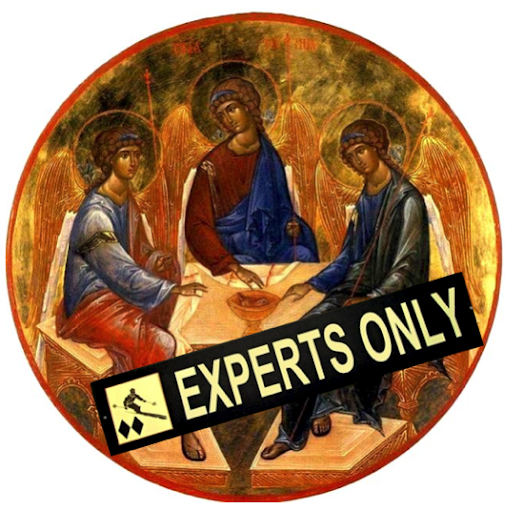
Experts

Last Sunday was Trinity Sunday – the day when the Church focuses on the one God having revealed himself to be a communion of three persons, whose self-giving love for one another means that they are both three and one – distinct persons, yet of one substance. As St. John Paul II put it in Familiaris Consortio (§11): “God is love and in Himself He lives a mystery of personal loving communion.”

John Paul II then goes on to discussing the relevance of an understanding of the Trinity for humanity, when he says that

“God created man in His own image and likeness: calling him to existence through love, He called him at the same time for love. […] Creating the human race in His own image and continually keeping it in being, God inscribed in the humanity of man and woman the vocation, and thus the capacity and responsibility, of love and communion. Love is therefore the fundamental and innate vocation of every human being.”

Maybe naively, but I therefore expected to read some edifying insight into this trinitarian nature of God when picking up an official leaflet distributed with my parish’s newsletter last Sunday. Instead, I started reading a piece that kicks off as follows:

“The liturgy of Trinity Sunday is full of abstract words that many of us find difficult – unity, trinity, person, substance. They can seem to belong more to a mathematical text-book than to a prayer. This is the technical language of theology, necessary but only for experts.”

At this point I stopped reading, since, whatever followed, could be neither edifying nor enriching, and I preferred to spend the rest of the time I had before mass in a positive way instead of by trying to calm myself down in the face of more drivel.

I am not sure what maths books the author of the above patronizing had read, but I can only think of one of those four terms coming up there. More seriously wrong is the idea though that our understanding of the nature of God is in some way an academic exercise, that it is something that just has to be put up with and that it is best left to experts. The rest of us, for whom this must all be terribly confusing, should just get on with our lives and not let ourselves be troubled by abstract concepts. In fact, we should shelve all this hoity-toity talk about persons and substances under the soothing blanket of “mystery,” as the author of the above insult to every rational human being suggests later in the same piece.

Absolutely no way, Bruce! This would be – to use a soccer analogy – like telling players that they didn’t need to know anything about the Laws of the Game, that they should just run around kicking the ball however they liked (since those complicated rules would just give them headaches) and that the referees would tell them what’s going on and, at some point, who won.

Luckily the author in question here is comfortably outranked by another, whose words I will chose to use against him and to adhere to myself. Yes, you guessed it – I am talking again about St. John Paul II, who said:

“[T]he Trinity is beyond the capacities of our understanding and can only be known through revelation. Nevertheless, this mystery which infinitely transcends us is also the reality closest to us, because it is the very source of our being. For in God we “live and move and have our being” (Acts 17:28), and what St Augustine says of God must be applied to all three divine persons: he is “intimior intimo meo” (Confessions, 3, 6, 11). In the depths of our being, where not even our gaze can penetrate, the Father, Son and Holy Spirit, one God in three persons, are present through grace. Far from being a dry intellectual truth, the mystery of the Trinity is the life that dwells in us and sustains us. […]

He is love in his inner life, where the Trinitarian dynamism is the very expression of the eternal love with which the Father begets the Son and both give themselves to each other in the Holy Spirit. He is love in his relationship to the world, since the free decision to make it out of nothing is the fruit of this infinite love which radiates into the sphere of creation.”

Yes, the Trinity is a mystery, but saying so is not a conversation stopper or an excuse, and neither is it code for saying that we cannot think or reason about what it means. Christianity has at its heart the gift of revelation, where God became man and dwelt among us, precisely so that we could also have some understanding of who He is. While being wholly other, and justifiably approached also by apophatic means, He is at the same time “more inward to us than our inmost self and higher than our highest self” (“intimior intimo meo et superior summo meo”), as St. Augustine says. Being made in His image means that by understanding Him we understand ourselves, and vice versa, and this surely is worth struggling for and putting up with (seemingly) abstract and technical language for.

Let’s not let others tell us that thinking about the Trinity is for experts only, that it is too technical and abstract for us to trouble our pretty little heads with. Let’s receive the gift of revelation and the glimpses of His innermost life that God shared with us, since these are treasures beyond the wildest imagination and keys to unlocking joy in our lives. And even if you, my dear reader, are not a Christian, see what it is that we mean by speaking about God as Trinity, since it tells you what we mean by love.