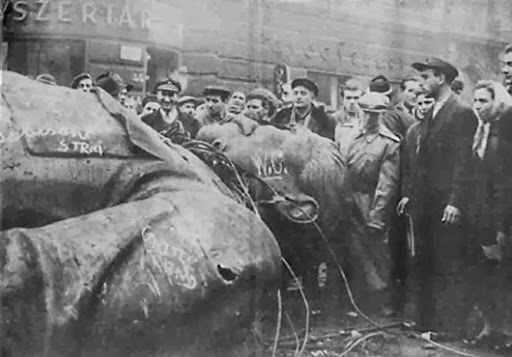
The tyranny of absolutism

Stalin

Walking home this evening I felt like Douglas Hofstadter may have felt when coming up with the central idea of his spectacular Gödel, Escher, Bach book. Unlike his realization about a “golden braid” linking the thoughts of Kurt Gödel, M. C. Escher and Johann Sebastian Bach, which all shed light on infinity, I felt like I saw a way to connect the seemingly opposed words of Popes Benedict XVI and Francis with regard to relativism.

Benedict XVI famously attacked relativism in his sermon during the opening mass of the conclave that elected him, saying:

“To have a clear faith, according to the creed of the Church, is often labeled as fundamentalism. While relativism, that is, allowing oneself to be carried about with every wind of “doctrine,” seems to be the only attitude that is fashionable. A dictatorship of relativism is being constituted that recognizes nothing as absolute and which only leaves the “I” and its whims as the ultimate measure.”

The message here is very clear – the arbiter of truth and falsehood as well as good and evil has become the individual, with no intrinsic meaning left for these concepts beyond what each person chooses to invest them with for themselves. It is not only a relativity of meaning but also a solitude – I have my truth and you yours and that is the end of the story. In his book-length interview with Benedict XVI (“Light Of The World”), Peter Seewald, gets Benedict to elaborate on the above idea, when he says:

“It is obvious that the concept of truth has become suspect. Of course it is correct that it has been much abused. Intolerance and cruelty have occurred in the name of truth. To that extent people are afraid when someone says, “This is the truth”, or even “I have the truth.” We never have it; at best it has us. No one will dispute that one must be careful and cautious in claiming the truth. But simply to dismiss it as unattainable is really destructive.

A large proportion of contemporary philosophies, in fact, consist of saying that man is not capable of truth. But viewed in that way, man would not be capable of ethical values, either. Then he would have no standards. Then he would only have to consider how he arranged things reasonably for himself, and then at any rate the opinion of the majority would be the only criterion that counted. History, however, has sufficiently demonstrated how destructive majorities can be, for instance, in systems such as Nazism and Marxism, all of which also stood against truth in particular.

[…] That is why we must have the courage to dare to say: Yes, man must seek the truth; he is capable of truth. It goes without saying that truth requires criteria for verification and falsification. It must always be accompanied by tolerance, also. But then truth also points out to us those constant values which have made mankind great. That is why the humility to recognize the truth and to accept it as a standard has to be relearned and practiced again.”

Essentially, Benedict says that just because we cannot possess the truth, it does not mean that “the” truth does not exist. Our access to it is imperfect and tolerance and caution are called for, but denying its existence (just because of our epistemological constraints) is a dangerous path to follow. The picture from the above is very clear – relativism (making one’s “I” the ultimate arbiter of truth) is a tyranny and a reliance of one’s self is dangerous.

Fast-forward to this morning’s interview1 with Pope Francis talking to Eugenio Scalfari and take a look at what he has to say on the subject:

“Scalfari: Your Holiness, is there is a single vision of the Good? And who determines it?

Francis: Each of us has their own vision of Good and also of Evil. We have to encourage him to proceed towards that which he thinks is Good.

Scalfari: Your Holiness, you have already written it in the letter you addressed to me. Conscience is autonomous, you said, and everyone must obey their own conscience. I think that’s one of the most courageous passages spoken by a Pope.

Francis: And I repeat it here. Each one has their own idea of Good and of Evil and must choose to follow Good and fight Evil as they understand them. This would suffice to make the world a better place.”

“Each one has their own idea of Good and Evil […] as they understand them.” But, this sounds precisely like the relativism (the “I” being arbiter of truth) that Benedict denounced and declared a destructive danger. Are Francis and Benedict disagreeing here? Is Francis changing Church teaching?

I don’t think so. Instead, I believe, that their apparent opposition flows from the different perspectives from which they speak about truth and good and evil. Benedict describes what you’d see from God’s perspective: truth is absolute and denying its existence and substituting one’s whims for it, just because humans can’t access it, is a mistake. Francis, instead looks at the picture from the perspective of the individual: trust your conscience’s discernment between good and evil and choose good. Each human has a conscience by means of which they can discern (to varying degrees of faithfulness – “At present we see indistinctly, as in a mirror” as St. Paul says in 1 Corinthians 13:12) a reflection of the absolute truth. It is the same landscape, but Benedict looks down from the mountaintop while Francis looks up from the valley.

Applying this to myself, I can simultaneously believe in absolute truth and goodness, while being aware of my own inability to grasp them fully (or even with a known level of (in)accuracy). This epistemic constraint in no way undoes the meaningfulness of pursuing goodness and truth and instead makes tolerance and dialogue necessary. It also means that – as Francis said in the same interview – “Proselytism is pompous foolishness that has no sense. We must get to know each other and listen to each other and grow our understanding of the world around us.” I believe we are all accessing fragments of the one Truth,2 which makes me want to know what you have understood as much as deepening my understanding of my own faith.


1 The English translation sadly has some serious issues at the time of this post’s writing (the tile itself being seriously mistranslated), as a result of which I started from it but made adjustments based on reading the Italian original.
2 This is consonant with Francis saying, still in this same interview that “I believe in God. Not a Catholic God, there is no Catholic God, there is God.”
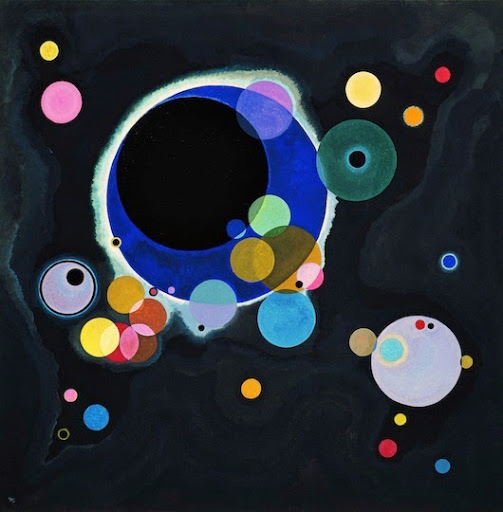
Kandinsky: innermost necessity of the soul

Kandinsky several circles website hd 5 13

[Warning: long read :)] Wassily Kandinsky, the father of abstract painting, is among those artists whom I have greatest affinity to, not for some specific reason, but simply because of the persistent bond that I feel between his work and myself. Looking at a piece like “Composition VIII” or at “St George I,” a reproduction of which we have in our living room, is always an experience that is hard to describe and that I prefer to leave unverbalized.

A couple of days ago I then came across a video from 1926 of him painting, which was a completely unexpected treat (thanks, @openculture!) and which lead me to his book “Point and line to plane,” where he gives the following, stunning definition of the point:

“The geometric point is an invisible thing. Therefore, it must be defined as an incorporeal thing. Considered in terms of substance, it equals zero. Hidden in this zero, however, are various attributes which are “human” in nature. We think of this zero — the geometric point — in relation to the greatest possible brevity, i.e., to the highest degree of restraint which, nevertheless, speaks. Thus we look upon the geometric point as the ultimate and most singular union of silence and speech. […] In the flow of speech, the point symbolizes interruption, non-existence The (negative element), and at the same time it forms a bridge from one existence to another (positive element). In writing, this constitutes its inner significance.”

This is clearly neither a mathematical definition, nor a scientific one (invisible=incorporeal?), but a phenomenological, even spiritual one. It is more like what a close friend would say in a eulogy, and that is how I felt when reading this book: to Kandinsky the point, line and plane were not some hypothetical concepts, but intimate friends and collaborators. His writing about them at times sounds like a person’s memoirs, rather than detached rationalizations of a theorist. Needless to say, I was hooked, and then delighted when I came to reading the foreword to the book (which I don’t tend to do as a rule) and discovering that “Point and line to plane” was the sequel to “On the spiritual in art.” This fact alone pointed me to another interpretative key for the above passage about the point, and its parallels with the person of Jesus and indeed with the Trinity jumped out at me. The process of non-existence, while simultaneously bridging between existences is precisely the dynamic between the persons of the Trinity (each emptying themselves – becoming nothing1 – out of love for the other).

If you have any interest in art, I can’t recommend “On the spiritual in art” too highly – not only is it an insight into one of the greatest painters of all time, but, to my mind, it is of the order of Plato’s Republic in terms of foundation myths.

Kandinsky starts out by emphasizing the necessity to act in the present moment (much like Le Corbusier insisted too), instead of attempting to imitate the past, which he depicts in harsh terms:

“[E]very cultural period creates art of its own, which can never be repeated again. An effort to revive art-principles of the past, at best, can only result in works of art resembling a still-born child. […] The sculptor’s attempts to employ Greek principles can only achieve a similarity in form, while the work itself remains for all time without a soul.”

Within the space of a couple of pages from the beginning, Kandinsky then proceeds to present his view of the hierarchy of spiritual life, which he equates with that of artistic life, since “[the] grammar of painting [… are] the rules of the inner necessity […] of the soul.”:

“A large acute triangle divided into unequal segments, the narrowest one pointing upwards, is a schematically correct representation of spiritual life. The lower the segment the larger, wider, higher, and more embracing will be the other parts of the triangle. The entire triangle moves slowly, almost invisible, forward and upward and where the apex was “today,” the second segment is going to be “tomorrow,” that is to say, that which today can be understood only by the apex, and which to the rest of the triangle seems an incomprehensible gibberish, tomorrow forms the true and sensitive life of the second segment.

At the apex of the top segment, sometimes one man stands entirely alone. His joyous vision corresponds to a vast inner sorrow, and even those, who are closest to him, do not comprehend him. […] Artists are to be found in every segment of this imaginary triangle. Each one of these artists, who can see beyond the limits of his present stage, in this segment of spiritual evolution is a prophet to those surrounding him and helps to move forward the ever obstinate carload of humanity. However, one of those not possessed by such vision, or misusing it for base purposes and reasons, when he closes the triangle may be easily understood by his fellow men and even acclaimed. The larger the segment (that is, the lower it lies in the triangle), the greater is the number of people to comprehend the words of the artist. In spite of it and correspondingly every group consciously or unconsciously hungers for spiritual food.”

While the above is unquestionably elitist, there are several details to note, which, I believe, hint at a dichotomy with the universally-accessible. First, the interconnectedness of the entire universe of spiritual ascent and the impact of its protagonists on all (“where the apex was “today,” the second segment is going to be “tomorrow.””). Second, the positive view of everyone’s potential to comprehend advances in art, albeit with a delay (“[T]hat which today […] to the rest of the triangle seems an incomprehensible gibberish, tomorrow forms the true and sensitive life of the second segment.”). Third, the desire of all for genuine spiritual food, in spite of some contenting themselves with fakes. Added to the above pull towards democratization of the elite striving for spiritual/artistic progress is also his declaration that “[a]nyone, who absorbs the innermost hidden treasures of art, is an enviable partner in building the spiritual pyramid, which is meant to reach into heaven.”

This tension is further carried forward, when Kandinsky argues that there is only a single criterion for what makes eternal art – its “inner necessity” from the perspective of its author:

“The artist should be blind to the importance of “recognition” or “non-recognition” and deaf to the teachings and demands of the time. His eye should be directed to his inner life and his ear should harken to the words of the inner necessity. Then, he will resort with equal ease to every means and achieve his end. […] All means are sacred when called upon by innermost necessity.”

““[O]uter necessity” […] can never lead beyond the limits of the conventional, that is, traditional “beauty” only. The “inner necessity” does not know such limits and, for this reason, often creates results which are conventionally termed “ugly.” “Ugly” is, therefore, only a conventional term which continues to lead a sham life long after the inner necessity […] has been superseded. At that time, everything was considered ugly if it was not connected with the inner necessity of the time, and anything so connected was termed beautiful. Everything, which appeals to the inner necessity is already beautiful by its virtue, and will be recognized sooner or later.”

“As no “dissonant notes” exist in music, nor in painting “inharmony,” in these two art expressions every sound, whether harmony or discord, is beautiful (appropriate), if it results from inner need. The inner value of each and every movement will soon be felt, as the inner beauty replaces the sensuous aspect. Thus, “ugly” movements suddenly appear beautiful, from which an undreamed power and vital force will burst forth instantly.”

Rooting perfection in “inner necessity” also changes the criteria by which art is judged and the means that are justified for its pursuit:

“A “perfect drawing” is the one where nothing can be changed without destroying the essential inner life, quite irrespective of whether this drawing contradicts our conception of anatomy, botany, or other sciences.”

“Likewise, colours should be used not because they are true to nature but only because the colour harmony is required by the paintings individually. The artist is not only justified in using any form necessary for his purposes, but it is his very duty to do so. Neither anatomical correctness nor any basic overthrow of scientific statements are necessary, only the artist’s unlimited freedom in the selection of his means.”

“This unlimited freedom must be based on inner necessity (which is called honesty). This is not only the principle of art but of life. This principle is the great sword of the superman with which he fights the Philistines.”

More than anything, the above reminds me of St. Augustine’s most famous dictum: “Love and then what you will, do,” which we could put into Kandinsky’s mouth as “Be honest and then what you will, paint,” without incurring any contradiction with his own words.

I have to say that reading “On the spiritual in art” has made me feel even closer to Kandinsky and has armed me with new means, with which I can revisit his paintings (and those of others!) in an attempt to connect with the innermost necessity that lead to their creation.


1 This self-emptying – kenosis – is explicitly indicated in St. Paul’s letter to the Philippians (2:5-9) and beautifully explained also by Hans Urs von Balthasar: “The Father, in uttering and surrendering himself without reserve, does not lose himself. He does not extinguish himself by self-giving, just as he does not keep back anything of himself either. For in this self surrender he is the whole divine essence. Here we see both God’s infinite power and his powerlessness; he cannot be God in any other way but in this “kenosis” within the Godhead itself.” (Theo-Drama: Theological Dramatic Theory: The Action Vol 4).

Does the word “infinity” make you uncomfortable?

The Dominoes Are Falling

I learned a lesson today: never read the parish newsletter before the start of mass. This morning I did and it just lead to regret as I spent the vast majority of mass being distracted1 by it and trying to reconstruct in my mind the reasons against an argument put forward in it. What is even worse is that this wasn’t just the regular newsletter that our parish priest prepares (and that has as yet lead neither to disappointment, nor elation), but a newsletter – “Our Faith on Sunday” – prepared by the company who provides the weekly mass sheets and who ought to know better.

The argument in question is that of Aristotle’s unmoved mover (or first cause), which is a form of the cosmological argument. The basic idea is the following: since all change (motion, temperature variation, …) is the result of a previous change, there are two possibilities: either a causal chain stretching back into an infinite past or a first, “unmoved mover” that triggered a finite chain of causal links leading to the present. The possibility of infinite regress is dismissed as ridiculous, ergo there had to be a first mover. So far Aristotle’s argument from over 2300 years ago, which at that time was unarguably brilliant and which has survived without chinks into the 18th century (this by itself being pretty impressive too!). So, Aristotle comes out pretty well from this incident. The same cannot be said about the nameless author, who not only sticks it into a parish newsletter in 2012 without attribution, but who – to add insult to injury – finishes the piece with saying that the “unmoved mover” is God.

No it ain’t! And that is just the start of a litany of complaints that flooded my mind this morning, with the following being the 800 pound gorillas:

  1. In this context, the gravest mistake is clearly to present a piece of philosophy (however good it may be) and to equate it with God. Not just to say: “Well, this concept gives us hints about some aspects of what God may be like,” but to say “Unmoved mover = God.” Not only is this entirely divorced from Christian theology (giving a false sense of being able to grasp God in His fullness, etc.) but it is positively counterproductive. In essence the argument postulates a God who is relegated to a distant past, who is far removed from us and who just plays the role of a snooker player, hitting the first ball that leads to a vast sequence of knock-ons – a true God of Gaps. This is not the God of Christianity. It is not the loving Father who sent his Son to become one of us and the Holy Spirit to guide us. It is not the God who’s three persons love one another to the point of being one and who invites us to partake in His innermost life. The “unmoved mover” is a cheap imitation and one that is rightly and thankfully the butt of atheist jokes.
  2. Next, taking a philosophical argument made over two thousand years ago and (presumably, hopefully!) not checking whether there have been any significant challenges made against it is pretty sloppy too. And an excuse of obscurity cannot be used here either as the cosmological argument (whose one variant this is) has been debated to death! Furthermore, its critics have included such giants of philosophy as David Hume, who challenged the notion of causation itself (arguing that our senses simply don’t have access to the necessary connection between supposed cause A and supposed effect B – instead, all we have are repeated experiences of event B following event A). With causation undermined, there is clearly no necessity for a “first cause.” Does that mean a disproof of God? No – just of the grotesque God of Gaps of the cosmological argument, and not a disproof as such (those live exclusively in the realm of mathematics or other formal systems – and even there are limited by incompleteness) but a counterargument instead.
  3. Finally, and this is a criticism that I cannot fairly level at the authors of the newsletter, there is also that recurring misunderstanding of infinity that hampers many a philosophical argument from centuries past. Before Georg Cantor’s groundbreaking work on set theory and the concept of cardinality and the subsequent advances in our understanding of infinite sets and their properties (with contributions by pioneers like David Hilbert), an arm-waving approach to infinity and blanket statements about its unintelligibility or impossibility (e.g., by Thomas Aquinas2) were all we could manage. Today these are just not good enough anymore. E.g., a good example of how the impossibility of an infinite sequence of causes can be refuted can be found in Peter Clark’s paper: “Consider the set of events with no first member but a last member: {… an … a4, a3, a2, a1, a0} [where] for every j (aj-1 causes aj). There is no logical contradiction in this supposition whatsoever. […] Every event in the above sequence is finitely accessible from each and every event preceding it.” What this means is that an infinite sequence stretching back in time does not imply the necessity for a member that is infinitely far in the past. No matter how far you go back in the sequence (i.e., an) – and remember that you can’t go back to the beginning, which does not exist – there is a finite number of steps that bring you to the present (i.e., a0). All the infinity of the sequence means is that there is no first member, without necessarily entailing members that are infinitely removed in the past. This may sounds counterintuitive, but presents no logical contradiction.3

So: lesson learned. Next time, I’ll defer reading the newsletter until after mass and especially its “Faith and Reason” section, where, ironically, Aristotle’s argument was plagiarized.


1 I almost missed this gem of a line from St. Paul’s letter to the Philippians: “And this is my prayer: that your love may increase ever more and more in knowledge and every kind of perception, to discern what is of value” (1:9-10), again pointing to an induction of orthodoxy from orthopraxy.
2 “The existence of an actual infinite multitude is impossible. For any set of things one considers must be a specific set. And sets of things are specified by the number of things in them. Now no number is infinite, for number results from counting through a set of units. So no set of things can actually be inherently unlimited, nor can it happen to be unlimited.” (Thomas Aquinas, Summa Theologica, Part 1, Question 7, Article 4).
3 I realize this paragraph barely scratches the topic of infinity, to which I hope to return in the future … Also, please, note that I am not advocating an argument for the universe having existed infinitely – I am merely pointing to the objection to an infinite causal chain being outdated.