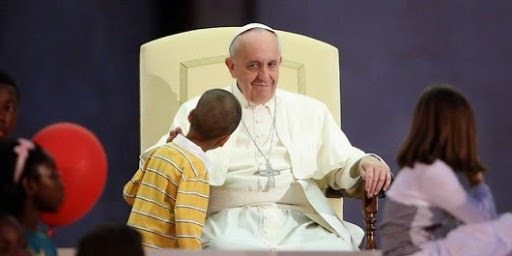
“After much debate had taken place, …” is not a quote from an article about the Synod, but about the Council of Jerusalem, from the Acts of the Apostles (15:7), where there was ample discord among participants, some favoring tradition – extending Jewish circumcision to all Christians – and others feeling compelled to change in response to a prompting from the Holy Spirit, put into words by St. Peter, the pope in office then, who said (15:9-11):
“[God] made no distinction between us and them, for by faith he purified their hearts. Why, then, are you now putting God to the test by placing on the shoulders of the disciples a yoke that neither our ancestors nor we have been able to bear? On the contrary, we believe that we are saved through the grace of the Lord Jesus, in the same way as they.”
I don’t know about you, but this very much reminds me of Pope Francis’ homilies from the last two days …
Reading the reports about the Synod since the “relatio post disceptationem” has been released could give one the sense that it has been a mistake, that it is leading to a schism, that what it says will be retracted and that there is huge opposition to its content in general. Not being at the Synod myself (obviously!), it is hard to get a sense of the temperature on the ground. While there is no shortage of positive, optimistic voices coming from there, e.g., Cardinal Lluís Martínez Sistach of Barcelona tweeting this morning that “The atmosphere at the Synod is one of communion and of being pastoral. The Church wants to become closer to and be with all the families of the world,” the vast majority of media outlets report mayhem (which, lets be honest, sells better than harmony :).
Without wanting to give too much oxygen to negativity, I would just like to point to a lack of subtlety in reporting the words of the Synod Fathers. E.g., taking Cardinal Raymond Burke’s words that the relatio “advances positions which many synod fathers do not accept and, I would say, as faithful shepherds of the flock cannot accept,” and presenting them as disagreement with the relatio is accurate. However, the same conclusion can’t be drawn from what Cardinal Wilfrid Napier saying:
“The message has gone out: This is what the synod is saying, this is what the Catholic church is saying. And it’s not what we’re saying at all. No matter how we try correcting that … there’s no way of retrieving it. The message has gone out and it’s not a true message. Whatever we say hereafter is going to be as if we’re doing some damage control.”
This is universally interpreted as “Cardinal Napier says, message of “relatio” is not true.” Hold on. Read it again. What does he actually say? What does he say the message is? He even spells it out: “The message has gone out: This is what the synod is saying, this is what the Catholic church is saying.” The message is that the content of the relatio expresses the consensus of the Synod and presents the teaching of the Church. That, as Cardinal Napier rightly says, is untrue. The “relatio” is a working document (as it states itself) put together by a committee as input to the discussions and adjustments that it is receiving as we speak, during this week’s work in smaller groups. It couldn’t possibly be an expression of the Synod’s consensus, since the Synod Fathers first saw it the morning it was publicly read out and streamed across the internet. I can very well see how this would be irritating to those at the Synod, regardless of what they think about the content.
With that out of the way, let me point you to a couple of interviews that have come out over the course of the last day and that I consider to have great beauty.
First, the following interview with a Rwandan couple – Jean Dieudonné and Emerthe Gatsinga, who are members of the Focolare Movement, who are at the Synod as “auditors,” and with whom I am in complete agreement, has been published on the Vatican Television YouTube channel:
“Jean: “Families need the help of the Church to deepen their faith. Because, with faith in Jesus one receives, one earns the strength to overcome various situations. When there is faith, when one has chosen to place Jesus at the first place in one’s life, everything is possible. Life is not always easy, but in Jesus we take strength for overcoming many difficulties.”
Eremite: “With faith, the husband gives dignity to the wife. This helps the development of the family, because they try to build it together, relying on love. Like that, the family can be promoted in a spirit of reciprocal love and also of mutual help.””
A brief interview with Archbishop Vincenzo Paglia, President of the Pontifical Council for the Family, again underlines what this Synod is about, with a constant thread of closeness to and love for all running through his words: 1
“There is a need for attentive listening and accompanying, because there are also wounded families. It is not like there is the category of the divorced and remarried, there are stories, at times even dramatic ones. The theme with highest priority is that of closeness to all of them, with no one excluded. Then, within this new horizon, there is also the question of access to the sacraments. And here I have to say that, once the indissolubility of marriage is confirmed, which is that the true marriage is the one that took place and the rest is not a marriage union, then there is a range of possibilities. Certainly there are still some clean-cut cases, but it seems to me that there should be openness to evaluate individual cases by bishops so that a closer, more direct solution may be found. […]
[Homosexuals] are our brothers or sisters. To be loved as children of God to the end, to be embraced, accompanied, sustained, to be close to. Another question is that of marriage. Because marriage, since the world has been the world, is between man and woman. […] Then … affection … well we can be attracted by anyone. What’s more, I wish for all of us that we would all love each other, so we aren’t like frigid sticks that don’t encounter each other! The challenge is how to be close to those who are maybe in difficulty, and here I believe that it is all of us, believers, who need to take the first step. Whoever is in difficulty is to be embraced and helped. […]
There is a greater understanding that to participate in the Eucharist also means to be in communion – not only by listening to the Word of God – Bread descended from Heaven – but also by being in communion with the body and blood of the Lord. In this sense, doctrine grows, expands, like each one of us. I, when I was ten years old, was very different from how I am now. I had hair and today I don’t anymore. But I am always Vincenzo! I am always me. And this is also how it is with Christianity. We mustn’t be rigid men made of marble, constrict ourselves, one the other hand we can’t stretch our necks to infinity either. I believe that the Gospel here is important. If we are faithful to the Gospel, we avoid all risks of turning Christianity into an ideology. The Gospel is the same, but the Spirit helps us to understand it in a way that fits the time in which we live. Today we are at the beginning of the 21st century. Many things have changed. We must be able to – and this is why the Spirit of the Lord is important – to speak the Gospel that has always been, in a way that the men and women of today may understand and put into practice.”
Cardinal Christoph Schönborn of Vienna gave an interview yesterday, in which he shared his experience of a gay couple with great humility: “In Vienna, I got to know two men of homosexual orientation who have been living together for some time in a civil partnership. And I have seen how they have been helping each other when one of them fell seriously ill. It was wonderful, both in human and Christian terms, how one has cared for the other, staying by his side. These are things that need to be recognized. Jesus said: tax collectors and prostitutes will precede you into the Kingdom of God.2 And he says this to us, us cardinals, bishops, priests. Many times, even if we do not approve of this form of sexuality, we can bow down in front of exemplary human behavior.” Schönborn, himself a son of divorced parents, then also spoke about the importance of putting children first when families fall apart, and gave a first-hand account:
“Those who get divorced and have children must never forget that they remain parents. They mustn’t allow for the weight of their failure to fall on the shoulders of their children. There is so much suffering today … I was thirteen years old [when my parents divorced]. It’s strange, but what stays with you is the dream that your parents get back together, until the end of their lives. It’s an instinctive thing, not rational. It is the heart. I know a lot of children in my situation. The dream remains for Mum and Dad to get back together.”
Another interview, very much worth reading in full, that has been published yesterday is with Bishop Anthony Borwah from Liberia, who was invited to participate at the Synod, but who has remained at home due to borders closing as a result of the outbreak of Ebola. At the beginning of the interview he says: “As Bishop of my people I carry within my heart their wounds and pains every moment of life here.” And this attitude also shines through the passage I would like to quote next, where he speaks about one of the sufferings of his people. His words struck me to be extremely Jesus-like:
“Generally the economy of the nation is in the pocket of few men, hence there is a lot of women prostitution. I often say that these prostitutes are prophets and friends of Jesus as they signify the inequality, marginalization and injustice meted out against the poor and nobodies of our society, especially women. Women are generally subject to men culturally, and are often subjected to brutal domestic violence and impoverishment. The government of President Ellen Johnson Sirleaf has done a lot to raise the dignity of womanhood in beloved Liberia, but the walk is still too long.”
Finally, to round out the above thoughts on the family, I would like to share a quote from the writings of the Servant of God Igino Giordani, who speaks about how he, a married man and father of four children, understood God’s plan for the family:
“The family is not closed in on itself, as if in a fortress, but it grows like a cell that lives for itself when it lives with its brothers. It communicates in some way with the whole of humanity, which has the potential to be the Church, which is the family of God the Father. As it participates in the ideals and hopes, joys and sorrows of the largest family, there is no danger of boredom and loneliness, and not even of being abandoned, for its individual members. From this communion, which carries with it the duties of apostolate, of charity and justice, towards society, it can be understood how great the scope of the social and spiritual responsibilities of marriage is.”
1 Like a lot of the text here, this too is my own, choppy translation, which seems even choppier to me in this case, since listening to Archbishop Paglia’s Italian has been a bit like drinking from a fire hose for me. Apologies for any gross misinterpretations.
2 cf. Matthew 21:31.
 eyebeleave