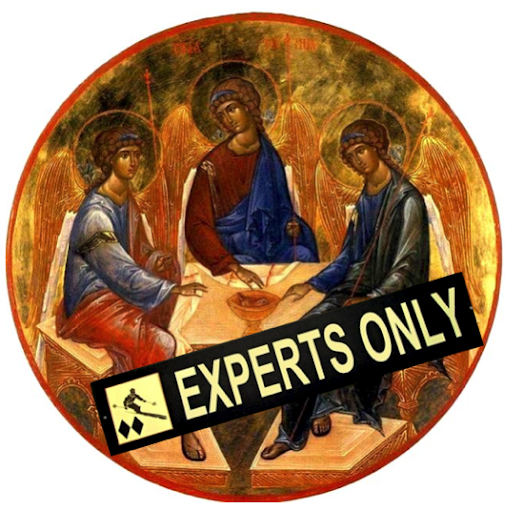
Theology: necessary, but only for experts

Experts

Last Sunday was Trinity Sunday – the day when the Church focuses on the one God having revealed himself to be a communion of three persons, whose self-giving love for one another means that they are both three and one – distinct persons, yet of one substance. As St. John Paul II put it in Familiaris Consortio (§11): “God is love and in Himself He lives a mystery of personal loving communion.”

John Paul II then goes on to discussing the relevance of an understanding of the Trinity for humanity, when he says that

“God created man in His own image and likeness: calling him to existence through love, He called him at the same time for love. […] Creating the human race in His own image and continually keeping it in being, God inscribed in the humanity of man and woman the vocation, and thus the capacity and responsibility, of love and communion. Love is therefore the fundamental and innate vocation of every human being.”

Maybe naively, but I therefore expected to read some edifying insight into this trinitarian nature of God when picking up an official leaflet distributed with my parish’s newsletter last Sunday. Instead, I started reading a piece that kicks off as follows:

“The liturgy of Trinity Sunday is full of abstract words that many of us find difficult – unity, trinity, person, substance. They can seem to belong more to a mathematical text-book than to a prayer. This is the technical language of theology, necessary but only for experts.”

At this point I stopped reading, since, whatever followed, could be neither edifying nor enriching, and I preferred to spend the rest of the time I had before mass in a positive way instead of by trying to calm myself down in the face of more drivel.

I am not sure what maths books the author of the above patronizing had read, but I can only think of one of those four terms coming up there. More seriously wrong is the idea though that our understanding of the nature of God is in some way an academic exercise, that it is something that just has to be put up with and that it is best left to experts. The rest of us, for whom this must all be terribly confusing, should just get on with our lives and not let ourselves be troubled by abstract concepts. In fact, we should shelve all this hoity-toity talk about persons and substances under the soothing blanket of “mystery,” as the author of the above insult to every rational human being suggests later in the same piece.

Absolutely no way, Bruce! This would be – to use a soccer analogy – like telling players that they didn’t need to know anything about the Laws of the Game, that they should just run around kicking the ball however they liked (since those complicated rules would just give them headaches) and that the referees would tell them what’s going on and, at some point, who won.

Luckily the author in question here is comfortably outranked by another, whose words I will chose to use against him and to adhere to myself. Yes, you guessed it – I am talking again about St. John Paul II, who said:

“[T]he Trinity is beyond the capacities of our understanding and can only be known through revelation. Nevertheless, this mystery which infinitely transcends us is also the reality closest to us, because it is the very source of our being. For in God we “live and move and have our being” (Acts 17:28), and what St Augustine says of God must be applied to all three divine persons: he is “intimior intimo meo” (Confessions, 3, 6, 11). In the depths of our being, where not even our gaze can penetrate, the Father, Son and Holy Spirit, one God in three persons, are present through grace. Far from being a dry intellectual truth, the mystery of the Trinity is the life that dwells in us and sustains us. […]

He is love in his inner life, where the Trinitarian dynamism is the very expression of the eternal love with which the Father begets the Son and both give themselves to each other in the Holy Spirit. He is love in his relationship to the world, since the free decision to make it out of nothing is the fruit of this infinite love which radiates into the sphere of creation.”

Yes, the Trinity is a mystery, but saying so is not a conversation stopper or an excuse, and neither is it code for saying that we cannot think or reason about what it means. Christianity has at its heart the gift of revelation, where God became man and dwelt among us, precisely so that we could also have some understanding of who He is. While being wholly other, and justifiably approached also by apophatic means, He is at the same time “more inward to us than our inmost self and higher than our highest self” (“intimior intimo meo et superior summo meo”), as St. Augustine says. Being made in His image means that by understanding Him we understand ourselves, and vice versa, and this surely is worth struggling for and putting up with (seemingly) abstract and technical language for.

Let’s not let others tell us that thinking about the Trinity is for experts only, that it is too technical and abstract for us to trouble our pretty little heads with. Let’s receive the gift of revelation and the glimpses of His innermost life that God shared with us, since these are treasures beyond the wildest imagination and keys to unlocking joy in our lives. And even if you, my dear reader, are not a Christian, see what it is that we mean by speaking about God as Trinity, since it tells you what we mean by love.
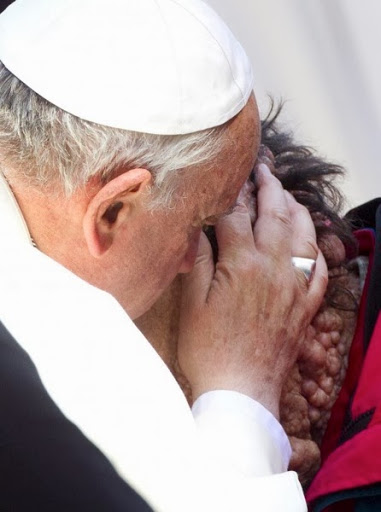
This is what the Gospel looks like

Pope disfigured man

Pope Francis has given another interview – this time to Andrea Tornielli (a contributor to the always up-to-date Vatican Insider blog) at the Italian La Stampa newspaper – and the following are some of my favorite passages:1

“[Christmas] speaks to us of tenderness and hope. When God meets us, he tells us two things. The first one is: have hope. God always opens doors, he never closes them. He is the dad who opens doors for us. Second: don’t be afraid of tenderness. When Christians forget about hope and tenderness, they become a cold Church that doesn’t know where to go and that entangles itself into ideologies, into worldly attachments. Instead, God’s simplicity tells you: go forward, I am a Father who caresses you. I am scared when Christians lose hope and the capacity to embrace and caress.”

Christmas is about hope and warmth, fueled by and in imitation of God and directed towards others.

“What we read in the Gospels is an announcement of joy. The evangelists have described a joy. No consideration is given to the unjust world, to how God could be born into such a world. All this is the fruit of our own contemplations: the poor, the child that has to be born in uncertainty. is born into a precarious situation. Christmas was not a condemnation of social injustice, of poverty; instead, it was an announcement of joy. Everything else are conclusions that we draw. Some are correct, others are less so, and others still are ideologized. Christmas is joy, religious joy, God’s joy, interior, luminous, of peace.”

Christmas is, first and foremost, joy. Let’s not rush to its implications at the expense of overlooking that deep joy that it heralds.

“A teacher of life for me has been Dostoevskij, and a question of his, both explicit and implicit, has always gone around in my heart: “Why do children suffer?” There is no explanation. […] In front of a suffering child, the only prayer that comes to me is the prayer why. Why, Lord? He doesn’t explain anything to me. But I feel that he is looking at me. So I can say: You know the why, I don’t it and You don’t tell me, but You are looking at me and I trust You, Lord, I trust your gaze.”

Suffering can’t – and mustn’t! – be explained away, but it can be lived while trusting in God’s loving gaze.

“The other day at the Wednesday General Audience, there was a young mother with her baby that was only a few months old, behind one of the barriers. As I passed by, the baby cried a lot. The mother was caressing it. I said to her: madam, I think the little one is hungry. She replied: Yes, it’s probably time … I responded: But, give it something to eat, please! She was shy and didn’t want to breastfeed in public, while the Pope was passing. So, I wish to say the same to humanity: give something to eat! That woman had milk to give to her child, in the world we have enough food to feed everyone.”

There is food for everyone – let’s not make our shyness an obstacle for it to get to its rightful recipient.

“Marxist ideology is wrong. But in my life I have met many Marxists who are good people, so I don’t feel offended.”

Don’t conflate ideology with its adherents. Even wrong ideologies have good people following then.

“During these first nine months, I have received visits from many Orthodox brothers, Bartholomew, Hilarion, the theologian Zizioulas, the Copt Tawadros: this last one is a mystic, he’d enter the chapel, remove his shoes and go to pray. I felt like their brother. They have apostolic succession, I received them as brother bishops. It is painful that we are not yet able to celebrate the Eucharist together, but there is friendship. I believe that the way forward is this: friendship, common work, and prayer for unity. We blessed each other, one brother blesses the other, one brother is called Peter and the other Andrew, Mark, Thomas …”

I have no comment to add – only to say how it warms my heart to hear Francis refer to the Orthodox patriarchs as his brothers and liken their relationship to those among the apostles. This is very much in continuation of the tremendous advances made by John Paul II and Benedict XVI, but I am moved by the beauty of the simplicity with which Francis puts the situation.

“I knew a parish priest in Hamburg who was dealing with the beatification cause of a Catholic priest guillotined by the Nazis for teaching children the catechism. After him, in the line of condemned individuals, was a Lutheran pastor who was killed for the same reason. Their blood became mixed. That parish priest told me he had gone to the bishop and said to him: “I will continue to deal with the cause, but for both of them, not just the Catholic priest’s.” This is the ecumenism of blood.”

That we are followers of Jesus, regardless of what Church we belong to is a matter that goes to the bone, into our blood. There we are already one.

“We must try to facilitate people’s faith, rather than control it. Last year in Argentina, I condemned the attitude of some priests who would not baptize the children of unmarried mothers. This is a sick mentality.”

We are not gate-keepers, but each other’s brothers and sisters instead.

“A few months ago, an elderly cardinal said to me: “You have already started the reform of the Curia with your daily masses at St. Martha’s.” This made me think: reform always begins with spiritual and pastoral initiatives rather than with structural changes.”

Structures must be a consequence of life and the best leadership is by example. This point of Pope Francis’ is also in sync with my previous criticisms of his actions being explained away as only “pastoral” and with comments made by Fr. Antonio Spadaro in the New Yorker interview, where he says, when asked about the style-versus-substance debate concerning Pope Francis: “Style is not just the cover of the book. It’s the book itself! Style is the message. The substance is the Gospel. This is what the Gospel looks like.”


1 Please, note that the following quotes are close to the official English translation, but that I have modified them here and there based on the Italian original – not necessarily in the belief of making them “better” – only with the aim of preserving some of the nuances of how Pope Francis expresses himself.