Synod15: courage, humility and prayer

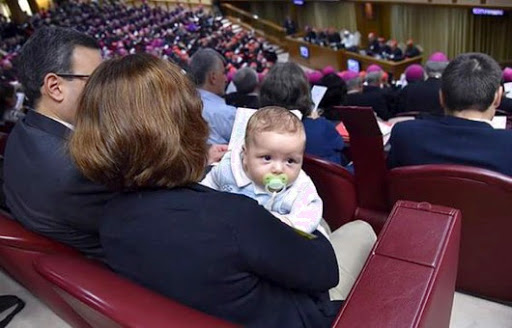
Baby at synod

This morning saw the opening of the Ordinary Synod on the Family, entitled “The vocation and mission of the family in the Church and the contemporary world.” The first General Congregation consisted of an opening address by Pope Francis, an overview of the journey traversed so far by Card. Baldisseri and an introduction by Card. Erdő.

Pope Francis spoke briefly and after calling for parrhesia (speaking boldly), frankness and a bearing in mind of the supreme law being the salvation of souls (for which he referenced Can. 1752), he proceeded to spell out what a synod is (and is not):1

“I would like to remind you that the Synod is not a conference or a “parlor”, it is not a parliament or a senate, where one comes to an agreement. The Synod, instead, is an ecclesial expression, which is that it is the Church walking together to read reality with the eyes of faith and with the heart of God; it is the Church who questions herself about her own fidelity to the deposit of faith, which for her is not a museum to look at or even just to protect, instead it is a living source from which the Church quenches her thirst so as to quench the thirst of and illuminate the deposit of life.

The Synod necessarily moves within the bosom of the Church and in the Holy People of God to which we belong as pastors, that is servants.

The Synod is also a protected space where the Church experiences the action of the Holy Spirit. In the Synod the Spirit speaks through the language of all the people who let themselves be led by the God who always surprises, by the God who reveals to the little ones what he hides from the wise and the intelligent, by the God who created the law and the Sabbath for man and not vice versa, by the God who leaves the ninety-nine sheep to find the one lost sheep, by the God who is always greater than our logic and our calculations.

Let us recall, however, that the Synod may be a space of the Holy Spirit only if we, its participants, put on vestments of apostolic courage, evangelical humility and trusting prayer.”

Francis then proceeds to elaborate on these three prerequisites for receiving the Holy Spirit:

“Apostolic courage that doesn’t allow itself to be scared either in the face of the temptations of the world that tend to extinguish the light of the truth in the hearts of men, replacing it with small and temporary lights, or when faced with hearts turned to stone that – in spite of good intentions – drive people away from God. “Apostolic courage that brings life and that does not turn our Christian life into a museum of memories” (Homily at Santa Marta, 28 April 2015).

Gospel humility that knows how to empty itself of its own conventions and prejudices, to listen to his brother Bishops and be filled with God. Humility that leads to not pointing a finger at others to judge them, but to offer them a hand to help lift them up without ever feeling superior to them.

Trusting prayer is performed by the heart when it opens to God, when all of our moods are silenced to listen to the gentle voice of God that speaks in silence. Without listening to God all our words will only be “words” that do not sate and that do not serve. Without letting ourselves be guided by the Spirit, all our decisions will only be “decorations” that instead of exalting the Gospel cover it and hide it.”

To conclude, Pope Francis returns to contrast the workings of parliaments with what the Synod is called to:

“As I said, the Synod is not a parliament, where it is necessary to negotiate, to bargain or to compromise, so as to reach consensus or a common agreement. Instead, the only method of the Synod is to open up to the Holy Spirit, with apostolic courage, with evangelical humility and trusting prayer; so that it may be Him who guides us, who enlightens us and who makes us put before our eyes not our personal opinions, but faith in God, fidelity to the Magisterium, the good of the Church and the salus animarum [salvation of souls].”

Cardinal Baldisseri then presented an extensive review of the synodal way that has been followed so far – including an overview of last year’s Extraordinary Synod and the work carried out by the Church worldwide during this past year in preparation for the present Synod. Cardinal Baldisseri also presented the methodology that will be followed during this year’s Synod.

Next, Cardinal Erdő presented an overview of the instrumentum laboris published in June that will be the basis for the Synod’s work over the next three weeks (each week focusing on one of its three parts).


1 In this post and in all that will follow about the Synod, I will strive to share information as soon as possible, which means that many of the English translations will be my, rough ones. If the link I provide to the source is not in English, please, assume that the translation is mine, with all the caveats that that carries.

Synod15: gentle breeze, faint light

Vatican pope francis vigil prayer before synod assembly afp 041015

The second in a pair of Synods on the Family opened this morning with a mass presided over by Pope Francis. It will last for the next three weeks, during which 270 Synod Fathers (45 of which have been directly nominated by the pope), 51 auditors (among whom there are 9 married couples) and 14 fraternal delegates (representatives of other Christian churches and ecclesial communities) will discuss “The vocation and mission of the family in the Church and the contemporary world.” This will be done by following the structure of the working document (“instrumentum laboris”) that was published at the end of June, where each week will focus on one of the document’s parts: “Considering the challenges of the family,” “The Discernment of the Family Vocation,” and “The Mission of the Family Today.”

Like I did last year, I will again try to share excerpts from the material published during this Synod and I will here start with selecting parts from yesterday’s prayer vigil for the Synod and his homily at the opening mass of the Synod this morning.

Pope Francis opened his prayer vigil address with underlining the gentleness of God’s call:

“God’s grace does not shout out; it is a whisper which reaches all those who are ready to hear the gentle breeze – that still, small voice. It urges them to go forth, to return to the world, to be witnesses to God’s love for mankind, so that the world may believe…”

Then, he spoke about the fundamental importance of the Holy Spirit, by referring to the Greek Orthodox Patriarch Ignatius IV of Antioch who said that:

“without the Holy Spirit God is far off, Christ remains in the past, the Church becomes a mere organization, authority becomes domination, mission becomes propaganda, worship becomes mystique, Christian life the morality of slaves.”

Francis then set out his desires for the Synod:

“[L]et us pray that the Synod which opens tomorrow will show how the experience of marriage and family is rich and humanly fulfilling. May the Synod acknowledge, esteem, and proclaim all that is beautiful, good and holy about that experience. May it embrace situations of vulnerability and hardship: war, illness, grief, wounded relationships and brokenness, which create distress, resentment and separation. May it remind […] every family, that the Gospel is always “good news” which once again enables us to start over. From the treasury of the Church’s living tradition may the Fathers draw words of comfort and hope for families called in our own day to build the future of the ecclesial community and the city of man.”

To emphasize the importance of even the smallest good, Francis then declared that “Every family is always a light, however faint, amid the darkness of this world,” and he equated love for even the most insignificant neighbor with an ascent to God: “For in loving others, we learn to love God, in stooping down to help our neighbour, we are lifted up to God.”

Concluding the vigil he then set out parallels between the family and the Church, again drawing on the image of the Church being mother, father and a community of siblings and at the same presenting ideals for both Church and family to strive for:

“In the “Galilee of the nations” of our own time, we will rediscover the richness and strength of a Church which is a mother, ever capable of giving and nourishing life, accompanying it with devotion, tenderness, and moral strength. For unless we can unite compassion with justice, we will end up being needlessly severe and deeply unjust.

A Church which is family is also able to show the closeness and love of a father, a responsible guardian who protects without confining, who corrects without demeaning, who trains by example and patience, sometimes simply by a silence which bespeaks prayerful and trusting expectation.

Above all, a Church of children who see themselves as brothers and sisters, will never end up considering anyone simply as a burden, a problem, an expense, a concern or a risk. Other persons are essentially a gift, and always remain so, even when they walk different paths.

The Church is an open house, far from outward pomp, hospitable in the simplicity of her members. That is why she can appeal to the longing for peace present in every man and woman, including those who – amid life’s trials – have wounded and suffering hearts.

This Church can indeed light up the darkness felt by so many men and women. She can credibly point them towards the goal and walk at their side, precisely because she herself first experienced what it is to be endlessly reborn in the merciful heart of the Father.”

This morning, Pope Francis then set out his vision for the Synod to the Synod Fathers themselves, by plotting a path from the individual, through the relationship between a man and a woman to the family. The starting point here, as in St. John Paul II’s Theology of the Body, is Adam’s solitude in the Genesis accounts of creation that has echoes in today’s world:

“The drama of solitude is experienced by countless men and women in our own day. I think of the elderly, abandoned even by their loved ones and children; widows and widowers; the many men and women left by their spouses; all those who feel alone, misunderstood and unheard; migrants and refugees fleeing from war and persecution; and those many young people who are victims of the culture of consumerism, the culture of waste, the throwaway culture.

Today we experience the paradox of a globalized world filled with luxurious mansions and skyscrapers, but a lessening of the warmth of homes and families; many ambitious plans and projects, but little time to enjoy them; many sophisticated means of entertainment, but a deep and growing interior emptiness; many pleasures, but few loves; many liberties, but little freedom… The number of people who feel lonely keeps growing, as does the number of those who are caught up in selfishness, gloominess, destructive violence and slavery to pleasure and money.

Our experience today is, in some way, like that of Adam: so much power and at the same time so much loneliness and vulnerability. The image of this is the family. People are less and less serious about building a solid and fruitful relationship of love: in sickness and in health, for better and for worse, in good times and in bad. Love which is lasting, faithful, conscientious, stable and fruitful is increasingly looked down upon, viewed as a quaint relic of the past. It would seem that the most advanced societies are the very ones which have the lowest birth-rates and the highest percentages of abortion, divorce, suicide, and social and environmental pollution.”

God’s response to Adam’s loneliness, and to the loneliness we experience today, is to give him “another heart like his own”:

“This is God’s dream for his beloved creation: to see it fulfilled in the loving union between a man and a woman, rejoicing in their shared journey, fruitful in their mutual gift of self. It is the same plan which Jesus presents in today’s Gospel: “From the beginning of creation, ‘God made them male and female’. For this reason a man shall leave his father and mother and be joined to his wife, and the two shall become one flesh. So they are no longer two but one flesh” (Mk 10:6-8; cf. Gen 1:27; 2:24).

[… Jesus] brings everything back to the beginning, to the beginning of creation, to teach us that God blesses human love, that it is he who joins the hearts of two people who love one another, he who joins them in unity and indissolubility. This shows us that the goal of conjugal life is not simply to live together for life, but to love one another for life! In this way Jesus re-establishes the order which was present from the beginning.”

Pope Francis presents a profound insight about Jesus’ self-sacrificing love, perceived as folly by his contemporaries, being the key to understanding the indissolubility and exclusivity of conjugal love:

““What therefore God has joined together, let not man put asunder” (Mk 10:9). This is an exhortation to believers to overcome every form of individualism and legalism which conceals a narrow self-centredness and a fear of accepting the true meaning of the couple and of human sexuality in God’s plan.

Indeed, only in the light of the folly of the gratuitousness of Jesus’ paschal love will the folly of the gratuitousness of an exclusive and life-long conjugal love make sense.

For God, marriage is not some adolescent utopia, but a dream without which his creatures will be doomed to solitude! Indeed, being afraid to accept this plan paralyzes the human heart.”

What can the Church do to support such a Christocentric understanding and living of marriage?

“We see people chase after fleeting loves while dreaming of true love; they chase after carnal pleasures but desire total self-giving. […]

In this extremely difficult social and marital context, the Church is called to carry out her mission in fidelity, truth and love.

To carry out her mission in fidelity to her Master as a voice crying out in the desert, in defending faithful love and encouraging the many families which live married life as an experience which reveals of God’s love; in defending the sacredness of life, of every life; in defending the unity and indissolubility of the conjugal bond as a sign of God’s grace and of the human person’s ability to love seriously.”

Such a defense of faithful love is built on two pillars: truth and charity:

“The Church is called to carry out her mission in truth, which is not changed by passing fads or popular opinions. The truth which protects individuals and humanity as a whole from the temptation of self-centredness and from turning fruitful love into sterile selfishness, faithful union into temporary bonds. “Without truth, charity degenerates into sentimentality. Love becomes an empty shell, to be filled in an arbitrary way. In a culture without truth, this is the fatal risk facing love” (Benedict XVI, Caritas in Veritate, 3).

And the Church is called to carry out her mission in charity, not pointing a finger in judgment of others, but – faithful to her nature as a mother – conscious of her duty to seek out and care for hurting couples with the balm of acceptance and mercy; to be a “field hospital” with doors wide open to whoever knocks in search of help and support; even more, to reach out to others with true love, to walk with our fellow men and women who suffer, to include them and guide them to the wellspring of salvation.”

And finally, Francis calls for an intensified love for those who fall and err so that the Church may be the bridge it is called to be:

“I remember when Saint John Paul II said: “Error and evil must always be condemned and opposed; but the man who falls or who errs must be understood and loved… we must love our time and help the man of our time” (John Paul II, Address to the Members of Italian Catholic Action, 30 December 1978). The Church must search out these persons, welcome and accompany them, for a Church with closed doors betrays herself and her mission, and, instead of being a bridge, becomes a roadblock: “For he who sanctifies and those who are sanctified have all one origin. That is why he is not ashamed to call them brethren” (Heb 2:11).”

To my mind, Pope Francis’ words last night and today are a beautiful synthesis of what he has taught about the family all throughout this year and what he has already emphasized during the last Synod. I pray for him, the whole Synod and all families that the next three weeks may be a journey towards Pope Francis’ vision of bringing God’s love to all.

Schönborn: The door is never closed

Yesterday, the Jesuit journal, La Civiltà Cattolica, published an extensive interview of its director Fr. Antonio Spadaro, SJ with Cardinal Christoph Schönborn of Vienna in Italian. Even though some partial translations in English are already available, the following is my, rough translation of the passages that spoke to me most strongly (it is around 90% of the full text and the passages I left out were only left out for practical reasons …).

In response to a question about whether the scope of the upcoming Synod on the family ought to be doctrinal, Cardinal Schönborn replied:

“The challenge that Pope Francis puts in front of us is to believe that, with the courage that comes from simple closeness, from the everyday reality of people, we will not distance ourselves from doctrine. We don’t risk diluting its clarity by walking with people, because we ourselves are called to walk in faith. Doctrine isn’t, in the first place, a series of abstract statements, but the light of the word of God demonstrated by the apostolic witness at the heart of a Church and in the hearts of believers who walk in the world today. The clarity of the light of faith and its doctrinal development in each person is not in contradiction with the journey that God undertakes with us, who are often far from living the Gospel fully.”

When asked about how we ought to view and what attitude we ought to have towards those who live in irregular arrangements, he then replied:

“At the last Synod, I proposed an interpretative key that has lead to much discussion and was referred to in the Relatio post disceptationem, but that was no longer present in the final document, the Relatio Synodi. It was an analogy with the ecclesiological interpretative key given by Lumen Gentium, the constitution on the Church, in its article 8. There the question is: “Where is the Church of Christ? Where it is incarnated concretely? Does the Church of Jesus Christ, which he desired and founded, really exist?” To this, the Council responded with the famous statement: “The only Church of Christ subsists in the Catholic Church”, subsistit in Ecclesia catholica. It is not a pure and simple identification, like saying that the Church of Jesus Christ is the Catholic Church. The Council affirmed: it “subsists in the Catholic Church”, united with the Pope and legitimate bishops. The Council adds this phrase, which has become key: “Although many elements of sanctification and of truth are found outside of its visible structure. These elements, as gifts belonging to the Church of Christ, are forces impelling toward catholic unity.” Other denominations, other churches, other religions are not simply nothing. Vatican II excludes and ecclesiology of the all or nothing. The all is fulfilled in the Catholic Church, but there are elements of truth and holiness in other churches, and even in other religions. These elements are elements of the Church of Christ, and by their nature they tend to catholic unity and the unity of mankind, towards which the Church herself tends, in anticipation of, so to speak, the great plan of God that is the one Family of God, humanity. The approach of the Council is justified in this key, because of which one does not consider first what is missing in the other Churches, Christian communities or religions, but what is positive there. One gathers the semina Verbi, as has been said, the seeds of the Word, elements of truth and sanctification.”

And how does this translate to the family?

“I simply proposed to apply this interpretation to the ecclesiological reality of the sacrament of marriage. Because marriage is a Church in miniature, an ecclesiola, the family as a small Church, it seems legitimate to me to establish an analogy and say that the sacrament of marriage is fully realized where there is a properly established sacrament between a man and a woman living in faith etc. But this does not prevent that, outside of this full realization of the sacrament of marriage, there be elements of marriage that are anticipatory signs, positive elements.”

Let’s take, for example, civil marriage:

“Yes, we consider it as something more than simple cohabitation. Why? It is a simple civil contract that from a strictly ecclesial point of view has no meaning. But we recognize that in civil marriage there is more commitment, therefore a greater alliance, than in simple cohabitation. The two make a commitment before society, humanity and themselves, in a more explicit alliance, anchored legally with sanctions, obligations, duties, rights … The Church believes that this is a further step than simply living together. There is in this case a greater proximity to sacramental marriage. As a promise, an anticipatory sign. Instead of speaking about all that is missing, one can approach these realities, noting the positive that exist in this love that is becoming more stable.”

How do we therefore consider situations that have objective shortcomings?

“We should look at the numerous situations of coexistence not only from the point of view of what is missing, but also from the point of view of what is already promised, what is already present. Moreover, the Council adds that, although there is always real holiness in the Church, it is made up of sinners and advances along the path of conversion (LG 8). It is always in need of purification. A Catholic mustn’t put themselves on a step above others. There are saints in all the Christian churches, and even in other religions. Jesus said twice to the pagans, a woman [cf. Luke 8:48] and a Roman officer [Luke 7:9]: “I tell you, not even in Israel have I found such faith.” A true faith, that Jesus found outside the chosen people.”

So, the dividing line is not between those who live sacramental marriage and who don’t?

“Those who have the grace and the joy of living sacramental marriage in faith, humility and mutual forgiveness, in a trust in God who acts in our daily lives, know how to look and discern in a couple, in a cohabitation, the elements of true heroism, true charity, true mutual giving. Even though we must say: “It is not yet the full reality of the sacrament.” But who are we to judge and say that there are no elements of truth and sanctification in them? The Church is a people that God draws to himself and to which all are called. The Church’s role is to accompany everyone in growth, along a path. As a pastor I experience this joy of being on a journey, among believers, but also among many non-believers.”

Cardinal Schönborn then gives examples of how a person who has been through several marriages may find faith in later life and how accompanying them and caring for them may require considering their specific, individual circumstances rather than a simple application of rules. He concludes that answer with saying “I can’t hide […] that I have been shocked by how a purely formalist way of thinking wields the axe of the “intrinsece malum.” Fr. Spadaro then explains it in a footnote thus: “What is meant by an “intrinsically evil” (intrinsece malum) act is an action whose moral connotation is such that it can in no case change from negative to positive. Therefore it is an act that is always considered morally evil, irrespective of the ulterior intentions of the one acting and of the circumstances.”

Could you elaborate on the problem of that which is defined as “intrinsece malum”?

“In practice, it excludes any reference to the question of fitness [convenientia] that, for St. Thomas, is always a way of expressing prudence. It is neither utilitarianism nor an easy pragmatism, but a way to express a sense of appropriateness, of conformity, of harmony. Regarding the question of divorce, this type of argument has been systematically excluded by our intransigent moralists. If misunderstood, the intrinsece malum suppresses discussion of – by definition complex – circumstances of and situations in life. A human act is never simple, and the risk is to “paste” in a false relationship between the true object, purpose and circumstances, which instead should be read in the light of freedom and of an attraction to the good. The free act is reduced to a physical one so that the clarity of logic suppresses any moral discussion and all circumstances. The paradox is that by focusing in the intrinsece malum one loses all the wealth, I would say almost the beauty of a moral articulation, resulting in its annihilation. Not only does the moral analysis of situations become univocal, but but one is left cut off from a comprehensive perspective on the dramatic consequences of divorce: economic, educational, psychological, etc. This is true for everything that regards the themes of marriage and the family. The obsession with intrinsece malum has so impoverished the debate that we are deprived of a wide range of arguments in favor of the uniqueness, indissolubility, openness to life, of the human foundation of the doctrine of the Church. We have lost the flavor of discourse on these human realities. One of the key elements of the Synod is the reality of the Christian family, not from an exclusive point of view, but from an inclusive one. The Christian family is a grace, a gift of God. It is a mission, and by its nature – if it is lived in a Christian way – is something to be welcomed. I remember a proposal for a pilgrimage for families in which the organizers wanted to invite only those who practice natural birth control. During a meeting of the Bishops Conference we asked them how they would: “Select only those who practice 100%, n%? How do you do that?”. From these somewhat caricature expressions you realize that if the Christian family is lived in this way, it inevitably becomes sectarian. A world apart. When you seek safety, you are not a Christian, you are focused only on yourself!”

On the challenges of pastoral accompaniment of persons living in irregular unions:

“If a valid sacramental marriage existed, a second marriage is an irregular union. However, there is the whole dimension of spiritual and pastoral care for people living in irregular situations, where it will be necessary to discern between everything and nothing. You can not transform an irregular situation into a regular, but there are ways of healing, of deepening, ways in which the law is experienced step by step. There are also situations where the priest, the accompanying person, who knows the people well, may arrive at saying: “Your situation is such that, in conscience, in your and in my consciousness as a pastor, I see your place in the sacramental life of the Church.””

Could you tell me about a pastoral experience that was particularly significant for you?

“I have an unforgettable memory of the time when I was a student at Saulchoir, with the Dominicans in Paris. I was not yet a priest. Under the bridge over the Seine that leads to the Évry convent lived a homeless couple. She had been a prostitute and I don’t know what he has done in life. Certainly they were not married, nor did they frequent the Church, but every time I passed by there, I said to myself: “My God, they help each other along the path through such a hard life.” And when I saw gestures of tenderness between them, I said to myself: “My God, it is beautiful that these two poor people should help each other, what a great thing!” God is present in this poverty, this tenderness. We must break free from this narrow perspective on the access to the sacraments in irregular situations. The question is: “Where is God in their lives? And how can I, as a pastor, discern the presence of God in their lives? And how can they can me to better discern the work of God in a life?” We need to learn how to read the Word of God in actu [in reality] between the lines on which life is written and not only between the lines of incunabula!”

Are there any situations that are irreparable for the mercy of God?

“There may certainly be situations of self-exclusion. When Jesus says: “But you were unwilling” [Matthew 23:37]. Faced with this, in some way, God is disarmed, because He gave us the freedom … And the Church must recognize and accept the freedom to say no. It’s hard to want to reconcile at all costs complex situations in life with full participation in the life of the Church. This will never prevent either hoping or praying, and will always be an invitation to entrust such a situation to the providence of God, which can continuously offer instruments of salvation. The door is never closed.”

How can we find realist and Gospel-based words to accompany homosexuals along their journey of faith?

“We can and we must respect the decision to form a union with a person of the same sex, to seek means under civil law to protect their living together with laws to ensure such protection. But if we are asked, if it is demanded of the Church to say that this is a marriage, well, we have to say: non possumus [we cannot]. It is not a discrimination of persons: to distinguish does not mean to discriminate. This absolutely does not prevent having great respect, friendship, or collaboration with couples living in this kind of union, and above all we mustn’t look down on them. No one is obliged to accept this doctrine, but one can’t pretend that the Church does not teach it.”

Have you come across circumstances in the lives of homosexuals that have spoken to you in a particular way?

“Yes, for example, I know a homosexual person who has lived a series of experiences for years, not with a particular person or cohabiting, but frequent experiences with different people. Now he has found a stable relationship. It is an improvement, if nothing else then on a human level, this not jumping from one relationship to another, but being in a stable relationship that is not based only on sexuality. One shares one’s life, one shares the joys and sufferings, one helps one another. We must recognize that this person has made an important step for his own good and for the good of others, even though, of course, this is not a situation that the Church can consider regular. The judgment on homosexual acts as such is necessary, but the Church mustn’t look first in the bedroom, but in the dining room instead! We must accompany.”

What then is the correct, Gospel-based attitude in the face of all these challenges?

“Pope Benedict has magnificently shown in his teaching that the Christian life is not at first a morality, but a friendship, a meeting, a person. In this friendship we learn how to behave. If we say that Jesus is our teacher, it means that we learn directly from him the path of Christian life. It is not a catalog of abstract doctrine or a backpack full of heavy stones that we must carry, it is a living relationship instead. In the life and Christian practice of following Christ, the Christian path shows its soundness and its fruits of joy. Jesus promised us that on this path “the Holy Spirit will teach you everything and remind you of all that I told you.” (Jn 14:26). The entire doctrine of the Church acquires sense only in a living relationship with Jesus, of a friendship with him and a docility towards the guidance of the Holy Spirit. Herein lies the power of Pope Francis’ gestures. I think that he really lives the charism of the Jesuits and of St. Ignatius, that of being available to the movement of the Holy Spirit. It is also the classical doctrine of St. Thomas on the new law, the law of Christ, which is not an external law, but the work of the Holy Spirit in the human heart. Of course, we also need external teaching, but for it to be a living reality, it must pass through the heart. When we observe a lived Christian marriage, we perceive the meaning of marriage; and seeing Mother Teresa in action, in her gestures, we understand what it means to love the poor. Life teaches us doctrine, more than doctrine not teaching us life.”

How do we unite the two dimensions of doctrine and mercy?

“The doctrine of the Church is the doctrine of the Good Shepherd. In an attitude of faith, there is no opposition between “doctrine” and “pastoral”. Doctrine is not an abstract utterance without a link to “what the Spirit says to the churches” (Rev 2.7). Pastoral ministry is not a degraded putting into practice, or even a pragmatic version of doctrine. The doctrine is the teaching of the “Good Shepherd”, which manifests itself in his person, the true way of life, a teaching of a Church who, as she walks, goes towards all those who are awaiting Good News, a waiting that is sometimes kept secret in the heart . The pastoral is a doctrine of salvation in actu [in reality], the “Good Teacher”‘s Word of life for the world. There is an involution between these two dimensions of the Word of God, of which the Church is bearer. The pastoral without doctrine is nothing but a “clashing cymbal” (1 Cor 13.1). The pastoral without doctrine is only “human thought” (Mt 16:[23]). Doctrine is first of all the Good News: “For God so loved the world that he gave his only Son, so that everyone who believes in him might not perish but might have eternal life.” (Jn 3:16). It is the announcement of the fundamental truth of faith: God has used mercy. And all that the Church teaches is this message, that is then translated into complementary doctrines, into a true hierarchy of truth, both dogmatic and moral. We must constantly return to the kerygma, to what is essential and gives meaning to our whole body of doctrine, especially to moral teaching.”

We need to be pastors [shepherds] …

“Pope Francis calls each of us, pastors to a real pastoral conversion. In the final speech of the Synod, he summed up what he meant when he said that the experience of the Synod is an experience of the Church: one, holy, catholic, and apostolic and composed of sinners, in need of His mercy. It is the Church who is not afraid of eating and drinking with prostitutes and tax collectors. The Pope expresses perfectly the balance that must characterize this pastoral conversion. At the end of this, his speech, all spontaneously stood up, and there was a unanimous and intense applause. Everyone felt that it was the Pope, Peter, who spoke.”

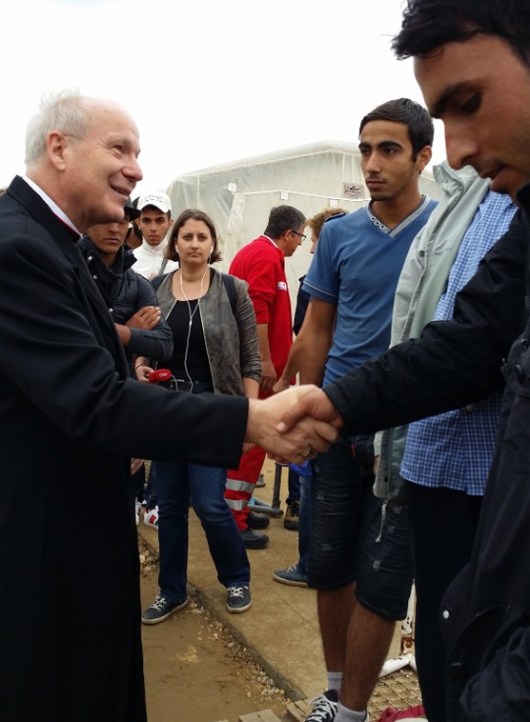
I feel a great sense of gratitude towards Cardinal Schönborn for his deep wisdom and obvious love for humanity, that has also shone during this last days in his welcoming of Syrian refugees – a welcoming that was not only conceptual by highly practical when he went to meet and welcome them as they crossed the border from Hungary to Austria. I wish the bishops of other Central European countries would follow his example. I am also grateful to Fr. Spadaro for not only having conducted such an outstanding interview, but for having made it freely available. Thank you!

Synod15: the joy of feeling loved

Emmaus arcabas

Today saw the publication of the “instrumentum laboris” (working document) that will be used in preparation for this October’s Synod on the Family and that incorporates answers from around the world to the questionnaire put forward at the end of last year’s Synod. The document is 21K words long, only available in Italian so far and reproduces the “lineamenta” (directives for the work to be done between the two synods on the family) of last year’s Synod in their entirety. As a result, the following will focus on those of the 147 paragraphs of the “instrumentum laboris” that differ from the 61 paragraphs of the “lineamenta” and the English wording here will be my own, crude translation.

The first part of the text is entitled “Listening to the challenges of the family,” which presents a rather pessimistic view of the current state of the family, starting with the following statement:

“Only a minority live, support and put forward the Catholic Church’s teaching on marriage and the family, recognizing in it the goodness of God’s creative plan. Marriages, religious or not, are on the decrease and the number of separations and divorces is growing.” (§7)

The following sections the speak about the a variety of challenges, from cultural (where differences between men and women are not understood and instead denied), to social, economic and political ones (where insufficient support for the life of the family is bemoaned). The particular difficulties following from solitude, old age, the last stages of life and bereavement, disability and migration are also profiled.

The many difficulties related to the unequal treatment of women are then spelled out in §30:

“Many have observed that the processes of the emancipation of women have brought their role in the growth of the family and society to the fore. It remains true, however, that the status of women in the world is subject to large differences resulting primarily from cultural factors. It ought not be thought that problematic situations could be resolved simply by an end to difficult economic conditions and the arrival of modern culture, as evidenced by the difficult conditions of women in various countries that have recently become developed.

In western countries, the emancipation of women requires a rethinking of the duties of spouses in their reciprocity and common responsibility for family life. In developing countries, the exploitation and violence perpetrated against women’s bodies is supplemented by onerous tasks imposed on them even during pregnancy, as well as forced abortions and sterilizations, not to mention the extremely negative practices connected with procreation (for example, the renting of a uterus or the market in embryonic gametes). In advanced countries, the desire for a child “at all costs” has not resulted in happier or stronger family, but has in many cases actually exacerbated the inequality between women and men. The sterility of a woman is, according to the prejudices present in various cultures, a socially discriminating condition.

What could contribute to a more decisive role of women would also be a greater recognition of their responsibilities in the Church: their involvement in decision-making; their participation, not only formal, in the government of some institutions; their involvement in the formation of ordained ministers.”

The first part of the “instrumentum laboris” concludes with remarks on bioethics, the need for formation about affectivity and the importance of bearing in mind that even those “far” from the life of the Church are “persons loved by God” and that all ought to be looked upon with understanding (§36).

The second part of the text is entitled “Discernment of the call to family life”, where a lack of knowledge of Scripture and its reading in the family is first noted with concern. The value of indissolubility is then emphasizes:

“The witness of couples who live Christian marriage in its fullness highlights the value of this indissoluble union and awakens the desire to embark on ever new paths of marital fidelity. Indissolubility is a person’s response to a deep desire for mutual and enduring love: a love that is “forever” and that becomes choice and self-giving of each spouse to the other, of the couple towards God and towards all those whom God entrusts to them.” (§42)

The unitive and procreative character of marriage, of the family being in the image of the Trinity, the missionary character of the family, prayer in the family and the importance of catechesis are addressed next, followed by a call to emphasizing the joy that springs from the life of a family:

“The joy of a person is an expression of their full realization. To present the unique joy that comes from the union of spouses and the establishment of a new family, it is beneficial to show the family as a place of personal, gratuitous relationships, unlike those in other social groupings. Mutual and gratuitous giving, being the origin of life and a place where all members are cared for, from the youngest to the elderly, are just some of aspects that make the family unique in its beauty. It is important let the idea grow that marriage is a choice for life that does not limit our existence, but makes it richer and fuller, even in difficulties.” (§55)

A call is next made for a greater appreciation of the value of marriage and of a recognition of the good in the life of unmarried couples who may be on the road towards sacramental marriage:

“The Church is aware of the high profile of the mystery of marriage between man and woman. […] The seriousness of adhering to it and the courage that it requires ought to be appreciated in a particular way today, when the value of this inspiration, which covers all the relationships built by a family, is called into question, or even censored and removed.

Therefore, even in the case where the decision to proceed to sacramental marriage by cohabiting or civilly married couples is still in an immature, virtual or early state, or only a gradual approximation, it is asked that the Church does not shirk from the task of encouraging and supporting such development. At the same time, it would be good if the Church showed appreciation and friendship with regard to the commitments already made, where she ought to recognize elements that are consistent with the plan of God for his creation.” (§57)

This need for welcoming those who are potentially on a journey towards an understanding and practice of marriage shared with the Church is again emphasized in §61:

“The attitude of the faithful towards people who have not yet come to the understanding of the importance of the sacrament of marriage ought to be expressed in particular through a relationship of personal friendship, accepting the other as they are, without judging, meeting their basic needs and at the same time witnessing to the love and mercy of God. It is important to be clear about the fact that we are all weak, sinners like the others, without giving up on affirming the goodness and values of Christian marriage. Also, we ought to become aware of the fact that the family in God’s plan is not a duty, but a gift, and that today the decision to approach the sacrament is not something already given, but a step to be arrived at and goal to be achieved.”

The “instrumentum” then speaks about the fear of young people to get married, also because they see so many failed marriages, and the second part of the document concludes with the following paragraph on the relationship between mercy and truth (§68):

“For the Church this is about departing from the concrete situations of today’s families, all in need of mercy, starting with those who suffer most. In mercy, in fact, the sovereignty of God shines, with which he is faithful, time and again, to his own being, which is love (cf. 1 Jn 4: 8), and to his covenant. Mercy is the revelation of God’s loyalty and identity with himself, and therefor, at the same time, a demonstration of Christian identity. Therefore mercy does not take away anything from the truth. She herself is revealed truth and is closely linked with the fundamental truths of the faith – the incarnation, death and resurrection of the Lord – without which she would fall into nothingness. Mercy is “the core of the revelation of Jesus Christ” (MV, 25).”

The third part of the text is entitled “The mission of the family today” and it starts by identifying tenderness in the family with the tenderness of God:

“Tenderness means to give with joy and stir in the other the joy of feeling loved. It is expressed particularly in turning with exquisite attention to the limits of the other, especially when they emerge clearly. Delicacy and respect mean healing wounds and giving back hope, reviving confidence in the other. Tenderness in family relationships is the everyday virtue that helps to overcome the inner and relational conflicts. In this regard, Pope Francis invites us to reflect: “We have the courage to welcome with tenderness the difficulties and problems of those who are near to us, or do we prefer impersonal solutions, perhaps effective but devoid of the warmth of the Gospel? How much the world needs tenderness today! The patience of God, the closeness of God, the tenderness of God.”(Homily for the Midnight Mass on the Solemnity of Christmas, December 24, 2014).” (§70)

Next, the point is made that the family is a subject of pastoral work and ought to think about the Church as “we,” and attention is paid to a point that was also very prominent during last year’s Synod, which is the need for a new language:

“The Christian message must be announced with preference for a language that will inspire hope. It is necessary to adopt communication that is clear and inviting, open, that does not moralize, judge and control, that bears witness to the Church’s moral teaching, while remaining sensitive to the conditions of each individual.

Because the Magisterium of the Church is no longer understood by many on certain topics, there is an urgent need for a language that can reach everyone, especially young people, to convey the beauty of family love and an understanding of the meaning of terms such as donation, conjugal love, fertility and procreation.” (§78)

That such hope and joy filled communication is set in a cultural context is underlined next, followed by an exposition of the concept of a “symphony of differences”:

“Starting from an observation of religious and cultural pluralism, it is hoped that the Synod will protect and enhance the image of a “symphony of differences.” It is shown that as a whole the pastoral care of marriage and family needs to value positive elements that are found in different cultural and religious experiences, which are a “praeparatio evangelica” [“preparation for the Gospel”]. Through an encounter with those who have followed a path of awareness and responsibility with regard to the authentic goods of marriage, one can establish an effective collaboration for the promotion and defense of the family.” (§83)

The following paragraphs speak about formation in the family, recognizing its currently meager state and underlining the importance of thorough and extensive preparation for marriage. Mention is also made of the importance of the role of the family in the formation of future priests and in the continuous formation of the clergy and pastoral workers. The need for accompanying newlyweds and for participating in socio-political processes that favor the family is also stressed.

Next, the “instrumentum laboris” turns to pastoral care for those who may be on a journey towards sacramental marriage and those who live in “wounded” families (“separated, divorced and not remarried, divorced and remarried, single parent families”), paying particular attention to the “art of accompaniment”:

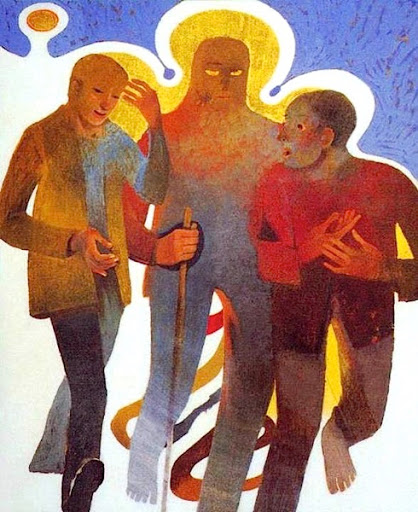
“Many have appreciated the references of the Synod Fathers to the image of Jesus who accompanies the disciples of Emmaus. Staying close to a family as a journeying companion means, for the Church, to adopt a wise and nuanced attitude. Sometimes, we need to stay close and listen in silence; at other times, to stand in front and point to the way ahead; at yet other times, to stand behind to support and encourage. In an affectionate sharing, the Church makes her own the joys and hopes, the sorrows and anxieties of every family.” (§110)

The importance of being close to the divorced who do not remarry and of reinforcing in them the knowledge that God never abandons us is followed by an insistence on the need for speeding up procedures for recognizing marital nullity. That this also requires formation and greater numbers of tribunal staff and clear guidelines on top of which individual cases may then be approached is discussed next. After emhasizing the need for finding ways to integrate the divorced and remarried into the life of the Church, the “instrumentum laboris” speaks about the possibility of a “penitential way:”

“[T]here is broad agreement about the idea of a journey of reconciliation or penance, under the authority of the Bishop, for the divorced and civilly remarried faithful who are in irreversible cohabitation. With reference to Familiaris Consortio §84, a process is suggested of becoming aware of failure and of the wounds produced by it, and, with repentance, a verification of the possible nullity of marriage, to make a commitment to spiritual communion and a decision to live in continence.

What others mean by a penitential way instead is a process of clarification and reorientation, following the experience of failure, accompanied by a priest appointed for this purpose. This process should lead the concerned party to developing a fair assessment of their condition. This process that same priest too would develop his own assessment so as to make use of the power of binding and loosing in a manner adequate to the situation.” (§123)

The need for more coherent practice with regard to mixed marriages (i.e., among Christians) and marriages with a disparity of cult (between a Catholic and a non-baptized person) is then stated, followed by a section on pastoral attention towards “persons with a homosexual tendency” [note the return of the word “welcomed” – for background see here :)]:

“It is reaffirmed that each person, regardless of their sexual orientation, must be respected in their dignity and welcomed with sensitivity and delicacy, both in the Church and in society. It would be desirable that diocesan pastoral plans paid specific attention to the accompaniment of families in which homosexual person live and of these same persons.” (§131)

The following paragraphs then speak about procreation, where the following passage is particularly significant:

“Bearing in mind the wealth of wisdom contained in Humanae Vitae, two poles emerge in relation to the issues it deals with there that need to be constantly balanced. On the one hand, the role of conscience, understood as God’s voice, which resounds in the human heart that has been taught to listen to it; on the other, the directions of objective morality, which prevent thinking about procreation as a reality to be decided arbitrarily, irrespective of the divine plan for human procreation. When reference to the subjective pole dominates, there is a risk of making easy, selfish choices; in the other case, moral norms are perceived as an unbearable burden, not corresponding to the needs and possibilities of the person. The combination of the two aspects, lived under the accompaniment of a competent spiritual guide, will help the spouses to make choices that are fully human and that conform to the will of the Lord.” (§137)

Next, the goodness of adoption is emphasized, followed by a reaffirmation of the insistence of the value and dignity of life from conception to natural death, and the “instrumentum laboris” concludes by underlining the challenges and importance of education in the family.

Finally the prayer to the Holy Family that Pope Francis first shared during the General Audience on 25th March 2015 is presented in preparation for this October’s Synod:

“Jesus, Mary and Joseph,
in you we contemplate
the splendour of true love,
to you we turn with trust.

Holy Family of Nazareth,
grant that our families too
may be places of communion and prayer,
authentic schools of the Gospel
and small domestic Churches.

Holy Family of Nazareth,
may families never again experience
violence, rejection and division:
May all who have been hurt or scandalized
find ready comfort and healing.

Holy Family of Nazareth,
may the approaching Synod of Bishops
make us more mindful
of the sacredness and inviolability of the family,
and its beauty in God’s plan.

Jesus, Mary and Joseph,
graciously hear our prayer.

Amen.”

From a first reading, I believe that the “instrumentum laboris,” elaborated in close collaboration with Pope Francis represents only minor adjustments to the final “relatio” of last year’s Synod. Including the full text of last year’s Synod is a strong signal of continuity and the new paragraphs predominantly focus on elaborating on what was there last year. Only in few cases can the new material be seen as a nudge towards one of alternative lines of thought present during last year’s Synod. The reiteration of the “penitential way” for the remarried and divorced and the re-introduction of the word “accogliere” (“to welcome”) with regard to homosexual persons (which was there in the intermediate working document of last year’s Synod but then got removed from the final one) are – to my mind – the most prominent examples. What also permeates the document are echoes of Pope Francis’ closing speech from last year where he insisted on the Church “flinging open” her doors to all and of the need for tenderness, accompanying and personal relationships rather than the blind following of rules that have also been key themes of his pontificate.

[UPDATE (1st July 2015): The official English translation of the “instrumentum” is now available.]
A marriage and family questionnaire

John Everett Millais Christ in the House of His Parents `The Carpenter s Shop Google Art Project s

Ahead of this October’s Synod on the Family, the Bishops of England and Wales have published a questionnaire about marriage and the family, in line with the recommendations issued at the end of last year’s Extraordinary Synod on the same subject. If you reside in England or Wales, I would very much encourage you to complete it, and if you live elsewhere, you might like to find out whether your local bishops’ conference is doing something similar.

Finally, in case you are interested, I would also like to share my own responses to this questionnaire, which I found to be a good opportunity for stopping and reflecting (although not in one go, obviously – I wrote these lines while taking a break from a basketball game with my sons, later while having a couple of minutes to myself before a supper and finally while waiting for a flight – continuity, sadly, is the stuff of fairytales :).

What are your joys and hopes of marriage and family life today?

To me the greatest source of joy with regard both to the family and marriage is the warmth and tenderness that can be experienced there. The family is where all its members can be free to express themselves unreservedly, to share their joys and sorrows, to develop their love for others and to know that their welcome by all in the family is unconditional. It is a place where difficulties can be overcome without judgment and where successes can be shared without envy. Above all though, marriage and the family are an openness to participating in the life of the Trinity: in mutual self-giving, in loving and being loved, that invite Jesus’ presence among those gathered together in His name

What are your struggles and fears of marriage and family life today?

The struggles and challenges that each member of a family faces individually are also a challenge for the family as a whole. Self-centeredness, isolation, indifference, consumerism, a lack of concern for the poor and a tendency to see what distinguishes at the expense of what unites are all prominent dangers. What makes them worse is if they are faced individually and without the benefit of the family or the relationship between spouses. And what makes them even more serious is if a family closes itself, instead of sharing its warmth and tenderness with those around it, if it only looks inside, instead of recognising the presence of God in all around them. These are the greatest dangers and fears I see today. 

How can we better understand marriage as a vocation?

By first understanding and responding to the vocation that follows from baptism and that consists in participation in Christ’s priestly, prophetic and royal nature. Only then can the membership in the mystical body of Christ that the Eucharist gives life to and the access to the Holy Spirit that follows from confirmation be understood and lived. And only on the basis of a conscious experience of these sacraments can an understanding of the sacramentality and vocational nature of marriage be understood and its choice, instead of the choice of other vocations, be discerned and made in alignment with the will of God. Both the putting into practice of the Gospel and a life-long learning of the faith are indispensable here.

  How does your marriage enrich you?

This is a question akin to asking about the benefits derived from oxygen. Getting married is an existential transformation that is followed by a new, joint being where the spouses are one. It is a monologue becoming dialogue, an individual participating in communion and a one that is not alone. It is a complementarity that is not self-sufficient or self-fulfilling but oriented towards God and neighbours instead. 

How does your family life enrich those around you?

This question would better be addressed to those around my family, while for us it is more of an examination of conscience. I hope those around us feel welcomed by us as they are and feel that we understand and don’t judge them. If we keep Jesus’ words and He makes His home with us, I hope we are able to share Him with those whom we meet. 

In what way, through the abiding presence of God, is your family “salt of the earth and light to the world,” and a place of and for handing on our faith?

By placing the Gospel at the heart of our family’s life: as a guiding light and explicit interpretative key for the events in our family and the world at large, as the motivation for our actions, as a mirror in which to identify our failings and as the inspiration for starting again and again with putting it into practice. 

Do you have any other comments?

I would like to express my wholehearted agreement with and support for Pope Francis’ words at the close of last year’s Extraordinary Synod on the Family, where he emphasised the need for the Church to be open to all, not ashamed of the wounds of our fallen brothers and sisters, and be “[t]he Church that has doors wide open to receive the needy, the repentant and not only the righteous or those who think they are perfect!”