Žižek’s Holy Spirit: equality, love, community, freedom

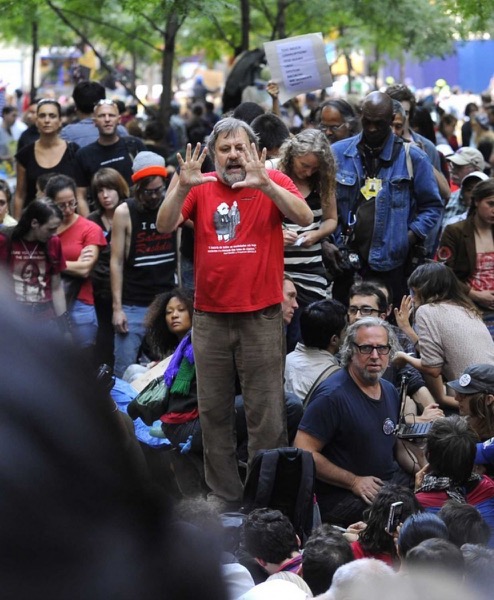
Zizek occupy wall street

2002 words, 10 min read

The Post-Marxist philosopher Slavoj Žižek is perhaps a surprising source of insights about the Holy Spirit, but I believe that his perspective is highly relevant for atheists and Christians alike. My first encounter with his thought on the subject was in a transcript of him addressing Occupy Wall Street protesters at Zuccotti Park in 2011:

“What is Christianity? It’s the Holy Spirit. What is the Holy Spirit? It’s an egalitarian community of believers who are linked by love for each other, and who only have their own freedom and responsibility to do it. In this sense, the Holy Spirit is here now. And down there on Wall Street, there are pagans who are worshipping blasphemous idols.”

Instead of being a throw-away comment of the moment, Žižek’s view of the Holy Spirit is the result of careful reflection from a number of viewpoints.

In a 2007 lecture – entitled “Meditation on Michelangelo’s Christ on the Cross” – he elaborated on how it is that the Holy Spirit is the source of the Christian community and pointed to the radicality of life that such a basis implies:

“The Holy Spirit is the love between believers; it is the spirit of the community of believers, according to the famous words of Christ: “For where two or three have gathered together in my name, I am there in their midst.” (Matthew 18:20) I think this passage should be taken literally. So what does this mean? Even today, the message is very radical. The temptation to be resisted is the temptation of meaning itself. […] I claim that Christ died on the cross precisely to reject […] attempts at finding a higher purpose or meaning. Rather the message is: “Your standards matter to me. I throw myself into creation, and abandon my place up there.” The conclusions are radical. The ultimate meaning of Christianity for me is a very precise one. It is not: “We should trust God. The big guy’s with me, so nothing really bad can happen.” That is too easy. The message is not: “We trust God.” The message is rather: “God trusts us.” The gesture of Christ says, “I leave it over to you.” Usually we read religion as the way to guarantee meaning: We are concerned with the small details of everyday life and never know what will come of it all, or how things will turn out; we can only make wagers, and we do this maybe to ensure that God will arrange things in our favor. But the meaning of the death of Christ for me is the opposite: God made the wager on us. It is really a crazy wager, where God is saying: “I leave it to you. Holy Ghost, community of believers, you have to do it!””

In the same piece Žižek also demonstrates that his thoughts on the Holy Spirit are not merely an analysis from outwith or a thinking about an other, but that they are pertinent to his own context and community:

“[The] link between Christian community and the progressive movement is crucial. And here I’m not playing a cheap game of identifying radical political movements as a kind of religious community; what I’m referring to is the idea of a radical community of believers. The ideal is neither that of blind liberal individuals collaborating with each other, nor the old organic conservative community. It is a community along the lines of the original Christian community: A community of outcasts. We need this today, this idea of an egalitarian community of believers that is neither the traditional heretical community nor the liberal multiplicity. This is why I and many other leftist philosophers, such as Alain Badiou and others, are so interested in rereading, rehabilitating, and reappropriating the legacy of Paul. It is not just a matter of private religious convictions. I claim that if we lose this key moment—the moment of realizing the Holy Spirit as a community of believers—we will live in a very sad society, where the only choice will be between vulgar egoist liberalism or the fundamentalism that counterattacks it. This is why I—precisely as a radical leftist—think that Christianity is far too precious a thing to leave to conservative fundamentalists. We should fight for it. Our message should not be, “You can have it,” but “No, it’s ours. You are kidnapping it.””

Žižek’s thoughts on the Holy Spirit have deeper roots still, which go to the very heart of the Christian mystery of the Trinity and the incarnation. In a 2004 paper entitled “Death’s Merciless Love”, he reflects on how the transcendent-immanent, divine-human gap is resolved by Jesus’ death on the cross, which finds its fulfilment in and unity with the Holy Spirit:

“[I]n order for humanity to be restored to God, [Christ as the mediator between God and humanity] must sacrifice himself. In other words, as long as Christ is here, there can be no Holy Ghost, which IS the figure of the reunification of God and humanity. Christ as the mediator between God and humanity is, to put it in today’s deconstructionist terms, the condition of possibility AND the condition of impossibility between the two: as mediator, he is at the same time the obstacle which prevents the full mediation of the opposed poles. Or, to put it in the Hegelian terms of the Christian syllogism: there are two “premises” (Christ is God’s Son, fully divine, and Christ is man’s son, fully human), and to unite the opposed poles, to arrive at the “conclusion” (humanity is fully united with God in the Holy Spirit), the mediator must erase himself out of the picture. Christ’s death is not part of the eternal cycle of the divine incarnation and death, in which God repeatedly appears and then withdraws into himself, in his Beyond. As Hegel put it, what dies on the Cross is NOT the human incarnation of the transcendent God, but the God of Beyond Himself. Through Christ’s sacrifice, God Himself is no longer beyond, but passes into the Holy Spirit (of the religious community). In other words, if Christ were to be the mediator between two separated entities (God and humanity), his death would mean that there is no longer a mediation, that the two entities are apart again. So, obviously, God must be the mediator in a stronger sense: it’s not that, in the Holy Spirit, there is no longer the need for Christ, because the two poles are directly united; for this mediation to be possible, the nature of both poles must be radically changed, i.e. in one and the same movement, they both must undergo a transubstantiation. Christ is, on the one hand, the vanishing mediator/medium through whose death God-Father himself “passes into” the Holy Spirit, and, on the other hand, the vanishing mediator/medium through whose death human community itself “passes into” the new spiritual stage.

These two operations are not separated, they are the two aspects of one and the same movement: the very movement through which God loses the character of a transcendent Beyond and passes into the Holy Spirit (the spirit of the community of believers) EQUALS the movement through which the “fallen” human community is elevated into the Holy Spirit. In other words, it is not that, in the Holy Ghost, men and God communicate directly, without Christ’s mediation; it is rather that they directly coincide – God is NOTHING BUT the Holy Spirit of the community of believers. Christ has to die not in order to enable direct communication between God and humanity, but because there is no longer any transcendent God with whom to communicate.”

In a 2009 book entitled “The Monstrosity of Christ. Paradox or Dialectic?” and co-authored with the Anglican theologian John Milbank, Žižek challengingly draws the identification of the community of believers with the Holy Spirit and of the Holy Spirit with the crucified and risen Christ to its ultimate conclusion, which is a life at the end of history, a life of “ethical extravagance” and “permanent revolution”:

“There is, however, a third position between these two extremes, that of the Holy Spirit, of the apocalyptic community of believers, of the self-organization dialectical clarity versus the misty conceit of paradox of believers who drew from Christ’s nonreturn after his death the correct conclusion: they were awaiting the wrong thing, Christ already had returned as the Holy Spirit of their community. The very meaning of Christ’s death is that the work to be done is theirs, that Christ put his trust in them. Once we accept this, Eagleton’s reading of Jesus’ “ethical extravagance” also becomes problematic:

“What one might call Jesus’s ethical extravagance—giving over and above the measure, turning the other cheek, rejoicing in being persecuted, loving one’s enemies, refusing to judge, non-resistance to evil, laying oneself open to the violence of others—is . . . motivated by a sense that history is now at an end. Recklessness, improvidence and an over-the-top lifestyle are signs that God’s sovereignty is at hand.There is no time for political organization or instrumental rationality, and they are unnecessary in any case.”

But is this “extravagance” really constrained to the end-of-time atmosphere in which all we can do is wait and get ready for the Second Coming? Is it not that, in an apocalyptic time—the time of the end of time, as Agamben put it—we have both aspects, “ethical extravagance” as well as political organization? The specificity of the Holy Spirit, the apocalyptic emancipatory collective, is that it is precisely an organization which practices these “ethical extravagances,” i.e., which lives its life in an apocalyptic “state of emergency” in which all ordinary legal (and moral) commitments are suspended, practiced in the mode of “as if not.” The problem with the Church is that it betrayed original Christianity not by its organization, but by the type of this organization: the apocalyptic community of believers which lives in the emergency state of a “permanent revolution” is changed into an ideological apparatus legitimizing the normal run of things. In other words, with the Church, we are not active enough: the pressure of the Second Coming is eased, all we have to do is to lead our daily lives following the prescribed ethico-religious rules, and Salvation will come by itself.“

In summary, Žižek’s Holy Spirit – like all of Žižek’s Trinity – invites to a life of radical commitment in the present, to a life lived with and for others and therefore in God, a life steeped in freedom:

“So what I claim is that something absolutely unheard of happens with Christianity which is that Christ, the death of Christ, means something very radical. It means, in all other religions we trust God, we believe in God. The death of Christ [instead] means, God trusted us. It means, “I give you your freedom, it’s up to you.” The Holy Ghost for me is — and I take it literally when it says in the Bible “Whenever the two of you are there, I will be there, I am there.” — it means the gift of freedom. It means, God doesn’t want to play that “up there a guarantee,” it means God entrusts the fate of creation, his own fate, into us. It means what happens here is part of, as it were, the history of God. And […] à propos iconoclasm […]: the prohibition to make images of God in Judaism does not mean this gnostic way “oh it’s too mysterious, we cannot paint it.” It means the exact opposite! It means God is alive not in your stupid deep meditations of up there, but how you act and react with others. And that’s why you shouldn’t make images because it’s not an image to be made up there. And I think, if anything, even more this holds for Christianity. That’s for me what the Holy Ghost is. God is no longer the substantial master up there, God is — to put it in this way — the spirit of our community, the gift of freedom.”

Realities > ideas

803 words, 4 min read

During the last weeks I have been thinking a lot about one of the lemmas that Pope Francis presents in Evangelii Gaudium, namely that realities are greater than ideas (§231-233). There he argues that “[t]here […] exists a constant tension between ideas and realities. Realities simply are, whereas ideas are worked out. There has to be continuous dialogue between the two, lest ideas become detached from realities. […] This calls for rejecting the various means of masking reality: angelic forms of purity, dictatorships of relativism, empty rhetoric, objectives more ideal than real, brands of ahistorical fundamentalism, ethical systems bereft of kindness, intellectual discourse bereft of wisdom.” This, however, is not a one-way street of adjusting ideas to match reality, but also a call to putting our ideas and convictions into practice: “Not to put the word into practice, not to make it reality, is to build on sand, to remain in the realm of pure ideas and to end up in a lifeless and unfruitful self-centredness and gnosticism.” Leaving ideas and realities disconnected either results in our being deluded and/or disconnected from the world.

The above words of Pope Francis came to my mind recently in the context of hearing about how a friend of mine had made a mistake at work and how their attempt at presenting the situation in a way that didn’t correspond with the facts lead to a lot of tension, hurt and ultimately evil. What occurred to me then was another of Pope Francis’ recurring expressions, that the Devil is the “Father of Lies” (John 8:44). If lies then are a mismatch between reality and ideas, and the Devil personifies a turning away from God, who is good, then calling him the Father of Lies both points to that turning away being from the truth too (which also has its pinnacle and fulfilment in God) and it elevates lying to a privileged position among sins. Not necessarily from a perspective of gravity, but as the principle behind all evil.

Ultimately, it now seems to me, all evil has its roots in lies, in ideas being disconnected from reality and there being no correspondence between the two. If I hate, exploit, discriminate against or even murder another person, I have to have believed or at least implicitly assumed that they are different from me, that they are inferior to me, that their life matters less, that they are not beloved children of God. It is lies like these, mismatches between ideas and realities like these, that are the basis of and pre-requisite for evil.

Now, looking at the above, it might at first seem like an impossible situation: a mismatch between ideas and realities leads to evil, we only have direct access to ideas (challenge: try to give an example of something that is not an idea) and their mismatch with realities (that we do not have direct cognitive access to) is unknowable and seemingly inevitable. What a cruel setup!

Well, I don’t believe that this is what is actually going on. Instead of the above prison of ideas – inescapable and unsurpassable – I believe, with psychologists everywhere, that we experience reality not only in terms of ideas, but also in a variety of other conscious and unconscious ways. As a result, we may be saved from erroneous – and therefore potentially evil-oriented – ideas by our unconscious experiences. At some point we may be overcome by a feeling that our ideas just don’t add up and we may be prompted to re-examine and potentially change them, in spite of the epistemological gulf that persists between our minds and whatever gives rise to our experiences.

How can such a safety mechanism be triggered? Not primarily by being exposed to ideas (sadly, including these very ones), but by participating in realities and allowing these to interact with my conscious and unconscious processes. Having a low opinion of certain attitudes, choices or world views, the best thing to do alongside engaging with them rationally is to get to know those who have, have made or hold them. Like that, I can relate not only to their ideas, but also to their realities in a richer and fuller way and any lies I believe in may be challenged and overcome, much like the example given by the Marxist thinker Terry Eagleton, who suggests that meeting fulfilled childless women can lead one to abandon the untruthful conviction that they are all embittered.

This is both the way to stress and refine my own ideas and the mechanism by which I can have an effect on the ideas of others – not only by sharing my own ideas with them but by putting them into practice myself so that the other may experience them more fully than ideas alone would allow them to.

Ideology

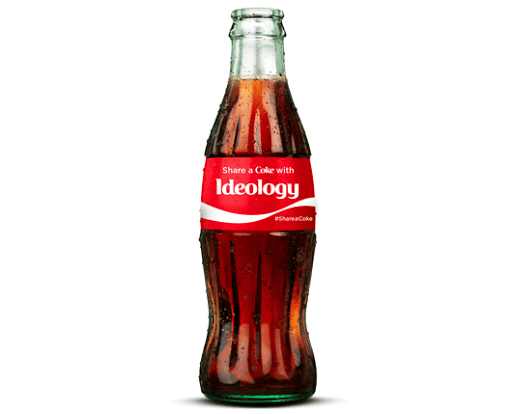
Coke ideology

2254 words, 11 min read

One of the fundamental questions of human existence is the basis on which we interpret reality, make subsequent decisions and perform resulting actions. How do I know what is happening in the world, how do I react to that reality and what actions do I take on the basis of these reactions? These questions have been at the heart of philosophy, theology, economics, politics and many other forms of human endeavour for millennia and remain open problems to this day, to which many answers are offered but which each one has to answer for themselves, or that each one will at least have unconscious answers to that drive their choices.

In the above context, a particularly negative role is played by ideologies, which are injected between a subject and the reality they inhabit and which distort their choices. Instead of a subject engaging with reality and deriving choices on its basis, an ideologised subject takes the tenets of their ideology as a source of decision making. Instead of their own understanding of reality, which ideology suppresses, distorts and supplants, the ideologised subject derives decisions and actions from their ideology. An ideology that taught the impossibility of fire would see its followers proclaim it while burning to death in blazing house.

If ideologies are at odds with reality, why would anyone follow them though? Why would anyone act on a basis disconnected from reality? I believe there are several reasons for this: First, it is increasingly difficult to tell reality from ideology, both because of the inherent challenges of knowledge that epistemology has been grappling with since antiquity (e.g., the ultimate impossibility of going beyond my own experiences) and because of the growing complexity of global interconnectedness and the impossibility of experiencing all relevant events for oneself. Second, even a direct engagement with reality (as far as epistemologically possible) that would seem free from ideology would not be free from some a priori conceptual framework of beliefs not derived from reality (e.g., repeatability, causality, falsifiability), which leads to the obvious question of what makes one set of beliefs an ideology while another set is a valid conceptual apparatus necessary for engaging with reality.

In other words, how do we recognise ideologies so that we may avoid them ourselves and so that we may help others not become entrapped by them.

In fact, the original intention of the French philosopher Antoine Destutt de Tracy, who coined the term ideology during the French Revolution, was to devise a rational system that could counter what he saw as the irrational mob rule of the day, i.e., precisely not what is understood by ideology today. However, already Tracy’s initial opponent, Napoleon Bonaparte, used the term ideology in a derogatory way. Karl Marx then picked up Napoleon’s use of the word and directed it against the ideological patterns employed by the capitalist bourgeoisie he challenged. Ideology has since been a mainstay of marxist analysis, in particular by thinkers like Louis Althusser, Terry Eagleton and Slavoj Žižek, who see ideology as a means of control, effected by imposing a set of action-oriented beliefs whose scrutiny is prohibited and which are placed above experience.

Eagleton presents a variety of definitions of the concept in his 1991 book “Ideology: An Introduction”, starting with the most widely-held one, formulated by John B. Thompson:

“A dominant power may legitimate itself by promoting beliefs and values congenial to it; naturalising and universalising such beliefs so as to render them self-evident and apparently inevitable; denigrating ideas which might challenge it; excluding rival forms of thought, perhaps by some unspoken but systematic logic; and obscuring social reality in ways convenient to itself. Such ‘mystification.’, as it is commonly known, frequently takes the form of masking or suppressing social conflicts, from which arises the conception of ideology as an imaginary resolution of real contradictions. In any actual ideological formation, all six of these strategies are likely to interact in complex ways.”

While the reference to a “dominant power” may render the above definition too narrow, as Eagleton and other have argued, its focus on the denigration of challenging ideas, the exclusion of rival forms of thought, the obscuring of reality and the offering of imaginary resolutions can readily be recognised in ideologies regardless of whether or not they come from a position of power.

With such a broadening of the scope of ideology, and given the challenges of distinguishing it from other sets of ideas or beliefs, it is no surprise to see Louis Althusser argue that we are all “ideological subjects”, that being ideological is inherent to being a subject and that “man is an ideological animal by nature”. Althusser also points to a particularly insidious pattern employed by ideologies, where fictitious relationships are presented as real, to further ulterior motives:

“But it is by an apprenticeship in a variety of know-how wrapped up in the massive inculcation of the ideology of the ruling class that the relations of production in a capitalist social formation, i.e. the relations of exploited to exploiters and exploiters to exploited, are largely reproduced. The mechanisms which produce this vital result for the capitalist regime are naturally covered up and concealed by a universally reigning ideology of the School, universally reigning because it is one of the essential forms of the ruling bourgeois ideology: an ideology which represents the School as a neutral environment purged of ideology (because it is … lay), where teachers respectful of the ‘conscience’ and ‘freedom’ of the children who are entrusted to them (in complete confidence) by their ‘parents’ (who are free, too, i.e. the owners of their children) open up for them the path to the freedom, morality and responsibility of adults by their own example, by knowledge, literature and their ‘liberating’ virtues.”

Kaustuv Roy then takes Althusser’s theory and identifies a pattern in ideological beliefs which is that of being lacunar, of leaving “holes” in the legitimacy and truth of the discourses constructed from them:

“The proposition “modern education promises equal opportunity for all” is not, on the face of it, a false or untrue proposition. It is, after all, one of its basic premises. At the same time, we know that existing property relations, differential schooling, elite behaviour, and social prejudices all falsify this “true” proposition. Again, consider the proposition “the law takes precedence before anything else.” This is not untrue in its purely rational form, yet, we know that many things including social, political, and financial power often determine which way the law moves. […] In other words, they are pre-aligned toward certain effects. The above are examples of “lacunar discourse,” meaning that they cover up or hide a lacuna. A number of propositions which are not untrue suggest or lead up to other propositions which are operatively and pragmatically untrue. In other words, the former cluster create an aura of “truth” that point toward and suggest legitimacy for another set whose assumptions are simply not true. In a restricted and more useful sense, ideologies can be seen as lacunar discourses that offer legitimacy to a wide range of assumptions by starting off from reasonable propositions.”

Slavoj Žižek uses a similar example of falsehood admixed with truth as a starting point of his analysis of ideology:

“[T]he starting point of the critique of ideology has to be full acknowledgement of the fact that it is easily possible to lie in the guise of truth. When, for example, some Western power intervenes in a Third World country on account of violations of human rights, it may well be ‘true’ that in this country the most elementary human rights were not respected, and that the Western intervention will effectively improve the human rights record, yet such a legitimization none the less remains ‘ideological’ in so far as it fails to mention the true motives of the intervention (economic interests, etc.).”

While most critiques of ideology see it as a mechanism of manipulation that some impose on others, Žižek thinks of it in a rather different way:

“[I]deology is not simply imposed on ourselves. Ideology is our spontaneous relation to our social world, how we perceive each meaning and so on and so on. We, in a way, enjoy our ideology. To step out of ideology, it hurts. It’s a painful experience. You must force yourself to do it.”

Given such ubiquity of ideology and its being a constituent part of human nature, the question becomes not one of how to avoid ideologies that may be coming my way from afar, but to strive for a recognition and avoidance of ideological patterns in thought and action. This realisation is present already Eagleton’s analysis, who, as a Marxist, sees the danger of ideologisation even in movements close to his own world view, instead of only in the capitalist system that is opposed to it.

It should therefore come as no surprise that the recognition of ideologisation and attempts to counter it can arise in all contexts, even the one that Althusser used as the ideological case study par excellence – the Catholic Church. This is a strong theme in the thought and actions of the current pope, Francis, who has frequently spoken about and decried ideologies both outside and within the Church.

Looking at the Church, Francis’ homily from 23rd October 2013 is a particularly cutting critique:

“Faith passes, so to speak, through a purifying apparatus and becomes ideology. And ideology does not attract. In ideologies there is no Jesus: his tenderness, love, meekness. And ideologies are rigid, always. Always: rigid. And when a Christian becomes a disciple of ideology, he has lost faith: he is no longer a disciple of Jesus, he is a disciple of this attitude of thought, of that … And this is why Jesus says to them: ‘You have taken away the key to knowledge’ [Luke 11:52]. The knowledge of Jesus is transformed into an ideological and even moralistic knowledge, because they closed the door with so many prescriptions.

Faith becomes ideology and ideology frightens, ideology chases people away, drives people away and takes the Church away from people. But it is a serious disease, this of ideological Christians. It’s a disease, but it’s not new, is it? Already the Apostle John, in his first Letter, spoke of this. Christians who lose faith and prefer ideologies. Their attitude is: to become rigid, moralistic, ethicist, but without goodness. The question may be this, right? But why can a Christian become like that? What happens in the heart of that Christian, of that priest, of that bishop, of that Pope, who becomes so? Simply one thing: that Christian does not pray. And if there is no prayer, you always close the door.

They do not pray, they abandon faith and turn it into a moralistic, casuistic ideology, without Jesus. And when a prophet or a good Christian reproaches them, they do the same thing they did with Jesus: When he came out of there, the scribes and Pharisees began to treat him in a hostile way – these ideologues are hostile – and to make him speak on many subjects, trying to ensnare him – they are insidious – to surprise him in a few words out of his own mouth. They are not transparent. Eh, poor things, they are people soiled by pride. Let us ask the Lord for grace, first: do not stop praying, so as not to lose faith, remain humble. And so we will not become closed, we won’t close the way to the Lord.”

If you are reading the above and are not a Christian, it is worth saying something about prayer, lest is may sound like something archaic or even ideological. Prayer here is, I believe, to be read as a conscious attitude of being close to God and of seeking to love in every present moment. This is consistent with how Francis speaks about it and also with Jesus telling his disciples to pray always (cf. Luke 18:1). Prayer here is an attitude seeking closeness with and responding to reality, i.e., a fundamentally anti-ideological attitude.

Another key to countering ideology according to Francis is to place the encounter with others ahead of ideas or ideologies. E.g., during his trip to Cuba in 2015 he said: “Service is never ideological, for we do not serve ideas, we serve people.” In fact, this reminds me of the suggestion Eagleton makes about how one might become freed from an ideological belief, where he too points to the power of evidence and of encounter with other persons: “If someone really does believe that all childless women are thwarted and embittered, introducing him to as many ecstatic childfree women as possible might just persuade him to change his mind.”

Looking at the above I have the impression that, instead of thinking that there are some specific, well-delineated ideologies that need to be avoided and countered, I need to recognise that I too am steeped in ideology and that I may not even be aware of that being the case. What can I do about it? Having seen ideological patterns of discourse laid bare, I can strive to recognise them and counter their closed, narrow and restrictive mode by contrasting them with evidence and experience. And, I can direct my attention to those around me so that I may relate to and discover each person instead of letting ideologies become filters through which I see them. As Žižek says though, it will be hard and painful, but it strikes me as a fight worth fighting.