Science grows Church’s understanding

350px God the Geometer0

As was immediately clear from a first reading, “the” interview given by Pope Francis last Thursday to Jesuit magazines is a text rich both in spiritual and intellectual treasures and will be a prominent trigger of reflection for a long time to come.

Today I’d like to take a closer look at a passage from it that has immediately caught my eye, but that received little attention so far. It addresses the relationship between science and religion in a, to my mind, very positive way:

“[H]uman self-understanding changes with time and so also human consciousness deepens. Let us think of when slavery was accepted or the death penalty was allowed without any problem. So we grow in the understanding of the truth. Exegetes and theologians help the church to mature in her own judgment. Even the other sciences and their development help the church in its growth in understanding. There are ecclesiastical rules and precepts that were once effective, but now they have lost value or meaning. The view of the church’s teaching as a monolith to defend without nuance or different understandings is wrong.”

While the opposition between science and religion certainly does not apply to the Catholic Church – with Blessed Pope John Paul II’s landmark encyclical Fides et Ratio being a categorical statement of the mutual benefits of faith and reason and with Pope Benedict XVI having spoken of the necessity of dialogue between science and faith 1 – Francis’ positioning of science as “helping the church in its growth in understanding” is a significant move. Like with many of Francis’ statements, it could be argued that they contain nothing new (Fides et Ratio already saying that “science can purify religion from error and superstition”) or that they are only new in style – and in some sense that is true, since he is firmly rooted in the Church, but it would, I believe, also miss an important nuance.

While I have always read Fides et Ratio as positioning faith and reason as separate, but mutually “strengthening” entities,2 here I see Francis presenting theology and science as two activities whose results both help the Church, the former leading to mature judgment while the latter resulting in increased understanding. This is a picture that does not place theology in a privileged, internal position with regard to the Church, and science as an external, while admittedly positive, activity, but positions both as engines of progress that deepen our humanity.3

While the above is clearly my reading and attempted unpacking of Francis’ condensed thought, I believe it is compatible with another of the important points he makes in “the” interview, namely that the Church is the “faithful people of God,”4 and that “‘thinking with the church’ [does not mean] only thinking with the hierarchy of the church,” that it “does not concern theologians only.” Seen in this way, “[t]he church is the totality of God’s people” and is therefore formed as much by theology as by science. Science becomes an internal concern of the Church – the People of God – and its advances and insights form her teaching from within.5 In many ways this also reminds me of Francis’ address to Brazil’s “leaders of society” during his visit in July, where he emphasizes that Christianity “combines transcendence and incarnation” and “faith and reason unite, the religious dimension and the various aspects of human culture – art, science, labour, literature…”

The above sketch, which I don’t believe I am bolting on to Francis’ thought, strikes me as a natural evolution of the solid foundations that John Paul II laid down, and I am curious to see whether it will find support in his future teaching.


0 I don’t mean to distract, but note the fractal in this 13th century illuminated illustration!
1 “In the great human enterprise of striving to unlock the mysteries of man and the universe, I am convinced of the urgent need for continued dialogue and cooperation between the worlds of science and of faith in the building of a culture of respect for man, for human dignity and freedom, for the future of our human family and for the long-term sustainable development of our planet. Without this necessary interplay, the great questions of humanity leave the domain of reason and truth, and are abandoned to the irrational, to myth, or to indifference, with great damage to humanity itself, to world peace and to our ultimate destiny.” (Pope Benedict XVI, Address To The Pontifical Academy Of Sciences, 8 November 2012)
2 As Lumen Fidei puts it in §32.
3 Echoing the affirmation in Fides et Ratio that “Men and women have at their disposal an array of resources for generating greater knowledge of truth so that their lives may be ever more human.”
4 The definition presented in Lumen Gentium, as Francis points out.
5 This is not a conflation of the two – theology and science – but a recognition of their equal import for the Church’s progress.
Abortion

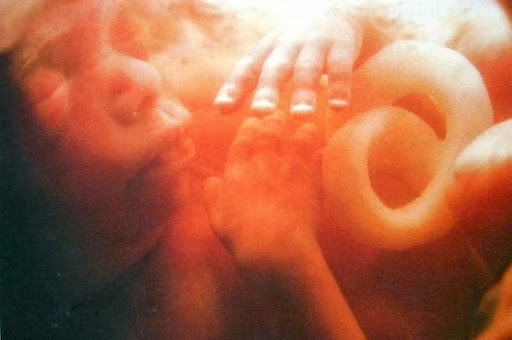
Foetus 5 months

If you search through the 166 posts published on this blog since its launch over a year ago, you won’t find any mention of abortion. If, like soviet historians who, when they failed to find any sign of telephone cables during their excavations, inferred the use of wireless communication in 19th century Russia, you interpret this as my not considering the topic important, you’d be wrong. Fundamentally I find myself in the same boat as Pope Francis, whose first and until two days ago only public reference to it has been during the off-the-cuff interview with the press on his return flight from Rio, where he said that “[t]he Church has already addressed [this] issue and its position is clear.”

In his interview with Jesuit media two days ago (“the” interview), he returned to the topic and essentially just expanded on his point from the Rio flight:

“We cannot insist only on issues related to abortion, gay marriage and the use of contraceptive methods. This is not possible. I have not spoken much about these things, and I was reprimanded for that. But when we speak about these issues, we have to talk about them in a context. The teaching of the church, for that matter, is clear and I am a son of the church, but it is not necessary to talk about these issues all the time.”

In fact, the root of this reluctance is not born of attempts to please or to be popular, but of a profound care for those who are affected by suffering, as is clear from the example that Francis gives just before the above declaration:

“The confessional is not a torture chamber, but the place in which the Lord’s mercy motivates us to do better. I also consider the situation of a woman with a failed marriage in her past and who also had an abortion. Then this woman remarries, and she is now happy and has five children. That abortion in her past weighs heavily on her conscience and she sincerely regrets it. She would like to move forward in her Christian life. What is the confessor to do?”

On the above basis, Francis proceeds to lay out his vision of how the teaching of the Church on questions like abortion, which he adheres to and upholds, fits into the bigger picture:

“The dogmatic and moral teachings of the church are not all equivalent. The church’s pastoral ministry cannot be obsessed with the transmission of a disjointed multitude of doctrines to be imposed insistently. […] We have to find a new balance; otherwise even the moral edifice of the church is likely to fall like a house of cards, losing the freshness and fragrance of the Gospel. The proposal of the Gospel must be more simple, profound, radiant. It is from this proposition that the moral consequences then flow.”

While the above may (with a stretch of the imagination) sound like a move away from what the Church teaches about abortion, that is decidedly not the case, as Francis’ immediately following point (made in the context of what sermons ought to be like) demonstrates:

“[We] must begin with the first proclamation, with the proclamation of salvation. There is nothing more solid, deep and sure than this proclamation. Then you have to do catechesis. Then you can draw even a moral consequence. But the proclamation of the saving love of God comes before moral and religious imperatives. […] The message of the Gospel, therefore, is not to be reduced to some aspects that, although relevant, on their own do not show the heart of the message of Jesus Christ.”

The picture here is very clear: God loves all and wants all to love each other, like he loves them. Only once this is internalized and felt can its consequences be understood also with one’s reason and “imperatives” make sense. Yet, in spite of their clarity, the interview that the above words are taken from has by many media outlets been taken as a departure from the condemnation of abortion. E.g., the Daily Mail summed it up by saying that Francis “condemned the church’s obsession with such ‘small-minded things’ [as abortion].” The mind boggles!

Not by coincidence, I believe, Francis then addressed a group of Catholic gynecologists the very next day (yesterday) and spoke very clearly and at length about the evil of abortion, in a context where that made perfect sense:

“A widespread mentality of the useful, the “throw away culture” which today enslaves the hearts and intelligences of so many, has a very high cost: it requires eliminating human beings, especially if physically or socially weaker. Our answer to this mentality is a decisive and unhesitant “yes” to life. “The first right of a human person is his/her life. He/she has other goods and some of them are more precious; but life is the fundamental good, condition for all the others” (Congregation for the Doctrine of the Faith, Declaration on Procured Abortion, November 18, 1974, 11). Things have a price and are saleable, but persons have a dignity, they are worth more than things and they have no price. Because of this, attention to human life in its totality has become in recent times a real and proper priority of the Magisterium of the Church, particularly for life which is largely defenseless, namely, that of the disabled, the sick, the unborn, children, the elderly.

Each one of us is called to recognize in the fragile human being the face of the Lord, who in his human flesh experienced indifference and loneliness to which we often condemn the poorest, be it in developing countries, be it in well-off societies. Every unborn child, condemned unjustly to being aborted, has the face of the Lord, who before being born, and then when he was just born, experienced the rejection of the world. And every elderly person, even if he/she is sick or at the end of his/her days, bears in him/herself the face of Christ. They cannot be discarded!”

Francis then points to the fundamental logic behind the Church’s teaching:

“[Life] is always, in all its phases and at every age, sacred and is always of quality. And not because of a discourse of faith, but of reason and science! There is no human life that is more sacred than another, as there is no human life that is qualitatively more significant than another.”

I wholeheartedly agree and absolutely fail to see how a Catholic can possibly think otherwise: abortion, like euthanasia and any neglect, torture or killing of a human person, is an absolute evil. By the exact same logic, it is necessary to treat all with mercy and compassion though, and I equally fail to understand how a Catholic can possibly think otherwise. Directing hatred at another human being, absolutely regardless of what they have done or who they are, is as much contrary to the sanctity of life as abortion or euthanasia.

Pope Francis: "the" interview

117049 pope francis

I believe it will take many weeks and months to digest all Pope Francis has said in the interview granted to Fr. Antonio Spadaro, editor in chief of the Italian Jesuit journal La Civiltà Cattolica, and published simultaneously in multiple Jesuit publications worldwide. As a taster, let me just pick out my favorite parts, from the English version in America magazine:

  1. “I am a sinner whom the Lord has looked upon. I ​​am one who is looked upon by the Lord. I always felt my motto, Miserando atque Eligendo [By Having Mercy and by Choosing Him], was very true for me.”
  2. “According to St. Ignatius, great principles must be embodied in the circumstances of place, time and people. In his own way, John XXIII adopted this attitude with regard to the government of the church, when he repeated the motto, ‘See everything; turn a blind eye to much; correct a little.’”
  3. “[N]ow I hear some people tell me: ‘Do not consult too much, and decide by yourself.’ Instead, I believe that consultation is very important.”
  4. “I see the holiness in the patience of the people of God: a woman who is raising children, a man who works to bring home the bread, the sick, the elderly priests who have so many wounds but have a smile on their faces because they served the Lord, the sisters who work hard and live a hidden sanctity. […] This was the sanctity of my parents: my dad, my mom, my grandmother Rosa who loved ​​me so much. In my breviary I have the last will of my grandmother Rosa, and I read it often. For me it is like a prayer. She is a saint who has suffered so much, also spiritually, and yet always went forward with courage.”
  5. “This church with which we should be thinking is the home of all, not a small chapel that can hold only a small group of selected people. We must not reduce the bosom of the universal church to a nest protecting our mediocrity. And the church is Mother; the church is fruitful. It must be. You see, when I perceive negative behavior in ministers of the church or in consecrated men or women, the first thing that comes to mind is: ‘Here’s an unfruitful bachelor’ or ‘Here’s a spinster.’ They are neither fathers nor mothers, in the sense that they have not been able to give spiritual life. Instead, for example, when I read the life of the Salesian missionaries who went to Patagonia, I read a story of the fullness of life, of fruitfulness.”
  6. “I see clearly that the thing the church needs most today is the ability to heal wounds and to warm the hearts of the faithful; it needs nearness, proximity. I see the church as a field hospital after battle. It is useless to ask a seriously injured person if he has high cholesterol and about the level of his blood sugars! You have to heal his wounds. Then we can talk about everything else. Heal the wounds, heal the wounds…. And you have to start from the ground up.”
  7. “The church sometimes has locked itself up in small things, in small-minded rules. The most important thing is the first proclamation: Jesus Christ has saved you. And the ministers of the church must be ministers of mercy above all. The confessor, for example, is always in danger of being either too much of a rigorist or too lax. Neither is merciful, because neither of them really takes responsibility for the person. The rigorist washes his hands so that he leaves it to the commandment. The loose minister washes his hands by simply saying, ‘This is not a sin’ or something like that. In pastoral ministry we must accompany people, and we must heal their wounds.”
  8. “Instead of being just a church that welcomes and receives by keeping the doors open, let us try also to be a church that finds new roads, that is able to step outside itself and go to those who do not attend Mass, to those who have quit or are indifferent. The ones who quit sometimes do it for reasons that, if properly understood and assessed, can lead to a return. But that takes audacity and courage.”
  9. “A person once asked me, in a provocative manner, if I approved of homosexuality. I replied with another question: ‘Tell me: when God looks at a gay person, does he endorse the existence of this person with love, or reject and condemn this person?’ We must always consider the person. Here we enter into the mystery of the human being. In life, God accompanies persons, and we must accompany them, starting from their situation. It is necessary to accompany them with mercy. When that happens, the Holy Spirit inspires the priest to say the right thing.”
  10. “The dogmatic and moral teachings of the church are not all equivalent. The church’s pastoral ministry cannot be obsessed with the transmission of a disjointed multitude of doctrines to be imposed insistently. Proclamation in a missionary style focuses on the essentials, on the necessary things: this is also what fascinates and attracts more, what makes the heart burn, as it did for the disciples at Emmaus. We have to find a new balance; otherwise even the moral edifice of the church is likely to fall like a house of cards, losing the freshness and fragrance of the Gospel. The proposal of the Gospel must be more simple, profound, radiant. It is from this proposition that the moral consequences then flow.”
  11. “We must walk united with our differences: there is no other way to become one. This is the way of Jesus.”
  12. “Women are asking deep questions that must be addressed. The church cannot be herself without the woman and her role. The woman is essential for the church. Mary, a woman, is more important than the bishops. I say this because we must not confuse the function with the dignity. We must therefore investigate further the role of women in the church. We have to work harder to develop a profound theology of the woman. Only by making this step will it be possible to better reflect on their function within the church. The feminine genius is needed wherever we make important decisions. The challenge today is this: to think about the specific place of women also in those places where the authority of the church is exercised for various areas of the church.”
  13. “[T]here is a temptation to seek God in the past or in a possible future. God is certainly in the past because we can see the footprints. And God is also in the future as a promise. But the ‘concrete’ God, so to speak, is today. For this reason, complaining never helps us find God. The complaints of today about how ‘barbaric’ the world is—these complaints sometimes end up giving birth within the church to desires to establish order in the sense of pure conservation, as a defense. No: God is to be encountered in the world of today.”
  14. “In this quest to seek and find God in all things there is still an area of uncertainty. There must be. If a person says that he met God with total certainty and is not touched by a margin of uncertainty, then this is not good. For me, this is an important key. If one has the answers to all the questions—that is the proof that God is not with him. It means that he is a false prophet using religion for himself. The great leaders of the people of God, like Moses, have always left room for doubt. You must leave room for the Lord, not for our certainties; we must be humble.”
  15. “If the Christian is a restorationist, a legalist, if he wants everything clear and safe, then he will find nothing. Tradition and memory of the past must help us to have the courage to open up new areas to God. Those who today always look for disciplinarian solutions, those who long for an exaggerated doctrinal ‘security,’ those who stubbornly try to recover a past that no longer exists­—they have a static and inward-directed view of things. In this way, faith becomes an ideology among other ideologies. I have a dogmatic certainty: God is in every person’s life. God is in everyone’s life. Even if the life of a person has been a disaster, even if it is destroyed by vices, drugs or anything else—God is in this person’s life. You can, you must try to seek God in every human life. Although the life of a person is a land full of thorns and weeds, there is always a space in which the good seed can grow. You have to trust God.”
  16. “[H]uman self-understanding changes with time and so also human consciousness deepens. Let us think of when slavery was accepted or the death penalty was allowed without any problem. So we grow in the understanding of the truth. Exegetes and theologians help the church to mature in her own judgment. Even the other sciences and their development help the church in its growth in understanding. There are ecclesiastical rules and precepts that were once effective, but now they have lost value or meaning. The view of the church’s teaching as a monolith to defend without nuance or different understandings is wrong.”

Wow! I am deeply grateful for having such a loving and holy pope and one whose teaching will, I believe, bear abundant fruit not only for Christians but for all.