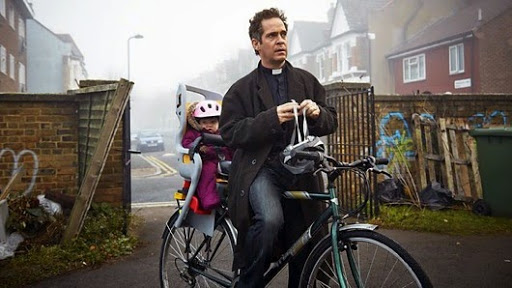
The BBC’s Rev: Christian or “just” nice?

Rev

One of my favorite TV series of all time is Rev – the BBC comedy about an Anglican priest in a London inner-city parish, with a minuscule congregation of misfits, and facing a barrage of trials both internal and from within and outwith the Anglican Church. The casting and acting are superb, the story lines varied, the contrast between the Rev’s psychology and the supporting cast’s caricatures comedic and the insightfulness of observation razor sharp.

Unlike other religiously-themed comedies, like the legendary Father Ted, Rev is not only about laughs, but very much also about a portrayal of a man’s sincere desire to love God and his fellow men and women. It is a love that falters and falls, but a love that is sincere and persistent.

In one episode we see the Rev go out of his way to be welcoming to a sinner (a sex offender just released from prison) in spite of his entire congregation’s opposition and his own revulsion. In another episode he struggles with his Church’s and his own views on homosexuality while going out of his way to be welcoming of his gay friends. In yet another episode he goes out of his way to work with the local Imam in spite of the humiliation that their financial imbalance brings him.

In fact, the formula of a Rev episode is a going out of one’s way, in pursuit of the excluded, the peripheral, the needy, regardless of the cost to oneself. And throughout these trials and adventures, the Rev converses with Jesus, with whom he pleads, to whom he complains, but in whom he trusts and whom he loves. In many ways, Rev expands on Blessed Mother Teresa’s saying: “God does not require that we be successful, only that we be faithful.”

Why, you may ask yourself, have I gone to the trouble of writing the above, albeit short, review of Rev? The reason is simple – an article in yesterday’s Telegraph, where Rev is denounced as un-Christian by reducing Christianity to being merely “nice” and leaving out “that Christians do nice things not just because they are nice people but because they are commanded to by scripture.” The article’s author then proceeds to list 8 “against”s that Christians need to be, and concludes with the following, peculiar piece of moral theology: “Christians who fail to point out these sins are surely as culpable as the people who commit them.”

However, the most offensive aspect of this article is not so much its twisted view of Christianity, but the following anti-atheist statement: “Nice atheists don’t have to [tell people when they’re going wrong] because there’s no commandment to rescue others from themselves.” This is offensive not only because it suggests that Christians only do what they do because they are commanded to do so – rather than because they (like all men and women!) are made in the image of God and have a deep-seated call to participate in the Trinity’s life of mutual self-giving – but also because it suggests that atheists don’t have a desire to correct wrongs. This is absurd, offensive and factually incorrect. Rather than try to build an extensive case, let me just point to a single counterexample: Albert Camus speaking to Dominicans about what atheists expect of Christians, showing great concern for them and being an exemplary “external” conscience for them.

In an attempt to bolster its credibility, the article also refers to Archbishop Justin Welby, who “disagrees with the show’s depiction of Anglican life because he notes that many churches are growing.” That is quite true – and a point I wholeheartedly agree with. However, it conveniently fails to mention that – in the same piece by the Archbishop – he also says that it is “great viewing.” Furthermore, the former Archbishop of Canterbury – Dr. Rowan Williams says that it tells us “something about the continuing commitment of the church to run-down and challenging areas. It also shows us someone who prays honestly.”

Finally, let me put one more card on the table – Pope Francis’ ever-versatile Evangelii Gaudium, where he has the following to say:

“[A] missionary style is not obsessed with the disjointed transmission of a multitude of doctrines to be insistently imposed. […] What counts above all else is “faith working through love” (Galatians 5:6). Works of love directed to one’s neighbour are the most perfect external manifestation of the interior grace of the Spirit: “The foundation of the New Law is in the grace of the Holy Spirit, who is manifested in the faith which works through love”. (St. Thomas Aquinas, Summa Theologica, I-II, q. 108, a. 1.)” (§35, §37)

Does the word “infinity” make you uncomfortable?

The Dominoes Are Falling

I learned a lesson today: never read the parish newsletter before the start of mass. This morning I did and it just lead to regret as I spent the vast majority of mass being distracted1 by it and trying to reconstruct in my mind the reasons against an argument put forward in it. What is even worse is that this wasn’t just the regular newsletter that our parish priest prepares (and that has as yet lead neither to disappointment, nor elation), but a newsletter – “Our Faith on Sunday” – prepared by the company who provides the weekly mass sheets and who ought to know better.

The argument in question is that of Aristotle’s unmoved mover (or first cause), which is a form of the cosmological argument. The basic idea is the following: since all change (motion, temperature variation, …) is the result of a previous change, there are two possibilities: either a causal chain stretching back into an infinite past or a first, “unmoved mover” that triggered a finite chain of causal links leading to the present. The possibility of infinite regress is dismissed as ridiculous, ergo there had to be a first mover. So far Aristotle’s argument from over 2300 years ago, which at that time was unarguably brilliant and which has survived without chinks into the 18th century (this by itself being pretty impressive too!). So, Aristotle comes out pretty well from this incident. The same cannot be said about the nameless author, who not only sticks it into a parish newsletter in 2012 without attribution, but who – to add insult to injury – finishes the piece with saying that the “unmoved mover” is God.

No it ain’t! And that is just the start of a litany of complaints that flooded my mind this morning, with the following being the 800 pound gorillas:

  1. In this context, the gravest mistake is clearly to present a piece of philosophy (however good it may be) and to equate it with God. Not just to say: “Well, this concept gives us hints about some aspects of what God may be like,” but to say “Unmoved mover = God.” Not only is this entirely divorced from Christian theology (giving a false sense of being able to grasp God in His fullness, etc.) but it is positively counterproductive. In essence the argument postulates a God who is relegated to a distant past, who is far removed from us and who just plays the role of a snooker player, hitting the first ball that leads to a vast sequence of knock-ons – a true God of Gaps. This is not the God of Christianity. It is not the loving Father who sent his Son to become one of us and the Holy Spirit to guide us. It is not the God who’s three persons love one another to the point of being one and who invites us to partake in His innermost life. The “unmoved mover” is a cheap imitation and one that is rightly and thankfully the butt of atheist jokes.
  2. Next, taking a philosophical argument made over two thousand years ago and (presumably, hopefully!) not checking whether there have been any significant challenges made against it is pretty sloppy too. And an excuse of obscurity cannot be used here either as the cosmological argument (whose one variant this is) has been debated to death! Furthermore, its critics have included such giants of philosophy as David Hume, who challenged the notion of causation itself (arguing that our senses simply don’t have access to the necessary connection between supposed cause A and supposed effect B – instead, all we have are repeated experiences of event B following event A). With causation undermined, there is clearly no necessity for a “first cause.” Does that mean a disproof of God? No – just of the grotesque God of Gaps of the cosmological argument, and not a disproof as such (those live exclusively in the realm of mathematics or other formal systems – and even there are limited by incompleteness) but a counterargument instead.
  3. Finally, and this is a criticism that I cannot fairly level at the authors of the newsletter, there is also that recurring misunderstanding of infinity that hampers many a philosophical argument from centuries past. Before Georg Cantor’s groundbreaking work on set theory and the concept of cardinality and the subsequent advances in our understanding of infinite sets and their properties (with contributions by pioneers like David Hilbert), an arm-waving approach to infinity and blanket statements about its unintelligibility or impossibility (e.g., by Thomas Aquinas2) were all we could manage. Today these are just not good enough anymore. E.g., a good example of how the impossibility of an infinite sequence of causes can be refuted can be found in Peter Clark’s paper: “Consider the set of events with no first member but a last member: {… an … a4, a3, a2, a1, a0} [where] for every j (aj-1 causes aj). There is no logical contradiction in this supposition whatsoever. […] Every event in the above sequence is finitely accessible from each and every event preceding it.” What this means is that an infinite sequence stretching back in time does not imply the necessity for a member that is infinitely far in the past. No matter how far you go back in the sequence (i.e., an) – and remember that you can’t go back to the beginning, which does not exist – there is a finite number of steps that bring you to the present (i.e., a0). All the infinity of the sequence means is that there is no first member, without necessarily entailing members that are infinitely removed in the past. This may sounds counterintuitive, but presents no logical contradiction.3

So: lesson learned. Next time, I’ll defer reading the newsletter until after mass and especially its “Faith and Reason” section, where, ironically, Aristotle’s argument was plagiarized.


1 I almost missed this gem of a line from St. Paul’s letter to the Philippians: “And this is my prayer: that your love may increase ever more and more in knowledge and every kind of perception, to discern what is of value” (1:9-10), again pointing to an induction of orthodoxy from orthopraxy.
2 “The existence of an actual infinite multitude is impossible. For any set of things one considers must be a specific set. And sets of things are specified by the number of things in them. Now no number is infinite, for number results from counting through a set of units. So no set of things can actually be inherently unlimited, nor can it happen to be unlimited.” (Thomas Aquinas, Summa Theologica, Part 1, Question 7, Article 4).
3 I realize this paragraph barely scratches the topic of infinity, to which I hope to return in the future … Also, please, note that I am not advocating an argument for the universe having existed infinitely – I am merely pointing to the objection to an infinite causal chain being outdated.