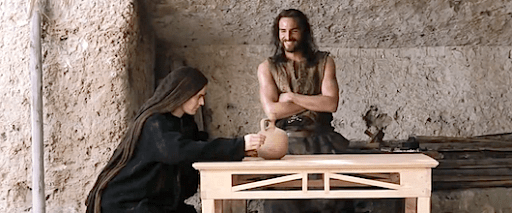
Jesus laughed

Jesus laughed

In many ways I find the subject of today’s post among the most difficult to talk about as, to me, it is akin to asking whether Jesus looked people in the eye when he spoke to them (or whether he looked down at his feet instead). Neither is mentioned in the Bible, yet both seem equally self-evident to me. I have yet to meet a loving, kind, compassionate person whom I haven’t also seen and heard laughing. So why is it that I am even writing about this topic?

The most immediate reason is a message I received from my bestie ML a couple of days ago, in which he shares a frustration that I too have had for years: the tendency of some to make a science out of distinguishing between joy and “mere fun,” branding one as a deplorable, shallow waste of time while extolling the other as a good, clean, Christian virtue. The point here isn’t that no distinctions ought to be made between varieties of enjoyment (the joy of mutual love, of a joke shared among friends, of delighting in success not being consubstantial with sadism or schadenfreude), but that such an enterprise bears the great risk of draining the joy out of Christian life through a process of abstract analysis and categorization that leaves one dour and cold.

In fact, the above thoughts were triggered by one of Pope Francis’ homilies from last week, where he says:

“A Christian is a man and a woman of joy. Jesus teaches us this, the Church teaches us this, in a special way in this liturgical time. What is this joy? Is it having fun? No: it is not the same. Fun is good, eh? Having fun is good. But joy is more, it is something else. […] Fun, if we want to have fun all the time, in the end becomes shallow, superficial, and also leads us to that state where we lack Christian wisdom. […] Joy is another thing. Joy is a gift from God. It fills us from within. It is like an anointing of the Spirit. [… On the other hand, s]ometimes melancholy Christian faces have more in common with pickled peppers than the joy of having a beautiful life.”

Clearly Francis distinguishes between fun that becomes shallow and joy that “fills us from within,” but he also warns against the lifelessness that follows from an absence of joy and that this is not Christian.

Having read and re-read Francis’ sermon many times over the last days, I am coming to the conclusion that the distinction ought not to be between fun and joy but between fun that leads to or subsists in joy and fun that does not and that leads to resentment, frustration and disappointment. In fact, Francis himself says that “Having fun is good[, b]ut joy is more” and I believe that this leads to a reading not of dichotomy but of set relationships, where fun and joy overlap. I’d like to go a step further though and argue that if joy is sought on the back of avoiding fun then only the latter is likely to be be achieved. Fun is a context in which relationships are built and avoiding it or looking down on it will eventually cut a person off from their neighbors – precisely the neighbors Jesus asks me to love like myself.

If I just look at my best friends, I can say with confidence that the moments that have lead to the birth of friendship have been ones of fun and joy – of delighting in each other, of recognizing oneself in the other, of having fun being together. This is not all that friendship is and moments of difficulty and suffering certainly test and strengthen it, but ultimately, as John Paul II said: “We are an Easter people.” Being an “Easter people” means both understanding the fundamental value that suffering has and realizing that its embracing is not for its own sake but as a means that leads to the joy of the resurrection.

But where does the question about whether Jesus laughed fit into this picture? It comes precisely from concerns about fun: should it be discredited or seen as a potential contributor to love and joy. At least up until the middle ages, many viewed laughter with deep-seated suspicion, but there were also those, like Erasmus of Rotterdam, who wrote the “Morias Enkomion” (“In Praise of Folly”) to his friend, St. Thomas More, who were its proponents. I don’t mean to mount an extensive defense of Jesus’ having laughed here – it is not something I believe is necessary and if you are convinced he never laughed, then Billy Graham would tell you: “I feel sorry for [you], because a balanced sense of humor can save us from taking ourselves too seriously, and help us see through the pride and pretense of our sinful world.” If, however, you’d like to see such a defense of laughter, others have done so very well already and I’d just pick out two: first, there are the very interesting scriptural pointers by the Protestant Rev. Kuiper and second, the great defense of humour by the Jesuit Fr. Martin, both of which I very much recommend.

To conclude on a fun note, let me leave you with a couple of examples of humor and laughter from the bible and the sayings of the saints (who are always a great weather vane for orthopraxy):

  1. St. Sarah (yes, “Old Testament” figures are held up as saints in the Catholic Church), who is the patron saint of laughter, laughed when God told her she’d get pregnant in her nineties: “God has given me cause to laugh, and all who hear of it will laugh with me.” (Genesis 21:6). Not only did Sarah laugh, but her son was named Isaac, which means “He laughed.”
  2. Jesus, during the “Sermon on the Plain” says: “Blessed are you who are now weeping, for you will laugh.” (Luke 6:21).
  3. Jesus often employs humor (which does not preclude him making important points at the same time) – e.g., as in the “eye of the needle” image: “[I]t is easier for a camel to pass through the eye of a needle than for one who is rich to enter the kingdom of God.” (Matthew 19:24).
  4. I have previously argued that the opening line of the Johannine prologue has the structure of a joke.
  5. When St. Thomas More is about to be executed for disobeying Henry VIII, he pulls his beard off the chopping block and tells the executioner: “This hath not offended the king.”
  6. In instructions to fellow nuns, St. Teresa of Ávila said: “What would happen if we hid what little sense of humor we had? Let each of us humbly use this to cheer others.”
  7. When asked by a journalist “How many people work in the Vatican?,” Blessed Pope John XXIII replied: “About half.”

🙂

Igino Giordani: the oxymoron of a catholic party

Foco2

I have long been aware of the figure of Igino Giordani through his writings, of which the most beautiful one to me is his “Diary of Fire” and I also knew of his having been an MP in the Italian parliament, a journalist and an expert on the Fathers of the Church. It is only now though, after having read his memoirs (“Memorie d’un cristiano ingenuo” – “Memoirs of a simple christian”) that I am beginning to realize more fully the enormity of his example. While in the past I have very much admired certain aspects of his life, I am now seeing that it is really his life as a whole that is an instance of his imitation of Jesus. To give you a sense of what I mean, let me pick out just a couple of moments from his autobiography.

While I don’t intend to summarize his story, it is worth noting that Giordani (1894–1980) was the first of six children of a bricklayer and his illiterate wife and that he initially trained to become a bricklayer like his dad. Thanks to his father’s employer, who provided him with the necessary financial support, Giordani ended up attending a junior seminary and eventually studying humanities at the University of Rome. On the verge of going to university, he was conscripted and sent to fight in the First World War. There a bullet shattered a ten centimeter segment of his right femur, requiring a three year stay in hospital and a series of 18 operations (the first of which was performed without anesthetics!).

It is at this point of exposure to war, that I was particularly impressed by the following passage, where Giordani talks about the impossibility he felt of “killing a human person: a brother”:1

“The five or six shots that I fired, in the air, I did out of necessity: I could never aim the barrel of my gun at the enemy trenches, with the intention of killing a child of God.”

Upon being discharged from hospital at the end of the war, Giordani immediately finds himself confronted with another battle: that of opposing the fascist regime and the alignment of parts of the Church with it. Here he speaks out against clericalism, which is:

“an exploitation of religious power for the political ends of a government, a party, a bank, … [… It is an] iron belt, disguised as gold, by which the freedom of the children of God was restrained, the proclamation of the Gospel deformed and the spirituality of the Church compromised.”

And adds that:

“During other periods Christianity was being attacked in the name of reason and freedom, while today we can affirm that it is only by a destruction of reason and freedom that Christianity can be attacked.”

A particularly poignant assessment of that period is also expressed by him as follows:

“Christ wasn’t crucified because Judas betrayed him, but he was crucified because Pilate washed his hands of him.”

Giordani’s outspoken attacks against the abuse of clerical power and offenses against reason, published also in the monthly “Parte Guelfa” whose editor he was, led to a clear and direct condemnation by Church authorities in 1925. Instead of rebelling and placing himself in opposition against the Church, Giordani chose obedience and published one final issue of the magazine. There, on the first page, he reprinted the authorities’ condemnation and added that the magazine “submits itself fully” to the Church’s judgment and “happily offers its loyal and disinterested allegiance,” evidenced by its decision to shut down. This struck me in many ways like St. Thomas More’s silence, which in “A Man For All Seasons” was described as “bellowing up and down Europe!” or Pierre Teilhard de Chardin’s obedient submission to being denied permission to publish his theological and philosophical works.

After the war, Giordani moves from being part of the antifascist resistance to joining the public political life, which results in his becoming a member of the Italian parliament. Here, the following reasoning about how the Church and politics are to relate struck me in particular (and I believe it prefigures the Vatican II position also expressed in Lumen Gentium2):

“The Church incarnates the Gospel: but it mustn’t become a party, confuse itself with a category (party or regime) because it is catholic, i.e., universal, and, as the mystical Christ, it must love all, serve all, even enemies.”

All of the above paints a very clear picture to my mind of someone who was all about following Jesus, disregarding whether that brought him into conflict with state or Church, but also of someone who did it with tremendous humility and, as the memoirs’ title indicates, simplicity. A great example of this attitude is also the following event:

“One day Pius XII called me […] and asked me: “Giordani, but what have you written in that newspaper3 of yours? I have received complaints saying that you are a revolutionary” He then quoted a phrase from my latest cover story, where it says that the excess of the rich is the lack of the poor: that unjust or unjustly used property is theft.
“Holy Father,” I answered, “that is a quote from Saint John Chrysostom.”
“But you should have said so …”
“Holy Father, when an article is written in half an hour or an hour, there is not time for citing sources.”
“True, true, ” he said, beginning to smile, “They say that you are a revolutionary. But, don’t worry, they also say that about me: what do you think? In fact, in these days, Roosevelt put it as “too radical””
“But,” I replied, “a true christian is necessarily a revolutionary: don’t we want to change the world? But, our revolution is beneficial, it builds rather than destroys; brings love instead of hatred, it brings society back together in solidarity.”

There would be so much more to say about him (e.g., his life as a lay, married person and father of four, his establishing of the modern Vatican library (and publishing a journal of library science that both the Moscow and Beijing libraries subscribed to during the height of communism), his career as a writer, his encounters with the great minds of the 20th century, etc.), but that will have to wait for a future post. To conclude, let me instead leave you with the following poem by Igino Giordani, which also gives us a glimpse of his interior life:

“I have begun to die
and what happens,
matters to me no more;
now I want to vanish
in the forsaken heart of Jesus.
All this sinning,
by greed and by vanity,
in love disappears:
I have reconquered my freedom.
I have begun to die
to death that no longer dies;
now I want to rejoice
with God in his eternal youth.”

It should come as no surprise that Igino Giordani – Servant of God – is in the process of being recognized as a saint – a saint I will be very proud of!


1 All the quotes from Igino Giordani here are from “Memorie d’un cristiano ingenuo,” with the crude translations from Italian, for which I apologize, being mine.
2 “[T]he faithful should learn how to distinguish carefully between those rights and duties which are theirs as members of the Church, and those which they have as members of human society. Let them strive to reconcile the two, remembering that in every temporal affair they must be guided by a Christian conscience, since even in secular business there is no human activity which can be withdrawn from God’s dominion. [… I]t must be admitted that the temporal sphere is governed by its own principles, since it is rightly concerned with the interests of this world.” (Lumen Gentium, §36)
3 “Il Quotidiano” was a daily newspaper, directed by Giordani 1944–1946.