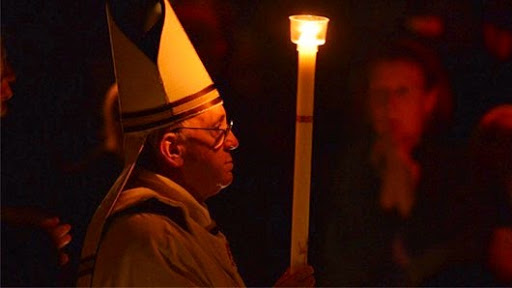
Synod14: A light that is among us and walks with us

Lumen fidei

Today sees the third day of the Extraordinary Synod on the Family, as well as the publication of various interviews with the Synod Fathers over the course of the last 24 hours, who are left free to speak to the media outside the discussions held within the Synod. I believe that this is a great innovation and one that gives a strong sense of transparency to the process.

Here I would like to pick out some words of Fr. Adolfo Nicolas, the superior general of the Jesuits, who said that “there can be more Christian love in a couple who lives in irregular circumstances than one married in church,” echoing Benedict XVI saying that “agnostics, who are constantly exercised by the question of God, those who long for a pure heart but suffer on account of our[, the Church’s,] sin, are closer to the Kingdom of God than believers whose life of faith is “routine” and who regard the Church merely as an institution, without letting their hearts be touched by faith.” Fr. Nicolas is also reported as saying: “A divorced person has suffered, but we withdraw medicine from him or her who needs it most. No, this cannot be!”

The Archbishop of Dublin, Diarmuid Martin’s intervention in the Synod has also been reported in more detail, where he is quoted as saying:

“[M]any men and women, without making explicit reference to the teaching of the Church, actually live out the value of marital fidelity day-by-day, at times heroically. They would hardly recognise their own experience in the way we present the ideals of married life. Indeed many in genuine humility would probably feel that they are living a life which is distant from the ideal of marriage as presented by Church teaching.”

Martin then proceeded to make a plea for an “incarnated” teaching, close to the reality of people’s lives:

“To many the language of the Church appears to be a disincarnated language of telling people what to do, a “one way dialogue”. I am in no way saying that the Church is not called to teach. I am not saying that experience on its own determines teaching or the authentic interpretation of teaching. What I am saying is that the lived experience and struggle of spouses can help find more effective ways of expression of the fundamental elements of Church teaching. Jesus himself accompanied his preaching the good news with a process of healing the wounded and welcoming those on the margins. His teaching was never disincarnated and unmoved by the concrete human situation in which people could come to be embraced by the Good News. Jesus’ care for the sick and the troubled and those weighed down by burdens is the key which helps to understand how he truly is the Son of God.”

Finally, in a brief interview with Cardinal Nichols there is, I believe, an example of what such new language (and more!) might look like, when he says:

“The family is a place of prayer, the family is a place of shared faith, the family is a place where failure is accepted and worked through, because we want to live by the compassion and the forgiveness that the Lord offers.

I don’t doubt that most young people aspire to having their own family, having their own family within the stable relationship between husband and wife, having that family with a sense of permanence and a permanent, faithful commitment. Nobody wants a wife or a husband who is unfaithful. And so what we have to get across to people is that casual relationships before marriage is actually being casual with somebody’s future husband or wife. And its that sense of the real value that’s written in us, its in the hearts of people, that they aspire to, that has consequences for how we behave today as well.”

Turning to today’s proceedings, the program started with an address by Archbishop Philip Tartaglia of Glasgow, where he first gave an account of happy family life:

“[W]hen husband and wife are happy together and are blessed with children, then love expands from two to three and four and five. In a family, there is every opportunity to be patient and kind and excusing and trusting. There is every opportunity to renew faithfulness to one another by laughing together, crying together, supporting one another, saying sorry to one another, giving one another the benefit of the doubt, embracing one another, being happy for each other, just knowing the right word at the right time. And when those things happen, we are privileged to behold the beauty and simplicity and strength of married love and of family love, a love which truly through the grace of Christ endures all things.”

It is against this backdrop that Tartaglia then declares the need for the Church to help those for whom the above picture does not hold:

“But when families fracture, love is the first casualty. The love which was the glue between spouses turns to hate very quickly. Intimate communion of life is replaced with a terrible logic of division. Children’s peace of heart is shattered and they find themselves both loving and hating their parents at the same time.

Into this sadness, the Church has to find a way to speak St Paul’s words of love, which compassionately excuse and forgive, but which also heal and renew and lift up again; where forgiveness is not accommodation or indifference but genuine and sometimes hard-won reconciliation, engendering new trust, new hope, new endurance, and new faithfulness, a new page in the story of love of husband and wife and their children.”

The press conference that took place again at 1 pm, saw a reading out of notes from yesterday afternoon’s and this morning’s session, followed by additional comments made by Fr. Rosica on the basis of English and French contributions during the sessions, including the observation that “[w]e must appeal to the Bible over language of natural law, when we root ourselves in scripture it has a positive effect,” commenting that while natural law is like a fixed spotlight, the Bible speaks about a soft light that is among us and walks with us (i.e., Jesus).1 On a related point, Fr. Dorantes, representing Spanish speakers, used another image about light, saying that the Synod Fathers argued that the Church needs to move from being like a lighthouse that is fixed in place, to being like a torch that men and women can carry with them to shed light on their lives.

The Nigerian Archbishop Ignatius Kaigama, who was also present at the press conference, spoke about the Nigerian bishop’s opposition to the criminalisation of homosexuality:

“We would defend any person with a homosexual orientation who is being harassed, imprisoned or punished….so when the media takes our story they should balance it….we try to share our point of view (but) we don’t punish them. The government may want to punish them but we don’t, in fact we will work to tell the government to stop punishing those who have different orientations.”

The notes from yesterday afternoon’s session were then published, where a link was made between faith and the family, where “the crisis of faith and the crisis of the family was underlined: it was said that the first generates the second. This is because faith is seen mostly as a set of doctrinal mores, whereas it is primarily a free act by which one entrusts oneself to God.” The impact of working conditions on family life and a focus on issues particularly relevant in Africa followed (including “polygamy, levirate marriage, sects, war, poverty, the painful crisis of migration, international pressure for birth control, and so on”).

The notes from this morning’s session then speak about challenges faced in the Middle East and North Africa, where there are “difficult political, economic and religious situations, with serious repercussions on families.” Here the response to a variety of challenges was always along the lines that “Such couples […] must not be neglected and the Church must continue to take care of them” and that “the need to follow the path of mercy in difficult situations was underlined.” The discussion then turned to challenges arising from unstable employment and unemployment:

“The distress caused by the lack of a secure job creates difficulties within families, along with the poverty that often prevents families from having a home. Furthermore, a lack of money often leads to it becoming “deified” and to families being sacrificed on the altar of profit. It is necessary to re-emphasise that money must serve rather than govern.”

And finally, “[t]here was further reflection on the need for greater preparation for marriage, also with special attention to emotional and sexual education, encouraging a true mystical and familiar approach to sexuality.”


1 Note that this relates very well also to Pope Francis’ catechesis on the gifts of the Holy Spirit, where he said: “God forgives always, we men forgive sometimes, but creation never forgives.”

Synod14: Truly love families in difficulty

Francis at synod

Continuing with my coverage of the Extraordinary Synod on the Family (see the other posts here), today I’d like to pick out some passages from the Vatican’s official notes on the discussions of yesterday afternoon’s 2nd session of the Synod, where important points were made, first on the need to engage with the world as it is today, also adapting our language in response to it – and, I’d argue, also our understanding, since a simple rephrasing is not going to be sufficient, or even possible, since true dialogue alters all parties involved in it:

“[T]here has emerged the need to adapt the language of the Church, so that doctrine on the family, life and sexuality is understood correctly: it is necessary to enter into dialogue with the world, looking to the example offered by the Vatican Council, or rather with a critical but sincere openness. If the Church does not listen to the world, the world will not listen to the Church. And dialogue may be based on important themes, such as the equal dignity of men and women and the rejection of violence.”

The importance of sharing lived experiences of putting the Gospel into practice, instead of dry and dead theory, was emphasised next:

“The Gospel must not be explained, but rather shown – it was said in the Assembly – and above all, the lay faithful must be involved in the proclamation of the Good News, demonstrating the missionary charism. Evangelisation must not be a depersonalised theory, but must instead ensure that families themselves give concrete witness to the beauty and truth of the Gospel. […] The Church, instead, must be “magnetic”; it must work by attraction, with an attitude of friendship towards the world.”

Next, a point from the opening document was underlined, by returning to the importance of recognising the good there is in every situation, and making reference to the law of gradualness that Cardinal Kasper spoke about in his now-famous speech during the last consistory, that St. John Paul II also put forward in his Familiaris Consortio, and whose basic idea is to recognise the need to gradually approach a desired end state, as if following stepping stones from wherever a person or family is in the present:

“[E]ven imperfect situations must be considered with respect: for instance, de facto unions in which couples live together with fidelity and love present elements of sanctification and truth. It is therefore essential to look first and foremost at the positive elements, so that the Synod may infuse with courage and hope even imperfect forms of family, so that their value may be recognised, according to the principle of graduality. It is necessary to truly love families in difficulty.”

Worth noting is also the variant on the above that Fr. Rosica reported during the press conference, where he quoted a Synod Father as saying: “There are different expressions of what is family today and we have to be sensitive to that.”

Finally, the notes also addressed the need to present the good of sexuality: “[T]he essential value of sexuality within marriage was also considered: sexuality outside marriage is discussed so critically that married sexuality can appear almost as a concession to imperfection.”

The discussions from this morning’s session are then summed up in a separate note, where the fist point raised was a call for emphasising the positive and the vocational nature of marriage:

“The suggestion was to look not only towards remedies for failure of the conjugal union, but also to focus on the conditions that render it valid and fruitful. It is necessary to transmit a vision of marriage that does not regard it as a destination, but rather as a path to a higher end, a road towards the growth of the person and of the couple, a source of strength and energy. The decision to marry is a true vocation and as such requires fidelity and coherence in order to become a true locus for the growth and the protection of the human being.”

Next, the need for extensive preparation and accompaniment was stated, also with the consequences of failure bluntly put on the table:

“[M]arried couples must be accompanied throughout their path in life, by means of intense and vigorous family pastoral care. The path of preparation for the marriage sacrament, must therefore be long, personalised and also severe, without the fear of eventually leading to a reduction in the number of weddings celebrated in Church. Otherwise, there is the risk of filling the Tribunals with marriage cases.”

The importance of appropriate language and of dialogue surfaced again this morning:

“[T]he debate focused on the need to renew the language of the proclamation of the Gospel and the transmission of doctrine: the Church must be more open to dialogue, and must listen more frequently (and not only in exceptional cases) to the experiences of married couples, because their struggles and their failures cannot be ignored; on the other hand, they can be the basis of a real and true theology.”

To flesh out some of the above points, the press conference that followed at 1 pm Roman time included specific examples of what such a renewal of language needs to address. Fr. Rosica, the English language Vatican spokesperson, noted that terms like “Living in sin,” “intrinsically disordered,” and “contraceptive mentality” were singled out by the Synod Fathers as examples of “harsh language” where there was a need for change that would demonstrate the Church’s openness and love. Cardinal Nichols, who was also present at the press conference, characterized the atmosphere at the Synod as one where bishops are “speaking as priests, members of families, and not as academics,” adding that “It’s very lovely.” 🙂 On the same note, the Jesuit Fr. Antonio Spadaro – also a participant of the Synod – noted that “the attempts to paint a picture of fighting among cardinals melt like snow in the sun. At the Synod what is lived is an experience of Church …”

Me atheist, you Vatican spokesman

Chinese whispers

The journalistic farce that followed Pope Francis’ now-famous “atheists” homily is best viewed through Monty Python lenses, where it is in many ways like the final scene of the Life of Brian.1 There, a centurion comes to rescue Brian from the cross, but when he asks “Where is Brian of Nazareth?!” everyone volunteers, even to the point of one of the other crucifixion victims saying “I’m Brian, and so’s my wife!”

Let’s backtrack though and see what happened step by step. First, there was Francis’ homily itself:

“The Lord has redeemed all of us, all of us, with the Blood of Christ: all of us, not just Catholics. Everyone! ‘Father, the atheists?’ Even the atheists. Everyone! And this Blood makes us children of God of the first class! We are created children in the likeness of God and the Blood of Christ has redeemed us all! And we all have a duty to do good. And this commandment for everyone to do good, I think, is a beautiful path towards peace. If we, each doing our own part, if we do good to others, if we meet there, doing good, and we go slowly, gently, little by little, we will make that culture of encounter: we need that so much. We must meet one another doing good. ‘But I don’t believe, Father, I am an atheist!’ But do good: we will meet one another there.”

When I first read this, a couple of hours after Francis delivered it during his 7 am Domus Sanctae Marthae mass on 22nd May, I felt great joy and gratitude for having a Pope who is open and welcoming to all – just like Jesus was. I thought no more about it, since it seemed to me to be just a re-iteration – albeit a very welcome and clear one – of what the Church has been teaching consistently since Vatican II.2 In essence, Francis was saying that we hope to see atheists in heaven as much as we hope to be there ourselves. This is not to impose beliefs on those who believe neither in God nor in the existence of heaven, but to assure them that we, Catholics (and many other Christians too), believe in a God who loves all and welcomes all, regardless of their beliefs.

When I then looked at Twitter later in the day, I saw it ablaze with two types of reactions: very positive ones both from Christians and atheists, welcoming the invitation to dialogue and the appreciation of the good done by atheists (e.g., see the Huffington Post article from the same day and note the Pope’s homily being the second most shared piece on Reddit) and very critical ones – mainly from “traditional” Catholics (e.g., see a particularly forceful and conceited criticism here).

The day ended well for this story though, with a spot-on rebuke of Francis’ critics from a 1964 homily of the then-Fr. Joseph Ratzinger, shared in a blog post by Anna Williams:

“It seems as if we want to be rewarded, not just with our own salvation, but most especially with other people’s damnation—just like the workers hired in the first hour. That is very human, but the Lord’s parable [of the workers in the vineyard (Matthew 20:1-6)] is particularly meant to make us quite aware of how profoundly un-Christian it is at the same time.”

So far, so good: another great homily by Pope Francis, mostly positive and some negative reactions and a great put-down of the critics to round out the day.

The next morning, the weather turned though and a farce of epic proportion began brewing with the news of a Vatican spokesperson having issued a correction of Pope Francis’ words. As far as I can tell, the source of this red herring was a post on cnn.com, which stated that “On Thursday, the Vatican issued an “explanatory note on the meaning to ‘salvation.’” The Rev. Thomas Rosica, a Vatican spokesman, said that people who [are] aware of the Catholic church “cannot be saved” if they “refuse to enter her or remain in her.”” This was quickly picked up by media outlets around the world, with headlines like: “Vatican Clarifies Pope’s ‘Atheist’ Remarks,” “Vatican corrects Pope: Atheists are still going to hell,” and “Not so fast: Vatican says Pope Francis got it wrong, atheists do go to hell.”

It was immediately clear to me that something didn’t add up here: first, Fr. Thomas Rosica isn’t “a Vatican spokesman” (Fr. Federico Lombardi being “the” Vatican spokesperson, who has been in office for many years),3 second, “people who are aware of the Catholic Church and are not in her cannot be saved” is not at all what the Catechism says4 and third, any member of the Catholic Church (never mind a priest or Vatican member of staff) who felt it to be their job to issue an “explanatory note” about the Pope’s words off their own back and unprompted by the Pope better check themselves, before they wreck themselves.

In any case, I was curious to see this alleged “explanatory note,” so I (foolishly!) headed over to the Vatican website, where – naturally – there was no trace of it. Instead, I tracked it down on zenith.org here and I found – as I should have anticipated – that it was actually not a bad commentary on Francis’ words (and, no, it did not contain the offensive quote on “being aware of the Catholic Church” attributed to it on cnn.com). So, the facts of the matter are that the Vatican never issued any communication to “correct” Francis’ words and Fr. Rosica actually did a good job of commenting on the Pope’s words in my opinion (if you take care to read the whole text rather than pick phrases out of context – or even misquote them).

Like in so many cases before (did anyone say “Jesus’ wife”?), this incident was a display of journalistic ineptitude, carelessness and superficiality.

To conclude though I’d rather leave you on a positive note – a quote from Pope John Paul II’s address to the United Nations from 1995, which Fr. Rosica quoted in his explanatory note:

“Because of the radiant humanity of Christ, nothing genuinely human fails to touch the hearts of Christians. Faith in Christ does not impel us to intolerance. On the contrary, it obliges us to engage others in a respectful dialogue. Love of Christ does not distract us from interest in others, but rather invites us to responsibility for them, to the exclusion of no one and indeed, if anything, with a special concern for the weakest and the suffering. Thus, as we approach the two thousandth anniversary of the birth of Christ, the Church asks only to be able to propose respectfully this message of salvation, and to be able to promote, in charity and service, the solidarity of the entire human family.”

[UPDATE] I actually started writing this post several days ago and I was beginning to wonder whether it still made sense to publish it, since the events it speaks about took place two weeks ago. Surely the storm in a teacup would have died down since then and Francis’ words would be seen for what they were. Last night and then this morning I saw two articles that changed my mind though: first, one by the otherwise very cogent Fr. Alexander Lucie-Smith, who concluded his latest blog post with the following: “Heresy, and atheism, produce nothing beautiful. They can’t. They are stony barren fields.” and second, a post by the atheist Herb Silverman, whose take on the matter is that “Perhaps Pope Francis forgot to run this concession by the papal censors, because the following day the Vatican announced a do-over. The Rev. Thomas Rosica, a Vatican spokesman, said that those who are aware of the Catholic Church “cannot be saved” if they “refuse to enter her or remain in her.” […] So Rev. Rosica is simply reiterating the traditional Catholic position that atheists can go to hell.” Sadly, this post still has currency, but I hope that you have found it to be of some interest.


1 And those of you who are well versed in all matters Python, will also have spotted the direct reference to the “nurse” sketch, which is closely related to the present matter too.
2 For previous coverage of how the Church relates to atheists, see the following posts.
3 Though he did translate for Lombardi during the last conclave, so the mixup could be excused – if the source were not supposed to be engaged in journalism.
4 What the Catechism actually says is this: “Hence they could not be saved who, knowing that the Catholic Church was founded as necessary by God through Christ, would refuse either to enter it or to remain in it.” (§846)
Knowing and necessary – two very strong words, on a very different end of the scale to being aware that the Catholic Church exists! In effect it means that if you act against your own certain conviction that being in the Catholic Church is necessary for salvation, you are choosing to reject it and it is your freedom that is being respected instead of you being excluded.