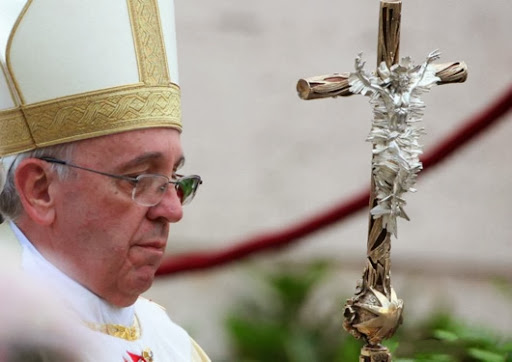
Imagine what the most offensive, sacrilegious and vile depiction of Jesus could be. Now look at the staff (a “ferula”) that Pope Francis holds in the above photo. Is that what you expected? I hope not, but if you googled “pope francis new ferula,” all you’d find is outrage, offence and adjectives like “misconceived,” “bizarre,” “ugly,” “offensive,” “nasty” and “profane.” Not only would these be outliers further down the search results, but it would be literally all you’d find – and I spent a couple of days trying to find anything positive at all about this new liturgical object used by Pope Francis.
So, why is it that this staff causes so much offense? If you abstract away the, sadly, harsh language of the reactions published so far, by sources who self-apply the “traditionalist” label, the root of the outrage is the depiction of the risen Christ instead of the crucified one. In most cases this is presented as being self-evidently an aberration, and one of the sources points to an encyclical by Pope Pius XII and quotes the following fragment:
““…one would be straying from the straight path … were he to order the crucifix so designed that the divine Redeemer’s body shows no trace of His cruel sufferings” (Pius XII, Encyclical Mediator Dei, par. 62).”
When I saw this, I immediately thought: “Great! Finally something specific and something that is likely to be usable against the new staff’s detractors.” As with most fanatics, their quoting of scriptures or other texts tends to be very selective and even just the immediate neighborhood of their snippets is likely to be their undoing. The same scenario applies here, if you look at the expanded quote below, still just staying within paragraph 62 and the opening sentence of paragraph 63 of Pius XII’s Mediator Dei:
“Assuredly it is a wise and most laudable thing to return in spirit and affection to the sources of the sacred liturgy. For research in this field of study, by tracing it back to its origins, contributes valuable assistance towards a more thorough and careful investigation of the significance of feast-days, and of the meaning of the texts and sacred ceremonies employed on their occasion. But it is neither wise nor laudable to reduce everything to antiquity by every possible device. Thus, to cite some instances, one would be straying from the straight path were he to wish the altar restored to its primitive tableform; were he to want black excluded as a color for the liturgical vestments; were he to forbid the use of sacred images and statues in Churches; were he to order the crucifix so designed that the divine Redeemer’s body shows no trace of His cruel sufferings […] Clearly no sincere Catholic can refuse to accept the formulation of Christian doctrine more recently elaborated and proclaimed as dogmas by the Church, under the inspiration and guidance of the Holy Spirit with abundant fruit for souls, because it pleases him to hark back to the old formulas.”
Before looking at the point about crucifixes that vexes Francis’ detractors, let’s just look at Pius XII’s categorical denunciation of traditionalism! The Holy Spirit is constantly active in the Church and more recent elaborations of teaching supersede older ones. By his own words, Pius XII is setting the scope of his own teaching to expire upon being superseded by that of his successors, so even if his words had been in conflict with Francis’ staff, Francis actions would take precedent and would do so by Pius XII’s own teaching.
Now, let’s think about what Pius XII actually said about crucifixes, where he objects to them being “so designed that the divine Redeemer’s body shows no trace of His cruel sufferings.” Is he saying that the risen Christ mustn’t be depicted? Not at all. Only that the corpus shall show the traces of crucifixion torture, which early crucifixes did not show. Up until the early 5th century, only crosses and not crucifixes (i.e., crosses with a corpus) were used – and even those only sparsely. The next period then saw depictions of Jesus’ body on crosses, but in the form of unrealistic representations, like the following one, which is among the earliest ones:
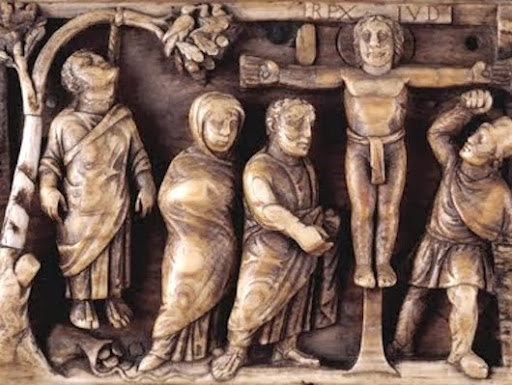
Here Jesus is upright, looking ahead, showing strength. What is Pius XII saying though? That our 5th century brothers and sisters were “straying from the straight path”? Certainly not! Only that if we imitated them in the misguided belief of the past having been a truer, purer, more genuine Christianity, we would be the ones straying and denying the Holy Spirit.
So, my reading of Pius XII is that we are to be open to the Holy Spirit now and that he underlined the importance of depicting the signs of the crucifixion horrors in crucifixes. Let’s now take a closer look at Francis’ new staff – the “crux gloriosa” and examine more closely the choices made by its author, the Roman sculptor Maurizio Lauri:
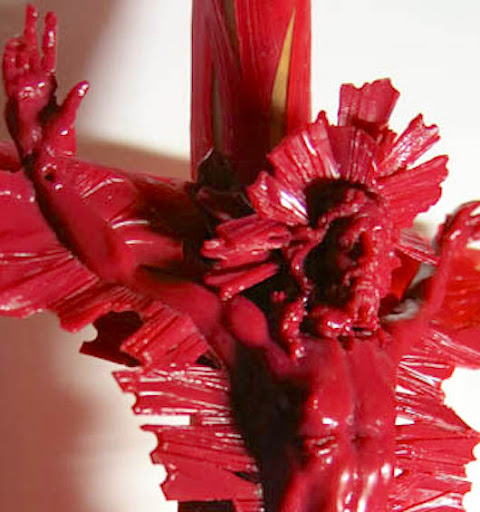
From the above wax cast of the staff, it can clearly be seen that Jesus’ body bears the “trace[s] of His cruel sufferings” – his wrists are pierced,1 his side shows a swollen stab wound, his hands look mangled. This is not the Christus victor depiction of the first nine centuries, but instead a form that incorporates the “Christus mortuus” features whose importance Pius XII insisted upon too.
I believe the crucifix on Pope Francis’ new ferula displays a great degree of continuity with the last two millennia of depicting Jesus’ passion (incidentally, in a particular way with the San Damiano cross through which St. Francis heard Jesus speak to him). While clearly showing that Jesus’ execution on the cross was barbaric and crushing, it also depicts the inexorable link between this suffering, which Jesus underwent out of love, and the resurrection that followed it and that engenders mercy, hope and joy. Rather than in any way negating the monumental scale of Jesus’ suffering, the Lauri ferula projects it towards the resurrection that followed His excruciating death. It seems to me like Lauri was giving form to St. Paul saying: “we do see Jesus crowned with glory and honor because he suffered death” (Hebrews 2:9).
Finally, I have also been struck by the provenance of the materials used for making the Lauri ferula. The staff and crucifix atop it are made of mahogany, bronze and silver, where the metals were mined by Goldlake – an Italian company operating in Honduras and working to explicitly ethical standards, in partnership with local churches in both countries. During the presentation of the ferula to Franics, the CEO of Goldlake – Giuseppe Colaiacovo, explained: “Your holiness […] we would like to present you with this object, made from the materials of the earth, which therefore are poor materials, but which then become transformed by the artistic spirit.” Not only do I see a tremendously orthodox and historically grounded theology behind the form of the ferula, but its material provenance itself bears a positive message in itself.
1 A fact worthy of note by itself, since it is in agreement with recent research that shows how Jesus was nailed to the cross not by his palms, as is typical in depictions of the crucifixion, but by his wrists.

 eyebeleave