Probably the best movie about Jesus

Il vangelo

Franco Zefirelli’s “Jesus of Nazareth”? No. (Phew!)

Mel Gibson’s “The Passion of the Christ”? No, not that one either. (Phew, again!)

No, “probably the best movie about Jesus” is Pier Paolo Pasolini’s “The Gospel According to St. Matthew.”

“Says who?,” you ask.

Well, none other than the Vatican’s own newspaper, l’Osservatore Romano, which in a review on the 50th anniversary of the movie’s premiere had the following to say (in the words of Emilio Ranzato):

“Whether it be a movie about a crisis in progress or about its overcoming, The Gospel according to Matthew remains a masterpiece, and probably the best movie about Jesus ever made. It is certainly the one in which his words ring out most fluidly, in the most elevated and the most powerful way. Hewn out of bare rock, like the best moments of Pasolinian cinema.”

But, what makes this movie the pinnacle of depicting Jesus’ life? The l’Osservatore Romano review elaborates:

“The director follows the Gospel pages to the letter and doesn’t shy away even from talking about miracles, which he presents with an inspiration worthy of a believer. In this way, on the one hand confirming the validity and power of the Christian word, but, on the other hand, giving it a more down-to-earth context in which to spread, the director clearly intends to give a thrust both towards the marxist and ecclesial worlds. At the same time, however, and maybe unexpectedly, he finds peace in a place that is equidistant from these two poles. Surely there have been few other times in the history of cinema where a representation that plays on sacred strings, or even only mythical and epic ones, has been built on such a sincere realism.”

So, what drove this marxist (and atheist and gay) director to making a movie about Jesus? He explains this himself – during the year before the movie’s release – in a letter to Lucio Caruso of the Pro Civitate Christiana of Assisi (a Christian volunteer organization):

“The first time I visited all of you in Assisi, I found the Gospels at my bedside: your diabolical calculation!

That day, in your place, I read them from beginning to end, like a novel.

And in the exaltation of reading – as you know, it’s the most exalting thing one can read! – there came to me among other things, the idea of making a film… as the days and later the weeks went by, the idea kept getting more overwhelming and exclusive. It threw in the shade all the other ideas for work I had in my head, it weakened and devitalised them.

And it alone remained, alive and thriving within me… my idea is this: to follow the Gospel according to Saint Matthew, point by point, without making a script or adaptation of it. To translate it faithfully into images, following its story exactly without any omissions or additions.

The dialogue too should be strictly that of Saint Matthew, without even a single explanatory or connecting sentence, because no image or inserted word could ever attain the poetic heights of the text… to put it very simply and frankly, I don’t believe that Christ is the son of God, because I am not a believer – at least not consciously. But I believe that Christ is divine. I believe that is, that in him humanity is so kind and ideal as to exceed the common terms of humanity. For this reason I say “poetry” – an irrational instrument to express this irrational feeling of mine for Christ.”

His answer to the question of why he, a non-believer, had made a film which dealt with religious themes, at a press conference in 1966, is also illuminating:

“If you know that I am an unbeliever, then you know me better than I do myself. I may be an unbeliever, but I am an unbeliever who has a nostalgia for a belief.”

But, how does one who is not a Christian create a piece of art that is recognized by Christians as their own, and not only that, but a masterpiece? Here Pasolini’s answer is very telling:

“[T]he rule that dominated the making of the film was the rule of analogy. That is, I found settings that were not reconstructions but that were analogous to ancient Palestine. The characters, too—I didn’t reconstruct characters but tried to find individuals who were analogous. I was obliged to scour southern Italy, because I realized that the pre-industrial agricultural world, the still feudal area of southern Italy, was the historical setting analogous to ancient Palestine. One by one I found the settings that I needed for The Gospel. I took these Italian settings and used them to represent the originals. I took the city of Matera, and without changing it in any way, I used it to represent the ancient city of Jerusalem. Or the little caverns of the village between Lucania and Puglia are used exactly as they were, without any modifications, to represent Bethlehem. And I did the same thing for the characters. The chorus of background characters I chose from the faces of the peasants of Lucania and Puglia and Calabria. […]

In reality, my method consists simply of being sincere, honest, penetrating, precise in choosing men who psychological essence is real and genuine. Once I’ve chosen them, then my work is immensely simplified. I don’t have to do with them what I have to do with professional actors: tell them what they have to do and what they haven’t to do and the sort of people they are supposed to represent and so forth. I simply tell them to say these words in a certain frame of mind and that’s all. And they say them.”

Whether intentionally or not, this way of analogy is precisely Jesus’ own method. The employment of parables, and his teaching in its entirety rely fundamentally on analogy. Here is God – the infinite, omnipotent, omniscient, wholly transcendent and other – speaking to his creatures, who are addled with limitations, and the only possible way is that of analogy, since the listeners have no direct access to the ultimate realities that the speaker is trying to convey. At the heart of this method is in fact the very life of the Trinity, where each Person empties itself so as to receive the other and fully gives itself to the other that is ready to receive them. This self-othering1 nature of God is the basis of analogy, which Pasolini applied masterfully and I would like to argue that his work resonates with Christians not only because of the subject matter, but because of the method that begot it. And I have to say that I am a great fan of it too!

To conclude, I’d just like to share a fragment of the dialogue between the Franciscan Fr. Ugolino Vagnuzzi and Pier Paolo Pasolini that took place in June ’68 and that Fr. Vagnuzzi published a couple of days ago. It starts with Pasolini’s words:

““I saw Christ with two “eyes,” one being mine – of a rational man, modern and a lay person; the other being the look of a simple person with great faith. These two visions complement each other, I’ll explain: I saw him as the Son of God, mystically, religiously, but at the same time I saw him as a revolutionary.”

I asked him [writes Fr. Ugolino] whether before or after that Christ was so successful in the cinema, he had said something to him.

“Religious convictions or non-belief are like blocks of quartz. The reasons that make these blocks dissolve is always mysterious, so I can say neither yes nor no to you.”

I was deeply moved when he then turned to me with these words:

“You see, dear Brother, you and I are one on one and the other on the other bank of a river. A bridge unites us where we can meet. Both of us must travel some distance. I am certain that you will not say no to taking these steps, which are precious to me.””


1 A term coined by my überbestie CS.
Theology: necessary, but only for experts

Experts

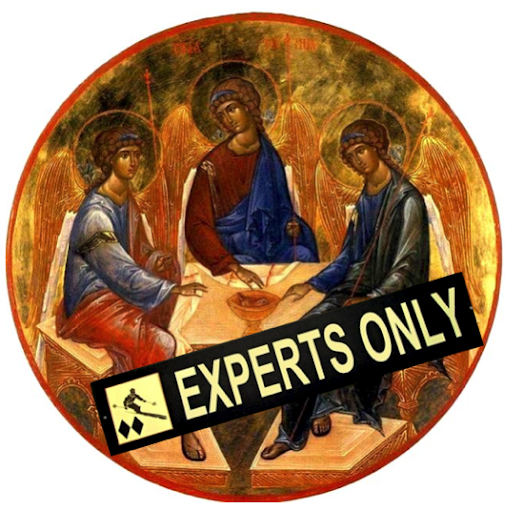
Last Sunday was Trinity Sunday – the day when the Church focuses on the one God having revealed himself to be a communion of three persons, whose self-giving love for one another means that they are both three and one – distinct persons, yet of one substance. As St. John Paul II put it in Familiaris Consortio (§11): “God is love and in Himself He lives a mystery of personal loving communion.”

John Paul II then goes on to discussing the relevance of an understanding of the Trinity for humanity, when he says that

“God created man in His own image and likeness: calling him to existence through love, He called him at the same time for love. […] Creating the human race in His own image and continually keeping it in being, God inscribed in the humanity of man and woman the vocation, and thus the capacity and responsibility, of love and communion. Love is therefore the fundamental and innate vocation of every human being.”

Maybe naively, but I therefore expected to read some edifying insight into this trinitarian nature of God when picking up an official leaflet distributed with my parish’s newsletter last Sunday. Instead, I started reading a piece that kicks off as follows:

“The liturgy of Trinity Sunday is full of abstract words that many of us find difficult – unity, trinity, person, substance. They can seem to belong more to a mathematical text-book than to a prayer. This is the technical language of theology, necessary but only for experts.”

At this point I stopped reading, since, whatever followed, could be neither edifying nor enriching, and I preferred to spend the rest of the time I had before mass in a positive way instead of by trying to calm myself down in the face of more drivel.

I am not sure what maths books the author of the above patronizing had read, but I can only think of one of those four terms coming up there. More seriously wrong is the idea though that our understanding of the nature of God is in some way an academic exercise, that it is something that just has to be put up with and that it is best left to experts. The rest of us, for whom this must all be terribly confusing, should just get on with our lives and not let ourselves be troubled by abstract concepts. In fact, we should shelve all this hoity-toity talk about persons and substances under the soothing blanket of “mystery,” as the author of the above insult to every rational human being suggests later in the same piece.

Absolutely no way, Bruce! This would be – to use a soccer analogy – like telling players that they didn’t need to know anything about the Laws of the Game, that they should just run around kicking the ball however they liked (since those complicated rules would just give them headaches) and that the referees would tell them what’s going on and, at some point, who won.

Luckily the author in question here is comfortably outranked by another, whose words I will chose to use against him and to adhere to myself. Yes, you guessed it – I am talking again about St. John Paul II, who said:

“[T]he Trinity is beyond the capacities of our understanding and can only be known through revelation. Nevertheless, this mystery which infinitely transcends us is also the reality closest to us, because it is the very source of our being. For in God we “live and move and have our being” (Acts 17:28), and what St Augustine says of God must be applied to all three divine persons: he is “intimior intimo meo” (Confessions, 3, 6, 11). In the depths of our being, where not even our gaze can penetrate, the Father, Son and Holy Spirit, one God in three persons, are present through grace. Far from being a dry intellectual truth, the mystery of the Trinity is the life that dwells in us and sustains us. […]

He is love in his inner life, where the Trinitarian dynamism is the very expression of the eternal love with which the Father begets the Son and both give themselves to each other in the Holy Spirit. He is love in his relationship to the world, since the free decision to make it out of nothing is the fruit of this infinite love which radiates into the sphere of creation.”

Yes, the Trinity is a mystery, but saying so is not a conversation stopper or an excuse, and neither is it code for saying that we cannot think or reason about what it means. Christianity has at its heart the gift of revelation, where God became man and dwelt among us, precisely so that we could also have some understanding of who He is. While being wholly other, and justifiably approached also by apophatic means, He is at the same time “more inward to us than our inmost self and higher than our highest self” (“intimior intimo meo et superior summo meo”), as St. Augustine says. Being made in His image means that by understanding Him we understand ourselves, and vice versa, and this surely is worth struggling for and putting up with (seemingly) abstract and technical language for.

Let’s not let others tell us that thinking about the Trinity is for experts only, that it is too technical and abstract for us to trouble our pretty little heads with. Let’s receive the gift of revelation and the glimpses of His innermost life that God shared with us, since these are treasures beyond the wildest imagination and keys to unlocking joy in our lives. And even if you, my dear reader, are not a Christian, see what it is that we mean by speaking about God as Trinity, since it tells you what we mean by love.

Gifts of the Holy Spirit

Mnemosyne

Pope Francis uses virtually every opportunity he gets to speak about the Holy Spirit, with whom he calls Christians to have a personal relationship:

“We believe in God who is Father, who is Son, who is Holy Spirit. We believe in Persons, and when we talk to God we talk to Persons: or I speak with the Father, or I speak with the Son, or I speak with the Holy Spirit. And this is the faith. [… Not, a]n ‘all over the place – god,’ a ‘god-spray’ so to speak, who is a little bit everywhere but who no-one really knows anything about.”

But, who is this third person of the Trinity? The most concise characterization that Francis provides here is that the Holy Spirit is “God active in us,” the one who, as Jesus said, “will guide [us] to all truth” (John 16:13), and he expands on this by saying that the Holy Spirit is:

“the soul, the life blood of the Church and of every individual Christian: He is the Love of God who makes of our hearts his dwelling place and enters into communion with us. The Holy Spirit abides with us always, he is always within us, in our hearts.”

Because of his being active in the present, the Holy Spirit “is always somewhat ‘the unknown’ of the faith,” and consequently the reactions to his promptings can at times be less than positive, to the point of annoyance:

“Even among us, we see manifestations of this resistance to the Holy Spirit. Actually, to say it clearly, the Holy Spirit annoys us. Because he moves us, he makes us journey, he pushes the Church to go forward. And we are like Peter at the Transfiguration: ‘Oh, how wonderful it is for us to be here, all together!’ But let it not inconvenience us. We would like the Holy Spirit to doze off. We want to subdue the Holy Spirit. And that just will not work. For he is God and he is that wind that comes and goes, and you do not know from where. He is the strength of God; it is he who gives us consolation and strengthen to continue forward. But to go forward! And this is bothersome. Convenience is nicer. You all could say: ‘But Father, that happened in those times. Now we are all content with the Holy Spirit’. No, that is not true! This is still today’s temptation.”

If the Church is guided by the promptings of the Holy Spirit, she too will exude courage, candor and freedom, as Francis said during the Regina Caeli address this Pentecost, adding:

“Take note: if the Church is alive, she must always surprise. It is incumbent upon the living Church to astound. A Church which is unable to astound is a Church that is weak, sick, dying, and that needs admission to the intensive care unit as soon as possible!”

But how can I tell whether I am listening to the Holy Spirit and allowing myself to be guided by him? Here a great check-list are his gifts, which Pope Francis spoke about in a series of Wednesday general audiences that concluded only last week.

The seven gifts of the Holy Spirit, as laid out in the Catechism (§1831) and as discussed by Francis, are: wisdom, understanding, counsel, fortitude, knowledge, piety and fear of the Lord, which “complete and perfect the virtues of those who receive them.” However, when Pope Francis met with a stadium-full of members of the Charismatic Renewal movement, and when he asked them which was the first gift of the Holy Spirit (an obvious trick question, that was met with embarrassed awkwardness :), he said: “It is the gift of himself, the one who is love and who makes us fall in love with Jesus.”

Instead of attempting a synthesis of the seven already synthetic general audience talks, I would just like to pick out my favorite passages from each one next:

  1. Wisdom “is the grace of being able to see everything with the eyes of God. It is simply this: it is to see the world, to see situations, circumstances, problems, everything through God’s eyes. [… T]his comes from intimacy with God, from the intimate relationship we have with God, from the relationship children have with their Father. [… T]he Holy Spirit thus makes the Christian “wise”. Not in the sense that he has an answer for everything, that he knows everything, but in the sense that he “knows” about God, he knows how God acts, he knows when something is of God and when it is not of God.”
  2. Understanding “is a grace which [… gives] the ability to go beyond the outward appearance of reality and to probe the depths of the thoughts of God and his plan of salvation. […] This of course does not mean that a Christian can comprehend all things and have full knowledge of the designs of God: all of this waits to be revealed in all its clarity once we stand in the sight of God and are truly one with Him. However, as the very word [“l’intelletto” in Italian] suggests, understanding allows us to “intus legere”, or “to read inwardly”: this gift enables us to understand things as God understands them, with the mind of God. […] Jesus himself told his disciples: I will send you the Holy Spirit and he will enable you to understand all that I have taught you [cf. John 16:13]. To understand the teachings of Jesus, to understand his Word, to understand the Gospel, to understand the Word of God.”
  3. Counsel “is the gift through which the Holy Spirit enables our conscience to make a concrete choice in communion with God, according to the logic of Jesus and his Gospel. […] In intimacy with God and in listening to his Word, little by little we put aside our own way of thinking, which is most often dictated by our closures, by our prejudice and by our ambitions, and we learn instead to ask the Lord: what is your desire? What is your will? What pleases you? In this way a deep, almost connatural harmony in the Spirit grows and develops within us and we experience how true the words of Jesus are that are reported in the Gospel of Matthew: “do not be anxious how you are to speak or what you are to say; for what you are to say will be given to you in that hour; for it is not you who speak but the spirit of your Father speaking through you” (10:19-20). It is the Spirit who counsels us, but we have to make room for the Spirit, so that he may counsel us. And to give space is to pray, to pray that he come and help us always.”
  4. Fortitude. “[T]hrough the gift of fortitude, the Holy Spirit liberates the soil of our heart, he frees it from sluggishness, from uncertainty and from all the fears that can hinder it, so that Lord’s Word may be put into practice authentically and with joy. The gift of fortitude is a true help, it gives us strength, and it also frees us from so many obstacles. […] The Apostle Paul said something that will benefit us to hear: “I can do all things in him who strengthens me” (Philippians 4:13). When we face daily life, when difficulties arise, let us remember this: “I can do all things in him who strengthens me”. The Lord always strengthens us, he never lets strength lack. The Lord does not try us beyond our possibilities. He is always with us.”
  5. Knowledge “is a special gift, which leads us to grasp, through creation, the greatness and love of God and his profound relationship with every creature. When our eyes are illumined by the Spirit, they open to contemplate God, in the beauty of nature and in the grandeur of the cosmos, and they lead us to discover how everything speaks to us about Him and His love. All of this arouses in us great wonder and a profound sense of gratitude! [… I]f God sees creation as good, as a beautiful thing, then we too must take this attitude and see that creation is a good and beautiful thing. […] Creation is ours so that we can receive good things from it; not exploit it, to protect it. God forgives always, we men forgive sometimes, but creation never forgives and if you don’t care for it, it will destroy you.”
  6. Piety “indicates our belonging to God and our profound relationship with Him, a bond that gives meaning to our life and keeps us sound, in communion with Him, even during the most difficult and tormenting moments. […] It is a relationship lived with the heart: it is our friendship with God, granted to us by Jesus, a friendship that changes our life and fills us with passion, with joy. Thus, the gift of piety stirs in us above all gratitude and praise. [… S]ome think that to be pious is to close one’s eyes, to pose like a picture and pretend to be a saint. In Piedmont we say: to play the “mugna quacia” [literally: the pious or serene nun]. This is not the gift of piety. The gift of piety means to be truly capable of rejoicing with those who rejoice, of weeping with those who weep, of being close to those who are lonely or in anguish, of correcting those in error, of consoling the afflicted, of welcoming and helping those in need. The gift of piety is closely tied to gentleness. The gift of piety which the Holy Spirit gives us makes us gentle, makes us calm, patient, at peace with God, at the service of others with gentleness.”
  7. Fear of the Lord reminds us “of how small we are before God and of his love and that our good lies in humble, respectful and trusting self-abandonment into his hands. This is fear of the Lord: abandonment in the goodness of our Father who loves us so much. […] It does not mean being afraid of God: we know well that God is Father, that he loves us and wants our salvation, and he always forgives, always; thus, there is no reason to be scared of him! […] It is precisely in experiencing our own limitations and our poverty, however, that the Holy Spirit comforts us and lets us perceive that the only important thing is to allow ourselves to be led by Jesus into the Father’s arms. […] When we are pervaded by fear of the Lord, then we are led to follow the Lord with humility, docility and obedience. This, however, is not an attitude of resignation, passivity or regret, but one of the wonder and joy of being a child who knows he is served and loved by the Father. Fear of the Lord, therefore, does not make of us Christians who are shy and submissive, but stirs in us courage and strength! It is a gift that makes of us Christians who are convinced, enthusiastic, who aren’t submissive to the Lord out of fear but because we are moved and conquered by his love! To be conquered by the love of God! This is a beautiful thing. To allow ourselves to be conquered by this love of a father, who loves us so, loves us with all his heart.”

What struck me first as I read Francis’ words is how the gifts of the Holy Spirit are extraordinary (knowledge of whether something is of God, an understanding with the mind of God, communion with God, freedom from uncertainty, contemplation of God, friendship with God, being led by Jesus) and how no sane person could claim to have the means of achieving them. Were I to say that I can “think with the mind of God,” I would be a good candidate for being committed to a mental asylum. That is precisely not what Francis is saying though. He is at pains to differentiate the gifts of the Holy Spirit from self-delusional claims of omniscience, “full knowledge of the designs of God,” or self-originating sanctity. The key idea here is that these extraordinary realities are gifts as opposed to achievements – and they are gifts whose effects come about “little by little,” as we make ourselves receptive of them, by putting aside our ways of thinking, our ambitions and prejudices. The relationship with the Holy Spirit is one of contradictions, of extremes: on the one hand it calls for child-like trust and self-effacing humility, on the other hand it brings passion, freedom and joy.

The Trinity – the mystery of love

Chagall abraham angels

Imagine coming across a popular science article containing the following:

“Science says light is “strange.” According to Albert Einstein, light is somehow also a stream of particles but not a stream of particles.”

You’d hardly think that you were reading the work of an award-winning journalist and would instead be checking whether the piece was a satire on the lack of science literacy.

Sadly, the same doesn’t seem to apply when it comes to the coverage of religion, since the above is a transposition of the following excerpt from an article published on the CNN Belief Blog yesterday:

“Christianity says the Trinity is a “mystery” of faith. According to Christian tradition, God begets a son who is somehow also Him but not Him.”

Not only is the source an established news broadcaster, but the author himself – Jeffrey Weiss – is described as “an award-winning religion reporter,” and – ironically – there is no suggestion of parody in the piece.

Instead of having a go at the article piece by piece, let me try to say what I understand by saying that God is both three and one. It is always easier just to mock than to put one’s neck on the line by being constructive, so I’ll take a risk and open myself to criticism next.

First, let me say that the Trinity is a mystery. What I don’t mean by that though is that it cannot be thought or spoken about, that it is irrational or that stating that it is a mystery is a conversation stopper. The universe too is full of mystery and while science is making tremendous progress in understanding it better and better, there are still many phenomena that we cannot fully explain (e.g., how does anesthesia work, what happened during the Planck epoch, what causes a reversal in the Earth’s magnetic field’s polarity, etc.). You could say that these phenomena are mysteries. What would be understood by that is that something about them eludes our explanatory capacity and, most likely, that we are trying to get a better understanding of them.

It is in this sense that the Trinity is a mystery, and the fact that our imperfect grasp of it fuels the desire of Christians to deepen their understanding, rather than being an obstacle to it, can be seen easily if one samples not only the output of theological work but also the insights of mystics and saints.

Before proceeding to share examples of Christian thought about the Trinity, let me put my own cards on the table (which, naturally, have their source in the experiences and thoughts of others :). I believe that the Christian teaching about God being both three and one is all about expressing core aspects of what love is, since God is Love. Love necessarily requires more than one party and is a dynamic relationship. Furthermore, it is a relationship in which change is fueled by loss and gain, by nothingness and being. When I take my son to the playground, instead of reading that next book or sleeping, I am losing my selfish plans (and in some sense annihilating that part of my self that was invested in them) and instead giving part of my self (that part which instead of pursuing my own plans will now chase him around a playground) to him. In some sense, as a result of my love for my son, part of me becomes part of him. However, when love is reciprocated, the element of loss, which is real, becomes compensated for, and – in this example – the laughter of my son, his joy, his wellbeing return to me as gifts from him and close the cycle started by my giving up on reading at the beginning of this story. Finally, the exchange of self that – motivated by love – took place here, is real in the sense that what was lost by one and gained by another are real and substantially change them. In some sense the exchange itself – the relationship – is as real as the persons between which it took place.

With an exposition of love in the above terms, the Trinity can be seen as its reductio ad absurdum, where the Father gives all of himself to the Son (thereby losing himself completely) and the Son reciprocates the gift by giving himself fully to the Father in return. The Holy Spirit then is the relationship of the Father and the Son personified, and by simultaneously not being and being, the three persons of the Trinity are the one God who is.

Such a conception of the Trinity makes all relationships of love be modeled on the innermost life of God, and while it is complex and abstract, it is no more so than theories of contemporary physics.1 St. Gregory of Nazianzus (in the 4th century AD!) refers to the Trinity as “the infinite co-naturality of three infinites” (a phrase any thinker could be proud of) and Blessed Pope John Paul II explains the motive for such trinity: “God is one, but not alone.” That relationships are the key to the Trinity is also apparent already in St. Augustine, who equates love with the Trinity by saying: “If you see love, you see the Trinity. Since you see someone who loves, someone who is loved, and the love uniting them.” Augustine then proceeds to underline how completely the persons of the Trinity are “co-natural,” by saying that the Father “is not called Father with reference to himself but only in relation to the Son; seen by himself he is simply God.” (De Trinitate VII, 1, 2), which the then-Cardinal Joseph Ratzinger explains as:

“‘Father’ is purely a concept of relationship. Only in being-for the other is he Father; in his own being-in-himself he is simply God. Person is the pure relation of being related, nothing else. Relationship is not something extra added to the person, as it is with us; it only exists at all as relatedness.” (Introduction to Christianity)

In summary, and in Chiara Lubich’s words, the Trinity is revealed to us “as unconditional, reciprocal self-giving, as mutual loving, self-emptying out of love, as total and eternal communion.” It is a mystery, but one that speaks volumes about what Christianity means both by love and by God and what relationships it strives towards already in the here and now.


1 And I am not saying that theology is physics, but merely drawing a comparison between the level of intuitiveness and simplicity of their concepts.

She said, he said

Fragments

Have you ever been approached by a Jehova’s witness and had them quote from the Bible to you? I have (several times 🙂 and the thing that first struck me, and I have found almost invariably since, is that they tend to use a small set of passages to further their cause while being blind to the fullness of the Good News. A frequent example is their reference to Revelation for arguing that very few will be saved (and that they can get you a seat): “I heard the number of those who had been marked with the seal, one hundred and forty-four thousand marked from every tribe of the Israelites” (Revelation 7:4). Yet, only a couple of sentences later John says: “After this I had a vision of a great multitude, which no one could count, from every nation, race, people, and tongue. They stood before the throne and before the Lamb, wearing white robes and holding palm branches in their hands.” (Revelation 7:9). And my pointing it out to them in their copy of the Bible tends to be the end of our friendly chat …

“OK,” you may think, “so Jehova’s witnesses are a bit blinkered – but I already knew that!” and you’d be right. There is no surprise there, but where I have been surprised recently was by the controversy surrounding Dr. Tina Beattie, Professor of Catholic Studies at Roehampton University. Prof. Beattie has last week had an invitation revoked to be a Visiting Fellow at the University of San Diego and to deliver a series of talks. Naturally, she objected and she went on to claim that unfounded denunciations of her writings by numerous “Catholic” blogs were to blame. This is not the first time such cancellations happened either, as plans for a lecture by her at Clifton Cathedral in Bristol have also been cancelled recently on grounds of her alleged heterodoxy. Such claims by her and her critics made me curious about what was behind them and the following is what I managed to piece together.

First of all, Prof. Beattie does not deny that she holds some views that are in conflict with the teaching of the Church (e.g., she signed a letter to The Times, saying that Catholics could, “using fully informed consciences, … support the legal extension of civil marriage to same-sex couples.”) Instead, she justifies her position by the following:

“I am an academic theologian who is also a practising Catholic. (This is subtly different from claiming to be a Catholic theologian if that implies somebody with a licence who is authorised to teach by the official magisterium). […]

Any academic theologian working in a university must […] seek to promote an intellectual culture in which reason rather than fideism is the basis for enquiry and research, knowing that in the Catholic tradition reason and revelation go hand in hand. […]

I have also always had absolute respect for the difference between the doctrinal truths of the faith, made knowable through revelation alone, and those truths which are arrived at by reason and which involve philosophical reflection informed by natural law and in engagement with other sources of human knowledge. So, with regard to all the doctrinal teachings that belong within the deposit of faith entrusted to the Church, my theological position is absolutely orthodox.”

Hmm … where to start?! Even before looking at what Prof. Beattie has to say, I see several issues with how she positions herself, although I also see things that I agree with unreservedly! Promoting an “intellectual culture in which reason rather than fideism is the basis for enquiry and research” is certainly one of them. Where Prof. Beattie and I would part ways though is her compartmentalization of herself: as a practicing Catholic on the one had and as a critical academic on the other. Not only do I believe this to be unhealthy, but also impossible! Either one strives to be a practicing Catholic (with all that implies and not only with a cherry–picking of it), or one places themselves outside that community and is honest about it.

Such bipolarity is further underlined by the last part of the above quote, where Prof. Beattie draws a line between faith “knowable through revelation alone” and “truths arrived at by reason [and] human knowledge.” At its basis this is just as contradictory a position as the practicing-academic one. Dei Verbum states very clearly that “God, who spoke of old, uninterruptedly converses with the bride of His beloved Son; [through the] Holy Spirit, through whom the living voice of the Gospel resounds in the Church, and through her, in the world” (§8). To draw a line between God speaking “of old” and his “uninterrupted conversation” with the Church is just as contrary to what the Church teaches as the other topics that she has been picked up on.

I don’t mean to recount in a lot of detail what Prof. Beattie is being criticized for, and if you are easily (or even not all that easily 🙂 offended, please, skip to the last paragraph.

The key bone of contention, as cited by the “Protect the Pope” blog and many others, beyond her support for same-sex marriage and abortion under some circumstances, is the claim that she describes the Mass as “an act of (homo) sexual intercourse” on pp. 80 of her book entitled “God’s Mother, Eve’s Advocate.” This is an accusation that Prof. Beattie vehemently denies and claims is a result of a misunderstanding:

“In the work that is cited and quoted by these bloggers, I was writing an extended critique of the theology of Hans Urs von Balthasar, whose writings I have studied for a number of years. My comments were made in the context of my deep concern over his highly sexualised representation of the Mass. This criticism is shared by a number of others who have written on von Balthasar. The suggestion that I mock the Mass because I criticise another theologian’s interpretation is outrageous.”

I have to say I agree with Prof. Beattie here: the remarks she is being attacked for are ones she herself is critical of and attributes to another. On pp. 196 of the same book she states clearly that “neo-orthodox theology risks reducing the Mass to an orgasmic celebration of homosexual love.” Where my agreement fizzles out though is with her attributing the view she criticizes to von Balthasar. While I haven’t studied his writings “for a number of years,” I am familiar with some of them and have even tracked down the following passage, where von Balthasar talks about the Trinity (which must also inform his views on the mass), in terms that others have taken as him reading their relationships in sexual terms:

“In Trinitarian terms, of course, the Father, who begets him who is without origin, appears primarily as (super-) masculine; the Son, in consenting, appears as (super-) feminine, but in the act (together with the Father) of breathing forth the Spirit, he is (super-) masculine. As for the Spirit, he is (super-) feminine. There is even something (super-) feminine about the Father too, since as we have shown, in the action of begetting and breathing forth he allows himself to be determined by the Persons who thus proceed from him.” (Hans Urs von Balthasar, Theo-drama. V: The last act, pp. 91)

To take the above and interpret it as von Balthasar talking about homosexual relationships among the persons of the Trinity or during the mass is confused though – and, more importantly from the perspective of the argument I am trying to make here, not what von Balthasar meant! Here it suffices to just read on in the same paragraph, where he says:

“The very fact of the Trinity forbids us to project any secular sexuality into the Godhead (as happens in many religions and in the gnostic syzygia). It must be enough for us to regard the ever-new reciprocity of acting and consenting, which in turn is a form of activity and fruitfulness, as the transcendent origin of what we see realized in the world of creation: in the form and actualization of love and its fruitfulness in sexuality.”

Far from sexualizing the Trinity, von Balthasar instead points to the Trinitarian origin of human sexuality, where its self-giving, reciprocal, consenting and fruit-bearing aspects reflect the dynamics of intra-Trinitarian relationships. A very different and wholly orthodox view in my opinion … It may well be that her way of interpreting von Balthasar is again a consequence of Prof. Beattie’s distinction between Scripture and Tradition as it seems like the taking of a text in isolation and a free interpretation of it (free as in fall – not beer :).

In summary, I acknowledge that I only have a very partial view of Prof. Beattie’s thought and even though she recently prepared a “public statement on [her] theological views,” its focus was on what she does not mean rather than on what she does – a useful, but inherently limited exercise. Further, her self-justification seems to rely on a separation between Catholic practice and academic thought and between Scripture and Tradition, neither of which are beneficial or orthodox. While I wholeheartedly support Prof. Beattie’s commitment to a reasoned critique of Church teaching and to the model of “diversity in unity,” her own approach seems to me heterodox not only in content but also in method. Finally, let me express an even more categorical disagreement with blogs like “Protect the Pope,” who snatch a fragmentary quote out of context and present it in a light that is diametrically opposed to its original meaning and, furthermore, that they take this to initiate a witch-hunt! In the end we arrive at a misrepresentation of a misinterpretation, which instead of supporting either party’s position just places both into disrepute. This is not a reasoned diversity manifesting itself (which I would wholeheartedly support and be proud of), but brawlers lashing out at each other in the dark.