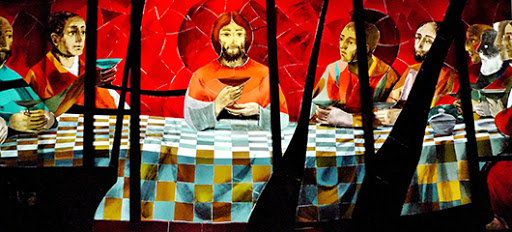
For reasons beyond the scope of this post I feel compelled to take up my quest to read the documents of Vatican II during this Year of Faith, by postponing and leapfrogging the last two chapters of Lumen Gentium and confronting the Council’s constitution on the liturgy: Sacrosanctum Concilium.1 Here I have to admit that the opening chapters of the document were challenging in that their form had to be endured for the sake of getting to their content, but – like when reading The Name of the Rose, where Umberto Eco himself characterizes the first 100 pages as a mountain that is to be climbed to reach the rewards lying beyond it2 – the core of the reform of the liturgy, as well as the very frank and practical steps defined for achieving it, are gems worth working for and I hope you too will take on the climb.
Before delving into the content of Sacrosanctum Concilium, it is worth noting that the concept of liturgy (λῃτουργία / leitourgia) predates Christianity and has its origins in ancient Greece where it referred to a public service – a work (ἔργο / ergon) of the people (λαός / Laos) – “whereby [a city-state’s] richest members […] financed the State with their personal wealth.” In the Christian context, this public service has since the first century AD had as its core what Jesus himself had “told His followers to do in memory of Him” – i.e., to nourish themselves by His body and blood, which he shared with the apostles at the Last Supper (cf. Luke 22:19). This Christian liturgy is a public service in that it strengthens and supports those who participate in it, by bringing them closer both to God and to each other.
The aim then of Sacrosanctum Concilium is to support Christian life by adapting “to the needs of our own times [that] which [is] subject to change; foster[ing] whatever can promote union among all who believe in Christ; strengthen[ing] whatever can help to call the whole of mankind into the […] Church.” The result is a desire to “reform and promote the liturgy,” where the changes introduced in it are a consequence of the Church “be[ing] both human and divine, visible and yet invisibly equipped, eager to act and yet intent on contemplation, present in this world and yet not at home in it.”
As in the other Vatican II documents, the starting point here too is the Trinity, where:
“[God] sent His Son, the Word made flesh, anointed by the Holy Spirit, to preach the gospel to the poor, to heal the contrite of heart, to be a “bodily and spiritual medicine”, the Mediator between God and man. […] Therefore in Christ “the perfect achievement of our reconciliation came forth, and the fullness of divine worship was given to us”. […] Thus by baptism men are plunged into the paschal mystery of Christ: they die with Him, are buried with Him, and rise with Him. [Thus, since its beginning] the Church has never failed to come together to celebrate the paschal mystery: reading those things “which were in all the scriptures concerning him” (Luke 24:27) [and] celebrating the eucharist in which “the victory and triumph of his death are again made present”.”
In the liturgy, there is a particular, personal presence of Jesus, who
“is always present in His Church, especially in her liturgical celebrations. He is present in the sacrifice of the Mass, not only in the person of His minister, “the same now offering, through the ministry of priests, who formerly offered himself on the cross”, but especially under the Eucharistic species. […] He is present in the sacraments, so that when a man baptizes it is really Christ Himself who baptizes. He is present in His word, since it is He Himself who speaks when the holy scriptures are read in the Church. He is present, lastly, when the Church prays and sings, for He promised: “Where two or three are gathered together in my name, there am I in the midst of them” (Matthew 18:20).”
In other words, the liturgy is a personal encounter with Jesus, which demands one’s full and active participation both individually and as a community. Sacrosanctum Concilium’s objective is to reform the liturgy as it was before Vatican II, since:
“the liturgy is made up of immutable elements divinely instituted, and of elements subject to change. These not only may but ought to be changed with the passage of time if they have suffered from the intrusion of anything out of harmony with the inner nature of the liturgy or have become unsuited to it. In this restoration, both texts and rites should be drawn up so that they express more clearly the holy things which they signify; the Christian people, so far as possible, should be enabled to understand them with ease and to take part in them fully, actively, and as befits a community.”
The first principle in such a restoration is to foster “warm and living love for scripture,” which “is of the greatest importance in the celebration of the liturgy.” The second is that “[liturgical services] are celebrations of the Church, which is the “sacrament of unity,” [of] the holy people united.” Third, while “the sacred liturgy is above all things the worship of the divine Majesty, it likewise contains much instruction for the faithful. For in the liturgy God speaks to His people and Christ is still proclaiming His gospel. And the people reply to God both by song and prayer. […] The rites should [therefore] be distinguished by a noble simplicity; they should be short, clear, and unencumbered by useless repetitions; they should be within the people’s powers of comprehension, and normally should not require much explanation.”
Guided by the above principles, the use of mother tongues (which were not in liturgical use before Vatican II) in addition to Latin is encouraged, “in the first place [for] the readings and directives, and [for] some of the prayers and chants.” Sacrosanctum Concilium goes much further though, in an effort to bring the liturgy close to all of its participants and allow for full participation as a community:
“Even in the liturgy, the Church has no wish to impose a rigid uniformity in matters which do not implicate the faith or the good of the whole community; rather does she respect and foster the genius and talents of the various races and peoples. Anything in these peoples’ way of life which is not indissolubly bound up with superstition and error she studies with sympathy and, if possible, preserves intact. Sometimes in fact she admits such things into the liturgy itself, so long as they harmonize with its true and authentic spirit. […] In some places and circumstances, however, an even more radical adaptation of the liturgy is needed. […] The competent territorial ecclesiastical authority […], must, in this matter, carefully and prudently consider which elements from the traditions and culture of individual peoples might appropriately be admitted into divine worship. Adaptations which are judged to be useful or necessary should then be submitted to the Apostolic See, by whose consent they may be introduced. To ensure that adaptations may be made with all the circumspection which they demand, the Apostolic See will grant power to this same territorial ecclesiastical authority to permit and to direct […] the necessary preliminary experiments over a determined period of time among certain groups suited for the purpose.”
The above, to me, is the first of the real eye-openers about Sacrosanctum Concilium in that is seems to go way beyond what I see in the Church today. Here there is a clear intention to recognize what is good in various cultures and make it part of the public service that is the liturgy. This is not the cultural imperialism that the Church is often criticized for, but a readiness to seek out and recognize value wherever it is present, so that communities can bring their treasures to the table at which the Last Supper is celebrated, instead of being observers at a foreign spectacle. Neither is it recalcitrant adherence to established forms or wanton novelty for its own sake, but a process that involves controlled “experiments” – the last concept I expected to see in an official Church document.
To further make them accessible to all and welcoming of participation,
“the rites are to be simplified, due care being taken to preserve their substance; elements which, with the passage of time, came to be duplicated, or were added with but little advantage, are now to be discarded; other elements which have suffered injury through accidents of history are now to be restored to the vigor which they had in the days of the holy Fathers. […] Especially on Sundays […] there is to be restored, after the Gospel and the homily, […] “the prayer of the faithful.” By this prayer, in which the people are to take part, intercession will be made for holy Church, for the civil authorities, for those oppressed by various needs, for all mankind, and for the salvation of the entire world.”
These are changes that not only invite participation by a community, but do so in a way where it faces both Jesus and the world. Clear efforts are also made here to involve the laity in new ways where “provision [are to] be made [so] that some sacramentals […] may be administered by qualified lay persons.”
In amongst the extensive list of specific changes introduced by Sacrosanctum Concilium, there are also several whose directness and verging on irony were a treat to read in a document of this kind: “The rite for the baptism of infants is to be revised, and it should be adapted to the circumstance that those to be baptized are, in fact, infants.” [Duh! :)], “The prayer for the bride, [is to be] amended to remind both spouses of their equal obligation to remain faithful to each other.” and “The accounts of martyrdom or the lives of the saints are to accord with the facts of history.” were definitely among my favorites.
Finally, the reform of the liturgy is also extended to the music and visual art used to support and enhance it, with a strong emphasis on simplicity and service:
“[B]ishops and other pastors of souls must be at pains to ensure that, whenever the [liturgy] is to be celebrated with song, the whole body of the faithful may be able to contribute that active participation which is rightly theirs. […] In certain parts of the world […] there are peoples who have their own musical traditions, and these play a great part in their religious and social life. For this reason due importance is to be attached to their music, and a suitable place is to be given to it, not only in forming their attitude toward religion, but also in adapting worship to their native genius. Therefore, when missionaries are being given training in music, every effort should be made to see that they become competent in promoting the traditional music of these peoples, both in schools and in sacred services.
The Church has not adopted any particular style of art as her very own; she has admitted styles from every period according to the natural talents and circumstances of peoples, and the needs of the various rites. Thus, in the course of the centuries, she has brought into being a treasury of art which must be very carefully preserved. The art of our own days, coming from every race and region, shall also be given free scope in the Church, provided that it adorns the sacred buildings and holy rites with due reverence and honor. [… Bishops], by the encouragement and favor they show to art which is truly sacred, should strive after noble beauty rather than mere sumptuous display. […] Let bishops carefully remove […] those works of artists which […] lack artistic worth, [or display] mediocrity and pretense. […] And when churches are to be built, let great care be taken that they be suitable for the celebration of liturgical services and for the active participation of the faithful.”
Reading through the entirety of Sacrosanctum Concilium, what stuck in my mind was how apt the term “restoration” was for what its principles and instructions amount to. It is a restoration of the simplicity and immediacy of being in Jesus’ presence that the apostles and the Early Church must have experienced. It is a de-cluttering, a removal of exaggeration and deformation, and a consistent and all-pervasive re-focusing on the liturgy being “performed by the Mystical Body of Jesus Christ, that is, by the Head and His members.” The changes to the structure and extent of the liturgy, the use of the congregation’s mother tongue and the principles guiding the use of music and art all serve a single purpose: to make the liturgy be a knowing, active, living expression of a community, gathered around the one table in the Upper Room, with Jesus at it’s head.
1 As is now de rigueur here for posts that verge on or fully wade into the theologically technical, please, consider reading paragraph two of the following post as a caveat, if you are not a Catholic.
2 “After reading the manuscript, my friends and editors suggested I abbreviate the first hundred pages, which they found very difficult.and demanding. Without thinking twice, I refused, because, as I insisted, if somebody wanted to enter the abbey and live there for seven days, he had to accept the abbey’s own pace. If he could not. he would never manage to read the whole book. Therefore those first hundred pages are like a penance or an initiation, and if someone does not like them, so much the worse for him. He can stay at the foot of the hill.” (Umberto Eco, Reflections on “The Name of the Rose”)

 ” and I highly recommend it to you in full.
 eyebeleave