Viaticum

Emmaus Helge Boe

1746 words, 9 min read

Back in 2015, Pope Francis visited a Lutheran church in Rome and answered three questions from the congregation: one, from a 9-year-old boy, on what he liked about being Pope, another, from the community’s treasurer who was involved in a project for refugees, on how to avoid resignation and people turning to erecting walls, and the final one, which I’d like to take a look at here, on intercommunion. In particular, I would like to present Pope Francis’ answer more fully and, as always arguably, more closely than the Vatican’s official English translation.

As a result, the following account of his words will be a combination of the official English translation, which I will seek to follow as much as possible, and of my, coarse translation of his words when it departs from a more verbatim translation of the original Italian. Details about my departures from the official translation will be provided in the endnotes, not to interfere with a reading of his response to this important question.

Before proceeding, I’d like to thank the Vatican for its prompt and broad translation of the pope’s words into English – having access to them in this way is not something I take for granted and my alternative translation exercise here is not meant to be an attack or even a criticism, merely a different translation, possibly done with different objectives to the official one. E.g., I will favour closer, more verbatim English choices wherever these are available, even at the cost of a result that may sound odd or flow less well than other alternatives. The matter at hand is highly delicate and important and I believe that as close a rendering of the pope’s words as possible is preferable here, also because these were off-the-cuff remarks rather than a prepared text.

So, let’s begin at the beginning, with the question put to Pope Francis about intercommunion:1

“My name is Anke de Bernardinis and, like many members of our community, I am married to an Italian, who is a Roman Catholic Christian. We have been living together happily for many years, sharing joys and sufferings. And therefore it hurts is very much that we are divided in our faith and that we cannot partake together in the Lord’s Supper. What can we do to, at last, reach communion on this point?”

The pope then responds (all changes are highlighted in bold type, bold text without an endnote indicates a word missing from the official translation but present in the Italian original):

“Thank you, Ma’am. Regarding the question on sharing the Lord’s Supper, it is not easy for me to answer you, especially in front of a theologian like Cardinal Kasper! I’m afraid! I think the Lord told us2 when he gave us this command: “Do this in memory of me”. And when we share in the Lord’s Supper, we remember and imitate,3 we do the same thing that the Lord Jesus did. And the there will be the Lord’s Supper, there will be the final banquet in the New Jerusalem,4 but this will be the last one. Instead on the journey, I ask myself5 — and I don’t know how to answer, but I am making your question my own — I ask myself: “Is sharing the Lord’s Supper the end of a journey or is it the viaticum for walking together? I leave the question to the theologians, to those who understand. It is true that in a certain sense sharing is saying that there are no differences between us, that we have the same doctrine — I underline the word, a difficult word to understand — but I ask myself: but don’t we have the same Baptism? And if we have the same Baptism, we have to walk together. You are a witness to a journey that is also profound6 because it is a conjugal journey, a journey properly of the family7, of human love and of shared faith. We have the same Baptism. When you feel you are a sinner — I too feel I am quite a sinner — when your husband feels he is a sinner, you go before the Lord and ask forgiveness; your husband does the same and goes to the priest and asks for8 absolution. They are remedies for9 keeping Baptism alive. When you pray together, that Baptism grows, it becomes strong; when you teach your children who Jesus is, why Jesus came, what Jesus did, you do the same, whether in Lutheran language or in Catholic language10, but it is the same. The question: and the Supper? There are questions to which only if one is honest with oneself and with the few theological “lights” that I have, one must respond the same, you see. “This is my Body, this is my Blood”, said the Lord, “do this in memory of me”, and this is a viaticum that helps us to walk11. I had a great friendship with an Episcopalian bishop, 48 years old, married with two children, and he had this concern: a Catholic wife, Catholic children, and he a bishop. He accompanied his wife and children to Mass on Sundays and then went to worship with his community. It was a step of participating in the Lord’s Supper. Then he passed on, the Lord called him, a just man. I respond to your question only with a question: how can I do [things] with my husband12, so that the Lord’s Supper may accompany me on my way13? It is a problem to which each person must respond. A pastor friend of mine said to me: “We believe that the Lord is present there. He is present. You believe that the Lord is present. So what is the difference?” — “Well, there are explanations, interpretations…”. Life is greater than explanations and interpretations. Always refer to Baptism: “One faith, one baptism, one Lord”, as Paul tells us, and from there draw the consequences14. I would never dare give permission to do this because it is not my competence15. One Baptism, one Lord, one faith. Speak with the Lord and go forward. I do not dare say more.”

From the perspective of translation it could be argued that 14/15 of my changes don’t do much to the resulting meaning, and I would agree with that. My objective there was only to make subtle changes of nuance and not to suggest that what an English reader would understand from the original translation would be different in essence from what an Italian reader would get from reading the official, Italian transcript.

However, I made one rather substantial and important change: the translation of the Italian “competenza” as “competence” instead of as “authority” as in the official English version. Since the English language contains the word “competence”, which not only has the same origin, but also the same meaning and polysemic scope as the Italian “competenza” (i.e., it is not a so-called “false friend”), choosing a synonym for it that narrows meaning and changes polysemy is, to my mind, an unnecessary change to Francis’ words. Further, to map “competenza” to “authority” is particularly serious in the case of the pope, who enjoys “supreme, full, immediate, and universal ordinary power in the Church” (cf. Cann. 331-334).

Rendering “competenza” as authority leaves Francis’ words sounding like giving permission for intercommunion is something he cannot do. This is certainly a possible interpretation of “competenza”. Another is that he meant that this decision is not for him to make, that he does have the power to make it, but that the most “competent” party is the person who faces this situation directly. I believe that if Francis had wanted to get the former interpretation across, he could have used another Italian word that was equally open to him: “autorità”. But he didn’t.

Instead he did the following, which, to my mind, is more consistent with my translation: he presents the choice of two interpretations of the Eucharist – as sign of having arrived at the end of a journey (the Eschaton, the New Jerusalem), or as a viaticum (provisions for a journey – that which gives the sustenance needed for journeying). Having presented the two alternatives, Francis then comes down on the side of the latter. He links his choice to Jesus’ words from the Last Supper and, importantly, he also does so on the basis that we, Christians are all journeying together on the one journey, which our shared baptism opens to us and to which it introduces us. Francis further underlines this oneness of journey – the journey that needs a viaticum – by repeating St. Paul’s kerygmatic “One faith, one baptism, one Lord” not once but twice in the course of his answer. Now, why doesn’t he just use his authority to permit what his interlocutor asks? I believe it is because the answer depends on where one is on this journey, on whether one is on this one, shared journey or not.

“One faith, one baptism, one Lord.”


1 For a start, the question is not translated in the official English version, which only provides the following account: “Then Anke de Bernardinis, the wife of a Roman Catholic, expressed sorrow at “not being able to partake together in the Lord’s Supper” and asked: “What more can we do to reach communion on this point?”.”
2 Italian: “ci ha detto”; English: “gave us [the answer]”.
3 Italian: “la Cena del Signore, ricordiamo e imitiamo,”; English: “, remember and emulate the Lord’s Supper,”.
4 Italian: “E la Cena del Signore ci sarà, il banchetto finale nella Nuova Gerusalemme ci sarà”; English: “And the Lord’s Supper will be, the final banquet will there be in the New Jerusalem”
5 Italian: “mi domando”; English: “I wonder”
6 Italian: “un cammino anche profondo”; English: “an even profound journey”
7 Italian: “un cammino proprio di famiglia”; English: “truly a family journey”
8 Italian: “chiede”; English: “requests”
9 Italian: “rimedi per”; English: “ways of”
10 Italian: “in lingua luterana che in lingua cattolica”; English: “in Lutheran or Catholic terms”
11 Italian: “che ci aiuta a camminare”; English: “which helps us to journey”
12 Italian: “come posso fare con mio marito”; English: “how can I participate with my husband”
13 Italian: “strada”; English: “path”
14 Italian: “e di là prendete le conseguenze”; English: “and take the outcome from there”
15 Italian: “non è mia competenza”; English: “I do not have the authority”

Discernment in the flow of life, not black or white

Francis refugees

1873 words, 9 min read

On Friday morning, Pope Francis gave an interview to the Italian daily, L’Avvenire, in which he spoke at length about the Year of Mercy that concluded yesterday, about Christian unity and where he also addressed criticisms leveled at his last apostolic exhortation, Amoris Lætitia. Even though he does not name his critics, a letter published this week by four cardinals, who express “doubts” and ask for “clarification”, must have also been on Francis’ mind. What follows is my translation of parts of the interview, where I attempted to stay as close to the way Francis expresses himself in Italian, even at the expense of some of the phrases not sounding natively English (since they are not :).

Francis starts by speaking about what the Year of Mercy has meant for him:

“Those who discover that they are loved very much begin to exit a bad loneliness, a separation that brings one to hating others and oneself. I hope that many people have discovered that they are loved very much by Jesus and that they have let themselves be embraced by him. Mercy is the name of God and is also his weakness, his weak point. His mercy always leads him to forgiveness, to forgetting our sins. I like to think that the Almighty has bad memory. Once he forgives you, he forgets. Because he is happy to forgive. For me that is enough. Like with the adulterous woman of the Gospel, “whom He loved very much.” “Because He has loved very much.” The whole of Christianity is here.”

When Francis is then asked about whether his aims for the Year of Mercy had been achieved, his response shows a beautiful focus on discerning the will of God moment by moment:

“But I have not made a plan. I simply did what the Holy Spirit inspired me to do. Things just came along. I let myself be carried by the Spirit. It was only about being docile to the Holy Spirit, about letting Him act. The Church is the Gospel, it is the work of Jesus Christ. It is not journey of ideas, a tool for affirming them. And in the Church things come about when the time is ripe, when one offers oneself.”

In a response about the roots in the Year of Mercy being in the Second Vatican Council, Pope Francis then speaks about the nature of the Church:

“Experiencing in one’s own life the forgiveness that embraces the entire human family is the grace that the apostolic ministry announces. The Church exists only as a tool for communicating to people the merciful plan of God. At the Council the Church felt the responsibility of being in the world as a living sign of the love of the Father. With Lumen Gentium she ascended to the sources of her nature, to the Gospel. This moves the axis of the concept of Christianity from a certain legalism, which can be ideological, to the Person of God that has made itself mercy in the incarnation of the Son. Some – think of certain responses to Amoris Laetitia – continue to not understand, either white or black, even though it is in the flow of life that one ought to discern. The Council has told us this, historians, however, tell us that that a Council needs a century to become well absorbed by the body of the Church … We are halfway.”

Ecumenism was also addressed in the interview, where Francis first spoke about the continuity between his efforts and those of his predecessors and of the Council, before turing to his relationship with the heads of other Christian churches:

“I live it with a lot of brotherhood. Brotherhood can be felt. There is Jesus in the midst. To me they are all brothers. We bless one another, one brother blesses another. When with Patriarch Bartholomew and Hieronymus we went to Lesbos in Greece to meet the refugees we felt as one. We were one. One. When I went to see Patriarch Bartholomew at the Phanar in Istanbul for the feast of St Andrew, for me it was a great joy. In Georgia I met Patriarch Ilia who had not gone to Crete for the Orthodox Council. The spiritual harmony that I had with him was profound. I felt that I was in front of a saint, a man of God took my hand, told me beautiful things, more with gestures than with words. The patriarchs are monks. You see behind a conversation that they are men of prayer. Kirill is a man of prayer. Also the Coptic Patriarch Tawadros, whom I have met, took off his shoes as he entered the chapel and went to pray. The Patriarch Daniel of Romania a year ago gave me a book in Spanish by St. Sylvester of Mount Athos, I have already read about the life of this great holy monk in Buenos Aires: “To pray for humanity is to shed one’s own blood.” The Saints unite us inside the Church, making her mystery current. With our Orthodox brothers we on a journey, we are brothers, we love each other, we care together, they come to study here and with us. Bartholomew also studied here.”

When asked whether the Bishop of Rome shouldn’t focus on the Catholic Church full-time instead of spending time with the heads of other Churches, Francis proceeded to spell out first principles:

“Jesus himself prayed to the Father to ask that those who are his may be one, so that the world may believe. It is his prayer to the Father. Since always, the Bishop of Rome has been called to be a custodian of, to seek and to serve this unity. We also know that the wounds of our divisions are destroying the body of Christ, we cannot heal them by ourselves. So, it is not possible to impose plans or systems to become one again. To ask for unity among Christians we can only look to Jesus and ask that the Holy Spirit works among us. That it may be him to make unity. In the meeting in Lund with the Lutherans I have repeated the words of Jesus when he says to his disciples: “Without me you can do nothing.””

Another criticism leveled by some at Pope Francis’ ecumenical efforts is that he wants to “protestantize” the Catholic Church, to which his response is very simple:

“I don’t loose sleep over it. I continue on the road of those who have preceded me, I follow the Council. As for opinions, we must always distinguish the spirit in which they are said. When there isn’t a bad spirit, they also help on the journey. In other cases it can be seen straightaway that criticism are made here and there to justify a previously adopted position, they are not honest, they are made with a bad spirit to stir up division. It can be seen immediately that certain rigorisms stem from a lack, from a wanting to hide one’s sad dissatisfaction inside an armor. If you watch the movie Babette’s Feast, this rigid behavior can be seen there.”

Next, Francis is asked whether his focus on working together with other Churches for those who are in need isn’t a putting to one side of theological question and he again goes straight to the core:

“This is not a setting aside of something. Serving the poor means to serve Christ, because the poor are the flesh of Christ. And if we serve the poor together, it means that we Christians find ourselves united in touching the wounds of Christ. Here I think of the work that Caritas and Lutheran charitable organizations can do together after the meeting in Lund. It is not an institution, it is a journey. Certain ways of opposing the “things of doctrine” with the “things of pastoral charity” instead are not according to the Gospel and create confusion.”

In response to a question about what he meant when he spoke about unity being made while walking together, Francis said:

“Unit is not made because we agree among ourselves, but because we walk following Jesus. And while walking, by the working of the One we follow, we can discover ourselves united. It is the walking behind Jesus that unites. To convert ourselves means to let the Lord live and work in us. Like that we find ourselves united in our common mission of proclaiming the Gospel. Walking and working together, we realize that we are already united in the name of the Lord, and that, therefore, unity is not created by us. We realize that it is the Spirit who impels us and carries us ahead. If you are docile to the Spirit, it will be He who will tell you the step you can take, the rest is done by Him. It is not possible to walk behind Christ if you are not carried, if you do not pushed by Spirit with his strength. Because of this it is the Spirit who is the author of Christian unity. So, this is why I say that unity is made along a journey, because unity is a grace that you have to ask for, and also because I repeat that every proselytizing among Christians is sinful. The Church never grows by proselytizing but “by attraction,” as Benedict XVI wrote. Proselytism among Christians is therefore in itself a grave sin because it contradicts the very dynamics of how to become and remain Christian. The Church is not a football team that seeks fans.”

Speaking about the importance of baptism in response to a question about something that Francis said to Patriarch Kirill, he focuses on the importance of the incarnation as protection against ideologies:

“To rediscover our unity we don’t need to “go beyond” baptism. Having the same baptism means to confess together that the Word has made itself flesh: this saves us. All ideologies and theories are born of those who do not stop at this, who do not remain in the faith that recognizes Christ who has come in the flesh, and who want to “go beyond.” From there come all the positions that take the flesh away from the Church of Christ, which “de-flesh” the Church. If we look together at our shared baptism we are also freed from the temptation of Pelagianism, which wants to convince us that we are saved by our own strength, by our own activism. And staying at baptism also saves us from gnosis. This one distorts Christianity, reducing it to a path of knowledge, which can do without a real encounter with Christ.”

What strikes me most as I re-read Pope Francis’ words is his total focus on Jesus as the person whose presence among His followers is what unites them, what guides them and what is the basis of a discernment whose horizon is the present moment. This is a Christianity that is exciting, challenging and lived in direct relationship with God, who has made himself one of us to the point of also taking on our physical nature. Everything then follows from such a life – the Year of Mercy, ecumenism, dialogue, forgiveness and a pervasive sense of joy and openness.

Marriage after death

Adam

1621 words, 8 min read

Last Saturday I attended a wedding during which the priest conducting the ceremony started his sermon by addressing the bride and groom with: “Today is the greatest day of your lives.” While this was undoubtedly well intentioned and said in the spirit of underlining the goodness of marriage and the joy of the occasion, my mind – and I am not proud of this – immediately transformed itself into a hatchet and shredded that statement to smithereens. “Do you mean that it is downhill from here?” “They haven’t even gotten married yet and you are telling them that any attempt at growth and development is doomed?”

Thankfully I then turned to one of my favorite kōans that I reached for with the intention of weaponizing it (not a nice thing to do to a kōan), but whose memory derailed my rage as I remembered it’s beautiful twist.

The kōan in question is about a famous general, who went to see a zen master to ask him for a nice piece of calligraphy to use as interior decoration. The zen master happily agreed and, when the general returned a week later, presented him with a beautifully executed inscription that read: “Father dies, son dies, grandson dies.” The general exploded with rage, drew his sword and, before cleaving the zen master in half, gave him an opportunity to explain himself. The zen master, all surprised, looked at the general and said: “What don’t you like about the inscription? Would you prefer to see your son die and for your father to see both his and your death? What I have written for you is the natural progression of life, which is true happiness and prosperity.” The general, ashamed about his hasty rage, left with his sword unused and grateful for the master’s good wishes.

Suitably calmed, and recognizing a fellowship with the kōanic general, I asked myself what I would have wished the couple to be their greatest day – if I had to, although that is not something that would have come to me naturally. And I arrived at: “May the greatest day of your marriage be the day one of you dies.” Thankfully I wasn’t asked for my opinion and, even if I had been and if I had said what I thought, the bride and groom are, to the best of my knowledge, not versed in martial arts or marksmanship. Nonetheless, if I had been asked and if there had been the inevitable, outraged call for an explanation, I would have pointed to my wish being one for maximum greatness. Wishing for the last day of a marriage to be its greatest is both a wish for continuous growth in greatness and, at the same time, a suggestion that every day of a marriage contains the greatness of all the days that preceded it and that the last day is therefore going to be the greatest by definition.

This lead me to thinking about the end of marriage, which the Catholic Church teaches comes with the death of one of the spouses,1 and to wondering about what that meant. How do I, a married person, relate to my spouse once they or I die? Is that it? In the next life, will we, who are one flesh now, be strangers? If I survive my spouse, will they, who have already passed into life everlasting, be there without being one with me? Somehow that did not seem right at all, since it violates the central Christian understanding of who God is. The God who is Love and who is Three and One. How could the God of Love dissolve the bond of love that marriage effects? How could the God of unity wish for the oneness of husband and wife to be annulled at the point of unity with Him? No, that didn’t seem right at all.

The obvious thing to do was to go back to where Jesus spoke about marriage to the Sadducees, who tried to set him a trap by running a hypothetical scenario past him and asking him a question designed to undermine the idea of the resurrection:

“Teacher, Moses said, ‘If a man dies without children, his brother shall marry his wife and raise up descendants for his brother.’ Now there were seven brothers among us. The first married and died and, having no descendants, left his wife to his brother. The same happened with the second and the third, through all seven. Finally the woman died. Now at the resurrection, of the seven, whose wife will she be? For they all had been married to her.” (Matthew 22:24-28)

What a nice, little trap! If Jesus says that she is the wife of all of the brothers, he says that in the next life there is polyandry, which, like polygamy, was against the Law, and he therefore undermines the credibility of the resurrection that the Sadducees denied. Alternatively, if he says that she isn’t anyone’s wife (or only the wife of one of the brothers) then he puts the solidity of marriage into question, which is also enshrined in the Law, and the Sadducees win again.

So, let’s see what Jesus said to them in reply:

“You are misled because you do not know the scriptures or the power of God. At the resurrection they neither marry nor are given in marriage but are like the angels in heaven.” (Matthew 22:29-30)

Now, the way this is typically read is to say that there is no marriage in Paradise, however, I would like to argue, that such an interpretation is not a particularly close reading of Jesus’ words. Jesus didn’t say “At the resurrection she won’t be anyone’s wife.” Instead, he said: “At the resurrection they neither marry nor are given in marriage.” In other words, no marriage is contracted in the next life. And, let’s not forget his admonition: “You are misled because you do not know the scriptures or the power of God.” I.e., the way you are looking at marriage is not from God’s point of view.

I believe that there is another reading of what Jesus’ words about marriage mean, which we can get to by the light of St. Paul saying:

“For no one hates his own flesh but rather nourishes and cherishes it, even as Christ does the church, because we are members of his body. “For this reason a man shall leave [his] father and [his] mother and be joined to his wife, and the two shall become one flesh.” This is a great mystery, but I speak in reference to Christ and the church.” (Ephesians 5:29-32)

Notice how St. Paul parallels first, a person’s love for their own flesh, second, Christ’s love for the Church, who is His flesh (body), made up by us, and, third, husband and wife becoming one flesh in marriage. This, indeed is the sacrament of marriage, that the “one flesh” of married spouses is sacrament (“efficacious sign of grace”2) of the “one body” of Christ and us, His Church.

Therefore, I believe that what happens at the death of one of the spouses is that the unity of flesh that previously resided in the created, passes, with the now ever-alive spouse, into the uncreated, where the unity of Christ’s Body dwells. Instead of suggesting that the bond, which ontologically makes the spouses one, breaks at the point of one of their deaths, I believe that Jesus’ and St. Paul’s words point to another reading: that this bond persists; no longer only as a bond between the spouses, but now also as an eternal constituent of the Body of Christ. The bond of marriage, contracted on Earth, remains both the force that made the spouses one here and, at the same time, becomes like the bonds of unity that in Paradise will bind us to Christ and to all other members of his body.

Finally, I also believe that the above reading is consistent with what the Church teaches, since it does not argue for a multiplicity of marriage bonds on Earth, but only for a recognition of their persistence in and subsummation into the bonds that make up the Body of Christ in Paradise. What ends with death is the exclusivity of the bond of one man and one woman, but not the bond itself, which now becomes one with the oneness of Christ and His Church.

So, maybe a better wish for newlyweds would be: “May every day be the greatest day of your lives.” The sequential days of chronos now, and the eternal day of kairos then.


1 “A marriage that is ratum et consummatum can be dissolved by no human power and by no cause, except death.” (Can. 1141) This is also related to St. Paul saying the following about death ending the bond of marriage: “Thus a married woman is bound by law to her living husband; but if her husband dies, she is released from the law in respect to her husband. Consequently, while her husband is alive she will be called an adulteress if she consorts with another man. But if her husband dies she is free from that law, and she is not an adulteress if she consorts with another man.” (Romans 7:2-3).
2 “The sacraments are efficacious signs of grace, instituted by Christ and entrusted to the Church, by which divine life is dispensed to us. The visible rites by which the sacraments are celebrated signify and make present the graces proper to each sacrament. They bear fruit in those who receive them with the required dispositions.” (Catechism of the Catholic Church, §1131)

The only thing that’s changed is everything

Francis behind cross

2610 words, 13 min read

Yesterday, at the closing mass of the Synod on the Family, Pope Francis concluded his homily with the following words:

“There is a […] temptation, that of falling into a “scheduled faith”. We are able to walk with the People of God, but we already have our schedule for the journey, where everything is listed: we know where to go and how long it will take; everyone must respect our rhythm and every problem is a bother. We run the risk of becoming the “many” of the Gospel who lose patience and rebuke Bartimaeus. Just a short time before, they scolded the children (cf. Mark 10:13), and now the blind beggar: whoever bothers us or is not of our stature is excluded. Jesus, on the other hand, wants to include, above all those kept on the fringes who are crying out to him. They, like Bartimaeus, have faith, because awareness of the need for salvation is the best way of encountering Jesus. In the end, Bartimaeus follows Jesus on his path (cf. v. 52). He did not only regain his sight, but he joined the community of those who walk with Jesus. Dear Synod Fathers, we have walked together.”

To my mind, these few lines sum up the Synod perfectly, by presenting two poles: one, characterized by rules, clarity and predictability and the other by an path that twists and turns, that is full of surprises, but where we are walking not only among Jesus’ friends, but side-by-side with Jesus himself.

Detractors of the Synod have already declared it a failure, a preservation of the status quo, a “no change” of doctrine, a failure for not opening up access to the Eucharist for the divorced and remarried and a giving-in to African pressures on gays. They, however, are precisely the group for whom Pope Francis had harsh words in the speech he delivered after the Synod Fathers voted on the final report (the Relatio Finalis) paragraph-by-paragraph:

“[The Synod] was about bearing witness to everyone that, for the Church, the Gospel continues to be a vital source of eternal newness, against all those who would “indoctrinate” it in dead stones to be hurled at others. It was also about laying bare closed hearts that frequently hide even behind the Church’s teachings or good intentions, in order to sit in the chair of Moses, sometimes with superiority and superficiality, and judge difficult cases and wounded families.”

Instead of being a failure, I believe, that the Synod was a dramatic first step along the path that Pope Francis presented the week before, on the occasion of the 50th anniversary of the institution of the Synod of Bishops. In that landmark speech, Francis shared his vision of a synodal Church, a Church that is on a journey with Christ in the present moment:

“A synodal Church is a Church of listening, knowing that listening “is more than hearing”. It is a mutual listening in which everyone has something to learn. Faithful people, the College of Bishops, Bishop of Rome: each one listening to the others; and all listening to the Holy Spirit, the “Spirit of truth” (Jn 14:17), to know what he “says to the Churches” (Rev 2:7).”

In such a synodal Church, authority too changes, and becomes rooted in the cross, as Pope Francis explains:

“Let us never forget it! For the disciples of Jesus, yesterday, today and always, the only authority is the authority of service, the only power is the power of the cross, in the words of the Master: “You know that the rulers of the Gentiles lord it over them, and the great ones make their authority over them felt. But it shall not be so among you. Rather, whoever wishes to be great among you shall be your servant; whoever wishes to be first among you shall be your slave.”(Mt 20: 25-27). It shall not be so among you: in this expression we reach the heart of the mystery of the Church – “it shall not be so among you” – and receive the necessary light to understand hierarchical service.”

Pope Francis is also very clear, in the homily he delivered on the morning of the Synod’s last day, about a consequence of being a journeying, synodal Church also being constant change. However, since the journeying party includes Jesus, it is not a thrashing about or a bending with the wind. Instead it is a tight adherence to the person of Christ, while being immersed in the ever-changing now. A freedom with rather than a freedom from or a freedom to:

“The times change and we Christians must change continuously. We must change while being firm in our faith in Jesus Christ, firm in the truth of the Gospel, but our attitude must move continuously according to the signs of the times. We are free. We are free by the gift of freedom that Jesus Christ gave us. But it is our task to look at what happens inside us, to discern our feelings, our thoughts; and what happens outside us and to discern the signs of the times. With silence, with reflection and with prayer.”

All of the above is, to my mind a beautiful spelling out of what Pope Benedict XVI meant when he said, at the beginning of the 2012-13 Year of Faith, that faith “is no theory, but an encounter with a Person who lives within the Church.”

With the above perspective, of a community walking with Jesus, where service is the basis of authority and where life is full of surprises because we aren’t following a set of instructions, but developing a relationship with Jesus instead, let us look at what the Synod on the Family was all about.

First, the Synod was a resounding endorsement of the family, as Cardinal Schönborn put very clearly:

“I think that the principal message of this Synod is the theme of the Synod: that the Catholic Church around the world, with one billion and 200 million Catholics, have discussed the topic of marriage and the family for two years, with all its positives aspects and difficulties … This alone is a remarkable fact for our time, because the core of the message is this: a great yes to the family. The success of this Synod for me is a great yes to the family; that the family is not over, not an old model, but that it is a fundamental model of human society.”

Second, that this endorsement wasn’t just a pre-cooked message to be rubber-stamped, but that it was, instead, the result of an intense process of discernment, discussion and at times even outright verbal warfare both inside the Synod and by interests outside it. Just as examples, a letter from some cardinals to the pope got leaked and resulted in all sorts of recriminations, some cardinals accused others of being opposed to Jesus, and false news about the pope’s health was released two days before the final vote. The inappropriate nature of some of the behavior inside the Synod lead the German language working group to open their final report with the following words:

“We have observed the public statements of individual Synod Fathers regarding the people, content and course of the Synod with great dismay and sadness. This contradicts the spirit of walking together, the spirit of the Synod and its elementary rules. The images and comparisons used are not only coarse and wrong, but hurtful. We distance ourselves from them categorically.”

Third, that there was a great diversity among the Synod Fathers. One of the English language working group’s reports stated that “[o]n many […] points there was consensus, on others there was wide if not universal agreement, and on a few there was significant disagreement.” Pope Francis too saw this very clearly, when he said in his closing speech:

“[W]e have also seen that what seems normal for a bishop on one continent, is considered strange and almost scandalous for a bishop from another; what is considered a violation of a right in one society is an evident and inviolable rule in another; what for some is freedom of conscience is for others simply confusion. Cultures are in fact quite diverse, and each general principle needs to be inculturated, if it is to be respected and applied.”

To my mind this is a very positive picture, which sends a clear message that it is possible to talk about even divisive and sensitive topics openly in the Church.

Fourth, that there was a tremendous desire for unity in the Synod, in the face of the variety of disparate views represented in it. Two things evidence this very clearly. First, that all of the final report’s 94 points were accepted with a 2/3rds majority. In fact, the vast majority (something around 80% of the points) were accepted with near unanimity, and even the handful of more controversial points received support from over 2/3rds of the Synod Fathers. Second, that the German language working group, which included the strongest proponents of both positions in favor of least change (Cardinal Gerhard Ludwig Müller) and of most change (Cardinal Walter Kasper), arrived at unanimous support for all of its reports. Cardinal Reinhard Marx, who was also in that group, gave a very intimate account of how that came about in one of the official press conferences:

“You have to argue. You can’t say I have an opinion. You must be very clear in your knowledge, to quote St. Thomas and the others. When you listen for a few minutes to Cardinal Müller, Cardinal Kasper and Cardinal Schönborn discussing about St. Thomas that is very interesting and when they say St. Thomas said this or that then he really did. So, you have to be together and say: that is the meaning of St. Thomas. […] We had the will to make a text together. It was clear when we wouldn’t find unanimity but we tried to come together and also in the different points, for example regarding the divorced and remarried, we tried to make a text that everyone could accept as a proposal to the Holy Father. [Before the first set of reports we felt that other groups were looking to us to see whether we would find unanimity, given who we are in this group] and Cardinal Schönborn said: “The others are looking at us, so make an effort to come together.””

Fifth, the Synod presented the family as a subject, an agent, rather than an as an object, as something that needs to be managed. One of the Italian working groups put this particularly clearly:

“Given […] that evangelization is the duty of the whole Christian people, […] families, under the grace of the sacrament of marriage, need to become ever more subjects of pastoral care, expression of a mission that becomes visible through a concrete life, not something that is only theoretical but an experience of faith rooted in people’s real problems. Priests should therefore be trained to recognize families as subjects, valuing the skills and experiences of all: lay, religious and ordained.”

Sixth, that the sheer variety and breadth of family circumstances and factors affecting them requires closeness, tenderness and discernment to be the basis of sharing God’s love with all. No set of rules, laws, principles can be a substitute for personal relationships, and Pope Francis is very clear about this too:

“[T]he true defenders of doctrine are not those who uphold its letter, but its spirit; not ideas but people; not formulae but the gratuitousness of God’s love and forgiveness. This is in no way to detract from the importance of formulae, laws and divine commandments, but rather to exalt the greatness of the true God, who does not treat us according to our merits or even according to our works but solely according to the boundless generosity of his Mercy (cf. Rom 3:21-30; Ps 129; Lk 11:37-54). It does have to do with overcoming the recurring temptations of the elder brother (cf. Lk 15:25-32) and the jealous labourers (cf. Mt 20:1-16). Indeed, it means upholding all the more the laws and commandments which were made for man and not vice versa (cf. Mk 2:27).”

An example of this personal discernment-based approach is also the proposal in the final report regarding the divorced and re-married, which says (in §85-86):

“It is […] the task of pastors to accompany interested [divorced and civilly remarried] persons on the way of discernment in keeping with the teaching of the Church and the guidance of bishops. In this process it will be useful to make an examination of conscience through times of reflection and penitence. The divorced and remarried should ask themselves how they behaved toward their children when the conjugal union entered into crisis; if there were attempts at reconciliation; how is the situation with the abandoned partner; what consequences the new relationship has on the rest of the family and the community of the faithful; what example it offers to young people who must prepare for marriage. A sincere reflection can strengthen the trust in the mercy of God which is never denied to anyone. […] Therefore, while upholding a general norm, it is necessary to recognize that the responsibility regarding certain actions or decisions is not the same in all cases. Pastoral discernment, while taking account of the rightly formed conscience of persons, must take responsibility for these situations. Even the consequences of the acts carried out are not necessarily the same in all cases. The process of accompaniment and discernment directs these faithful to an awareness of their situation before God. Conversation with the priest, in the internal forum, contributes to the formation of a correct judgment on what hinders the possibility of a fuller participation in the life of the Church and the steps that can foster it and make it grow.”

Seventh, that mercy is the root of divine love [“Misericordia est radix amoris divini”] as already St. Thomas Aquinas taught and as Pope Francis again underlined as the Synod closed and as the opening of the Jubilee of Mercy approaches:

“The Church’s first duty is not to hand down condemnations or anathemas, but to proclaim God’s mercy, to call to conversion, and to lead all men and women to salvation in the Lord (cf. Jn 12:44-50). […] In effect, for the Church to conclude the Synod means to return to our true “journeying together” in bringing to every part of the world, to every diocese, to every community and every situation, the light of the Gospel, the embrace of the Church and the support of God’s mercy!”

One of the Synod Fathers, Fr. Antonio Spadaro SJ, the director of the Jesuit journal La Civiltà Cattolica, summed this up beautifully in a tweet today:

“After #Synod15 the #Jubilee switches from the binary logic of a door, open/closed, to that of a face, which vitally changes before another face.”


Just in case you are left feeling short-changed about the content of the final report, the scarcity of references to it in the above post are a consequence of two facts: first, that it has no magisterial value (i.e., it is not the Church speaking to its faithful or the world through it – instead, it is a collection of ideas that serve as input for Pope Francis), and, second, that it was the shared journey of the Synod Fathers that matters rather than that document – in keeping with Pope Francis’ call for being a synodal Church instead of one that feels herself best expressed in laws, rules or documents.

The light of the world

Zen photon garden

[Guest post: The following is an extended version of an article prepared for publication in print by Dr. Ján Morovič, which is reproduced here with the author’s permission.]

By pronouncing “Let there be light.” (Genesis 1:3), God spoke it into being and when he became incarnate in the person of Jesus, he identified himself with it by proclaiming: “I am the light of the world. Whoever follows me will not walk in darkness, but will have the light of life.” (John 8:12). Jesus even attributed that same nature to us, when turning to the crowd who had just heard him preach the beatitudes, and saying: “You are the light of the world.” (Matthew 5:14-15). Light was also the sign by which Jesus’ divinity was manifested to Peter, James and John on Mount Tabor, an event about which Matthew wrote: “[H]e was transfigured before them; his face shone like the sun and his clothes became white as light.” (17:2). Finally, completing the arc started in Genesis, the New Testament ends by foretelling – in its last chapter – a definitive victory of light, where those gathered around God at the end of time are described as follows: “Night will be no more, nor will they need light from lamp or sun, for the Lord God shall give them light, and they shall reign forever and ever.” (Revelation 22:5).

Not only is light singled out in Scripture, and existentially identified with God and his sons and daughters, but it is also presented as the means by which understanding comes about. St. Paul exhorts the first Christians in Ephesus to “[l]ive as children of light” (5:8) and emphasizes the tight link between light and vision: “But all things become visible when they are exposed by the light, for everything that becomes visible is light. […] Watch carefully then how you live, not as foolish persons but as wise.” (5:13,15).

Such an understanding of light is, in fact, very close to how contemporary science defines it: as “radiation […] considered from the point of view of its ability to excite the human visual system” (CIE, 2011). Light is fundamentally about the effect of matter on human sensory perception. The only thing that makes the range of electromagnetic radiation with wavelengths between around 400 and 700 nanometers be light is that our eyes are lined with cells in which oxidation takes place when such radiation is incident on them. This, in turn, triggers an electrical signal that passes through an interconnected sequence of neural layers, leading to the back of the brain, where such signals are further processed in dramatically complex and varied ways that lead to our visual experiences.

The evolution of vision, which originated during the lower Cambrian period 508 million years ago (Parker, 2009) in the photoreceptor proteins of single-cell organisms, has reached a remarkable degree of sensitivity to light in humans. For a start, our eyes go to extraordinary lengths to detect light. A single photon incident on a photoreceptive rod cell in a human retina triggers a signal, and even though it takes five to nine photons landing on such a cell for at least 100 milliseconds for the signal to make it past the visual system’s noise suppression, reach the brain and result in conscious perception (Hecht et al., 1942), the staggering degree of the eye’s sensitivity becomes clear when these numbers are put into perspective: a single candle emits 5 million billion (i.e., 5×10¹⁵ – a quadrillion!) photons during such a 100 millisecond period. Put differently, a single candle could be seen in complete darkness from a distance of 30 miles between two mountaintops.

As if this wasn’t enough, our eyes go further still. Instead of simply relaying signals from the array of light-sensitive cells that line their backs, such signals are first combined so that the relationships of a signal from one cell with those from cells around it are amplified. This center-surround mechanism (Wandell, 1995) means that the boundaries between differently-colored regions in our environment are emphasized. Further down the neural pathway from the eyes to the brain, in the lateral geniculate nucleus, the signals from cells sensitive to different ranges of radiation wavelengths are again processed and differences between opponent colors: red-green, yellow-blue and black-white are also enhanced (de Valois et al., 1966). As a result, the signal that originates in the light-sensitive cells of our eyes is enhanced both for spatial and color discrimination, even before it is reaches and is processed and interpreted by the brain and leads to a conscious experience.

What does all of the above mean though, and how can we even begin to reflect on Scripture and the findings of contemporary science side-by-side? Even though Scripture is not and does not claim to be science, and, e.g., the Genesis account of creation is better thought of as symbolical (like the Catechism of the Catholic Church teaches (§337)) or as myth, this does not mean that it “refer[s] to fictitious-fabulous content, but simply to an archaic way of expressing deeper content.” (John Paul II, 2011). The truth revealed in Scripture, the truth sought by empirical and scientific means and even the truth expressed in art are not distinct truths though, and instead present different modes of knowledge of the one reality. John Paul II derives this position from the principle of non-contradiction, whereby truth cannot contradict truth. Hence, the truth, which

“God reveals to us in Jesus Christ, is not opposed to the truths which philosophy perceives. On the contrary, the two modes of knowledge lead to truth in all its fullness. The unity of truth is a fundamental premise of human reasoning, as the principle of non-contradiction makes clear. Revelation renders this unity certain, showing that the God of creation is also the God of salvation history. It is the one and the same God who establishes and guarantees the intelligibility and reasonableness of the natural order of things upon which scientists confidently depend, and who reveals himself as the Father of our Lord Jesus Christ.” (John Paul II, 1998)

During this Year of Light, proclaimed by the United Nations for 2015, we can look at the insights about it both from Scripture and science, and form a picture that is richer than either of them would provide by themselves. Instead of considering these two modes of knowledge as competing with each other, or requiring each other for justification, they stand on their own feet and complement each other. With respect to light, science shows us its fundamentally relational nature – both because of its very definition pointing to the relationship between humans and the world around us, and because of how human vision is tuned to the perception of relationships among the matter that acts upon it. Science also underscores the importance that light has for life, by showing the extraordinary sensitivity that has evolved to it. Scripture, in turn, identifies light with God, with those who follow him, and with the destiny of creation, and it points to light as a means for attaining wisdom and persistence in living as God’s children.


References
CIE (2011) CIE S 017/E:2011 ILV: International Lighting Vocabulary, CIE, Vienna, Austria
De Valois R. L., Abramov I., Jacobs G. H. (1966) Analysis of Response Patterns of LGN Cells, Journal of the Optical Society of America, 56:966–977.
Hecht S., Schlaer S., Pirenne M. H. (1942) Energy, Quanta and vision, Journal of the Optical Society of America, 38:196-208.
John Paul II (2011) Man and Woman He Created Them, Pauline Books and Media
John Paul II (1998) Fides et Ratio, Encyclical Letter, §34
Parker, A. R. (2009) On the origin of optics, Optics & Laser Technology 43(2):323–329.
Wandell B. A. (1995) Foundations of Vision, Sinauer Associates, Sunderland, MA. [UPDATE on 2nd July 2015: An abridged version of this post has now been published in New City Magazine.]


Harmony in diversity

Turkey popejpeg 01dca c0 327 5242 3382 s561x327

10380974 837984076265611 4582951503244712748 n

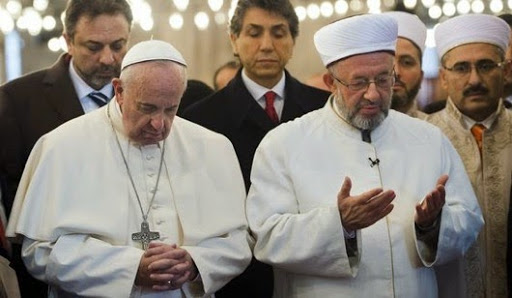
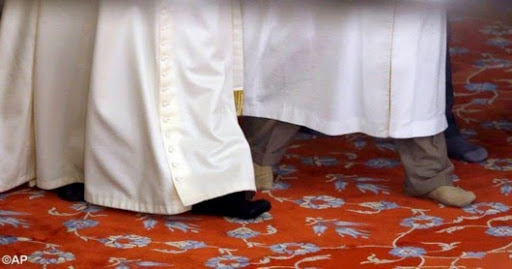
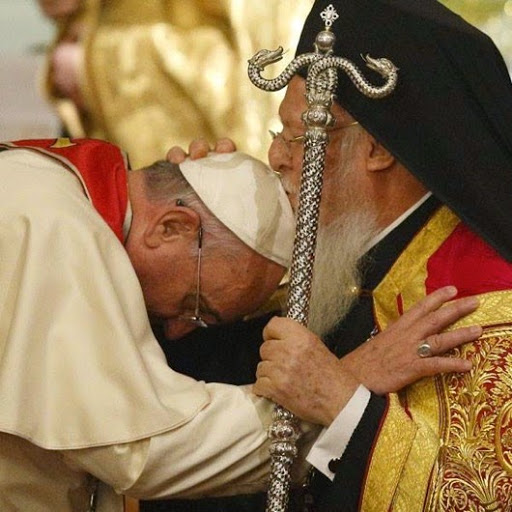
Last weekend Pope Francis visited Turkey, a country where 99.8% of the population is Muslim and where there are only about 35,000 Roman Catholics – truly a peripheral choice, fitting perfectly into Francis’ focus throughout his pontificate. What I would like to do in this post is just to pick out a couple of my favorites from among the things the pope said and share with you three photos – the two at the top, of Francis praying with Istanbul’s Grand Mufti Rahmi Yaran in the Blue Mosque and the one in the middle of Francis – and with him the entire Roman Church – being blessed (and kissed on the head) by Ecumenical Patriarch Bartholomew I.

In his first address in Turkey, to civil authorities, Francis emphasized the centrality of human dignity and brotherhood:

“Today what is needed is a dialogue which can deepen the understanding and appreciation of the many things which we hold in common. Such a dialogue will allow us to reflect sensibly and serenely on our differences, and to learn from them.

There is a need to move forward patiently in the task of building a lasting peace, one founded on respect for the fundamental rights and duties rooted in the dignity of each person. In this way, we can overcome prejudices and unwarranted fears, leaving room for respect, encounter, and the release of more positive energies for the good of all.

To this end, it is essential that all citizens – Muslim, Jewish and Christian – both in the provision and practice of the law, enjoy the same rights and respect the same duties. They will then find it easier to see each other as brothers and sisters who are travelling the same path, seeking always to reject misunderstandings while promoting cooperation and concord. Freedom of religion and freedom of expression, when truly guaranteed to each person, will help friendship to flourish and thus become an eloquent sign of peace.”

Later during the first day, Francis addressed the president of the Diyanet, the Department For Religious Affairs, denouncing religious extremism and fundamentalism:

“Particular concern arises from the fact that, owing mainly to an extremist and fundamentalist group, entire communities, especially – though not exclusively – Christians and Yazidis, have suffered and continue to suffer barbaric violence simply because of their ethnic and religious identity. They have been forcibly evicted from their homes, having to leave behind everything to save their lives and preserve their faith. This violence has also brought damage to sacred buildings, monuments, religious symbols and cultural patrimony, as if trying to erase every trace, every memory of the other.

As religious leaders, we are obliged to denounce all violations against human dignity and human rights. Human life, a gift of God the Creator, possesses a sacred character. As such, any violence which seeks religious justification warrants the strongest condemnation because the Omnipotent is the God of life and peace. The world expects those who claim to adore God to be men and women of peace who are capable of living as brothers and sisters, regardless of ethnic, religious, cultural or ideological differences.”

The next day, during his homily at the Catholic Cathedral of the Holy Spirit in Istanbul, Francis focused first on the fundamental role of the Holy Spirit in our lives and then on the nature of diversity in unity:

“When we pray, it is because the Holy Spirit inspires prayer in our heart. When we break the cycle of our self-centredness, and move beyond ourselves and go out to encounter others, to listen to them and help them, it is the Spirit of God who impels us to do so. When we find within a hitherto unknown ability to forgive, to love someone who doesn’t love us in return, it is the Spirit who has taken hold of us. When we move beyond mere self-serving words and turn to our brothers and sisters with that tenderness which warms the heart, we have indeed been touched by the Holy Spirit.

It is true that the Holy Spirit brings forth different charisms in the Church, which at first glance, may seem to create disorder. Under his guidance, however, they constitute an immense richness, because the Holy Spirit is the Spirit of unity, which is not the same thing as uniformity. Only the Holy Spirit is able to kindle diversity, multiplicity and, at the same time, bring about unity. When we try to create diversity, but are closed within our own particular and exclusive ways of seeing things, we create division. When we try to create unity through our own human designs, we end up with uniformity and homogenization. If we let ourselves be led by the Spirit, however, richness, variety and diversity will never create conflict, because the Spirit spurs us to experience variety in the communion of the Church. […] Saint Basil the Great’s lovely expression comes to mind: “Ipse harmonia est”, He himself is harmony.

The temptation is always within us to resist the Holy Spirit, because he takes us out of our comfort zone and unsettles us; he makes us get up and drives the Church forward. It is always easier and more comfortable to settle in our sedentary and unchanging ways. In truth, the Church shows her fidelity to the Holy Spirit in as much as she does not try to control or tame him. And the Church shows herself also when she rejects the temptation to look only inwards. We Christians become true missionary disciples, able to challenge consciences, when we throw off our defensiveness and allow ourselves to be led by the Spirit. He is freshness, imagination and newness.”

On the Saturday evening then came a particularly moving moment of “mystical tenderness” (as Fr. Antonio Spadaro, SJ put it), shown in the following photo and following these words by Pope Francis, addressed to the Patriarch Bartholomew:

“Andrew and Peter heard [the promise of joy]; they received this gift. They were blood brothers, yet their encounter with Christ transformed them into brothers in faith and charity. In this joyful evening, at this prayer vigil, I want to emphasize this; they became brothers in hope – and hope does not disappoint us! What a grace, Your Holiness, to be brothers in the hope of the Risen Lord! What a grace, and what a responsibility, to walk together in this hope, sustained by the intercession of the holy Apostles and brothers, Andrew and Peter! And to know that this shared hope does non deceive us because it is founded, not upon us or our poor efforts, but rather upon God’s faithfulness.

With this joyful hope, filled with gratitude and eager expectation, I extend to Your Holiness and to all present, and to the Church of Constantinople, my warm and fraternal best wishes on the Feast of your holy Patron. And I ask a favour of you: to bless me and the Church of Rome.”

IMG 4226

The final day of Francis’ trip – Sunday 30th November, the feast day of St. Andrew, patron saint of the Orthodox Church – started with an address during the Orthodox Divine Liturgy at the Patriarchal Church of St. George in Istanbul, where his focus was on the relationship between the Catholic and Orthodox Churches and where he first underlined deeply personal nature of the Christian life:

“Meeting each other, seeing each other face to face, exchanging the embrace of peace, and praying for each other, are all essential aspects of our journey towards the restoration of full communion. All of this precedes and always accompanies that other essential aspect of this journey, namely, theological dialogue. An authentic dialogue is, in every case, an encounter between persons with a name, a face, a past, and not merely a meeting of ideas.

This is especially true for us Christians, because for us the truth is the person of Jesus Christ. The example of Saint Andrew, who with another disciple accepted the invitation of the Divine Master, “Come and see”, and “stayed with him that day” (Jn 1:39), shows us plainly that the Christian life is a personal experience, a transforming encounter with the One who loves us and who wants to save us. In addition, the Christian message is spread thanks to men and women who are in love with Christ, and cannot help but pass on the joy of being loved and saved. Here again, the example of the apostle Andrew is instructive. After following Jesus to his home and spending time with him, Andrew “first found his brother Simon, and said to him, ‘We have found the Messiah’ (which means Christ). He brought him to Jesus” (Jn 1:40-42). It is clear, therefore, that not even dialogue among Christians can prescind from this logic of personal encounter.”

Next, Francis reiterated the Vatican II Unitatis Redintegratio position that the Catholic Church recognizes that the Orthodox Churches “possess true sacraments, above all – by apostolic succession – the priesthood and the Eucharist, whereby they are still joined to us in closest intimacy” and that “it is of the greatest importance to preserve and support the rich patrimony of the Eastern Churches.” He then set out his vision for the road towards full communion:

“I believe that it is important to reaffirm respect for this principle as an essential condition, accepted by both, for the restoration of full communion, which does not signify the submission of one to the other, or assimilation. Rather, it means welcoming all the gifts that God has given to each, thus demonstrating to the entire world the great mystery of salvation accomplished by Christ the Lord through the Holy Spirit. I want to assure each one of you here that, to reach the desired goal of full unity, the Catholic Church does not intend to impose any conditions except that of the shared profession of faith.”

And finally, he called for joint action already, as a consequence of being Jesus’ disciples, in three areas: the poor, the victims of conflicts and young people.

Next followed a common declaration by Pope Francis and Patriarch Bartholomew, of their desire “to intensify our efforts to promote the full unity of all Christians, and above all between Catholics and Orthodox. […] asking our faithful to join us in praying “that all may be one, that the world may believe” (Jn 17:21).” And finally, Pope Francis went to meet with young refugees from Turkey, Syria and Iraq who were being looked after by Salesians in Istanbul, where he said:

“Dear young people, do not be discouraged. It is easy to say this, but please make an effort not to be discouraged. With the help of God, continue to hope in a better future, despite the difficulties and obstacles which you are currently facing. […] Remember always that God does not forget any of his children, and that those who are the smallest and who suffer the most are closest to the Father’s heart.”

As has been customary on Pope Francis’ trips, there was a press conference this time too during the return flight, where journalists could ask him questions directly. Here I’d just pick out his answer to a question about what praying in the Blue Mosque meant for him:

“I went there, to Turkey, as a pilgrim, not as a tourist. And I went there primarily for the feast [of St. Andrew] that we celebrated today: I came precisely to share it with Patriarch Bartholomew, with a religious motive. But then, when I went to the mosque, I could not say, “No, now I’m a tourist.” No, it was all religious. And I saw that wonderful place! The mufti explained things well to me, with such gentleness, and also using the Qur’an, which speaks of Mary and John the Baptist, he explained everything to me … That’s when I felt the need to pray. And I said: “Shall we pray a bit?” – “Yes, yes,” he said. And I prayed for Turkey, for peace, for the mufti … for all … for myself, since I need it … I prayed, really … And I prayed for peace, above all. I said, “Lord, let’s put an end to these wars …” So, it was a moment of sincere prayer.”

Theology: necessary, but only for experts

Experts

Last Sunday was Trinity Sunday – the day when the Church focuses on the one God having revealed himself to be a communion of three persons, whose self-giving love for one another means that they are both three and one – distinct persons, yet of one substance. As St. John Paul II put it in Familiaris Consortio (§11): “God is love and in Himself He lives a mystery of personal loving communion.”

John Paul II then goes on to discussing the relevance of an understanding of the Trinity for humanity, when he says that

“God created man in His own image and likeness: calling him to existence through love, He called him at the same time for love. […] Creating the human race in His own image and continually keeping it in being, God inscribed in the humanity of man and woman the vocation, and thus the capacity and responsibility, of love and communion. Love is therefore the fundamental and innate vocation of every human being.”

Maybe naively, but I therefore expected to read some edifying insight into this trinitarian nature of God when picking up an official leaflet distributed with my parish’s newsletter last Sunday. Instead, I started reading a piece that kicks off as follows:

“The liturgy of Trinity Sunday is full of abstract words that many of us find difficult – unity, trinity, person, substance. They can seem to belong more to a mathematical text-book than to a prayer. This is the technical language of theology, necessary but only for experts.”

At this point I stopped reading, since, whatever followed, could be neither edifying nor enriching, and I preferred to spend the rest of the time I had before mass in a positive way instead of by trying to calm myself down in the face of more drivel.

I am not sure what maths books the author of the above patronizing had read, but I can only think of one of those four terms coming up there. More seriously wrong is the idea though that our understanding of the nature of God is in some way an academic exercise, that it is something that just has to be put up with and that it is best left to experts. The rest of us, for whom this must all be terribly confusing, should just get on with our lives and not let ourselves be troubled by abstract concepts. In fact, we should shelve all this hoity-toity talk about persons and substances under the soothing blanket of “mystery,” as the author of the above insult to every rational human being suggests later in the same piece.

Absolutely no way, Bruce! This would be – to use a soccer analogy – like telling players that they didn’t need to know anything about the Laws of the Game, that they should just run around kicking the ball however they liked (since those complicated rules would just give them headaches) and that the referees would tell them what’s going on and, at some point, who won.

Luckily the author in question here is comfortably outranked by another, whose words I will chose to use against him and to adhere to myself. Yes, you guessed it – I am talking again about St. John Paul II, who said:

“[T]he Trinity is beyond the capacities of our understanding and can only be known through revelation. Nevertheless, this mystery which infinitely transcends us is also the reality closest to us, because it is the very source of our being. For in God we “live and move and have our being” (Acts 17:28), and what St Augustine says of God must be applied to all three divine persons: he is “intimior intimo meo” (Confessions, 3, 6, 11). In the depths of our being, where not even our gaze can penetrate, the Father, Son and Holy Spirit, one God in three persons, are present through grace. Far from being a dry intellectual truth, the mystery of the Trinity is the life that dwells in us and sustains us. […]

He is love in his inner life, where the Trinitarian dynamism is the very expression of the eternal love with which the Father begets the Son and both give themselves to each other in the Holy Spirit. He is love in his relationship to the world, since the free decision to make it out of nothing is the fruit of this infinite love which radiates into the sphere of creation.”

Yes, the Trinity is a mystery, but saying so is not a conversation stopper or an excuse, and neither is it code for saying that we cannot think or reason about what it means. Christianity has at its heart the gift of revelation, where God became man and dwelt among us, precisely so that we could also have some understanding of who He is. While being wholly other, and justifiably approached also by apophatic means, He is at the same time “more inward to us than our inmost self and higher than our highest self” (“intimior intimo meo et superior summo meo”), as St. Augustine says. Being made in His image means that by understanding Him we understand ourselves, and vice versa, and this surely is worth struggling for and putting up with (seemingly) abstract and technical language for.

Let’s not let others tell us that thinking about the Trinity is for experts only, that it is too technical and abstract for us to trouble our pretty little heads with. Let’s receive the gift of revelation and the glimpses of His innermost life that God shared with us, since these are treasures beyond the wildest imagination and keys to unlocking joy in our lives. And even if you, my dear reader, are not a Christian, see what it is that we mean by speaking about God as Trinity, since it tells you what we mean by love.

Patriarchal plan perplexity

1231

The other day I came across a series of blog posts by Phillip Cary, professor of philosophy at Eastern University, Yale Divinity alumnus and author of multiple books, three of which were even published by OUP. Given his credentials, my expectations were high and – after reading the posts – my subsequent disappointment, by their obvious lack of insight, commensurably deep.

The posts are an exegesis of the first chapters of Genesis regarding the relationship between man and woman, with the penultimate one focusing on Genesis 3:16 – the words God addresses to the woman after she and the man eat from the forbidden “tree of knowledge of good and evil”: “To the woman he said: I will intensify your toil in childbearing; in pain you shall bring forth children. Yet your urge shall be for your husband, and he shall rule over you.” Cary is “puzzled” here by the juxtaposition of the woman’s desire for her husband and his ruling over her and sets out to interpret the meaning of these words of Scripture from the perspective of being God’s plan for how man and woman are to relate:

“My assumption has been that God’s word in Genesis 3 aims at a justice that sets things right. So how does patriarchy, the rule of a man over his wife, set things right? […]

[T]he key point about this patriarchal framework [… is]: because the property of the patriarch consists fundamentally of living things, the increase of wealth and the blessing of procreation are nearly the same thing in Genesis. […]

[T]he man who rules over his wife has a deep economic interest in seeing that she lives well, is healthy and flourishes together with her children, being fruitful and multiplying.”

[And from the following post: T]hat is the framework within which I think we can begin to make sense of patriarchy, where procreation, wealth and the father’s rule of the household coincide. And that in turn is the initial framework we need to see the meaning of God’s word to the woman about her desire for her husband and his ruling over her.”

What I understand from the above is that Cary is saying the following: making the man rule over the woman, in response to their joint disobedience, is a way to re-introduce the value of life in a world where death has entered as a result of the Fall. Life is an economic good and by making procreation a contributor to its proliferation, the husband – who is in charge of the household – benefits and consequently treats his wife well, like he would any other profit-generating asset.

Charming.

Before we get sucked into a diatribe against such a view, let’s take a breath and rewind to Genesis 2:24,1 where man and woman are described before the Fall and where their relationship is one of profound unity: “a man leaves his father and mother and clings to his wife, and the two of them become one body.” In the “one body” there is no master versus slave, no ruler versus subject – there is only one union between man and woman. This is God’s plan for humanity, and, I believe, Cary’s basic mistake is in taking the punishment delivered to man and woman after their disobedience and mistaking it for how man and woman are meant to relate to each other, to the point of arguing for the economic benefits of a relationship that is instituted as punishment. This is like taking the punishing of a child by making them sit still and extolling the virtues of motionlessness in terms of its low carbon footprint.

In fact, Cary’s approach is also at odds with the interpretation Blessed Pope John Paul II makes of Genesis 3:16 in his Man and Woman He Created Them:2

“[T]he words of Genesis 3:16 signify above all a breach, a fundamental loss of the primeval community-communion of persons. This communion had been intended to make man and woman mutually happy through the search of a simple and pure union in humanity, through a reciprocal offering of themselves, that is, through the experience of the gift of the person expressed with soul and body.”

He even goes on to characterize the state instituted in Genesis 3:16 as being a “deformation” of the “original beatifying conjugal union of persons” before the Fall. And if any more evidence were needed for taking this verse not as God’s plan for humanity but as a description of what happens when that plan is corrupted, we only need to look as far as the second reading from the feast of the Holy Family nine days ago, where St. Paul has the following to say: “Wives, be subordinate to your husbands [… h]usbands, love your wives” (Colossians 3:18-19). The advice here is not for husbands to rule, but to love, which, incidentally, also means to self-empty, to subordinate oneself – the exact same thing also asked of wives. The result is a mutual subordination of husband and wife to each other, or – as John Paul II put it – “a reciprocal offering of themselves […] with soul and body.”


1 Just to avoid misunderstandings, speaking about the events described in Genesis does not presuppose considering them to be historical events. The opening chapters of Genesis are a myth, which does not mean to suggest that they are false, but instead that they speak about deep anthropological, psychological and ontological features in a more archaic form – by way of analogy instead of by description of events in this Universe.
2 For more on this book by John Paul II, see here.

Camus on dialogue, revolt, beauty and love

Camus

One of the features of Pope Francis’ first encyclical, Lumen Fidei, that stood out for me most is its constant reference to love, regardless of the specific subject of its reflection. This certainly is not surprising in the context of Christian theology – a theology that is all about God, who is Love – but it’s all-pervasiveness nonetheless made me think. In particular, it made me think about what someone who is not a Christian, who is an atheist or humanist, would say on the subject.

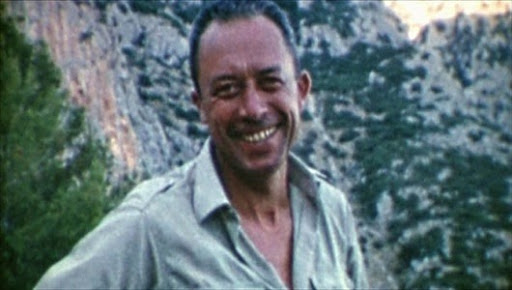
With these questions in mind, I turned to my “read later” reading list and my eyes landed on a piece by Cardinal Gianfranco Ravasi, where he speaks about how Albert Camus‘ thought is a confrontation with the same questions that Christianity grapples with. Questions of meaning, purpose, suffering, revolt, hope and love.

Ravasi there starts with quoting from a talk Camus gave to a group of Dominicans in 1948, where he says to his hosts that “the world of today needs Christians who remain Christians” and where he declares:

“I shall not, as far as I am concerned, try to pass myself off as a Christian in your presence. I share with you the same revulsion from evil. But I do not share your hope, and I continue to struggle against this universe in which children suffer and die.”

This directness and honesty of Camus has always been very attractive to me, which made me look for the full text of his talk to the Dominicans and I found a fairly extensive set of fragments from it here. What struck me there is how I find myself very much agreeing with him, where what he says is in fact a very powerful examination of conscience for Christianity and also for me personally.

From these fragments it is explicit that the Dominicans invited Camus to talk to them about what “unbelievers expect of Christians,” which makes me very impressed with them too, and for which Camus also acknowledged their “intellectual generosity.” He then proceeds to set out the following principles of dialogue:

that “if I allowed myself at the end of this statement to demand of you certain duties, these could only be duties that it is essential to ask of any man today, whether he is or is not a Christian.”

that “I shall never start from the supposition that Christian truth is illusory, but merely from the fact that I could not accept it.”

and that “I shall not try to change anything that I think or anything that you think (insofar as I can judge of it) in order to reach a reconciliation that would be agreeable to all. On the contrary, what I feel like telling you today is that the world needs real dialogue, that falsehood is just as much the opposite of dialogue as is silence, and that the only possible dialogue is the kind between people who remain what they are and speak their mind.”

These are an excellent set of principles: do to others as you would want them to do to you, the principle of charity and respect for the other being who they are, not setting out to change them. In fact, they seem to me to be very much in sync with what Pope Francis said on the same topic: “Dialogue is born of an attitude of respect towards another person, of a conviction that the other has something good to say; it requires that we make space in our heard their point of view, their opinion and their position.”

With these principles as the basis, Camus proceeds to spelling out his expectations:

“What the world expects of Christians is that Christians should speak out, loud and clear, and that they should voice their condemnation in such a way that never a doubt, never the slightest doubt, could rise in the heart of the simplest man. That they should get away from abstraction and confront the blood-stained face history has taken on today. The grouping we need is a grouping of men resolved to speak out clearly and to pay up personally. When a Spanish bishop blesses political executions, he ceases to be a bishop or a Christian; even a man; he is a dog just like the one who, backed by an ideology, orders that execution without doing the dirty work himself. We are still waiting, and I am waiting, for a grouping of all those who refuse to be dogs and are resolved to pay the price that must be paid so that man can be something more than a dog. […]

Perhaps we cannot prevent this world from being a world in which children are tortured. But we can reduce the number of tortured children. And if you don’t help us, who else in the world can help us do this? […]

But it may be […] that Christianity will insist on maintaining a compromise or else on giving its condemnations the obscure form of the encyclical. Possibly it will insist on losing once and for all the virtue of revolt and indignation that belonged to it long ago. In that case Christians will live and Christianity will die. In that case the others will in fact pay for the sacrifice. [… I]f Christians made up their minds to it, millions of voices—millions, I say—throughout the world would be added to the appeal of a handful of isolated individuals who, without any sort of affiliation, today intercede almost everywhere and ceaselessly for children and for men.”

When I read this, it really stopped me in my tracks. This is the kind of dialogue that we, Christians need – someone from the “outside” shaking us, pointing to our errors and doing so not for the sake of some propagandist point-scoring, but out of a genuine concern for our returning to our roots and maintaining our identity. In many ways, what Pope Francis is doing now from the “inside” is similar – the call to poverty, to the “existential peripheries” and to respect for and collaboration with atheists are all examples of it and I am deeply grateful to him and to Camus.

Returning to Ravasi’s discourse, he steers it to another very interesting point of common interest to Christianity and Camus, by quoting from “Helen’s Exile” and then from “The Rebel”:

“Man cannot do without beauty, and this is what our era pretends to want to disregard. It steels itself to attain the absolute and authority; it wants to transfigure the world before having exhausted it, to set it to rights before having understood it. Whatever it may say, our era is deserting this world.”

“Beauty, no doubt, does not make revolutions. But a day will come when revolutions will have need of beauty.”

Here the connection between beauty and the revolt Camus speaks about to the Dominicans is clear – both are set against an exploitation and ignoring of the world. Revolt is directed against suffering while beauty is aimed at appreciating existence.

Ravasi then makes the, to me at first surprising, summary of the above as being “the way of love.” To get a sense of why he may have interpreted it as such, Camus’ own words in “The Rebel” point to the key: “The procedure of beauty, which is to contest reality while endowing it with unity, is also the procedure of rebellion.” Rebellion and beauty bring about unity, which in turn is synonymous with love in Christianity – the Persons of the Trinity being One is their love for each other; Jesus-Love is present among his followers if they are united in his name (cf. Matthew 18:20), etc.

Finally, to underline the importance Camus gives to love, Ravasi quotes the following from his “Notebooks” from 1937:

“If someone told me to write a book on morality, it would have a hundred pages and ninety-nine of them would be blank. On the last page I would write, “I recognize only one duty and that is to love.” And as far as everything else is concerned, I say no.”

St. Augustine would be pleased, as am I 🙂