Eternity today

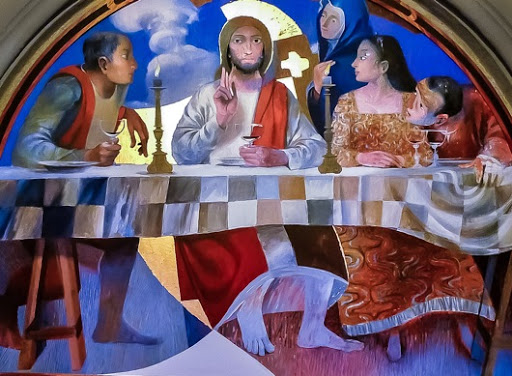
Arcabas canaa l

Today the Church has launched its Year of Faith, whose announcement motivated me three months ago to start writing this blog. While the Year of Faith was its explicit impetus, my deeper reasons were both a desire to be clearer to myself about what it was that my faith meant to me and implied for me and a desire to make explicit my deep-seated conviction that imitating Jesus was not contrary to reason or to my scientific profession and that it ought to be more accessible to my friends with other religious beliefs or none. By this I don’t mean in any way an attempt to convince them of anything, but simply by making my faith explicit and by revealing its consequences and connections to the broader philosophical, cultural, artistic and scientific contexts, show that it makes sense and that it allows me to seek the goals and values that they themselves share. I was also keen to look for the underlying similarities among all who employ reason honestly and who seek the common good and to show that at this level are all close to one another. Whether this is something that has emerged from the last 68 posts is something you’ll have to judge for yourself. All I can say is that it has been a positive experience for me, especially in the cases where a post has lead to or was triggered by dialogue.

With that preamble out of the way, let me share with you my take on today’s opening of the Year of Faith by pulling together some of the points made by Pope Benedict XVI in his sermon during the opening mass, Archbishop Rowan Williamsaddress to the Bishops’ Synod yesterday and Patriarch Bartholomew I’s greeting this morning. This fact alone, of having the heads of the Roman Catholic, Anglican and Eastern Orthodox communities come together at the opening of this Year of Faith is great cause for enthusiasm to me, as it points to their shared belief in Jesus being present “where two or three are gathered together in [his] name” (Matthew 18:20) and in their shared commitment to “witness together to the Gospel message of salvation and healing for the least of our brethren: the poor, the oppressed, the forgotten in God’s world.” (Bartholomew I).

To my mind, Archbishop Williams’ talk yesterday did a great job of setting the scene by reflecting on what it is that attracts people to authentic, lived Christianity:

“[It is] the possibility, quite simply, of living more humanly – living with less frantic acquisitiveness, living with space for stillness, living in the expectation of learning, and most of all, living with an awareness that there is a solid and durable joy to be discovered in the disciplines of self-forgetfulness that is quite different from the gratification of this or that impulse of the moment.”

He argues, as do I, that the behavior to which authentic Christians are lead by their desire to imitate Jesus has universal value and is not something alien or parallel to what all others seek too. Williams follows the above with a warning though: “The man who seeks sincerity, instead of seeking truth in self-forgetfulness, is like the man who seeks to be detached instead of laying himself open in love.” (Henri de Lubac, Paradoxes of Faith, pp. 114) – striving to share with the world what it means to follow Jesus cannot be sought for its own sake as that defeats its own purpose. Such self-consciousness about one’s faith and its perception by others, by definition, cannot be overcome by being even more self-conscious about it:

“We have to return to St Paul and ask, ‘Where are we looking?’ Do we look anxiously to the problems of our day, the varieties of unfaithfulness or of threat to faith and morals, the weakness of the institution? Or are we seeking to look to Jesus, to the unveiled face of God’s image in the light of which we see the image further reflected in ourselves and our neighbours?”

In many ways it is like how Douglas Adams describes flying in the Hitchhiker’s Guide: a throwing of oneself to the ground and accidentally missing, by having been distracted at the critical moment. Sharing my faith is like throwing myself into following Jesus and being distracted by my friends. 🙂

What does it mean though to follow Jesus? How can you even try to imitate a carpenter, healer, prophet, teacher, … from two thousand years ago? Here Pope Benedict argues that we face a fundamental tension when striving to

“mak[e] the truth and beauty of the faith shine out in our time, without sacrificing it to the demands of the present or leaving it tied to the past: the eternal presence of God resounds in the faith, transcending time, yet it can only be welcomed by us in our own unrepeatable today.”

Applying Jesus’ message to the conditions we are in today is essential, but so is remaining faithful to it and this is the challenge that both the Second Vatican Council, which opened 50 years ago today, and this new Year of Faith strive to address. To Pope Benedict, the key though is the person of Jesus, through whom “God’s face is revealed to us.” “[T]he closer [we] get to him, the closer [we] get to the hearts of [our] brothers and sisters” (Chiara Lubich, Essential Writings, p.37; quoted by Archbishop Williams).

Civil disobedience

399px Cloak of Conscience Closeup

One of the most common charges against “religious” people in general and Catholics in particular is that they surrender the use of their critical faculties and follow orders from their leaders like sheep. In other words: they are no trouble, they won’t break rank and are all-round model citizens.

Today I’d like to argue that this is as far from the truth as possible, and I will take advantage of the Vatican’s foreign secretary, Archbishop Dominique Mamberti’s address to the United Nations from last Monday, which in many ways tracks Pope Benedict XVI’s speech at the German Bundestag, delivered last year.

He starts by acknowledging the dangers that follow from the “financial crisis, which is worsening some humanitarian and environmental emergencies, does not seem yet to be over, and may even herald new and dangerous conflicts” and that spreading “the rule of law by every means becomes a particularly urgent task for a just, equitable and effective world governance.” Then, he fully aligns himself with the UN’s insistence on: “the unbreakable link between the rule of law and respect for human rights, […] the judicial control of laws and of executive power, […] transparency in acts of governance and the existence of public opinion capable of expressing itself freely.” Mamberti’s key point comes next though:

“The rule of law is also put at risk when it is equated with a legalistic mentality, with a formal and uncritical adherence to laws and rules, in an attitude which can even paradoxically degenerate into a means of abusing human dignity and the rights of individuals, communities and states, as happened during the totalitarian regimes of the 20th century. Furthermore, in the phrase “rule of law”, the concept “law” should be understood as “justice”.”

The first thing to note here is that it calls for critical thinking and, I believe, that, as far as they are rules, this warning also applies to Church teaching. Taking even the ‘rules’ that the Church presents to its members and applying them with a “legalistic mentality, with a formal and uncritical adherence” can lead to their perversion. The Church has very rightly emphasized a focus on deepening one’s relationship with Jesus during the upcoming Year of Faith, rather than talking about making oneself familiar with Church “rules.”

In case you think that this is just my own interpretation of Church teaching, as opposed to the official line, let me point to one of my favorite lines from the Catechism:

A human being must always obey the certain judgment of his conscience. If he were deliberately to act against it, he would condemn himself. (CCC, §1790)

In fact, this brings us back to Mamberti’s talk, where he affirms that justice is “proper and inalienable to the nature of every human being.” Bringing all of this together in fact puts a Catholic into a position of having to critically assess laws and being called both to strict adherence to those that are aligned with their conscience and to resistance against those that don’t. This is neither a position of blind obedience, nor one of disregard for the law, but a more complex, but far more personally and socially rewarding one, where discernment and prudence need to be exercised.

Let’s get back to Mamberti though and see what he has to say about justice:

“Man is not merely self-creating freedom. Man does not create himself. He is intellect and will, but he is also nature, and his will is rightly ordered if he respects his nature, listens to it and accepts himself for who he is, as one who did not create himself. In this way, and in no other, is true human freedom fulfilled, and it is only in this way that we can speak truly of the rule of law.”

The key here, to my mind, is that freedom is not arbitrary. You can’t just decide, with disregard for human nature and your conscience, what behavior to follow and expect that it will allow you to remain free.

Just to avoid giving the impression that this topic is in any way simple, Mamberti rightly recognizes that “[t]he question of how to recognize what is truly right and thus to serve justice when framing laws has never been simple, and today in view of the vast extent of our knowledge and our capacity, it has become still harder.” The more you know the more difficult certainty becomes, which echoes Socrates’ “The more I learn, the more I learn how little I know.” And, finally, he postulates a very clear link between a subversion of the law and the economic crisis that the world is in today:

“It is well known that, at the international level, there are interest groups present who, by means of formally legitimate procedures, are impacting on the policies of states in order to obtain multilateral norms which not only cannot serve the common good but which, under the guise of legitimacy, are in fact an abuse of norms and of international recommendations, as has been seen in the recent financial crisis.”

Even just the last 100 years have been addled with abuses of the law that were fully legal in the sense of not exhibiting procedural violations. It would be a mistake to think though that this is all in the past or that it only applies to regimes notorious for human rights abuses. Even in the “civilized West” there are attacks on the rights of peoples to express their desire for self-determination and on the practice of religious freedom. As St. Augustine said “Without justice – what else is the State but a great band of robbers?”

Jesus’ wife: clicks, facts and ‘children in a marketplace’

King jesus wife

I wasn’t going to write about this, but then I received a direct (and very welcome) requests by my bestie PM, and with his help realized that there was a much more interesting angle to this story than the obvious (and not all that exciting) one.

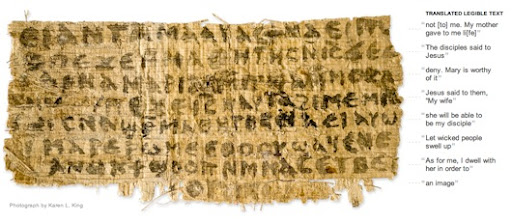
Let’s start with the facts of the matter: a fragment of Coptic script on papyrus that may date from the 4th century AD and that consists of 49.5 words in its English translation (see the top of this post) was presented at the International Congress of Coptic Studies on 18th September. The fragment contains no complete sentences and the sole reason for its overnight fame are the following words it contains:

Jesus said to them, “My wife

Looking at reports in the media, the following picture emerges:

“Even with many questions unsettled, the discovery could reignite the debate over whether Jesus was married, whether Mary Magdalene was his wife and whether he had a female disciple.” (New York Times)
“The discovery that some ancient Christians thought Jesus had a wife could shake up centuries-old Christian traditions” (Washington Post)
“A discovery by a Harvard researcher may shed light on a controversial aspect of the life of Jesus Christ.” (Huffington Post)
“A Harvard Divinity School professor’s interpretation of a scrap of fourth-century Egyptian papyrus that quotes Jesus Christ making reference to a wife could stoke new debates to the role of women in Christianity, theologians say.” (Boston Herald)
“An 4th century papyrus fragment could call centuries of celibacy into question.” (Time)

The message is clear: this is a major discovery that could alter that very foundations of Christianity in one fell swoop. As much fun as it would be to debunk statements like the above, it would be falling for a textbook straw man argument (as some have, while others, like Fr. James Martin, haven’t). Instead, let me defer any comment on the matter, until we see Dr. Karen L. King, the scholar who presented the fragment at the Congress, speak for herself. And what better way to do that than to refer to a draft of her peer-reviewed journal paper, to be published in the Harvard Theological Review (link courtesy of Harvard Magazine):

“This is the only extant ancient text which explicitly portrays Jesus as referring to a wife. It does not, however, provide evidence that the historical Jesus was married, given the late date of the fragment and the probable date of original composition only in the second half of the second century. Nevertheless, if the second century date of composition is correct, the fragment does provide direct evidence that claims about Jesus’s marital status first arose over a century after the death of Jesus in the context of intra-Christian controversies over sexuality, marriage, and discipleship.
[…]
The use of the term “gospel” here regards the probable genre of the work to which this fragment belonged (see below, “Genre”) and makes absolutely no claim to canonical status nor to the historical accuracy of the content as such. This invented reference in no way means to imply that this was the title in antiquity, or that “Jesus’s wife” is the “author” of this work, is a major character in it, or is even a significant topic of discussion—none of that can be known from such a tiny fragment. Rather the title references the fragment’s most distinctive claim (that Jesus was married), and serves therefore as a kind of short-hand reference to the fragment.”

Wait, what?! Unlike the cat-among-pigeons reaction of the media, Dr. King’s words (maybe with a little help from the journal’s reviewers 🙂 sound rational, factual and well representative of what this fragment may be: a text recorded probably in the 4th century AD that may be a copy of a 2nd century one, situated among the ’intra-Christian controversies’ of the day. No “Christianity 2.0”, no “we have had it all wrong for 2000 years” and no “shake up.”

In this (hopefully) more complete picture, Dr. King (who, after all was speaking at the Institutum Patristicum Augustinianum, which is part of the Pontifical Lateran University – i.e., popularly known as the “Pope’s University”!) comes up smelling of roses, while the various media reports happen to fit the topic that I actually wanted to talk about today like a glove! Namely, yesterday’s Gospel reading, in which Jesus vents his frustration with childish attitudes. In Luke 7:31-35 he is reported as saying the following:

“To what shall I compare the people of this generation?
What are they like?
They are like children who sit in the marketplace and call to one another,

‘We played the flute for you, but you did not dance.
We sang a dirge, but you did not weep.’

For John the Baptist came neither eating food nor drinking wine,
and you said, ‘He is possessed by a demon.’
The Son of Man came eating and drinking and you said,
‘Look, he is a glutton and a drunkard,
a friend of tax collectors and sinners.’
But wisdom is vindicated by all her children.”

When I read this, I could picture Jesus’ disbelief in the face of his contemporaries’ conduct (“What are they like?!”), who thought of John the Baptist as a nutter and of Jesus himself as a pig [my own words :] and who jumped at anything to push their own agendas. How little has changed in 2000 years!

Let me not finish on a negative note though as I do see this episode as positive overall. That a new fragment from the early days of Christianity has come to light is great (the more we know the better, since knowledge is power and the truth will set us free [apologies for this fragment–peddling – it just seemed fitting :]) and so is the scholarly integrity of Dr. King and her fellow coptologists, who can shed light on the history of this find and its place within the overall corpus of early Christian writings.


I know the media reports are a straw man, but a very juicy and tempting one, so let me just take one slash at it: Assuming the fragment’s authenticity (which I am in no position to question or believe in) places it into the 4th century. Taking it as a record of events from the first century is like someone discovering the following fragment from this post in the 38th century: “Newton wrote: ‘This quantity I designate by the name of aura” and considering it as a record of Newton’s words from 1687 …

On an entirely separate and unrelated note, let me just share what I found out about the following words that Jesus speaks in Luke’s Gospel: ‘We played the flute for you, but you did not dance. We sang a dirge, but you did not weep.’ This intrigued me straightaway and I first though that it may come from one of the Psalms or another part of the Bible. It seems instead that they were just part of a game that kids played at the time. Two groups would be formed – one playing jolly music and another a wailing funereal tune and they’d compete in who’d gather more followers as they moved through the streets. What a bizarre (but great 🙂 game! Thanks to St. Cyril of Alexandria for the tip!

Martini: backstabber or faithful son?

Primus inter pares

You’ll know from a previous post here, that I am becoming a great fan of Cardinal Martini, whose funeral was celebrated two days ago and whose exchange of letters with Umberto Eco I enjoyed greatly. Upon hearing of his death, I was keen to learn more about him and I also eagerly read the last interview with him, published in the Corriere della Sera (and available in English translation here).

The interview took place on 8th August and asks Martini to comment on the state of the Church – a question he is very well positioned to answer and that he answers with great honesty. Martini says that the church is tired, culturally out of date, being weighted down by bureaucracy and basically showing the traits of a mature business rather than a dynamic start-up (my words :). The Church lacks the dynamism of John the Baptist and St. Paul, the faith of the Roman centurion (whose servant Jesus healed) and of St. Mary Magdalen and the closeness to the people that the Servant of God, Bishop Óscar Romero and the Jesuit martyrs of El Salvador had. Martini’s answer to this predicament is to involve more people from outside formal Church structures, to recognize our own errors and start a process of conversion, to return to the Word (i.e., to a personal closeness to the Gospel), to renew an adherence to the sacraments and to be open to all, regardless of what family and social circumstances they are in. Finally, he exhorts us to renew our faith, confidence and courage and to let ourselves be conquered by God’s love.

My immediate reaction was that of gratitude for such a greatly distilled analysis of where the Church is today, for the degree of honesty and self-criticism, for the concrete steps forward and for a final call to love.

The second hand, to form applause with Martini’s interview, then is the message that Pope Benedict XVI sent to his funeral. The pope picks a line from Psalm 119: “Your word is a lamp for my feet, a light for my path” to sum up the cardinal’s life, calls him a “generous and faithful pastor of the Church” and states that everything Martini did was “for the greater glory of God.” The pope then goes on to say that:

[h]e did so with a great openness of heart, never refusing to encounter and dialogue with anyone, responding concretely to the Apostle’s invitation to “always be ready to give an explanation to anyone who asks you for a reason for your hope ” (1 Peter 3:15).

Finally, he concludes by saying: “May the Lord, who guided Cardinal Carlo Maria Martini his whole life, receive this tireless servant of the Gospel and of the Church in the Heavenly Jerusalem.” Not only an elegant nod to Martini’s fondness for the earthly Jerusalem, but also an endorsement of his faithfulness to and inspiration from God.

If it were just for these two texts – the last interview with Martini and the pope’s message at his funeral – you could think that the two were uncontroversial parts of giving thanks for the life of a great son of the Church and, I believe you’d be right. A quick look at the press presents a very different picture though. The Independent calls Martini’s interview “a damning critique that has rocked the Catholic Church,” the Daily Mail calls it a “scathing attack,” the Belfast Telegraph says that the “Vatican is rocked by Cardinal Martini’s damning words from beyond the grave” and all news outlets latch on to Martini’s saying that “the Church is two hundred years behind.” Reading these and virtually all other reports (with the notable exception of Fr. Lucie-Smith’s blog), you’d think that Martini’s last interview was some kind of vengeful, underhand jab at the Church. Instead, I see Martini’s words as much more in line with Blessed Pope John Paul II’s emphasis on acknowledging past wrongs as a first step towards a renewal of the Church. E.g., in Incarnationis Mysterium he says that the Church “should kneel before God and implore forgiveness for the past and present sins of her sons and daughters” (Section 11), such humble repentance being in fact a common feature of the attitude of saints.


I’d first like to thank my bestie, PM, for suggesting this as a topic for a post 🙂

I also realize that I may come across as someone who unreservedly agrees with everything the Church and its representatives do. Let me assure you that this is far from the case and may in fact be more a consequence of my desire to focus on what is good and worth sharing rather than on presenting a complete, balanced view of how I see the Church. As an example of something that recently irked me, take a look at the third question in this very recent interview with Cardinal Cormac Murphy-O’Connor:

Q: At a lecture after Archbishop Vincent Nichols’ installation you urged Christians to treat atheists and agnostics with deep esteem. However, later you are quoted as saying that a lack of Faith is the ‘greatest of all evils’. You blamed atheism for war and destruction, and implied it was a greater evil than sin itself. Is this a contradiction, or were you misquoted?
[At this point Cardinal Cormac got up and went to his adjacent study. Perhaps this was an abrupt end to our interview? However, after a few minutes he returned with two books.]
A: Yes, I was misquoted – it was out of context. To get the full meaning of what I said, I would encourage [you] to study the books I have assembled ‘Faith in Britain’ and ‘Faith in Europe’.

No, thanks … If the Cardinal cannot address this, very good question in the interview and his only recourse is to bring back TWO books that the reader is to study and from which they are to distill what the Cardinal thinks, then in all likelihood those books are not going to be any help either. Seeing a response like this (and much of the lengthy interview) just makes me recoil in frustration and shake my head in disappointment …

Servant of servants

Jesusfeet

Today is the feast of a saint whose name alone – Pope Gregory the Great – promises an edifying closer look and, if you have been following this blog (e.g., here and here), you will also know that he influences the Church to this day. St. Gregory had a varied and rich career, whose first milestone (after an extensive and broad eduction spanning music, law, mathematics and natural sciences) was to be named Prefect of the City of Rome (effectively its mayor). Following the death of this father, Gregory became a monk though and withdrew from the world, only to be called upon by Pope Pelagius II to act as his ambassador to Constantinople. Instead of being allowed to retire to the monastic life after this mission, he was instead elected pope, very much against his will, and lead the Church for 14 years during which he introduced reforms both in the administration of the Church and in its liturgy.

There would be lots to say about St. Gregory, but I would like to focus only on two points:

  1. His love for the poor and his large-scale charitable work, best expressed by him saying: “I hold the office of steward to the property of the poor.” St. Gregory saw the church as a not-for-profit organization (in secular terms) and distributed the many donations the Church received to the poor – only keeping what was necessary for maintaining its facilities and supporting its personnel.
  2. His reluctance towards being pope, born of a deep humility, very clearly expressed by his adoption of the title “Servant of the servants of God” – by far my favorite papal title and one used to this day by his successors. St. Gregory also emphasized the importance of personal spiritual life for those holding high office in the Church, e.g., by saying “[U]nder the cloak of the Ecclesiastical office, I found myself plunged on a sudden in a sea of secular matters, and because I had not held fast the tranquillity of the monastery when in possession, I learnt by losing it, how closely it should have been held.” This is certainly an attitude I have seen very clearly both in the current pope and his predecessor and in many priests I have known and admire.