Lumen Gentium: The mystery of the church

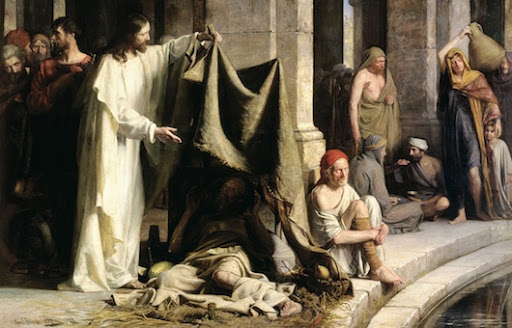
Christ Healing the Sick at Bethesda

In my attempt to read the full set of Vatican II documents during this Year of Faith, and after having greatly enjoyed both reading Dei Verbum and trying to share my takeaways from it here, I have turned to the next one of the four dogmatic constitutions: Lumen Gentium.1

The first thing to note about Lumen Gentium (LG) is its heft – while Dei Verbum (DV) comes in at ~6K words, LG clocks up just short of 35K. To keep my posts from draining your tablet batteries and to make the challenge more manageable for myself, I am going to look at LG chapter by chapter. The second aspect of LG that jumped out at me was its language as compared with DV. While DV strikes me as much more direct, synthetic and to the point, in LG there seems to be a much greater use of epithets, honorifics and circumlocution. This is not by way of criticism, but just as an observation that would probably make me recommend DV more easily than LG to someone who would otherwise not read these kinds of texts.

With the preambles out of the way, let me share with you what the first chapter of Lumen Gentium, entitled “The Mystery of the Church,” meant to me. While the whole of LG is about the Church, its first chapter is essentially the answer the Church gives to the question: “Who are you?” Even if you aren’t a Catholic, you can take the answer to be how the Church thinks of herself, and throughout this chapter you’d see that it does so along two dimensions: God-Church-World and Nature-Mission. The Church presents herself “as a sign and instrument both of a very closely knit union with God and of the unity of the whole human race” – facing not only towards God but also towards humanity, and “desires […] to unfold more fully to the faithful of the Church and to the whole world its own inner nature and universal mission.”

God the Father created the world and planned to “raise men to a participation of the divine life.” The Church, which Jesus “inaugurated,” is the “Kingdom of heaven on earth,” the Kingdom of the divine life. This may at first sound odd, but I believe, it could also have been put as “where God’s law (i.e., love) is adhered to on earth,” with the “where” not being restricted to location but applicable also to persons (i.e., an “in whom” and “among whom”). This ”Kingdom” is “the unity of all believers who form one body in Christ,” where that unity is “expressed and brought about” by the Eucharist:

“[I]n the breaking of the Eucharistic bread, we are taken up into communion with Him and with one another. “Because the bread is one, we though many, are one body, all of us who partake of the one bread”. In this way all of us are made members of His Body, “but severally members one of another”.”

The image of the Church as the “body of Christ” is very prominent in LG – Jesus is the “head of the Body which is the Church [… and all its] members ought to be molded in the likeness of Him, until Christ be formed in them.” This is very clearly not just about “what would Jesus do” but about a “becoming Jesus” and thereby “becoming one another.” This is not some rhetorical flourish, but an emphasis on the profound, existential nature of following Jesus, who “is the image of the invisible God and in [whom] all things came into being.” And neither is it about my, individual seeking of God only, but fundamentally about how I relate to others, how I become a “member of another,” how – as Cardinal Martini put it “the other is within us.” This is further emphasized in the following passage, where the role of the Holy Spirit (who “was sent [… to] continually sanctify the Church”) is presented:

“Giving the body unity through Himself and through His power and inner joining of the members, [the Holy] Spirit produces and urges love among the believers. From all this it follows that if one member endures anything, all the members co-endure it, and if one member is honored, all the members together rejoice.”

If this all sounds too idealized and removed from reality, it is worth bearing in mind that it is about what the Church is (or how it thinks of itself) and not about what it looks like. While saying anything about being (as opposed to empirically observed phenomena) is very difficult (if not impossible, if you are epistemologically honest) in the context of philosophy and science. Christianity, on the other hand, holds beliefs about it, justified by revelation in the person of Jesus and subsequently illuminated by the Holy Spirit.

What about the way that the Church appears? How does that relate to the “body of Christ” presented above? Here LG is very explicit:

“[T]he society structured with hierarchical organs and the Mystical Body of Christ, are not to be considered as two realities, nor are the visible assembly and the spiritual community, nor the earthly Church and the Church enriched with heavenly things; rather they form one complex reality which coalesces from a divine and a human element. For this reason, by no weak analogy, it is compared to the mystery of the incarnate Word. As the assumed nature inseparably united to Him, serves the divine Word as a living organ of salvation, so, in a similar way, does the visible social structure of the Church serve the Spirit of Christ, who vivifies it, in the building up of the body.”

Jesus, the Word of God, is to Jesus the person who walked the earth 2000 years ago as the social structure – the Church, is to the Mystical Body of Christ – the Church. Just like every aspect of how Christianity views anything is ultimately rooted in the Trinity, so too the Church mirrors the incarnation of one of its Persons – Jesus. I believe this is a very powerful way of understanding the Church, that reconciles both the temporal, limited, imperfect with the infinite, perfect that sustains it and gives life to it.

Just to avoid giving the impression that LG is divorced from the phenomenological experience of the Church, with its obvious limitations, that sadly also include some shocking perversions, it is useful to highlight the following passage:

“While Christ, holy, innocent and undefiled knew nothing of sin, but came to expiate only the sins of the people, the Church, embracing in its bosom sinners, at the same time holy and always in need of being purified, always follows the way of penance and renewal. […]

By the power of the risen Lord it is given strength that it might, in patience and in love, overcome its sorrows and its challenges, both within itself and from without, and that it might reveal to the world, faithfully though darkly, the mystery of its Lord until, in the end, it will be manifested in full light.”

Finally, I was also encouraged to see a clear acknowledgement that the Church as an organization does not claim to have a monopoly, by saying that “many elements of sanctification and of truth are found outside of its visible structure” and a clear reminder of the Church’s status in the world:

“Just as Christ carried out the work of redemption in poverty and persecution, so the Church is called to follow the same route that it might communicate the fruits of salvation to men. Christ Jesus, “though He was by nature God … emptied Himself, taking the nature of a slave”, and “being rich, became poor” for our sakes. Thus, the Church, although it needs human resources to carry out its mission, is not set up to seek earthly glory, but to proclaim, even by its own example, humility and self-sacrifice.”

While I have certainly found the first chapter of Lumen Gentium much more challenging than Dei Verbum (and I don’t know how well I managed to get my impressions from it across), it has left me with a vision of the Church that is profound, universal, open and positioned to draw itself and all closer to God-Love.


1 If you haven’t read my post on Dei Verbum (and I am not suggesting you should feel bad about that :), you might like to at least take a quick look at the caveat there in paragraph 2.


Dei Verbum: a first look

Word made flesh 2

As set out in a previous post, I have embarked on a journey through the 16 Vatican II documents, starting with the dogmatic constitution Dei Verbum here.

Before getting into it, let me start with a few words to those of you – my friends! – who hold no or other beliefs about God than me. Without meaning to tell you what to do, I’d say that probably the best attitude to have when reading this post (and the rest of the series that will follow on Vatican II) is that of Thomas Nagel in his well-known paper entitled: “What is it like to be a bat?1 I don’t mean to get sidetracked here into his superb challenge to how consciousness is to be approached, but would just like to take some pointers from him on how one can consider the words of another, who holds different beliefs (and I am talking purely about understanding, without meaning to reduce relationships to knowledge alone). Nagel has the key insight that the question of what it is to be a bat is not about what it would be like for me to be a bat, but what it is for a bat to be a bat. “Yet if I try to imagine this, I am restricted to the resources of my own mind, and those resources are inadequate to the task. I cannot perform it either by imagining additions to my present experience, or by imagining segments gradually subtracted from it, or by imagining some combination of additions, subtractions, and modifications.” Just to avoid any misunderstanding, I believe these limitations apply in both directions. I too lack the direct experience of not believing in God or of holding other beliefs to my own, and therefore can only get so far with understanding what it is like to be an atheist or agnostic using my own “inadequate resources.” Sticking to Nagel’s example, trying to understand another person with whom I don’t share a key characteristic is like trying to understand from a bat what it is like to have sonar. Even if the bat could speak English, we wouldn’t have a shared vocabulary for it to quite get that across to me. In spite of such limitations, I hope that you will find interest in how Catholics look at the way they believe God has revealed himself to the world, which is precisely the subject of Dei Verbum.

Where else would the discourse start but with a quote from the New Testament, where John says the following:

“We announce to you the eternal life which dwelt with the Father and was made visible to us. What we have seen and heard we announce to you, so that you may have fellowship with us and our common fellowship be with the Father and His Son Jesus Christ” (1 John 1:2-3)

This puts us in a very clear context from the word go: that of continuity with Jesus’s disciples desiring to share what they have “seen and heard,” for the sake of building relationships with others and with God. The purpose of Dei Verbum then is to clarify how the above revelation of God to the world is to be understood. This revelation, where “the invisible God out of the abundance of His love speaks to men as friends and lives among them, so that He may invite and take them into fellowship with Himself.”

Dei Verbum proceeds to present different ways in which God has revealed and continues to reveal himself:

  1. Nature. “God, who through the Word creates all things and keeps them in existence, gives men an enduring witness to Himself in created realities” and “he ceaselessly kept the human race in His care, to give eternal life to those who perseveringly do good in search of salvation.” The message here is clear: God can be found in his creation,2 “known […] by the light of human reason” and all who live for others rather than themselves will find him.
  2. The people of Israel. “Then, at the time He had appointed He called Abraham in order to make of him a great nation. Through the patriarchs, and after them through Moses and the prophets, He taught this people to acknowledge Himself the one living and true God, provident father and just judge.” The books of the Old Testament “give expression to a lively sense of God, contain a store of sublime teachings about God, sound wisdom about human life, and a wonderful treasury of prayers, and in them the mystery of our salvation is present in a hidden way.” Even though these books “also contain some things which are incomplete and temporary, [we] should receive them with reverence.” “God, the inspirer and author of both Testaments, wisely arranged that the New Testament be hidden in the Old and the Old be made manifest in the New.”
  3. Jesus. “He sent His Son, the eternal Word, who enlightens all men, so that He might dwell among men and tell them of the innermost being of God.” God sends his Son, Jesus – the “eternal Word” – and through his life, teaching, death and resurrection, God shows himself directly to us and reveals himself in full intimacy.
  4. The Holy Spirit. For someone to “freely assent to the truth revealed by Him […], the grace of God and the interior help of the Holy Spirit must precede and assist” and “[t]o bring about an ever deeper understanding of revelation the same Holy Spirit constantly brings faith to completion.” While revelation is complete in the person of Jesus, the Holy Spirit (“the Spirit of truth”), whom Jesus sent to his followers after his resurrection, continues to deepen our understanding of it.

How is it then, that God’s revelation is preserved, maintained and spread? Jesus commissioned the Apostles to share with others “what they had received from [His lips], from living with Him, and from what He did, or what they had learned through the prompting of the Holy Spirit.” They were also prompted to “commit the message of salvation to writing” and, “to keep the Gospel forever whole and alive.” “[T]he Apostles left bishops as their successors, “handing over” to them “the authority to teach in their own place.” (St. Irenaeus, Against Heretics III, 3)” Since the words of the Gospel are put into practice by Jesus’ followers, and since the Holy Spirit inspires them, “there is a growth in the understanding of the realities and the words which have been handed down.” This to me is quite a key passage – the account of Jesus’s life and teaching is not a static piece of text, frozen in time, but instead a source of growing understanding and new insights brought about with the help of the Holy Spirit in those who follow Jesus: “[T]hus God, who spoke of old, uninterruptedly converses with the bride of His beloved Son; [through the] Holy Spirit, through whom the living voice of the Gospel resounds in the Church, and through her, in the world.” The upshot of this is a very tight link between Scripture (a record of Jesus’ life and teaching) and Tradition (Jesus’ followers’ growing insight into Scripture from putting it into practice and with the help of the Holy Spirit), interpreted over time by the successors of the Apostles.

How is one to understand the nature of Scripture though? Dei Verbum first reaffirms the Church’s belief in “the books of both the Old and New Testaments in their entirety, with all their parts, [being] sacred and canonical because written under the inspiration of the Holy Spirit, they have God as their author and have been handed on as such to the Church herself.” However, since they were written by men, we “should carefully investigate what meaning the sacred writers really intended, and what God wanted to manifest by means of their words.” Here, a distinction needs to be made between passages that are “historical, prophetic, poetic, or of other forms of discourse.” “[We] must investigate what meaning the sacred writer intended to express and actually expressed in particular circumstances by using contemporary literary forms in accordance with the situation of his own time and culture. [… D]ue attention must be paid to the customary and characteristic styles of feeling, speaking and narrating which prevailed at the time of the sacred writer, and to the patterns men normally employed at that period in their everyday dealings with one another.” This is as far from literalism as you can get – instead it is a teasing out of intention from a text anchored in a specific period of history and in a specific geographical location. No wonder its understanding has the potential to grow and for “new insights [to be] brought about”!

An important warning follows next in Dei Verbum: “serious attention must be given to the content and unity of the whole of Scripture if the meaning of the sacred texts is to be correctly worked out [and t]he living tradition of the whole Church must be taken into account along with the harmony which exists between elements of the faith.” Understanding what was meant by a passage from Scripture mustn’t be done on the basis of picking a couple of phrases out of the whole and trying to make sense of them from scratch. They are part of a textual corpus and there is a rich body of existing insight into them and interpretation of them, to which any new understanding can add. Preserving the message God sent us through his Son and the Holy Spirit – and understanding it in the context I am in – requires a careful and critical interaction with all of Scripture, in which the Church’s judgment plays a key guiding and interpretative role too. Ultimately, the aim is “that we may learn the gentle kindness of God, which words cannot express, and how far He has gone in adapting His language with thoughtful concern for our weak human nature” (St. John Chrysostom, On Genesis).

Within the New Testament, the Gospels have a special “preeminence,” “for they are the principal witness for the life and teaching of the incarnate Word.” Their authors wrote the four Gospels, “selecting some things from the many which had been handed on by word of mouth or in writing, reducing some of them to a synthesis, explaining some things in view of the situation of their churches and preserving the form of proclamation but always in such fashion that they told us the honest truth about Jesus. For their intention in writing was that […] we might know “the truth” concerning those matters about which we have been instructed.” To make these “words of God” “accessible at all times, the Church […] sees to it that suitable and correct translations are made into different languages, especially from the original texts of the sacred books.” Preference is given also to producing translations “with the separated brethren[…, so that] all Christians will be able to use them.”

Finally, all Christians are called to a frequent reading of Scripture and to accompany it with prayer, “so that God and man may talk together; for “we speak to Him when we pray; we hear Him when we read the divine saying.” (St. Ambrose, On the Duties of Ministers I)” In this way “the treasure of revelation, entrusted to the Church, may more and more fill the hearts of men.”

So, these are my 1500 word notes on the 6000 word Vatican II text 🙂 – if you are interested, do read it in full. I certainly got a lot out of it and feel very comfortable with what the Church teaches about Scripture: they are believed to be the true Words of God, but since they were recorded by humans and within the “literary forms” and cultural conventions of a specific place and time, the task of understanding what the authors’ intentions were and what God meant to communicate, is a delicate process. That it is a process is also key, to my mind – it is not like these 2000 year old texts can just be internalized immediately (no text can!). Instead, they require knowledge, discernment, an open mind and the willingness to hear what God has to say to me – here and now.

Lumen Gentium is up next, and since it has 27000 words, I reckon it will occupy me for a while :).


1 Thanks to my bestie, Margaret, for introducing me to this paper a good 10 years ago! If you are interested in consciousness at all, I highly recommend it in full.
2 Note, that this does not imply the lunacy of Creationism – instead, I read this as, with our best knowledge today, God sustaining a universe that he made to follow the (his!) Standard Model.

Havel, Jobs and my conciliar reading list

Redemptorist

The Year of Faith has properly kicked off in our parish today, with a letter from our local bishop being read out during the masses. While nothing new struck me about its content, it’s focus on two “pillars” for deepening an understanding of the Catholic faith – the Catechism and the documents of Vatican II – gave me an idea. Since I know the Catechism fairly well and have read it in full not that long ago, I’ll set myself the challenge of reading the 16 Vatican II documents during the coming year. I’ll proceed in the order shown here, starting with the four conciliar constitutions (being the highest level of Papal decree with legislative power): Dei Verbum (on divine revelation), Lumen Gentium (on the Church), Sacrosanctum Concilium (on the liturgy) and Gaudium et Spes (on the Church in the “modern world”). If you are that way inclined, why don’t you join me in starting with Dei Verbum.

Another pleasant surprise at today’s mass were the Year of Faith diaries ordered by our parish priest from Redemptorist Publications. I am not usually one for diaries, but I was asked by my spouse to buy one and I have to say, I have been impressed both by the layout and aesthetics and the content, from which I would like to share with you two of the quotes provided there for reflection:

“Remembering that I’ll be dead soon is the most important tool I’ve encountered to help me make the big choices in life. Because almost everything – all external expectations, all pride, all fear of embarrassment or failure – these things just fall away in the face of death, leaving only what is truly important.” (Steve Jobs)

“Isn’t it the moment of most profound doubt that gives birth to new certainties? Perhaps hopelessness is the very soil that nourishes human hope; perhaps one could never find sense in life without first experiencing its absurdity.” (Václav Havel)

Kudos to the Redemptorists for such great choices and on to Dei Verbum!