Let yourself cross the bridges that you build

Bosnia Pope Visit JPEG 027fc c0 276 3726 2447 s561x327

Last weekend, Pope Francis spent a day in Sarajevo, where he met with secular authorities, youth and representatives of different religions and where he powerfully spoke out against war and called for all to become “artisans of peace.” In this post I would just like to share what to me where the highlights of that day.

Right at the start of the day, when addressing the authorities, Francis called for an opposition to those who promote violence and for a uniting of “different voices”:

“In order to successfully oppose the barbarity of those who would make of every difference the occasion and pretext for further unspeakable violence, we need to recognize the fundamental values of human communities, values in the name of which we can and must cooperate, build and dialogue, pardon and grow; this will allow different voices to unite in creating a melody of sublime nobility and beauty, instead of the fanatical cries of hatred.”

Next, during mass at Sarajevo’s Koševo Stadium he spoke about how one works for peace in practice:

“So how does one do this, how do we build peace? The prophet Isaiah reminds us succinctly: “The effect of righteousness will be peace” (32:17). Opus justitiae pax (“the work of justice is peace”), from the Vulgate version of Scripture, has become a famous motto, even adopted prophetically by Pope Pius XII. Peace is a work of justice. Here too: not a justice proclaimed, imagined, planned… but rather a justice put into practice, lived out. The Gospel teaches us that the ultimate fulfilment of justice is love: “You shall love your neighbour as yourself” (Mt 22:39; Rm 13:9). When, by the grace of God, we truly follow this commandment, how things change! Because we ourselves change! Those whom I looked upon as my enemy really have the same face as I do, the same heart, the same soul. We have the same Father in heaven. True justice, then, is doing to others what I would want them to do to me, to my people (cf. Mt 7:12).

Saint Paul, in the second reading, shows us the attitude needed to make peace: “Put on then… compassion, kindness, lowliness, meekness and patience, forbearing one another and, if one has a complaint against another, forgiving each other; as the Lord has forgiven you, so you also must forgive” (Col 3:12-13).”

Following the mass, and after hearing the testimonies of priests and religious who were tortured during the Bosnian war, Pope Francis spoke off-the-cuff instead of following his prepared text:

“Another thing that struck me in their talks was mention of the one hundred and twenty days spent in the concentration camp. How many times the spirit of the world makes us forget our ancestors, the sufferings of our forebears! Those days are counted, not in days, but by the minute, because every minute, every hour is torture. To live together like this, dirty, with no food or water, in the heat and cold – and for a long time! And we, who complain when we have a toothache, or who want to have a television in our comfortable rooms, or who whisper behind the back of our Superior when the meals are not so good… Do not forget, I beg of you, the witness of your ancestors. Think of how much these persons have suffered; think of the six litres of blood that this priest had to receive – he, the first one who spoke – in order to survive. Conform your lives worthily to the Cross of Christ.

Worldly sisters, priests, bishops, and seminarians are a caricature, and are of no use to the Church. They do not remember the martyrs. They have lost the memory of Jesus Christ crucified, our only glory.

Another thing that comes to mind is the story of the soldier who gave a pear to the Sister; and that Muslim woman who now lives in America, who brought something to eat… We are all brothers and sisters. Even the cruel man has thought… well, I don’t know what he thought, but he felt the Holy Spirit in his heart and perhaps he thought of his mother and said, “Have this pear and say nothing to anyone”. And the Muslim woman who reached out beyond her own religious tradition: she loved. She believed in God and she did good.

Look for the good of everyone. Each person has potential, the seed of goodness. We are all children of God.”

From the meeting with representatives of different religions and Christian denominations, where Pope Francis agains spoke about dialogue and peace, what struck me was the prayer he said there together by Muslim, Jewish and Christian faithful:

“Almighty and eternal God,
good and merciful Father;
Creator of heaven and earth, of all that is visible and invisible;
God of Abraham, God of Isaac, God of Jacob,
King and Lord of the past, of the present and of the future;
sole judge of every man and woman,
who reward your faithful with eternal glory!
We, the descendants of Abraham according to our faith in you, the one God,
Jews, Christians and Muslims,
humbly stand before you
and with trust we pray to you
for this country, Bosnia and Herzegovina,
that men and women, followers of different religions, nations and cultures
may live here in peace and harmony.
We pray to you, O Father,
that it may be so in every country of the world!
Strengthen in each of us faith and hope,
mutual respect and sincere love
for all of our brothers and sisters.
Grant that we may dedicate ourselves
courageously to building a just society,
to being men and women of good will,
filled with mutual understanding and forgiveness,
patient artisans of dialogue and peace.
May each of our thoughts, words and actions
be in harmony with your holy will.
May everything be to your glory and honour and for our salvation.
Praise and eternal glory to you, our God!
Amen.”

Next, Pope Francis met with young people, where he again put his prepared speech aside and answered their questions instead, where two fragments stood out for me:

“It is not a case of “them and us”, but rather of “we”. We want to be “us”, to not destroy our homeland, to not ruin our country. You are a Muslim, you are a Jew, you are Orthodox, you are Catholic… but we are “us”. This is how to make peace.

[…]

Everyone speaks of peace: some world leaders speak of peace, and say beautiful things about peace, but behind it all they still sell weapons. From you, I expect honesty, coherence between what you think, what you feel and what you do: these three things together. The contrary is called hypocrisy.

[…]

Be united, build bridges, but also let yourselves cross the bridges that you build. This is brotherhood.”

Finally, as is now customary with Pope Francis’ trips abroad, there was a press conference during the flight back. There, one of the journalists asked him to elaborate on what he meant by referring to world leaders who speak openly of peace while selling weapons, to which he replied:

“Sure: there’s always hypocrisy! Thus I said that it is not enough just to talk about peace, one must also work for peace! And the one who only talks about peace but doesn’t work for it is contradicts himself; and the one who speaks of peace while promoting war, for example, through the selling of weapon, is a hypocrite. It’s that simple…”

At the end of the press conference, a French journalist jumped in to ask the pope about whether he would come to France in spite of problems with the French government, which may have been a reference to the stand-off about the candidate they put forward as ambassador to the Vatican, who is gay. After reassuring the journalist that he would come to France, Pope Francis said what was my favorite line of the whole trip:

“As for problems: little problems are not problems!”

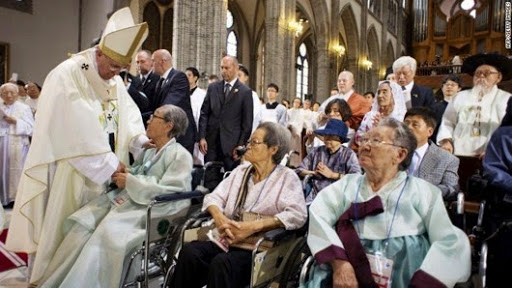
Francis in Korea: Come to my house, enter my heart

140818151053 pope comfort women s036314271 story tablet

Three weeks ago Pope Francis made a five-day visit to South Korea where he again spoke with great clarity about a number of topics and where he gave witness to the Good News of the Gospel by actions at least as much as by words. Instead of providing a comprehensive account of the trip, which can be found in many other places, I would just like to bring together my favorite passages from the around 15 talks he gave there.

Upon his arrival, Francis presented his approach to diplomacy:

“The quest for peace also represents a challenge for each of us, and in a particular way for those of you dedicated to the pursuit of the common good of the human family through the patient work of diplomacy. It is the perennial challenge of breaking down the walls of distrust and hatred by promoting a culture of reconciliation and solidarity. For diplomacy, as the art of the possible, is based on the firm and persevering conviction that peace can be won through quiet listening and dialogue, rather than by mutual recriminations, fruitless criticisms and displays of force.”

Followed by a reflection on how peace, justice and development are interrelated:

“Peace is not simply the absence of war, but “the work of justice” (cf. Is 32:17). And justice, as a virtue, calls for the discipline of forbearance; it demands that we not forget past injustices but overcome them through forgiveness, tolerance and cooperation. It demands the willingness to discern and attain mutually beneficial goals, building foundations of mutual respect, understanding and reconciliation. May all of us dedicate these days to peace, to praying for it and deepening our resolve to achieve it.”

And finally, he underlined the universal need of being heard:

“How important it is that the voice of every member of society be heard, and that a spirit of open communication, dialogue and cooperation be fostered. It is likewise important that special concern be shown for the poor, the vulnerable and those who have no voice, not only by meeting their immediate needs but also by assisting them in their human and cultural advancement.”

Later that same day, when addressing the Korean bishops, Francis warned them against becoming an affluent, middle class Church where the poor do not feel at home and that becomes mediocre:

“There is a danger, a temptation which arises in times of prosperity: it is the danger that the Christian community becomes just another “part of society”, losing its mystical dimension, losing its ability to celebrate the Mystery and instead becoming a spiritual organization, Christian and with Christian values, but lacking the leaven of prophecy. When this happens, the poor no longer have their proper role in the Church. This is a temptation from which particular Churches, Christian communities, have suffered greatly over the centuries; in some cases they become so middle class that the poor even feel ashamed to be a part of them. It is the temptation of spiritual “prosperity”, pastoral prosperity. No longer is it a poor Church for the poor but rather a rich Church for the rich, or a middle class Church for the well-to-do. Nor is this anything new: the temptation was there from the beginning. Paul had to rebuke the Corinthians in his First Letter (11:17), while the Apostle James was even more severe and explicit (2:1-7): he had to rebuke these affluent communities, affluent Churches for affluent people. They were not excluding the poor, but the way they were living made the poor reluctant to enter, they did not feel at home. This is the temptation of prosperity. I am not admonishing you because I know that you are doing good work. As a brother, however, who has the duty to confirm his brethren in the faith, I am telling you: be careful, because yours is a Church which is prospering, a great missionary Church, a great Church. The devil must not be allowed to sow these weeds, this temptation to remove the poor from very prophetic structure of the Church and to make you become an affluent Church for the affluent, a Church of the well-to do – perhaps not to the point of developing a “theology of prosperity” – but a Church of mediocrity.”

The next day, on 15th August, Francis had his first meeting with youth gathered from all over Asia, where he first recalled the need for the Church to “be a seed of unity for the whole human family,” and then proceeded to reflect on an experience shared before his address that was about the challenges of discerning one’s vocation:

“What Marina said really struck me: about the conflict she felt in her life. What to do in this situation? Take up the path of consecrated life, religious life, or study to be better able to help others.

This is only an apparent conflict, because when the Lord calls, he always does so for the good of others, whether it is through the religious life, the consecrated life, or as a lay person, as the father or mother of a family. The goal is the same: to worship God and to do good to others. What should Marina do, and the many others of you who are asking the same question? I once asked it myself: What path should I choose? But you do not have to choose any path! The Lord must choose it! Jesus has chosen it! You have to listen to him and ask: Lord, what should I do?

This is the prayer that a young person should make: “Lord what do you want from me?” With prayer and the advice of some good friends – laity, priests, religious sisters, bishops, popes (even the Pope can offer some good advice!) – you can find the path that the Lord wants for you.”

He then went on to underline the fundamental simplicity of love:

“The path of love is simple: love God and love your neighbor, your brother or sister, the one at your side, who needs love and so many other things. “But Father, how do I know that I love God?” Only if you love your neighbor, if you do not hate your neighbor and do not harbor hatred in your heart, do you love God. This is the sure proof.”

Later that day Francis paid a surprise visit to the Jesuit HQ in Korea, where he said the following to his brothers:

“There are no wounds that can’t be consoled by the love of God. This is how we must live: seeking Jesus Christ so that we may carry this love to consoling wounds, healing wounds. […] God always consoles, always waits, always forgets, always forgives. There are many wounds in the Church. Wounds that are often provoked by ourselves, practicing Catholics and ministers of the Church.

Don’t tell off the people of God anymore! Console the people of God! Often our clerical attitudes lead to clericalism that harms the Church so much. Being a priest does not result in the status of public officials, but of shepherd. Please, be shepherds and not public officials. And when you are in the confessional, remember that God never tires of forgiving. Be merciful!”

Two days later, Francis met bishops from all over Asia to whom he spoke about the simultaneous need for a clear sense of one’s own identity and of openness and receptivity to others, as the basis for dialogue:

“But in undertaking the path of dialogue with individuals and cultures, what should be our point of departure and our fundamental point of reference, which guides us to our destination? Surely it is our own identity, our identity as Christians. We cannot engage in real dialogue unless we are conscious of our own identity. We can’t dialogue, we can’t start dialoguing from nothing, from zero, from a foggy sense of who we are. Nor can there be authentic dialogue unless we are capable of opening our minds and hearts, in empathy and sincere receptivity, to those with whom we speak. In other words, an attentiveness in which the Holy Spirit is our guide. […] And if our communication is not to be a monologue, there has to be openness of heart and mind to accepting individuals and cultures. Fearlessly, for fear is the enemy of this kind of openness.”

And he proceeded to warn against becoming bogged down in formalism, superficiality and easy answers:

“Without a grounding in Christ, the truths by which we live our lives can gradually recede, the practice of the virtues can become formalistic, and dialogue can be reduced to a form of negotiation or an agreement to disagree. An agreement to disagree… so as not to make waves… This sort of superficiality does us great harm. […] Then […] there is [… another] temptation: that of the apparent security to be found in hiding behind easy answers, ready formulas, rules and regulations. Jesus clashed with people who would hide behind laws, regulations and easy answers… He called them hypocrites. Faith by nature is not self-absorbed; it “goes out”. It seeks understanding; it gives rise to testimony; it generates mission. In this sense, faith enables us to be both fearless and unassuming in our witness of hope and love. Saint Peter tells us that we should be ever ready to respond to all who ask the reason for the hope within us (cf. 1 Pet 3:15). Our identity as Christians is ultimately seen in our quiet efforts to worship God alone, to love one another, to serve one another, and to show by our example not only what we believe, but also what we hope for, and the One in whom we put our trust (cf. 2 Tim 1:12).”

Next, Francis insisted on the need for acceptance of others (“Come to my house, enter my heart.”) which has a profound basis in Jesus’ incarnation and in us all being children of the one Father. Empathy and a welcoming of others are core to Christianity and fear for one’s own identity is wholly unwarranted:

“[T]ogether with a clear sense of our own Christian identity, authentic dialogue also demands a capacity for empathy. For dialogue to take place, there has to be this empathy. We are challenged to listen not only to the words which others speak, but to the unspoken communication of their experiences, their hopes and aspirations, their struggles and their deepest concerns. Such empathy must be the fruit of our spiritual insight and personal experience, which lead us to see others as brothers and sisters, and to “hear”, in and beyond their words and actions, what their hearts wish to communicate. In this sense, dialogue demands of us a truly contemplative spirit of openness and receptivity to the other. I cannot engage in dialogue if I am closed to others. Openness? Even more: acceptance! Come to my house, enter my heart. My heart welcomes you. It wants to hear you. This capacity for empathy enables a true human dialogue in which words, ideas and questions arise from an experience of fraternity and shared humanity. If we want to get to the theological basis of this, we have to go to the Father: he created us all; all of us are children of one Father. This capacity for empathy leads to a genuine encounter – we have to progress toward this culture of encounter – in which heart speaks to heart. We are enriched by the wisdom of the other and become open to travelling together the path to greater understanding, friendship and solidarity. “But, brother Pope, this is what we are doing, but perhaps we are converting no one or very few people…” But you are doing it anyway: with your identity, you are hearing the other. What was the first commandment of God our Father to our father Abraham? “Walk in my presence and be blameless”. And so, with my identity and my empathy, my openness, I walk with the other. I don’t try to make him come over to me, I don’t proselytize. Pope Benedict told us clearly: “The Church does not grow by proselytizing, but by attracting”. In the meantime, let us walk in the Father’s presence, let us be blameless; let us practice this first commandment. That is where encounter, dialogue, will take place. With identity, with openness. It is a path to greater knowledge, friendship and solidarity. As Saint John Paul II rightly recognized, our commitment to dialogue is grounded in the very logic of the incarnation: in Jesus, God himself became one of us, shared in our life and spoke to us in our own language (cf. Ecclesia in Asia, 29).”

And finally, Francis places the importance of a shared journey above the others’ conversion and distances the Church from ideas of conquest:

“I am not referring to political dialogue alone, but to fraternal dialogue… “But these Christians don’t come as conquerors, they don’t come to take away our identity: they bring us their own, but they want to walk with us”. And the Lord will grant his grace: sometimes he will move hearts and someone will ask for baptism, sometimes not. But always let us walk together. This is the heart of dialogue.

The next day, during a meeting with religious leaders, Francis returns to the importance of shared journeying:

“Life is a journey, a long journey, but a journey which we cannot make by ourselves. We need to walk together with our brothers and sisters in the presence of God. So I thank you for this gesture of walking together in the presence of God: that is what God asked of Abraham. We are brothers and sisters. Let us acknowledge one another as brothers and sisters, and walk together.”

And finally, during the flight back to Rome, Francis again answers questions put to him there and then by the journalists on board, where three stood out for me in particular. First, in response to being asked about whether he isn’t concerned that his gesture of wearing a yellow ribbon (a sign of solidarity with the victims of the Sewol ferry disaster) might be misunderstood politically, Francis answers:

“Whenever you find yourself facing human suffering, you have to do what your heart tells you to. Then people will say: “He did it for this or that political reason”; let them say what they want. But when you think of these men and woman, these fathers and mothers who have lost their children, their brothers and sisters, of the immense pain of such a disaster, I don’t know, my heart.. I am a priest and I feel the need to draw near! That’s how I feel; that is the first thing. I know that the comfort that any word of mine might give is no cure, it doesn’t bring the dead back to life, but human closeness at these times gives us strength, there is solidarity… […] I would like to add something. I took this (holding up a ribbon). After I carried it for half a day – I took it for solidarity with them – somebody came up to me and said: It’s better to take that off… You should be neutral …” “But listen, where human suffering is involved, you can’t be neutral”. That was my answer; that’s how I feel.”

Second, in response to a question about military intervention in Iraq and also addressing the topic of torture, Francis says:

“Thank you for your very clear question. In these cases, where there is an unjust aggression, I can only say that it is licit to stop the unjust aggressor. I emphasize the word: “stop”. I’m not saying drop bombs, make war, but stop the aggressor. The means used to stop him would have to be evaluated. Stopping an unjust aggressor is licit. But we also need to remember! How many times, with this excuse of stopping an unjust aggressor, the powers have taken over peoples and carried on an actual war of conquest! One nation alone cannot determine how to stop an unjust aggressor. After the Second World War, there was the idea of the United Nations: that is where discussion was to take place, to say: Is this an unjust aggressor? It would seem so. How do we stop him?” This alone, nothing else. Second, minorities. Thanks for using that word. Because people say to me: “the Christians, the poor Christians…” And it is true, they are suffering, and martyrs, yes, there are many martyrs. But there are also men and women, religious minorities, not all Christians, and all are equal before God. To stop an unjust aggressor is a right of humanity, but it is also a right of the aggressor to be stopped in order not to do evil. […]

Today, torture is an almost, I would say, ordinary means used in intelligence work, in trials… And torture is a sin against humanity, it is a crime against humanity. And to Catholics, I say: to torture a person is a mortal sin; it is a grave sin, but even more, it is a sin against humanity.”

And third, in a question about his upcoming encyclical on ecology, Francis spoke again about the relationship between science and faith, being more specific about how he sees the value of science in the context of this document of Catholic teaching:

“[T]here are also scientific hypotheses [to be taken into account], some of them quite solid, others not. In this kind of encyclical, which has to be magisterial, one can only build on solid data, on things that are reliable. If the Pope says that the earth is the centre of the universe, and not the sun, he errs, since he is affirming something that ought to be supported by science, and this will not do. That’s where we are at now. We have to study the document, number by number, and I believe it will become smaller. But to get to the heart of the matter and to what can be safely stated. You can say in a footnote: “On this or that question, there are the following hypotheses…”, as a way of offering information, but you cannot do that in the body of encyclical, which is doctrinal and has to be sound.”
Just war?

Ploughshares

[Warning: long read :)]

Jesus was a pacifist. To deny this in the face of his own words – “But I say to you, whoever is angry with his brother will be liable to judgment.” (Matthew 5:22), “But I say to you, love your enemies, and pray for those who persecute you.” (Matthew 5:44), “But I say to you, offer no resistance to one who is evil. When someone strikes you on (your) right cheek, turn the other one to him as well.” (Matthew 5:39) and “Put your sword back into its sheath, for all who take the sword will perish by the sword.” (Matthew 26:52) – would be sheer dishonesty.

How about the Church though, has it stuck to Jesus’ pacifist position? Let’s see what it says in the Catechism:

“(§2304) Respect for and development of human life require peace. Peace is not merely the absence of war, and it is not limited to maintaining a balance of powers between adversaries. Peace cannot be attained on earth without safeguarding the goods of persons, free communication among men, respect for the dignity of persons and peoples, and the assiduous practice of fraternity.

(§2307) The fifth commandment forbids the intentional destruction of human life. Because of the evils and injustices that accompany all war, the Church insistently urges everyone to prayer and to action so that the divine Goodness may free us from the ancient bondage of war.

(§2308) All citizens and all governments are obliged to work for the avoidance of war. However, “as long as the danger of war persists and there is no international authority with the necessary competence and power, governments cannot be denied the right of lawful self-defense, once all peace efforts have failed.” (Gaudium et Spes, 79 § 4)

(§2309) The strict conditions for legitimate defense by military force require rigorous consideration. The gravity of such a decision makes it subject to rigorous conditions of moral legitimacy. At one and the same time:

  • the damage inflicted by the aggressor on the nation or community of nations must be lasting, grave, and certain;
  • all other means of putting an end to it must have been shown to be impractical or ineffective;
  • there must be serious prospects of success;
  • the use of arms must not produce evils and disorders graver than the evil to be eliminated.

The power of modern means of destruction weighs very heavily in evaluating this condition. These are the traditional elements enumerated in what is called the “just war” doctrine. The evaluation of these conditions for moral legitimacy belongs to the prudential judgment of those who have responsibility for the common good.

(§2314) “Every act of war directed to the indiscriminate destruction of whole cities or vast areas with their inhabitants is a crime against God and man, which merits firm and unequivocal condemnation.” (Gaudium et Spes, 80 § 3)”

While the above does talk about circumstances under which war is justified, it is a last resort, acceptable under the simultaneous satisfaction of specific conditions listed above, and has self-defense as its purpose, with indiscriminate destruction and the devastating effects of modern means of warfare ringing alarm bells. During the progress of such self-defense (the only possible trigger for just military action), the Catechism further emphasizes that “The Church and human reason both assert the permanent validity of the moral law during armed conflict. “The mere fact that war has regrettably broken out does not mean that everything becomes licit between the warring parties.” (Gaudium et Spes, 79 § 4)” and proceeds to warn against the abuses so endemic in war and against the accumulation of arms. Finally, the Catechism draws attention to the root causes, of which war can be a symptom, and calls for their treatment:

“(§2317) Injustice, excessive economic or social inequalities, envy, distrust, and pride raging among men and nations constantly threaten peace and cause wars. Everything done to overcome these disorders contributes to building up peace and avoiding war.”

And Pope Francis, where does he stand? There can be no doubt here that he, like Jesus, is an absolute pacifist:

“War is madness. It is the suicide of humanity. It is an act of faith in money, which for the powerful of the earth is more important than the human being. For behind a war there are always sins. [… War] is the suicide of humanity, because it kills the heart, it kills precisely that which is the message of the Lord: it kills love! Because war comes from hatred, from envy, from desire for power, and – we’ve seen it many times – it comes from that hunger for more power.” (Homily at Domus Sanctae Marthae, 2 June 2013).

“We have perfected our weapons, our conscience has fallen asleep, and we have sharpened our ideas to justify ourselves. As if it were normal, we continue to sow destruction, pain, death! Violence and war lead only to death, they speak of death! Violence and war are the language of death! […]

My Christian faith urges me to look to the Cross. How I wish that all men and women of good will would look to the Cross if only for a moment! There, we can see God’s reply: violence is not answered with violence, death is not answered with the language of death. In the silence of the Cross, the uproar of weapons ceases and the language of reconciliation, forgiveness, dialogue, and peace is spoken. […]

violence and war are never the way to peace! Let everyone be moved to look into the depths of his or her conscience and listen to that word which says: Leave behind the self-interest that hardens your heart, overcome the indifference that makes your heart insensitive towards others, conquer your deadly reasoning, and open yourself to dialogue and reconciliation. Look upon your brother’s sorrow and do not add to it, stay your hand, rebuild the harmony that has been shattered; and all this achieved not by conflict but by encounter! […]

Let the words of Pope Paul VI resound again: “No more one against the other, no more, never! … war never again, never again war!” (Address to the United Nations, 1965).” (Prayer Vigil for Peace, 7 September 2013)

And Francis is not alone is his radical stance against war, Blessed Pope John Paul II said that “War should belong to the tragic past, to history: it should find no place on humanity’s agenda for the future” and that “Humanity should question itself, once more, about the absurd and always unfair phenomenon of war, on whose stage of death and pain only remain standing the negotiating table that could and should have prevented it.” Benedict XVI too was clear about war being a failure: “War, with its aftermath of bereavement and destruction, has always been deemed a disaster in opposition to the plan of God, who created all things for existence and particularly wants to make the human race one family.”

So, you may ask, what is the point of writing about the attitude of Jesus, the Church and recent popes with regard to war, when it is so obviously pacifist and admitting of military self-defense only under almost theoretical, extreme conditions and applying to specific parts of an armed conflict? Sadly there are other, vocal proponents of a very different take on this topic, who – to my mind unbelievably – present their positions as Catholic and who tend to trace them to statements like the following one by George Weigel, who feels supported by Sts. Augustine and Thomas Aquinas:

“Thus those scholars, activists, and religious leaders who claim that the just war tradition “begins” with a “presumption against war” or a “presumption against violence” are quite simply mistaken. It does not begin there, and it never did begin there. To suggest otherwise is not merely a matter of misreading intellectual history (although it is surely that). To suggest that the just war tradition begins with a “presumption against violence” inverts the structure of moral analysis in ways that inevitably lead to dubious moral judgments and distorted perceptions of political reality.”

With Jesus and the Church’s position having been stated with such force and clarity over the last decades, I won’t even go to the trouble of addressing positions like Weigel’s point-by-point and would just like to note that they are akin to reading St. Paul and arguing in favor of slavery today. Positions that may be textually consistent with the source they claim justifies them, but that both miss the original author’s intentions (just think about what slavery would be like if “master” and “slave” followed St. Paul’s advice1) and the fact that the Church is the living Mystical Body of Jesus that has considerably matured over the last 2000 years.


1 “Slaves, be obedient to your human masters with fear and trembling, in sincerity of heart, as to Christ, not only when being watched, as currying favor, but as slaves of Christ, doing the will of God from the heart, willingly serving the Lord and not human beings, knowing that each will be requited from the Lord for whatever good he does, whether he is slave or free. Masters, act in the same way toward them, and stop bullying, knowing that both they and you have a Master in heaven and that with him there is no partiality.” (Ephesians 6:5-9) A classic “infiltrate and destroy from within” tactic if ever I saw one.

Igino Giordani: the oxymoron of a catholic party

Foco2

I have long been aware of the figure of Igino Giordani through his writings, of which the most beautiful one to me is his “Diary of Fire” and I also knew of his having been an MP in the Italian parliament, a journalist and an expert on the Fathers of the Church. It is only now though, after having read his memoirs (“Memorie d’un cristiano ingenuo” – “Memoirs of a simple christian”) that I am beginning to realize more fully the enormity of his example. While in the past I have very much admired certain aspects of his life, I am now seeing that it is really his life as a whole that is an instance of his imitation of Jesus. To give you a sense of what I mean, let me pick out just a couple of moments from his autobiography.

While I don’t intend to summarize his story, it is worth noting that Giordani (1894–1980) was the first of six children of a bricklayer and his illiterate wife and that he initially trained to become a bricklayer like his dad. Thanks to his father’s employer, who provided him with the necessary financial support, Giordani ended up attending a junior seminary and eventually studying humanities at the University of Rome. On the verge of going to university, he was conscripted and sent to fight in the First World War. There a bullet shattered a ten centimeter segment of his right femur, requiring a three year stay in hospital and a series of 18 operations (the first of which was performed without anesthetics!).

It is at this point of exposure to war, that I was particularly impressed by the following passage, where Giordani talks about the impossibility he felt of “killing a human person: a brother”:1

“The five or six shots that I fired, in the air, I did out of necessity: I could never aim the barrel of my gun at the enemy trenches, with the intention of killing a child of God.”

Upon being discharged from hospital at the end of the war, Giordani immediately finds himself confronted with another battle: that of opposing the fascist regime and the alignment of parts of the Church with it. Here he speaks out against clericalism, which is:

“an exploitation of religious power for the political ends of a government, a party, a bank, … [… It is an] iron belt, disguised as gold, by which the freedom of the children of God was restrained, the proclamation of the Gospel deformed and the spirituality of the Church compromised.”

And adds that:

“During other periods Christianity was being attacked in the name of reason and freedom, while today we can affirm that it is only by a destruction of reason and freedom that Christianity can be attacked.”

A particularly poignant assessment of that period is also expressed by him as follows:

“Christ wasn’t crucified because Judas betrayed him, but he was crucified because Pilate washed his hands of him.”

Giordani’s outspoken attacks against the abuse of clerical power and offenses against reason, published also in the monthly “Parte Guelfa” whose editor he was, led to a clear and direct condemnation by Church authorities in 1925. Instead of rebelling and placing himself in opposition against the Church, Giordani chose obedience and published one final issue of the magazine. There, on the first page, he reprinted the authorities’ condemnation and added that the magazine “submits itself fully” to the Church’s judgment and “happily offers its loyal and disinterested allegiance,” evidenced by its decision to shut down. This struck me in many ways like St. Thomas More’s silence, which in “A Man For All Seasons” was described as “bellowing up and down Europe!” or Pierre Teilhard de Chardin’s obedient submission to being denied permission to publish his theological and philosophical works.

After the war, Giordani moves from being part of the antifascist resistance to joining the public political life, which results in his becoming a member of the Italian parliament. Here, the following reasoning about how the Church and politics are to relate struck me in particular (and I believe it prefigures the Vatican II position also expressed in Lumen Gentium2):

“The Church incarnates the Gospel: but it mustn’t become a party, confuse itself with a category (party or regime) because it is catholic, i.e., universal, and, as the mystical Christ, it must love all, serve all, even enemies.”

All of the above paints a very clear picture to my mind of someone who was all about following Jesus, disregarding whether that brought him into conflict with state or Church, but also of someone who did it with tremendous humility and, as the memoirs’ title indicates, simplicity. A great example of this attitude is also the following event:

“One day Pius XII called me […] and asked me: “Giordani, but what have you written in that newspaper3 of yours? I have received complaints saying that you are a revolutionary” He then quoted a phrase from my latest cover story, where it says that the excess of the rich is the lack of the poor: that unjust or unjustly used property is theft.
“Holy Father,” I answered, “that is a quote from Saint John Chrysostom.”
“But you should have said so …”
“Holy Father, when an article is written in half an hour or an hour, there is not time for citing sources.”
“True, true, ” he said, beginning to smile, “They say that you are a revolutionary. But, don’t worry, they also say that about me: what do you think? In fact, in these days, Roosevelt put it as “too radical””
“But,” I replied, “a true christian is necessarily a revolutionary: don’t we want to change the world? But, our revolution is beneficial, it builds rather than destroys; brings love instead of hatred, it brings society back together in solidarity.”

There would be so much more to say about him (e.g., his life as a lay, married person and father of four, his establishing of the modern Vatican library (and publishing a journal of library science that both the Moscow and Beijing libraries subscribed to during the height of communism), his career as a writer, his encounters with the great minds of the 20th century, etc.), but that will have to wait for a future post. To conclude, let me instead leave you with the following poem by Igino Giordani, which also gives us a glimpse of his interior life:

“I have begun to die
and what happens,
matters to me no more;
now I want to vanish
in the forsaken heart of Jesus.
All this sinning,
by greed and by vanity,
in love disappears:
I have reconquered my freedom.
I have begun to die
to death that no longer dies;
now I want to rejoice
with God in his eternal youth.”

It should come as no surprise that Igino Giordani – Servant of God – is in the process of being recognized as a saint – a saint I will be very proud of!


1 All the quotes from Igino Giordani here are from “Memorie d’un cristiano ingenuo,” with the crude translations from Italian, for which I apologize, being mine.
2 “[T]he faithful should learn how to distinguish carefully between those rights and duties which are theirs as members of the Church, and those which they have as members of human society. Let them strive to reconcile the two, remembering that in every temporal affair they must be guided by a Christian conscience, since even in secular business there is no human activity which can be withdrawn from God’s dominion. [… I]t must be admitted that the temporal sphere is governed by its own principles, since it is rightly concerned with the interests of this world.” (Lumen Gentium, §36)
3 “Il Quotidiano” was a daily newspaper, directed by Giordani 1944–1946.