Oscar Wilde: Socialism, Jesus, Art

Roses for stalin

Even before reading his work, I was a fan of Oscar Wilde on the basis of his witticisms, with my favorite being the following (from The Picture of Dorian Gray): “It is only shallow people who do not judge by appearances.” While it could be dismissed as just a throwaway flourish, I have always felt a sense of depth behind it and proceeded to read his writings with great joy.

The other day I then came across a reference to his essay, “The Soul of Man under Socialism,” in the context of theories of art and I was immediately keen to read it. Even though the essay’s focus is socialism – a topic of limited interest to me, since I have experienced a failed attempt of implementing it first hand – I would like to acknowledge Wilde’s prophetic anticipation of the flaws of its authoritarian flavor, as practiced in the Soviet bloc, when he says: “If the Socialism is Authoritarian; if there are Governments armed with economic power as they are now with political power; if, in a word, we are to have Industrial Tyrannies, then the last state of man will be worse than the first.” +1!

What I found more interesting than the call to anarchic socialism, were Wilde’s thoughts on Jesus, whom he introduces thus:

“‘Know thyself’ was written over the portal of the antique world. Over the portal of the new world, ‘Be thyself’ shall be written. And the message of Christ to man was simply ‘Be thyself.’ That is the secret of Christ.”

This is a great synthesis of the Gospel and it seems to me that it derives from what is already there in Genesis, which says that “God created mankind in his image” (1:27). Being created in God’s image and being myself put me on a path towards God, closeness to whom is my fulfillment, and I see why Wilde presents it as Jesus’ “secret” and then proceeds to elaborate on what this “Be thyself” implies:

“What Jesus meant, was this. He said to man, ‘You have a wonderful personality. Develop it. Be yourself. Don’t imagine that your perfection lies in accumulating or possessing external things. Your affection is inside of you. If only you could realise that, you would not want to be rich. Ordinary riches can be stolen from a man. Real riches cannot. In the treasury-house of your soul, there are infinitely precious things, that may not be taken from you.’”

This very closely tracks Jesus’ saying: “Do not store up for yourselves treasures on earth, where moth and decay destroy, and thieves break in and steal. But store up treasures in heaven, where neither moth nor decay destroys, nor thieves break in and steal. For where your treasure is, there also will your heart be.” (Matthew 6:19-21). Such an attitude has direct consequences, which Wild puts in a particularly clear and again Gospel-mirroring way:

“If a man takes their cloak, they are to give him their coat, just to show that material things are of no importance. If people abuse them, they are not to answer back. What does it signify? The things people say of a man do not alter a man. He is what he is. Public opinion is of no value whatsoever. Even if people employ actual violence, they are not to be violent in turn. That would be to fall to the same low level. After all, even in prison, a man can be quite free. His soul can be free. His personality can be untroubled. He can be at peace. And, above all things, they are not to interfere with other people or judge them in any way.”

Reading the above, in particular the point about freedom in prison (which Wilde too knew about from first hand experience), made me think of all those who have been and to this day are imprisoned not for criminal reasons but as a form of persecution for their beliefs and convictions, whether political, personal or religious. The Vietnamese Cardinal François-Xavier Nguyễn Văn Thuận then sprung to mind, who insisted that the focus needs to be maintained on living in every present moment even as he was in solitary confinement while imprisoned by the Communist regime:

“While in prison, everyone waits for freedom, every day, every minute. We must live each day, each minute of our life as though it is the last.”

His was not only a tolerance of the desolate conditions he had to endure but a being himself as a follower of Jesus:

“I am happy here, in this cell, where white mushrooms are growing on my sleeping mat, because You are here with me, because You want me to live here with You. I have spoken much in my lifetime: now I speak no more. It’s Your turn to speak to me, Jesus; I am listening to You.”

Returning to Wilde’s essay, there is a clear sense of him having understood something profound about Jesus’ message, while at the same time I have to say that I am far from agreeing with his views on the family (where he claims that Jesus advocated its abolition) or on the poor (although he certainly makes important observations there also, especially as far as dignity is concerned). Only after these topics does Wilde turn to art, which was the initial motive for my reading his essay, and kicks off by warning against the exercise of control over art:

“[W]henever a community or a powerful section of a community, or a government of any kind, attempts to dictate to the artist what he is to do, Art either entirely vanishes, or becomes stereotyped, or degenerates into a low and ignoble form of craft. A work of art is the unique result of a unique temperament. Its beauty comes from the fact that the author is what he is. It has nothing to do with the fact that other people want what they want. Indeed, the moment that an artist takes notice of what other people want, and tries to supply the demand, he ceases to be an artist, and becomes a dull or an amusing craftsman, an honest or a dishonest tradesman. He has no further claim to be considered as an artist.”

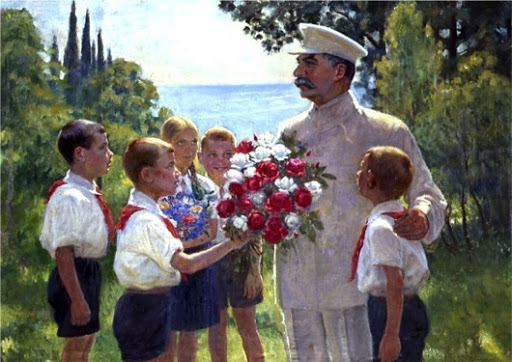
The key idea here is very much consonant with Kandinsky’s concept of the inner necessity and the dire consequences that Wild foretells in the case of dictatorship bearing on art are very much what I believe can be seen in that repugnant “art” called Socialist Realism or the soulless classicism of the Third Reich.

Wilde then makes a great point about the absurdity of public expectation and tastes attempting to influence art, by drawing parallels with science and philosophy:

“Art should never try to be popular. The public should try to make itself artistic. There is a very wide difference. If a man of science were told that the results of his experiments, and the conclusions that he arrived at, should be of such a character that they would not upset the received popular notions on the subject, or disturb popular prejudice, or hurt the sensibilities of people who knew nothing about science; if a philosopher were told that he had a perfect right to speculate in the highest spheres of thought, provided that he arrived at the same conclusions as were held by those who had never thought in any sphere at all–well, nowadays the man of science and the philosopher would be considerably amused.”

Finally, Wilde underlines again the absurdity of measuring art against past criteria and precedents:

“[A]n educated person’s ideas of Art are drawn naturally from what Art has been, whereas the new work of art is beautiful by being what Art has never been; and to measure it by the standard of the past is to measure it by a standard on the rejection of which its real perfection depends.”

The above very much reminds me of Le Corbusier exclaiming: “Every day, every hour, the Earth sees splendors surging up which are truths and present-day beauty,” and I have to say that I feel great affinity with what the last three artists – Le Corbusier, Kandinsky and Wilde – whose thoughts on art I have read recently are saying. True art springs from the innermost being of an artist – necessarily in the now – and cares only about its own honesty and purity. Yet, it is not detached from the world, since – in Wilde’s words – it rises up from “the perfection of the soul that is within him,” a perfection rooted in God and thereby connected to the souls of all.
Kandinsky: innermost necessity of the soul

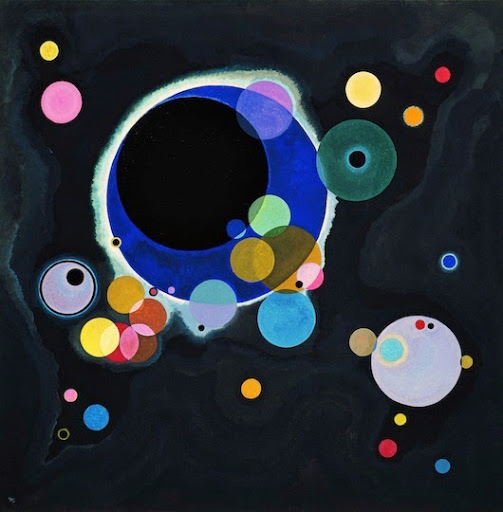
Kandinsky several circles website hd 5 13

[Warning: long read :)] Wassily Kandinsky, the father of abstract painting, is among those artists whom I have greatest affinity to, not for some specific reason, but simply because of the persistent bond that I feel between his work and myself. Looking at a piece like “Composition VIII” or at “St George I,” a reproduction of which we have in our living room, is always an experience that is hard to describe and that I prefer to leave unverbalized.

A couple of days ago I then came across a video from 1926 of him painting, which was a completely unexpected treat (thanks, @openculture!) and which lead me to his book “Point and line to plane,” where he gives the following, stunning definition of the point:

“The geometric point is an invisible thing. Therefore, it must be defined as an incorporeal thing. Considered in terms of substance, it equals zero. Hidden in this zero, however, are various attributes which are “human” in nature. We think of this zero — the geometric point — in relation to the greatest possible brevity, i.e., to the highest degree of restraint which, nevertheless, speaks. Thus we look upon the geometric point as the ultimate and most singular union of silence and speech. […] In the flow of speech, the point symbolizes interruption, non-existence The (negative element), and at the same time it forms a bridge from one existence to another (positive element). In writing, this constitutes its inner significance.”

This is clearly neither a mathematical definition, nor a scientific one (invisible=incorporeal?), but a phenomenological, even spiritual one. It is more like what a close friend would say in a eulogy, and that is how I felt when reading this book: to Kandinsky the point, line and plane were not some hypothetical concepts, but intimate friends and collaborators. His writing about them at times sounds like a person’s memoirs, rather than detached rationalizations of a theorist. Needless to say, I was hooked, and then delighted when I came to reading the foreword to the book (which I don’t tend to do as a rule) and discovering that “Point and line to plane” was the sequel to “On the spiritual in art.” This fact alone pointed me to another interpretative key for the above passage about the point, and its parallels with the person of Jesus and indeed with the Trinity jumped out at me. The process of non-existence, while simultaneously bridging between existences is precisely the dynamic between the persons of the Trinity (each emptying themselves – becoming nothing1 – out of love for the other).

If you have any interest in art, I can’t recommend “On the spiritual in art” too highly – not only is it an insight into one of the greatest painters of all time, but, to my mind, it is of the order of Plato’s Republic in terms of foundation myths.

Kandinsky starts out by emphasizing the necessity to act in the present moment (much like Le Corbusier insisted too), instead of attempting to imitate the past, which he depicts in harsh terms:

“[E]very cultural period creates art of its own, which can never be repeated again. An effort to revive art-principles of the past, at best, can only result in works of art resembling a still-born child. […] The sculptor’s attempts to employ Greek principles can only achieve a similarity in form, while the work itself remains for all time without a soul.”

Within the space of a couple of pages from the beginning, Kandinsky then proceeds to present his view of the hierarchy of spiritual life, which he equates with that of artistic life, since “[the] grammar of painting [… are] the rules of the inner necessity […] of the soul.”:

“A large acute triangle divided into unequal segments, the narrowest one pointing upwards, is a schematically correct representation of spiritual life. The lower the segment the larger, wider, higher, and more embracing will be the other parts of the triangle. The entire triangle moves slowly, almost invisible, forward and upward and where the apex was “today,” the second segment is going to be “tomorrow,” that is to say, that which today can be understood only by the apex, and which to the rest of the triangle seems an incomprehensible gibberish, tomorrow forms the true and sensitive life of the second segment.

At the apex of the top segment, sometimes one man stands entirely alone. His joyous vision corresponds to a vast inner sorrow, and even those, who are closest to him, do not comprehend him. […] Artists are to be found in every segment of this imaginary triangle. Each one of these artists, who can see beyond the limits of his present stage, in this segment of spiritual evolution is a prophet to those surrounding him and helps to move forward the ever obstinate carload of humanity. However, one of those not possessed by such vision, or misusing it for base purposes and reasons, when he closes the triangle may be easily understood by his fellow men and even acclaimed. The larger the segment (that is, the lower it lies in the triangle), the greater is the number of people to comprehend the words of the artist. In spite of it and correspondingly every group consciously or unconsciously hungers for spiritual food.”

While the above is unquestionably elitist, there are several details to note, which, I believe, hint at a dichotomy with the universally-accessible. First, the interconnectedness of the entire universe of spiritual ascent and the impact of its protagonists on all (“where the apex was “today,” the second segment is going to be “tomorrow.””). Second, the positive view of everyone’s potential to comprehend advances in art, albeit with a delay (“[T]hat which today […] to the rest of the triangle seems an incomprehensible gibberish, tomorrow forms the true and sensitive life of the second segment.”). Third, the desire of all for genuine spiritual food, in spite of some contenting themselves with fakes. Added to the above pull towards democratization of the elite striving for spiritual/artistic progress is also his declaration that “[a]nyone, who absorbs the innermost hidden treasures of art, is an enviable partner in building the spiritual pyramid, which is meant to reach into heaven.”

This tension is further carried forward, when Kandinsky argues that there is only a single criterion for what makes eternal art – its “inner necessity” from the perspective of its author:

“The artist should be blind to the importance of “recognition” or “non-recognition” and deaf to the teachings and demands of the time. His eye should be directed to his inner life and his ear should harken to the words of the inner necessity. Then, he will resort with equal ease to every means and achieve his end. […] All means are sacred when called upon by innermost necessity.”

““[O]uter necessity” […] can never lead beyond the limits of the conventional, that is, traditional “beauty” only. The “inner necessity” does not know such limits and, for this reason, often creates results which are conventionally termed “ugly.” “Ugly” is, therefore, only a conventional term which continues to lead a sham life long after the inner necessity […] has been superseded. At that time, everything was considered ugly if it was not connected with the inner necessity of the time, and anything so connected was termed beautiful. Everything, which appeals to the inner necessity is already beautiful by its virtue, and will be recognized sooner or later.”

“As no “dissonant notes” exist in music, nor in painting “inharmony,” in these two art expressions every sound, whether harmony or discord, is beautiful (appropriate), if it results from inner need. The inner value of each and every movement will soon be felt, as the inner beauty replaces the sensuous aspect. Thus, “ugly” movements suddenly appear beautiful, from which an undreamed power and vital force will burst forth instantly.”

Rooting perfection in “inner necessity” also changes the criteria by which art is judged and the means that are justified for its pursuit:

“A “perfect drawing” is the one where nothing can be changed without destroying the essential inner life, quite irrespective of whether this drawing contradicts our conception of anatomy, botany, or other sciences.”

“Likewise, colours should be used not because they are true to nature but only because the colour harmony is required by the paintings individually. The artist is not only justified in using any form necessary for his purposes, but it is his very duty to do so. Neither anatomical correctness nor any basic overthrow of scientific statements are necessary, only the artist’s unlimited freedom in the selection of his means.”

“This unlimited freedom must be based on inner necessity (which is called honesty). This is not only the principle of art but of life. This principle is the great sword of the superman with which he fights the Philistines.”

More than anything, the above reminds me of St. Augustine’s most famous dictum: “Love and then what you will, do,” which we could put into Kandinsky’s mouth as “Be honest and then what you will, paint,” without incurring any contradiction with his own words.

I have to say that reading “On the spiritual in art” has made me feel even closer to Kandinsky and has armed me with new means, with which I can revisit his paintings (and those of others!) in an attempt to connect with the innermost necessity that lead to their creation.


1 This self-emptying – kenosis – is explicitly indicated in St. Paul’s letter to the Philippians (2:5-9) and beautifully explained also by Hans Urs von Balthasar: “The Father, in uttering and surrendering himself without reserve, does not lose himself. He does not extinguish himself by self-giving, just as he does not keep back anything of himself either. For in this self surrender he is the whole divine essence. Here we see both God’s infinite power and his powerlessness; he cannot be God in any other way but in this “kenosis” within the Godhead itself.” (Theo-Drama: Theological Dramatic Theory: The Action Vol 4).