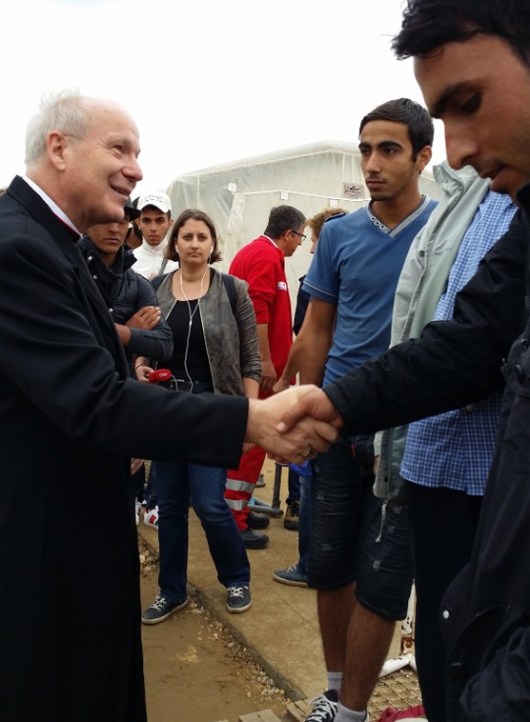
Yesterday, the Jesuit journal, La Civiltà Cattolica, published an extensive interview of its director Fr. Antonio Spadaro, SJ with Cardinal Christoph Schönborn of Vienna in Italian. Even though some partial translations in English are already available, the following is my, rough translation of the passages that spoke to me most strongly (it is around 90% of the full text and the passages I left out were only left out for practical reasons …).
In response to a question about whether the scope of the upcoming Synod on the family ought to be doctrinal, Cardinal Schönborn replied:
“The challenge that Pope Francis puts in front of us is to believe that, with the courage that comes from simple closeness, from the everyday reality of people, we will not distance ourselves from doctrine. We don’t risk diluting its clarity by walking with people, because we ourselves are called to walk in faith. Doctrine isn’t, in the first place, a series of abstract statements, but the light of the word of God demonstrated by the apostolic witness at the heart of a Church and in the hearts of believers who walk in the world today. The clarity of the light of faith and its doctrinal development in each person is not in contradiction with the journey that God undertakes with us, who are often far from living the Gospel fully.”
When asked about how we ought to view and what attitude we ought to have towards those who live in irregular arrangements, he then replied:
“At the last Synod, I proposed an interpretative key that has lead to much discussion and was referred to in the Relatio post disceptationem, but that was no longer present in the final document, the Relatio Synodi. It was an analogy with the ecclesiological interpretative key given by Lumen Gentium, the constitution on the Church, in its article 8. There the question is: “Where is the Church of Christ? Where it is incarnated concretely? Does the Church of Jesus Christ, which he desired and founded, really exist?” To this, the Council responded with the famous statement: “The only Church of Christ subsists in the Catholic Church”, subsistit in Ecclesia catholica. It is not a pure and simple identification, like saying that the Church of Jesus Christ is the Catholic Church. The Council affirmed: it “subsists in the Catholic Church”, united with the Pope and legitimate bishops. The Council adds this phrase, which has become key: “Although many elements of sanctification and of truth are found outside of its visible structure. These elements, as gifts belonging to the Church of Christ, are forces impelling toward catholic unity.” Other denominations, other churches, other religions are not simply nothing. Vatican II excludes and ecclesiology of the all or nothing. The all is fulfilled in the Catholic Church, but there are elements of truth and holiness in other churches, and even in other religions. These elements are elements of the Church of Christ, and by their nature they tend to catholic unity and the unity of mankind, towards which the Church herself tends, in anticipation of, so to speak, the great plan of God that is the one Family of God, humanity. The approach of the Council is justified in this key, because of which one does not consider first what is missing in the other Churches, Christian communities or religions, but what is positive there. One gathers the semina Verbi, as has been said, the seeds of the Word, elements of truth and sanctification.”
And how does this translate to the family?
“I simply proposed to apply this interpretation to the ecclesiological reality of the sacrament of marriage. Because marriage is a Church in miniature, an ecclesiola, the family as a small Church, it seems legitimate to me to establish an analogy and say that the sacrament of marriage is fully realized where there is a properly established sacrament between a man and a woman living in faith etc. But this does not prevent that, outside of this full realization of the sacrament of marriage, there be elements of marriage that are anticipatory signs, positive elements.”
Let’s take, for example, civil marriage:
“Yes, we consider it as something more than simple cohabitation. Why? It is a simple civil contract that from a strictly ecclesial point of view has no meaning. But we recognize that in civil marriage there is more commitment, therefore a greater alliance, than in simple cohabitation. The two make a commitment before society, humanity and themselves, in a more explicit alliance, anchored legally with sanctions, obligations, duties, rights … The Church believes that this is a further step than simply living together. There is in this case a greater proximity to sacramental marriage. As a promise, an anticipatory sign. Instead of speaking about all that is missing, one can approach these realities, noting the positive that exist in this love that is becoming more stable.”
How do we therefore consider situations that have objective shortcomings?
“We should look at the numerous situations of coexistence not only from the point of view of what is missing, but also from the point of view of what is already promised, what is already present. Moreover, the Council adds that, although there is always real holiness in the Church, it is made up of sinners and advances along the path of conversion (LG 8). It is always in need of purification. A Catholic mustn’t put themselves on a step above others. There are saints in all the Christian churches, and even in other religions. Jesus said twice to the pagans, a woman [cf. Luke 8:48] and a Roman officer [Luke 7:9]: “I tell you, not even in Israel have I found such faith.” A true faith, that Jesus found outside the chosen people.”
So, the dividing line is not between those who live sacramental marriage and who don’t?
“Those who have the grace and the joy of living sacramental marriage in faith, humility and mutual forgiveness, in a trust in God who acts in our daily lives, know how to look and discern in a couple, in a cohabitation, the elements of true heroism, true charity, true mutual giving. Even though we must say: “It is not yet the full reality of the sacrament.” But who are we to judge and say that there are no elements of truth and sanctification in them? The Church is a people that God draws to himself and to which all are called. The Church’s role is to accompany everyone in growth, along a path. As a pastor I experience this joy of being on a journey, among believers, but also among many non-believers.”
Cardinal Schönborn then gives examples of how a person who has been through several marriages may find faith in later life and how accompanying them and caring for them may require considering their specific, individual circumstances rather than a simple application of rules. He concludes that answer with saying “I can’t hide […] that I have been shocked by how a purely formalist way of thinking wields the axe of the “intrinsece malum.” Fr. Spadaro then explains it in a footnote thus: “What is meant by an “intrinsically evil” (intrinsece malum) act is an action whose moral connotation is such that it can in no case change from negative to positive. Therefore it is an act that is always considered morally evil, irrespective of the ulterior intentions of the one acting and of the circumstances.”
Could you elaborate on the problem of that which is defined as “intrinsece malum”?
“In practice, it excludes any reference to the question of fitness [convenientia] that, for St. Thomas, is always a way of expressing prudence. It is neither utilitarianism nor an easy pragmatism, but a way to express a sense of appropriateness, of conformity, of harmony. Regarding the question of divorce, this type of argument has been systematically excluded by our intransigent moralists. If misunderstood, the intrinsece malum suppresses discussion of – by definition complex – circumstances of and situations in life. A human act is never simple, and the risk is to “paste” in a false relationship between the true object, purpose and circumstances, which instead should be read in the light of freedom and of an attraction to the good. The free act is reduced to a physical one so that the clarity of logic suppresses any moral discussion and all circumstances. The paradox is that by focusing in the intrinsece malum one loses all the wealth, I would say almost the beauty of a moral articulation, resulting in its annihilation. Not only does the moral analysis of situations become univocal, but but one is left cut off from a comprehensive perspective on the dramatic consequences of divorce: economic, educational, psychological, etc. This is true for everything that regards the themes of marriage and the family. The obsession with intrinsece malum has so impoverished the debate that we are deprived of a wide range of arguments in favor of the uniqueness, indissolubility, openness to life, of the human foundation of the doctrine of the Church. We have lost the flavor of discourse on these human realities. One of the key elements of the Synod is the reality of the Christian family, not from an exclusive point of view, but from an inclusive one. The Christian family is a grace, a gift of God. It is a mission, and by its nature – if it is lived in a Christian way – is something to be welcomed. I remember a proposal for a pilgrimage for families in which the organizers wanted to invite only those who practice natural birth control. During a meeting of the Bishops Conference we asked them how they would: “Select only those who practice 100%, n%? How do you do that?”. From these somewhat caricature expressions you realize that if the Christian family is lived in this way, it inevitably becomes sectarian. A world apart. When you seek safety, you are not a Christian, you are focused only on yourself!”
On the challenges of pastoral accompaniment of persons living in irregular unions:
“If a valid sacramental marriage existed, a second marriage is an irregular union. However, there is the whole dimension of spiritual and pastoral care for people living in irregular situations, where it will be necessary to discern between everything and nothing. You can not transform an irregular situation into a regular, but there are ways of healing, of deepening, ways in which the law is experienced step by step. There are also situations where the priest, the accompanying person, who knows the people well, may arrive at saying: “Your situation is such that, in conscience, in your and in my consciousness as a pastor, I see your place in the sacramental life of the Church.””
Could you tell me about a pastoral experience that was particularly significant for you?
“I have an unforgettable memory of the time when I was a student at Saulchoir, with the Dominicans in Paris. I was not yet a priest. Under the bridge over the Seine that leads to the Évry convent lived a homeless couple. She had been a prostitute and I don’t know what he has done in life. Certainly they were not married, nor did they frequent the Church, but every time I passed by there, I said to myself: “My God, they help each other along the path through such a hard life.” And when I saw gestures of tenderness between them, I said to myself: “My God, it is beautiful that these two poor people should help each other, what a great thing!” God is present in this poverty, this tenderness. We must break free from this narrow perspective on the access to the sacraments in irregular situations. The question is: “Where is God in their lives? And how can I, as a pastor, discern the presence of God in their lives? And how can they can me to better discern the work of God in a life?” We need to learn how to read the Word of God in actu [in reality] between the lines on which life is written and not only between the lines of incunabula!”
Are there any situations that are irreparable for the mercy of God?
“There may certainly be situations of self-exclusion. When Jesus says: “But you were unwilling” [Matthew 23:37]. Faced with this, in some way, God is disarmed, because He gave us the freedom … And the Church must recognize and accept the freedom to say no. It’s hard to want to reconcile at all costs complex situations in life with full participation in the life of the Church. This will never prevent either hoping or praying, and will always be an invitation to entrust such a situation to the providence of God, which can continuously offer instruments of salvation. The door is never closed.”
How can we find realist and Gospel-based words to accompany homosexuals along their journey of faith?
“We can and we must respect the decision to form a union with a person of the same sex, to seek means under civil law to protect their living together with laws to ensure such protection. But if we are asked, if it is demanded of the Church to say that this is a marriage, well, we have to say: non possumus [we cannot]. It is not a discrimination of persons: to distinguish does not mean to discriminate. This absolutely does not prevent having great respect, friendship, or collaboration with couples living in this kind of union, and above all we mustn’t look down on them. No one is obliged to accept this doctrine, but one can’t pretend that the Church does not teach it.”
Have you come across circumstances in the lives of homosexuals that have spoken to you in a particular way?
“Yes, for example, I know a homosexual person who has lived a series of experiences for years, not with a particular person or cohabiting, but frequent experiences with different people. Now he has found a stable relationship. It is an improvement, if nothing else then on a human level, this not jumping from one relationship to another, but being in a stable relationship that is not based only on sexuality. One shares one’s life, one shares the joys and sufferings, one helps one another. We must recognize that this person has made an important step for his own good and for the good of others, even though, of course, this is not a situation that the Church can consider regular. The judgment on homosexual acts as such is necessary, but the Church mustn’t look first in the bedroom, but in the dining room instead! We must accompany.”
What then is the correct, Gospel-based attitude in the face of all these challenges?
“Pope Benedict has magnificently shown in his teaching that the Christian life is not at first a morality, but a friendship, a meeting, a person. In this friendship we learn how to behave. If we say that Jesus is our teacher, it means that we learn directly from him the path of Christian life. It is not a catalog of abstract doctrine or a backpack full of heavy stones that we must carry, it is a living relationship instead. In the life and Christian practice of following Christ, the Christian path shows its soundness and its fruits of joy. Jesus promised us that on this path “the Holy Spirit will teach you everything and remind you of all that I told you.” (Jn 14:26). The entire doctrine of the Church acquires sense only in a living relationship with Jesus, of a friendship with him and a docility towards the guidance of the Holy Spirit. Herein lies the power of Pope Francis’ gestures. I think that he really lives the charism of the Jesuits and of St. Ignatius, that of being available to the movement of the Holy Spirit. It is also the classical doctrine of St. Thomas on the new law, the law of Christ, which is not an external law, but the work of the Holy Spirit in the human heart. Of course, we also need external teaching, but for it to be a living reality, it must pass through the heart. When we observe a lived Christian marriage, we perceive the meaning of marriage; and seeing Mother Teresa in action, in her gestures, we understand what it means to love the poor. Life teaches us doctrine, more than doctrine not teaching us life.”
How do we unite the two dimensions of doctrine and mercy?
“The doctrine of the Church is the doctrine of the Good Shepherd. In an attitude of faith, there is no opposition between “doctrine” and “pastoral”. Doctrine is not an abstract utterance without a link to “what the Spirit says to the churches” (Rev 2.7). Pastoral ministry is not a degraded putting into practice, or even a pragmatic version of doctrine. The doctrine is the teaching of the “Good Shepherd”, which manifests itself in his person, the true way of life, a teaching of a Church who, as she walks, goes towards all those who are awaiting Good News, a waiting that is sometimes kept secret in the heart . The pastoral is a doctrine of salvation in actu [in reality], the “Good Teacher”‘s Word of life for the world. There is an involution between these two dimensions of the Word of God, of which the Church is bearer. The pastoral without doctrine is nothing but a “clashing cymbal” (1 Cor 13.1). The pastoral without doctrine is only “human thought” (Mt 16:[23]). Doctrine is first of all the Good News: “For God so loved the world that he gave his only Son, so that everyone who believes in him might not perish but might have eternal life.” (Jn 3:16). It is the announcement of the fundamental truth of faith: God has used mercy. And all that the Church teaches is this message, that is then translated into complementary doctrines, into a true hierarchy of truth, both dogmatic and moral. We must constantly return to the kerygma, to what is essential and gives meaning to our whole body of doctrine, especially to moral teaching.”
We need to be pastors [shepherds] …
“Pope Francis calls each of us, pastors to a real pastoral conversion. In the final speech of the Synod, he summed up what he meant when he said that the experience of the Synod is an experience of the Church: one, holy, catholic, and apostolic and composed of sinners, in need of His mercy. It is the Church who is not afraid of eating and drinking with prostitutes and tax collectors. The Pope expresses perfectly the balance that must characterize this pastoral conversion. At the end of this, his speech, all spontaneously stood up, and there was a unanimous and intense applause. Everyone felt that it was the Pope, Peter, who spoke.”
I feel a great sense of gratitude towards Cardinal Schönborn for his deep wisdom and obvious love for humanity, that has also shone during this last days in his welcoming of Syrian refugees – a welcoming that was not only conceptual by highly practical when he went to meet and welcome them as they crossed the border from Hungary to Austria. I wish the bishops of other Central European countries would follow his example. I am also grateful to Fr. Spadaro for not only having conducted such an outstanding interview, but for having made it freely available. Thank you!
 eyebeleave