Today I’d like to bring you my, rough English translation of Cardinal Gianfranco Ravasi’s 2011 talk, entitled: “The invisible in the visible: art and faith,” which has given me great joy and which I hope will delight you too:
The title of this talk, “The invisible in the visible: art and faith”, points spontaneously to two great painters of the last century. On the one hand Paul Klee and on the other Joan Miró, who in different ways, but with the same substance, have declared that art does not represent the visible, but the invisible that is in the visible. […]
For Vasari, the holy and the beautiful, holiness and beauty, intertwine. Not as extrinsic realities, but almost as if they were, among themselves, sisters. So, in a certain sense we can say, and I would like to demonstrate only […] this sisterhood between art and faith. […]
As a premise, we know that a single expression is used, curiously, to indicate two realities that are similar, but that are also profoundly different. Isn’t it true that one speaks about the inspiration of the Scriptures, of the word of God? The word of the Scriptures is inspired. And doesn’t this same expression also get used to speak about artistic inspiration? It can therefore be seen that both faith and art, the witness of the divine word and of the human word, have inside them a seed of eternity. A seed of the infinite. A dimension that precedes them and that exceeds them, that surpasses them.
The artist, in a certain sense like the prophet, has inside them a voice that comes from the beyond and the other. And Beyond and Other need to be written with capital letters. The invisible that is in the visible.
It is interesting to note that, e.g., in the Scriptures, chapter 35 of Exodus speaks about Bezalel, who is an artisan, an artist, who built the ark and the mobile temple of the desert that the Hebrews carried with them. Having left the drama of their enslavement in Egypt behind, they carry with them a mobile temple. So, what is said about this artist is that he was filled with the spirit of God (cf. Exodus 35:30-31), exactly like a prophet.
And think about how in the first book of Chronicles, in chapter 25 […] musicians are mentioned, the singers in the temple. It is said that they were inspired by God. And do you know what Hebrew expression is used? Navi – the same one as used for prophets (cf. 1 Chronicles 25:1). Prophets and musicians are almost the same reality, infused by the spirit of God.
This is why speaking about art and faith isn’t speaking about two external realities. Unfortunately, however, as we know well, a divorce has been consummated and art and faith do not walk together anymore. Therefore we must struggle to rediscover [..] the harmony that is beneficial for art, precious for art, so that it no longer has to lose itself in the vague, the inconsistent, the banal, and may rediscover the great narratives, the great symbols, the great themes, the great challenges: the invisible. On the other hand it is beneficial for faith because we must say “God” in a beautiful way, as the Bible says in Psalm 47: “sing to God with art!”1
My reflection […] is linked to two movements that revolve around a single symbol. A symbol that, I have to say, is a bit strange and that might puzzle you. […] I take this symbol from a phrase of the then-Cardinal Ratzinger, from one of his articles on faith and art. He wrote the following words, in which you will see the symbol that I’ll then use: “Beauty wounds, and by doing so reminds the person of their ultimate destiny.” Hence, beauty, art as a wound. And we will see that faith too is a wound.
So, let’s start with this theme: the wound. The wound makes us bleed. The wound unsettles, torments. It doesn’t let you sleep. It is a plague. Hence, art, like faith, have this scope. To make you tremble.
What is the great illness of our times? […] Indifference, superficiality, banality. The French Catholic writer, Bernanos, in one of his novels […] – The Impostor, tells the story of a priest – Fr. Cenabre – who loses his faith and becomes an atheist. He writes: “There is a fundamental difference between emptiness and absence. Emptiness is nothing, a lack of substance. Absence is not a nothing.” When I go home, to my sisters, in the north, in Milan, we still have the two empty chairs of my dad and my mother. They are apparently empty. But, in reality, they aren’t. They are an absence. An absence that, in this case, is filled with memories, and for the believer also with another type of presence, by a nostalgia. Our times have lost the absence of God, the nostalgia for great values. These are empty times, lacking substance.
Some of you will know the great painter, Braque, friend of Picasso, cubist, who then also went beyond cubism, and so on, and who died in 1963. And Braque said this phrase, which is not entirely true, but that has its meaning: “Art is made to disturb, science to reassure.” Technology. We are children of technology. Technology will solve all your problems. Don’t ever ask yourselves the great questions.
This is why we must return greatness to art. When I speak about art I don’t only have figurative arts in mind – sculpture, painting, etc. – I speak about art in general, with all of its thousand manifestations that pass from literature through music to photography to the cinema. We have a need for returning to, rediscovering this restlessness.
[…] Henry Miller, who as a profoundly anti-christian writer, even a scandalous one at a certain moment, wrote a book entitled “The wisdom of the heart.” And in that work there is the following paradoxical phrase on which we must meditate: “Art, like faith, is good for nothing, other than to give you the meaning of life.”
You see, if you have to look for food, for the immediate, are chasing fashions, you have no need for art. On the contrary! Poetry. What’s it for? Hölderlin wrote an entire poem: “Wozu Dichter?” [“Why poets?”] Apparently they are good for nothing. But, like faith, they point you to the meaning of life.
That is why we need this wound, this restlessness, in a time that is so superficial, in which we are dragged along, in which we have passed from immorality, which means that we are at least aware of it, to amorality, total indifference. […]
The wound keeps you awake. And it therefore keeps you continuously looking. So, there is another element that associates art and faith in this context of the wound. Wonder. When you are in front of a work of art, that work of art isn’t to be explained, to tell the truth. You can say something about its origin, about the image it depicts, about something. But, you have to, in the end, if you want to enter in harmony with it, succeed in establish a bond of wonder, of contemplation, as is indeed the case with faith. Yes, there is need for reason, but in the end, art is an intuition, something that dazzles you.
The poet, Ezra Pound, said:2 “Do you perhaps explain the charm of an April wind? Do you perhaps explain the luminous beauty of one of Plato’s thoughts? Do you perhaps explain the unexpected beauty that you perceive in a woman’s face?” They don’t have explanations. You discover them, unexpectedly. They are an epiphany. So, we still need clear eyes. Eyes that has been dirtied by so many images of extreme vulgarity and superficiality and violence … We need to regain the eye of a child that is filled with wonder when faced with the marvels of being and of human creatures. In front of the marvels of the divine. This is why faith and art are like each other.
The English writer […] Chesterton, wrote these words: “The dignity of the artist lies in his duty of keeping awake the sense of wonder in the world.” And he continued: “The world will never starve for want of wonders; […] There are plenty of them, I assure you […], but only for want of wonder.” Because it is no longer able to contemplate, to look, to go beyond the skin, the surface of things.”
This was my first reflection, the simpler one, the second one is a little more complex, also because I would like to enter the theme in a more profound way.
Art and faith as wound, as we have said, that generates restlessness, that makes you tremble, that looks for something that isn’t there in our times anymore: the question about the meaning of what you do, who you are, of what is.
In the second reflection I will take that same symbol of the wound [“ferita”] that in Italian has another word that derives from it: “slit” [“feritoia”].3 So, I would say that art, like faith, is a slit through which the absolute, the transcendent, mystery can be accessed. I would, therefore, like to invite you now to look for where these slits are so that we may discover a mystery, something that exceeds us, that transcends us, which is what true art and great, authentic faith need to do. I would, in this regard, like to put forward five ways, which in the end justify the fact that there exists a religion like the Christian one, which is the celebration of art.
Let’s start from a Biblical text what, paradoxically, begins with a negation of art. You remember the first commandment of the decalogue, the great, so called aniconic commandment, i.e., that wipes out images: “You shall not make for yourself an idol or a likeness of anything in the heavens above or on the earth below or in the waters beneath the earth” (Exodus 20:4). Avert your eyes from the golden calf! Sure, it is idols that are condemned here, but then you know that during the course of history some have taken this by the letter, and have drowned art. Think of Islam which, for some time already is moving in this direction. God must never be represented, and human beings neither, because there is always this risk of idolatry. […] It is not for nothing that at a certain moment Protestantism has exalted music in a particular way. Bach was a protestant. Schütz was a protestant. Pachelbel – protestant. Then there is Handel. A whole line that goes towards music, towards its sound that is extraordinarily potent in speaking to us about the eternal and the infinite, while avoiding recourse to images. Why is it then that Christianity has instead, over the centuries, returned to and celebrated the image.
Overcoming this silence, the silence of the images of art therefore, has been done in certain ways, which I would now like to evoke because they are ways in which the famous slit appears.
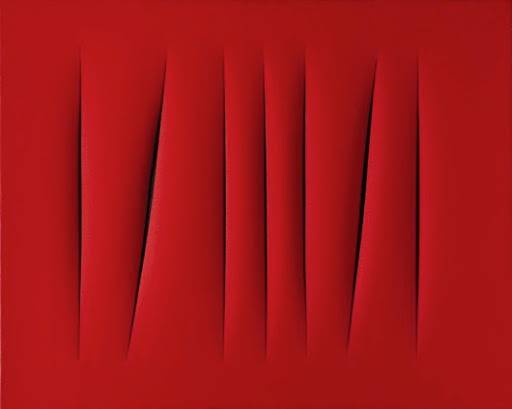
In parenthesis, regarding slits, I would like to tell you something that you may not have heard before. […] You all know a great painter, who was important in the last century: Lucio Fontana. I knew his widow, and I know many of his works since I am from Milan and he was from Milan too. Why is Fontana famous? Because, at a certain moment, he made that famous gash in a canvas. He painted it and slashed it. And do you know that when others asked: “But why?,” critics elaborated complicated discourses to explain it. But when they asked the artist himself, he responded with a phrase that is almost the formulation of the thesis of this second movement. He replied: “For me, this cut is a glimmer of the absolute, of the infinite.” It is almost a going beyond the canvas, beyond matter, to look for depth, for the secret.
First of all there is a place where the Bible sees a slit opening towards the infinite, the eternal, the divine. And this reality, a reality that is fundamental also, e.g., for literature, is the word. If you look closely, God, precisely because images are forbidden, is presented in the beginning of the first line of the Bible using this expression: “God said: Let there be light, and there was light.” (Genesis 1:3). The silence of nothingness is slashed by a word. Also, how does the New Testament begin? Ideally, with the prologue of John: “In the beginning was the Word.” (John 1:1). Absolute primacy.
When Moses, and maybe you have never heard this phrase, because it is from a book that is read little, speaks in Deuteronomy, the fifth book of the Bible, in its fourth chapter, verse 12. When in Deuteronomy Moses describes the entire experience of Sinai, of what the Hebrews have experiences up there, once they were back down in the valley. Moses says: “Then the LORD spoke to you from the midst of the fire. You heard the sound of the words, but saw no form; there was only a voice.” (Deuteronomy 4:12) God is a voice. He is a word that creates, that saves, that liberates. So, the first place where we find a slit: the word. It is not for nothing that the Bible is at the center of our faith. It is a word. And this word pierces and shows you the horizon that is God.
Jesus, for example, is his word, his lips, his parables; his 32 parables, or 72 if one also includes the extended metaphors, are an expression of the power of this word. I don’t know whether you have in your minds that episode recounted in the seventh chapter of John. One day the priests of the temple decide to shut up this voice that is so annoying – Christ, so they send their police, i.e., the temple guard, and tell them to go and arrest him. These simple people go and return. But they come back with empty hands. And the priests ask: why haven’t you brought him? And their response is, in my opinion, illuminating for this first way: “Never before has anyone spoken like this one.” (cf. John 7:32-46) And the hands drop. Words can’t be imprisoned.
This is why it is important for the word, the word of God, to be at the center of our liturgy, of our lives. And it is important for art, for poetry for example, to continue to exist, to open this slit onto the infinite.
The second element, and I will do this one more quickly, because in a certain sense I have already called it out. The second place, the second slit is the cosmos, nature. Nature that is seen as a decipherable element, not as an accumulation either of cells or of matter. There is a phrase in the book of Wisdom (13:5), that is important. It says: “For from the greatness and the beauty of created things their original author, by analogy, is seen.” Analogos in Greek means a ladder – rung by rung. So, you see: this experience is to be had in nature. This is why art so often starts from nature. Not to represent her as such but to manage and create landscapes of the soul. All the great scenes of nature that are in the backdrops made by great artists are an evocation of something that speaks of harmony and that therefore speaks of beauty and of God.
Let’s think along this line about Psalm 19. Do you remember it? The song of the sun: “The heavens declare the glory of God; the firmament proclaims the works of his hands.” (Psalms 19:2) When the Hebrews even now, today, in the synagogue celebrate what we call the feast of Pentecost, they call it Shavuot, the Feast of Weeks, seven weeks after Easter, they sing a hymn that basically says this: Between heaven and earth, God has unfurled a great parchment that is nature and on it He wrote a message. We must tear a quill from a shrub to write on this parchment our response of praise: the alleluia.
So, you see this idea that in nature, in the beauty of nature, that art transfigures, there is the secret of God. A word of God that has been called the cosmic revelation, open to all. The revelation of the Bible is open to believers, that of the cosmos – the great book of the universe, as Galileo said.
The third way is a way that is particularly significant and that, in the context of art, has a particular meaning, but that we’ll base on a phrase of the Bible that is usually interpreted in a completely different way, which is not the correct reading of the text. It is an extremely famous expression. But, first, let’s start with saying what this way is. It is that way that in this moment allows you to communicate also beyond words. It is the way of faces. Faces. We know that communication happens through faces. They aren’t planes, surfaces. They are signals. Think, e.g., of two people in love. When they have exhausted all words, and if they are truly in love, what do they do? They look into each other’s eyes. This, looking each other in the eyes, is not merely about seeing the pupils of the other. It is, instead, a language. As Pascal said: “In faith, as in love, silences are far more eloquent than words.” A communion of faces.
In the Bible there is this phrase, in Genesis 1:27, that says: “God created mankind in his image; in the image of God he created them.” Here we have that fundamental law of Eastern languages, that is the Biblical one, of parallelism. Things get repeated so that they may leave more of a mark in one’s attention, or also to explain them. “God created mankind in his image; in the image of God he created them.” And then it continues and explains what the image is, what is it that corresponds to the image. “[I]n the image of God he created them; male and female he created them.” So, the image, the statue that looks most like God, what is it? The Patristic tradition, the tradition influenced by the Greeks, responded that it is our soul. But the Bible doesn’t say that. What’s more, the Bible speaks about the soul in an altogether different way. The Bible considers the human being in its fullness.
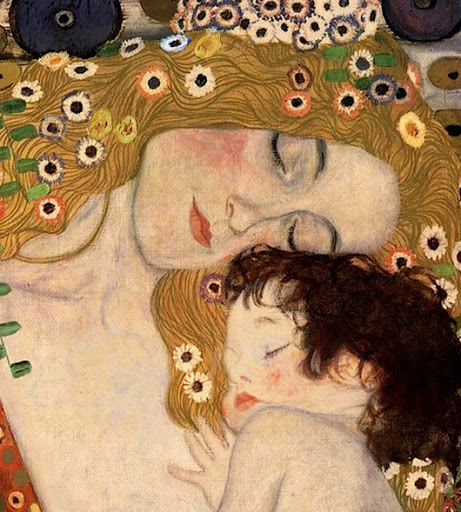
So, what would it be instead? Is it that God is both male and female? Evidently not. The Bible has continuously fought against a sexist concept of the divine, as the nations who surrounded it had and that the Bible condemned. Peoples who, for example, believed that when there was a storm it was the orgasm of a male and a female god and the rain was the seed, the fertile seed of the god who thereby fertilized nature. And the cracked earth was like a womb that received the seed of the god. The Bible rejected this type of concept and continues to consider it an idolatry. So, what would this image of God be like? And here the slit can be seen in the faces of man and woman, the male and the female, through which we see God. And the answer is obvious because as Genesis unfolds, the history of salvation is built on generations. What this means is that that which represents God most for us are man and woman in their capacity to give live. If you will, their capacity to love. So, this is why the human figure of the male and female saint becomes so fundamental, because at the heart of this reality, which is that of the human person in their generative capacity, in their capacity to give live, is the reflection of the Creator Himself. Creation continues precisely because man and woman continue to generate and generation in man and woman is born of a wellspring of love. So, this is the third way, a slit open onto the divine.
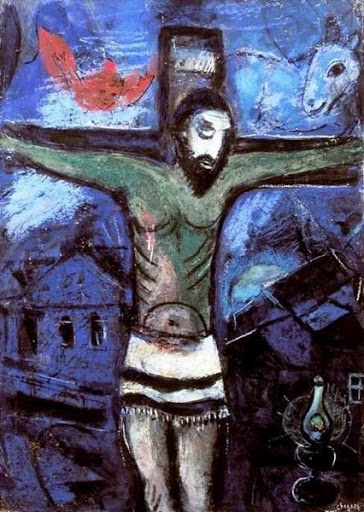
Number four. And here we arrive at another face, a fundamental face, that is at the center of all of our churches. A face that also dominates artistic tradition, but above all it also dominates faith. It is the face of Christ. Colossians 1:15. What does Paul say? “[Christ] is the image of the invisible God.” God has His image in Christ and it is a carnal image. And it is because of this that when the temptation comes, which is the temptation of iconoclasm that I referred to before, that negates the possibility of art, artists and theologians like St. John Damascene continue to repeat: if we negate images, we also negate the incarnation. We negate that God has made himself visible in a face. And it is because of this that the face of Christ is a face that is repeated infinitely many times. And it is because of this that St. John Damascene encouraged the following experience: […] “If a pagan comes to you and ask you: “How is your faith? What is your faith?,” don’t answer them. Take them by the hand, lead them into a church and show them the paintings, the images.” You see, God is in the image of Christ that reflects the divine, that reflects the mystery, the transcendent.
In some cases though, and I wouldn’s say always, since we are starting to revive the sisterhood between art and faith, but in some contemporary, modern churches it is better not to bring pagans, atheists since they would completely lose their faith. […]
The fifth and last way that I would like to recall is the way of the liturgy. The liturgy is the place where […] music succeeds in passing through hearts. Therefore it is necessary ceaselessly to return to the beauty of temples, of art, where the liturgy is celebrated, to a proclamation of the word in a beautiful way, to song, to celebration that is a drama that has its own dignity and nobility. […] It is said that contemporary music is [inadequate] … That is not true, because in contemporary music, the music of our days, that has its own musical grammars, there is its own beauty. Think about what happened when in the 16th century, imagine being inside St. Peter’s, where before only Gregorian chant was heard. Gregorian chant is most pure in spaces like that because, thanks to the echoes that are there, it becomes a song that is enshrined and held in that space and it is a monodic song that rises up high and allows for the possibility of being welcomed by a sonorous womb. But, what happens in the 16th century? Palestrina introduces polyphony into the liturgy. Polyphony disrupts the unicity of Gregorian chant, it multiplies the voices, makes them cross each other, one above the other, it constructs new harmonies through a sequence of crossings. This must have been scandalous at the time! But then think about the masterpieces of faith that have been created thanks to it. Slits, also in this case, onto the beauty of the divine. Let’s just think of the absolute pinnacle of music, who is Bach. Or think of Palestrina’s Sicut cervus, with its absolute purity that, however, consists in a richness of voices and that celebrates a need of the divine, which is like an instinctive, physical need. Like the doe [cerva] that charges ahead towards the river bed, where it expects to find water but that is dry. And now it launches into a cry of lament, a lament of thirst … in Hebrew there is a thing that can’t be translated into our languages, because in Hebrew there is a single word – nefesh – that at the same time means throat and soul. So, when we translate: “My soul thirsts for the living God” (cf. Psalms 42:3), in Hebrew there is a joke – the throat, which indicates a need for God that is physical. So, all of this has been exalted through new music and it is because of this that I am struggling for contemporary art with its new expressions [to have its place]. Not always and only retracing the past, which, however, is the great, supreme heritage that we mustn’t forget or humiliate, we mustn’t discard it […] but we also have to be open so that the liturgy may once again become the highroad on which art and faith meet each other and walk together.
There was a very important thing in the statutes of the artists of Siena in the 14th century. In the statutes of these artists, one of the first paragraphs was this: “We, artists, have as our task to show to people who don’t know how to read the Bible the great marvels worked by God throughout history.” The artist, you see, was in the cathedrals, the great churches of the past, for a good reason. There was a Bible of stone, pages of stone, the bas-reliefs, or, instead there were pages of frescoes, or paintings, that spoke about God. The liturgy always needs to have in its interior, as Jean Guitton, the French Catholic philosopher, said – making a play on words in Latin – it needs to have at the same time mumen and lumen. Lumen, because it must be light, must be representation, must show reality straightaway in all its beauty. But, it is not just any old representation like you would have in some arbitrary building. It also must be mumen, that is mystery, which is beyond the slit.
I have presented two moments to you about this single symbol. I have concluded. We have presented, on the one hand, art and faith as wound. We need a thrill. We need to be a bit shaken. To return again to this intensity. It is always impressive to see, e.g., in great squares, and it is sad because it is often the young generations, people moving as if they were flocks. They move like that – without purpose. And they may even be next to marvelous monuments that used to speak in extraordinary ways […]. This flow, almost a drift … This is the great need of our times. To do things again so that this thrill may return.
I often quote […] a phrase from the diary of a Danish, Christian, Protestant philosopher, a strong believer, of the 19th century – Søren Kierkegaard. He spoke in the 19th century, but think how true this reality is in our days too … He said – he used this image […]: “The ship is in the hands of the cook’s mate and what the captain’s megaphone transmits is no longer the route of the ship but what we shall be eating tomorrow.”4 How many are, e.g., in front of a television, or a computer. They learn about everything. They know, they can look for everything. But what they are lacking, and let’s return to Miller, is the route, meaning.
Once, in Florence, I was walking along with a friend of mine, whom many of you know – one of the greatest poets of the last century: Mario Luzi […], and he – it was an afternoon or maybe evening – […] said to me: “Look,” the lights in the windows were coming on in the houses and in the flats you could literally see in almost all of them the bluish rectangle of the television. And he said a phrase to me – he spoke slowly – a phrase that has always impressed me. He said: “We don’t know whether these people, who are there in front of the television, have their hands up as a sign of surrender or adoration.” Effectively this is true. In the end it tells you everything about what you’ll eat tomorrow, about all that is happening – the banal and the vulgar. It tells you all about fashions, but about the route? Here is the open wound.
On the other hand we have also wanted to evoke the need for transcendence. Art and faith that take you towards the beyond, the divine, in these different forms, these five ways that we have called out: the word, the world, the human face, the face of Christ, and finally the celebration.
And now I’ll finish and conclude with two witnesses that I would like to seal together […]. I’d like to finish with a lay voice, the voice of a writer, since we need both the voice of faith and the voice of art. He is a famous writer whose books still sell even after a long time since his death. It is the German, Herman Hesse, who is much liked also by the youth. The author of Siddhartha, of Narcissus and Goldmund. He once wrote a historical novel that has two artistic protagonists already in its title: Klein und Wagner. So, on the one hand figurative art and on the other music. And at the end he says, he explains what art is. And, look, he wasn’t a particularly strong believer. He did have his own spirituality in his own way, imbued with oriental elements. And this is the definition he writes: “Art means: seeing God in everything.”5 The slit. Seeing God in everything.
But, I would like to conclude with the voice of believers, a choral voice, and I’ll leave the words as they sound. There are two subjects who speak, in a choral way representing also all of us.
On 8th December 1965, the Council concludes and messages are sent, where one is also addressed to artists. Let’s hear the words of the council fathers: “This world in which we live needs beauty in order not to sink into despair. It is beauty, like truth, which brings joy to the heart of man and is that precious fruit which resists the year and tear of time, which unites generations and makes them share things in admiration. And all of this is through your hands.” The Council has thanked artists, the true, great artists.
On the other hand there is the voice from which I have started, the voice of Benedict XVI […] who addressed artists in the Sistine Chapel and his talk finished as follows. And I too will finish with these words that speak to artists, that speak about beauty and that are spoken by a pastor, a believer, by him who continuously feels the need for art and faith to be together. So, here are his words, spoken on 21 November 2009: “You are the custodians of beauty: thanks to your talent, you have the opportunity to speak to the heart of humanity, to touch individual and collective sensibilities, to call forth dreams and hopes, to broaden the horizons of knowledge and of human engagement. Be grateful, then, for the gifts you have received and be fully conscious of your great responsibility to communicate beauty, to communicate in and through beauty! Through your art, you yourselves are to be heralds and witnesses of hope for humanity! And do not be afraid to approach the first and last source of beauty, to enter into dialogue with believers, with those who, like yourselves, consider that they are pilgrims in this world and in history towards infinite Beauty! Faith takes nothing away from your genius or your art: on the contrary, it exalts them and nourishes them, it encourages them to cross the threshold and to contemplate with fascination and emotion the ultimate and definitive goal, the sun that does not set, the sun that illumines this present moment and makes it beautiful.”
Thank you.
1 Note that this is a verbatim translation of the Italian rendering of the end of Psalm 47:8, the term “art” does not appear in most English ones. The New American Bible simply says “sing praise”, while the King James Bible, which – in this case – comes closest to the Italian that Ravasi uses, renders that phrase as “sing ye praises with understanding.”
2 This probably refers to the following passage from Pound’s The Serious Artist:“You don’t argue about an April wind, you feel bucked up when you meet it. You feel bucked up when you come on a swift moving thought in Plato or on a fine line in a statue.”
3 “Feritoia” in Italian can refer to a narrow slit or opening, e.g., in a wall that can can let light in, or an arrow loop through which archers can shoot out of a fortress’ walls.
4 It looks like this refers to the following entry in Kierkegaard’s diary from 24th January 1847: “Suppose there is only one megaphone on a ship and the cook’s mate has appropriated it, an act that all regarded as appropriate. Everything the cook’s mate to has to communicate (“Some butter on the spinach” or “Fine weather today” or “God knows if there’s something wrong below in the ship” etc.) is communicated through the megaphone, but the captain has to give his commands solely by means of his voice, for what the captain has to say is not so important. Yes, the captain finally has to ask the cook’s mate to help him so that he can be heard, if the cook’s mate would be no good as to “report” the order, which, it must be admitted, sometimes gets completely garbled in going through the cook’s mate and his megaphone, in which case the captain strains his little voice in vain, for the cook and his megaphone are heard. Finally the cook’s mate gets control, because he has the megaphone.”
5 Incidentally Benedict XVI quotes that same definition in his address to artists two years earlier.
 eyebeleave