She said, he said

Fragments

Have you ever been approached by a Jehova’s witness and had them quote from the Bible to you? I have (several times 🙂 and the thing that first struck me, and I have found almost invariably since, is that they tend to use a small set of passages to further their cause while being blind to the fullness of the Good News. A frequent example is their reference to Revelation for arguing that very few will be saved (and that they can get you a seat): “I heard the number of those who had been marked with the seal, one hundred and forty-four thousand marked from every tribe of the Israelites” (Revelation 7:4). Yet, only a couple of sentences later John says: “After this I had a vision of a great multitude, which no one could count, from every nation, race, people, and tongue. They stood before the throne and before the Lamb, wearing white robes and holding palm branches in their hands.” (Revelation 7:9). And my pointing it out to them in their copy of the Bible tends to be the end of our friendly chat …

“OK,” you may think, “so Jehova’s witnesses are a bit blinkered – but I already knew that!” and you’d be right. There is no surprise there, but where I have been surprised recently was by the controversy surrounding Dr. Tina Beattie, Professor of Catholic Studies at Roehampton University. Prof. Beattie has last week had an invitation revoked to be a Visiting Fellow at the University of San Diego and to deliver a series of talks. Naturally, she objected and she went on to claim that unfounded denunciations of her writings by numerous “Catholic” blogs were to blame. This is not the first time such cancellations happened either, as plans for a lecture by her at Clifton Cathedral in Bristol have also been cancelled recently on grounds of her alleged heterodoxy. Such claims by her and her critics made me curious about what was behind them and the following is what I managed to piece together.

First of all, Prof. Beattie does not deny that she holds some views that are in conflict with the teaching of the Church (e.g., she signed a letter to The Times, saying that Catholics could, “using fully informed consciences, … support the legal extension of civil marriage to same-sex couples.”) Instead, she justifies her position by the following:

“I am an academic theologian who is also a practising Catholic. (This is subtly different from claiming to be a Catholic theologian if that implies somebody with a licence who is authorised to teach by the official magisterium). […]

Any academic theologian working in a university must […] seek to promote an intellectual culture in which reason rather than fideism is the basis for enquiry and research, knowing that in the Catholic tradition reason and revelation go hand in hand. […]

I have also always had absolute respect for the difference between the doctrinal truths of the faith, made knowable through revelation alone, and those truths which are arrived at by reason and which involve philosophical reflection informed by natural law and in engagement with other sources of human knowledge. So, with regard to all the doctrinal teachings that belong within the deposit of faith entrusted to the Church, my theological position is absolutely orthodox.”

Hmm … where to start?! Even before looking at what Prof. Beattie has to say, I see several issues with how she positions herself, although I also see things that I agree with unreservedly! Promoting an “intellectual culture in which reason rather than fideism is the basis for enquiry and research” is certainly one of them. Where Prof. Beattie and I would part ways though is her compartmentalization of herself: as a practicing Catholic on the one had and as a critical academic on the other. Not only do I believe this to be unhealthy, but also impossible! Either one strives to be a practicing Catholic (with all that implies and not only with a cherry–picking of it), or one places themselves outside that community and is honest about it.

Such bipolarity is further underlined by the last part of the above quote, where Prof. Beattie draws a line between faith “knowable through revelation alone” and “truths arrived at by reason [and] human knowledge.” At its basis this is just as contradictory a position as the practicing-academic one. Dei Verbum states very clearly that “God, who spoke of old, uninterruptedly converses with the bride of His beloved Son; [through the] Holy Spirit, through whom the living voice of the Gospel resounds in the Church, and through her, in the world” (§8). To draw a line between God speaking “of old” and his “uninterrupted conversation” with the Church is just as contrary to what the Church teaches as the other topics that she has been picked up on.

I don’t mean to recount in a lot of detail what Prof. Beattie is being criticized for, and if you are easily (or even not all that easily 🙂 offended, please, skip to the last paragraph.

The key bone of contention, as cited by the “Protect the Pope” blog and many others, beyond her support for same-sex marriage and abortion under some circumstances, is the claim that she describes the Mass as “an act of (homo) sexual intercourse” on pp. 80 of her book entitled “God’s Mother, Eve’s Advocate.” This is an accusation that Prof. Beattie vehemently denies and claims is a result of a misunderstanding:

“In the work that is cited and quoted by these bloggers, I was writing an extended critique of the theology of Hans Urs von Balthasar, whose writings I have studied for a number of years. My comments were made in the context of my deep concern over his highly sexualised representation of the Mass. This criticism is shared by a number of others who have written on von Balthasar. The suggestion that I mock the Mass because I criticise another theologian’s interpretation is outrageous.”

I have to say I agree with Prof. Beattie here: the remarks she is being attacked for are ones she herself is critical of and attributes to another. On pp. 196 of the same book she states clearly that “neo-orthodox theology risks reducing the Mass to an orgasmic celebration of homosexual love.” Where my agreement fizzles out though is with her attributing the view she criticizes to von Balthasar. While I haven’t studied his writings “for a number of years,” I am familiar with some of them and have even tracked down the following passage, where von Balthasar talks about the Trinity (which must also inform his views on the mass), in terms that others have taken as him reading their relationships in sexual terms:

“In Trinitarian terms, of course, the Father, who begets him who is without origin, appears primarily as (super-) masculine; the Son, in consenting, appears as (super-) feminine, but in the act (together with the Father) of breathing forth the Spirit, he is (super-) masculine. As for the Spirit, he is (super-) feminine. There is even something (super-) feminine about the Father too, since as we have shown, in the action of begetting and breathing forth he allows himself to be determined by the Persons who thus proceed from him.” (Hans Urs von Balthasar, Theo-drama. V: The last act, pp. 91)

To take the above and interpret it as von Balthasar talking about homosexual relationships among the persons of the Trinity or during the mass is confused though – and, more importantly from the perspective of the argument I am trying to make here, not what von Balthasar meant! Here it suffices to just read on in the same paragraph, where he says:

“The very fact of the Trinity forbids us to project any secular sexuality into the Godhead (as happens in many religions and in the gnostic syzygia). It must be enough for us to regard the ever-new reciprocity of acting and consenting, which in turn is a form of activity and fruitfulness, as the transcendent origin of what we see realized in the world of creation: in the form and actualization of love and its fruitfulness in sexuality.”

Far from sexualizing the Trinity, von Balthasar instead points to the Trinitarian origin of human sexuality, where its self-giving, reciprocal, consenting and fruit-bearing aspects reflect the dynamics of intra-Trinitarian relationships. A very different and wholly orthodox view in my opinion … It may well be that her way of interpreting von Balthasar is again a consequence of Prof. Beattie’s distinction between Scripture and Tradition as it seems like the taking of a text in isolation and a free interpretation of it (free as in fall – not beer :).

In summary, I acknowledge that I only have a very partial view of Prof. Beattie’s thought and even though she recently prepared a “public statement on [her] theological views,” its focus was on what she does not mean rather than on what she does – a useful, but inherently limited exercise. Further, her self-justification seems to rely on a separation between Catholic practice and academic thought and between Scripture and Tradition, neither of which are beneficial or orthodox. While I wholeheartedly support Prof. Beattie’s commitment to a reasoned critique of Church teaching and to the model of “diversity in unity,” her own approach seems to me heterodox not only in content but also in method. Finally, let me express an even more categorical disagreement with blogs like “Protect the Pope,” who snatch a fragmentary quote out of context and present it in a light that is diametrically opposed to its original meaning and, furthermore, that they take this to initiate a witch-hunt! In the end we arrive at a misrepresentation of a misinterpretation, which instead of supporting either party’s position just places both into disrepute. This is not a reasoned diversity manifesting itself (which I would wholeheartedly support and be proud of), but brawlers lashing out at each other in the dark.
The child inside

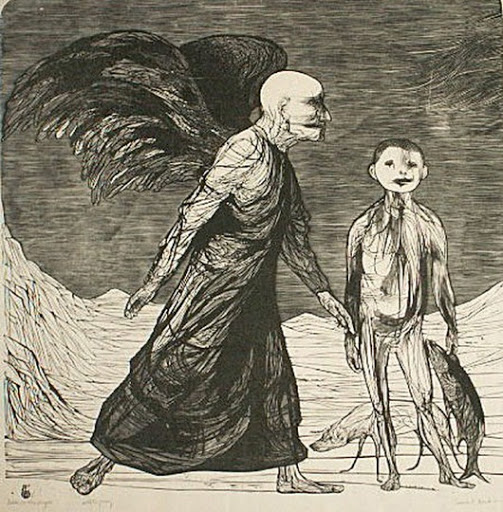
Tobias angel

The other day I came across a beautiful letter written by the poet Ted Hughes to his then 24-year-old son Nicholas, and reading it I was immediately struck by his fatherly love, by the strange familiarity, yet distinctness, of his advice and by the streak of sadness running through it.
The gist of Hughes’ advice derives from the idea that “every single [person] is, and is painfully every moment aware of it, still a child.”:

“It’s something people don’t discuss, because [they] are aware of [it] only as a general crisis of sense of inadequacy, […] or a sense of not having a strong enough ego to meet and master inner storms that come from an unexpected angle. But not many people realise that it is, in fact, the suffering of the child inside them.
Everybody tries to protect this vulnerable […] eight year old inside, and to acquire skills and aptitudes for dealing with the situations that threaten to overwhelm it. So everybody develops a whole armour of secondary self, the artificially constructed being that deals with the outer world, and the crush of circumstances.
And when we meet people, this is what we usually meet [and we] end up making ‘no contact.’ But when you develop a strong divining sense for the child behind that armour, and you make your dealings and negotiations only with that child, you find that everybody becomes, in a way, like your own child. It’s an intangible thing. But they too sense when that is what you are appealing to, and they respond with an impulse of real life, you get a little flash of the essential person, which is the child.”

When I first read this, I immediately had the sense that it contains those “reflected rays of truth” (Nostra Aetate 2); I could sense the traces of Jesus’s words in it – both in the image of the child as the underlying paradigm (“I say to you, unless you turn and become like children, you will not enter the kingdom of heaven.” Matthew 18:3) and in the mechanism of getting to a true “meeting” by having inner child engage with inner child. In fact, if you read on in Matthew’s Gospel, Jesus says: “whoever receives one child such as this in my name receives me” (18:5) and St. Paul elsewhere adds: “yet I live, no longer I, but Christ lives in me” (Galatians 2:20) which takes us to the long-established Christian image of each one of us being Jesus – having Jesus inside. With this key, I can read Hughes’ “child inside” as Jesus, which makes his proposal for how to truly meet another person essentially take us to Jesus’: “where two or three are gathered together in my name, there am I in the midst of them” (Matthew 18:20). If Jesus in me and Jesus in another connect, He is not only in each one of us, but also among us. Our meeting becomes like that of the persons of the Trinity, where the “meeting” itself takes on a level of reality like that of those who meet (“[Y]ou see the Trinity if you see love … They are three: the lover, the loved, and the love.” St. Augustine).
Am I saying that this is what Hughes meant? Certainly not. While being clearly distinct, the negative image of a person’s inner child being hidden behind the “armour of [the artificially constructed,] secondary self” does have close parallels with and traces of the Gospel. The difference between Hughes’ “inner child” and Jesus seems to grow further still in the following lines though:

“Usually, that child is a wretchedly isolated undeveloped little being. It’s been protected by the efficient armour, it’s never participated in life, it’s never been exposed to living and to managing the person’s affairs, it’s never been given responsibility for taking the brunt. And it’s never properly lived. That’s how it is in almost everybody. And that little creature is sitting there, behind the armour, peering through the slits. […] At every moment, behind the most efficient seeming adult exterior, the whole world of the person’s childhood is being carefully held like a glass of water bulging above the brim. And in fact, that child is the only real thing in them. It’s their humanity, their real individuality, the one that can’t understand why it was born and that knows it will have to die, in no matter how crowded a place, quite on its own. That’s the carrier of all the living qualities. It’s the centre of all the possible magic and revelation.”

This does sound quite unlike Jesus – or does it? Looking more closely, it seems to me that a lot of what Hughes says here is reminiscent of Jesus suffering on the cross, even to the point of feeling abandoned by his Father (“My God, my God, why have you forsaken me?” Mark 15:34). The wretched isolation facing death – that is Jesus on the cross and that is Jesus in me, when I am made to suffer by others or when I make him suffer in me by placing my own interests before those of others. Read in this way, Hughes view of the person and inter-personal relationships, appear in a very Christian light. Here Jesus suffers in those who smother him with an “artificially constructed, secondary self” and shows an “impulse of real life” when he is allowed to meet himself in another person.
Hughes then continues with a seeming contradiction, which, however, supports the above, Christocentric reading:

“That’s the paradox: the only time most people feel alive is when they’re suffering, when something overwhelms their ordinary, careful armour, and the naked child is flung out onto the world. […] But when that child gets buried away under their adaptive and protective shells—he becomes one of the walking dead, a monster.”

It is in his suffering that Jesus most vividly show’s his love for us, his friends, and it is in suffering that I too am most undeniably called to make a choice between what matters and that “artificial armour” that I allow to obstruct Jesus’ life in me. This is not some morbid fascination with suffering or a form of masochism – on the contrary, it is a realization that in suffering I have an opportunity to encounter Jesus, who then takes me with him to the joy of resurrection. Hughes does not wallow in the negative either and leads his son to the following conclusion:

“[The] only thing people regret is that they didn’t live boldly enough, that they didn’t invest enough heart, didn’t love enough. Nothing else really counts at all. It was a saying about noble figures in old Irish poems—he would give his hawk to any man that asked for it, yet he loved his hawk better than men nowadays love their bride of tomorrow. He would mourn a dog with more grief than men nowadays mourn their fathers.”

The call to love that Hughes arrives at is nothing other than Jesus’ challenge to all who came to seek his advice: “love one another as I love you[, for n]o one has greater love than this, to lay down one’s life for one’s friends” (John 15:12-13).


If, like me until very recently, you haven’t read any of Hughes’ poetry, here is a great selection – mostly from Crow. As you will see, the tone is dark, cutting, negative and atheist throughout, but I couldn’t but see the beauty of his language and the heartfelt cry of his voice.
All saints

Saints friends

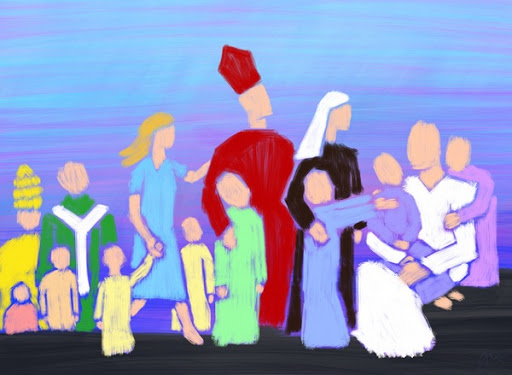
If you are a regular reader, you’ll know that the saints are very close to my heart and a frequent topic on this blog. Today, I’d just like to share the above painting with you (the cover of an book on saints for children, in preparation by my besties PM and JM) and the following quote:

“[O]nce you enter into friendship with God, everything in your life begins to change. … You are attracted to the practice of virtue. You begin to see greed and selfishness and all the other sins for what they really are, destructive and dangerous tendencies that cause deep suffering and do great damage. … You begin to feel compassion for people in difficulties and you are eager to do something to help them. … And once these things begin to matter to you, you are well on the way to becoming saints” (Benedict XVI, addressing Catholic pupils on 17 September 2010, during his visit to the UK)

Happy All Saints day!

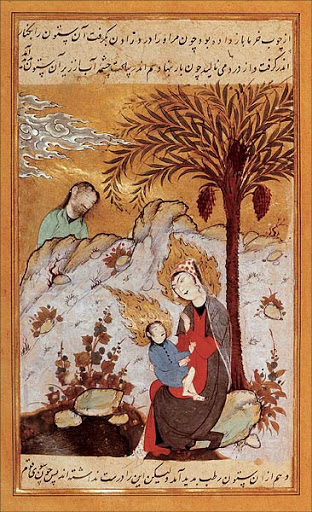
Queen of Paradise مريم

Mariam

A couple of days ago I came across the following tweets, written by a Muslim:

“Mary = Maryam/Miryam. “None among women have reached perfection except Mary the Virgin” – P. Muhammad”

“Since the Quran venerates her & the Prophet Muhammad called her […] the Queen of Paradise, I do recourse to her intercession.”

As you can imagine, it stopped me in my tracks and I have been trying to find out more about where these statements fitted within Islamic teaching. While I was vaguely aware of the Qur’an considering Jesus a prophet and also mentioning Mary (and doing so more extensively even than the New Testament), what I learned over the last couple of days goes so far beyond that and I would like to share it with you.

Muslims believe that God sent the angel Gabriel to the prophet Muhammad, who transmitted to him God’s words, verbatim – the Qur’an. There Mary is mentioned from the start and the Annunciation, is recounted as follows in the third chapter (Surat ‘Āli `Imrān):

“[T]he angels said, “O Mary, indeed Allah has chosen you and purified you and chosen you above the women of the worlds. O Mary, be devoutly obedient to your Lord and prostrate and bow with those who bow [in prayer].”” (Qur’an, 3:42-43)

“[T]he angels said, “O Mary, indeed Allah gives you good tidings of a word from Him, whose name will be the Messiah, Jesus, the son of Mary – distinguished in this world and the Hereafter and among those brought near [to Allah].
He will speak to the people in the cradle and in maturity and will be of the righteous.”
She said, “My Lord, how will I have a child when no man has touched me?” [The angel] said, “Such is Allah; He creates what He wills. When He decrees a matter, He only says to it, ‘Be,’ and it is.
And He will teach him writing and wisdom and the Torah and the Gospel.
And [make him] a messenger to the Children of Israel, [who will say], ‘Indeed I have come to you with a sign from your Lord in that I design for you from clay [that which is] like the form of a bird, then I breathe into it and it becomes a bird by permission of Allah. And I cure the blind and the leper, and I give life to the dead – by permission of Allah.”” (Qur’an, 3:45-49)

The Qur’an also talks about Mary’s birth, the years leading up to the Annunciation and her life of prayer under the supervision of the prophet Zechariah in earlier verses:

“[W]hen the wife of ‘Imran [Joachim] said, “My Lord, indeed I have pledged to You what is in my womb, consecrated [for Your service], so accept this from me. Indeed, You are the Hearing, the Knowing.”
But when she delivered her, she said, “My Lord, I have delivered a female.” And Allah was most knowing of what she delivered, “And the male is not like the female. And I have named her Mary, and I seek refuge for her in You and [for] her descendants from Satan, the expelled [from the mercy of Allah].”
So her Lord accepted her with good acceptance and caused her to grow in a good manner and put her in the care of Zechariah. Every time Zechariah entered upon her in the prayer chamber, he found with her provision. He said, “O Mary, from where is this [coming] to you?” She said, “It is from Allah. Indeed, Allah provides for whom He wills without account.””(Qur’an, 3:35-37)

Later on, chapter 19 (Surat Maryam) is dedicated to Mary, which after an account of John the Baptist’s birth proceeds to re-tell the Annunciation (having the angel say to Mary: “I am only the messenger of your Lord to give you [news of] a pure boy.”) and then proceeding to the birth of Jesus:

“So she conceived him, and she withdrew with him to a remote place.
And the pains of childbirth drove her to the trunk of a palm tree. She said, “Oh, I wish I had died before this and was in oblivion, forgotten.”
But he called her from below her, “Do not grieve; your Lord has provided beneath you a stream.
And shake toward you the trunk of the palm tree; it will drop upon you ripe, fresh dates.” (Qur’an, 19:22-25)

“[S]he pointed to him. They said, “How can we speak to one who is in the cradle a child?”
[Jesus] said, “Indeed, I am the servant of Allah. He has given me the Scripture and made me a prophet.
And He has made me blessed wherever I am and has enjoined upon me prayer and zakah as long as I remain alive
And [made me] dutiful to my mother, and He has not made me a wretched tyrant.
And peace is on me the day I was born and the day I will die and the day I am raised alive.”” (Qur’an, 19:29-33)

Mary is mentioned 34 times in the Qur’an (the only woman to be referred to by name) and there is a wealth of ways in which she is revered and taken as an example in Islam. What am I, a Catholic, to make of this though? Primarily, my reaction is one of joy at having discovered a previously unknown community of my Mother’s sons and daughters. There is no doubt in my mind that Muslims who look to Mary as a role model (which I didn’t know existed before) have a lot in common with me and that is unquestionably a delight. Even from the few quotes above (that barely scratch the surface and don’t even touch on exegesis), it is clear though that there are dramatic differences here both in direct contrast (e.g., the account of Jesus’ birth being at odds with its Christian understanding) and in terms of lacking parallel accounts (Mary’s youth not being recounted in the New Testament), not to mention the very different conception of Jesus as compared to the Christian one. While it would be a mistake to look for syncretism (it always is), I believe it would also be a missed opportunity to only focus on differences. The Catechism of the Catholic Church is very clear about there being goodness and truth to be found in all religions (§843) and that they all “reflect a ray of that truth which enlightens all men” (Nostra Aetate 2). I certainly feel enriched from having read the above passages of the Qur’an and will seek to further deepen my understanding.

Allāhu Akbar.

Contemporary art and its enemies

To paraphrase Karl Popper, let me start by saying that it is “impossible to make art in such a way that it cannot be misunderstood.” Over the course of this last week I have come across no less than three articles in which Christian authors denounce the evils of contemporary art.

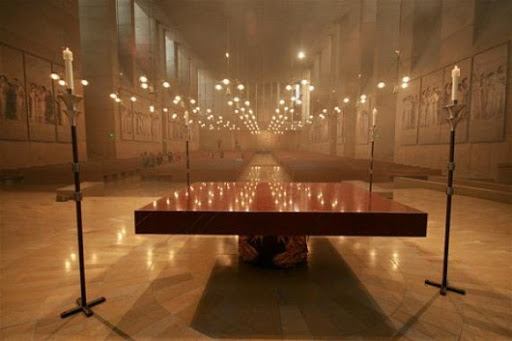
Cathedral our lady angels 4961 large slideshow

First, there is our old friend Nikos Salingaros – of Oakland Cathedral review fame, who has a go at the Cathedral of Our Lady of the Angels this time. His argument is again the same: “We have here a celebration of asymmetry, which might be understandable if there were a sound reason for it coming either from design necessities, or from religion.1 But there is none. The building’s asymmetry serves an essentially negative purpose: to deny coherence and harmony.2” And there is the usual litany of nonsensical gems like: “geometrical fundamentalism,” “naked concrete walls [being] ultimately unpleasant,” lacking “connective ornament,” and claiming that religion “has a natural affinity with traditional architectural expressions of coherence” before taking Antoni Gaudí’s3 name in vain. There is only one thing to say in response to this: bullspit! Instead of trying to debunk this junk head on, I think that I have a sense of the root cause of his confused misreading of this piece of architecture: an expectation of the literal. God is perfect harmony, so churches need to be perfectly symmetrical; the Church values continuity, so a church needs to look old; the soul needs to ascend to God, so there need to be vertical lines in the church’s geometry (and the list of naïveté goes on and on). What I believe this approach entirely misses are two key aspects of beauty: mystery and surprise! Why is it that an object evokes emotions, triggers reflection, prompts insight and delivers aesthetic joy and pleasure? Sure, there are plenty of theories, but periodically an artist comes along and creates a piece that breaks them, yet that is unmistakably appreciated as art. Surprise too is a key element of art, in my opinion, and the kind of literal expectations that Salingaros relies on would entirely eradicate it.

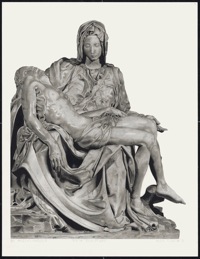
Second, I have made the virtual acquaintance of another budding art critic: Jimmy Akin, who takes it upon himself to have a go at the Vatican’s touring art exhibit: “The Vatican Splendors: A Journey Through Faith and Art,” exclaiming that the works “from the mid-2oth [sic] century onward were terrible.”4 Akin is much more to the point than Salingaros and doesn’t even feel the need to back up his claims – the art of the last 60+ years is just “terrible.” But what he lacks in specificity, he certainly makes up for in initiative, with the “brilliant” idea to do something about “all the lousy Catholic art” by “supporting Catholic art education so that we can get better Catholic artists.” So far so good – I am filled with anticipation of the centre of excellence he’ll propose to support and the examples of their great Catholic art, done right [no, not really]. Instead, Akin unveils the following “stupendously amazing” piece by a 12th grader:

Pieta drawing

And, just to underline the horrors of the “lousy” art we have had to put up with, he pulls out Pericle Fazzini’s “The Resurrection” situated in the Vatican’s Paul VI’s hall:

Paul vi resurrection

I am stunned by this guy’s barefacedness. How can he put a school-kid’s (admittedly skillfully executed) drawing of Michelangelo’s Pieta beside Fazzini’s masterpiece (a 66×23 foot bronze created it in 1977 and showing Jesus rising from the crater of a nuclear bomb) and say: more of the former and less of the latter, please! The mind boggles!

Third, I have come across a far more cogent, yet – to my mind – still misguided, piece by Francis Phillips. Here the composer James MacMillan is first quoted as saying that “[a]rt can be a window on to the mind of God. Through this window we can encounter beauty and divine truth” and I am thinking that I have finally come across a good piece on the subject, following the arid head banging of Salingaros and Akin. Sadly, Phillips decides to take us down a frustrating route too, by turning a promising piece into a crusade against the National Gallery in London showing Richard Hamilton’s “The Passage of the Angel to the Virgin.” The piece is a giclée photomontage that bases itself on Fra Angelico’s Annunciation, but with two female nudes where Fra Angelico has the angel Gabriel and the Virgin Mary. Phillips proceeds to label it as “scandalous,” as “shocking to Catholics, who have a particular reverence for the Virgin Mary,” as skewed for “[p]ortraying the Angel Gabriel as a young woman [since] the traditional Christian understanding of angels [is] as sexless spiritual beings”5 and as “desecrating.” Personally, I have a profound love for Mary and a deep gratitude to her for being the model of the perfect Christian, but I have to say that I disagree with all of the above. Since some of you may side with Phillips in your reaction to this piece, I will not reproduce it here, but only provide this (NSFW) link for those of you who choose to follow it. I have to say that I am not a fan of this piece by any means, but my reaction is one of curiosity about why Hamilton made the choices he made in it. Instead of a feeling of indignation, my response is more one of boredom and I would just walk past it and enjoy the rest of the National Gallery’s exquisite collection, instead of mounting a (failed) attempt to have it taken down, as Phillips did.

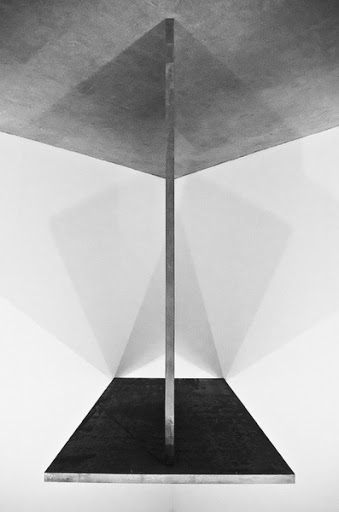
A point that seems to emerge to me from these last two articles is one of a decorative and exegetical role for art. A looking for pieces that would be good interior decoration for a church or that would illustrate a passage from Scripture or the Catechism. While some great art can certainly do that, it will do so in a way that transcends the simple, literal and functional. Other, equally great art would be entirely out of place as decoration though, yet would have the capacity to “be a window on to the mind of God.” I am certainly not thinking of Hamilton’s piece here, but more of something along the lines of Richard Serra’s work, such as his “Trip Hammer”:

Serra

Relegating “the mind of God” to decoration just seems like something that not even a heathen would do …

UPDATE (12/11/2012): My bestie JM went to visit the Cathedral of our Lady of the Angels, with my über-besties MR and RR, and had the following to say:

I went to visit the Cathedral last weekend, in anticipation of coming down either on the side of its supporters or detractors. Instead, while I am undeniably an outright fan of it as a place of worship, I have to say that it is so ugly on the outside that only its mother could love it. You would be forgiven for mistaking it for a car park or a storage facility, if it wasn’t for the separate bell tower carrying a cross and the rather beautiful statue of Mary above its main entrance.

The interior is another story and is an unreserved and total success. The space is vast without being overpowering; it is light and welcoming and beautifully laid out not only in the main nave but also with its numerous chapel-like spaces that face out and away from the building’s main volume. They, like the whole church, are bathed in natural light and house content as diverse as a shrine to Our Lady of Guadalupe, a Día de los muertos arrangement, a temporary exhibit by a local painter, artifacts from Pope John Paul II’s visit to LA and the confessionals. Outside too, the space is at the service of the community, with a great playground and a cafe/grill on the other side of a large square adjacent to the Cathedral.

In many ways this church is like one of those great Northern European cathedrals turned inside out. Instead of an ornate exterior and a plainer interior, here money has been spent on the interior space that church goers enjoy (including a great set of tapestries showing the communion of saints – and not only of canonized ones) while leaving the exterior plain and purely functional. Would I have preferred a more pleasing external architecture? No doubt! But, I believe the diocese spent their money where it matters to its members and visitors. This is a church that embraces those who come to it, instead of advertising itself to all. Not that the latter has little value, but I see why they would have favored the former. For some photos of my visit, see this Flickr set.


1 I wasn’t going to engage with this nonsense, but – come on! – to claim that there is no “religious” reason for asymmetry! How about the following (vastly incomplete) examples: good – evil, infinite – finite, uncreated – created, selfless – selfish. And the list could go on and on.
2 How about: to show movement, ascent, growth, a pull towards God?
3 To invoke Gaudí in an argument for traditional, symmetrical, literal architecture is just beyond nuts!
4 The hubris here would easily make Achilles’ dragging Hector’s lifeless body behind his chariot in front of the gates of Troy an act of level-headed diplomacy.
5 Not noticing the irony of this objection. Would the sexless angel better be portrayed as a man? Why?

Divergent rays

Nasa sun

The Gospel verse “In the beginning was the Word” has been going around in my head, ever since it dawned on me last weekend that it clearly points to something having preceded it. Thinking more about it made me revisit a text (actually, various fragments of it, since it has, as yet, not been published in full) where Chiara Lubich recounts her “intellectual visions” of Paradise that started in 1949. In particular, I wanted to re-read how she described Jesus, the Word:

“I found myself […], as in a vision seen with the eyes of the soul, having come into the Bosom of the Father, who showed me, as it were, the inside of a sun that was all gold or flames of gold, infinite, but not frightening.”

“[F]rom the walls inside the Sun, the Father pronounced the word: Love, and this Word, concentrated in the heart of the Father, was his Son.”

The picture here is very vivid and in many ways like those of St. Hildegard of Bingen’s visions. It transmits a very clear sense of what it may have seemed like to be there “in the beginning.” Reading on, Chiara also shares the following vision of creation:

“When God created, He created all things from nothing because He created them from Himself: from nothing signifies that they did not pre-exist because He alone pre-existed (but this way of speaking is inexact as in God there is no before and after). He drew them out from Himself because in creating them He died (of love), He died in love, He loved and therefore He created.

As the Word, who is the Idea of the Father, is God, analogously the ideas of things, that “ab aeterno” are in the word, are not abstract, but they are real: word within the Word.

The Father projects them — as with divergent rays — “outside Himself,” that is, in a different and new, created dimension, in which he gives to them “the Order that is Life and Love and Truth.” Therefore, in them there is the stamp of the Uncreated, of the Trinity.”

I find the above paragraphs particularly important since they indicate several key ways of thinking about how God and the universe are related:

  1. That God (the Trinity, the Uncreated) can be found in nature since it bears His “stamp,”
  2. that Jesus – the Word – is not only God who made himself present in the world as a human being 2000 years ago, but is the very means by which the Father goes “outside Himself” in His Creation,
  3. that creation is an act of self-noughting love, and
  4. that creation can be thought of as a new dimension of God.

This relationship is clearly not that of a “God of gaps,” cobbled-on caricature, but a tightly-interwoven, integral, first-person communion. Creation is to God as the rays of the sun are to the sun.

In fact, the picture of the sun and its divergent rays (and the use of “picture” is very deliberate, given what follows), is also very much consonant with Wittgenstein’s thoughts on how a system (the world) and its meaning relate:

“The sense of the world must lie outside the world. In the world everything is as it is and happens as it does happen. In it there is no value—and if there were, it would be of no value.

If there is a value which is of value, it must lie outside all happening and being-so. For all happening and being-so is accidental.

What makes it non-accidental cannot lie in the world, for otherwise this would again be accidental.

It must lie outside the world.” (Tractatus Logico-Philosophicus, 6.41)

Where does this leave a Christian in terms of how science and revelation make sense of the world? I believe, James Clerk Maxwell put it very well: “I think Christians whose minds are scientific are bound to study science that their view of the glory of God may be as extensive as their being is capable.” It is with this mindset that Prof. John Lennox commented on the Higgs Boson discovery by saying “God created it, Higgs predicted it and Cern found it.” Instead of a conflict, the advances of science are as much a source of wonder and joy to a Christian as are the visions of those who seek God and to whom he makes himself known in entirely unscientific ways.

Bishops’ synod conclusions: faith open to reason and science

The Bishops’ synod on the New Evangelisation (i. e., a renewed sharing of the Good News with those who have drifted away from the Church) concluded on Friday and resulted in 58 “propositions” that were presented to the pope and that will form the basis of a future encyclical. If you are not into the whole synod thing, here are (telegraphically) at least the points that stood out for me:

  1. Not a proposition, but nonetheless worth noting, is the fact that the propositions were written in English rather than the usual Latin (although the authoritative final version will still use it) and that “with the kind permission of the Holy Father, Pope Benedict XVI, the provisional, unofficial English version, prepared under the auspices of the General Secretariat of the Synod of Bishops [which is normally kept confidential], is published in the Bulletin of the Holy See Press Office.”
  2. Prop. 8: “The world is God’s creation and manifests his love.” This presents a very positive view of the world, unlike attitudes in the past where “the world” was presented more like a necessary evil, in conflict with God.
  3. Prop. 12: The “hermeneutic of reform in continuity,” championed by Pope Benedict XVII is taken as the underlying method, as described here: “There is the “hermeneutic of reform”, of renewal in the continuity of the one subject-Church which the Lord has given to us. She is a subject which increases in time and develops, yet always remaining the same, the one subject of the journeying People of God. […] However, wherever this interpretation guided the implementation of the Council, new life developed and new fruit ripened” (Benedict XVI, Address to the Roman Curia, 22 December 2005)” I believe this shows very clearly an acknowledgement of the need to keep updating the Church and also the tension of this process with the need to stay faithful to Jesus’ teaching.
  4. Prop. 13: “believers must strive to show to the world the splendor of a humanity grounded in the mystery of Christ” Again there is recognition of the value of the natural (humanity) and a claim of its fulfilment in the divine (Jesus).
  5. Prop. 17: “It is necessary not only to show that faith does not oppose reason, but also to highlight a number of truths and realities which pertain to a correct anthropology, that is enlightened by natural reason. Among them, is the value of the Natural Law, and the consequences it has for the whole human society. The notions of “Natural Law” and “human nature” are capable of rational demonstrations, both at the academic and popular levels.” This was followed with a call to develop a “theology of credibility,” that expresses Church teaching in terms consistent with current scientific understanding.
  6. Prop. 20: “Christ, the “Good Shepherd” (cf. Jn 10:11) is the Truth in person, the beautiful revelation in sign, pouring himself out without measure. It is important to give testimony […], not only of his goodness and truth, but also of the fullness of his beauty. […] Beauty attracts us to love, through which God reveals to us his face in which we believe.”
  7. Prop. 54 (in full): “The dialogue between science and faith is a vital field in the New Evangelization. On the one hand, this dialogue requires the openness of reason to the mystery which transcends it and an awareness of the fundamental limits of scientific knowledge. On the other hand, it also requires a faith that is open to reason and to the results of scientific research.”
  8. Prop. 55: “believers and non-believers can dialogue about fundamental themes: the great values of ethics, art and science, and the search for the transcendent. This dialogue is directed in particular to “those to whom religion is something foreign, to whom God is unknown and who nevertheless do not want to be left merely Godless, but rather to draw near to him, albeit as the Unknown” (Benedict XVI, Address to the Members of the Roman Curia, 21 December 2009).”

I was pleased to see so much emphasis on reason, science and credibility and will try to do the little I can to contribute towards them myself.

In the beginning

In the beginning

This is my third attempt at starting a post1 that I have been thinking about intensively all weekend (and that follows a train of thought that I have nursed on and off for years). Why write about it now? Because I believe I have finally understood something that has been staring me in the face for years: the opening line of St. John’s Gospel is a joke!

“Whoa!” I hear you say “Hold it right there!” Before you start crying “Blasphemy!” or “Stone him!,” please, do hear me out.2 I don’t mean to say that it is ridiculous, frivolous, trivial or inconsequential. On the contrary! I believe that I can now see a twist of humor in it that furthermore alludes to complexity that would otherwise have taken tomes upon tomes to try and spell out and that would have been well beyond St. John or the Christians of the first many centuries.

Picture this (imaginary, non-canonical!) scene:

God the Father, Jesus and the Holy Spirit are sitting around a table, chatting (you can imagine that this is what they spoke about in the scene Rublev painted, if you like):

Father: OK, guys, let’s get John started with his Gospel.

Jesus: Dad, can we have him spell out how it all started, and not just open with my birth?

HS: Sure(!), but the maths might be a tad beyond him, don’t you think?

Jesus: I didn’t mean to give him the full recipe, HS! This is not about repeatability and independent verification …

HS: So, were you thinking along the lines of the atemporal – yet dynamic, hyper-dimensional, infinite, partaking in the finite, linear, half-axis of time and being delimited in space? Even if we dumb it down to the level of philosophy, it’s still a tall order (although if anyone can do it, I can!).

Father: Look, HS, Jesus does have a point – we could give them a sense of what is going on, without having to bring Ambrose, Thomas or Albert forward. Surely you can think of some little quip to point them in the right direction.

[A “moment”’s silence later.]

HS: It’s a bit cheeky, but how about this – and I’m just riffing here (plus they’ll have to wait for Ludwig and Martin to start unpacking it) …

Jesus: Get on with it! We may have all eternity, but I’d rather get back to giving Sidd some more hints.

HS: All right, all right! How about John opens with this: “In the beginning was the Word!”

The Father and Jesus look at each other, wide-eyed, exclaim: “Genius!” and the triune bursts out laughing.

The insight I had, while walking to mass on Sunday morning and thinking about Dei Verbum, the Johannine prologue and Descartes’ “cogito,” was the following: Saying “In the beginning was the Word” is like starting a recipe with “knead the dough.” A word cannot possibly be the start: it requires a language, other words, syntax, grammar and speakers and listeners who know how to play the games it facilitates. Saying “In the beginning was the Word” is saying “Look, this is as far back as we can take you, but know that there was lots that came before.” It places at the beginning an innocent-looking entity: a word, yet one that vehemently points beyond itself. To meaning, to reference, to relation, to function, to communication, to a meeting of minds. With a simple sentence, John (with some help), gives a masterclass on the inevitability of the preexisting and the core of Trinitarian relationships, where, like a word, each person points beyond themselves.

“Alright,” you say, “but why call it a joke?” I believe the structure of this sentence is precisely that of all one-liners: the first part (“In the beginning”) prepares you for a certain set of expectations and the second surprises you with something that just does not fit (“the Word,” which cannot possibly be in the beginning :). This is exactly what Kant meant with “Laughter is an effect that arises if a tense expectation is transformed into nothing.” Not wanting to kill humor with explanation, let me leave you with another example of the same comedic form: “Every winter when the first snow fell, I’d run to the front door with excitement, start banging on it and shout: “Mum! Dad! Let me in!”” (Milton Jones).

Realizing the above, I started seeing the Johannine pattern elsewhere too. Descartes, starts with “cogito ergo sum,” in an attempt to draw a line and derive a philosophy from that stake in the ground. Yet, it is a line that carries a lot of baggage beyond itself. My own earlier attempt too, which tries to take the “cogito” a step further by starting with “Language” is nothing but an explicit acknowledgement of such a necessary preexistence and in no way escapes or circumvents it. Unsurprisingly, the account of creation in Genesis uses the word/language mechanism for indicating the process of creation, where matter is spoken into being (“Then God said: Let there be light, and there was light” (Genesis 1:3)). More surprisingly, one of the Hindu creation accounts (the Nasadiya Sukta in the Rigveda) also employs a similar, though not identical, mechanism: “The One breathed windlessly and self-sustaining […] that was the primal seed, born of the mind.” Even the creation account of the Sumerians (The debate between Sheep and Grain, written in the 3rd millennium BC), highlights the role of language in the process: “the great gods, did not even know the names Grain or Sheep.”

What is clear to me from the above is the fundamental role of language in the process of something coming from nothing, which in a sense undermines the idea of a true nothing having preceded the something. With this in mind, the Christian identification of Jesus with “the Word,” which I have been wondering about for years, makes perfect sense. The Father makes himself known to us by speaking his Son, who in turn points back to Him: “Whoever has seen me has seen the Father.” (John 14:9) and then: “The words that I speak to you I do not speak on my own. The Father who dwells in me is doing his works. Believe me that I am in the Father and the Father is in me, or else, believe because of the works themselves.” (John 14:10-11, with a nice hat-tip to orthopraxy).

So, let me finish with a one-liner: “In the beginning was the Word.” 🙂


1 In a previous version I would have taken you through Lemaître, the Planck epoch and the opening lines of the Tanakh, before getting to the Johannine prologue.
2 Thanks to my über–bestie, PM, for his Nihil Obstat and Transferitur (the Imprimatur of the digital age) – much appreciated!

Hellfire and brimstone: not in my name

While the current bishop’s synod in Rome is a joy to follow (with gems like Archbishop Williams’ talk or the pope’s opening sermon and contributions from many of the world’s bishops as well as other invited participants), there are the inevitable oddities swirling around its periphery.

Today, for example, I came across a piece about one of the synod’s observers, Dr. Ralph Martin, Director of Graduate Theology and New Evangelization at Sacred Heart Major Seminary in Detroit, who argues that “Evangelization should include fear of hell” and that “[t]he assumption that almost everyone is basically good and destined for heaven is a “silent apostasy” infecting a culture “drifting toward destruction.”” Martin then proceeds to invoke Lumen Gentium (the Vatican II document I am reading now) and say that while it “does allow the possibility “for certain people to be saved without hearing the Gospel under specific conditions,” […] very often people aren’t inculpably ignorant of the Gospel, they’re not seeking God, they’re not living according to the light of their conscience, they’re not responding to God’s grace, and they actually exchange the truth of God for a lie.” In summary, “we can’t presume that everyone’s on the way that’s leading to Heaven.”

I couldn’t disagree more!

  1. While Martin (rightly) points out that people are often “not living according to the light of their conscience” (and who isn’t at some time or another?!), it is some stretch to go from there to suggest that they (we!) are not on the way to heaven.
  2. Lumen Gentium makes absolutely no mention of hell (or any related concept I could think of) whatsoever, so brandishing it as the justification of one’s views is a bit of a leap of (non)faith.
  3. Martin’s approach seems divorced from both Benedict XVI’s and John Paul II’s teaching about hell:

    “[H]ell is the ultimate consequence of sin itself… Rather than a place, hell indicates the state of those who freely and definitively separate themselves from God, the source of all life and joy.” (Blessed Pope John Paul II, general audience, 28 July 1999)

    “Who will [be in hell]? The Church has never made any pronouncement in this regard. This is a mystery, truly inscrutable, which embraces the holiness of God and the conscience of man. The silence of the Church is, therefore, the only appropriate position for Christian faith. Even when Jesus says of Judas, the traitor, “It would be better for that man if he had never been born” (Matthew 26:24), His words do not allude for certain to eternal damnation.” (Blessed Pope John Paul II, Crossing the Threshold of Hope)

    “Perhaps there are not so many who have destroyed themselves so completely, who are irreparable forever, who no longer have any element upon which the love of God can rest, who no longer have the slightest capacity to love within themselves. This would be hell.” (Pope Benedict XVI, question and answer session with the priests of Rome, 11 February 2008)

    With the above concept of hell (a voluntary separation of oneself from God, in the face of God!), it is hard to see who would be there. Benedict XVI only goes so far as to say that there are perhaps “not so many” there, while John Paul II flatly refuses to speculate! Both of their positions are very much aligned though with the view that Martin opposes (“[t]he assumption that almost everyone is basically good and destined for heaven”) and calls a “silent apostasy” … Not the smartest of criticisms to level at a pope and especially not at the current and previous ones.

  4. Threatening others with hell just seems to be contrary both to the Golden Rule and the Good News that Jesus taught, as can be seen also from what some of the early Church Fathers had to say about the subject, including St. Gregory of Nyssa’s belief that “all free creatures will share the grace of salvation” (i.e., apocatastasis) and another exclaiming: “If anyone has to be in hell, let it be me.” Even just from the perspective of charity, I cannot see how I could wish for anything other than for hell to be empty.
  5. Even from a psychological perspective, reinforcement of good behaviour is more effective than threatening to punish bad behaviour (e. g., see Kahneman’s treatment of the subject).
  6. Jesus’ call is a positive one: love your neighbor as yourself, feed the hungry, clothe the naked, visit prisoners, … Following it leads to heaven, while just trying to avoid transgressions that are punishable is not enough.

I don’t mean to deny the reality of hell – just like heaven (communion with God-Love), a foretaste of hell (separation from God-Love) can readily be had in this life already. What I am saying though is that a focus on hell is counterproductive. By keeping my eyes on God in my neighbors, I am leaving myself less time to be absorbed by myself. Hell is kept at bay by my being busy with the pursuit of heaven.

Dei Verbum: a first look

Word made flesh 2

As set out in a previous post, I have embarked on a journey through the 16 Vatican II documents, starting with the dogmatic constitution Dei Verbum here.

Before getting into it, let me start with a few words to those of you – my friends! – who hold no or other beliefs about God than me. Without meaning to tell you what to do, I’d say that probably the best attitude to have when reading this post (and the rest of the series that will follow on Vatican II) is that of Thomas Nagel in his well-known paper entitled: “What is it like to be a bat?1 I don’t mean to get sidetracked here into his superb challenge to how consciousness is to be approached, but would just like to take some pointers from him on how one can consider the words of another, who holds different beliefs (and I am talking purely about understanding, without meaning to reduce relationships to knowledge alone). Nagel has the key insight that the question of what it is to be a bat is not about what it would be like for me to be a bat, but what it is for a bat to be a bat. “Yet if I try to imagine this, I am restricted to the resources of my own mind, and those resources are inadequate to the task. I cannot perform it either by imagining additions to my present experience, or by imagining segments gradually subtracted from it, or by imagining some combination of additions, subtractions, and modifications.” Just to avoid any misunderstanding, I believe these limitations apply in both directions. I too lack the direct experience of not believing in God or of holding other beliefs to my own, and therefore can only get so far with understanding what it is like to be an atheist or agnostic using my own “inadequate resources.” Sticking to Nagel’s example, trying to understand another person with whom I don’t share a key characteristic is like trying to understand from a bat what it is like to have sonar. Even if the bat could speak English, we wouldn’t have a shared vocabulary for it to quite get that across to me. In spite of such limitations, I hope that you will find interest in how Catholics look at the way they believe God has revealed himself to the world, which is precisely the subject of Dei Verbum.

Where else would the discourse start but with a quote from the New Testament, where John says the following:

“We announce to you the eternal life which dwelt with the Father and was made visible to us. What we have seen and heard we announce to you, so that you may have fellowship with us and our common fellowship be with the Father and His Son Jesus Christ” (1 John 1:2-3)

This puts us in a very clear context from the word go: that of continuity with Jesus’s disciples desiring to share what they have “seen and heard,” for the sake of building relationships with others and with God. The purpose of Dei Verbum then is to clarify how the above revelation of God to the world is to be understood. This revelation, where “the invisible God out of the abundance of His love speaks to men as friends and lives among them, so that He may invite and take them into fellowship with Himself.”

Dei Verbum proceeds to present different ways in which God has revealed and continues to reveal himself:

  1. Nature. “God, who through the Word creates all things and keeps them in existence, gives men an enduring witness to Himself in created realities” and “he ceaselessly kept the human race in His care, to give eternal life to those who perseveringly do good in search of salvation.” The message here is clear: God can be found in his creation,2 “known […] by the light of human reason” and all who live for others rather than themselves will find him.
  2. The people of Israel. “Then, at the time He had appointed He called Abraham in order to make of him a great nation. Through the patriarchs, and after them through Moses and the prophets, He taught this people to acknowledge Himself the one living and true God, provident father and just judge.” The books of the Old Testament “give expression to a lively sense of God, contain a store of sublime teachings about God, sound wisdom about human life, and a wonderful treasury of prayers, and in them the mystery of our salvation is present in a hidden way.” Even though these books “also contain some things which are incomplete and temporary, [we] should receive them with reverence.” “God, the inspirer and author of both Testaments, wisely arranged that the New Testament be hidden in the Old and the Old be made manifest in the New.”
  3. Jesus. “He sent His Son, the eternal Word, who enlightens all men, so that He might dwell among men and tell them of the innermost being of God.” God sends his Son, Jesus – the “eternal Word” – and through his life, teaching, death and resurrection, God shows himself directly to us and reveals himself in full intimacy.
  4. The Holy Spirit. For someone to “freely assent to the truth revealed by Him […], the grace of God and the interior help of the Holy Spirit must precede and assist” and “[t]o bring about an ever deeper understanding of revelation the same Holy Spirit constantly brings faith to completion.” While revelation is complete in the person of Jesus, the Holy Spirit (“the Spirit of truth”), whom Jesus sent to his followers after his resurrection, continues to deepen our understanding of it.

How is it then, that God’s revelation is preserved, maintained and spread? Jesus commissioned the Apostles to share with others “what they had received from [His lips], from living with Him, and from what He did, or what they had learned through the prompting of the Holy Spirit.” They were also prompted to “commit the message of salvation to writing” and, “to keep the Gospel forever whole and alive.” “[T]he Apostles left bishops as their successors, “handing over” to them “the authority to teach in their own place.” (St. Irenaeus, Against Heretics III, 3)” Since the words of the Gospel are put into practice by Jesus’ followers, and since the Holy Spirit inspires them, “there is a growth in the understanding of the realities and the words which have been handed down.” This to me is quite a key passage – the account of Jesus’s life and teaching is not a static piece of text, frozen in time, but instead a source of growing understanding and new insights brought about with the help of the Holy Spirit in those who follow Jesus: “[T]hus God, who spoke of old, uninterruptedly converses with the bride of His beloved Son; [through the] Holy Spirit, through whom the living voice of the Gospel resounds in the Church, and through her, in the world.” The upshot of this is a very tight link between Scripture (a record of Jesus’ life and teaching) and Tradition (Jesus’ followers’ growing insight into Scripture from putting it into practice and with the help of the Holy Spirit), interpreted over time by the successors of the Apostles.

How is one to understand the nature of Scripture though? Dei Verbum first reaffirms the Church’s belief in “the books of both the Old and New Testaments in their entirety, with all their parts, [being] sacred and canonical because written under the inspiration of the Holy Spirit, they have God as their author and have been handed on as such to the Church herself.” However, since they were written by men, we “should carefully investigate what meaning the sacred writers really intended, and what God wanted to manifest by means of their words.” Here, a distinction needs to be made between passages that are “historical, prophetic, poetic, or of other forms of discourse.” “[We] must investigate what meaning the sacred writer intended to express and actually expressed in particular circumstances by using contemporary literary forms in accordance with the situation of his own time and culture. [… D]ue attention must be paid to the customary and characteristic styles of feeling, speaking and narrating which prevailed at the time of the sacred writer, and to the patterns men normally employed at that period in their everyday dealings with one another.” This is as far from literalism as you can get – instead it is a teasing out of intention from a text anchored in a specific period of history and in a specific geographical location. No wonder its understanding has the potential to grow and for “new insights [to be] brought about”!

An important warning follows next in Dei Verbum: “serious attention must be given to the content and unity of the whole of Scripture if the meaning of the sacred texts is to be correctly worked out [and t]he living tradition of the whole Church must be taken into account along with the harmony which exists between elements of the faith.” Understanding what was meant by a passage from Scripture mustn’t be done on the basis of picking a couple of phrases out of the whole and trying to make sense of them from scratch. They are part of a textual corpus and there is a rich body of existing insight into them and interpretation of them, to which any new understanding can add. Preserving the message God sent us through his Son and the Holy Spirit – and understanding it in the context I am in – requires a careful and critical interaction with all of Scripture, in which the Church’s judgment plays a key guiding and interpretative role too. Ultimately, the aim is “that we may learn the gentle kindness of God, which words cannot express, and how far He has gone in adapting His language with thoughtful concern for our weak human nature” (St. John Chrysostom, On Genesis).

Within the New Testament, the Gospels have a special “preeminence,” “for they are the principal witness for the life and teaching of the incarnate Word.” Their authors wrote the four Gospels, “selecting some things from the many which had been handed on by word of mouth or in writing, reducing some of them to a synthesis, explaining some things in view of the situation of their churches and preserving the form of proclamation but always in such fashion that they told us the honest truth about Jesus. For their intention in writing was that […] we might know “the truth” concerning those matters about which we have been instructed.” To make these “words of God” “accessible at all times, the Church […] sees to it that suitable and correct translations are made into different languages, especially from the original texts of the sacred books.” Preference is given also to producing translations “with the separated brethren[…, so that] all Christians will be able to use them.”

Finally, all Christians are called to a frequent reading of Scripture and to accompany it with prayer, “so that God and man may talk together; for “we speak to Him when we pray; we hear Him when we read the divine saying.” (St. Ambrose, On the Duties of Ministers I)” In this way “the treasure of revelation, entrusted to the Church, may more and more fill the hearts of men.”

So, these are my 1500 word notes on the 6000 word Vatican II text 🙂 – if you are interested, do read it in full. I certainly got a lot out of it and feel very comfortable with what the Church teaches about Scripture: they are believed to be the true Words of God, but since they were recorded by humans and within the “literary forms” and cultural conventions of a specific place and time, the task of understanding what the authors’ intentions were and what God meant to communicate, is a delicate process. That it is a process is also key, to my mind – it is not like these 2000 year old texts can just be internalized immediately (no text can!). Instead, they require knowledge, discernment, an open mind and the willingness to hear what God has to say to me – here and now.

Lumen Gentium is up next, and since it has 27000 words, I reckon it will occupy me for a while :).


1 Thanks to my bestie, Margaret, for introducing me to this paper a good 10 years ago! If you are interested in consciousness at all, I highly recommend it in full.
2 Note, that this does not imply the lunacy of Creationism – instead, I read this as, with our best knowledge today, God sustaining a universe that he made to follow the (his!) Standard Model.