Stubbornly unholy brutalist: church architecture today

Churchcocathedral

Cathedral christ light som220109 th 0

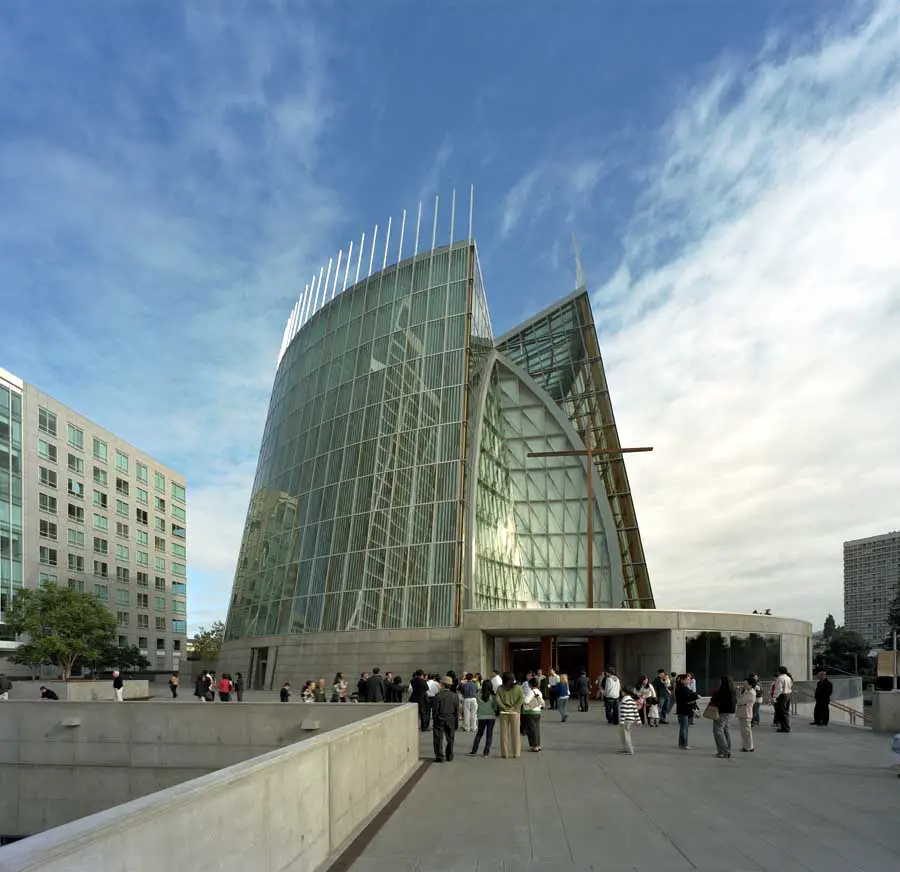
Which of the above churches looks more aesthetically appealing to you? The top or the bottom one? If you answered ‘top,’ kindly move along as you will at best find offence in what follows. If, however, your answer was ‘bottom,’ please, come with me on a brief journey of ‘I can’t believe they said that!’

The church at the top happens to be the Co-Cathedral of the Sacred Heart in Houston while the bottom photo shows the Cathedral of Christ the Light in Oakland. Now, why did I pick these two churches for the following rant? The choice was far from random and was in fact motivated by an article published two days ago by an ‘architectural theorist,’ ‘the author of many books.’ At first I hoped to learn something interesting from reading it, but instead it just made me outraged at the pure nonsense of the views it propounded.

In summary, the article’s author argues in favor of the traditional (yet to the author ‘innovative’) Houston [co-]cathedral, which provides “[h]armonious ornamentation achieved through multiple symmetries [that] nourishes our senses and creates in us a healing state.” The style is even likened to Viennese Secession! [Wagner and Olbrich are spinning in their graves …]

Instead, the Oakland cathedral is an exercise in technocratic self indulgence, failing to provide a “traditional church volume” and opening itself to criticisms like the following: “Why are the wooden slats horizontal instead of vertical? Are we not trying to connect vertically to the universe, to transcend the materiality of this building so that our souls can rise upwards?” Aside from the obvious counter arguments of why bricks or stone slabs in churches built in the past are not positioned vertically but instead horizontally, I find the idea that the orientation of wooden slats can inhibit transcendence preposterous and trivial (reminding me of the tin foil hats worn by those afraid of having their minds intercepted). Let us take a look at the interior of the Oakland cathedral to get a first hand feel for its potential to enable a rising up of souls:
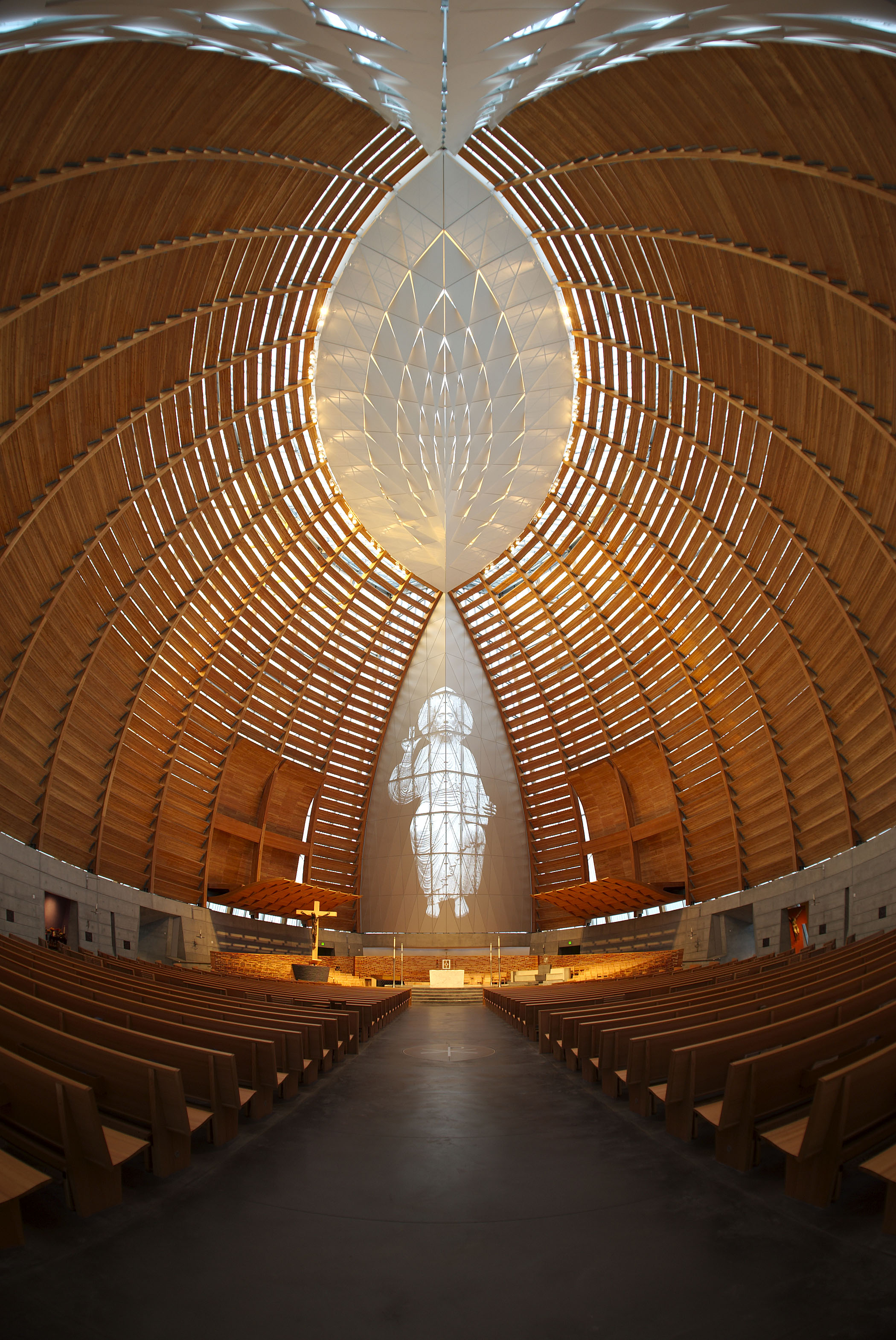
BLAUSTEIN CCL 4688

And for comparison let’s also look inside the Houston Co-cathedral:

Dsc 0001

If you’ve read this far (and are not doing it just to raise your blood pressure), then the above needs no explanation.

Then there are also those “stubborn asymmetries,” “the use of brutalist concrete[, which is] fundamentally unholy [and does not] conveyed a love for the Creator,” and not being “appropriate for housing the timeless truths offered by religion.”

Wow! Not only does the author not like the Oakland cathedral, but considers it unholy and inappropriate! I couldn’t disagree more and am baffled by his credentials.

First, let me get one point out of the way: I am grateful for the existence of both buildings since they provide spaces where the Church (i. e., people) can meet to build a community, celebrate mass and house the Eucharist. That is not what this rant is about.

Second, let me challenge the conclusions of the article on theological grounds. Christianity is an incarnate, living, historic religion where it’s “timeless truths” are timeless in substance but very much temporally incarnate in form! Since the person of Jesus, the Church has been a body with spatio-temporal location, evolving its understanding and putting into practice of the revelation Jesus brought. How can it therefore be claimed that there are some ancient, preferred church architectures rather than a preference for using the best of contemporary architecture?! Weren’t the Hagia Sophia, the Antwerp cathedral and the Sagrada Familia all children of their times? Should church architecture have stopped at the catacombs? I find this kind of thinking as incongruous as that of Catholics who want to cling onto tradition as it was in the early 20th century (but why then?!). Authentic tradition leads up to the now and is the fruit of the Holy Spirit’s continuing life in the Church.

Third, let me argue that the Oakland cathedral is aesthetically vastly superior to the Houston one. Just look at them! The former looks like the result of inspiration meeting taste, while the latter seems to me like a conveyor-belt, Disneyfied knock-off. I guess you either see that or not …


Apologies if this was too harsh, but I couldn’t let a piece like that just go. Not only are there plenty of ‘Catholic’ voices out there that make us seem like fools, but also fools without taste, like the one I tried to respond to here.


Hatred and liberty cannot coexist

Chief Rabbi Lord Sacks pic 3 Copy

I have been following Lord Sacks, the chief rabbi of the Commonwealth, for a while on Twitter and have greatly enjoyed his writings ever since. Today’s post on his website is no exception and is well worth reading in full. Kicking off with a great quote by Martin Luther King:

Darkness cannot drive out darkness: only light can do that. Hate cannot drive out hate: only love can do that. Hate multiplies hate, violence multiplies violence, and toughness multiplies toughness …

he then goes on to discuss one of the instructions Moses gives to his people: “Do not hate an Egyptian, because you were a stranger in his land.” (Deuteronomy 23: 8). Lord Sacks emphasizes how counter-intuitive a law this is, given the exploitation and slavery the Israelites suffered at the hands of the Egyptians, instead of a spell of hospitality that the quote may suggest. His key point though is that hatred makes us slaves of the past and allows for past wrongs to persist in us even after they occurred. This does not mean that injustice ought to be forgotten, but only that its remembrance is to serve the purpose of prevention rather than retaliation. The key paragraph from Lord Sacks’s exegesis to me is the following though:

Hatred and liberty cannot coexist. A free people does not hate its former enemies; if it does, it is not yet ready for freedom. To create a non-persecuting society out of people who have been persecuted, you have to break the chains of the past; rob memory of its sting; sublimate pain into constructive energy and the determination to build a different future.

In many ways this is similar also to what St. Augustine, whose feast it is today, said:

“[He] he shall neither hate the man because of his vice, nor love the vice because of the man, but hate the vice and love the man. For the vice being cursed, all that ought to be loved, and nothing that ought to be hated, will remain.” (The City of God, 14:6)

Here Lord Sacks’ words can be read as saying that a fault’s or wrongdoing’s ‘cure’ needs to be accelerated and that those who have been wronged can take the first step. Maybe hatred is not a feeling I have myself, but there are certainly past events that have hurt or saddened me and I will strive to apply Lord Sacks’s advice to my attitude to them.

I say polygon, you say polyhedron


When you look at the above image, what do you see? Two triangles and five quadrangles, a cube or something else? Now, let’s turn to the following thought experiment:

You are strapped into a chair, your head held firmly in place, and you see a bright, diffuse screen in front of you, showing a series of black lines. You notice that the screen can go from an only-just visible black point at its periphery, via lines cutting across it or forming triangles with its edges, to closed squares or even constellations of polygons moving and morphing across it. You also notice that there are several knobs and levers at your disposal and that you can influence the shapes seen on the screen. Your task is to work out how the patterns you see are formed.

All you have access to in this case is a sequence of experiences of a two-dimensional, bounded world, yet through painstaking experiments you come to the realization that what you are seeing is consistent with there being a wireframe cube behind the screen. All the patters, the changes from one pattern to another and the lengths of edges could be the result of a wireframe cube casting a shadow. Once you arrive at your conclusion you are released from your restraints and are free to exit the room. As you do so, another person exits the room next to you. A quick chat reveals you had the same experience, but it turns out that they are convinced that it was just a computer screen rather that the silhouette of a mesh cube. You enter each other’s rooms and realize that they look identical! You believe their room shows a 3D cube’s shadow; they believe your room contains a 2D computer-driven display. You both look for a way to access what is behind the respective screens and after a while you find the rooms backing onto your two ones. Your screen and theirs were indeed driven differently: one was a display driven by a computer and the other a piece of translucent plexiglass having a backlit cube cast shadows on it. Which was which remains a secret guarded by the two of you.

Now, my question to you: who was the more rational participant in this experiment? The person postulating a 3D entity on the basis of strictly 2D evidence or the person whose theories remained firmly 2D, in line with the nature of their evidence?

I would like to argue that they were both equally rational and that the distinction between them was not along rational-irrational lines and to underline the fact that they were both deriving their world views from the same evidence.

What was the point of this whole exercise though? It was to propose that empirical evidence alone is not sufficient to constrain explanation to a solely empirical domain (even just the use of mathematics in science, with its universal quantifier is beyond the empirical) and that the exact same experiences can be held up as a basis for alternative theories.

The last exegetical point I’d like to make though is that the two protagonists of the thought experiment can learn a lot from each other. The person hypothesizing the 3D cube can lend the other means for simplification while the strictly 2D person can share a more refined understanding of 2D relationships, which also enrich the cube’s understanding.

Why is it that I am concerned by the evidence-theory relationship and try to dig into its nature? It is because this is a key stumbling block in the rapprochement between atheist scientists and the rational religious. The former don’t get how the latter can transcend evidence while the latter are threatened by the former’s insights into empirical evidence. The many-to-many nature of the evidence-theory relationship also underlies inter-religious dialogue. Since the transcendent is infinite, hyper-dimensional and vastly exceeding the fragmentary insights we can have of it, also in terms of aspects we don’t even know about!, it is understandable that different interpretations of its actions have been formed in different cultures and by different people. It would be short-sighted to stop at an incompatibility between the monotheism of some religions, the personal Trinitarian insight of Christianity, the polytheism of Hinduism and the apparent atheism of Buddhism (in the strict sense of atheism as opposed to its current use as anti-theism) and arrive at the erroneous conclusion that these religions talk about different things rather than differently about aspects of the same (please, don’t mis-read this as me saying that everything that all religions claim is true, that all religions are equally true or that religions can be freely intertwined and recombined. End of caveat :).

If there is a God, who is infinite, transcendent and vastly more complex than us, wouldn’t his actions as experienced in our limited realm lead precisely to the variety of religions as well as agnosticism and atheism that we see today?


Just a quick hat-tip to Flatland, to the Chinese Room thought experiment and to the story of the blind men and an elephant (and surely to many others :).

The rosary and I


A Navy SEAL (possibly previously involved in an operation closely watched by the POTUS himself) abseils from the ceiling of a small church, neutralizes and removes an old lady praying the rosary and disappears as quickly as she appeared. As commander of the unit, I judge the operation a success: mass is no time to pray the rosary. But, I am daydreaming …

What I wanted to talk about this time is why I do pray the rosary (and instead of a [possibly reasonably] well researched piece, I’d just like to share my personal experience, on a topic well worth returning to later, with more time to spend). The rosary is my favorite prayer as it is so versatile – you can use it as a basis for reflection, repeating its words almost mechanically (along the lines of Buddhist and Hindu mantras) and leaving your mind open to listening to the Holy Spirit; you can actually meditate on its words, which take you through the incarnation to contemplating the completion of our earthly journey and which do so focusing on Jesus through the optics of Mary; you can also use it as a way to work your way through the becoming flesh, teaching, suffering and resurrection of Jesus; you can also just employ it as a way to keep your mind from getting caught up in negative and harmful thoughts or an excess of self-pity; you can also use it to give thanks for the gifts of friendship, love and providence that can be recognized in our daily lives. And this is just the beginning!

The rosary has for me also been an act of uncontrollable resistance in the face of the oppressive regime I grew up in. On my way to school I would be praying it on the bus, where any outward sign of religiosity would be illegal and risk reprisal. Silently I was turned towards Jesus while Big Brother was watching and I knew, that unlike Winston Smith, he would never win my love. Years later, I would pray it on my way to university in an environment steeped in consumerism, and here too the rosary spread its mantle around me and allowed me to relate to my neighbors for what they were and not what they had.

I apologize if this sounds exaggerated, but the rosary has played an important part in my life – and it still does. It is the basis for not getting sucked into the ever-changing whirlpools that come in my way and for keeping my eyes on what matters: to love my friends and Jesus did and to aim to make everyone a friend of mine.

It would be grossly misleading to leave even this personal confession of rosary praying without pointing briefly to what prayer is an here there is none better that Fr. Pasquale Foresi, who said:-

Prayer does not consist in dedicating time during the day to meditation, or to reading some passages from Scripture or from the writings of the saints, or in thinking of God or our ourselves with the aim of some internal reform. This isn’t prayer in its essence.

Reciting the rosary or morning or evening prayers is just the same. One can do these things all day without ever having prayed even for a minute.

Prayer, to be truly such, requires above all a relationship with Jesus: to go with the spirit beyond our human condition, our worries, our prayers – no matter how nice and necessary they may be, and establishing this intimate, personal relationship with him.

Elsewhere he even says: you can pray even when you are saying prayers :). Essentially the rosary is an excuse, a basis for trying to orient myself towards Jesus and as such I am a great fan of it.


First, thanks to my dad for suggesting this topic 🙂 and second, if you have any experience of prayer – or something else related to it – that you’d like to share, feel free to leave a comment. 🙂

UPDATE: For a great rosary joke, see this video by Jesuit Fr. James Martin 🙂 – the whole “Forty Days of Funny” series is excellent …

The wedding garment


Yesterday’s gospel reading was a bit of a puzzler and as I don’t think I ever heard it convincingly explained in a homily or made satisfactory sense of it myself, I started digging a bit into it. The text is from Matthew’s gospel (22:1-14) and presents the parable of the king’s son’s wedding feast where those who are invited refuse and the king’s servants bring in whomever they can find. The parable then ends in one of the guests being expelled for wearing the wrong gear plus there is a bit of killing too. Here is the full text:

Jesus said to the chief priests and the elders of the people, ‘The kingdom of heaven may be compared to a king who gave a feast for his son’s wedding. He sent his servants to call those who had been invited, but they would not come. Next he sent some more servants. “Tell those who have been invited” he said “that I have my banquet all prepared, my oxen and fattened cattle have been slaughtered, everything is ready. Come to the wedding.” But they were not interested: one went off to his farm, another to his business, and the rest seized his servants, maltreated them and killed them. The king was furious. He despatched his troops, destroyed those murderers and burnt their town. Then he said to his servants, “The wedding is ready; but as those who were invited proved to be unworthy, go to the crossroads in the town and invite everyone you can find to the wedding.” So these servants went out on to the roads and collected together everyone they could find, bad and good alike; and the wedding hall was filled with guests. When the king came in to look at the guests he noticed one man who was not wearing a wedding garment, and said to him, “How did you get in here, my friend, without a wedding garment?” And the man was silent. Then the king said to the attendants, “Bind him hand and foot and throw him out into the dark, where there will be weeping and grinding of teeth.” For many are called, but few are chosen.’

So, what does all this mean? I had a quick look at homilies over the last 2000 years and found the following:

  1. St. Cyril of Jerusalem (4th century AD) basically considers this parable self-explanatory 😐
  2. St. John Chrysostom (4th century AD) gives the parable a historical reading whereby those invited are the people of Israel while the random crowd picked from the cross-roads are the Gentiles. He also focuses on the invitation to the latter being due to no merit of their own but wholly down to grace. The most interesting part if the parable to me is the poor guy who gets kicked out after he was invited at random. Here St. John focuses on the fact that he condemns himself – only after the king personally questions him about his improper attire (representing the corrupted state of his life) and he is unable to bring anything to his own defense, is he condemned. St. John also makes a point about this guest having had a clean garment given to him to begin with: “And yet the calling was of grace; wherefore then doth He take a strict account? Because although to be called and to be cleansed was of grace, yet, when called and clothed in clean garments, to continue keeping them so, this is of the diligence of them that are called.” This addresses the prima facie peculiarity of the parable: why punish someone who was invited in at random. The answer seems to be that the second cohort of guests were given appropriate attire (grace) but failed to maintain it.
  3. St. Augustine (4th-5th century AD) offers a rather convoluted explanation of this parable, spending an inordinate amount of time on evidencing that the one expelled guest actually represents a whole category (he is to be commended for his rigor though). As regards the expelled guest, St. Augustine equates the wedding garment with charity and quotes St. Paul to warn against its imperfect variants :““though I distribute all my goods for the use of the poor, and though I give my body to be burned, and have not charity, it profiteth me nothing.” This then is “the wedding garment.””
  4. Martin Luther (14th-15th century AD) reiterates the historical reading of St. John and St. Augustine and, as regards the expelled guest he characterizes them as follows: “These are pious people, much better than the foregoing; for you must consider them the ones who have heard and understood the Gospel, yet they cleaved to certain works and did not creep entirely into Christ; like the foolish virgins, who had no oil, that is, no faith.” That is, Christians, who were given everything, but have squandered it. What is it that God wants instead? Here Martin Luther has the following to say: “Now, what do we bring to him? Nothing but all our heart-aches, all our misfortunes, sins, misery and lamentations.” God wants us to be open with him and give him our all – weaknesses and strengths included.
  5. Finally, Pope Benedict XVI also offers his reading of this parable in a recent sermon: “God is generous to us, He offers us His friendship, His gifts, His joy, but often we do not accept His words, we show more interest in other things, we put our material concerns, our interests first.” As far as the expelled guest, Pope Benedict says: “on entering the hall, the king sees someone who has not wanted to wear the wedding garment, and for this reason he is excluded from the feast.” again echoing St. John’s position that the wedding garment was available to the guest but that it was his choice not to wear/maintain it. Pope Benedict then quotes St. Gregory the Great, who says that “this garment is symbolically interwoven on two pieces of wood, one above and one below: love of God and love of our neighbour.”

This parable has certainly been given a lot of thought since Jesus shared it with his followers and it seems clear that it is squarely directed at those who have heard the call of God to follow him. It is a warning both to those who hear it and ignore it and to those who follow it on the surface, but don’t back it up with faith and charity. In no way is this any criticism of sincere atheists/agnostics. Instead it is a rather harsh warning to those of us who claim to be Jesus’ followers, and, as St. John says “indicates […] the strictness of the life required, and how great the punishment appointed for the careless.” So, instead of a “oh, isn’t this a bit unfair to the poor, random fella” the message is clearly: take your relationship with God seriously – it is no game.

Salve Regina


Salve, Regina, Mater misericordiæ,
vita, dulcedo, et spes nostra, salve.
ad te clamamus exsules filii Hevæ,
ad te suspiramus, gementes et flentes
in hac lacrimarum valle.
Eia, ergo, advocata nostra, illos tuos
misericordes oculos ad nos converte;
et Iesum, benedictum fructum ventris tui,
nobis post hoc exsilium ostende.
O clemens, O pia, O dulcis Virgo Maria.

Today is the feast of Mary, Queen of Heaven, and my first reaction was to skip this as a blog topic as monarchic themes mean nothing to me (their frequent use in theology being, to my mind, a historical aberration rather than something that tells us anything profound about God). Then I remembered the hymn Salve Regina, in its original above and in a contemporary English translation here:

Hail, holy Queen, Mother of mercy,
our life, our sweetness, and our hope.
To you we cry, the children of Eve;
to you we send up our sighs,
mourning and weeping in this land of exile.

Turn, then, most gracious advocate,
your eyes of mercy toward us;
lead us home at last
and show us the blessed fruit of your womb, Jesus:
O clement, O loving, O sweet Virgin Mary.

This hymn is one of the few that have emotional resonance for me both because it has been sung at important moments in my life and because it says some key things about Mary, who is the model for how to follow her son, Jesus. The hymn both sets the context of suffering and persecution that Mary was exposed to throughout her life (just think of her desolation at the foot of the cross), and that we too experience at different moments, and points to its resolution in her son. Why is it though that Mary should play this role of intercessor? Can’t we just pray to Jesus? Sure! Invoking Mary’s help in no way bypasses Jesus – in fact if you look at everything we know about her, it always points to God. Does this mean that she is in some way insubstantial? On the contrary! What I see when I look at Mary is a person fulfilled to the maximum since she perfectly followed God’s plan for her. I believe God has a plan for each one of us (a plan that always starts in the now, regardless of what we have done before) and that fulfils us, gives us joy and makes us free.

The cowardice and weakness of good men


St. Pope Pius X, whose feast day it is today, has been a hero of mine since my childhood, when I read his inspiring biography by Wilhelm Hünermann. He grew up in a poor family and was given an education only thanks to his parish priest’s charity. As he then rose through the ranks of the Church, he maintained his focus on the essential and lived in Evangelical poverty until his death. Upon being elected pope he decided to only use a small room in the Vatican and proceeded to sell off many of the papacy’s insignia (including the papal tiara – the headpiece adorned with three crowns), with the takings going to the poor. He also suffered greatly from the upheaval that culminated in WWI, saying that “[i]n our time more than ever before, the chief strength of the wicked, lies in the cowardice and weakness of good men.”

Given this great saint’s and pope’s holiness, I am just dismayed at the break-away ‘traditionalist’ group – the Society of St. Pius X – using his name in vain. I am sure it wouldn’t be to his liking …


A post about St. Pius X can’t go out without mention of a prank he pulled as a kid. When asked to look after an old lady’s house in her absence, he went on to teach her cats to fear the rosary by chasing them with a stick while rattling it. When the old lady returned and got to praying the rosary, her cats went nuts 🙂

The Word is near you


Today is the feast day of St. Bernard of Clairvaux, a great reformer of the Church and of monasticism and co-founder of the Cistercians. He also warned strongly against antisemitism and was an outspoken critic of the corruption in the Church of the 12th century (e. g., saying “One cannot now say, the priest is as the people, for the truth is that the people are not so bad as the priest.”) In many ways he prefigured the Reformation, and while he was an outspoken critic, he remained a reformer who stayed faithful to the Church and was later proclaimed saint and Doctor of the Church. What I find most attractive about him though are his insights about how to follow in Jesus’ footsteps, with sayings like “The true measure of loving God is to love Him without measure.” My favourite though is: “You don’t have to navigate seas, break through clouds or cross the Alps. The way that is being shown to you is not long. You only have to go towards God as far as yourself since the Word is near you: it is in your mouth and in your heart.”

A self thinking thoughts that are (or, an invitation to epistemic honesty)

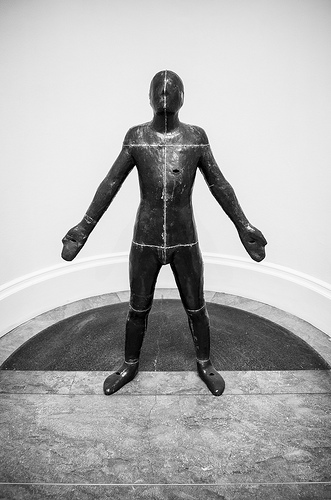
Gormley

Language.

Thought.

Being.

Self.

A much more honest kick-off to a quest for reliable knowledge than René’s “cogito ergo sum.” But where to go next? With a self thinking thoughts that are, how do we get to knowledge of a world beyond? I believe I can’t, or rather, that I can’t know. All I have access to is my self. How about sensory experiences though? Well, those are still only parts of me – the stream of images, sounds, smells, textures, temperatures, pressures, movements are nothing but events internal to me. Are they caused by a world beyond me? Just from what I have to go on, there is no way of telling.

You say though that you see the same moon, trees and world as I describe, so it must be other than both you and I. But, no … I only have my own experiences of you at my disposal and you may as easily be entirely part of me as an independent inhabitant of an external universe.

And, invoking Occam’s blade won’t get you anywhere either: surely a universe where only I, with my complex imagination, exist is simpler (but, I am not saying more believable) than one where myriads of entities inhabit a material world.

Admittedly, many have set out down this route (Descartes and Russell being only two of my many fellow travelers – needless to say, known to me only as parts of my self) but none, to my knowledge, have stayed true to their initial rigor.

The insurmountable epistemic chasm between the self and anything potentially beyond it is precisely that: an chasm insurmountable by knowledge. All I will ever have access to is me: whether it prima facie looks like you or an external world or not. With epistemic honesty no secunda facie is accessible and, I have to say that both René and Bertie have let themselves be blindsided by ‘reasonable’ arguments that made them fudge the chasm and build magnificent edifices of knowledge on air.

Maybe you’ll want to call my bluff (à la Camus’ Myth of Sisyphus, where he challenges all who truly believe life to be absurd to commit suicide) and either say: “Come on, old girl, you’ve had your fun. Surely you can’t believe this. Look around you: how could all this just be in your head?!” to which the answer should be obvious from the above.

Or, you could try a different, more subtle, line of attack: “If you really don’t think there is anything beyond yourself, why bother doing anything. Doesn’t it make progress, compassion, love and the suffering of others meaningless?” To which I’d admonish you with a quick: “Check yourself before you wreck yourself.” Why should the events that I only have access to via my own experiences be any less seriously confronted in the absence of knowledge of their origin? Experiencing what appears as someone else’s suffering is an experiencing of suffering and cries out for remedy and consolation. If anything, it makes all suffering my suffering and therefore gives its resolution heightened urgency and immediacy. All this is to address only a misinterpretation of what I have said though. Stating that nothing beyond the self can be known (since I only ever have access to myself) does not mean that beliefs cannot (or even ought not) be held about the existence of others or a shared world (or that reason cannot be applied to structuring, explaining and predicting experiences consistent with an external world). All it means is that these beliefs, if held, are not derived from experience but additional (though not contrary) to it.

I don’t see any reason to break with epistemic honesty and deny the epistemic inescapability of the self so that questions beyond the self can be addressed. All it takes is being honest about involving beliefs or at least assumptions.

UPDATE (24/09/2012): Having just listened to Antony Gormley’s talk at the latest TED conference, I am delighted to see that his approach to sculpture very much parallels the above epistemological argument. Unlike ancient Greek sculptors, who tried to get at a sculpture trapped in a block of marble, so to speak from the outside, Gormley’s approach is the opposite. He starts from the “darkness of the body,” which he invites us to explore as follows:

“Do you mind if we do something completely different? Can we all just close our eyes for a minute? Now, this isn’t going to be freaky. It isn’t some cultic thing. (Laughter) It’s just, it’s just, I just would like us all to go there. So I’m going to do it too. We’ll all be there together.

So close your eyes for a minute. Here we are, in a space, the subjective, collective space of the darkness of the body. I think of this as the place of imagination, of potential, but what are its qualities? It is objectless. There are no things in it. It is dimensionless. It is limitless. It is endless.

Okay, open your eyes.

That’s the space that I think sculpture – which is a bit of a paradox, sculpture that is about making material propositions – but I think that’s the space that sculpture can connect us with.”

Gormley’s “darkness of the body” is where epistemic honesty needs to start and where it remains even when we open our eyes.

Sun and moon and stars


Today is the feast day of the assumption of Mary into heaven. A unique honor reserved for Jesus’ mother who was not only conceived without original sin, lived a life without sin but was also lifted up into heaven at the end of her earthly journey.

To intuit the greatness of Mary and her key role in understanding both her son and the Trinity, the following is a fragment from one of the most recent mystical visions shedding light on her – that of Chiara Lubich in 1949:

“On that day I understood Mary, perhaps through an intellectual vision, as I had never seen her before. And now twelve years have passed since that day, but I still have the clear impression of the unexpected “greatness” that this discovery of the Mother of God in the Bosom of the Father made on me. As the blue of the sky contains sun and moon and stars, so Mary appeared to me, made by God so great as to contain God Himself in the Word.

I had never had such a notion of Mary, but there her divine [by participation] greatness was impressed upon my soul in such a way that I do not know how to say it again.

I can say only that no human reasoning would be able to render the idea.

That vision produced conviction.”