Sacrosanctum Concilium: liturgy together

Arcabas last supper

For reasons beyond the scope of this post I feel compelled to take up my quest to read the documents of Vatican II during this Year of Faith, by postponing and leapfrogging the last two chapters of Lumen Gentium and confronting the Council’s constitution on the liturgy: Sacrosanctum Concilium.1 Here I have to admit that the opening chapters of the document were challenging in that their form had to be endured for the sake of getting to their content, but – like when reading The Name of the Rose, where Umberto Eco himself characterizes the first 100 pages as a mountain that is to be climbed to reach the rewards lying beyond it2 – the core of the reform of the liturgy, as well as the very frank and practical steps defined for achieving it, are gems worth working for and I hope you too will take on the climb.

Before delving into the content of Sacrosanctum Concilium, it is worth noting that the concept of liturgy (λῃτουργία / leitourgia) predates Christianity and has its origins in ancient Greece where it referred to a public service – a work (ἔργο / ergon) of the people (λαός / Laos) – “whereby [a city-state’s] richest members […] financed the State with their personal wealth.” In the Christian context, this public service has since the first century AD had as its core what Jesus himself had “told His followers to do in memory of Him” – i.e., to nourish themselves by His body and blood, which he shared with the apostles at the Last Supper (cf. Luke 22:19). This Christian liturgy is a public service in that it strengthens and supports those who participate in it, by bringing them closer both to God and to each other.

The aim then of Sacrosanctum Concilium is to support Christian life by adapting “to the needs of our own times [that] which [is] subject to change; foster[ing] whatever can promote union among all who believe in Christ; strengthen[ing] whatever can help to call the whole of mankind into the […] Church.” The result is a desire to “reform and promote the liturgy,” where the changes introduced in it are a consequence of the Church “be[ing] both human and divine, visible and yet invisibly equipped, eager to act and yet intent on contemplation, present in this world and yet not at home in it.”

As in the other Vatican II documents, the starting point here too is the Trinity, where:

“[God] sent His Son, the Word made flesh, anointed by the Holy Spirit, to preach the gospel to the poor, to heal the contrite of heart, to be a “bodily and spiritual medicine”, the Mediator between God and man. […] Therefore in Christ “the perfect achievement of our reconciliation came forth, and the fullness of divine worship was given to us”. […] Thus by baptism men are plunged into the paschal mystery of Christ: they die with Him, are buried with Him, and rise with Him. [Thus, since its beginning] the Church has never failed to come together to celebrate the paschal mystery: reading those things “which were in all the scriptures concerning him” (Luke 24:27) [and] celebrating the eucharist in which “the victory and triumph of his death are again made present”.”

In the liturgy, there is a particular, personal presence of Jesus, who

“is always present in His Church, especially in her liturgical celebrations. He is present in the sacrifice of the Mass, not only in the person of His minister, “the same now offering, through the ministry of priests, who formerly offered himself on the cross”, but especially under the Eucharistic species. […] He is present in the sacraments, so that when a man baptizes it is really Christ Himself who baptizes. He is present in His word, since it is He Himself who speaks when the holy scriptures are read in the Church. He is present, lastly, when the Church prays and sings, for He promised: “Where two or three are gathered together in my name, there am I in the midst of them” (Matthew 18:20).”

In other words, the liturgy is a personal encounter with Jesus, which demands one’s full and active participation both individually and as a community. Sacrosanctum Concilium’s objective is to reform the liturgy as it was before Vatican II, since:

“the liturgy is made up of immutable elements divinely instituted, and of elements subject to change. These not only may but ought to be changed with the passage of time if they have suffered from the intrusion of anything out of harmony with the inner nature of the liturgy or have become unsuited to it. In this restoration, both texts and rites should be drawn up so that they express more clearly the holy things which they signify; the Christian people, so far as possible, should be enabled to understand them with ease and to take part in them fully, actively, and as befits a community.”

The first principle in such a restoration is to foster “warm and living love for scripture,” which “is of the greatest importance in the celebration of the liturgy.” The second is that “[liturgical services] are celebrations of the Church, which is the “sacrament of unity,” [of] the holy people united.” Third, while “the sacred liturgy is above all things the worship of the divine Majesty, it likewise contains much instruction for the faithful. For in the liturgy God speaks to His people and Christ is still proclaiming His gospel. And the people reply to God both by song and prayer. […] The rites should [therefore] be distinguished by a noble simplicity; they should be short, clear, and unencumbered by useless repetitions; they should be within the people’s powers of comprehension, and normally should not require much explanation.”

Guided by the above principles, the use of mother tongues (which were not in liturgical use before Vatican II) in addition to Latin is encouraged, “in the first place [for] the readings and directives, and [for] some of the prayers and chants.” Sacrosanctum Concilium goes much further though, in an effort to bring the liturgy close to all of its participants and allow for full participation as a community:

“Even in the liturgy, the Church has no wish to impose a rigid uniformity in matters which do not implicate the faith or the good of the whole community; rather does she respect and foster the genius and talents of the various races and peoples. Anything in these peoples’ way of life which is not indissolubly bound up with superstition and error she studies with sympathy and, if possible, preserves intact. Sometimes in fact she admits such things into the liturgy itself, so long as they harmonize with its true and authentic spirit. […] In some places and circumstances, however, an even more radical adaptation of the liturgy is needed. […] The competent territorial ecclesiastical authority […], must, in this matter, carefully and prudently consider which elements from the traditions and culture of individual peoples might appropriately be admitted into divine worship. Adaptations which are judged to be useful or necessary should then be submitted to the Apostolic See, by whose consent they may be introduced. To ensure that adaptations may be made with all the circumspection which they demand, the Apostolic See will grant power to this same territorial ecclesiastical authority to permit and to direct […] the necessary preliminary experiments over a determined period of time among certain groups suited for the purpose.”

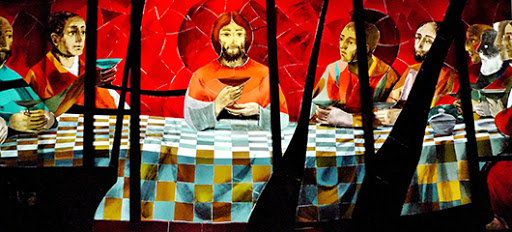
The above, to me, is the first of the real eye-openers about Sacrosanctum Concilium in that is seems to go way beyond what I see in the Church today. Here there is a clear intention to recognize what is good in various cultures and make it part of the public service that is the liturgy. This is not the cultural imperialism that the Church is often criticized for, but a readiness to seek out and recognize value wherever it is present, so that communities can bring their treasures to the table at which the Last Supper is celebrated, instead of being observers at a foreign spectacle. Neither is it recalcitrant adherence to established forms or wanton novelty for its own sake, but a process that involves controlled “experiments” – the last concept I expected to see in an official Church document.

To further make them accessible to all and welcoming of participation,

“the rites are to be simplified, due care being taken to preserve their substance; elements which, with the passage of time, came to be duplicated, or were added with but little advantage, are now to be discarded; other elements which have suffered injury through accidents of history are now to be restored to the vigor which they had in the days of the holy Fathers. […] Especially on Sundays […] there is to be restored, after the Gospel and the homily, […] “the prayer of the faithful.” By this prayer, in which the people are to take part, intercession will be made for holy Church, for the civil authorities, for those oppressed by various needs, for all mankind, and for the salvation of the entire world.”

These are changes that not only invite participation by a community, but do so in a way where it faces both Jesus and the world. Clear efforts are also made here to involve the laity in new ways where “provision [are to] be made [so] that some sacramentals […] may be administered by qualified lay persons.”

In amongst the extensive list of specific changes introduced by Sacrosanctum Concilium, there are also several whose directness and verging on irony were a treat to read in a document of this kind: “The rite for the baptism of infants is to be revised, and it should be adapted to the circumstance that those to be baptized are, in fact, infants.” [Duh! :)], “The prayer for the bride, [is to be] amended to remind both spouses of their equal obligation to remain faithful to each other.” and “The accounts of martyrdom or the lives of the saints are to accord with the facts of history.” were definitely among my favorites.

Finally, the reform of the liturgy is also extended to the music and visual art used to support and enhance it, with a strong emphasis on simplicity and service:

“[B]ishops and other pastors of souls must be at pains to ensure that, whenever the [liturgy] is to be celebrated with song, the whole body of the faithful may be able to contribute that active participation which is rightly theirs. […] In certain parts of the world […] there are peoples who have their own musical traditions, and these play a great part in their religious and social life. For this reason due importance is to be attached to their music, and a suitable place is to be given to it, not only in forming their attitude toward religion, but also in adapting worship to their native genius. Therefore, when missionaries are being given training in music, every effort should be made to see that they become competent in promoting the traditional music of these peoples, both in schools and in sacred services.

The Church has not adopted any particular style of art as her very own; she has admitted styles from every period according to the natural talents and circumstances of peoples, and the needs of the various rites. Thus, in the course of the centuries, she has brought into being a treasury of art which must be very carefully preserved. The art of our own days, coming from every race and region, shall also be given free scope in the Church, provided that it adorns the sacred buildings and holy rites with due reverence and honor. [… Bishops], by the encouragement and favor they show to art which is truly sacred, should strive after noble beauty rather than mere sumptuous display. […] Let bishops carefully remove […] those works of artists which […] lack artistic worth, [or display] mediocrity and pretense. […] And when churches are to be built, let great care be taken that they be suitable for the celebration of liturgical services and for the active participation of the faithful.”

Reading through the entirety of Sacrosanctum Concilium, what stuck in my mind was how apt the term “restoration” was for what its principles and instructions amount to. It is a restoration of the simplicity and immediacy of being in Jesus’ presence that the apostles and the Early Church must have experienced. It is a de-cluttering, a removal of exaggeration and deformation, and a consistent and all-pervasive re-focusing on the liturgy being “performed by the Mystical Body of Jesus Christ, that is, by the Head and His members.” The changes to the structure and extent of the liturgy, the use of the congregation’s mother tongue and the principles guiding the use of music and art all serve a single purpose: to make the liturgy be a knowing, active, living expression of a community, gathered around the one table in the Upper Room, with Jesus at it’s head.


1 As is now de rigueur here for posts that verge on or fully wade into the theologically technical, please, consider reading paragraph two of the following post as a caveat, if you are not a Catholic.
2 “After reading the manuscript, my friends and editors suggested I abbreviate the first hundred pages, which they found very difficult.and demanding. Without thinking twice, I refused, because, as I insisted, if somebody wanted to enter the abbey and live there for seven days, he had to accept the abbey’s own pace. If he could not. he would never manage to read the whole book. Therefore those first hundred pages are like a penance or an initiation, and if someone does not like them, so much the worse for him. He can stay at the foot of the hill.” (Umberto Eco, Reflections on “The Name of the Rose”)
Celibacy and marriage

Counsels

On Monday I listened with growing disappointment to a BBC Radio 4 program that intended to shed light on celibacy from the perspective of different faiths. The program’s panel was composed of a muslim cleric, a Catholic nun and an academic, who provided Buddhist and Hindu perspectives. Instead of dissecting the program here,1 I would like to share my personal, very much Christian, reflection and invite you to let me know what you make of it.

The optics I’d like to apply here are those of vocation.2 And I’d like to think about celibacy and marriage in parallel, since they are each key comparators for one another, and since talking about one without referencing the other would be artificial and woefully incomplete. Note also that I won’t attempt to knot a customary net of references, and will instead aim to present a synthetic and condensed exposition of my take on this topic, which has occupied my mind for a good 20 years so far.

First, I’d like to suggest that there is only one Christian vocation, which is to say (and keep saying) “Yes!” in response to God’s call to follow, imitate and love Him, directly and in my neighbors, and to give Him primacy in my life. Just as God didn’t supply Samuel with a job description when He called him (1 Samuel 3:1-10), like “a light silent sound” (1 Kings 19:12), or as Jesus didn’t issue the apostles with detailed terms and conditions (cf. Luke 5:1-11, Matthew 4:18-22), so too the specifics of following Him are part of the journey He invites me on. This adventure can take a myriad forms, like the infinite variety and ever-evolving novelty of God’s love itself.

Second, any perfection attained as a consequence of responding to God’s call is a gift. It can be welcomed and facilitated by staying attentive to the Holy Spirit’s “inspiration” in every present moment, by being open to embracing Jesus in every suffering and welcoming him among those who love one another mutually, and by placing one’s childlike trust in our loving Father. Perfection is not a human product, as the lives of so many saints attest.

Third, responding to my vocation yields both challenges and joys, where the natures and sources of both depend on the specific path I follow. On the surface of it, some are more likely if you are celibate while others are more typical of married life. Ultimately though, difficulties (suffering, frustration, disappointment) and joys alike are a consequence of what God wills or allows for me to experience and how I respond to it. This has nothing whatsoever to do with celibacy or marriage and everything to do with looking for God and embracing His will, moment by moment. Both have equal capacity for sanctification and torment, to the extent to which they lead to experiencing union with or absence from God.

Fourth, celibacy is a great treasure. It is an expression of a person’s permanent commitment to follow God’s call in total self-giving. By imitating Jesus’ celibate life, they, like He, devote themselves to supporting, enriching and guiding the People of God and proclaiming the Good News of God’s love to all. They, with their communities around them, are witnesses to God’s love in the world and a beacon of His fatherly and motherly love. The essence of celibacy is not a foregoing of sexual joy and the delights that one’s own children bring, but a positive, total gift of oneself to God, who is not to be outdone in generosity.

Fifth, marriage is a great treasure. It is an expression of a person’s permanent commitment to follow God’s call in total self-giving. By imitating the life of the Trinity, husband and wife become one family – a small church, where God dwells among those who follow his word. By “follow[ing] Jesus closely,”3 a family supports, enriches and guides the People of God and proclaims the Good News of God’s love to all. Married persons follow the evangelical counsels of poverty, obedience and chastity in ways proper to their circumstances and are available for transmitting God’s love to all. The essence of marriage is not an avoidance of a total commitment to God, a holding back of something for oneself, but a positive, total gift of oneself to God, who is not to be outdone in generosity.

Sixth, as one discerns how to follow God’s call in celibacy or marriage, it is understandable that one considers one’s own calling to be superior to the alternative. Since both have great riches and are means for sharing in the most intimate life of God, they each provide an overflowing basis for being extolled as superior. I believe that arguments for either exceeding the other ought to be read in this light – through their proponent’s eyes, and appreciated for being signs of the value and beauty that those who have chosen them see in them.

Finally, I would like to thank all who guided me during the time of discerning my vocation – some of whom were celibate, others married, and all of whom made me experience the presence of Jesus among his disciples – and my spouse, who is the tabernacle of our family.


1 If you’d like to hear it for yourself, a recording is available here. I’d be curious to know whether you found it enlightening or frustrating …
2 Since this is going to be spiritual and personal as much as intellectual, you might want to check out my standard Thomas-Nagel-inspired disclaimer in the second paragraph here.
3 Speaking about marriage a couple of weeks ago, Pope Francis described it as “men and women who have left their homes to commit to a lifelong marriage, that is to follow Jesus closely!”

Me atheist, you Vatican spokesman

Chinese whispers

The journalistic farce that followed Pope Francis’ now-famous “atheists” homily is best viewed through Monty Python lenses, where it is in many ways like the final scene of the Life of Brian.1 There, a centurion comes to rescue Brian from the cross, but when he asks “Where is Brian of Nazareth?!” everyone volunteers, even to the point of one of the other crucifixion victims saying “I’m Brian, and so’s my wife!”

Let’s backtrack though and see what happened step by step. First, there was Francis’ homily itself:

“The Lord has redeemed all of us, all of us, with the Blood of Christ: all of us, not just Catholics. Everyone! ‘Father, the atheists?’ Even the atheists. Everyone! And this Blood makes us children of God of the first class! We are created children in the likeness of God and the Blood of Christ has redeemed us all! And we all have a duty to do good. And this commandment for everyone to do good, I think, is a beautiful path towards peace. If we, each doing our own part, if we do good to others, if we meet there, doing good, and we go slowly, gently, little by little, we will make that culture of encounter: we need that so much. We must meet one another doing good. ‘But I don’t believe, Father, I am an atheist!’ But do good: we will meet one another there.”

When I first read this, a couple of hours after Francis delivered it during his 7 am Domus Sanctae Marthae mass on 22nd May, I felt great joy and gratitude for having a Pope who is open and welcoming to all – just like Jesus was. I thought no more about it, since it seemed to me to be just a re-iteration – albeit a very welcome and clear one – of what the Church has been teaching consistently since Vatican II.2 In essence, Francis was saying that we hope to see atheists in heaven as much as we hope to be there ourselves. This is not to impose beliefs on those who believe neither in God nor in the existence of heaven, but to assure them that we, Catholics (and many other Christians too), believe in a God who loves all and welcomes all, regardless of their beliefs.

When I then looked at Twitter later in the day, I saw it ablaze with two types of reactions: very positive ones both from Christians and atheists, welcoming the invitation to dialogue and the appreciation of the good done by atheists (e.g., see the Huffington Post article from the same day and note the Pope’s homily being the second most shared piece on Reddit) and very critical ones – mainly from “traditional” Catholics (e.g., see a particularly forceful and conceited criticism here).

The day ended well for this story though, with a spot-on rebuke of Francis’ critics from a 1964 homily of the then-Fr. Joseph Ratzinger, shared in a blog post by Anna Williams:

“It seems as if we want to be rewarded, not just with our own salvation, but most especially with other people’s damnation—just like the workers hired in the first hour. That is very human, but the Lord’s parable [of the workers in the vineyard (Matthew 20:1-6)] is particularly meant to make us quite aware of how profoundly un-Christian it is at the same time.”

So far, so good: another great homily by Pope Francis, mostly positive and some negative reactions and a great put-down of the critics to round out the day.

The next morning, the weather turned though and a farce of epic proportion began brewing with the news of a Vatican spokesperson having issued a correction of Pope Francis’ words. As far as I can tell, the source of this red herring was a post on cnn.com, which stated that “On Thursday, the Vatican issued an “explanatory note on the meaning to ‘salvation.’” The Rev. Thomas Rosica, a Vatican spokesman, said that people who [are] aware of the Catholic church “cannot be saved” if they “refuse to enter her or remain in her.”” This was quickly picked up by media outlets around the world, with headlines like: “Vatican Clarifies Pope’s ‘Atheist’ Remarks,” “Vatican corrects Pope: Atheists are still going to hell,” and “Not so fast: Vatican says Pope Francis got it wrong, atheists do go to hell.”

It was immediately clear to me that something didn’t add up here: first, Fr. Thomas Rosica isn’t “a Vatican spokesman” (Fr. Federico Lombardi being “the” Vatican spokesperson, who has been in office for many years),3 second, “people who are aware of the Catholic Church and are not in her cannot be saved” is not at all what the Catechism says4 and third, any member of the Catholic Church (never mind a priest or Vatican member of staff) who felt it to be their job to issue an “explanatory note” about the Pope’s words off their own back and unprompted by the Pope better check themselves, before they wreck themselves.

In any case, I was curious to see this alleged “explanatory note,” so I (foolishly!) headed over to the Vatican website, where – naturally – there was no trace of it. Instead, I tracked it down on zenith.org here and I found – as I should have anticipated – that it was actually not a bad commentary on Francis’ words (and, no, it did not contain the offensive quote on “being aware of the Catholic Church” attributed to it on cnn.com). So, the facts of the matter are that the Vatican never issued any communication to “correct” Francis’ words and Fr. Rosica actually did a good job of commenting on the Pope’s words in my opinion (if you take care to read the whole text rather than pick phrases out of context – or even misquote them).

Like in so many cases before (did anyone say “Jesus’ wife”?), this incident was a display of journalistic ineptitude, carelessness and superficiality.

To conclude though I’d rather leave you on a positive note – a quote from Pope John Paul II’s address to the United Nations from 1995, which Fr. Rosica quoted in his explanatory note:

“Because of the radiant humanity of Christ, nothing genuinely human fails to touch the hearts of Christians. Faith in Christ does not impel us to intolerance. On the contrary, it obliges us to engage others in a respectful dialogue. Love of Christ does not distract us from interest in others, but rather invites us to responsibility for them, to the exclusion of no one and indeed, if anything, with a special concern for the weakest and the suffering. Thus, as we approach the two thousandth anniversary of the birth of Christ, the Church asks only to be able to propose respectfully this message of salvation, and to be able to promote, in charity and service, the solidarity of the entire human family.”

[UPDATE] I actually started writing this post several days ago and I was beginning to wonder whether it still made sense to publish it, since the events it speaks about took place two weeks ago. Surely the storm in a teacup would have died down since then and Francis’ words would be seen for what they were. Last night and then this morning I saw two articles that changed my mind though: first, one by the otherwise very cogent Fr. Alexander Lucie-Smith, who concluded his latest blog post with the following: “Heresy, and atheism, produce nothing beautiful. They can’t. They are stony barren fields.” and second, a post by the atheist Herb Silverman, whose take on the matter is that “Perhaps Pope Francis forgot to run this concession by the papal censors, because the following day the Vatican announced a do-over. The Rev. Thomas Rosica, a Vatican spokesman, said that those who are aware of the Catholic Church “cannot be saved” if they “refuse to enter her or remain in her.” […] So Rev. Rosica is simply reiterating the traditional Catholic position that atheists can go to hell.” Sadly, this post still has currency, but I hope that you have found it to be of some interest.


1 And those of you who are well versed in all matters Python, will also have spotted the direct reference to the “nurse” sketch, which is closely related to the present matter too.
2 For previous coverage of how the Church relates to atheists, see the following posts.
3 Though he did translate for Lombardi during the last conclave, so the mixup could be excused – if the source were not supposed to be engaged in journalism.
4 What the Catechism actually says is this: “Hence they could not be saved who, knowing that the Catholic Church was founded as necessary by God through Christ, would refuse either to enter it or to remain in it.” (§846)
Knowing and necessary – two very strong words, on a very different end of the scale to being aware that the Catholic Church exists! In effect it means that if you act against your own certain conviction that being in the Catholic Church is necessary for salvation, you are choosing to reject it and it is your freedom that is being respected instead of you being excluded.

The church that can(not) change

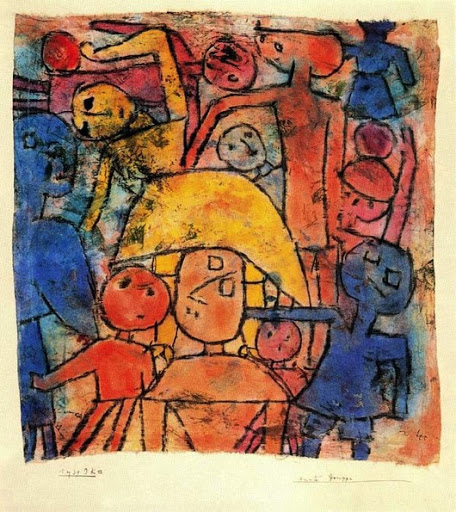
Paul Klee Colourful Group

A criticism frequently leveled at the Church is that it is set in its ways and that – unlike science – new inputs have no impact on its tenets. In a word, the Church comes across as static, in a world whose rate of change increases and that adapts and adjusts itself continuously. The end result is the appearance of mismatch and alienation, and Church representatives saying things like “These are the teachings of the church and they’re unchangeable truths.” does not help.

There is a very serious problem with statements like the above though and I am just saying so from the perspective of the Church itself, rather than as a criticism from outside. The problem is that such statements negate Jesus’ own words: “I have much more to tell you, but you cannot bear it now. But when he comes, the Spirit of truth, he will guide you to all truth.” (John 16:12-13). They deny “inspiration” received from the Holy Spirit and consider the Church’s teaching to be an immutable monolith obtained in one go rather than the gradual understanding of its full revelation in the person of Jesus. In fact Pope Francis himself reminds us that “throughout the history of salvation, whenever God reveals himself, He brings newness — God always brings newness — and demands our complete trust” and then goes on to challenge us:

“Are we open to God’s surprises? Or are we closed and fearful before the newness of the Holy Spirit? Do we have the courage to strike out along the new paths which God’s newness sets before us, or do we resist, barricaded in transient structures which have lost their capacity for openness to what is new?”

This is not to say that everything is open to change, but to be very clear about change being a core feature of Christian faith and consequently of the Church’s teaching too.

“OK,” you say “but does the Church actually change what it teaches?” Instead of answering that with a categorical “yes” and a lot of handwaving, let me present the following, very specific, example that I came across by accident some time ago. It concerns the question of “mixed marriages,” which here refers to marriages between one Catholic and one Christian, but non-Catholic spouse.

Let’s first look at how such marriages were spoken of in 1893, in Pope Leo XIII’s Constanti Hungarorum encyclical:

“[T]o remove the source of many evils, it is of utmost importance that pastors never cease to admonish their flocks to refrain as far as possible from entering into mixed marriages. Let the faithful correctly understand and resolutely remember that it is their duty to regard with horror such marriages, which the Church has always detested. They are to be abhorred for the reason which we emphasized in another letter, “They offer the opportunity for a forbidden sharing and participation in sacred things; they create a danger to the religion of the Catholic partner; they are an impediment to the virtuous education of children and very often cause them to become accustomed to viewing all religions as equal because they have lost the power of discriminating between the true and the false.” (Pope Leo XIII, Arcanum)”

Uff … “source of many evils,” “regard with horror,” “the Church has always detested,” “to be abhorred,” “impediment to the virtuous education of children [… who lose] the power of discriminating between the true and the false.” Sounds nasty!

Scroll ahead 100 years and look at what the 1993 Catechism of the Catholic Church says on the exact same subject (§1633-1637):

“[Mixed marriage] requires particular attention on the part of couples and their pastors. […] Difference of confession between the spouses does not constitute an insurmountable obstacle for marriage, when they succeed in placing in common what they have received from their respective communities, and learn from each other the way in which each lives in fidelity to Christ. But the difficulties of mixed marriages must not be underestimated. They arise from the fact that the separation of Christians has not yet been overcome. The spouses risk experiencing the tragedy of Christian disunity even in the heart of their own home. […] Through ecumenical dialogue Christian communities in many regions have been able to put into effect a common pastoral practice for mixed marriages. Its task is to help such couples live out their particular situation in the light of faith, overcome the tensions between the couple’s obligations to each other and towards their ecclesial communities, and encourage the flowering of what is common to them in faith and respect for what separates them.”

Hmm … “learn from each other the way in which each lives in fidelity to Christ,” “tragedy of Christian disunity […] in the heart of their own home,” “encourage the flowering of what is common to [the couple] in faith and respect for what separates them.” From abhorrently horrific, conscience-distorting evil to a challenging miniature laboratory of ecumenism where “fidelity to Christ” mutually enriches spouses – all in the space of 100 years. Not bad …

My “Faith on Sunday”

Ancient mercies

“God’s creation of the world out of nothing should always surprise and delight us. If God is his own happiness, He is absolutely complete to Himself. He has no need to crate anything, and yet He creates the world. It was a supremely free act and reveals to us a significant and consoling fact about God’s nature: He is playful! The closest analogy most of us have for God’s creative act is play. Strictly speaking, play’s primary end is play. In other words, its primary end is not outside itself, and in this way is analogous to creation. We may catch a glimpse of the nature of God’s will at each moment of time, if we consider God’s act of creation , and his holding everything in being, as pure play.”

All I can say to the above is “+1,” which fills me with delight since I far prefer supporting another’s views than being critical of them. What heightens my joy further is that this, great, presentation of an important aspect of God’s creativity (it’s gratuity and its being an unnecessary end in itself, and therefore like play) was published last Sunday in the “Our Faith on Sunday”’s “Faith and Reason” column, which I have criticized here extensively in the past. While I previously distanced myself from it vehemently,1 I can now wholeheartedly count myself among its supporters.2


1 For all my posts relating to this column – the previous seven of which were categorically critical, please, see here.
2 I would like to thank my besties PC, ML, KM, PM and JM for encouraging and transmitting the gist of my criticisms to the newsletter’s publishers. Without claiming that that had anything to do with their change of approach of the “Faith and Reason” column (and, I am guessing, author too – due to the dramatic change of tone, the greatly heightened consonance with what the Church’s magisterium have been saying for decades and the column’s revisiting of previously covered ground – last Sunday’s issue having discussed the same topic as the 31st March one), I am still grateful to them for having turned analysis into action.

The infinite nouns of unbelief

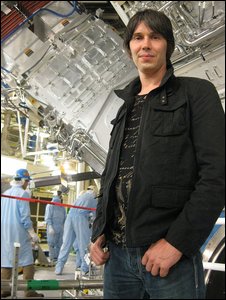
Brian cox

I have been a fan of the physicist Prof. Brian Cox for a while (not least for his TED appearances and the great “Wonders of the Universe” and “Wonders of Life” BBC series) and I now have a new reason: his views on the science-religion relationship:

“As someone who thinks about religion very little – I reject the label atheist because defining me in terms of the things I don’t believe would require an infinite list of nouns – I see no necessary contradiction between religion and science. By which I mean that if I were a deist, I would claim no better example of the skill and ingenuity of The Creator than in the laws of nature that allowed for the magnificent story of the origin and evolution of life on Earth, and their overwhelmingly beautiful expression in our tree of life. I am not a deist, philosopher or theologian, so I will make no further comment on the origin of the laws of nature that permitted life to evolve. I simply don’t know; perhaps someday we will find out.” (Preface, Wonders of Life)

Not only does Prof. Cox put himself into the shoes of those who hold beliefs different from his own – “if I were a deist” – (a key pre-requisite for dialogue), but he even extends the possibility of cognitive consonance to them – “I see no necessary contradiction between religion and science.”

While the above is great, and a real departure from how others, who equally don’t believe in God but have a negative take on the science-religion question, have been approaching this topic, what struck me most about Prof. Cox’s words1 is his saying that “I reject the label atheist because defining me in terms of the things I don’t believe would require an infinite list of nouns.” When I read this, I immediately thought that the same is true of me – “defining me in terms of the things I don’t believe would require an infinite list of nouns” – and that I would not want that either, if I were someone who does not believe in God. Just like I wouldn’t want to be labeled an “amanichean2 (which by virtue of what it denies links me to it), I can see why Prof. Cox is distancing himself from the atheist tag.

What the above attitude also points to is its complement: a focus on what one does believe in, and I think that Prof. Cox and I would have a lot in common, even in the absence of a shared belief in God.3


1 I first saw them in a tweet by @brainpicker and then traced their origin to the “Wonders of Life” book via a blog post.
2 Apologies for the possibly unnecessary neologism …
3 E.g., see a set-theoretic take in an earlier post here.

Jesus laughed

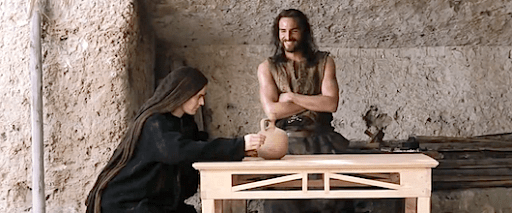
Jesus laughed

In many ways I find the subject of today’s post among the most difficult to talk about as, to me, it is akin to asking whether Jesus looked people in the eye when he spoke to them (or whether he looked down at his feet instead). Neither is mentioned in the Bible, yet both seem equally self-evident to me. I have yet to meet a loving, kind, compassionate person whom I haven’t also seen and heard laughing. So why is it that I am even writing about this topic?

The most immediate reason is a message I received from my bestie ML a couple of days ago, in which he shares a frustration that I too have had for years: the tendency of some to make a science out of distinguishing between joy and “mere fun,” branding one as a deplorable, shallow waste of time while extolling the other as a good, clean, Christian virtue. The point here isn’t that no distinctions ought to be made between varieties of enjoyment (the joy of mutual love, of a joke shared among friends, of delighting in success not being consubstantial with sadism or schadenfreude), but that such an enterprise bears the great risk of draining the joy out of Christian life through a process of abstract analysis and categorization that leaves one dour and cold.

In fact, the above thoughts were triggered by one of Pope Francis’ homilies from last week, where he says:

“A Christian is a man and a woman of joy. Jesus teaches us this, the Church teaches us this, in a special way in this liturgical time. What is this joy? Is it having fun? No: it is not the same. Fun is good, eh? Having fun is good. But joy is more, it is something else. […] Fun, if we want to have fun all the time, in the end becomes shallow, superficial, and also leads us to that state where we lack Christian wisdom. […] Joy is another thing. Joy is a gift from God. It fills us from within. It is like an anointing of the Spirit. [… On the other hand, s]ometimes melancholy Christian faces have more in common with pickled peppers than the joy of having a beautiful life.”

Clearly Francis distinguishes between fun that becomes shallow and joy that “fills us from within,” but he also warns against the lifelessness that follows from an absence of joy and that this is not Christian.

Having read and re-read Francis’ sermon many times over the last days, I am coming to the conclusion that the distinction ought not to be between fun and joy but between fun that leads to or subsists in joy and fun that does not and that leads to resentment, frustration and disappointment. In fact, Francis himself says that “Having fun is good[, b]ut joy is more” and I believe that this leads to a reading not of dichotomy but of set relationships, where fun and joy overlap. I’d like to go a step further though and argue that if joy is sought on the back of avoiding fun then only the latter is likely to be be achieved. Fun is a context in which relationships are built and avoiding it or looking down on it will eventually cut a person off from their neighbors – precisely the neighbors Jesus asks me to love like myself.

If I just look at my best friends, I can say with confidence that the moments that have lead to the birth of friendship have been ones of fun and joy – of delighting in each other, of recognizing oneself in the other, of having fun being together. This is not all that friendship is and moments of difficulty and suffering certainly test and strengthen it, but ultimately, as John Paul II said: “We are an Easter people.” Being an “Easter people” means both understanding the fundamental value that suffering has and realizing that its embracing is not for its own sake but as a means that leads to the joy of the resurrection.

But where does the question about whether Jesus laughed fit into this picture? It comes precisely from concerns about fun: should it be discredited or seen as a potential contributor to love and joy. At least up until the middle ages, many viewed laughter with deep-seated suspicion, but there were also those, like Erasmus of Rotterdam, who wrote the “Morias Enkomion” (“In Praise of Folly”) to his friend, St. Thomas More, who were its proponents. I don’t mean to mount an extensive defense of Jesus’ having laughed here – it is not something I believe is necessary and if you are convinced he never laughed, then Billy Graham would tell you: “I feel sorry for [you], because a balanced sense of humor can save us from taking ourselves too seriously, and help us see through the pride and pretense of our sinful world.” If, however, you’d like to see such a defense of laughter, others have done so very well already and I’d just pick out two: first, there are the very interesting scriptural pointers by the Protestant Rev. Kuiper and second, the great defense of humour by the Jesuit Fr. Martin, both of which I very much recommend.

To conclude on a fun note, let me leave you with a couple of examples of humor and laughter from the bible and the sayings of the saints (who are always a great weather vane for orthopraxy):

  1. St. Sarah (yes, “Old Testament” figures are held up as saints in the Catholic Church), who is the patron saint of laughter, laughed when God told her she’d get pregnant in her nineties: “God has given me cause to laugh, and all who hear of it will laugh with me.” (Genesis 21:6). Not only did Sarah laugh, but her son was named Isaac, which means “He laughed.”
  2. Jesus, during the “Sermon on the Plain” says: “Blessed are you who are now weeping, for you will laugh.” (Luke 6:21).
  3. Jesus often employs humor (which does not preclude him making important points at the same time) – e.g., as in the “eye of the needle” image: “[I]t is easier for a camel to pass through the eye of a needle than for one who is rich to enter the kingdom of God.” (Matthew 19:24).
  4. I have previously argued that the opening line of the Johannine prologue has the structure of a joke.
  5. When St. Thomas More is about to be executed for disobeying Henry VIII, he pulls his beard off the chopping block and tells the executioner: “This hath not offended the king.”
  6. In instructions to fellow nuns, St. Teresa of Ávila said: “What would happen if we hid what little sense of humor we had? Let each of us humbly use this to cheer others.”
  7. When asked by a journalist “How many people work in the Vatican?,” Blessed Pope John XXIII replied: “About half.”

🙂

Look at Mary, see Jesus

8717839098 b716ba634d

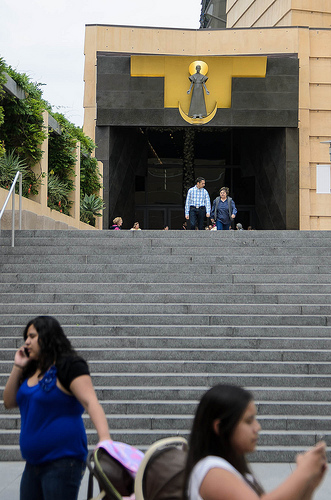
Last week I visited the Cathedral of Our Lady of the Angels in Los Angeles1 and it struck me that the statue above its entrance showed something akin to an optical illusion. Already when seen from afar, the statue above the main doors of the cathedral presented a somewhat ambiguous figure – the short hair, bare arms and forward facing palms were more consonant with an adolescent Jesus, prefiguring his later crucifixion wounds, while the context (i.e., it being the Cathedral of Our Lady and “the medium [being] the message” as McLuhan put it), the moon at the figure’s feet and the placement of the belt on the robe pointed to Mary, albeit posed in a highly unusual way.

In fact, if you look at the typical silhouettes of a statue of Mary (left – where her cloak dominates the outline), the LA statue (center) and a statue of Jesus (right – where head and hands are clearly distinct from the torso) you’ll see where my ambiguity came from:

Silhouette

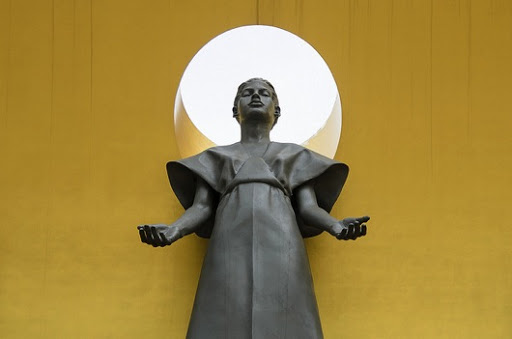
Even up close this ambiguity does not resolve itself:

8716719089 f0a29367d0 z

The muscular arms as well as the scale of the hands are consistent with a young man, while the dress becomes more clearly female and the face is sufficiently androgynous to allow both for a male and a female reading. In the end I am left with a feeling akin to viewing the rabbit-duck in that I can both resolve the ambiguity in Mary’s and in Jesus’ favor.

What the sculptor Robert Graham has achieved here – at least through my eyes, is to put in bronze the key to Mary being the model Christian. Saint Louis Marie de Montfort put it as follows: “We never give more honor to Jesus than when we honor his Mother, and we honor her simply and solely to honor him all the more perfectly. We go to her only as a way leading to the goal we seek – Jesus, her Son.” And Pope Benedict XVI simply expressed it by saying that we look to Christ by “going towards Mary who shows us Jesus.” Instead of seeking fame and glory for herself, her whole life was one of self-effacing humility, a constant pointing beyond herself – to Jesus – to the point of becoming transparent.


1 For more about the cathedral’s architecture see here.

Atheists: adversaries, or brothers?

Trio

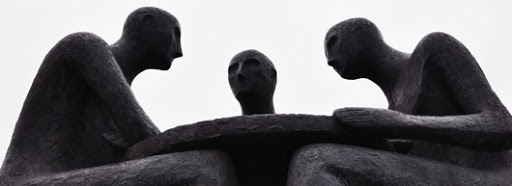
It is no secret that I have a great deal of respect for my atheist and agnostic friends and I feel like I have learned a lot from them about matters that are of profound value to me as a Christian. With Cardinal Ravasi I can also say that I too have absolutely no interest in converting them (or anyone else for that matter). At the same time I am aware of this attitude not having been the mainstream position of the Church for a long time (although there have always been those who have shared it – many of whom were saints) and that atheism is seen by some (many?) in the Church as a problem even today.

It is against this background that I was pleased to hear voices consonant with mine while reading two great books: On Heaven and Earth (by Cardinal Bergoglio – now Pope Francis – and Rabbi – and biophysicist! – Abraham Skorka, mentioned here before) and Colloqui (by Fr. Pasquale Foresi – one of the co-founders of the Focolare Movement).

Here Francis has the following to say:1

“When I meet atheist persons, I share with them human questions […] which are such rich material for sharing and working on together that they can easily lead to mutual and complementary enrichment. As a believer I know these riches are a gift from God[, but] instead of proselytizing, I respect atheists and I present myself the way I am. I have nothing to hide and I would not say that their life is condemned, because I am convinced that I have no right to judge their honesty. […] We have to be coherent with the message we receive from the Bible: all men and women are made in the image of God, whether they are believers or not.”

Later in the book, this attitude is also reinforced by Rabbi Skorka, saying that “we are all joined by the links of brotherhood.” While the position is, to my mind, positive – we are all brothers and sisters irrespective of our beliefs and there are great riches to be shared with each other in openness, a point worth elaborating on are the positions that Pope Francis rejects here – i.e., proselytism and condemnation.

Why these are novelties in the Catholic Church is addressed in Fr. Foresi’s book, which I happened to read at the same time :). There he points to the great changes that have been confirmed by the Second Vatican Council, a key point of which was an increased emphasis on and respect for following one’s conscience.2 Among others, this shift also legitimized pacifist positions held by prominent Christians during the last century’s World Wars. E.g., see the Catholic, Italian MP Igino Giordani – now in the process of being considered for sainthood, who championed a bill to allow for conscientious objectors to abstain from military service – incidentally in collaboration with atheist Communists (a great rarity during the first half of the 20th century).

It was on the back of this rediscovery of the importance of conscience that the honesty of atheist beliefs was contemplated and while the Church certainly has a position different from atheism, it stated clearly in the Gaudium et Spes constitution of the Second Vatican Council that,

“motivated by love for all men, [the Church] believes [that the] questions [raised by atheism] ought to be examined seriously and more profoundly. [… T]he Church sincerely professes that all men, believers and unbelievers alike, ought to work for the rightful betterment of this world in which all alike live; such an ideal cannot be realized, however, apart from sincere and prudent dialogue. Hence the Church protests against the distinction which some state authorities make between believers and unbelievers, with prejudice to the fundamental rights of the human person.” (Gaudium et Spes, 21)

Fr. Foresi explains that prior to Vatican II it was generally thought that “one couldn’t be an atheist in good faith, and that it was “impossible” for them to be saved.” This has all changed though, so that now there are not only individuals in the Church, who are keen to build relationships with their atheist friends, but it is the Church’s official teaching that the dignity of believers and non-believers alike be protected and valued.

And there is more. In his book, Fr. Foresi recounts how the Focolare Movement, founded by Chiara Lubich, has gone a step further and has done so with the Church’s formal approval. The Focolare Movement is an organization that promotes unity and universal brotherhood among all and even though it started in the Catholic Church during the Second World War, it also has members from other Christian churches and communities and from other religions. And it also counts agnostics or atheists among its members. While links with non-Catholics and atheists were at first informal, as the Focolare Movement was gaining official recognition by the Catholic Church, it also asked for its non-Catholic members to be officially recognized as such – a request eventually granted by the Vatican.

Why am I saying all this? Do I care so much about being “official”? No, not for its own sake, but I believe that it is an indication of how seriously these questions are taken by the Church and how it is not only its declared intention to be open to atheists but also something it approves formally.


1 Since I have the original book in Spanish, the English text is my rough translation.
2 For a more detailed discussion of this topic see a previous post.

The devil

Liardet2

Beyond his great humility, simplicity, personal poverty, warmth and approachability, what struck me about Pope Francis have also been his frequent references to the devil. He mentioned him as early as his first full day in office and keeps bringing him up at least on a weekly, if not a more frequent, basis in his sermons.

Since the devil is not part of what consciously constitutes my spiritual life, I have at first just glossed over his mentions, but I am now growing curious about why it is that Francis so frequently refers to him. It is not that I have an issue with the devil being referred to – it is more that I just haven’t given him much thought. The Christianity I try to practice is about love rather than the avoidance of sin, about following Jesus rather than combatting the devil and about seeking to encounter goodness, truth and beauty rather than learning how to recognize evil. It is not that I don’t care about avoiding evil, but I believe that to be a necessary side-effect of seeking good.

The problem of evil is unquestionably challenging though and its manifestations in the world are a source of horror and sorrow for me, which does make me want to understand why it is that Francis speaks so often about the devil. In fact, I have been reading Steven Pinker’s excellent The Better Angels of Our Nature precisely for the sake of gaining a better understanding of how it is that we, humans, are capable of the shocking atrocities that we keep perpetrating on each other. While Pinker is certainly critical of religion and opposed to the idea of the devil, he makes two points that I think are relevant here: first, that “[we] need to make the case that [our inner demons] exist, because there is a resistance in modern intellectual life to the idea that human nature embraces any motives that incline us toward violence at all,”1 and second that “[violence] is not a single motive, let alone a mounting urge. It is the output of several psychological systems that differ in their environmental triggers, their internal logic, their neurobiological basis, and their social distribution.” In other words, Pinker argues both that there is a tendency to deny the ubiquity of the capacity for violence and that its origins and manifestations are complex.

These two points are in fact a great bridge from contemporary psychology and anthropology to the Church’s teaching about evil and the devil. In its most recent (1975) review of the subject of the devil, the Congregation of the Doctrine of the Faith starts with the same kind of realization as Pinker makes in the context of violence – that “the very existence of the devil is frankly called into question.” On the point of complexity too, it calls for caution and reason: “The many forms of superstition [and] obsessional preoccupation with Satan […] have always been condemned by the Church. […] Reserve and prudence are in fact demanded. [… O]ne must exercise discernment. And one must leave room for research and its findings.” Finally, it also dispells a potential misunderstanding, where the devil could be used as an excuse and a barrier to seeking scientific understanding: “It is clear that [the Church] has never allowed man to rid himself of his responsibility by attributing his faults to the devil. The Church did not hesitate to oppose such escapism when the latter manifested itself, saying with St. John Chrysostom: “It is not the devil but men’s own carelessness which causes all their falls and all the ills of which they complain.””

So, why is it that the Church speaks about the devil? By far the most obvious and compelling answer is that Jesus himself did so – calling him “tempter” (Matthew 4:3), “accuser” (Revelation 12:10), “father of lies” and “murderer” (John 8:44). Who is this devil though, whom Jesus speaks about? Jesus himself describes him as follows: “He was a murderer from the beginning and does not stand in truth, because there is no truth in him.” (John 8:44). Two things are important here: first, that the devil has been present “from the beginning,” which the Catechism explains by saying that ““[t]he devil and the other demons were indeed created naturally good by God, but they became evil by their own doing.” Scripture speaks of a sin of these angels. This “fall” consists in the free choice of these created spirits, who radically and irrevocably rejected God.” (§391-392). This means that the devil is God’s creature, rather than an equivalent but opposed being, which in turn leaves God as having created only what is good and the devil opposing him out of pride and his free choice. The second part of Jesus’ profile of the devil is equally key: the devil has “no truth in him” – his temptations are lies and the sufferings they lead to are a consequence of an opposition to the truth.

Coming back to Pope Francis, let me just pick out a couple of his references to the devil:

  1. In his very first sermon after being elected pope, Francis quotes the French poet Léon Bloy: “Whoever does not pray to God, prays to the devil.” I read this as him pointing to there being no middle ground between truth and falsehood.
  2. During one of his morning masses in the Domus Sanctae Marthae, he points to the seriousness of falsehood: “We are all sinners; all of us. We all commit sins. But calumny is something else. It is of course a sin, too, but it is something more. Calumny aims to destroy the work of God, and calumny comes from a very evil thing: it is born of hatred. And hate is the work of Satan. Calumny destroys the work of God in people, in their souls. Calumny uses lies to get ahead. And let us be in no doubt, eh?: Where there is calumny, there is Satan himself.”
  3. On another occasion he places the impulse to gossip at the feet of the devil: “When we prefer to gossip, gossip about others, criticize others- these are everyday things that happen to everyone, including me – these are the temptations of the evil one who does not want the Spirit to come to us and bring about peace and meekness in the Christian community.”
  4. Finally, he also warns that “the devil, lead[s] us to believe that ghosts, fantasies, are reality,” again underlining how it is the absence of truth that is the root from which evil springs.

As you can see, the above is just my attempt to structure some first notes rather than an exposition of some clear insight. I am at the point of trying to begin to make sense of why it is that Francis keeps bringing up the devil and trying to understand why it is that Jesus, and subsequently the Church, speaks about him. The picture I am getting is one that certainly makes sense in the bigger context of creation and has the following as its core idea: The truth presented to a free recipient can be rejected out of pride, where subsequent lies result in evil and suffering. To have this rejection of the truth be the act of a creature, albeit spiritual, rather than “just” an abstract concept or principle is again consistent with the personal nature of the Trinity and the ultimate superiority of good to evil.


1 This reminded me of the following line from The Usual Suspects (delivered by the character Keyser Söze), which comes from Charles Baudelaire’s Le spleen de Paris: “The finest trick of the devil is to persuade you that he does not exist.”