Joy and humility, instead of rules and political correctness

Francis cast

What would it be like if the Pope were just a simple parish priest, saying daily morning masses in a small side-chapel and addressing a few simple words to his small flock. Well, that is precisely what has been going on since around a month ago in the Domus Sanctae Marthae – the Vatican guest house, where Pope Francis choses to reside and where he says daily morning mass. He invites various small groups of Vatican employees and addresses short sermons to them that are always rooted in the mass readings of the day and that have an immediately accessible style. Reading excerpts from these short homilies has been a daily joy for me over these last weeks and I would here like to share my favorite bits with you. If you’d like to follow these very short sermons yourself, the quickest way is to look at the Vatican Radio website, where they get published a couple of hours after their delivery.

Instead of trying to be in any way comprehensive, let me just pick out a few gems and leave you to follow up on their context if you wish. First, here are a couple of excerpts that show Francis’ take on what it means to be a Christian:

  1. Wonder and joy: “Wonder is a great grace, the grace that God gives us in our encounter with Jesus Christ. It is something that draws us outside of ourselves with joy … it is not a mere enthusiasm like that of sports fans when their favorite team wins, but it’s something deeper. Of course we cannot live forever in a state of wonder, but it is the beginning which leads to spiritual consolation. It is the consolation of those who have encountered Jesus Christ.”
  2. God spray: “Faith is not an impalpable presence, like an essence of mist that spreads around without really knowing what it is. God is a concrete ‘Person,’ and therefore faith in Him comes from a living encounter, which we experience as tangible. We believe in God who is Father, who is the Son, who is the Holy Spirit. We believe in people, and when we talk to God we talk to People: I speak with the Father, with the Son or with the Holy Spirit. And this is the faith. But faith is a gift, the Father gives it. This faith that makes us strong, it makes us joyful, this faith that always begins with the encounter with Jesus.”
  3. Facing difficulties: “When there are difficulties, we need to look closely at them, and confront them and speak about them. But never hide them. We must not be afraid of problems: Jesus himself said to his disciples: ‘It is I. Do not be afraid’. In life’s difficulties, with problems, with new things that we must face: the Lord is always with us. We may make mistakes, certainly, but he is always with us and says: ‘You made a mistake, now get back on the right path.’ Masquerading life, disguising life, is not a very good way to behave: no no. Life is what it is, that’s the reality. It’s exactly as God wants it to be, or as God allows it to be, it is what it is, and we have to accept it as it is.”
  4. Gossip: “When we prefer to gossip, gossip about others, criticize others – these are everyday things that happen to everyone, including me – these are the temptations of the evil one who does not want the Spirit to come to us and bring about peace and meekness in the Christian community. These struggles always exist in the parish, in the family, in the neighborhood, among friends. Instead, keep quiet and if you have something to say, say it to the interested parties, to those who can remedy the situation, but not to the entire neighborhood.”
  5. Love instead of rules: “The Lord saves us by His love: not with a letter, nor with a decree, but with his love, a love so great that it led him to send his Son, who, became one of us, walked with us, and this saves us. We are worthy, we are men and women of hope: this is what it means to be saved by love. The problem is that sometimes we want to save ourselves, and we believe we can do it, for example basing our security on money – and we think: ‘I have money, I am secure, I have it all, there are no worries, I have dignity: the dignity of a rich person.’ This is not enough. Think of the parable of the Gospel, of the man who had the full granary, who said, ‘I’ll make another to get more, and then I’ll sleep soundly,’ and the Lord says, ‘You fool! This evening you will die.’ That salvation is wrong, it is a temporary salvation, it is also only apparent salvation.”
  6. Normality, not magic: “God does not act like a fairy with a magic wand. Rather, he gives grace and says, as he said to all those he healed, ‘Go, walk.’ He says the same to us: ‘Move forward in your life, witness to everything the Lord does with us.’ Triumphalism is not of the Lord. The Lord came to Earth humbly; he lived his life for 30 years; he grew up like a normal child; he experienced the trial of work and the trial of the Cross. Then, in the end, he rose from the dead. The life of the Christian consists of a normality that is lived daily with Christ.”
  7. Forgiveness: “St. Paul said that his glory was Christ crucified in his sins. Why? Because he, in his sins, found Christ crucified who forgave him. In the middle of the ‘night,’ the many ‘nights,’ the many sins that we commit, because we are sinners, there is always the embrace of the Lord that helps us say: ‘This is my glory. I am a poor sinner, but You are my Savior.’ We think of how nice it is to be saints, but also how nice it is to be forgiven.”
  8. Peace: “Even in the most painful tests, a Christian never loses the peace and presence of Jesus. With a little courage we can pray: ‘Lord, grant me this grace which is the hallmark of our encounter with you: spiritual consolation and peace.’ A peace that we cannot lose because it is ours, it is the Lord’s true peace that cannot be bought or sold. It is a gift from God.”

Francis also presents are very beautiful view of the Church, both by pointing to its treasures and by warning against its pitfalls:

  1. Taming the Holy Spirit: “The Holy Spirit upsets us because it moves us, it makes us walk, it pushes the Church forward. We wish to calm down the Holy Spirit, we want to tame it and this is wrong. The Holy Spirit gives us the strength to go forward but many find this upsetting and prefer the comfort of the familiar. Nowadays everybody seems happy about the presence of the Holy Spirit, but it’s not really the case and there is still that temptation to resist it. The Second Vatican council was a beautiful work of the Holy Spirit. But 50 years later, have we done everything the Holy Spirit was asking us to do during the Council? The answer is ‘No.’ We celebrate this anniversary, we put up a monument but we don’t want it to upset us. We don’t want to change and what’s more there are those who wish to turn the clock back. This is called stubbornness and wanting to tame the Holy Spirit. The same thing happens in our personal life. The Spirit pushes us to take a more evangelical path but we resist this.”
  2. Saints v. ideologues: “The Word of Jesus goes to the heart because it is the Word of love, it is a beautiful word and brings love, makes us to love. But, ideologues cut off the road of love, and also that of beauty. And when ideology enters into the Church, when ideology enters into our understanding of the Gospel, no authentic comprehension is possible. And these ideologues, on the road of duty, load everything on the shoulders of the faithful. The ideologues falsify the gospel. Every ideological interpretation, wherever it comes from – is a falsification of the Gospel. And these ideologues – as we have seen in the history of the Church – end up being intellectuals without talent, ethicists without goodness – and let us not so much as mention beauty, of which they understand nothing. Rather, the path of love, the way of the Gospel, is simple: it is the road that the Saints understood. The saints are those who lead the Church forward! The road of conversion, the way of humility, of love, of the heart, the way of beauty …”
  3. The Church dormant: “The early Christians had nothing but the power of baptism that gave them their apostolic courage, the strength of the Spirit. I think of us, the baptized: do we really have this strength – and I wonder – do we really believe in this? Is Baptism enough? Is it sufficient for evangelization? Or do we rather ‘hope’ that the priest should speak, that the bishop might speak … and what of us? Then, the grace of baptism is somewhat closed, and we are locked in our thoughts, in our concerns. Or do we sometimes think: ‘No, we are Christians, I was baptized, I made Confirmation, First Communion … I have my identity card alright. And now, go to sleep quietly, you are a Christian.’ But where is this power of the Spirit that carries us forward? We need to be faithful to the Spirit, to proclaim Jesus with our lives, through our witness and our words. When we do this, the Church becomes a mother church that produces children and more children, because we, the children of the Church, we carry that. But when we do not, the Church is not the mother, but the babysitter, that takes care of the baby – to put the baby to sleep. It is a Church dormant. Let us reflect on our Baptism, on the responsibility of our Baptism.”
  4. Mother, not domestic administrator: “We, the women and men of the Church, we are in the middle of a love story: each of us is a link in this chain of love. And if we do not understand this, we have understood nothing of what the Church is. The Church does not grow by human strength. Some Christians have gone wrong for historical reasons, they have taken the wrong path, they have raised armies, they have waged wars of religion: that is another story, that is not the story of love. Yet we learn, with our mistakes, how the story of love goes. But how does it increase? Jesus said simply: like the mustard seed, it grows like yeast in the flour, without noise. The Church is not just another organization: she is Mother. How would you feel if someone said: she’s a domestic administrator? ‘No, I am the mother!’ And the Church is Mother. And we are in the middle of a love story that continues thanks to the power of the Holy Spirit. All of us together are a family in the Church, who is our Mother.”
  5. Humility, not conquest: “The style of evangelical preaching should have this attitude: humility, service, charity, brotherly love. ‘But … Lord, we must conquer the world!’ That word, conquer, doesn’t work. We must preach in the world. The Christian must not be like soldiers who when they win the battle make a clean sweep of everything. The Christian proclaims the Gospel with his witness, rather than with words. As St. Thomas Aquinas says: “A great soul that is not afraid of great things, that moves forward towards infinite horizons, and the humility to take into account the small things.” This is divine, it is like a tension between the great and the small. The triumph of the Church is the Resurrection of Jesus. But there is first the Cross. Today we ask the Lord to become missionaries in the Church, apostles in the Church but in this spirit: a great magnanimity and also a great humility. So be it.”

Synthetic life: out of bounds or cause for optimism?

Synthetic dna s

Take bottles of the chemicals that constitute living organisms and by following a process that does not involve re-using parts of living beings arrive at a new, living creature. That would the the synthetic creation of life from scratch.1

The pioneer of this strand of scientific endeavor is the biologist Dr. J. Craig Venter, who was among the first to sequence the human genome, and who is now seemingly nearing the first synthetic creation of life from fully non-living components. A prequel to this upcoming breakthrough has been the 2010 insertion of synthetic, man-made DNA into a bacteria, which resulted in the first living organism with an entirely artificial genome. While this had elements of being synthetic life, it was only partially so and Dr. Venter’s team is continuing in their quest. Last year they then passed the landmark of the first software simulation of an entire organism, and only last month Dr. Venter announced that his team is close to creating a living being from scratch. Their initial aim is to use the process for positive ends by creating artificial life that can “eat pollution and generate energy.”

While the scientific achievement of synthesizing life would unquestionably be a huge success (and the steps taken by Dr. Venter’s team already are!), there are also important ethical questions to consider, with multiple experts offering their assessments, from among which I would just like to offer two perspectives, at first introduced only anonymously:

Statement A: “All available evidence goes to show that there is no unmediated passage from non-life to life. [… A]ll living beings receive their life from a principle outside themselves, which is itself capable of infusing life; this we call God.”

Statement B: “If it is used to promote the good, to treat pathologies, we can only be positive[. …] If it turns out not to be [used] to respect the dignity of the person, then our judgment would change. [… Dr Venter’s work is a] further sign of intelligence, God’s gift to understand creation and be able to better govern it.”

The first statement is a classic “God of Gaps” stance, infused both with a lack of scientific understanding (i.e., missing the importance of the steps already made towards synthetic life and underestimating the likelihood of their ultimate success) and with a mistaking of a purely philosophical construct for the personal God of Abraham, Jesus and the Church. Statement A’s god is banished into ever-narrower, farther-removed spheres and serves a strictly soulless, utilitarian end. This god is now a workaround for the specter of infinite causal chains and now for the magical-seeming wafer-thin sliver wedged between not-life and life. If you have read this blog, you will know where Statement A comes from, and if not then I just apologize that I will not revealed its source, which I have already afforded more than its fair share of publicity. All I will say is that it is taken from a “catholic” newsletter that is broadly distributed in the UK.

I believe the best way to show how un-Christian the above is, is to contrast it with what Pope Francis said during the sermon of last Thursday’s morning mass in the chapel of the Domus Sanctae Marthae, where he is staying and where he has been inviting various groups working at the Vatican to celebrate mass with him:2

“But who is this God you believe in? An ‘all over the place – god’, a ‘god-spray’ so to speak, who is a little bit everywhere but who no-one really knows anything about? We believe in God who is Father, who is Son, who is Holy Spirit. We believe in Persons, and when we talk to God we talk to Persons: or I speak with the Father, or I speak with the Son, or I speak with the Holy Spirit. And this is the faith.”

You can just picture it: a storeroom somewhere, with a spray bottle with “life” written on it in black Sharpie, a box on another shelf with the “first mover” label beginning to peel, a pair of jars in the corner – one labelled “irresistible force,” the other “immovable object” – lids screwed tightly in place. All waiting to kick into action whenever necessary.

Let’s turn to Statement B, which directs its gaze to the good that synthetic life could do, while being conscious of its dangers, and which categorizes the intelligence that has lead to it as a good whose source is God. The source of this statement is a combination of what Archbishop Rino Fisichella, the then president of the Pontifical Academy for Life, and Cardinal Angelo Bagnasco, president of the Italian Bishops’ Conference, had to say when Dr. Venter announced the incorporation of fully synthetic DNA in a bacteria in 2010. It is a statement that views scientific progress as a means for greater good, as a way of deepening our understanding of how the universe that God created and sustains in its entirety operates, and as a licit use of the gift of reason, which also springs from God. The possibility of man-made, synthetic life is placed wholly inside God and seen as having a clear potential for good when used responsibly.


1 Although not “from scratch” in the Carl Sagan sense: “If you wish to make an apple pie from scratch, you must first invent the universe.”
2 This time it was the turn of the Italian State Police who serve the Vatican area.

Bonhoeffer, Lubich, Teilhard: A world luminous from within

Bonhoeffer lubich teilhard s

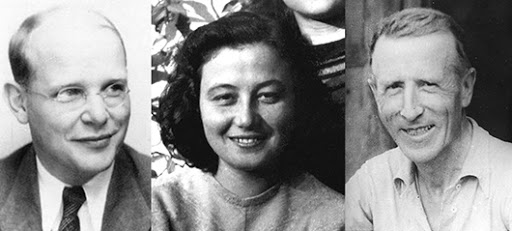
Sixty eight years ago yesterday, in the Flossenbürg concentration camp, the Lutheran pastor and theologian Dietrich Bonhoeffer was martyred. His opposition to Nazi euthanasia and genocide directed against the Jewish people, born of his discipleship of Jesus, earned him the gallows. While I have long been an admirer of Bonhoeffer’s witness and theology, I have only now come across the following passage from his Letters and Papers from Prison, where he points particularly lucidly to the alternative to the God of Gaps caricature still popular today:
“How wrong it is to use God as a stop-gap for the incompleteness of our knowledge. If in fact the frontiers of knowledge are being pushed further and further back (and that is bound to be the case), then God is being pushed back with them, and is therefore continually in retreat. We are to find God in what we know, not in what we don’t know.”

This emphasis on the presence of God in what we know made me think of Chiara Lubich’s mystical experience that started during the summer of 1949.1 There, before the start of the actual “intellectual visions,” she recounts the following:

“[N]ature seemed to me to be enveloped totally by the sun; it already was physically, but it seemed to me that an even stronger sun enveloped it, saturated it, so that the whole of nature appeared to me as being “in love.” I saw things, rivers, plants, meadows, grass as linked to one another by a bond of love in which each one had a meaning of love with regard to the others. […] I had seemed to see the blossom of a horse chestnut tree alive with a higher life that sustained it from beneath so that it seemed to be coming out towards me.” (Paradise ’49)

How is it though that one comes to seeing God “in what we know,” as “sustain[ing everything] from beneath”? Here, in the paragraphs preceding the above quote, Lubich says that “[for about five years w]e had been trying with great intensity to live [… communion] with Jesus in the Eucharist, with our brother or sister, with the Word of God […] constantly in the present moment.” Her answer then is that this experience of God “enveloping” all has for her and her companions followed a putting of the Gospel into practice.

This in turn made me think of Pierre Teilhard de Chardin’s “The Divine Milieu,” where he sets out “a way of teaching how to see” and starts by posing a challenge:

“God is as pervasive and perceptible as the atmosphere in which we are bathed. He encompasses us on all sides, like the world itself. What prevents you, then, from enfolding him in your arms? Only one thing: your inability to see him.”

Reflecting on the above near the end of his life, Teilhard shares the following:

“Throughout my life, by means of my life, the world has little by little caught fire in my sight until, aflame all around me, it has become almost completely luminous from within. … Such has been my experience in contact with the earth — the diaphany of the Divine at the heart of the universe on fire … Christ; his heart; a fire: capable of penetrating everywhere and, gradually, spreading everywhere.”

Again the vision of God illuminating the world “from within” follows a life focused on seeking Him, as Teilhard says in “The Divine Milieu,” both in what we do and what happens to us – both the active and the passive, and therefore in life as a whole:

“It is the whole of human life, down to its most “natural” zones, which, the Church teaches, can be sanctified. […] “So whether you eat or drink, or whatever you do, do everything for the glory of God.” (1 Corinthians 10:31).”


1 For previous mentions of “Paradise ’49” see the following posts here and here.

(A)synchronicity

French painter Georges Br 001

I hope you won’t cry “Apophenia!” or “Pareidolia!” once you read what I have written and that you will instead take it as my sharing a personal reflection.

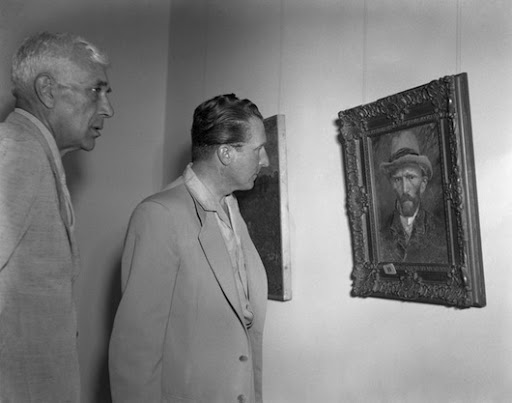
It all started when I saw the photo at the top of this post, where Georges Braque, one of the fathers of Cubism, is seen looking at Vincent van Gogh’s self–portrait. The thought that came to me straight-away was that I too have seen that painting and that this, in some sense, places me beside Braque, albeit at a different time. You could think of it as asynchronous colocation and as a variant of Jung’s synchronicity, where it is not meaning (or causation) that provides the link but an object … I swiped to the next story in my Flipboard stream, but this thought of having more in common with Braque than I previously thought, and of us having – in some sense – shared an appreciation of van Gogh’s work stayed with me.

A couple of days later, during the Easter vigil’s Litany of the Saints I then felt a particular connection with some of the names as they were being called out. They were saints whose lives and thoughts I am familiar with and with whom I felt a particular connection – Peter, John, Gregory, Augustine, Martin, Francis and Teresa of Jesus being just some of the most prominent ones. I felt like their names alone were keys that enabled a connection – in some sense …

When the litany concluded, I thought back to the Exsultet, sung at the beginning of the Easter vigil, which spoke to me already when I first heard it, and I realized that a good few of the saints, whose names were so significant to me just then, must also have listened to it. In some sense I felt like I was standing beside them as we jointly listened to this profound hymn of praise. Not only did I feel a connection to these specific saints, but to all who since at least the 4th century AD have celebrated the resurrection to the tune of this hymn. When I returned home, and after my family has gone to sleep, I looked more closely both at the Exsultet’s content, which contains so many gems of synthesis (cf. “O happy fault”), and at its history, where St. Augustine is one of the earliest sources mentioning it and where St. John Damascene (another favorite of mine) is credited with being the author of the text used today.

Returning to the Easter vigil, it’s high-point came with the Eucharist, which tied this strand of reflection together for me. The Eucharist is Jesus, who is the head and heart of His mystical body. By receiving Him and thereby being received into Him, I am connected not only to Him but to all who ever have and ever will be connected to Him. Through Jesus-Eucharist I am in a real sense connected to all of humanity – past, present and future, since he is the finite-infinite, the atemporal now.1

The intuition of connections across time and space, via a proxy like the painting that Braque and I viewed, or via a hymn that the saints, my friends, and I listened to, helped me more fully appreciate their reality in the Eucharist on Saturday night.


1 To my delight, this topic came up again while talking to my überbestie MR last night.

Neither faith nor reason: ex nihilo butchered

Nequaquam

Another Sunday, another “Faith and Reason” column in the “Our Faith on Sunday” newsletter, another spectacularly confused piece on an otherwise interesting topic, and this time – to add insult to injury – a complete disregard for the fact that it was Easter Sunday!

Instead of reflecting on something to do with the Easter triduum (e.g., the resurrection, Jesus’ descent into hell or his abandonment on the cross, or a myriad other aspects that could have been looked at from the faith-reason perspective), yesterday’s column was the following (with its first, superfluous sentence removed):

“[…] Creation ex nihilo (out of nothing) does not mean that, before matter was brought into existence, that there was absolute nothingness. If there had been absolutely nothing before creation, absolutely nothing could have come into existence. The nihil of ex nihilo refers to the nothing of material existence. Creation ex nihilo means that, before matter was called into being, there was no matter. God and the angels existed ‘before’ the creation of matter.”

Oh, man! Where to start? Before debunking the above hot mess, let me just put a couple of quotes from the Catechism on the table, so that the squirming irrationality of this week’s “Faith and Reason” column is counterbalanced by how the Church actually talks about God and creation:

“In [Jesus] “all things were created, in heaven and on earth… all things were created through him and for him. He is before all things, and in him all things hold together.” (Colossians 1:16-17)” (§291)

“We believe that God needs no pre-existent thing or any help in order to create, nor is creation any sort of necessary emanation from the divine substance. God creates freely “out of nothing”.” (§296)

“The world began when God’s word drew it out of nothingness; all existent beings, all of nature, and all human history are rooted in this primordial event, the very genesis by which the world was constituted and time begun. (cf. St. Augustine, De Genesi contra Manichaeos 1, 2, 4)” (§338)

Note how there is no arguing against the nothingness that preceded creation in the Catechism (neither in the passages quoted above nor anywhere else in its 2865 paragraphs) for it would be futile to do so. Even in the context of poetic (as distinct from philosophical, theological or scientific) language, both Genesis 1 (“In the beginning, when God created the heavens and the earth”) and John 1 (“In the beginning was the Word, and the Word was with God, and the Word was God. He was in the beginning with God. All things came to be through him, and without him nothing came to be.”) steer well clear of attempting to talk about what happened before “the beginning” in which God created the universe (i.e., space-time).

Why is that? Again we find the Church’s position in the Catechism as follows:

“Since our knowledge of God is limited, our language about him is equally so. We can name God only by taking creatures as our starting point, and in accordance with our limited human ways of knowing and thinking.”(§40)

“God transcends all creatures. We must therefore continually purify our language of everything in it that is limited, image-bound or imperfect, if we are not to confuse our image of God — “the inexpressible, the incomprehensible, the invisible, the ungraspable” — with our human representations. Our human words always fall short of the mystery of God. Admittedly, in speaking about God like this, our language is using human modes of expression; nevertheless it really does attain to God himself, though unable to express him in his infinite simplicity. Likewise, we must recall that “between Creator and creature no similitude can be expressed without implying an even greater dissimilitude”; and that “concerning God, we cannot grasp what he is, but only what he is not, and how other beings stand in relation to him.””(§42-43)

To me the key here is: “we can name God only by taking creatures as our starting point,” which you could transpose into Wittgensteinese as “we can only use the rules of games we have played.” In other words – the meanings of our language (using which we can “name” God) derive from our own, direct experiences, which take place firmly within the context of the universe and which therefore have a scope constrained to it. Instead of strictly following Wittgenstein’s “whereof one cannot speak, thereof one must be silent,” Christianity still talks about God and about what has been revealed to it about realities beyond the universe, but does so with great caution and with lots of “in some sense.”

To take the “ex nihilo” of God’s creative act and start qualifying it in the belief that it would otherwise preclude a pre-existence of God is jut confused, since before the “beginning” in which space-time were created, there is no before (which requires time) and to consider creation to be only of matter (and not of time as well – as the column’s author does) not only flies in the face of contemporary physics but also of St. Augustine’s insights, arrived at around 389 AD.

The crowning glory of yesterday’s column though is its assertion that “If there had been absolutely nothing before creation, absolutely nothing could have come into existence,” which is a direct denial of God’s ex nihilo bringing about of the universe (and of contemporary physics pointing to the same) and stands proudly alongside the same column barefacedly denying the incarnation the previous Sunday.

The most charitable interpretation of yesterday’s mental contortions is that they were a misguided attempt at trying to resolve a fictitious contradiction or a mistimed April Fools prank …


1 Previous ones having protested against the denial of the incarnation, the allegedly separate “orders of knowledge” of science and religion, the abuse of “cf.,” the perversion of philosophy and a plagiaristic ignorance of infinity.

Sign of contradiction

Contradictions

Imagine1 sitting on the terrace of a seaside hotel, coolly sipping afternoon drinks, and spotting a yacht heading straight towards you. On beaching the yacht, its sole passenger and captain – armed to the teeth and attempting to communicate with the holiday-makers by signs – persists in the conviction that she has reached a dangerous land, hitherto unknown to civilization, while actually having landed at another of her own homeland’s tourist destinations. You’d certainly feel for her and try to gently steer her in the right direction, but you couldn’t just play along with her delusion.

The above is exactly how I felt (minus the afternoon drink) when I saw a tweet two days ago pointing to “Project Reason” having triumphantly unmasked the shocking contradictions that addle the Bible, with the hope that it would finally bring those religious fanatics to their senses.

🙂

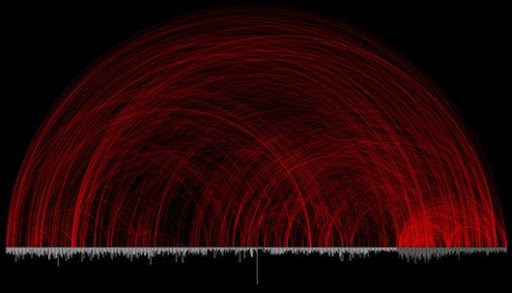
Having scoured the Bible end to end and connected verses that contradict each other, Project Reason have built – and rather beautifully visualized (see above) – a large database of intra-biblical contradictions. I am both grateful to them for this work and certain of the good that reading the Bible has done them (as it does anyone who reads it). What they haven’t done though is in any way question the Bible’s value or present someone who approaches scripture along Dei Verbum lines (i.e., “written under the inspiration of the Holy Spirit, they have God as their author,” but since they were written by men “[we] must investigate what meaning the sacred writer intended to express and actually expressed in particular circumstances by using contemporary literary forms in accordance with the situation of his own time and culture.”) with any challenge whatsoever.

Project Reason: “Aha! The Bible contains contradictions!”
Me: “Yeah, I know and am profoundly grateful for them!”
Project Reason: “?!” (plus an outsized bead of sweat, emblematic of certain Japanese cartoons, that appears during particularly awkward or embarrassing moments)

Let me try to explain why it is that I consider biblical contradictions a strength and source of comfort rather than a challenge or obstacle. The difficulty I have here is not how to do that, but which of the many parallel reasons to start with.

First, there is the angle that has nothing whatsoever to do with religion and that comes from the impossibility of simultaneously being complete and consistent, proven for formal systems by Kurt Gödel and discussed at some length in a previous post here. A system of axioms (rules) can either be consistent or complete, but not both – if it is consistent it has to be incomplete, while if it is complete it has to be inconsistent. Christians believe that revelation is complete in the person of Jesus, which makes inconsistency in his and the Church’s teachings be no surprise to those of us who have a fondness for formal systems and mathematics. That may sound weird, but it sure as Kurt is not unreasonable or irrational.

Second, Christianity (and Judaism too) is about the relationship with a person – God – not about following rules2 (as much as militant atheists would like to believe so). If anything, the contradictions in Scripture underline the necessity of seeking to personally relate to God, to listen to one’s conscience and to seek to live in every individual and unique moment in a way that is a participation in the life of God. In C. S. Lewis’ words: “Doctrines are not God: they are only a kind of map. But that map is based on the experience of people who really were in touch with God.” To which my bestie ML adds: “We should not mistake a map for the territory it describes. We do not turn to the page picturing the ocean in an atlas and expect our shoes to get wet.”

Third, there is the basic fact that different contexts require different words and actions to move them towards the same goal. When a child is very young (and I am thinking ~2 years) wouldn’t you exaggerate the dangers of them sticking anything into a power socket, while when they are older you can explain to them with greater precision what it is that would be dangerous and what wouldn’t (and introduce the whole topic of electricity, conductivity, etc.)? My favorite example of this type of “contradiction” is the “not with us = against us” versus “not against us = with us” case that Project Reason also picked up on. Here we have Jesus say “Whoever is not with me is against me” (Matthew 12:30) at one point and “For whoever is not against us is for us” (Mark 9:40) at another. A contradiction. Right? No, not really – in the first, Matthean case Jesus is referring to his driving out “demons” and this meaning that him and the demons are in opposition, while in the second, Marcan case Jesus is talking about someone who was driving out demons in his name and who his disciples were jealous of. Instead of being a contradiction, this example is actually fully consistent – Jesus is against demons and those who are also against demons are with him …

Fourth, if you believe that the Scriptures were “written under the inspiration of the Holy Spirit, [and] have God as their author” (Dei Verbum), then this immediately points to a necessary and vast mismatch in dimensionality between the source (God) and its representation/projection (human words and concepts during the first century AD). Like projections of even just a four-dimensional hypercube into 2D, which give rise to a myriad seemingly unrelated and “contradictory” shapes when considered only in 2D (e.g., how many vertices does this shape have? 4, 7, 16?):3

Tesseract

So too the projections of God’s words into human language necessarily result in apparent inconsistency and contradiction when considered only on the level of human language as opposed to seen as the reductions and conflations they are.

Fifth, to avoid giving the impression of all of the above just being post hoc attempts to explain a feature that the original authors of Scripture did not intend or were not aware of, it is worth noting that contradiction has been a strand in Christian theology that has its origins in the Gospels and that can be traced throughout the last two thousand years (with a recent peak in John Paul II’s thought). This can be seen from Simeon saying to Mary that Jesus “is destined for the fall and rise of many in Israel, and to be a sign that will be contradicted” (Luke 2:34) to St. Paul teaching that “For since in the wisdom of God the world did not come to know God through wisdom, it was the will of God through the foolishness of the proclamation [of the cross] to save those who have faith.” (1 Corinthians 1:21).

¡Viva la contradicción!


1 Thanks to G. K. Chesterton for this great image, borrowed from the opening paragraph of Orthodoxy.
2 But, wait! Didn’t your first point assume that Scripture was a formal system and you are now saying that it is not about rules. Aha! A contradiction! – Yes, I know … so? (see the third point).
3 For more detail see a previous post here.

Skin and heart, not antiques or novelties

Past present future 3 john kennard

Where does Pope Francis stand on the perennial question of reform versus continuity, progress versus tradition? His sermon during yesterday morning’s Chrism mass made it very clear – like Benedict XVI, who referred to it as “reform in continuity,” Francis too rejects a focus on tradition alone (calling it “antiques”) as well as on progress alone (“novelties”) and instead calls us to “put [our] own skin and [our] own heart on the line” and to live in the midst of our communities, sharing the life of our neighbors. Another way of reading the popes’ position is to cast it in terms of past, present and future, with a firm focus on living in the present moment instead of a nostalgia for a past Golden Age or a putting off of life until a bright future dawns.

While it contains a clear position on where Francis’ priorities lie, yesterday morning’s sermon – which I recommend highly in full – will, in my opinion, go down as the founding moment of a renewal of the priesthood, with the following being its key moments:

“[T]he anointing that [priests] receive is meant in turn to anoint God’s faithful people, whose servants they are; they are anointed for the poor, for prisoners, for the oppressed.[…]

A good priest can be recognized by the way his people are anointed. This is a clear test. When our people are anointed with the oil of gladness, it is obvious: for example, when they leave Mass looking as if they have heard good news. Our people like to hear the Gospel preached with “unction”, they like it when the Gospel we preach touches their daily lives, when it runs down like the oil of Aaron to the edges of reality, when it brings light to moments of extreme darkness, to the “outskirts” where people of faith are most exposed to the onslaught of those who want to tear down their faith. […]

We need to “go out”, then, in order to experience our own anointing, its power and its redemptive efficacy: to the “outskirts” where there is suffering, bloodshed, blindness that longs for sight, and prisoners in thrall to many evil masters. It is not in soul-searching or constant introspection that we encounter the Lord[…]

Those who do not go out of themselves, instead of being mediators, gradually become intermediaries, managers. We know the difference: the intermediary, the manager, “has already received his reward”, and since he doesn’t put his own skin and his own heart on the line, he never hears a warm, heartfelt word of thanks. This is precisely the reason why some priests grow dissatisfied, become sad priests, lose heart and become in some sense collectors of antiques or novelties – instead of being shepherds living with “the smell of the sheep”, shepherds in the midst of their flock, fishers of men. […]

It is not a bad thing that reality itself forces us to “put out into the deep”, where what we are by grace is clearly seen as pure grace, out into the deep of the contemporary world, where the only thing that counts is “unction” – not function – and the nets which overflow with fish are those cast solely in the name of the One in whom we have put our trust: Jesus.”

Wow! What a wake up call! And before you think: “Yeah! Them priests better get their act together,” let me just remind you (as I remind myself) that we all share in Jesus’ royal priesthood! When I heard Pope Francis say these words, I felt that he was addressing me. Do I share in the life of those around me? Do I live in their midst or am I withdrawn into introspection? These are undoubtedly great challenges, but ones that, I believe, will help all of us Christians to be more faithful followers of Jesus.

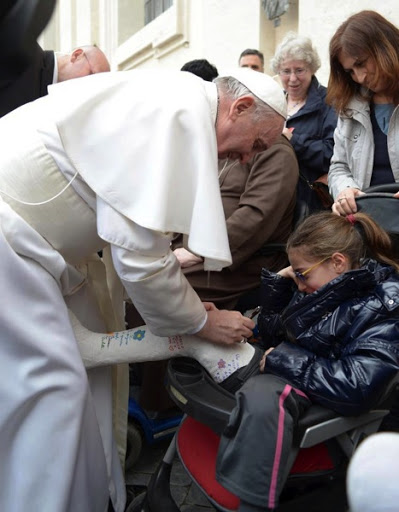
As is his trademark, Pope Francis proceeded to put his model of the priesthood into practice straight-away, by celebrating the Maundy Thursday mass in a juvenile detention center. Not only that, but he chose – against present liturgical law!1 – to wash the feet not of 12 men (which in the case of the popes’ Maundy Thursday masses have been priests), but of a group of youths, among whom were women as well as men and Muslims as well as Christians. This a shepherd in the midst of his flock, a fisherman putting “out into the deep”!

Not only his actions, but his words too, during the sermon of the same Maundy Thursday mass, illustrate his closeness and adaptation to the specific people he is with. The message he shares is universal, accessible to all and obviously comes from his heart:

“Help one another. This is what Jesus teaches us. This is what I do. And I do it with my heart. I do this with my heart because it is my duty, as a priest and bishop I must be at your service. But it is a duty that comes from my heart and a duty I love. I love doing it because this is what the Lord has taught me. But you too must help us and help each other, always. And thus in helping each other we will do good for each other.

Now we will perform the ceremony of the Washing of the Feet and we must each one of us think, Am I really willing to help others? Just think of that. Think that this sign is Christ’s caress, because Jesus came just for this, to serve us, to help us.”

This universality and at the same time specificity of his approach also shines through in his inviting ten parish priests from around Rome for lunch earlier that same day. One of the guests – the parish priest of the San Giacomo church in central Rome – reports:

“At first there was a bit of awkwardness – he is the pope after all – but he put everyone at ease. […] He didn’t want us to kiss his hand – instead he kissed each one of us. We asked him whether we could tell our parishioners that we had lunch with him and Francis told us to greet and bless them in his name. […] He also had a word of advice for each one of us. Since my parish is an inner city one, he invited me to keep my church open, as he already said during Wednesday’s general audience: “how sad to see closed churches!”. He told me that if the door is open, when someone passes by, they may enter and if they they also find a priest who is ready to hear their confession, it becomes an occasion for meeting Jesus and the Church.”


1 Although, personally and individually being the Catholic Church’s supreme and ultimate legislator, this is a moot point.

To the existential peripheries!

Rhee

Last week my überbestie PM and I were talking about Pope Francis and trying to come up with what the one new thing would be that we’d like him to do. After a run through the obvious candidates of married priests, female deacons and visible unity with other Christian communities (all of which merit consideration), we arrived at the following: for the Church to open herself so that anyone who wanted to could find themselves at home in her. While the Church needs to be faithful to transmitting the perfection and holiness of Jesus, she (i.e., including me!) also needs to love all and embrace all – again as Jesus did.

There are many aspects here that come to mind, from ways to be more inclusive towards those who are divorced and re-married and towards homosexual persons, via greater clarity about the rationality of our faith (which has been taught very clearly by both John Paul II and Benedict XVI, but which may not have percolated through all of the Church’s statements at the local level), to being more explicit about how it is that the Church positions herself with respect to secular society (a topic already touched upon by Francis in these first days of his pontificate). Quite how this is to be done is not clear to me, but what we arrived at with PM is that this is what we would like to see Pope Francis address. (Not that we are in a position of advising the pope, but it is still good to be clear to oneself where one sees the greatest wounds in the Church.)

Then something extraordinary happened yesterday: Cardinal Jaime Lucas Ortega y Alamino (the archbishop of Havana) published a text that I never believed would see the light of day – the notes of Cardinal Bergoglio’s pre-conclave speech. In the context of the Church’s openness, this is undoubtedly a major milestone. The discussions during the pre-conclave meetings of the cardinals are held under strictest secrecy and it is really only thanks to the pope’s explicit permission (given as pope) that Cardinal Ortega y Alamino could do what he did.

The full text is well worth reading and I would here like to emphasize just two passages.1 The first is about the kind of outreach Pope Francis has in mind:

“The Church is called to come out of herself and to go to the peripheries not only in the geographic sense but also the existential peripheries: those of the mystery of sin, of pain, of injustice, of ignorance, of doing without religion, of thought and of all misery.”

What struck me here is the focus on what is just beyond the scope of the Church today and that Francis looks at it very broadly – not only the partly-physical dimensions of pain, misery and injustice, but also the mental dimensions of ignorance and thought and the spiritual dimensions of sin and absence of religion. His obvious focus on and love of the poor that has stood out since the get go is clearly a part of a much broader vision of the peripheries.

The second passage that spoke to me is about the Church’s inward-looking degeneration:

“In Revelation [3:20], Jesus says that he is at the door and knocks. Evidently the text refers to his knocking from outside in order to enter but I think of the times in which Jesus knocks from within so that we will let him come out. The self-referent Church keeps Jesus Christ within herself and does not let him come out. When the Church is self-referent without realizing it, she believes she has her own light.”

Wow! This is a very serious self-accusation to make for the Church – that she is in the way for Jesus to reach out to humanity – i.e., the polar opposite of her raison d’être! Two things give me great hope here: first, that Pope Francis has such a stark view of what the Church needs to do and second, that it was him whom the college of cardinals elected pope! In a recent interview (where he refused to comment on its content since he was sworn to secrecy), Cardinal Tomko said that this pre-conclave speech of Cardinal Bergoglio’s was “very short, but had such a strong effect that everyone was stunned. It was very profound.” That the cardinals went for someone whose words were so far from the typical political shmoozing that we are used to from pre-election rallies is a great credit to them.

Finally, if there had been any doubt about these notes, today’s general audience address by Pope Franics surely lays them to rest:

“Jesus enters Jerusalem in order to give himself completely. He gives us his body and his blood, and promises to remain with us always. He freely hands himself over to death in obedience to the Father’s will, and in this way shows how much he loves us. We are called to follow in his footsteps. Holy Week challenges us to step outside ourselves so as to attend to the needs of others: those who long for a sympathetic ear, those in need of comfort or help. We should not simply remain in our own secure world, that of the ninety-nine sheep who never strayed from the fold, but we should go out, with Christ, in search of the one lost sheep, however far it may have wandered.”

To conclude, I would like to quote another sentence from Pope Francis’ talk this morning: “Holy Week is not so much a time of sorrow, but rather a time to enter into Christ’s way of thinking and acting.” and wish you all a great Holy Week!


1 But I can’t not mention his quoting the opening words of the Vatican II Dei Verbum document that is among my favourites and that he presents as the motto of the outgoing Church he wants to see: “Dei Verbum religiose audiens et fidente proclamans.” (“Hearing the word of God with reverence and proclaiming it with faith.”).

Defending the lion

Aslan roar

True to form, yesterday’s “Faith and Reason” column1 of the “Our Faith on Sunday” newsletter again hatcheted its way through another important question, i.e., of how the universe relates to God. It did its best both to obfuscate and to end up in absolute incompatibility with a Christian understanding of the topic. While I am still incredulous about the absurdity of the column’s content, at least the element of surprise is now taken out of the equation and I am in a position to read it and forget about it as opposed to being consumed with indignation :). Nonetheless, its confusion serves as an excuse to talk about how it is that the Church understands the various topics that it butchers.

Let me start this time with quoting the column’s full text and doing so in two parts – the first an attack on “the rationalist” and the second on “the pantheist”:

“The Rationalist’s answer to the origin of the universe can only sound absurd in the Christian’s ears. If matter were eternal and necessary, it would be divine; if divine, it would be the sufficient reason for its own existence. For matter to exist in the first place, it requires there to be a cause other than itself.”

The first thing that strikes me about the above is that it is an attack against a position that I personally have not seen held by anyone I know or even written about by anyone in the last 100 years. To give it column inches in a parish newsletter in 2013 is therefore utterly pointless to my mind. The position attacked here is one of claiming matter to have existed eternally, to have existed necessarily and to be “sufficient reason for its own existence.” This supposed position is then dealt a deadly blow by pointing out that matter requires a “cause other than itself.” At best the argument here is a re-heated Ancient Greek or Mediæval one, which starts from the position of everything requiring a reason for being and of that reason being a causal chain, which necessarily cannot be infinite. As such, it is also a regurgitated earlier “Faith and Reason” column, which I have already dealt with and which I will therefore say no more about here.

“The Pantheists would have us believe that the universe is an emanation from the substance of God. To believe this we need to hold that the infinite and the finite, that the necessary and contingent, are substantially the same; that the table I am writing on is just as divine as the supreme being that holds all things in existence. This is absurd, because, if the infinite became finite, it would no longer be infinite.”

The attack on what is referred to here as pantheism is more relevant, at least in that it is a position that some hold today, albeit in a variety of more or less strict and/or conscious ways. While the column’s author makes pantheism mean that “the universe is an emanation from the substance of God,” its meaning instead is that the universe is God (i.e., that there is an identity between the totality of nature and God). What the column’s author refers to as pantheism would more accurately be called emanationism, which in turn is sometimes linked to pantheism, but which is more about the origin of the universe than about its being.

Following this initial confusion between pantheism and emanationism, the column’s author goes on to assert that it implies that “we need to hold that the infinite and the finite […] are substantially the same.” I don’t see why that would be the case. If God is believed to be identical to nature (or even if nature “emanates” from God), there is no logical necessity to believe that there is a mismatch between the cardinality of the two, whether both be finite or infinite. The most absurd (to use the column author’s own language) part of the entire text though is the conclusion of its last sentence: “if the infinite became finite, it would no longer be infinite.” This final flourish is, I believe, a shot in the foot par excellence for a Christian “thinker” to make, since it is a direct denial of the incarnation. What else is God becoming Man in the person of Jesus, if not the infinite becoming finite, while retaining its infinity?! What the unidentified author of the “Faith and Reason” column has achieved is to first attack an irrelevant position, then mislabel and misanalyse a potentially interesting one and finally declare the heart of the Christian mystery absurd. Bravo!

Before attempting an alternative text in place of the above travesty, let me share with you my theory on the misguided fumblings of the column’s author. I believe it is motivated by the erroneous conviction that for the Christian faith to have rational credibility, all other views and beliefs have to be demonstrated as irrational, illogical and absurd, for fear of their discrediting Christianity. This is not only an insult to the freedom which is at the heart of God’s plan for us (i.e., his not forcing us to believe in him), but also an affront to the rationality and strength of the truth. Here, I believe the following quotes present the true Christian position much more lucidly and consistently than I ever could:

“The truth is like a lion. You don’t have to defend it. Let it loose. It will defend itself.” (St. Augustine)

“As far as preserving identity is concerned, it would be too little for the Christian, so to speak, to assert his identity in a such a way that he effectively blocks the path to truth. Then his Christianity would appear as something arbitrary, merely propositional. He would seem not to reckon with the possibility that religion has to do with truth. On the contrary, I would say that the Christian can afford to be supremely confident, yes, fundamentally certain that he can venture freely into the open sea of the truth, without having to fear for his Christian identity.” (Benedict XVI, Christmas Greetings to the Roman Curia, 2012)

To conclude, the following then is my alternative text for yesterday’s “Faith and Reason” column, using only one word more that the original:2, 3

“The question about the origins of the universe has been the object of many scientific studies which have enriched our knowledge of its age and dimensions, the development of life-forms and the appearance of man. These discoveries invite us to even greater admiration for the greatness of the Creator, prompting us to give him thanks for all his works and for the understanding and wisdom he gives to scholars and researchers.

To counteract erroneous theories about the universe’s origins, such as claims of its eternal existence (rationalist materialism) or of its identity with God (pantheism), faith leads reason to the understanding of this truth: “By faith we understand that the world was created by the word of God, so that what is seen was made out of things which do not appear.””


1 Previous ones having protested against the allegedly separate “orders of knowledge” of science and religion, the abuse of “cf.,” the perversion of philosophy and a plagiaristic ignorance of infinity.
2 For a more detailed look at the topic, see a previous post.
3 Cf. § 283, 285 and 286 of the Catechism of the Catholic Church, which is the verbatim source of ~90% of my alternative text.

Why did God make bad stuff?

Thorns

Since my sons, who are 5 and 10 years old, attend a non-Catholic school, I have been giving them Catechism lessons. The format is that I try to get them to propose topics, encourage them to share what they think themselves and then attempt to round out the picture we arrive at together. When we kicked-off these weekly catechism sessions, the first one was me pretending to be an alien and asking them to explain to me what this whole God, Jesus, Church business is all about – as you can imagine it was hilarious both for me and for them and I believe it gave catechism a place in the entertainment category :).

At the end of the most recent session, I again asked my boys for suggestions for the next topic, to which my older son replied: “Why did God make bad stuff?” I have to say I was really pleased with this question, since it shows that he is thinking carefully about his faith and also that he applies and contrasts it with his life.

What I would like to do next, therefore, is to sketch out the answer that I’ll try to get across in our Q&A-style format and thereby to attempt a response to the question of evil in language accessible to a 10-year-old, with a 5-year-old listening in. The following then are some of the questions/ideas I will try to share with them. As you’ll see, they expect certain responses from the boys that you’ll just have to intuit from my half of the conversation :):1

“What do you like best about your friends?

Great! Can you think of some examples when someone was kind/friendly/nice to you?
And you do the same to others as well, don’t you?

But do you think you can make someone be nice/friendly/kind?

That’s right, you can’t! They have to choose to be nice to you, don’t they? And sometimes even your friends aren’t nice – right? Can you think of some examples?

That’s not good, is it? But, do they stop being your friends?

Exactly, of course they don’t … What do you think you can do when they are not nice? Can you make them be nice?

Is there something else you can do though?

That’s right, you can keep being kind and loving towards them, regardless of what they do. But it’s best when they are kind and loving back to you, isn’t it?

What do you think God would like us to do?

And do you think he can make us be nice?

Sure, he could – but then it wouldn’t really be us who are loving him, would it? We would no longer choose to be kind and we’d be like robots instead. Do you think God wants us to be like robots?

So, it looks like God needs to give us the choice to be either good or bad, so that we can really choose to love him and the people around us … But, let’s think a bit more about the question we started with: “Why did God make bad stuff?” Do you think he really made bad stuff?

That’s right – he didn’t, because he is good and he always loves everyone! Good things are like light and bad things are like darkness – in the end there will be light everywhere. No matter how much darkness there is, it cannot stop the light shining from even just one candle.

So, you can see that when we are unkind to others it is not God who makes them suffer. He only lets it happen because he wants us to choose to be kind instead of forcing us. But, instead of choosing to be kind, we are sometimes mean – that’s pretty sad, isn’t it?

How do you think God feels when we are mean to each other?

Yes, he is sad too, because he loves every one of us very much and when we are mean to others we are also mean to him.

How about another, even more difficult question: Why is it that bad things happen that are not the result of someone being mean? Why do people get sick, why are there earthquakes or tsunamis, or why is it that God doesn’t stop people from being mean when what they do is very bad? What do you think?

It is tricky … And, to be honest I don’t know either! I don’t think anyone really knows. What we do know though is that when Jesus came to show us how God loves us, in the end he suffered a lot for us. As you know, he was killed in a very painful way on the cross. What do you think this tells us?

Yes, it must mean that there is a reason for suffering. We don’t know what it is, but we can trust that God is loving us even when things are difficult and painful. Just imagine that God, who can do anything he wants, chose to show us that he loves us so much that he is prepared even to suffer for us.

And do you remember what happened after Jesus was killed on the cross?

Yes, he came back to life and then went up to heaven. It is the same for us – when bad things happen we can say to Jesus: “I know you are with me now and I am with you on the cross.” You will see that you will feel Jesus close to you and he will then take you with him to heaven.”

I know the above is incomplete and far from a satisfactory treatment of the problem of evil for an adult audience (and probably even for kids). What I tried to do though is to give my sons a sense of how freedom plays a role here, how it is that we don’t have anything like a full answer and also how Jesus’ death and resurrection can help us at least intuit the value of suffering. Any thoughts on the above would be much appreciated – as always!


1 Not that I can hope for anything remotely as masterful as Camus’ The Fall, but at least the half-dialogue format of the following is inspired by it :).