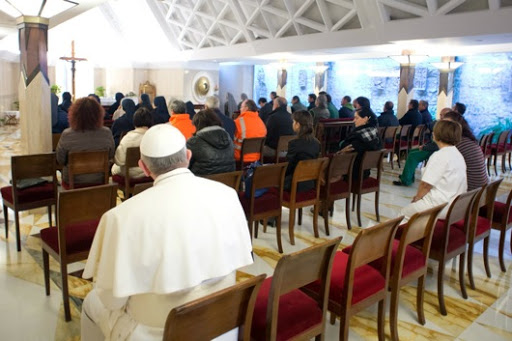
Pope Francis: Beauty, Goodness, Truth

Pope francis at back

As you many not have the time to follow all of Pope Francis’ talks during these first days of his pontificate, I have compiled the following links to them and my favorite quotes from each one of them – consider it a taster menu if you like:

  1. Patriarch Bartholomew I’s address to Pope Francis on behalf of the religious leaders meeting him after his installation mass on Tuesday:

    “This world is the domain where we realize [the] spiritual way of life, where we achieve our integration into the body of Christ, and where we are brought through Him into eternal life. [… W]e travel this way of truth, acquiring the heavenly through the earthly.”

  2. Pope Francis’ address to the religious leaders then affirmed his commitment both to ecumenism and inter-religious dialogue and he also took advantage of the occasion to emphasize again the importance of aligning ourselves also with those who hold no religious beliefs:

    “[W]e feel the closeness also of those men and women who, while not belonging to any religious tradition, feel, however the need to search for the truth, the goodness and the beauty of God, and who are our precious allies in efforts to defend the dignity of man, in the building of a peaceful coexistence between peoples and in the careful protection of creation.”

    If you are an agnostic or atheist, please, don’t read the above as the Pope imposing a search for God on you. I believe it only refers to a “search for […] truth, […] goodness and […] beauty” since in the Pope’s (and my!) eyes, these all point to God whether you are looking for him through them or not.

  3. During this morning’s mass with Vatican gardeners and cleaners, Pope Francis shared the following insight during his short, impromptu homily (with reference to today’s Gospel reading (John 10:31-42), where Jesus is facing an angry mob that is on the verge of stoning him).

    “When we have a heart of stone it happens that we pick up real stones and stone Jesus Christ in the person of our brothers and sisters, especially the weakest of them.”

  4. Later this morning, Pope Francis then met with the diplomatic corps, again returning to the topics of fraternity, poverty and peace that have been a constant throughout these first days of his being in office and he again underlined the importance of cordial relationships with all – whether they hold religious beliefs of not – and placed this also at the heart of our relationship with God:

    “It is not possible to build bridges between people while forgetting God. But the converse is also true: it is not possible to establish true links with God, while ignoring other people. […] And it is also important to intensify outreach to non-believers, so that the differences which divide and hurt us may never prevail, but rather the desire to build true links of friendship between all peoples, despite their diversity.”

Have a good weekend! 🙂

Tenderness

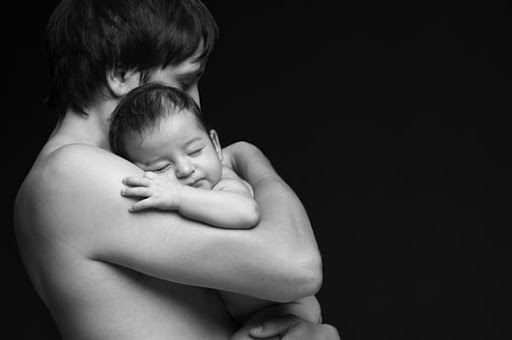
Father holding his newborn baby pavlo kolotenko

Pope Francis’ words and actions during yesterday’s inaugural mass are rich in inspiration, where one could reflect on his adherence to the readings of the day’s feast of St. Joseph instead of those intended for a Pope’s installation, his choice to depart from custom and have the Gospel sung in Greek as opposed to Latin (surely in honor of Patriarch Bartholomew I – the first Orthodox Patriarch to be at a pope’s inaugural mass since 1054!), his nods both to Benedict XVI and John Paul II, and his insistence on “authentic power [being] service.” Of all the aspects of the day, it is the following passage from his sermon that spoke to me most:

“[L]et us be “protectors” of creation, protectors of God’s plan inscribed in nature, protectors of one another and of the environment. […] Being protectors […] also means keeping watch over our emotions, over our hearts, because they are the seat of good and evil intentions: intentions that build up and tear down! We must not be afraid of goodness or even tenderness!

[… C]aring, protecting, demands goodness, it calls for a certain tenderness. In the Gospels, Saint Joseph appears as a strong and courageous man, a working man, yet in his heart we see great tenderness, which is not the virtue of the weak but rather a sign of strength of spirit and a capacity for concern, for compassion, for genuine openness to others, for love. We must not be afraid of goodness, of tenderness!”

Taken together with the other things Pope Francis said since his election (and before it!), I see a very clear call both to making a serious commitment – a commitment that has its eyes on the cross, that understands suffering as participation in Jesus’ passion, that is concerned about the truth and that exercises control over oneself, one’s emotions and impulses – and to transmitting the warmth, compassion and tenderness that God has for us to our brothers and sisters. While it was his emphasis on tenderness that caught my eye here, I have also been thinking about his positioning it in the context of protection, which seems to have these two sides: one of strength and effort on the side of the protector and the other of gentleness shown to the protected. In many ways this mirrors John Paul II’s dictum: “Be strict to yourself and generous to others.”

In my personal experience I have had several friends who have come to the – to my mind erroneous – conclusion that a spiritual life ought to suppress what they saw as a purely human need for warmth, for tenderness, for personal connection. This has always been an attitude that has made me concerned for their wellbeing and sadly in many cases has lead them to deep crises and disillusionment, which for some resulted even in an abandonment of their erstwhile ideals. At the heart of such an assumed spiritual-affective opposition is, in my opinion, a fundamental misunderstanding of what it is to be human – a person made in God’s image.

God being three persons who love each other to the point of being one means that we too are made for communion, for closeness, for togetherness – a point also highlighted by John Paul II saying: “God is One, but not alone”. The tenderness that Pope Francis talks about is therefore not something outside what it means to be a Christian, a follower of Jesus, and a human being made in God’s image, but very much at its heart. Even just a cursory glance at the Bible reveals that it is brimming over with God’s tenderness, where the following are just a couple of my favorite examples:

  1. “For God will hide me in his shelter
    in time of trouble,
    He will conceal me in the cover of his tent;
    and set me high upon a rock.” (Psalm 27:5)
  2. “Like a shepherd he feeds his flock; in his arms he gathers the lambs, Carrying them in his bosom, leading the ewes with care.” (Isaiah 40:11)
  3. ““Amen, I say to you, whoever does not accept the kingdom of God like a child will not enter it.” Then he embraced them and blessed them, placing his hands on them.” (Mark 10:15-16)
  4. “When Mary came to where Jesus was and saw him, she fell at his feet and said to him, “Lord, if you had been here, my brother would not have died.” When Jesus saw her weeping and the Jews who had come with her weeping, he became perturbed and deeply troubled, and said, “Where have you laid him?” They said to him, “Sir, come and see.” And Jesus wept. So the Jews said, “See how he loved him.”” (John 11:32-36)
  5. “Come to me, all you who labor and are burdened, and I will give you rest. Take my yoke upon you and learn from me, for I am meek and humble of heart; and you will find rest for your selves. For my yoke is easy, and my burden light.” (Matthew 11:28-30)
  6. “Jerusalem, Jerusalem, you who kill the prophets and stone those sent to you, how many times I yearned to gather your children together, as a hen gathers her young under her wings, but you were unwilling!” (Matthew 23:37)
  7. “Standing by the cross of Jesus were his mother and his mother’s sister, Mary the wife of Clopas, and Mary of Magdala. When Jesus saw his mother and the disciple there whom he loved, he said to his mother, “Woman, behold, your son.” Then he said to the disciple, “Behold, your mother.”” (John 19:25-17)

At the same time as placing tenderness at the heart of his message, Pope Francis also emphasizes that it – as well as the self-sacrifice implied by being protectors of the universe and of our brothers and sisters – is open to all: “The vocation of being a “protector”, however, is not just something involving us Christians alone; it also has a prior dimension which is simply human, involving everyone.” Where the Pope, and with him the whole Church, believes that every human “is a child of God.”

Pope Francis’ first week: Jesus

Francis pectoral cross s

In spite of the very short period of time that Pope Francis has been in office, one thing is clear – all he cares about is to put Jesus first and to introduce him to all in a gentle and warm way. This is a thread I see running through everything he does and I would like to share with you the highlights of the talks he has given in addition to his greeting immediately after being elected and his address to the cardinals the next day that I already wrote about (and that also form part of this Christocentric theme).

  1. “We can walk as much as we want, we can build many things, but if we do not profess Jesus Christ, things go wrong. We may become a charitable NGO, but not the Church, the Bride of the Lord.” (Missa pro Ecclesia with the Cardinal-Electors, 14th March)
    Instead of this being a dig at NGOs, as some media outlets interpreted it, it is instead an underlining of who the Church is and that her actions are a consequence of her fundamental nature. Even if we perform charitable actions, whose goodness is not questioned here, but fall silent about Jesus, we cease to be his Church.
  2. “When we journey without the Cross, when we build without the Cross, when we profess Christ without the Cross, we are not disciples of the Lord, we are worldly: we may be bishops, priests, cardinals, popes, but not disciples of the Lord.” (Missa pro Ecclesia)
    Pope Francis here makes it clear what the “professing Jesus” that he insisted on earlier means – it means following Jesus also in suffering and sacrifice and not only in what is “nice,” easy and comfortable. This is a temptation that St. Peter himself succumbed to, when, after Jesus told the disciples that he will “suffer greatly […] and be killed and on the third day be raised,” he then took him to one side and said: “God forbid, Lord! No such thing shall ever happen to you.” (Matthew 16:21-22) What I found particularly meaningful here were not only the above words but also the emphasis with which Francis said them and the time he took to address these words very personally to the cardinals.
  3. “Christ is the Church’s Pastor, but his presence in history passes through the freedom of human beings; from their midst one is chosen to serve as his Vicar, the Successor of the Apostle Peter. Yet Christ remains the centre, not the Sucessor of Peter: Christ, Christ is the centre. Christ is the fundamental point of reference, the heart of the Church. Without him, Peter and the Church would not exist or have reason to exist.” (Audience to representatives of the media, 16th March)
    Here I particularly like how Francis brings two aspects of being Jesus’ followers together: first that it is through us that Jesus’ presence persists in the world and second that this presence is not an imposition or an over-ride, but that it respects our freedom. Also, he again uses his election as an opportunity to put Jesus in the foreground.
  4. “[T]he Church exists to communicate precisely this: Truth, Goodness and Beauty in person.” (Audience to representatives of the media)
    Again Francis emphasizes that it is all about Jesus, who is Truth, Goodness and Beauty personified. Here the official transcript of his address has “in person” in quotation marks, while I believe – also from having listened carefully to him saying this sentence – that the meaning was not meant to be different from what “in person” ordinarily means. Jesus is Truth, Goodness and Beauty incarnate – i.e., in person.
  5. “Since many of you are not members of the Catholic Church, and others are not believers, I cordially give this blessing silently, to each of you, respecting the conscience of each, but in the knowledge that each of you is a child of God. May God bless you!” (Audience to representatives of the media)
    Seemingly an afterthought, Pope Francis adds these words in Spanish at the end of the audience, which he already concluded by saying “I cordially impart to all of you my blessing.” in Italian. Yet again he puts himself in second place, is concerned about the freedom and dignity of his audience and at the same time is clear about his beliefs. To my mind all of this radiates his concern and love for those to whom he speaks.
  6. “[God] has the ability to forget, [which is] special: He forgets [our sins], He kisses you, He embraces you, and He says to you, ‘Neither do I condemn you. Go, and from now, on, sin no more.’ [John 8:11] Only that counsel does He give you.” (Mass at St. Anne’s – the parish church of Vatican City, March 17th)
  7. “[W]e do not hear words of contempt, we do not hear words of condemnation [from Jesus], but only words of love, of mercy, that invite us to conversion.” (Angelus, 17th March)
    Here Francis continues with the theme of forgiveness and openness of Jesus towards all that he already sketched out during the morning mass and he again emphasizes Jesus’ love and invitation to a free conversion as opposed to condemnation or coercion.
  8. “In these days, I have been able to read a book by […] Cardinal Kasper, a talented theologian, a good theologian—on mercy. And it did me such good, […] so much good…”
    “I wanted to ask her[, the woman in her eighties who came to me to hear her confession and who told me “If the Lord didn’t forgive everyone, the world would not exist.”]: “Tell me, have you studied at the Gregorian [Pontifical University]?”, because that is the wisdom that the Holy Spirit gives: the inner wisdom of God’s mercy.”
    Finally, I also wanted to pick out the above moments from the Angelus address: first, Pope Francis choosing to highlight the thoughts of one of his cardinals instead of putting his own thoughts first and second, recognizing God’s wisdom in the words of a simple parishioner and sharing it with the world.

Not my “Faith on Sunday”

See no evil

Yes, you guessed it – another Sunday, another rant against the “Faith and Reason” column of the “Our Faith on Sunday” newsletter.1 This time the topic being butchered is the relationship between science and faith – a topic close to my heart, brain and mind.

To make matters worse, the column actually starts with an encouraging statement (“Could this be the first one that’s not utterly muddled?,” I ask myself while reading the opening lines.):

“[R]eason and faith can never truly be in opposition[, and] neither can science and religion[, since] the truths they seek are, once discovered, perfectly reconcilable.”

But then the column’s unidentified author returns to form and veers off into the morasses of confusion:

“[I]t cannot be too often repeated that the truths each seeks are in different orders of knowledge.”

Actually, it ought never to be repeated again! What a heretically dualist worldview lurks behind this sentence! As a Christian I believe in one Truth – God. The Truth that expresses the workings of the universe as much as it does the inner life of the Trinity. All truth, regardless of its object, is a manifestation of the Truth and, as such, is of equal standing. To suggest that truths pertaining to events accessible via the scientific method, reason, faith or religion are of different natures or orders is to place one’s world view alongside Gnostic dualism – a world view that divorces nature from God, joy from charity, beauty from experience and truth from reason.

“It is altogether outside the scope of natural science to enquire into the origin of the universe, because its origin is super-natural.”

This is neither self-evident (why couldn’t the universe have existed ab æterno?) nor does it follow from the scientific method’s principles and constraints (empirical data being pursuable, repeatability being a meaningful goal and evidence-theory consistency being seekable). Science is perfectly capable of enquiring into the origins of the universe and I would like to argue that it’s findings enrich me as a Christian in spelling out the workings of the existence that I believe God created. By this I don’t mean to suggest that science has fully explained the origins of the universe (what happened before the big bang, or even during the Planck epoch at its very beginning? where did the laws governing the quantum states of matter and the expansion following the initial singularity come from?), or even that I believe that it will. To go from there to asserting that “it is altogether outside the scope of natural science to enquire into the origin of the universe” is a fallacious leap and one that I categorically decline.

“Science treats of natural phenomena, i.e. things that fall under the purview of human sense perception (with or without the aid of scientific instruments). But the origin of the universe is a question about the origin of natural phenomena in general.

Let me pick up here on two misconceptions that bubble under the surface of the above two quotes. First, that somehow science is more dependent on sensory perception than religion is. How is it that I first learned about God, Jesus, the life of the Saints, the teachings of the Church, the love shown to me by my family, friends, strangers? How is it that St. Peter came to be a follower of Jesus or St. Francis develop his love for the poor? Did this take place in some supernatural, a-sensory world of ideas, or was it by sight, hearing and touch that the Gospel first reached me and continues to affect me? To deny the necessity (without saying sufficiency!) of sensory perception for the development of faith is to deny the Bible’s insistence on God seeing “that it was good” throughout the process of creation (cf. Genesis 1:10). Second, the above also suggests a very narrow, naïve view of science – a science that is constrained by sensory perception (albeit aided by “scientific instruments”). To my mind this is at best a mediaeval view, conjuring up images of astronomers looking through telescopes. Contemporary science is certainly reliant on evidence, but to claim that this is only on the basis of human sensory perception with or without the aid of instrumentation is somewhat naïve. What human sensory perception is being aided in the case of measurements of the universe’s background radiation?

“Now it is only in transcending the order of phenomena by human reasoning that we can hope to give a satisfactory answer to the question.”

What is the column’s author referring to here? Theoretical physics? He might as well be (although I don’t think that was their intention). Isn’t it a “transcending of phenomena by human reasoning” that is the bread and butter of theoretical physics? How are M-theory or the initial postulating of the Higgs Boson bound by phenomena? They are open to verification and potential consistency or inconsistency with empirical data, but no one would deny their scientific nature even during the very long stretches of time when no evidence is available either in agreement or contradiction with them.

Not to be just destructive, let me propose my alternative to the above science-religion positioning (while keeping its first sentence) and open myself too to criticism. For the sake of greater specificity, let me attempt to do so from a Christian, rather than a generic religious perspective:

“Reason and faith can never truly be in opposition, and neither can science and religion, since the truths they seek are, once discovered, perfectly reconcilable. Here science seeks to predict the events of the material world by striving for consistency between theory and empirical data. Such theories often start in unstructured, intuitive ways, before being developed with formal rigor and confronted with data gathered using means of measurement that both aid repeatability and extend far beyond what is within the reach of human senses. Christianity supplements the scientific view with the truths revealed in the person of Jesus – the God who became man – and by those revealed to the people of Israel before him. While some of these are extra-empirical, others are not, and their understanding is furthered by the application of the same reason that is also applied to science.”


1 The previous ones having protested against the abuse of “cf.,” the perversion of philosophy and a plagiaristic ignorance of infinity.

Pope Francis: Jesus in the Church and in every person

Francis on coach

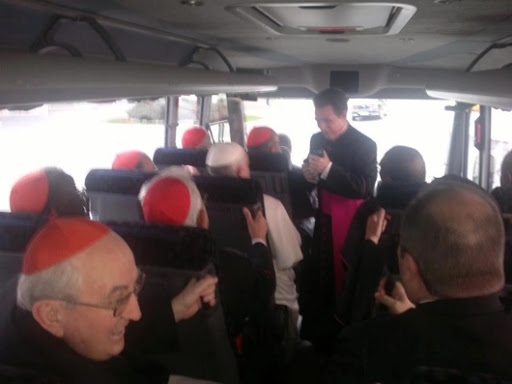
Earlier today Pope Francis addressed the cardinals and I would just like to share with you the points from his talk that most stood out for me:

  1. Referring to the period culminating in the conclave, Pope Francis said: “In this very cordial atmosphere our reciprocal knowledge of one another and mutual openness to one another, grew. And this is good because we are brothers. [… W]e are that community, that friendship, that closeness, that will do good for every one of us.” To my mind he yet again places himself among, not above the cardinals, just as he did immediately after his election when he refused to sit on the raised papal throne and instead welcomed the cardinals’ pledge of obedience standing at their level.
  2. Emphasizing the role of the Holy Spirit. he said: “He, the Paraclete, is the supreme protagonist of every initiative and manifestation of faith. It’s interesting and it makes me think. The Paraclete creates all the differences in the Church and seems like an apostle of Babel. On the other hand, the Paraclete unifies all these differences – not making them equal – but in harmony with one another.” Here I was particularly pleased to see Pope Francis’ underlining of the concept of unity in diversity (rather than identity) that Benedict XVI also pointed to repeatedly.
  3. “Stimulated by the Year of Faith, all together, pastors and faithful, we will make an effort to respond faithfully to the eternal mission: to bring Jesus Christ to humanity, and to lead humanity to an encounter with Jesus Christ: the Way, the Truth and the Life, truly present in the Church and, at the same time, in every person.” Jesus is in every person, within and outwith the Church, and it is for us to to facilitate for others to encounter him. This is an all-inclusive and non-imposing stance that I derive great joy from.
  4. Pope Francis then returned to the Holy Spirit, who “is the soul of the Church, with His life-giving and unifying strength. Of many He makes a single body – the mystical Body of Christ. Let us never give in to pessimism, to that bitterness that the devil tempts us with every day.” Aside from his reference to the devil, which already in the few speeches since his election seems to me more prominent than it was in Benedict’s language – but even with it, this is again a very positive, hope-filled and forward-looking take on the challenges ahead.

I look forward to getting a better grasp on Pope Francis’ mindset, but I am greatly encouraged by everything I have heard so far!

Pope Francis: "Brothers and sisters, good evening!"

Pope francis

Habemus Papam!

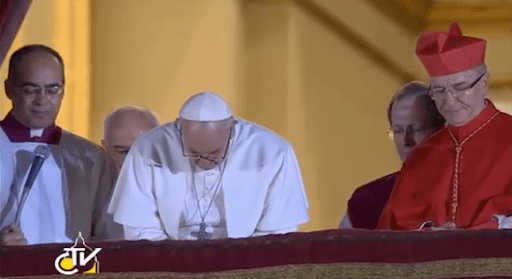
Jorge Mario Cardinal Bergoglio of the Society of Jesus, born in Argentina of Italian parents, is Pope Francis. His election fills me with joy and a great desire to find out as much about him as possible and to support him with my prayers and actions.

Already the words he shared from the balcony of St. Peter’s this evening are a joy to receive (and, please, do stay away from the ghastly BBC translation that obscures the humility, immediacy and ease of his words – their original being here in Italian and the following containing my own, crude translation):

  1. He starts with a simple greeting: “Brothers and sisters, good evening!” No pomp and circumstance – just a plain, fraternal greeting.
  2. Then: a joke! “You know that the job of the Conclave was to provide Rome with a bishop. It seems as if my brother cardinals went almost to the ends of the earth to get him …”
  3. Next, a call to prayer for Pope emeritus Benedict XVI – and not just a call but an actual prayer! Pope Francis leads those present in St. Peter’s square and all following him live over the internet by reciting the Our Father, the Hail Mary and the Glory Be there and then
  4. What follows then is the core message of his greeting: “And now we begin this journey: bishop and people. This journey of the Church of Rome, which presides in charity over all the Churches. A journey of fraternity, of love, of trust among us. We always pray for each other. We pray for the whole world, so that fraternity may grow in it.” Journey. Fraternity. Churches. World.
  5. What comes next is a masterclass in humility and in being serious about the fraternity which his very first words expressed and which punctuated his message: “I would like to ask you for a favor: before the bishop blesses the people, I ask you that you pray to the Lord that He bless me: the prayer of the people, asking a blessing for its bishop. In silence, lets make this prayer of you over me.” Pope Francis then bows his head for a good 15 seconds to receive the blessing he requested.
  6. Only then does Pope Francis turn to the expected “Urbi et Orbi” blessing after which he shares is plans for tomorrow: to pray to Mary for the protection of Rome.

In an attempt to learn more about Pope Francis, and wanting to do so from his own words as opposed to journalistic analyses or lists of dates, places and offices held, I first had to get past the myriad permutations of his biography now flooding the web (a particularly good and extensive one being here, and a more telegraphic one here).

The first source I arrived at are his homilies and pastoral messages as the Archbishop of Buenos Aires, whose archive is available here in Spanish. Here, let me just pick out a couple of passages from his Lenten message, dated 13th Februray 2013 and therefore serving as a very recent glimpse of his mindset. These lines seem to me to give a sense both of his concerns and of his style (translation again mine – apologies for its crudeness):

“Bit by bit we are getting used to hearing and seeing, through the mass media, the dark chronicles of contemporary society, presented almost with perverted joy, and we are getting used to touching and feeling it in our environment and in our own flesh. […] We live with murderous violence that destroys families and intensifies wars and conflicts in so many of the world’s countries. We live with envy, hatred, slander, worldliness in our heard. The suffering of the innocent and peaceful keeps slapping us; the contempts for the rights of the most fragile persons and countries are not far from us; the rule of money with its demonic effects like drugs, corruption, human trafficking – including of children – together with material and moral misery are currency. The destruction of decent work, painful emigrations and the lack of a future also join this symphony. Our errors and sins as Church aren’t left out of this large panorama either. [… All of this] speaks to us about our limitations, about our weakness and about our incapacity to transform this endless list of destructive realities.

The trap of powerlessness makes us think: Does it make sense to try and change all of this? Can we do something in the face of this situation? Is it worth trying, if the world continues its carnival dance that masks everything for a while? Nevertheless, when the mask slips, the truth appears and, in spite of it sounding anachronistic to many, sin appears again, which wounds our flesh with all its destructive force and twists the destinies of the world and of history.

Lent presents itself to us as a cry of truth and of hope, certain to answer a yes to the possibility of no longer putting on make-up and painting on plastic smiles as if nothing was going on. Yes, it is possible for everything to become new and different because God continues to be “rich in goodness and mercy, always ready to forgive” and encourages us to start again. Today we are invited again to undertake a Paschal journey towards Life, a journey that includes the cross and renunciation, that will be uncomfortable but not in vain. We are invited to recognize that something is not right in ourselves, in society or in the Church, to change, to turn, to convert ourselves.”

The second source I’d like to just mention is a book he co-authored with Rabbi Abraham Skorka, head of the Latin-American Rabbinical School, entitled “On Heaven and Earth,” where the two discuss a variety of topics from Christian and Jewish perspectives, seeking common ground while each remaining faithful to their own religion. In many ways this reminds me of Cardinal Martini and Umberto Eco’s dialogue, which I am a great fan of. For now, let me just pick out the following passage from this very promising book:

“Dialogue is born of an attitude of respect towards another person, of a conviction that the other has something good to say; it requires that we make space in our heard their point of view, their opinion and their position. Dialoguing involves a heartfelt welcome and not prior condemnation. To dialogue, one has to lower ones defenses, open the doors of one’s home and offer human warmth.”

Viva il Papa!

Breathe, think, struggle, love: pray

Job

To me one of the highlights of the last weeks has been the ability to follow Cardinal Gianfranco Ravasi’s Lenten spiritual exercises, delivered to the Vatican’s staff and to Pope Benedict XVI before his resignation. Being able to download them as podcasts, or purchasing their text in book form, means that anyone (who understands Italian :|) can follow them and in effect participate in an event that in the past would have been open to only a very select audience. I don’t mean to dwell on the fact of this new openness and would instead like to focus on the specific content that Cardinal Ravasi created and shared.

I have to admit that I am a huge fan of Cardinal Ravasi and have been ever since I first found out about the Courtyard of the Gentiles initiative launched by Benedict XVI and executed by the Pontifical Council for Culture under Ravasi’s leadership. The Courtyard fosters dialogue between believers and non-believers and has resulted in multiple events already at which Christian, agnostic and atheist speakers were invited to speak about different topics (the first one was in Paris and subsequent ones took place also in Stockholm and Assisi). Instead of just being a job that Ravasi has to oversee, this open, broad dialogue comes across as a core passion of his and a thread that can be traced through his publications and talks. In many ways Ravasi takes a similar view of the believer/non-believer dichotomy as Cardinal Martini did (who asserted that there is a part of both in each one of us, including himself), by declaring it as unhelpful and quoting Nietzsche, who said that “Only a person of deep faith can afford the luxury of skepticism.” Ravasi has also been quoted as saying that “[h]alf of my friends are non-believers” and answering “Absolutely not.” when asked whether he wanted to convert atheists. In short – a cardinal very much after my own heart and one who, I believe, embodies the following verse from the Gospel: “For whoever is not against us is for us.” (Mark 9:40).

Let me now return to the Lenten spiritual exercises that Cardinal Ravasi lead in the Vatican only a couple of weeks ago. Their theme was “The Face of God and the Face of the Human Person in the Prayers of the Psalms” and they consisted of 17 half-hour talks delivered over the course of a week. The topics spanned a very broad spectrum from creation, via wisdom, suffering and happiness to the family and immortality, to name but a few. While their backbone were the Psalms, Ravasi – in his characteristically open-minded style – took advantage of the insights of sources as diverse as Kierkegaard, Planck, Evdokimov, Bloch and the Egyptian pharaoh Thutmose III – just to give you a flavor …

The first thing that attracted me to this theme, beyond being delighted that it was Ravasi whom Benedict XVI picked to deliver it, is the fact that the Psalms are essentially the collection of prayers that Jesus himself used. Jesus, being a Jew, grew up with the Psalms as his prayer book, which means that when I pray with their help, I am following his example and am united with him. As soon as I heard that these spiritual exercises were centered around the Psalms, my first thought was immediately directed to prayer, which made it particularly pleasing that this was precisely the subject of Ravasi’s first talk too.

That’s where my ability to anticipate Ravasi’s moves ended though and his take on prayer was both novel, greatly thought provoking and deeply enjoyable. Instead of trying to give you an overview of all 17 talks, which I highly recommend in full, let me at least share what to me were the first talk’s highlights.1

To begin with, Ravasi approaches prayer by setting out to “outline the essential map of its structure,” which he does by identifying the four verbs of prayer. The first is “breathing,” which he kicks off by quoting Kierkegaard: “Rightly the ancient peoples used to say that praying is breathing. It shows how foolish it is to talk about whether one has to pray. Why do I breathe? Because, otherwise I would die. That is also how it is with prayer.” The link to the Psalms then comes in the form of highlighting that there is a single Hebrew word – nefesh – for “soul” and “throat,” which allows for a dual reading, e.g., of Psalm 42:3 “My soul/throat thirsts for God, the living God.” This in turn emphasizes a “physicality,” which leads Ravasi to the following exhortation:

“We, therefore, have to recover that spontaneity and constancy of an explicit, praying breath that the woman of the Song of Songs [… expressed as] “I was sleeping, but my heart was awake.” (5:2). Faith, like love, does not take up only some hours of existence, but is its soul, a constant breathing.”

The second verb of prayer is “thinking,” which leads Ravasi to the following affirmation: “Prayer is not simply an emotion. It has to involve reason and the will, reflection and passion, truth and action.” The model here is Mary, who, after giving birth to Jesus is reported by Luke to have “kept all these things, reflecting on them in her heart.” (Luke 2:19). Ravasi then digs deeper into the Greek word symballousa that is translated in the Gospel as “reflecting” and points out that its meaning is more of a “joining together in transcendent unity,” which is the “true “thinking” according to God.” The part on prayer as thinking concludes with a quote from Wittgenstein’s notes from World War I, where he says: “Praying is thinking about the meaning of life.”

“Struggling” is then the third verb of prayer, which has its roots in Jacob, Job and Jesus. Jacob, who at Penuel (Genesis 32:23-33) wrestled a mysterious, unknown being, so strong that it not only changed Jacob’s life and mission, but even his name (to Israel). This struggle is later referred to by Hosea as a cry to God and therefore a prayer: “He contended with an angel and prevailed, he wept and entreated him.” (Hosea 12:5). Job’s struggling prayer even refers to God as follows: “He pierces me, thrust upon thrust, rushes at me like a warrior.” (Job 16:14). Finally, in Jesus this aspect of prayer finds its peak on the cross, where he cries out: “My God, my God, why have you forsaken me?” (Mathew 27:46), quoting verse 2 of Psalm 22 in his moment of extreme suffering.

The verbs of prayer culminate in “loving,” which Ravasi introduces by quoting from St. John of the CrossSpiritual Canticle and thereby smoothly transitioning from struggle:

“Where have You hidden Yourself,
And abandoned me in my groaning, O my Beloved?
You have fled like the hart,
Having wounded me.
I ran after You, crying; but You were gone.”

Next, Ravasi introduces the transcendence and inaccessibility of God that is prominent in some religions and starts with the example of the Sumerians, who said about their chief deity, Enlil, that he was “like a knotted bundle of yarn than no one could untangle, like jumbled-up threads where no end is to be seen.” In Christianity the relationship is one of intimacy instead, since God is addressed as “abba” – Father (or more precisely, “daddy”) and this closeness can also be seen in some aspects of Islam, from where Ravasi quotes the 8th century Muslim mystic Rābiʿah al-Baṣrī:

“My Lord,
Each love is now alone with his beloved.
And I am alone with You.”

Finally, Ravasi concludes by the following passage from Psalm 123:1-2 and leaves us in a “silent meeting of gazes, where prayerful contemplation blossoms”:

“To you I raise my eyes,
to you enthroned in heaven.
Yes, like the eyes of servants
on the hand of their masters,
Like the eyes of a maid
on the hand of her mistress,
So our eyes are on the LORD our God,
till we are shown favor.”


1 All quotes from Ravasi’s talks here are my own translations from Italian – their crudeness is all mine.

Gödel, Church teaching, Holy Spirit

Gödel

One of the most disconcerting, but profoundly beautiful pieces of Mathematics are Kurt Gödel’s incompleteness theorems, which he proved in 1931 and which show that “no consistent system of axioms […] is capable of proving all truths about the relations of the natural numbers […]. For any such system, there will always be statements about the natural numbers that are true, but that are unprovable within the system [… and] that such a system cannot demonstrate its own consistency.”

Here axioms are a system’s premises or starting points that are taken for granted (as self-evident or as expressing a property of the entities the system refers to), and are not provable within that system, and theorems are statements derived from these axioms. Gödel’s theorems therefore say that no matter how complex a system of consistent axioms (i.e., axioms that cannot lead both to a theorem and its negation), the set of all possible theorems derived from it will not include all true statements about natural numbers. In other words, that there exists an arithmetic statement that is true but not provable within that system of axioms (i.e., not derivable from them). Gödel achieves this using an ingenious device – the so-called “Gödel sentence” – which in essence claims that it (the Gödel sentence) cannot be proved within a given, consistent axiomatic system.

If this theorem (the Gödel sentence) could be proved using a system’s axioms, then the system would contain a theorem that contradicts itself (i.e., the theorem stating that it cannot be proved would be proved). The system would therefore be inconsistent. However, since the axiomatic system is consistent, the theorem cannot be proved within it. The system’s consistency renders the theorem both true and outside the system. The system is therefore incomplete (not containing the true Gödel sentence) and provability-within-a-system-of-axioms is not the same as truth. This is the gist of the first of the two theorems, put in as plain language as I could manage.1

If you are still reading this, I guess you may be wondering “when do we get to the Church teaching bit?” and I apologize for the unusually lengthy preamble and for passing through the following de-tour, before attempting a bringing together of the strands I set out in the title. That detour regards the Theory of Everything (that I name-dropped in an earlier post) and the death-blow it was dealt by Gödel’s theorems. The Theory of Everything is “a putative theory of theoretical physics that fully explains and links together all known physical phenomena, and predicts the outcome of any experiment that could be carried out in principle.” While such a theory does not exist, for a long time it has been the goal that science has been striving for and that it believed to be progressing towards. One day it would arrive at a level of understanding of the universe that would allow it to predict any event and to do so using a single, unified theory.

Without going into to the varied arguments for the impossibility of such a theory, let me just quote Stephen Hawking:

“What is the relation between Gödel’s theorem, and whether we can formulate the theory of the universe, in terms of a finite number of principles. One connection is obvious. According to the positivist philosophy of science, a physical theory is a mathematical model. So if there are mathematical results that can not be proved, there are physical problems that can not be predicted. One example might be the Goldbach conjecture. Given an even number of wood blocks, can you always divide them into two piles, each of which can not be arranged in a rectangle. That is, it contains a prime number of blocks.

[…]

Some people will be very disappointed if there is not an ultimate theory, that can be formulated as a finite number of principles. I used to belong to that camp, but I have changed my mind. I’m now glad that our search for understanding will never come to an end, and that we will always have the challenge of new discovery. Without it, we would stagnate.”

So, what does all of this have to do with Church teaching or with the Holy Spirit? Well, if you look at any system of reasoning, where some statements are derived from others and where validity can be determined by comparing a statement with the system’s premises according to its rules of reasoning (themselves being premises), then such a system can be seen as having an underlying mathematical model, which thanks to Gödel is now forever revealed as incomplete. The Church’s teaching, as a set of premises (e.g., dogmas, Scripture, etc.) and statements derived from them, is therefore also subject to Gödel’s catch and, even from the perspective of logic alone, incapable of claiming to contain all truth.

Before you shout “Blasphemy!”,2 let me argue that this is neither negative nor new. The Church aims to proclaim the Good News of God’s love that Jesus brought both by his own teaching and – completely – in his own person. When Jesus says during the Last Supper: “I am in the Father and the Father is in me” (John 14:11) and that “[I have] been with you for so long a time and you still do not know me”, he is telling us that he – Jesus the person – is the message and that he cannot be reduced only to the teachings he explicitly shared with his disciples during those three short years of public ministry.

In fact, he proceeds to tell those assembled in the Upper Room that: “The Advocate, the holy Spirit that the Father will send in my name—he will teach you everything and remind you of all that [I] told you.” (John 14:26). During his last address to his followers, Jesus emphasizes the fact that the Church will, to use Hawking’s words “always have the challenge of new discovery,” thanks to the Holy Spirit, who will supply it with a continuous stream of inputs.3 Essentially, the Church can claim to have the Truth insofar as it is the Mystical Body of Jesus, who is its head, who is one with the Father and the Holy Spirit, who is God and who therefore is the fullness of Truth. As far as its explicit, finite set of teachings is concerned, it is subject to incompleteness. This is so not only because of the underlying limitations of any system that employs premises and statements derived from them (as Gödel’s theorems prove), but also because God, who is infinite, always-greater, cannot be encapsulated in a set of human-readable rules and statements. If we thought otherwise and viewed the Church’s teaching (qua teaching) as complete and comprehensive, “we would stagnate” (again borrowing Prof. Hawking’s words).

I believe the above is highly consistent with how Benedict XVI presented the aims of the Year of Faith that is currently in progress. Instead of calling the members of the Church to swat up on its rules and regulations, he invited them to “an encounter with a Person,” a “friendship with the Son of God.” This does not mean that knowledge of the understanding that the Church has gained since Jesus walked the Earth is not valuable (it is!), but that the Christian faith is “no theory.” To conclude, Benedict sums the centrality of the person of Jesus up as follows:

“The joy of love, the answer to the drama of suffering and pain, the power of forgiveness in the face of an offence received and the victory of life over the emptiness of death: all this finds fulfilment in the mystery of his Incarnation, in his becoming man, in his sharing our human weakness so as to transform it by the power of his resurrection.”


I would like to thank my überbestie, PM, for the sanity check, his Nihil Obstat and Transferitur.

1 For those of you who are mathematically inclined, the Wikipedia page on the incompleteness theorems both contains a sketch of the proof (including his beautiful arithmetization syntax, which allows for the Gödel sentence’s expression in arithmetic axiomatic systems) and points to more in-depth material. It also addresses how even adding the Gödel sentence to a set of axioms (i.e., making the Gödel sentence an axiom of a system) fails to defeat it :).
2 And proceed to purchase a small packet of gravel from Harry the Haggler.
3 E.g., see also the Second Vatican Council’s Dei Verbum saying: “Sacred tradition and Sacred Scripture form one sacred deposit of the word of God, committed to the Church.” and “This tradition […] comes from the Apostles [and is] develop[ed] in the Church with the help of the Holy Spirit.”

Ascending the mountain

Elijah

The last words one shares before a departure, especially one from which a return is unlikely or impossible, tend to contain the essence of what one wants those who stay behind to understand and internalize. It is with this in mind that I followed as much as I could of Pope Benedict XVI’s last days in office and listened with heightened attention to his words. Words that I found to be brimming with wisdom and love and whose highlights I would like to share with you.

Let me start by quoting from Benedict’s final Angelus greeting that took place on the last Sunday of his pontificate. It was there that he first introduced the picture of the mountain that then underpinned everything else he said during the following week:

“The Christian life consists in continuously scaling the mountain to meet God and then coming back down, bearing the love and strength drawn from him, so as to serve our brothers and sisters with God’s own love.”1

This is a beautiful synthesis of the two constituent aspects of being a Christian: the vertical, that refers to my relationship with God, and the horizontal, that relates to my relationship with fellow humans. Benedict’s image further emphasizes that it is the vertical that impels us to the horizontal and that the two are in a continuous dynamic.

Against this backdrop, Benedict presents his own role as follows:

“The Lord is calling me to “climb the mountain”, to devote myself even more to prayer and meditation. But this does not mean abandoning the Church, indeed, if God is asking me to do this it is so that I can continue to serve the Church with the same dedication and the same love with which I have done thus far, but in a way that is better suited to my age and my strength.”

To me this is the first of the gems of last week: service does not equal activity – instead it is a frame of mind, an attitude. While it may under many circumstances lead to activity, it can also manifest itself differently if one is incapacitated, while fundamentally remaining the same service.

On Wednesday, 27th February, during his last general audience Benedict returns to his role following the resignation by elaborating on the above picture as follows:

“I do not return to private life, to a life of travel, meetings, receptions, conferences and so on. I do not abandon the cross, but remain in a new way near to the Crucified Lord. I no longer wield the power of the office for the government of the Church, but in the service of prayer I remain, so to speak, within St. Peter’s bounds. St. Benedict, whose name I bear as Pope, shall be a great example in this for me. He showed us the way to a life which, active or passive, belongs wholly to the work of God.”

Far from being an opt-out, a return to the life of a leisurely academic or a move to the speaking circuit that retired politicians favor,2 Benedict remains close to the suffering Jesus whom he served in office and whom he will continue to serve away from the world. This is the second gem for me: Benedict’s move is not a giving up, but instead an expression of utter humility and a putting of the good of the Church before his own.3

Finally, we arrive at Thursday, 28th February – the last day of Pope Benedict XVI as the Bishop of Rome. The first thing that struck me here was the fact that all his activities during this day were streamed live on news.va, which meant that anyone could listen in both to him saying his farewell to the cardinals and later to the inhabitants of the town of Castel Gandolfo, where he will spend the first weeks after his resignation. I found this to be a wonderful thing for the Church to do and I hope that this openness and accessibility will persist.

In his short address to the cardinals, the first thing that struck me was Benedict’s perspective on his pontificate as a walk “in light of the presence of the Risen Lord,” which points squarely to Jesus’ appearance to his disciples on the road to Emmaus and which is the first nod to the Church being the living body of Christ that morning.

The second comes very soon after, when Benedict expresses his wish: “so that the College of Cardinals is like an orchestra, where diversity, an expression of the universal Church, always contributes to a superior harmony of concord.” Here we again have the image of a living body – the orchestra – as well as the introduction of a diversity that is constituent of harmony, which echoes his insistence on “the possibility of a unity which is not dependent upon uniformity” delivered during a talk in Jerusalem in 2009.

The third, and most explicit, angle, which Benedict says “is close to my heart” is a quote from Romano Guardini:

“The Church is not an institution devised and built at table, but a living reality. She lives along the course of time by transforming Herself, like any living being, yet Her nature remains the same. At Her heart is Christ.”

To which Benedict adds:

“[…T]he Church is a living body, animated by the Holy Spirit, and truly lives by the power of God, She is in the world but not of the world. She is of God, of Christ, of the Spirit. […] The Church lives, grows and awakens in those souls which like the Virgin Mary accept and conceive the Word of God by the power of the Holy Spirit. They offer to God their flesh and in their own poverty and humility become capable of giving birth to Christ in the world today. Through the Church the mystery of the Incarnation remains present forever. Christ continues to walk through all times in all places.”

This, to me, is the third gem: remember that the Church is alive, that its diverse, yet harmonious, ever changing, yet of constant nature, that it is Her who makes the Incarnation persistent and that it is through Her that Jesus walks the Earth wherever and whenever She is.

Mind. Blown.

Yet again Benedict transmits that serenity, calmness, confidence and at the same time humility that he has shared on previous occasions4 and takes advantage of this last official occasion to deliver yet another masterclass.

Then there is the brief greeting to the inhabitants of Castel Gandolfo, which to my mind is core to the conclusion of his papacy and which finishes with the following:

“I am simply a pilgrim beginning the last leg of his pilgrimage on this earth. But I would still with my heart, with my love, with my prayers, with my reflection, and with all my inner strength, like to work for the common good and the Good of the Church and of humanity. […]

I now wholeheartedly impart my blessing. Blessed be God Almighty, Father, Son, and Holy Spirit. Good night! Thank you all!”

This is the fourth of the gems I have received during this week from Pope Benedict: we Christians are all simple pilgrims, striving for the common good and for the good of the Church and even the position of greatest responsibility and power is only to be exercised as long as it is out of service. When it is then relinquished, one reverts to the shared Christian pilgrimage.

Finally, I keep coming back to the following thought of Cardinal Dolan’s, when asked what he is looking for in the next pope: “You always look for somebody that reminds you of Jesus.”

Dearest Holy Father, Benedict XVI, thank you for reminding me of Jesus!


1 Actually this is a quote from his Lenten message.
2 See, e.g., Hillary Clinton’s plans.
3 See him saying the following when he announced his resignation: “[I]n order to govern the barque of Saint Peter and proclaim the Gospel, both strength of mind and body are necessary, strength which in the last few months, has deteriorated in me to the extent that I have had to recognize my incapacity to adequately fulfill the ministry entrusted to me.”
4 To my mind one of the most staggering instances of this has been a passage I have quoted before, but one whose conclusion I’ll repeat here again: “I would say that the Christian can afford to be supremely confident, yes, fundamentally certain that he can venture freely into the open sea of the truth, without having to fear for his Christian identity.”
Utter confusion (cf. profound insight)

Military music

1+1=3 (cf. A. Whitehead and B. Russell, Principia Mathematica).

Two words: Falk lands (cf. Oxford English Dictionary).

The element of surprise (cf. D. Mendeleev, The Dependence between the Properties of the Atomic Weights of the Elements).

If you have read this blog before, you won’t be surprised if I tell you that this post (like two previous ones – here and here) will be about the infamous “Faith and Reason” column in the “Our Faith on Sunday” newsletter that my parish subscribes to. To be more specific, it will be a rant triggered by the abuse of the imperative singular form of the Latin verb conferre – abbreviated as “cf.”.

Last week I was already on the verge of charging at the column’s previous installment, which argued that reason is what is best about being human, but I decided against giving such a blatantly narrow-minded idea air time. When the column continued along the same track today and when it went from just being blinkered to plain ludicrous, my blood-pressure rose, and when its author suggested that their stumbling echoed Benedict XVI’s masterful Regensburg address,1 I snapped!

So, what did the column say today:

  1. That “[a]s a result of the fall man’s reasoning faculty was seriously damaged.”
  2. That “even after baptism his capacity to reason is handicapped by the scars of Original Sin.”
  3. That “[r]ationality is “of the inner nature of God”, and so in assuming a human nature, He especially assumes that human attribute which is most like Himself and which is at the same time most constitutive of human nature.”
  4. That “[r]isen, ascended, and glorified, human Reason now resides in the bosom of the Father.”
  5. “(cf. Benedict XVI’s address at the University of Regensburg, 2006.)”

Instead of expletives, let me try and argue against each of the above points, which to my mind are even more confused that the typical militant atheist jabs at Christianity:

  1. The assertion that “[a]s a result of the fall man’s reasoning faculty was seriously damaged” conjures up images of Adam and Eve discussing the, sadly now elusive, Theory of Everything before the fall. Taking a bite from the fruit of the forbidden tree then turns them into gibbering savages who are barely in a position to count their own fingers. While this sounds like an entertaining sketch, it has nothing to do with Genesis or with its contemporary Catholic exegesis. In the Genesis account of the fall, the immediate consequences are the appearance of shame and knowledge of good and evil and the subsequent burdening with hard work, tensions between man and woman and expulsion from the Garden of Eden, meted out as punishment. At no point is there any mention or indication of an impact on rational faculty. Turning to the Catechism, the discussion of Original Sin (§396-421) there centers on abuse of freedom, and of God’s trust and friendship, with the consequences being loss of holiness and harmony (with God, between man and woman, …) and a distortion of God’s image. The only mention there of anything to do with reason is man’s being “subject to ignorance, suffering and the dominion of death” (i.e., the building blocks of “concupiscence”). As far as ignorance is concerned, I’d be the last person to deny it, but it is hard to attribute it to the fall, since it was Adam and Eve’s pre-fall selves who were tricked by the snake in the Genesis creation myth …
  2. Saying that “even after baptism [the] capacity to reason is handicapped” also sounds bizarre, suggesting that baptism has – albeit limited – reason-enhancing properties! If that were the case, you’d expect for pre- versus post-baptism IQ tests to show statistically significant differences and one would have to think carefully when such a boost of intelligence would be most beneficial in a person’s life. Again, this is not only nonsensical, but also in direct contradiction with the Catechism, where §1264 says that “frailties inherent in life[, such] as weaknesses of character, and so on, as well as an inclination to sin that Tradition calls concupiscence” remain after baptism.
  3. The assertion that rationality is the human attribute that is most like God is akin to saying that the most important part of the human body is the brain. This too is absurdly reductive and I’d just let St. Paul counter-argue: “If the whole body were an eye, where would the hearing be? If the whole body were hearing, where would the sense of smell be?” (1 Corinthians 12:17).
  4. Suggesting that Jesus’s resurrection and ascension into heaven result in “human reason” residing in the bosom of the Father also smacks of great confusion. Is there a reason substantially different from God’s (as opposed to differing from it by degree) that before the resurrection was lacking in God and that the resurrection “imported”?
  5. Finally, let me turn to the part of today’s column that pushed me to writing this post: “(cf. Benedict XVI’s address at the University of Regensburg, 2006.)” When I read this I knew there was no way Benedict XVI could have said anything like the above – not even as a joke. Nonetheless, let’s follow up on the “cf.” and see what the cited source has to say about original sin, baptism, human reason and the other topics that the column’s unknown author strung together. Interestingly the Regensburg address contains precisely zero mention of baptism or indeed Original Sin (even “sin” only occurs as part of the words “single” and “since,” each used precisely once). What about “human reason”? Surely that phrase does occur in a talk entitled “Faith, Reason and the University. Memories and Reflections.” Here I have to admit that it does … once: “[T]he fundamental decisions made about the relationship between faith and the use of human reason are part of the faith itself; they are developments consonant with the nature of faith itself.” Wait, what? “Human reason” is part of faith and “consonant with the nature of faith”? Yet our trusty anonymous illuminator places it outside God, brought within His remit only thanks to the resurrection … At best the reference in today’s “Faith and Reason” column to Benedict XVI’s gem is (as the Marxist2 saying puts it) like military music is to music or military justice is to justice – and that’s being a shade unfair to the military.

1 And I mean his actual talk, to which I will return in a future post, as opposed to the reduction of its misinterpretation as being anti-Muslim that gripped the media at the time.
2 Groucho, not Karl – obviously …